






Abstract
Background
Off-label and Instructions-for-Use (IFU)-silent medical-device use is common in surgery. Such use is not inherently unsafe, unethical, or unlawful. However, it raises important questions about evidence, consent, professional judgement, documentation, adverse-event reporting, and institutional governance.
Methods
A review and critical synthesis of literature on off-label medical-device use, IFU-discordant use, physician-directed device use, and selected device examples relevant to general surgery was performed. Regulatory guidance from global agencies, professional statements, prior reviews, selected legal and governance literature, and device-specific surgical literature was reviewed.
Statistics
No meta-analysis was performed because the included literature was heterogeneous in device type, anatomical context, regulatory status, study design, and outcomes. Findings were synthesized descriptively.
Results
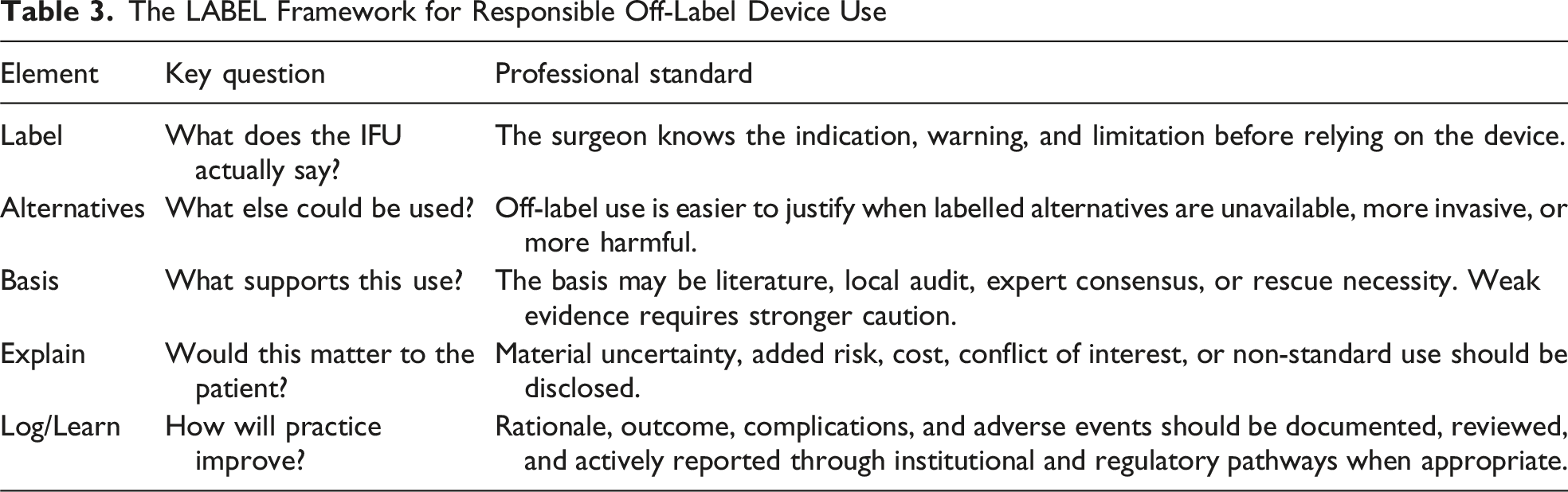
The literature fell into three groups: regulatory and professional guidance; previous reviews and specialty statements; and device-specific surgical literature. A practical taxonomy for off-label, IFU-silent use, modified use, reuse/reprocessing, expired-device use, and repurposing is summarised. We integrated off-label and IFU-silent device use with ethics, professionalism, consent, patient safety, adverse-event reporting, and governance. We propose the LABEL framework: Label, Alternatives, Basis, Explain, and Log/Learn.
Conclusion
Responsible off-label device use requires transparency and accountability. Sound judgement, evidence, patient-specific reasoning, consent, documentation, and audit remain professional obligations, and the LABEL framework provides a practical guide.
Keywords
Background
Laparoscopic, endoscopic, and percutaneous practice depends on devices, tools and technology. Many of these products are used exactly as described in the manufacturer’s Instructions for Use (IFU). Others are used in ways that are clinically intuitive, technically innovative, or supported by published experience, but not specifically described in the IFU. This creates a grey zone between on-label use, IFU-silent use, off-label use, IFU-discordant use, modified use, investigational use, and unapproved device use. The distinction matters. A device broadly indicated for soft-tissue approximation may not have established safety for every intraperitoneal or luminal use. A sealant may be licensed for haemostasis but used as an adhesive leak-prevention adjunct. A mesh may be supported by emerging evidence in selected contaminated fields, while product-specific labelling still contains warnings or cautions. Good surgical practice therefore cannot be reduced either to blind adherence to the IFU or casual disregard of it.
Regulatory guidance supports a balanced approach. The Food and Drug Administration (FDA) states that when a physician uses a legally marketed device outside its labelling to treat an individual patient and no research is being conducted, FDA does not require Institutional Review Board (IRB) review. If off-label use is part of a research study collecting safety or effectiveness data, IRB review is required. 1 The Medicines and Healthcare products Regulatory Agency (MHRA) states that using a device in a way other than described by the manufacturer is off-label and advises risk assessment, documentation, precautions to reduce risk, and patient consent. 2 The Therapeutic Goods Administration (TGA) similarly defines off-label medical-device use as use outside registered indications or intended uses, and states that the treating clinician is responsible for informed consent, including telling the patient if device use is off-label. 3
Previous work has addressed the policy implications of off-label drugs and devices and adverse incident reporting by diverse professionals.4-8 These contributions are important, but they do not fully address how a surgeon should reason when a device appears useful for a patient-specific problem, but the IFU is silent, cautionary, or discordant. Off-label use should therefore be understood as an important feature of surgical innovation as the IFU is necessary but not sufficient. It contains the manufacturer’s instructions, intended use, warnings, contraindications, and limitations. It is also the document against which off-label will be judged. However, it does not answer every clinical question. The ethical and professional challenge is to respect the IFU without treating it as the only source of decision making. The aim of this study is to synthesize regulatory guidance, prior reviews, device-specific surgical literature, and selected legal and governance lessons to develop a practical framework for responsible off-label and IFU-sensitive device use in surgery.
Methods
This article was conducted as a scoping-informed critical review. PRISMA-ScR principles informed the breadth of searching and categorisation of evidence, but the review was not intended to provide an exhaustive systematic evidence inventory.9,10 The aim was not to estimate a pooled effect size, but to map the literature, identify recurring concepts, distinguish regulatory and ethical categories, and develop a practical framework for surgical decision-making.
A search strategy was developed for PubMed/MEDLINE, Embase, Scopus, Web of Science, and Google Scholar. Search terms included combinations of: “off-label medical device,” “off-label device use,” “physician-directed use,” “Instructions for Use,” “IFU,” “surgical device,” “surgical innovation,” “device governance,” “barbed suture,” “lumen-apposing metal stent,” “fibrin sealant,” “haemostatic agent,” “hernia mesh contaminated field,” “device modification,” “single-use device reuse,” and “off-label promotion medical device.” Regulatory websites, professional society statements, and reference lists were searched manually.
A representative PubMed/MEDLINE search was: (“off-label” OR “off label” OR “physician-directed use” OR “Instructions for Use” OR IFU) AND (device* OR implant* OR stent* OR suture* OR mesh OR sealant*) AND (surg* OR endoscop* OR laparoscop* OR percutaneous). The syntax was adapted for the other databases, with additional device-specific searches using the terms listed above. Searches were last updated on 21.04.2026.
Sources were included when they addressed clinician-directed medical-device use outside or beyond the IFU, relevant regulatory or professional guidance, consent, governance, adverse-event reporting, or one of the selected surgical-device examples. Eligible sources included regulatory guidance, professional statements, reviews, policy analyses, legal analyses, case series, cohort studies, randomized trials, systematic reviews, and meta-analyses. Sources confined to off-label pharmacotherapy without device relevance, non-surgical devices without transferable governance lessons, promotional material without independent clinical or regulatory content, and publications unrelated to IFU-sensitive device use were excluded. Off-label drug literature was retained only when used as a conceptual comparator for repurposing. Search results were used to identify major evidence categories, landmark sources, and illustrative device examples rather than to calculate pooled estimates. Meta-analysis was inappropriate because the literature differed substantially in device type, anatomical site, clinical indication, IFU wording, regulatory jurisdiction, study design, and outcome definition. The evidence also ranged from regulatory guidance and professional statements to case series, randomized trials, and systematic reviews; descriptive synthesis was therefore considered more appropriate. Numerical findings from individual studies and reviews are reported descriptively. The evidence was synthesized into three groups: regulatory and professional guidance; previous reviews and specialty statements; and device-specific surgical literature.
Results
The first group consisted of regulatory and professional guidance. FDA, MHRA, and TGA guidance consistently distinguish clinician-directed off-label use from research, manufacturer promotion, and unapproved device use.1-3 The American Academy of Orthopaedic Surgeons (AAOS) position statement on physician-directed use of medical products is also useful because it emphasizes surgeon knowledge, scientific rationale, evidence, patient counselling, and records. 11
The second group consisted of previous reviews and specialty statements. Stafford reviewed policy implications of off-label drugs and medical devices, noting that off-label use is common and may promote innovation, while sometimes lacking strong evidence of safety and effectiveness. 4 Lennard and colleagues addressed adverse incident reporting and off-label device use from a surgeon’s perspective. 5 European Federation of National Associations of Orthopaedics and Traumatology (EFORT) provided recommendations for off-label use, mix-and-match, and mismatch in hip and knee arthroplasty. 7 The American Academy of Pediatrics addressed off-label medical-device use in children, where device-specific paediatric labelling is often absent. 8 These reviews confirm that off-label device use is a recognised professional and policy issue, but they are either general, specialty-specific, or population-specific.
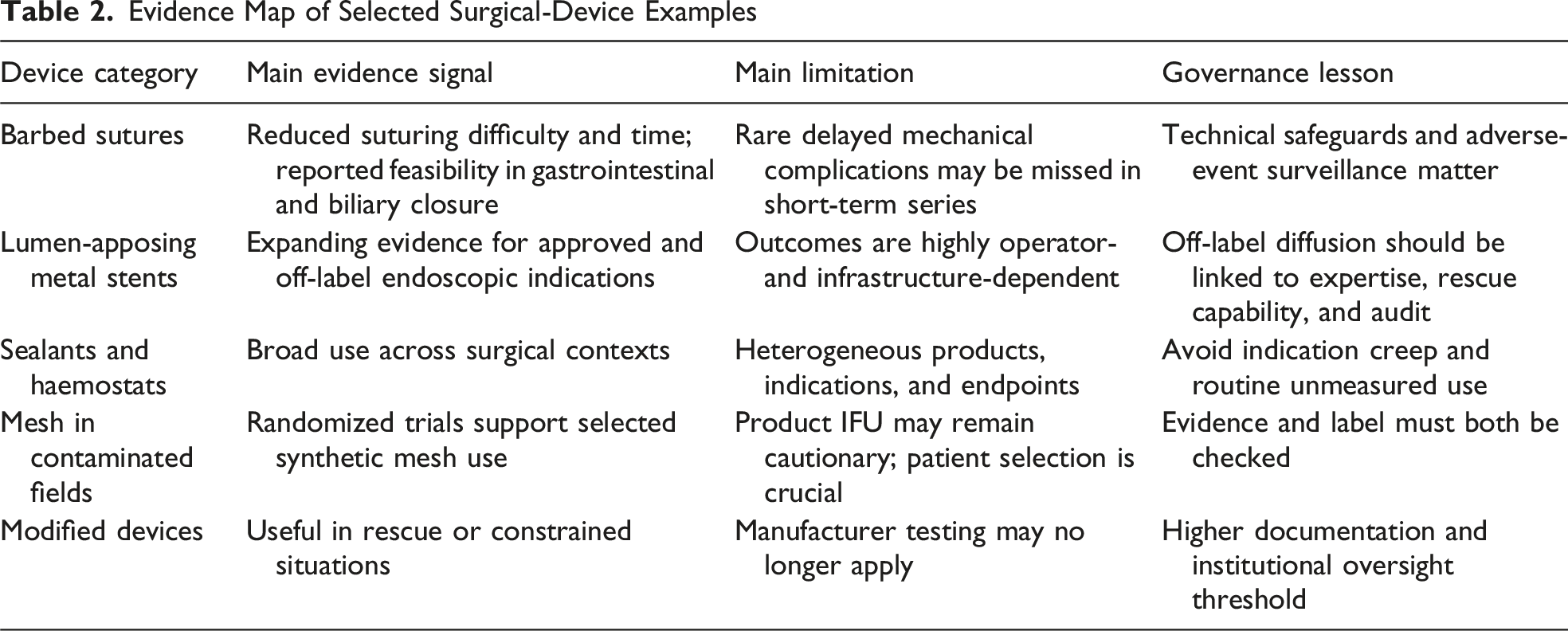
The third group consisted of device-specific surgical literature. Barbed sutures, lumen-apposing metal stents (LAMS), fibrin sealants, haemostatic agents, hernia mesh, and modified devices each illustrate a different form of label gap. Barbed sutures show the tension between technical benefit and intraperitoneal mechanical risk; LAMS illustrate expansion from approved to off-label endoscopic indications; sealants and haemostats show how familiar adjuncts may be used beyond product-specific indications; and mesh in contaminated fields demonstrates that product labelling, evidence, and standard practice may not always align.
Why Surgeons Use Devices Off-Label
Off-label device use in surgery appears to arise from five recurrent drivers: anatomical specificity, evidence lag, technical constraints, rescue necessity, and diffusion through professional networks. Anatomical specificity refers to the mismatch between product labelling and the specific tissue or operative field encountered in practice. Evidence lag occurs because device labels often change more slowly than surgical practice, especially when early evidence emerges through case series, technical reports, videos, or expert adoption. Technical constraints create additional pressure because limited access, loss of tactile feedback, and difficult intracorporeal suturing may make a device attractive even when conventional alternatives exist. Rescue necessity may justify the need to solve an unexpected intraoperative problem when standard options are unavailable or more harmful. Finally, professional diffusion through peer practice may normalize a use before the IFU or evidence base has caught up.
A Working Vocabulary
Definitions Relevant to Surgical-Device Use
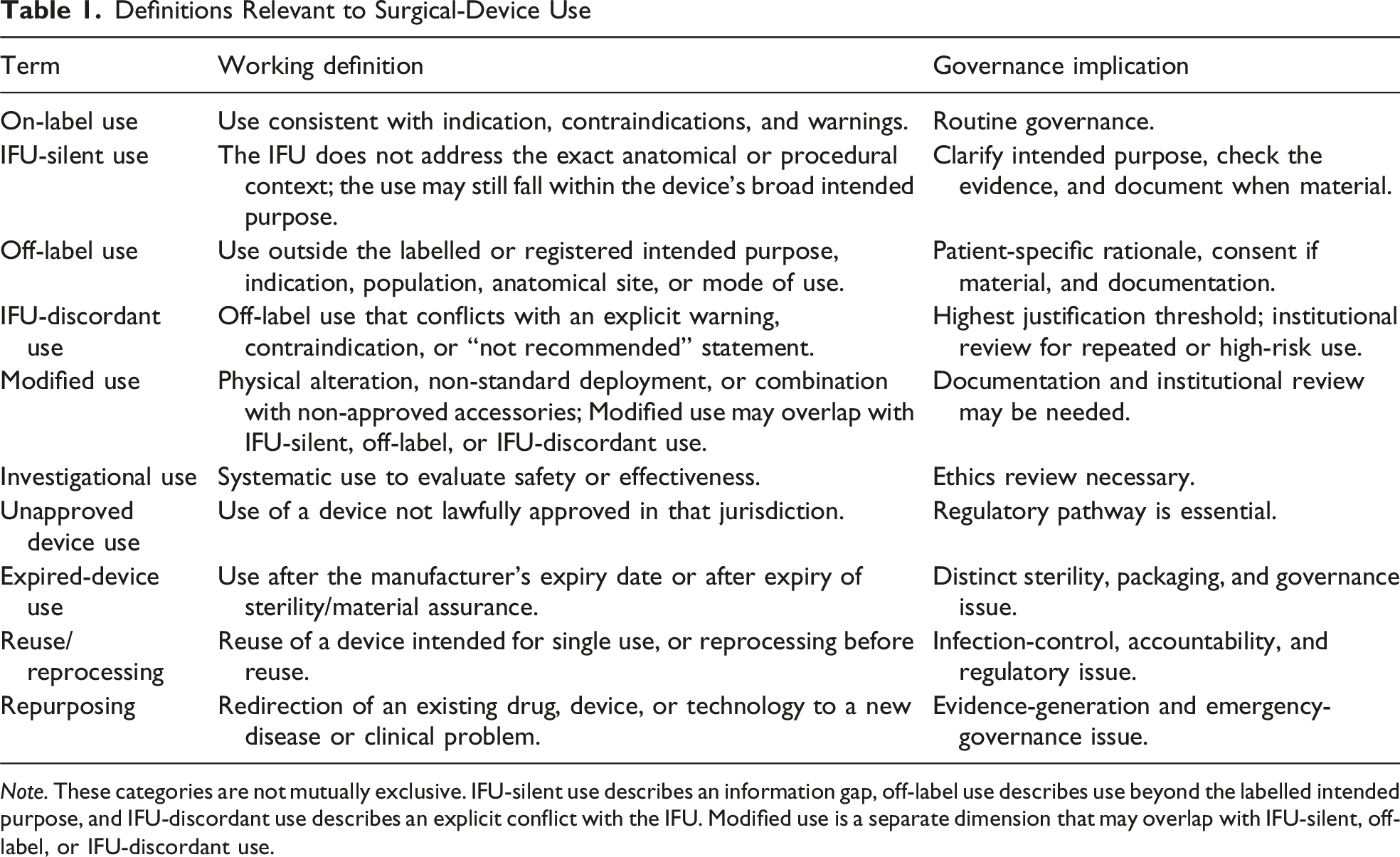
Note. These categories are not mutually exclusive. IFU-silent use describes an information gap, off-label use describes use beyond the labelled intended purpose, and IFU-discordant use describes an explicit conflict with the IFU. Modified use is a separate dimension that may overlap with IFU-silent, off-label, or IFU-discordant use.
Among the label-related categories, governance generally escalates from IFU-silent use to off-label use and is highest when use is IFU-discordant. IFU-silent use usually requires clarification of intended purpose, an evidence check, and documentation when material. Off-label use requires a patient-specific rationale and consent when relevant, while repeated or high-risk IFU-discordant use should prompt institutional review. Modified use should be assessed separately according to the extent of alteration, reversibility, device permanence, and available rescue options.
What Off-Label Use is Not
Off-label device use should not be conflated with expired-device use, reuse or reprocessing of single-use devices, or repurposing. Expired-device use raises separate concerns about sterility, packaging integrity, material stability, and manufacturer assurance, especially in humanitarian missions or medical-device donations to lower-resource settings. World Health Organization (WHO) guidance on medical-device donations emphasizes appropriateness to recipient needs, local policy, technical capacity, training, maintenance, and safe device management, rather than indication status alone. 12 Reuse or reprocessing of a single-use device is also distinct. It concerns cleaning, disinfection, sterilization, device integrity, infection prevention, and accountability after the manufacturer’s single-use assurance has ended; FDA guidance treats reusable-device reprocessing and reprocessed single-use devices as separate regulatory and safety issues.13,14 Unplanned reuse of a device during an intraoperative emergency is different from routine reprocessing for later use. It remains a high-risk rescue decision requiring immediate assessment of device integrity, sterility, available alternatives, and documentation, and should not become a routine local practice. Repurposing redirects an existing drug, device, or technology to a new disease or clinical problem. The COVID-19 experience with chloroquine and hydroxychloroquine illustrates how repurposing may begin under urgent clinical pressure but require rapid evidence correction when benefit is not confirmed or risk becomes unacceptable. 15
Barbed Sutures
Barbed sutures illustrate the value and hazard of IFU-sensitive surgical adaptation. Their practical appeal is obvious in minimally invasive surgery: knotless closure, even tension distribution, reduced intracorporeal knot tying, and shorter suturing time. Systematic reviews in gastrointestinal surgery report that barbed sutures can reduce suturing or anastomotic time without a clear overall increase in complications.16,17 Published series have reported feasibility of barbed sutures for laparoscopic common bile duct exploration and primary choledochorrhaphy. 18 The critical issue is that broad soft-tissue use does not automatically establish safety for every luminal or intraperitoneal application. Published warnings and case-based literature describe small-bowel obstruction when barbed suture ends hook onto adjacent bowel or mesentery. 19 Barbed sutures should therefore not be described as unsafe or prohibited. Their responsible use requires attention to tissue context, exposed tails, burying or trimming ends, case selection, and documentation when the use is outside local standard practice. This example also shows why short-term series may be falsely reassuring: a device can reduce operative time and appear safe in routine outcomes, yet still create rare delayed mechanical complications that require longer follow-up to detect.
Lumen-Apposing Metal Stents
LAMS show a different pattern: rapid expansion from defined endoscopic purposes into adjacent and off-label indications. LAMS were developed for transluminal drainage and have become central to interventional endoscopic ultrasound. Published experience includes approved and off-label indications, including pancreatic fluid collections, gallbladder drainage, gastroenterostomy, biliary drainage, gastrointestinal strictures, and temporary access procedures.20,21 One series of 303 patients reported that 190 patients, or 62.7%, received LAMS for off-label indications. 21 In selected patients, LAMS may avoid surgery or provide palliation. However, LAMS use is highly operator-dependent and requires expertise and fluoroscopic support. Adverse events such as bleeding or perforation may be serious. Off-label LAMS use should therefore be limited to operators with formal interventional endoscopy training, institutional credentialling, and access to endoscopic, radiological, and surgical rescue. Introduction of a new indication should include appropriate proctoring or peer review and prospective audit of outcomes. LAMS therefore shows how off-label use can evolve into accepted practice, but only when supported by expertise, audit, and outcome reporting.
Sealants and Haemostats
Fibrin sealants, glues, and topical haemostatic agents are often underestimated because they appear simple. Glue may function as a haemostat, adhesive, or sealant, and each use may have a different evidence base. Mandell and Gibran noted that fibrin sealants are used for a wide variety of off-label indications. 22 A broad systematic review of fibrin sealant in non-emergency surgery found use across multiple surgical contexts, while also highlighting uncertainty around benefits and harms in several settings. 23 The literature is difficult to interpret because endpoints differ: bleeding, drain output, seroma, fistula, leak, transfusion, reoperation, and cost are not interchangeable. The safety concern is not always failure but overuse. This therefore requires professional restraint. Familiarity is not evidence, and local habit is not the same as indication-specific benefit. This category illustrates ‘indication creep’: a product initially used for one biological purpose may gradually be applied to adjacent problems without each new use being supported by the same level of evidence.
Mesh in Contaminated Fields
Mesh use in contaminated or infected fields is label-sensitive rather than categorically off-label, because product-specific IFU cautions, wound contamination, evolving evidence, and patient factors may not align neatly. However, clinical evidence has challenged older assumptions. A randomized clinical trial in contaminated ventral hernia repair found lower 2-year recurrence with synthetic mesh than biologic mesh, with similar safety profiles. 24 The PRICE randomized trial found higher recurrence with biologic mesh compared with synthetic mesh, with similar postoperative complications. 25 This example highlights the difference between product labelling, clinical evidence, standard of care, and patient values. A use may be supported by emerging literature but still cautionary in a specific IFU. Conversely, broad labelling does not remove the need to assess wound class, bacterial burden, patient risk factors, mesh type, likelihood of explantation, and patient preferences. Patient preferences may also include material-specific concerns, such as religious or moral objections to porcine-derived biological mesh; such issues are not captured by recurrence or infection outcomes but may be decisive for ethically acceptable surgical care. 26 Mesh in contaminated fields is therefore best described as label-sensitive and evidence-evolving rather than simply off-label.
Modified Devices
Modified device use is the most ethically sensitive category because the surgeon may alter a device in a way the manufacturer did not test. Cutting, reshaping, combining, or using third-party accessories can change strength, sterility, deployment, compatibility, and failure mode. Such practices may be reasonable in selected circumstances, particularly rescue situations, but they require a higher threshold of justification. The greater the modification, the less the surgeon can rely on the manufacturer’s assurance of performance. This is where off-label use approaches surgeon-created innovation. Documentation and governance should increase accordingly. A single rescue modification may be defensible as patient-specific judgement. Repeated modified use becomes a local practice and should be audited, discussed, and, where appropriate, studied. Departments could maintain a simple modification register recording the device, nature and reason for alteration, alternatives considered, operator, patient outcome, and any adverse event. Repeated entries involving the same modification should trigger departmental review and consideration of formal evaluation.
Evidence Map of Selected Surgical-Device Examples
Discussion
The evidence base is heterogeneous. Regulatory and professional documents define the permissibility and responsibilities of off-label device use, but they are deliberately general and rarely direct procedure-specific surgical practice. Specialty reviews in orthopaedics and paediatrics confirm that off-label use is common and sometimes necessary, but their transferability to general surgery is limited because the devices, anatomy, permanence of implantation, and complication profiles differ. Device-specific literature is more clinically useful but remains sporadic. Barbed-suture studies often emphasize operative time, ease of closure, and short-term morbidity, while delayed morbidity may be missed without larger cohorts, longer follow-up, or adverse-event databases. LAMS studies provide important experience with expanded indications, but outcomes are highly operator dependent. Sealant and haemostat studies are difficult to synthesize because products, mechanisms, indications, and endpoints differ substantially. Mesh studies show that contemporary evidence may support selected synthetic mesh use in contaminated fields, while product-specific IFU warnings may remain cautionary. Overall, the literature supports neither prohibition nor casual normalization of off-label device use. It supports a middle position: disciplined, evidence-informed, patient-specific, documented, and auditable use.
When Off-Label Use Is Reasonable
Off-label use can be reasonable when it is patient-centred, evidence-informed, and proportionate. It may be justified when no suitable labelled alternative exists, when the off-label option avoids a more invasive procedure, when the anatomical problem is unusual, or when published evidence supports the practice. The clinical rationale should be stronger when the use is further from the IFU, when the device is implanted permanently, or when harm would be difficult to reverse. Off-label use should also be distinguished from research. Individual clinical use for patient care is not the same as systematic investigation. However, repeated use to generate generalizable safety or effectiveness data should move toward ethics review, registry, or formal evaluation.1,27-29 This approach is consistent with the Declaration of Helsinki’s guidance on unproven interventions in clinical practice, which permits carefully justified patient-specific use when approved options are inadequate or ineffective, but emphasizes expert advice, risk–benefit assessment, informed consent, and subsequent evaluation of safety and efficacy. 30
When Off-Label Use Becomes Unsafe
Off-label use becomes unsafe when the reason for using the device is weak or commercially shaped. Red flags include use despite lack of patient-specific rationale; failure to consider standard alternatives; repeated use without audit; undisclosed financial or training relationships; and failure to tell the patient when the information is material. “Everyone uses it,” “it works in my hands,” or “the representative said it is fine” are not evidence. They may be starting points for enquiry, but they cannot replace IFU review, literature review, local audits, or independent professional judgement. The greater the departure from the IFU, the greater the burden of justification.
Ethics and Professionalism
Off-label device use is a test of surgical professionalism. The surgeon’s first duty is to the patient. 31 A device may make an operation faster or easier, but convenience is not the same as benefit. The professional question is simple: is this device being used because it is better for this patient, or because it is familiar, fashionable, available, reimbursed, or promoted? Beneficence may justify off-label use when it provides a reasonable patient-specific advantage. Non-maleficence requires avoidance of preventable harm from untested use. Respect for autonomy requires disclosure when off-label status, IFU caution, additional cost, or uncertainty would reasonably matter to the patient. Justice requires attention to resource use and unequal access to expensive technologies. Professional integrity requires independence from industry influence and willingness to stop or modify practice when complications emerge. The most dangerous form of off-label use may be silent normalization. This drift is not rare in modern surgical learning. YouTube is widely used for surgical preparation, yet surgical videos often lack peer review, validated quality indicators, and transparent disclosure of conflicts or commercial influence. 32 In off-label device use, such videos may normalize a technique before the viewer understands whether it is on-label, evidence-supported, or reproducible locally. Professional societies and hospitals can reduce this risk by requiring video authors to identify the device, state whether the demonstrated use is on-label or IFU-sensitive, disclose sponsorship and conflicts, and describe patient selection, technical limitations, and complications. Institutional teaching libraries should preferentially host clinically reviewed material rather than rely on view counts, likes, or other popularity measures. 32 A device is demonstrated at a conference, used by a respected colleague, stocked by the hospital, and gradually becomes “how we do it,” without anyone checking the IFU, auditing outcomes, or discussing material uncertainty with patients. Professionalism requires surgeons to resist this drift.
Consent
Not every off-label device use requires a long consent discussion. Surgery involves many intraoperative choices that patients reasonably entrust to the surgeon. However, disclosure becomes important when the device use materially affects risk, alternatives, uncertainty, cost, postoperative expectations, or the patient’s ability to choose. Consent should be more explicit when the device use is clearly outside the IFU, when the IFU contains a relevant warning, when a labelled alternative exists, when evidence is limited, when the use is new to the surgeon or institution, when industry influence is present, or when the use is part of innovation, audit, registry, or research.2,3,11 Subject to local law and institutional policy, a verbal explanation documented in the clinical record may be sufficient for low-risk IFU-silent use when the departure does not materially change risk, alternatives, or cost. Explicit written consent should generally be obtained for IFU-discordant or modified use, permanent implantation, substantial uncertainty, important additional cost, or use that is new to the operator or institution. Investigational use requires formal research consent and ethics oversight. The purpose of disclosure is not to frighten the patient with regulatory language, but to explain facts honestly. Plain-language disclosure may be more useful than technical regulatory terminology. For example: This device is used by some surgeons for this type of problem, but this exact use is not specifically described in the manufacturer’s instructions. I think it is reasonable here because [reason]. The alternative is [alternative]. The specific uncertainty is [uncertainty].
This explanation respects autonomy without turning consent into a technical manual. Patients may accept uncertainty when it is explained; they are less forgiving when uncertainty is hidden.
Law, Governance and Audit
The main legal and governance risk in off-label device use usually lies not in clinician-directed judgement itself, but in poor surrounding conduct: promotional influence, concealment, inadequate oversight, failure to understand IFU limitations, poor documentation, or failure to disclose material uncertainty. Clinician-directed off-label use is different from manufacturer promotion, but it still requires professional discipline. Surgeons should therefore separate independent clinical judgement from commercial messaging and document the patient-specific rationale. Governance should not make surgeons afraid to innovate, but courageous to embrace it professionally and adopt it responsibly. Departments could maintain a short list of commonly used IFU-sensitive devices, document the reason for material off-label or IFU-silent use, review device-related complications at morbidity and mortality conferences, and report serious or repeated adverse events. Singapore’s Health Sciences Authority describes adverse-event reporting as part of post-market risk assessment, with the objective of reducing the likelihood or consequences of repeated adverse events. 33 FDA’s MAUDE database houses medical-device reports from mandatory reporters and voluntary reporters, including healthcare professionals, patients, and consumers. 34 These systems are imperfect and under-reporting is common, but the principle is important: device-related harm should enter a learning system. The aim is not to punish surgeons for adapting devices, but to prevent repeated unrecognized harm.
Surgical Innovation and the LABEL Framework
The LABEL Framework for Responsible Off-Label Device Use
Limitations
This review has limitations. First, off-label device use is difficult to study because IFU status is product-specific, jurisdiction-specific, and often not explicitly reported in clinical studies. Second, many surgical publications describe technical feasibility or outcomes without stating whether the use was on-label, IFU-silent, or off-label. Third, adverse-event reporting systems are useful for signal detection but are limited by under-reporting, incomplete denominator data, and variable causality assessment. Fourth, the device examples selected here are illustrative rather than exhaustive. The proposed LABEL framework should therefore be viewed as a practical professional tool rather than a validated checklist. Future work should prospectively assess the feasibility, reliability, and clinical effect of the LABEL framework, including whether it improves consent, documentation, adverse-event detection, and institutional learning. Specialty guidance for general and minimally invasive surgery could define minimum governance standards for commonly encountered IFU-sensitive uses. A multicentre or international registry could identify practice variation, recurrent device-specific harms, and safety signals that may not be visible in single-institution series.
Conclusion
Off-label and IFU-silent device use is part of modern surgery. It is often driven by anatomical specificity, evidence lag, technical constraints, rescue necessity, and diffusion through professional networks. Such use is not inherently unsafe, unethical, or negligent. However, it becomes problematic when it is commercially influenced, poorly evidenced, undisclosed, undocumented, or unaudited. The responsible surgeon does not treat the IFU as irrelevant, nor as the only source of good practice. Surgical judgement, evidence, patient-specific reasoning, consent, documentation, and outcome review are integral to innovative practice. The proposed LABEL framework—Label, Alternatives, Basis, Explain, and Log/Learn—offers a practical structure for professional, transparent, and accountable off-label device use.
Footnotes

Ethical Considerations
Not applicable. This article is a review and critical synthesis and did not involve human participants, patient data, or animal research.
Funding
The author received no financial support for the research, authorship, and/or publication of this article.
Declaration of Conflicting Interests
The author declared no potential conflicts of interest with respect to the research, authorship, and/or publication of this article.