







Abstract
While not as glamorous as flying, aircraft maintenance is a fundamental of aviation safety, and improper or inadequate maintenance can have far reaching consequences. With this in mind, and considering the paucity of substantive research in aircraft maintenance engineering, this study investigated how affect influenced decision making and action tendency in real-world challenging maintenance engineering scenarios in general aviation (GA). A study was undertaken combining a naturalistic decision making (NDM) technique with the Appraisal Tendency Framework (ATF) to analyze 10 different scenarios collected from aircraft maintenance engineers. A total of 11 contextual factors were elicited from which seven specific emotions emerged: anger, frustration, pride, hope, guilt, fear, and contempt. In most instances, the emotion was found to be incidental, meaning that the feelings at the time of the decision were not normatively relevant for deciding. Anger and contempt created action tendencies for risk taking, while feelings of pride were found to have a protective effect. The findings suggest that affect regulation is an inherent part of the system, such that affect dysregulation may represent a potential contributing factor for negative outcomes arising from action tendencies associated with other complex system influences. Future research directions are given.
Keywords
In 1985, Japan Airlines Flight 123 experienced an explosive decompression shortly after takeoff from Haneda Airport, Tokyo; the subsequent crash took the lives of all but four of the 524 people aboard. The ensuing investigation implicated the actions of aircraft maintenance engineers (the terminology for those who inspect, perform, or supervise maintenance and alteration of aircraft/aircraft systems varies from country to country; while we refer to them as Aviation Maintenance Engineers, they are also called Aircraft Maintenance Technicians [AMTs], Aircraft Mechanics, etc.) from 7 years prior, after they departed from the instructions contained with the authorized manual maintenance when repairing the plane’s bulkhead (Aircraft Accident Investigation Commission, 1987).
Aircraft maintenance plays a critical role in aviation safety. A complex and multifaceted environment, the interaction between humans and sophisticated technologies exploits potential error-producing conditions (Dumitru & Boscoianu, 2015; Hobbs, 2008; Shappell & Wiegmann, 2012). While considerable advances in airworthiness have engendered a safe and reliable industry, improper or inadequate maintenance has been identified as a significant accident-precipitating factor (Boyd, 2015). In Australia, such factors contribute up to 30% of all reported aviation accidents (Civil Aviation Safety Authority, 2013). This is of particular concern in the general aviation (GA) sector, where regulation has a tendency to be less stringent (Boyd & Stolzer, 2016) and where there is by comparison less oversight by both companies (internal) and regulators (external) than for commercial service providers. Comprising civil aviation operations other than scheduled commercial air transportation (e.g., gliders, corporate jet flights), GA includes business travel, agricultural aviation, flight training, medical transport, aerial mapping, and aerial law enforcement. In Australia, GA accounts for 90% of all aircraft and 40% of total flying hours (Australian Transport Safety Bureau [ATSB], 2015), and while this means that GA is 5 times more likely to be involved in an accident, rates have nearly doubled since 2005.
Naturalistic Decision Making (NDM) in Aircraft Maintenance Engineering
Various human factors and system dimensions contribute to error-producing conditions in aircraft maintenance engineering. These include skills and training, coordination of teams, fatigue, procedures, and staff supervision (Hobbs, 2003, 2008), and are complicated by having to work under time pressure, extreme weather, and within confined spaces (Dumitru & Boscoianu, 2015; Latorella & Prabhu, 2000; Raouf, Dhillon, & Liu, 2006). Decision making in tasks characteristic of aircraft maintenance are typified by an “if it is x then apply y” rule-based logic. For instance, if an aircraft is brought into the hangar with ignition problems, the first task is to check its spark plugs. However, decision making may also involve a deeper understanding of the situation and abstracting a complex flow of information associated with the aircraft system (e.g., an undercarriage retraction problem or an intermittent generator failure), requiring the engineer to focus on larger units and perform knowledge-based decisions. Approximately 50% of all decision-making errors in aviation maintenance reportedly occur at a rule- and knowledge-based level (Hobbs & Williamson, 2002).
Since the field first emerged in 1989, various models of NDM have been used to explain how people make decisions in real-world situations, or retrospectively made their decisions (e.g., Strauch, 2016), particularly in environments where complex, dynamic, and opaque factors impact how information is processed. For example, Klein’s (2008) process-driven recognition primed decision model describes how experts use situational cues to identify patterns from previous experiences and construct internal representations to make sense of the world around them (Jones, Ross, Lynam, Perez, & Leitch, 2011), particularly when assessing a situation. Pennington and Hastie’s (1986) explanation-based decisions model also emphasizes the role of situation assessment and recognition, predicting how decisions are made in situations where large amounts of incomplete, piecemeal, and temporally jumbled (though sequentially presented) information is processed. By comparison, Rasmussen’s (1983) typological cognitive control of decision processes model distinguishes between different types of behavior, showing how people focus on various parts of the system, from the concrete to the abstract, drawing attention to the influence of individual values and goals, as well as habit and automaticity (i.e., well-rehearsed skills).
While NDM models vary, the literature tends to agree that decision making does not consist of discrete isolated events or processes, that situation assessment is a critical element, and that decision makers draw on mental imagery (Klein, Orasanu, Calderwood, & Zsambok, 1993). Understanding the context surrounding the decision is a key aspect of the process, as is understanding how decision makers actually function, rather than how they should to function. This provides further context into the nature of decision-making error which can influence the process.
Affective Influences in NDM in Aircraft Maintenance Engineering
Study of performance shaping in aircraft maintenance engineering has shown that various factors can provoke unsafe behaviors in decisions (Hobbs, 2008). Affect is one such factor that has been researched in complex cognitive work in various real-world settings (e.g., Bowman & Rogers, 2016; Scribner, 2015) and may provide a window into the context surrounding decisions (Mosier & Fischer, 2010b) of the aircraft maintenance engineer. Varying in duration, cause, and consequence (Mosier & Fischer, 2010b), affect is a form of mental processing that reflects our internal subjective states and includes emotion, mood, and motivation (Cohen, Pham, & Andrade, 2006; Knutson, Katovich, & Suri, 2014). In the context of NDM, however, current literature emphasizes the expertise of the decision maker in objectively assessing critical situations, as opposed to the role or influence that affect regulation has in the process (Mosier & Fischer, 2009, 2010b).
The Federal Aviation Administration’s (2012) “dirty dozen” list of 12 common contributing factors of mistakes in the aviation workplace lends further insight between affect regulation and impact on safety; though based on elements of a training curriculum and targeting a broad range of maintenance roles, the list includes factors such as fatigue, pressure, and distractions, and identifies stress as “a physical, chemical, or emotional factor that results in physical or mental tension” (p. 1), attributing it as something that can influence potential negative outcomes.
Affect regulation in aircraft maintenance engineers is an important issue, given that emotion-related cognition tends to interrupt ongoing cognitive processes and redirect attention, memory, and judgment to address the pertinent emotion-inducing event (Chan & Singhal, 2013; Lazarus, 1991b). Strong emotions also have the ability to focus cognition and direct thoughts beyond the emotion-inducing scenario to unrelated events. In this case, affect is incidental, meaning that the subjective feeling carried over from earlier situations drives decision making and corresponding behaviors in future events (Lerner, Li, Valdesolo, & Kassam, 2015); this can happen in spite of incentives to disregard irrelevant influences (Lerner, Small, & Loewenstein, 2004). Given this, it is surprising that specific emotions, states, or action tendencies resulting from affective dysregulation are rarely considered within sociotechnical system approaches or taxonomies used to aid investigation. One explanation is that it would encourage blame and/or promote single factor explanations. All emotional stimuli are thought to capture attention more so than neutral stimuli, but for some emotions (e.g., anger), this can be very potent (Pratto & John, 1991). By triggering a set of responses across the behavioral, experiential, communicative, and physiological dimensions, emotions are thought to serve an adaptive coordination role in that they enable people to deal relatively quickly with problems and trigger action toward implicit goals and action tendencies (Frijda, Kuipers, & Ter Schure, 1989). To predict action tendencies with potentially negative outcomes, it may therefore be more useful to perceive affect as an inherent part of the human condition, and therefore in most cases, a product of other system-related influences.
While numerous theories associated with emotion and affect regulation exist, appraisal theory is useful for studying the effects of specific emotions on decision making, not only because it decomposes them into discrete dimensions, but because it enables them to be mapped onto judgment and decision-making processes. Lerner and colleague’s Appraisal Tendency Framework (ATF) predicts that emotions have motivational properties that take shape through cognitive appraisals and fuel carryover to subsequent decisions and actions (Lerner, 2016; Lerner & Keltner, 2000, 2001; Lerner et al., 2015). This means that the emotions comprising affect give rise to goal-directed processes, predisposing people to appraise events a certain way; while emotions exert influence on immediate decisions and choices (until the emotion-inducing event is resolved), their influence lingers and telegraphs forward to impact future judgments and decisions involving risk estimation. The cognitive appraisals associated with emotions reflect their character and influence the degree to which people feel certain or confident about their surroundings, for example, how they assign responsibility, causality, and blame (Lerner & Tiedens, 2006). Thus, the affective experience extends beyond determinations of “good” or “bad” in any given situation to appraisals of certainty (i.e., Is the situation certain or uncertain?), control (i.e., Is it controlled by the person or the situation?), and responsibility (i.e., Is the self of another person responsible?), all of which interact with risk estimation and propensity for risk-seeking choices (Lerner & Keltner, 2000, 2001). In the context of aircraft maintenance engineering, the concern is that affect dysregulation could attract risk taking.
The influence of affect and corresponding implications for risk estimation in aircraft maintenance are demonstrated through differences in the depth of processing engendered by different emotions. Some emotions, for example, activate “shallow” (i.e., automatic, stereotypical) heuristic processing where less attention is paid to the argument quality and more is given to superficial cues (Bodenhausen, Sheppard, & Kramer, 1994). While research investigating how affect impacts performance in the context of NDM is scarce, provoking a need for such research (Mosier & Fischer, 2009), even less, has evaluated how affect influences decisions made in the course of aircraft maintenance engineering. Given the prevalence of maintenance-related errors contributing to aviation accidents, there is a clear need to investigate how affect impacts decisions and actions in this domain. By understanding how emotions can lead aircraft maintenance engineers to certain decisions, research may be able to bridge the gap between decisions and potential negative outcomes in the context of this kind of cognition. This may lead to more informed development of taxonomies that recognize not only how affect influences decision making but, based on the action tendencies, also the specific influence from different kinds of affect.
Research Aim and Questions
This study combines NDM with the ATF to investigate how affect influences decision making and action tendency in real-world aircraft maintenance-engineering scenarios in the context of GA. The aim of the study is not to produce a definitive account of what gives rise to affective states in aircraft maintenance, or to generalize findings across aircraft maintenance engineers; rather, it is to elucidate the particular and specific. The aim of the study is thus to draw meaningful insights from affective experiences in real-world scenarios and explore how they influence decisions and actions from the standpoint of the aircraft maintenance engineer using the following two research questions:
Method
Quantitative and qualitative methods each have their own advantages and challenges (Brannen, 2005). Traditional laboratory studies can, for example, draw insights into microaspects of judgment and decision making, but a range of tools, including qualitative methods, must be employed with the goal to converge results, and provide viable predictions on how operators perform in dynamic environments (Mosier & Fischer, 2010a). Given the paucity of research in the GA area, and corresponding need to understand more about how specific emotions influence aircraft maintenance engineering work, this study drew on a qualitative phenomenological approach to obtain rich insight into the decision process, experiences, perceptions, and opinions of participants (Curry, Nembhard, & Bradley, 2009; Ferroff, Mavin, Bates, & Murry, 2012). This approach was selected (as opposed to Grounded Theory research or case study designs, for instance), because it described the common meaning for several individuals of their lived experiences of a concept or phenomenon, and the ability to produce a composite description of the essence of the experience (Creswell, 2013). This was the affective experience and its capacity to influence decisions and actions, and the sample comprised aircraft maintenance engineers in the Australian GA sector.
Semi-structured interviews were used to elicit knowledge and support the application of a NDM method called the Scenario Invention Task Technique (SITT) (Naweed & Balakrishnan, 2014; Naweed, Rainbird, & Dance, 2015); a generative simulation task, the SITT combined principles of multi-pass retrospective inquiry from the Critical Decision Method (Klein, Calderwood, & Macgregor, 1989) and story-telling in the Rich Picture Data method (Checkland, 1980; Monk & Howard, 1998) to externalize decision making in complex work. In this way, the SITT used retrospective and real-world experiences to effectively inform and ground prospective real-world situations.
The SITT and similar processes have been successfully applied in the context of NDM in a number of settings such as rail (Naweed & Balakrishnan, 2014) and health care (O’Keeffe, Tuckey, & Naweed, 2015) where people engage in complex and dynamic cognitive work. The process involves participants creating challenging scenarios and/or stories specific to their work with the aid of illustrations, schematic drawings, representations, and/or work plans to assist with articulation. It is therefore suited to research with individuals predisposed for mental imagery, such as that displayed by decision makers (Klein et al., 1993), and in the context of emotion-based research, where mechanisms such as forward reflection are considered to underlie ATF effects (Lerner & Tiedens, 2006).
Participation was restricted by sample size and eligibility to more accurately capture rich descriptions of real-world scenarios. As the intent of qualitative research is not to generalize information but to elucidate the specific, the recommended sample size in phenomenological studies from seminal work is 10 participants (Dukes, 1984; Riemen, 1986). This is still consistent with contemporary recommendations of sample size (Creswell, 2013) and allows rich insights to be gained from a particular social setting, benefited through the use of methodologies such as the SITT, which wield in-depth analytical processes (e.g., Crouch & McKenzie, 2006; Elmir, Jackson, Beale, & Schmied, 2010; Harenčárová, 2016).
Participants and Recruitment
Data were collected from participants in Queensland, New South Wales, and Victoria. Recruitment was based on convenience and purposive sampling, and a total of 10 aircraft maintenance engineers (nine males, one female) took part. The age ranged from 21 to 60 years (Mage = 41.2, SD = 11.37) with experience ranging from 1 to 42 years (Mexp = 17.8, SD = 10.5). Only two of the 10 participants identified their work as shift work. In terms of experience, the majority of participants identified as working with ultralights (70%), piston engine (80%), experimental (60%), warbird/classic (90%), and limited category (70%) aircraft. Most participants worked in privately owned (80%), charter (70%), and flight training (60%) maintenance categories. Prospective organizations were emailed an information sheet detailing the aims of the project and invited to contact researchers with the option of selecting a preferred interview mode (in-person; video conferencing).
Procedure
After providing informed consent and completing a demographical information card, participants were interviewed in two parts using the semi-structured protocol shown in Figure 1. Questions included closed-format responses, open-ended questions (to encourage consideration and presentation of new ideas), and cued questions (calling for relatively short answers in a narrow range). In the first part of the interview, general questions about experience in aviation/aircraft maintenance were asked as an ice breaker and to build rapport (e.g., “What encouraged you to go into aircraft maintenance?” “Do you remember the first aircraft you fixed?”). These questions also gained their perception of the aviation industry. Subsequent categories of questions sought to understand perspectives on safety (e.g., “How has the safety in aviation maintenance changed over the years?” “What do you think positively influences safety in the aviation industry?”) and factors that impact real-world maintenance work (e.g., “On a day-to-day basis, what sort of things obstruct you from completing a task?” “What sort of things would help you complete a task?”), with the objective to understand the sort of factors surrounding maintenance work that affected decision making and elicited emotion. At the end of the first part, a check of understanding was conducted and involved a summary of responses to bridge any gaps in understanding.
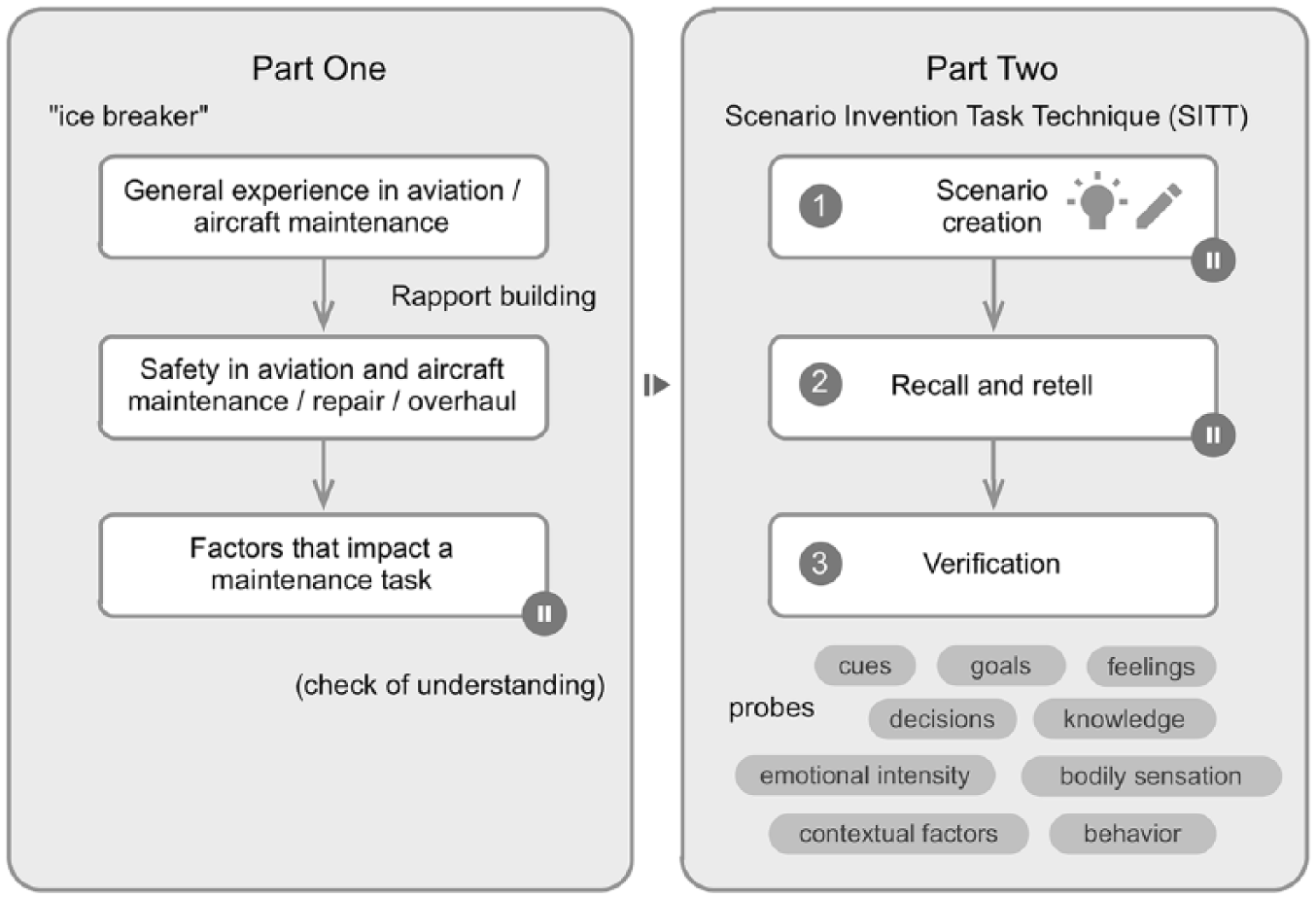
Overview of the interview protocol including the three steps of the SITT.
The SITT was applied over three steps in the second part, commencing with an instruction for the participant to forward reflect and “Imagine you are at work and completing a difficult maintenance-engineering task.” Participants were encouraged to explain the scenario during construction and created it using felt markers and A3-sized paper, concluding with another check of understanding. The next step (recall and retell) aimed to add further detail and information to the scenario to identify any gaps, ambiguous content, and/or conceptual leaps (e.g., “What else is going on around you?” “What materials do you have at hand to complete the task?” “What is the weather like?”), concluding in a final check of understanding for clarification. In the last step (verification), scenarios were explored with a series of probes to identify key decision points, elicit a self-awareness of emotions, and gauge the intensity of emotions, bodily sensations, feelings, and behaviors associated with them (e.g., “What are you thinking/seeing/feeling at this time?” “Why do you feel like this?” [Cues]; “What are your specific goals at this point?” [Goals]; “How did you obtain this information?” “What would a licensed/unlicensed Engineer do in this situation?” [Knowledge]). Both in-person (a total of six) and video-conferenced (a total of four) interviews took place in a private room and lasted approximately 60 min. All interviews were recorded with a digital voice recorder. For video-conferenced interviews, drawings were shared on screen, and subsequently scanned and emailed to researchers.
Ethical Considerations
The protocol was piloted prior to commencement. Given the role of affect in the study, the use of a hypothetical scenario approach limited risk associated with situations that had potential to cause distress. All participants reviewed their transcripts and drawings to verify the information. Identifying data were redacted at the time of transcribing to ensure anonymity and confidentiality. The study was approved by Central Queensland University’s Human Research in Ethics Committee (Approval no. H16/05-146).
Data Analysis
Voice recordings were transcribed verbatim and subsequently analyzed using a two-step process. In the first step, scenario data from the SITT were inductively analyzed (i.e., without pre-formulated categories) using conventional content analysis (Hsieh & Shannon, 2005), to identify and make links between key scenario features. Coding occurred semantically from description to interpretation, with codes undergoing refinement into categories. Next, scenario data were mapped deductively using the ATF; an overview of this is shown in Figure 2.
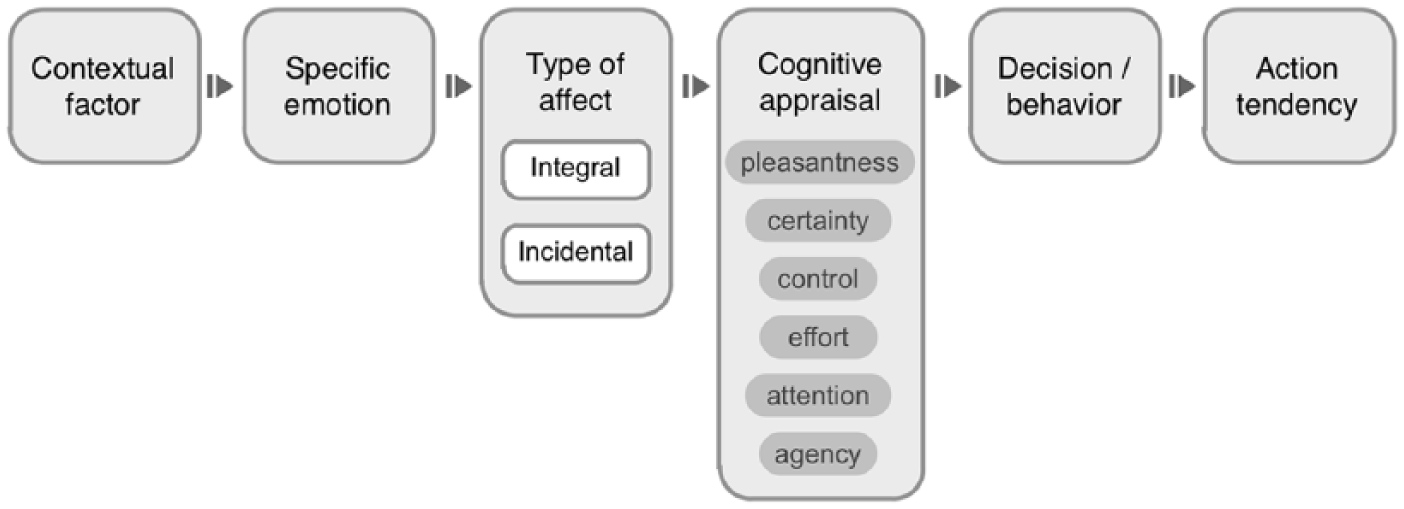
The Appraisal Tendency Framework used to analyze scenario data.
The framework was developed from Lerner’s research on the appraisal tendency approach (Lerner, 2016; Lerner & Keltner, 2000, 2001; Lerner et al., 2015), itself drawing on seminal work by Smith and Ellsworth (1985) which identified six cognitive dimensions for differentiating emotional experience. Similar deductive frameworks have been used to draw insight into safety performance–related decision making in experts in other domains (e.g., rail; Filtness & Naweed, 2017; Naweed, 2013). The ATF framework included systematic identification of the following: (1) key contextual factor(s) in the challenging maintenance task; (2) specific emotion associated with the contextual factor, including (3) incidental or integral tagging (i.e., classification of carryover effects); the (4) cognitive appraisal (i.e., meaning making) across six dimensions; and then (5) identification of the decision/behavior taken (by the Aircraft Maintenance Engineer); finally followed by (6) the associated action tendency. By way of relating this process with an exemplar, Figure 3 depicts a flowchart showing how the individual conclusions associated with the specific emotion in one of the contextual factors were determined. During analysis, particular emphasis was placed on looking for emotional congruence, meaning that the emotions referred by participants were indeed what they thought/said they were. The presence and role of multiple emotions (i.e., primary and secondary) were also gauged to determine and tease out the cognitive appraisals associated with the behaviors/decisions and action tendencies.
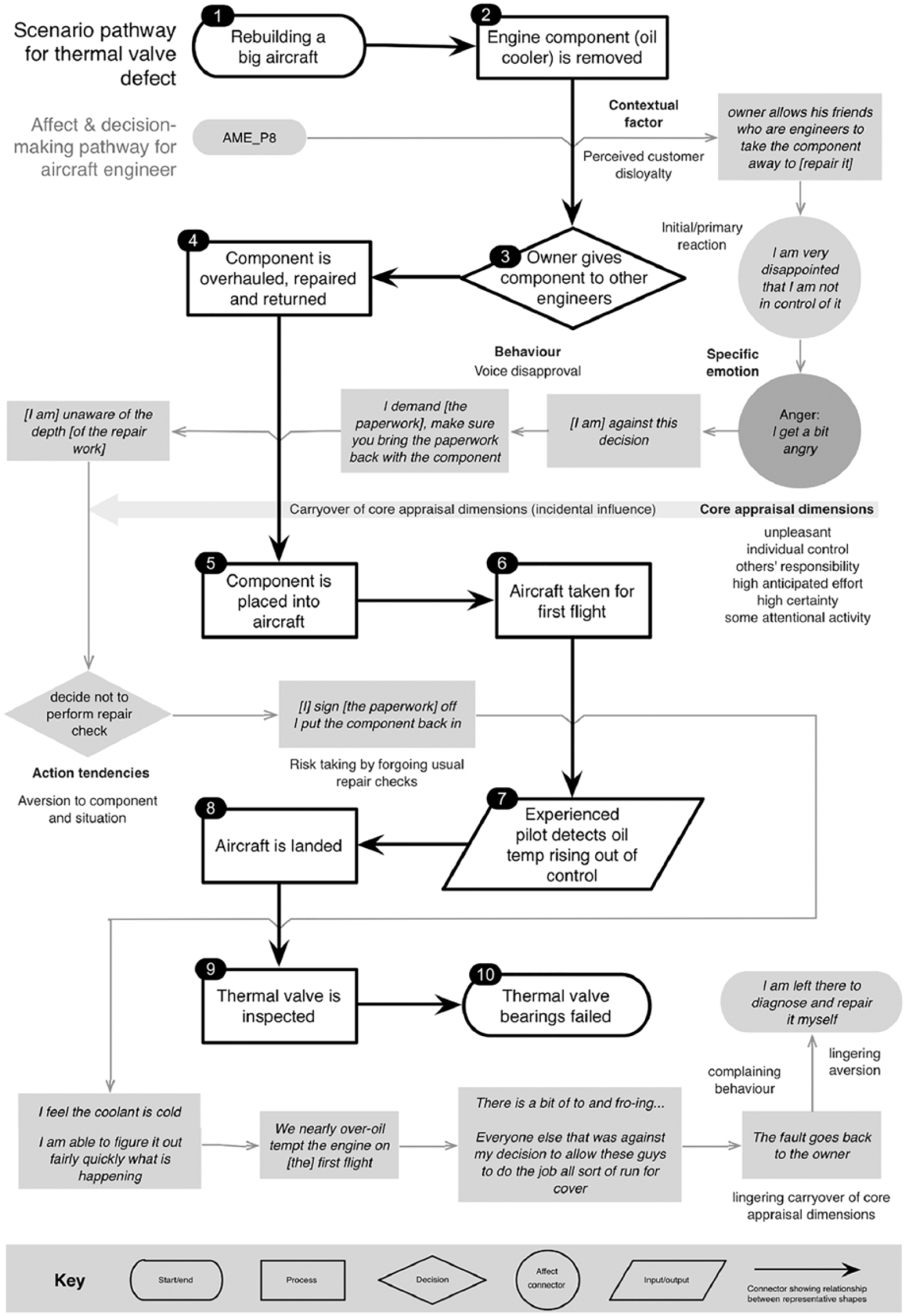
Example flowchart showing application of ATF to a key contextual factor from an example scenario.
Taken together, the combination of an NDM technique and use of the ATF approach was designed to draw insights, relationships, and meaning between contextual factors, affective states, and the decision-making processes uncovered in the first step, and in doing so, aid with interpretation of the findings.
Results
The first section presents the results of the content analysis, showing an overview of all the scenarios and their core features. The second section builds on the first by contextualizing the influence of affect in aircraft maintenance engineering work. Descriptions are given using three of the scenarios, including the emotions elicited in the course of maintenance work and the types of affect. The final section presents the results of the ATF mapping process, identifying the macro-level affective states across the scenarios, and cognitive appraisals impacting the decision-making process (corresponding with behaviors described by participants). Quotes (excerpts exceeding 40 words are linked to participant ID tags to enable the reader to draw connections with scenario type [from Table 1] and gauge the breadth of findings across data) and pictorial data are used to illustrate points being made. Note that the drawings in this paper are tidied and deidentified versions (digitally cropped, handwriting replaced with typescript, color adjusted for black and white print).
Overview of Each Scenario and Features
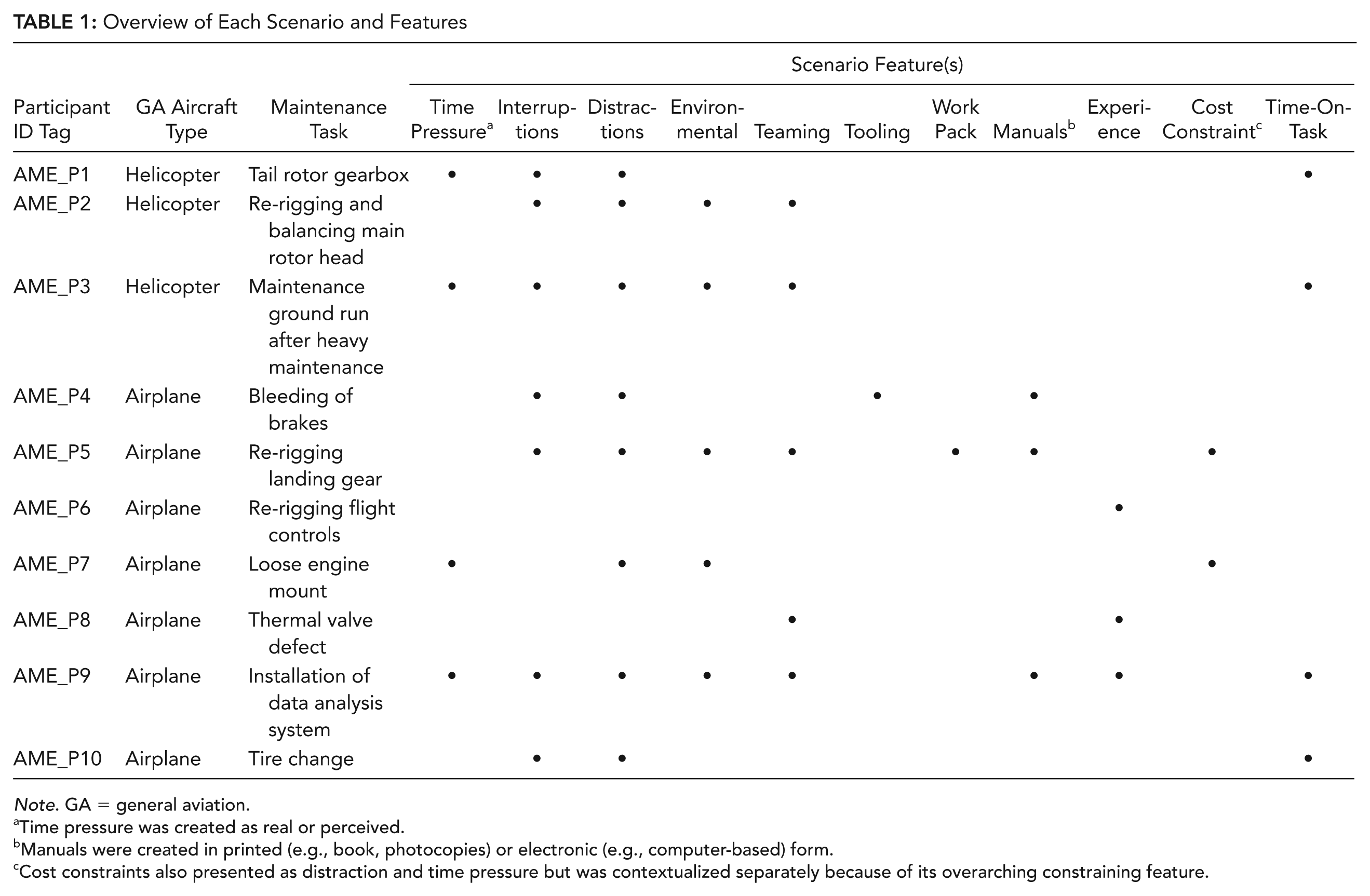
Note. GA = general aviation.
Time pressure was created as real or perceived.
Manuals were created in printed (e.g., book, photocopies) or electronic (e.g., computer-based) form.
Cost constraints also presented as distraction and time pressure but was contextualized separately because of its overarching constraining feature.
Overview of Aircraft Maintenance Engineering Scenarios
Each participant successfully created a maintenance scenario. Three of these were focused on maintenance work with helicopters, with the rest focused on airplanes. Table 1 shows an overview of the scenarios.
A total of 11 distinct scenario features were identified. These included (1) time pressure, where the time available to complete maintenance work was considered insubstantial; (2) interruptions, where maintenance tasks were disturbed by outside events (e.g., other people, phone calls) such that all work-related activity had to be suspended; (3) distractions, where focus was diverted to other physical and/or cognitive activities competing for attention, leading to cursory attention/neglect for primary maintenance work; (4) environmental, which included the space available for working (e.g., hangar), and weather-related factors such as heat, lack of air conditioning, and inclement conditions for test-flights; (5) teaming, which included work dynamics, communication, and/or coordination of other engineers/colleagues involved in the maintenance activity; (6) tooling, where affective states were linked with tools and devices required during maintenance tasks; (7) work pack, where affective states were linked with the availability of a maintenance work pack; (8) manuals, where affective states were linked with use of aircraft repair manuals and interaction with written instruction; (9) experience, denoting specific knowledge barriers associated with the maintenance task; (10) cost constraint, where affective states were overtly linked with monetary factors, such as a meta-awareness of the evolving cost of the maintenance work; and (11) time-on-task effects, reflecting stated deterioration of perceptual-motor performance (e.g., fatigue, sustained performance) in the scenario.
The maintenance tasks across all scenarios necessarily characterized technical work requiring highly skilled application of aircraft maintenance knowledge. In all but one scenario (AME_Ppt_9), maintenance work was fundamental for aircraft airworthiness. While the level of complexity of the maintenance tasks varied, all were considered to be relatively challenging. Interruptions and distractions featured prevalently across the scenarios and were related (i.e., interruption gave rise to distraction). For distractions, competing activities could be task-related (e.g., a concurrent job on same aircraft attracting attention away from primary maintenance task; preponderance with thoughts of future maintenance work) or non-task related (e.g., composing a personal text message while working; preponderance with family issues). In most instances, multiple features (>2) were coded for each scenario; in the exceptions to this, one scenario was coded only with “experience” and another was coded with “teaming.”
While the majority (80%) of participants did not identify as shift workers, fatigue (i.e., time-on-task) still emerged as a key feature.
Contextualizing the Influence of Affect in Aircraft Maintenance Engineering
Aircraft maintenance engineering was a highly complex and dynamic role, made more so by complicated processes and procedures that were not always systematic. Participants typically worked 8-hr days, though this regularly included an extra 2 to 4 hr (i.e., 10-to-12-hr days) and could spill into weekends.
Figure 4 shows example data from a scenario involving the installation of a data analysis system. An excerpt introducing the scenario is as follows: . . . so, we’re fitting a data-logger to one of the airplanes. It’s an automated racing data-logger, so it’s not really designed for aircraft so what we need to do is then come up with an engineering order. We have to design, with help from the engineering order engineer, to actually come up with what we’re going to do with it to fit it. That takes a lot of brain power, so we’ve got myself and an avionics engineer trying to rack our heads . . . (AME_P9)
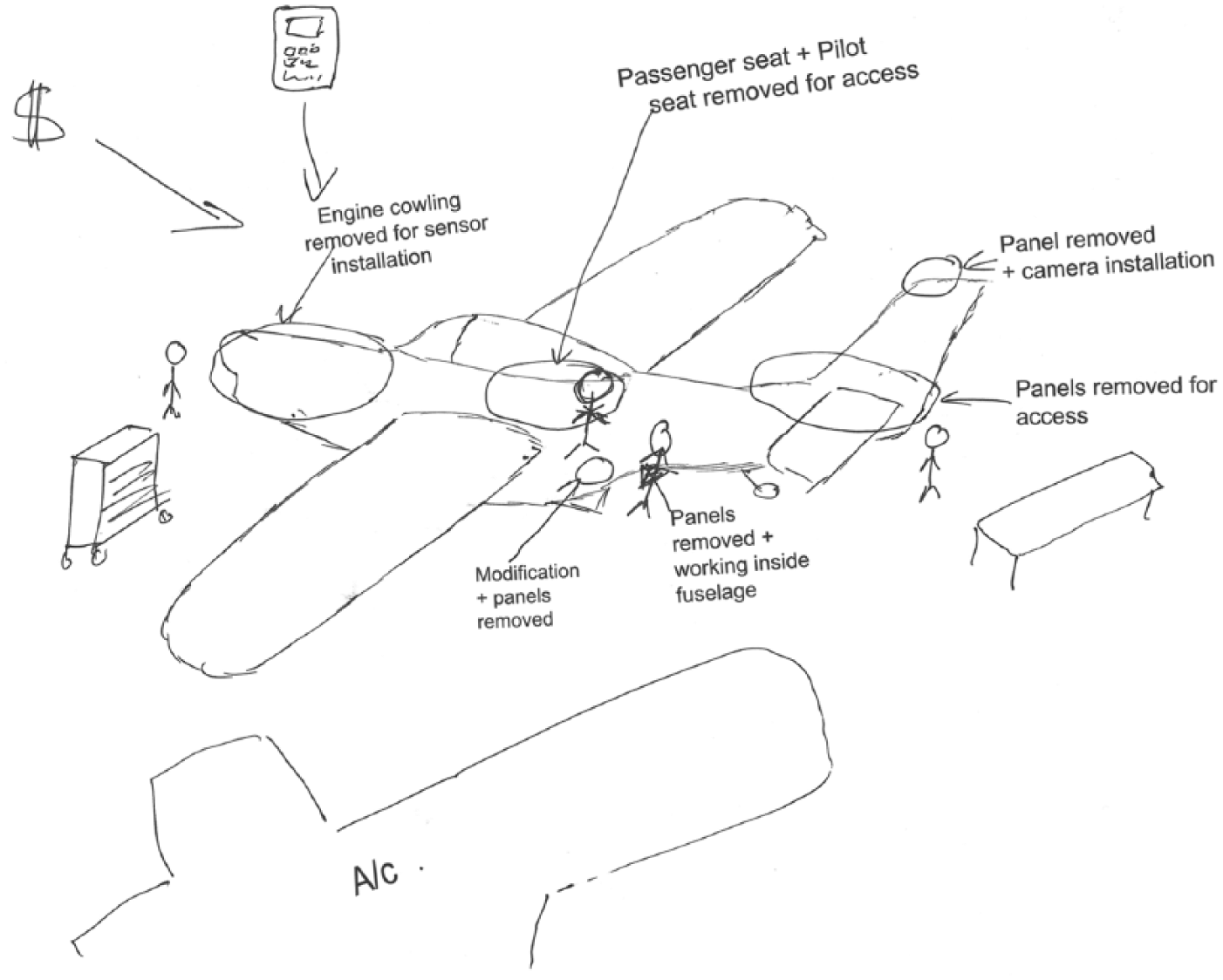
Illustration accompanying maintenance engineering scenario based on installing a data analysis system into an aircraft.
This scenario was constructed with a series of cognitive metafactors associated with its events, including time pressure (“We’ve got to get the airplane for a customer’s event, so we need to get the airplane done by a certain amount of time”), distractions (“our admin lady coming around”; ‘“have other engineers coming around”; “general public interference as well”), environmental (“high heat”), and issues associated with using instruction manuals (“pretty bad . . . all seem to be back-to-front”). In this scenario, contextual factors producing affective states included distraction from others, maintenance not working as desired, incorrect manuals, overrunning a job, and so on.
A second illustrative example is a scenario involving re-rigging of landing gear. An excerpt is as follows: . . . my part is to make sure when the landing gear comes up, it stops at the right time. Make sure when [the landing gear] comes down, it stops at the right time and make sure when they move the lever up and down, it all happens. Setting all that up, even out of the manuals that are 30 years old, is full-on . . . (AME_P5)
The metafactors associated included manual usability issues (“manuals that are 30 years old”), teaming factors (“I purely go off what the engine frame guys are up to. If they’ve already got the plane on jacks, then I might as well do the landing gear . . . so I’m not holding them up”), work pack anomalies (“the work pack is not ready”), cost constraints (“I can’t back date that work”), interruptions (“you’re using your brain [to concentrate] because you’ve got to work alongside the airframe guys”), distraction (“I’ve released that aircraft without knowing that it’s all, time wise, up to date”), and environmental issues (“trying to squeeze 10 planes into a hanger that is built for three”). In this scenario, contextual factors producing affective states, among others, included incorrect manuals, incomplete work pack, and negative rumination.
Figure 5 shows a thermal valve defect scenario, as follows: . . . [I am] rebuilding a big airplane, and the owner allows some other engineers to take a component away, overhaul it, repair it [. . .] I am unaware of the depth that that’d gone [sic], but they tell me that they had done the job properly. [They] put the component in the airplane. Then we have a problem. I am able to figure it out fairly quickly what is happening, and we nearly over oiled tempt an engine [sic] on its first flight . . . (AME_P8)
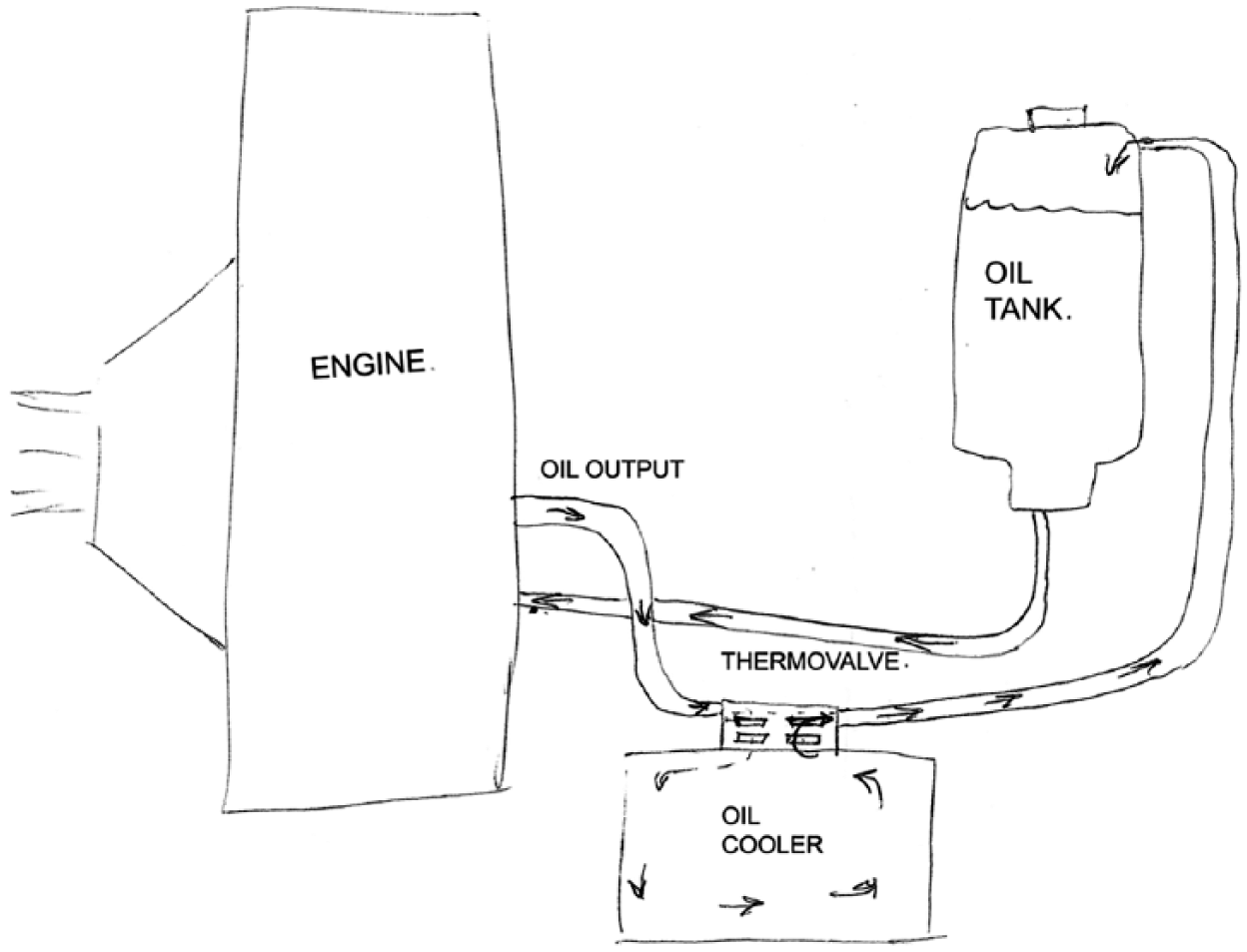
Illustration accompanying maintenance engineering scenario of a thermal valve defect.
The metafactors in this scenario included experience (“an oil cooler is taken out of the airplane by some friends of the owner”) and teaming factors (“There is a bit of to and fro-ing”). In this scenario, contextual factors producing affective states included customer disloyalty, the maintenance not working, negative rumination, incorrect manuals, and so on.
Emotions experienced in the context of these scenarios included frustration (e.g., “getting pissed off because it’s not doing what it’s supposed to do”; “you can get very frustrated quite quickly”), anger (e.g., “I get a bit angry, and I let people know”), and fear (e.g., “it’s a bit of a pain in the bum because you are worried”). In some instances, one emotion gave way to another (e.g., frustration turning into anger, worry turning into fear).
Action Tendencies Associated With Specific Emotions Across Various Aircraft Maintenance Engineering Contexts
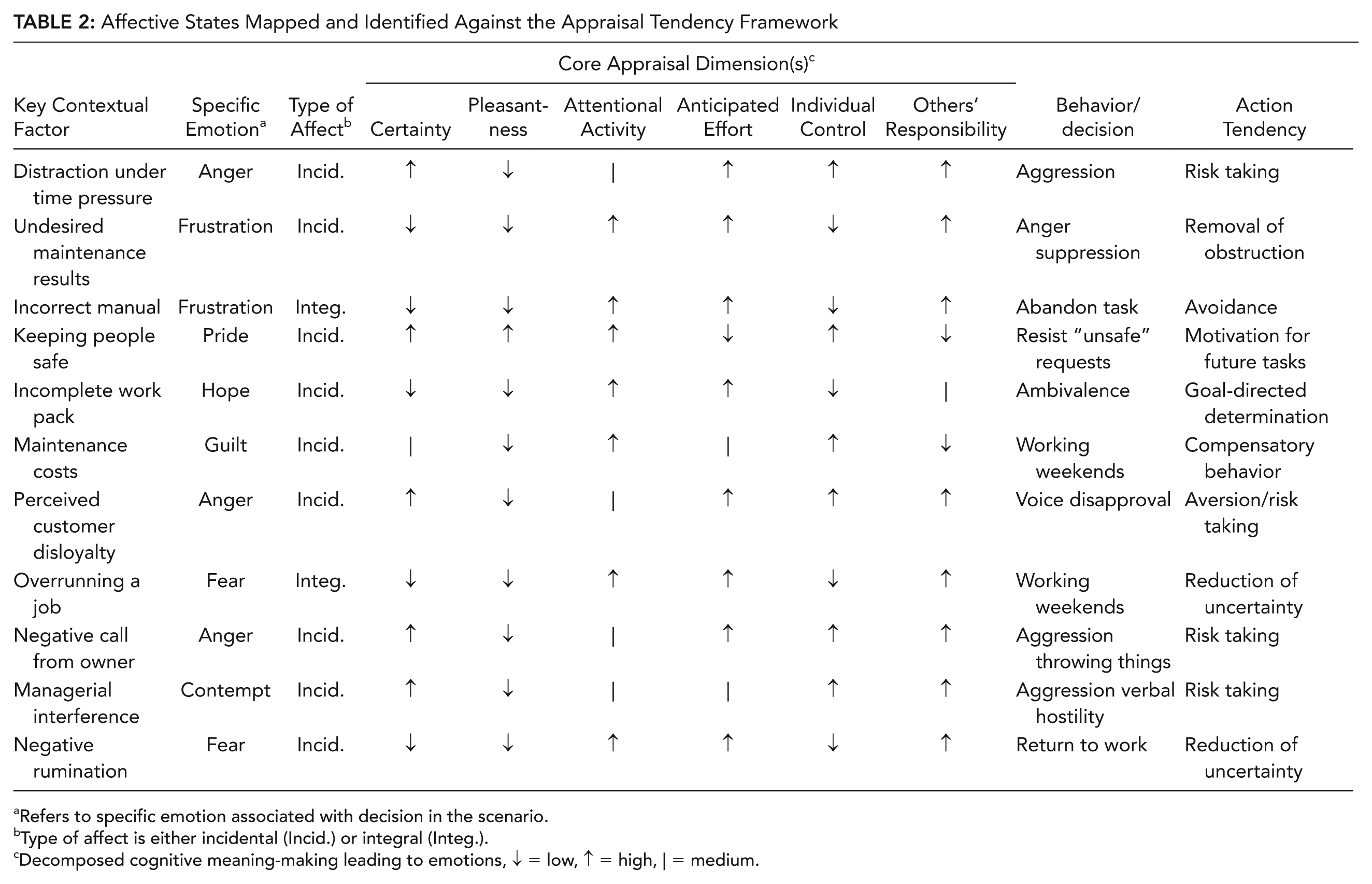
Participants indicated that they experienced emotions to different extremes over the course of day-to-day work: “It can be an emotional roller coaster in a day.” Table 2 consolidates the results of the ATF mapping process, identifying the affective influences on decision making.
Affective States Mapped and Identified Against the Appraisal Tendency Framework
Refers to specific emotion associated with decision in the scenario.
Type of affect is either incidental (Incid.) or integral (Integ.).
Decomposed cognitive meaning-making leading to emotions, ↓ = low, ↑ = high, | = medium.
A total of 11 distinct contextual factors were elicited across the scenarios from which seven specific emotions emerged: anger, frustration, pride, hope, guilt, fear, and contempt. In two instances, the affect was integral, meaning that feelings arose from the decision at hand, thus they were relevant to present judgments and choices (e.g., fear of overrunning the deadline of a maintenance job when deciding whether or not to work weekends). In the other nine instances, the affect was incidental, meaning that the feelings at the time of the decision were not normatively relevant for deciding, thus the emotional experience should have been irrelevant to present judgment and choices (e.g., guilt associated with having to ask for more money than quoted when deciding whether or not to work overtime). Table 2 also identifies the appraisal dimensions and tendencies underpinning the actions, and the links with behaviors/decisions described by participants.
Anger, risk taking, and aversion
Anger mapped against contextual factors of distraction under time pressure and negative call from owner, and in both of these instances, was incidental where the contextual factors (rather than the tasks) induced affective states that appeared to impact decision making. Anger is considered to score high on cognitive dimensions of certainty, individual control, and others’ responsibility, indicating that angry people perceive a large degree of certainty and individual control in new situations and, consequently, perceive less risk in their decisions. Performing maintenance tasks when the time available was considered insufficient, for example, was seen to produce psychological stress and then the anger from distraction carried over through subsequent displays of aggression: “someone will come over and just ask,” “can I borrow whatever” and “you jump down their throat”; “I get a bit angry, and I let people know”; “getting angry and throwing stuff across the hangar”; and You know you’re facing a whole situation where you’ve got to do a huge amount of work in a restricted amount of time. Then I think, if you’re leading into that, most of the time, Murphy being Murphy [“Murphy being Murphy” is a reference to Murphy’s/Sod’s Law, an epigram which assumes anything that can go wrong, will go wrong], one of these managers will come down while you’re in the middle of something and want to talk to you about something. Of course you bite their head off . . . (AME_P3)
Anger also carried over to impact situations outside of work (e.g., “I was coming home just angry, just so stressed, not sleeping”). Pervasive carryover effects of anger have appraisal tendencies for risk taking, with those induced not engaging in careful, detailed processing and, instead, engaging in more automatic, superficial, and heuristic processes (Lerner & Tiedens, 2006). This was observed in the study, for example, the anger associated with a negative call from an owner in the tire change scenario seeped into subsequent decisions: . . . [the Owner] is screaming for an aircraft to be ready, but then all of a sudden, you’ve got to get home to take the little one to art class or horse riding. There’s this process, that you may do it willingly or you may do it unwillingly, that you’ll go, “No, I’ll have a look at that next time,” and you’ll just pen it off and off you go. Then, all of a sudden, by the time you get back to it . . . it might be three years later . . . you look at and you go, this thing’s flogged out of its brain—it could have killed someone . . . (AME_P10)
Anger also mapped onto perceived customer disloyalty in scenario data as an incidental emotion, where the associated action tendency not only influenced risk taking but also induced aversion. For example, in the context of the thermal valve defect scenario, anger followed the initial reaction of feeling hurt and disappointed that the customer had used his own friends to repair an important engine component rather than let the aircraft engineer control the process himself. In this instance, anger not only reflected attempts to regain control, increase certainty, and manage responsibility (by attributing it to others) but also produced an aversive reaction to the component and the situation. This influenced the decision to forgo and/or oppose usual repair checks when the component was returned, with lingering effects carrying over to scenario end (see Figure 3, for illustrated example of anger and risk taking/aversion for this contextual factor). Disappointment is appraised as unexpected, wanting something pleasurable, thinking that one is morally right, and that circumstances are beyond one’s control, and when associated with anger, it has been shown to engender disapproval and complaining behaviors (Van Dijk & Zeelenberg, 2002).
Fear and reduction of uncertainty
Fear was mapped against two different contextual factors: overrunning a job and negative rumination. In the former, the emotion was integral to the decision (working over the weekend), but in the instance of negative rumination, it was incidental, where prolonged pessimistic reflection of the consequences of maintenance work appeared to induce a desire for additional verification. The behavior here was again to return to work. Fear is defined by cognitive appraisals of uncertainty, unpleasantness, and lack of individual control, meaning that fearful people have a tendency to perceive uncertainty, and situational control in new situations, therefore greater risk (Lazarus, 1991a), demanding extreme amounts of effort (Smith & Ellsworth, 1985). In line with this, when afraid, risk perception in the scenarios was driven by the desire to reduce uncertainty, and escape or avoid unpleasant and unsafe outcomes, for example, “I woke up at, Thursday morning, 3:00, and I couldn’t sleep. I’m thinking about a couple of things,” and I got the cylinders on, and . . . the engine hadn’t run, but it was . . . it got late, so I’ll stop [work]. That’s it. I’m going home. On the way home, I thought, “Oh, I don’t think I put the gudgeon pin, split-rings in.” The gudgeon pin basically holds the pistons, the connecting rod, and I couldn’t remember 100% . . . I knew I did it, but I couldn’t 100% remember that I did it. I went back in, took [the cylinder] off, found they were all in, all there, put it back together again and then went home. (AME_P9)
Frustration and engagement with obstructions
Frustration was mapped against two contextual factors: undesired maintenance results and incorrect manuals. In both instances, contextual factors were closely coupled with actual maintenance work. However, frustration elicited in the context of incorrect manuals appeared integral to decisions, while frustration born from maintenance tasks not working as desired or expected was incidental and tended to carryover. Much like anger, frustration is reportedly characterized by unpleasantness and anticipation for expending effort but features uncertainty about the situation and appraisals of low individual/high situational control. In the scenarios, substantive appraisals were consistent with perceptions of failure associated with tasks for which success was inherently expected (Fox & Spector, 1999), therefore often accompanied by uncertainty about its causes (Smith & Ellsworth, 1985). In the case of incorrect manuals, frustration bred decisions to abort the task linked with avoidant behavior such that work could not proceed without a period of absence (e.g., “It’s frustrating . . you’ll be sitting there scratching your head trying to figure something out . . . when we had one manual that was wrong . . . it basically wrecks a couple of days”). In the case of undesired maintenance results, frustration influenced anger suppression and the propensity to want to remove obstructions, for example, based on projections of future situations (“I get frustrated a lot, you might not have the parts [to complete the task] because some of these seals and that are one use only”), and also engendered aggression (“I like to achieve good, professional, efficient outcomes. If there’s things that frustrate that process, then, that really annoys me. I’m very task oriented, so I’ll tend to just become very, very focused on the task and often become more impatient with people around me”). Low-certainty appraisal tendencies such as frustration have been shown to provoke attentional narrowing and focusing on the minutiae (Lerner & Keltner, 2001).
Contempt and risk taking
Contempt was mapped against managerial interference. Appearing as an incidental emotion in this study, contempt mapped much like anger in terms of its appraisal outcomes, but with comparably lower anticipated effort and attentional activity. Beyond these dimensions, contempt was distinguished through perceptions of unfairness and unjustified negative consequences. In the scenarios, contempt was the leading reaction toward management whenever interpersonal engagements intruded on maintenance-related decisions or induced time pressure, for example, from the maintenance ground run after heavy maintenance scenario (AME_P3): All the maintainers and crew on the floor tried all these different ways of helping [Management] understand what we’re trying to do, and none of it worked out. It got to the point where the only thing that [Management] would listen to was if we just exploded like Chernobyl. It got their attention, you know? In this scenario, when there’s no time and we’ve got a mountain of work to do, and they show up, that’s what we’d go to straightaway . . .
Contempt appeared to present through aggression and verbal hostility, and tended to decrease perceptions of risk taking in subsequent decisions. Scoring high in appraisal dimensions of others’ responsibility in this context is supported by other research. In high risk organizations, management structures have been found to influence decisions toward unsafe acts (Heldal & Antonsen, 2014), in some cases, pressurizing aviation maintenance engineers to “sign off” on tasks which they deem unsatisfactory (Hampson, Junor, & Gregson, 2010).
Hope and goal-directed determination
Hope mapped against the lack of a complete work pack for the maintenance task required. A work pack effectively lists all the tasks, defects, and associated parts that are required and undertaken during maintenance; in practice, it is a document containing a pre-prepared, comprehensive, and modulated series of checks against which to reference the work from start to sign off. Hope presented as an incidental emotion with the feeling influencing decisions/actions in situations beyond the task at hand. As an emotion, hope scores low on certainty with events seen to be controlled by the situation, and a moderate attribution for others’ responsibility. It is also considered not a particularly pleasant state to be in, characterized by feelings that a desired outcome is possible but not completely certain (Smith & Ellsworth, 1985). From the re-rigging landing gear scenario, Even though you 100% trust [the airframe engineers] that they know what you need to do [sic], if they haven’t raised the work pack, they can’t have gone through every single log book and to work out what is actually do [sic] . . . you go off the word of the person and hope that they’re correct. (AME_P5)
In this scenario, hope went on to impact future decisions to produce undesired effects: “I’ve released that aircraft without knowing that it’s all, time wise, up to date.” In the scenario context, hope produced ambivalence (i.e., “inaction as action”) and a tendency for goal-directed determination, meaning a sense of successful agency and perceived availability of successful pathways (Snyder et al., 1991).
Guilt and compensatory behavior
Guilt mapped against the contextual factor of maintenance costs, specifically with growing costs and irrespective of whether or not the deviation for this was considered justifiable. Cognitive appraisals of guilt highlight it as an unpleasant state, with moderate certainty and effort about a situation. Importantly, guilt scores highly for individual control and very low for others’ responsibility, emphasizing a sense of self-blame (Smith & Ellsworth, 1985). Guilt was an incidental emotion in scenario data, impacting decisions in other situations, for example, in the following three scenarios: As the engineer, the owner expects me to go find [difficult to obtain maintenance components], and source these parts where actually it shouldn’t be my problem. If they do expect that I’m going to go to the first place that I can find them and that’s what I’m going to get, then they’re going to complain about the costs. (AME_P4) You start to feel a little bit bad about yourself I think. For costing the customer. You think, “Oh I should have gotten onto that [step] earlier. Should’ve realized that sooner,” or made that mistake, and now this is costing the customer time. I feel bad about that . . . I kind of think that maybe . . . I guess you . . . the pressures there start to maybe skip some safety aspect that would of got in the way [sic]. (AME_P7) . . . there’s the guilt that you’re left with, because, “Shit, I sort of said I would do this and I don’t really know what I’m doing.” Then, all of a sudden, you’re working overtime to do the job, because you’ve had to sit there and read the manual, because you said you knew what you were doing, but you had no idea. (AME_P10)
Pride and motivation toward future tasks
During interviews, every participant was able to describe the first aircraft they successfully fixed, and recalled it fondly. Pride is associated with goal attainment (Louro, Pieters, & Zeelenberg, 2005; Tracy & Robins, 2007) and, in scenarios, mapped against the overarching contextual factor of keeping people safe. This was projected by statements of unwavering adherence to safety in the face of uncertainty. Pride is a pleasant feeling, associated with high levels of situational certainty, desire to pay attention, and tendency to perceive the self as responsible for positive events in new situations (Lerner, 2016). In the scenarios, pride was often experienced after completing a task, particularly in defect identification, and long-term rebuilds: . . . there was a lot of pride and satisfaction in seeing the aircraft all back together again, final ground runs. Then, owners take it away and you see it flying . . . it’s nice to see an aircraft that’s been out of the air going again, and just knowing that it’s a much better craft after, after I signed her out compared to when it came in. (AME_P2) The end goal that you’re after is the aircraft is flying [sic], and it’s behaving as it should be, and everything’s working well. That’s the end goal and that’s what you try and, I don’t know, you cling to as you’re buried in the middle of the thing. (AME_P3)
The carryover effect following these situations was to resist requests from customers or others which were deemed unsafe, with action tendencies motivated toward future tasks: [Customers are] saying, “Oh, we’re going to be changing that in a year and a half. Can you just sign it off?” It’s stuff that we can’t do. I still pride myself in what I do in making sure that people are safe. (AME_P9)
Discussion
The overall aim of this study was to investigate how affect influenced decision making and action tendencies in challenging aircraft maintenance–engineering scenarios in GA. An NDM technique was combined with the ATF, and in accordance with the research questions and use of a phenomenological approach, results identified a series of specific features and contextual factors (RQ1), and an indication of how affect influenced decisions, behavior, and action tendencies in a range of real-world scenarios (RQ2).
Based on the study, cognitive work in aircraft maintenance engineering was complex and dynamic, made more so through engagement with complicated processes and procedures that were not always systematic. The cognitive work was directed by goals for safety and reliability, and required key research; analytical, conceptual, and planning skills; and an ability to diagnose mechanical problems differentially. The role also involved working with others, liaising directly with aircraft owners, and optimizing implications of cost, safety, and time. Beyond sourcing and fitting replacement parts, the work could also involve designing and implementing cost-effective equipment modifications.
While scenario creation was prompted with an instruction to complete a difficult maintenance engineering task, the complexity of the physical and cognitive work appeared matched by the complexity of decision making. Nearly all of the scenarios featured some kind of negative outcome, though engagement with pride appeared to provoke a protective effect. Interruptions and distractions tended to feature prevalently in the scenarios and corresponded with the effects of diverted attention in distraction taxonomies (Regan, Hallett, & Gordon, 2011). In general, however, scenario features were consistent with contemporary socio-technical systems’ decompositions and taxonomies, with items categorized as contributing factors at different layers (e.g., Baysari, McIntosh, & Wilson, 2008). However, affective states, and affective dysregulation in particular, do not feature in such decompositions. Considering that many of the emotions were a reaction to different system elements, affect regulation may be characterized as an inherent product of the system, with affect dysregulation representing a contributing factor for a potentially negative outcome arising from other (e.g., organizational) influences (e.g., managerial interference).
Decision making in the aircraft maintenance engineering role sought to limit uncertainty; in a number of scenarios, it was, however, clear that while the immediate action tendency was to avoid taking risks, the way that work was engaged with had the potential to create issues in other areas. For example, working on weekends when feeling guilty of maintenance costs or being fearful of overrunning a job did not seem to produce action tendencies for risk taking as far as the task was concerned, but did attract work–life conflicts and has been associated with occupational accidents (Wirtz, Nachreiner, & Rolfes, 2011).
Finally, this study is among the first to apply a combination of NDM with the ATF and, through use of a mapping process, analyze the impact of affective states on decision making in aircraft maintenance. The emotions uncovered as a result of this mapped onto the appraisals very effectively, and meaningfully, advocating use of this framework for further work in real-world settings to understand how people engage with cognitive work.
Strengths, Limitations, and Future Directions
This study was undertaken using methods and procedures designed to uphold the trustworthiness and credibility of the data collected, with researchers critically aware of their own role as research instruments and requirements for “bracketing” (i.e., setting aside their own views and experiences) (Creswell, 2013). Subjectivity and potential for researcher bias was handled through adherence to the SITT protocol during data collection, by anchoring to the scenario detail in ways that were non-leading, and through adherence to the systematic framework for analysis during the interpretive process. This was important for handling complex interplay between initial reactions and emotions associated with action tendency. Despite all this, the researcher cannot completely remove themselves from the situation, and this needs to be recognized as a potential limitation of the work.
The study coupled the aircraft maintenance engineer with their expertise and situated them within the lived experience of their natural environment. By using context-specific scenarios, a systematic process, and an established theoretical framework to guide analysis, the study harnessed substantial rigor and consistency within the confines of its research questions in the context of a phenomenological study, with findings suggesting that affect dysregulation should be considered an intrinsic part of this system. Initial conclusions from use of such techniques have later been validated and supported by traditional quantitative methods. For example, contentions by Naweed (2013) in a study using the SITT were later supported and empirically reinforced in a robust experimental design by Hickey and Collins (2017). For this reason, further research is fundamental for supporting the initial conclusions of the present study, and future work may build on these initial insights with quantitative rigor and experimental research designs to elicit more definitive conclusions.
The scenarios obtained and analyzed through the study demonstrated that affect and emotion played into NDM in aircraft maintenance engineering in complex ways. The heterogeneity of the sample in terms of age, level of experience with different aircraft, and the organizational profile introduced diversity in participants and created rich insights, which was also reflected in the diversity across scenario types. However, the study was localized to a sample of GA aircraft maintenance engineers in a single cultural context (i.e., Australia). Generalization of findings to other maintenance provider populations/aviation contexts was not the aim of this research; therefore, future work may use the research framework to collect yet more scenarios and extract further insights, and broaden the focus, for example, to major air carrier or repair stations work, or to other demographical contexts (e.g., Aviation Maintenance Technicians in the United States).
Improving our understanding of how affect influences decision making may open up opportunities for an array of potential practical applications, such as providing a “dashboard” to indicate when decision making is likely to be erroneous—which is to say that actions with potentially negative outcomes may not need to be mitigated if decisions made under certain affective states can be subdued. For example, specific types of features or number of features which promote negative outcome potential may be used to introduce an additional check (e.g., time pressure + distractions + cost constraints + time-on-task + issues with instruction manuals = five red flags → additional check). Future research could explore this avenue in more detail.
Finally, future work may consider how study findings play into the larger system. For example, intentional omission of an inspection in commercial aviation would currently be remediated through regulator fines, staff dismissal, operator re-training, union communication to educate, improvements to the workplace or procedure, as so on. However, as we have seen from these results, there is a great deal of complexity that underpins decisions, and in many cases, such reactive (and punitive) approaches are unlikely to quell the spontaneity of actions led by certain affective states “in the moment.” In the context of GA, such approaches may also be applied with a great deal more austerity. Some of the preventive strategies being used to moderate behavior in the study were maladaptive; anger suppression, for example, appeared to subdue corresponding tendencies for risk taking; however, the literature indicates that it is counterproductive and intensifies the state that one hopes to regulate (Wenzlaff & Wegner, 2000) and has also been linked with pathophysiological effects that have deleterious health impacts (Mills & Dimsdale, 1993). Given that many of the affective states were a typical feature of everyday aircraft maintenance, help and support are required for affect regulation. Future work can look to understand more about the preventive strategies used by engineers to knowingly or unknowingly regulate affect, and examine how this relates with decision making.
Conclusion
Improper aircraft maintenance has clear associations with decision making. Despite this, aircraft maintenance engineering is an under-researched area, particularly in the context of factors that influence how aircraft maintenance engineers work. This study combined an innovative NDM technique with the ATF approach to collect and analyze aircraft maintenance engineering scenarios featuring decisions and emotions where certain affective states played a key role in actions. Specific emotions were linked with action tendencies that directed behavior in future situations, including a propensity for risk taking. The study identified compelling relationships between different kinds of affect, and action tendencies associated with decision making, to the extent that it appeared a strident influence and contributing factor toward negative outcomes. The first study to combine NDM with ATF, the results also advocate continued use of this approach for further study of how people engage with cognitive work in real-world settings.
Footnotes

Anjum Naweed is an associate professor in applied cognitive science at the Appleton Institute for Behavioral Science in South Australia. His academic research has sought to advance theories of applied attention and develop new methods for describing and understanding human performance. His focus on decision making and knowledge representation is particularly concerned with the relationship between people and technologies, tools, environments, and systems, beginning with the user experience.
Kate Kingshott is a professional in aerospace engineering and ergonomics and has worked in the General Aviation sector for many years. She currently works at an Independent College as a provisional psychologist.