







Abstract
This article explores the play practices of EVE Online industrialists: those primarily responsible for generating the materials and equipment that drive the game’s robust economy. Applying the concept of “immaterial labor” to this underattended aspect of the EVE community, we consider the range of communicative and informational artifacts and activities industrialists enact in support of their involvement in the game—work that happens both in game and crucially outside of it. Moving past the increasingly anachronistic distinctions between digitally mediated labor and leisure, in game and out of game, we examine the relations of production in which these players are situated: to other EVE players, in-game corporations, the game’s developer, and the broader digital economy. Seen from this perspective, we consider the extent to which EVE both ideologically and economically supports the extension of capital into increasing aspects of our everyday lives—a “game” in which many play, but few win.
Introduction
Between January 28 and 29, 2014, a large confrontation in New Eden, EVE Online’s virtual universe, unfolded after a member of the “N3 coalition” neglected to make a payment to ensure their sovereignty over a system in which partner alliance, “Pandemic,” stored their space fleets. As a result, the rival “Clusterfuck Coalition” (CFC)—comprised of Russian and North American corporations—rushed in to battle for the system in “null sec” space. Spanning 21 hr, the confrontation, dubbed “The Battle of B-R5RB,” is now on record as “the biggest battle in all of EVE” (Aras, 2014), with CFC scoring a decisive victory. The story was picked up on not only by game journalist outlets such as Gamespot (Maiberg, 2014) and Rock, Paper, Shotgun (Grayson, 2014), but also by mainstream news sources such as the Daily Mail (Thornhill, 2014) and CBS (CBS Interactive Inc., 2014). Each report prominently features the cost of the fight in terms of number and value of ships lost, estimated to be at least US$300,000.
What makes this story particularly newsworthy, judging by this uptake, is the tremendous expense associated with the battle. While early reports (Castronova, 2005; Dibbell, 2006), of the “real world” value of virtual economies have since become commonplace (LaFrance, 2014) the significance of this recent story is the extent to which the scale and impact of the battle is so readily translated into terms of economic loss. EVE Online (EVE) is ostensibly about “internet spaceships” (Bergstrom, Carter, Woodford, & Paul, 2013); but its cultural importance is arguably found in the valuation of these spaceships and, subsequently, in the work of players who produce (and so often, and often gleefully, demolish) that virtual wealth.
Virtual Value
We are now well accustomed to capital, its transmission and accumulation, in its increasing array of virtual forms (which nonetheless have material applications, consequences, and rationales)—everything from the trade of drugs using Bitcoin, to digitized, algorithmic stock market trading, to the increasing role of game companies in no longer resisting, but actively encouraging (and profiting from) the exchange of “real” currencies for virtual ones—that it makes diminishing sense to hold on to the economic distinction between work and play. When trying to understand the cultural significance of EVE, it might be useful to begin with the premise that plays in EVE is not simply “analogous to,” “encroached upon by,” or “playing at” forms of economic production (work) in postindustrial capitalism, but may actually be one of those forms. EVE, we assert, is work.
Thus far, studies of EVE have examined the community’s most visible and notorious elements—those who engage in player-vs.-player (PVP) combat and its attendant practices of corporate subterfuge, backchannel negotiations, and often massive campaigns against other players, corporations, and alliances, such as the one described previously (Carter & Gibbs, 2013). These studies have been incredibly productive in terms of characterizing what sets EVE apart from other masssively-multiplayer online games (MMOGs): its steep learning curve (Paul, 2011a), the breadth and complexity of its player-driven economy (Woodford, 2014), its unforgiving environment (Bergstrom, Carter, Woodford, et al., 2013), and a player community that engages in and reports on spectacular displays of conspicuous consumption and destruction. Thus far, however, scant attention has been paid to the players involved in producing the game’s capital through their mining and manufacturing operations.
Our aim in this article is to draw from interviews with and observations of this underattended subset of the EVE community, carried out over the course of 3 years of qualitative fieldwork in both lab-based and public gaming settings. The goal is to shed light on the everyday and embodied labor of EVE players, focusing on those engaged in industrial practices (mining and manufacturing). We ask the following questions: What kinds of work are involved in industrially focused EVE play, and what other forms of contemporary (or historical) labor might we compare it to? How might we characterize the social relations of production (and consumption) enacted through the relations between industrialists and those who engage primarily in PVP play, both at the level of individual corporation members (corpmates) and larger corporate alliances? What are the broader configurations of digital technology, labor and capital in which EVE’s relations of production are embedded?
To address these questions, we first outline the range of approaches to studying EVE to date. As useful as these studies have been for illuminating the practices of PVP players, the activities of industrialists, and their relation to PVP players, remain underexplored. We offer both theoretical and methodological possibilities for this relative inattention. We then describe the larger study we draw from in this article, emphasizing the fundamental importance of face-to-face interactions with the participants in enabling us to document their embodied play practices and the range of work they do, both in-game and out, in support of their play.
Following this overview, we discuss the concept of “immaterial labor” (Dyer-Witheford and de Peuter, 2009; Lazzarato, 1996; Terranova, 2000) and its usefulness for understanding EVE. Immaterial labor becomes our framework for exploring the play practices of EVE industrialists observed over the course of our study, inviting attention to the informational and communicative work of industrialist players. We conclude by situating these players in the hierarchical relations of production that define this game.
As we demonstrate, a critical theorizing of EVE’s play practices helps us move past a limiting tendency in some studies of MMOGs to view them as sites that are somehow removed from, or at most virtual analogues of, other kinds of digitally mediated work. Instead, if we begin from the premise that EVE is not simply like work for some players and in some formats, but is already work—that is, activity that generates wealth within and for a broader economic order that is itself increasingly virtual (Dyer-Witheford & de Peuter, 2009; Hardt & Negri, 2005)—we can understand how involvement in EVE can be both pleasurable and exploitive, at the same time. Such a theorization might further illuminate broader transformations in our postindustrial knowledge economy, in which our communicational and leisure practices are increasingly made over into information commodities.
Literature Review
Despite its release nearly 11 years ago, EVE is a game that until quite recently has received little attention from game scholars. This dearth of scholarship is particularly evident when compared with the large body of research exploring multiple facets of gameplay and player culture surrounding World of Warcraft (WoW), ranging from in-game collaborative communication (Chen, 2012; Nardi & Harris, 2006) to the discourse of players on game-related message boards and websites (Braithwaite, 2014; Paul, 2011b; Wenz, 2013). While a corpus of EVE-related literature has begun to develop, spurred in part by two EVE-specific workshops hosted in 2013 (Bergstrom, Carter, & Woodford, 2013; Carter, Woodford, & Bergstrom, 2013), the content of presentations and articles arising from both workshops still account for only a fraction of the culture and norms of this gameworld. Despite its positioning in the MMOG market as a “sandbox style” game that allows for a diversity of play, we argue that academic investigations have remained largely focused on the activities of PVP players and the feats of subterfuge and destruction that make up the majority of the public conversations about the game. Still underexplored are the experiences and narratives of players primarily involved in the player-versus-environment (PVE; mining and industry) elements of gameplay.
Some obstacles that impede explorations of diverse play practices within EVE likely arise from the difficulty of conducting empirical research via common data collection methods utilized in MMOG research such as online ethnography or server scrapes. Woodford (2012) notes that EVE is designed in a way that makes it extremely difficult to observe in-gameplay, and that unlike WoW, its gameworld lacks areas in which researchers might strike up relations with potential informants. Not only does this make finding informants difficult, it makes ethnographic observation challenging, as the ethnographer must be aware of (and gain access to) what is happening outside the game client—colloquially referred to as the EVE “metagame”—as this is where most of the chatter, backroom dealings, and/or corporation recruitment is taking place. Both Carter, Gibbs, and Harrop (2012) and Woodford document how little of EVE is actually played within the game client, an observation that makes it particularly difficult to research (or even be aware of) less visible forms of EVE play.
In addition to the recognition that in-game activity constitutes only a small aspect of players’ EVE-related activities, the game is notoriously (and perhaps deliberately) confounding to new players (Bergstrom, 2013; Paul, 2011a). Due to its “ruthless play” (Carter, 2013) and the (perceived) prevalence of player scams, subterfuge, and betrayals, several researchers report difficulties in integrating with the game’s community (Bergstrom, 2013; Bergstrom, Carter, Woodford, et al., 2013; Paul, 2011a). For these and other reasons detailed previously, the EVE community is difficult to access, much less understand, from the inside out. In what follows, we outline our approach to observing and documenting the EVE-related activities of the participants. Viewing EVE play as a range practices encompassing both in-game and out-of-game artifacts and associations, the methodology we outline subsequently moves past some of these epistemological limitations.
Method
To examine the play practices of EVE industrialists, we are drawing from a 3-year (2009–2012) study investigating player practices in a variety of MMOGs including (primarily) WoW, Guild Wars, Maple Story, and EVE. This study combined laboratory-based research with fieldwork conducted at local area network (LAN) parties, fan culture conventions, Internet cafés, and other public gaming sites in Toronto, Vancouver, England, and Iceland. 1
For the laboratory-based portion of the study, players were recruited through flyers handed out around two university campuses in Canada and via snowball sampling. Upon consenting to participate in the study, players completed an online survey about their play habits and demographics on laboratory workstations, and underwent a short, semi-scripted intake interview, before engaging in 1- to 2-hr audio-visually recorded play sessions, either individually, in pairs, or in small peer groups.
Fieldwork in public gaming settings involved soliciting the participants to complete the survey, as well as any additional data collected (interview, video-recorded play, and travelogue) 2 wherever possible. Our ability to solicit this extra data varied depending on the site, with Internet cafés being much more restrictive than large-scale LAN parties in terms of participants’ willingness and ability to have their play observed and recorded.
We had difficulty recruiting EVE players through Canada-based research, meeting only five players. However, between 2010 and 2011, we visited four LAN parties in the United Kingdom, ranging in size from 600 to 2,400 attendees, and we were able to solicit surveys and other data from 24 active, committed EVE players. In addition, in spring 2012, CCP Games granted permission for a member of the research team to attend Fanfest, the annual EVE convention held in Reykjavik, Iceland. This annual event draws EVE players from around the world to spend 3 days attending panels, watching keynotes, and participating in a variety of EVE-themed events. The 2012 convention drew over 1,000 attendees, the vast majority of these attendees being male. The survey was completed by the 36 Fanfest participants, which, in addition to observations and semistructured interviews, gave us a better rounded picture of the EVE community. In particular, this event gave us insight into the fraught and often antagonistic relations between PVP players and industrialists, and the ways CCP itself seems to valorize the activities and experiences of PVP play as that which sets the game (and its community) apart.
In total, we recruited 65 EVE players to the study. While all the participants completed the online survey, the degrees and kinds of qualitative data collection differed from player to player. We conducted and recorded semi-scripted interviews with 11 of these participants, in which we asked them more in-depth questions about their involvement in a particular MMOG than was possible on the survey; we also audio-visually recorded in-game footage of 1 to 2 hr in duration from the nine participants. A summary of the types of data collected across the various study sites is included in Table1.
Summary of the Number of Participants and the Types of Data Collected Across Our Three Sites of Data Collection.
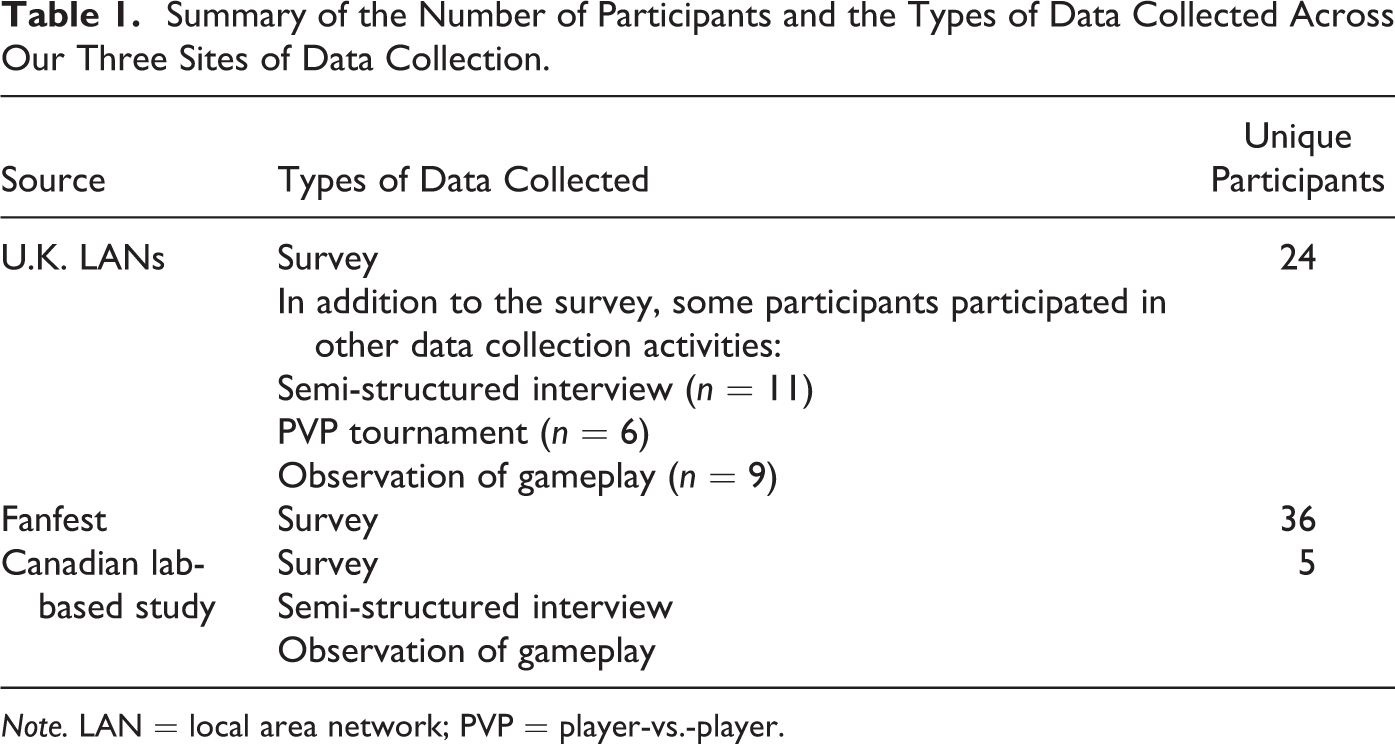
Note. LAN = local area network; PVP = player-vs.-player.
This approach enabled us to observe and inquire about the participants’ play practices through direct interaction with them. Hanging out in the same “meatspaces” as EVE players meant that we had unique insights into the everyday/everynight work of playing EVE, much of which (as Carter, Gibbs, & Harrop, 2012, point out) goes on outside of and away from the game itself. Spending time face-to-face—out of range of the computers housing valuable in-game wealth and information—also seemed to set the participants at ease, especially at the LAN series events.
Industrialists at Play
As previously stated, this article focuses specifically on EVE industrialists, a broad but often overlooked segment of the community responsible for generating the majority of capital in game through their work of extracting, safeguarding, trading, and processing raw materials from the gameworld to produce commodities (ships, equipment, etc.) for themselves and other players. Unlike most other MMOGs, in which lucrative weapons and gear can be obtained (farmed), fully formed and ready to use, from computer-controlled monsters, EVE has no such stratum of commodities. EVE players can farm materials and currency from nonplayer character (NPC) pirates, but the majority of material extracted directly from the gameworld is inert. The game’s economy is constituted through the production, trade, and destruction of spaceships, star bases, manufacturing equipment, weaponry, and so on; as a result, it is far more dependent on the work of players than other MMOGs. As LanUK30, one of the participants we met at our first Insomnia LAN party stated, EVE’s economy is “98% player driven.” According to the PVE players, we met in our study, EVE’s massive, complex player-driven economy—which features so prominently in reporting and research on EVE, typically when PVP players engage in spectacular bouts of destruction—would not exist without their work.
Theoretical Framework
In order to make sense of the play practices we observed in our interactions with EVE industrialists, we first consider how the relationship between digital play and economic production have been broached in a handful of ways by digital games and new media scholars. Work by both Castronova (2005) and Yee (2006) speak of intensive MMOG play “blurring of the boundaries” between work and leisure, with both the routinized and instrumental activities of players and the sale of virtual goods for “real” currencies regarded as instances in which MMOGs lose their presumed innocence as pure leisure activities. Such formulations rest on a misunderstanding of the historical relationship between the two; certain strains of critical theory, conversely regard leisure as fulfilling a vital role in the capitalist system, inducing consumption and conditioning laborers to be more tractable and willing (Jhally & Livant, 1986; Smythe, 1977).
Rather than positing a distinction between work and play that has only recently become eroded in MMOGs, a number of theorists have productively situated digital gameplay as a key component of postindustrial capitalism. Kline, Dyer-Witheford, and Peuter’s (2003) and Dyer-Witheford and de Peuter (2009) productively portray digital games as a new media industry on the cutting edge of globalized, neoliberal workforce transformations, including casualization, outsourcing, and general labor precarity. Kücklich (2005), Postigo (2010) and Sotamaa (2010) examine the practices of players who produce and publish modifications (mods) for games, and in doing so, provide gaming companies with free labor that extends their games’ commercial viability and longevity. In addition, Nakamura’s (2009) look at gold farming in MMOs—players in developed countries outsourcing their play to workers in the developing world—is compared to other historical and contemporary forms of “racialized labor.” Dyer-Witheford and de Peuter’s Games of Empire (2009) integrates these various activities—game production, mod making, MMOG play and gold farming—into an overarching theorization that sees digital games as the most cutting-edge instantiation of technology-fuelled capitalism and its drive to convert all areas of life into sites for economic production. Taken together, this work enables us to see the ways in which games and gameplayers are implicated in broader political economies characterized (among other things) by the widespread monetization of player activity. Under conditions in which work and play are becoming economically indistinct, holding on to a theoretical separation between the two seems untenable.
Play as Immaterial Labor
We aim to contribute to this scholarship, through an empirically driven interpretation that regards EVE industrialist play as a particular form of productive work—for example, activity that produces economic value. Rather than risk reproducing the binary between play and work by positing a “blurring” of the two we begin from the realization, articulated by Dyer-Witheford and de Peuter (2009) and Zhang and Fung (2014) that MMOG play is already a form of productive labor, in so far as publishers rely on the activities of players to generate and sustain the game’s value. To do so, we turn to theories of “immaterial labor” to ask what kinds of work EVE players carry out and what social and economic relations define this work.
Immaterial labor was initially articulated by Lazzarato (1996) and further developed by (among others), Terranova (2000), Hardt and Negri (2005), and Dyer-Witheford and de Peuter (2006, 2009). Under Lazzarato’s formulation, immaterial labor has two connotations, referring both to the emergence of nonmaterial commodities and their attendant modes of production, and to the increasing subsumption of lived experience (leisure, personal relationships) into means of generating more capital. In Multitude, Hardt and Negri expand on this articulation, defining immaterial labor as generating “immaterial products, such as knowledge, information, communication, a relationship, or an emotional response” (p. 107). They see it as occupying the same “hegemonic” position in contemporary society as industrial labor did 150 years ago, noting “just as in that phase all forms of labor and society itself had to industrialize, today labor and society have to informationalize, become intelligent, become communicative, become affective” (p. 109).
Unlike more conventional, fantasy-themed MMOGs, New Eden (the name of EVE’s universe) offers no pretenses of a pre-capitalist utopia (Dyer-Witheford & de Peuter, 2009): What makes EVE such a compelling site for study is precisely the fact that play is constituted through and constitutive of an economy based on the representation of industrial forms of virtual production. Players build, trade and operate mining tools, processing factories, transports, war machines to destroy enemy resources, and more war machines to prevent (or retaliate for) this destruction. Thus, while EVE’s fantasy-themed counterparts might offer experiences where capitalist accumulation is cloaked in “neo-medievalist” narratives and aesthetics (Dyer-Witheford & de Peuter, 2009, p. 150), New Eden presents a world in which heavy industry has literally taken over the universe—a universe which, at the same time, is animated by the postindustrial work of players.
Applied to our examination of player practices in EVE, immaterial labor enables us to begin from the recognition that labor and leisure are no longer distinct: As Hardt and Negri argue, whether “on the job” or at play, “there is no longer an outside to capital” (pp. 101–102). This enables us to get on with the business of documenting the often-overlooked activities of EVE industrialists, activities that are simultaneously pleasurable and productive, in the sense of generating economic value (for themselves or others). In this way, we aim to extend the theorization of digital play as both a mode and a site for new regimes of capital, by applying the concept of immaterial labor to EVE—a game that, as we argue, both simulates and stimulates unfettered capital.
To do so, we first explore EVE’s managerial mode of controlling in-game avatars, asking how this mode of input figures into the broader practices of EVE players for whom mining and manufacturing are their primary, if not exclusive, activities. We then examine the often fraught labor relations between industrialists and PVP players, informed by the perspective of the participants on both sides.
Management Immaterial
Although EVE gives players a deep and involved avatar customization system, the humanoid character is largely marginal; instead, the figure occupying the center of the screen is the spacecraft the player (and her avatar) is currently operating. For this reason, most of the EVE players we talked to and observed regarded their currently equipped spacecraft, not the humanoid character piloting it, as the embodiment of their agency in gamespace. In addition to this shift away from the humanoid avatar as the locus of player agency, EVE offers a distinctive mode of control which has more in common with simulation and information-management games, and other nongame activities, than it does with other MMOGs. EVE players do not directly fly their spaceships, manipulating their craft through key-triggered pitching, yawing, and firing (as in more action-oriented spaceship games such as X-Wing vs. TIE Fighter, Starfox, Descent, etc.); rather, they command their spaceships to fly to particular locations and execute particular orders. While this mode of operation bears some similarity to real-time strategy and multiplayer online battle arena games, in which players are required to carry out dozens, if not hundreds of commands a minute, EVE involves a far less intensive (and some would argue, more cerebral and less twitchy) rate of input, even in some PVP scenarios.
Conception and execution
This distinctive division of labor between conception (the work of the player) and execution (the work of the spacecraft) evokes the political economic distinction between “planning” and “doing,” regarded as a hallmark of conventional capitalist production (Mosco, 2009). EVE’s mode of input frees players’ hands, gaze and attention from the minutiae of maneuvering their spacecraft toward other—and as we discovered through fieldwork, more administrative and managerial—activities. 3 Whether playing the market, managing a corporation’s logistics and resource allocations, or optimally configuring a ship’s weapon and defense systems, the aspects of the game to which the participants in our study devoted the most time arguably involved conceptual, rather than operational expertise: more strategy, less twitch. As Yorklab252, who participated in our lab-based study stated, “one of the really interesting things about EVE is that it’s much less of a twitch game.…I mean it’s really a game about absorbing an awful lot of knowledge and understanding everything that can go on.”
EVE is by no means unique in terms of presenting players with a mode of engagement built around the navigation and manipulation of data: Games such as Drugwars have employed a similarly bureaucratic mode of control, while MMOG scholars have noted the highly instrumentalist practices of “power gamers” (Silverman & Simon, 2009; T. L. Taylor, 2006) and “theorycrafters” (Paul, 2011b) who attempt to understand and control the informational systems underlying games such as WoW and Everquest. The key difference between these practices as they emerge around other MMOGs versus the practices we observed in EVE, however, is that the former represents particular subcommunities of players who are often regarded as aberrant for engaging with the game’s mathematical substratum (T. L. Taylor, 2006). In EVE, the mathematical substratum is made readily available, and in order to participate in most of the game’s primary activities, players are compelled to engage with it. What is an extreme form of play in other MMOGs, therefore, is mundane and even inevitable in EVE. Conversely, what has conventionally been regarded as the epitome of white collar drudgery—sifting through endless charts and spreadsheets—is here regarded as central to the participants’ play, providing a ludic parallel to the conflation of work and leisure that Terranova (2000) sees as characteristic of immaterial labor and its central role in the postindustrial knowledge economy. In the following section, we further document the specific forms of work that this play involves.
Spreadsheets in space
As we have alluded to, much of the play of EVE industrialists involves monitoring and manipulating multiple information flows, including asset prices, chatter between corpmates, not to mention the out of game rumour mills and back-channeled trade intel. On MMOG-related websites and news forums, “spreadsheets in space” or “Excel Online” have long been popular terms to describe the informational demands of EVE play, particularly as applied to the activities of industrialists. While this term has generated ongoing debate in online forums (PVP players in particular seem to take offense to it; see, e.g., http://oldforums.eveonline.com/?a=topic&threadID=1547044), intensive development and use of both in-game and game-related information systems was, for many of our participants, an integral aspect of their involvement in the game.
In one example, Playces231, who participated in our lab-based portion of the study, used his ship’s travel time to a new location to alt-tab out of the game client and into an Excel spreadsheet, where he updated calculations of his corporation’s earnings. Despite being a relatively new player at the time, Playces231 had already established a means for documenting his industrialist corporation’s activities and income. According to other industrialist players we talked to, building and maintaining game-related databases and spreadsheets enabled them to carry out a range of calculational and managerial tasks. LanUK141, for instance, suggested that any degree of goal-driven play in EVE necessitates record keeping: If I decide I want to fly a new shiny ship, to be part of some community of people going out in those sorts of ships, I need a series of skills. For those skills I need money to buy the books to do whatever, so I need an income. To have an income, I've got to do a series [of missions]- It's not just a “Go fetch money,” it's a series of things. So, you have to retain where you're up to in each of your, sort of, streams of trying to produce an income.
For this player, the most straightforward way of “keeping your stuff in EVE organized,” as he put it, was to create and regularly update spreadsheets for each of his distinct activities.
In comparison, Yorklab252 used spreadsheets less as a means of record keeping, and more as a means of determining the relative value of certain items and activities: I don’t know that I do cataloging; I mean I do a lot of sort of out of game work, I do a fair amount of spreadsheet work to sort of make some calculations easier and stuff, but its not necessarily for record, its more like price checking, calculating how much a process is costing.
LanUK28, a corpmate of LanUK30 and a project manager in his “real” job, used a wide range of player-created information systems, including spreadsheets for performing calculations and documenting income streams. He also showed us the website he had built to help coordinate his corporation’s activities, with separate forum threads for new players, news updates reporting on alliances and conflicts with other corporations, and the daily and weekly tasks for each member of the corporation.
Since, as we argue here, competent industrialist play in EVE is cultivated and expressed through mastery of information and communication systems, then the artifacts players produce to record, calculate, and allocate their economic activities are not simply supplemental to or supportive of their play—their involvement in the game is, to a large extent, constituted through these practices. As we expand on subsequently, this recognition requires that we take a more expansive perspective on what it means to be involved in an MMOG, more than simply tallying the hours spent in-game. This is particularly (but not exclusively) true for EVE, in which much of the work players carry out happens when they are not logged in.
Self-sufficiency
In addition to constantly monitoring both in-game and game-related information displays, some of the industrialists we observed use “multi-boxing”: running multiple instances of the game client at once (either on one or multiple computers), with each separate client logged into a different account. These activities were most pronounced among members of the industrial corporation whom we met at Insomnia 40. In response to the travelogue question, “what do you do when your friends are not online?,” LanUK28 showed us a screenshot of two ships in the foreground, with an asteroid field in the background. His caption read, “My two characters will mine together. They have been skill trained to complement each other to make this easier.” At the same event, we observed LanUK32 operating three separate instances of the game at once, on a single computer. Over the course of 2 hr observing and occasionally chatting with him, he shifted his attention from one account to the next at regular intervals, while also engaging in strategic talk and banter with corpmates both physically present and online. He explained to us that each account was responsible for a different part of his supply chain. In this vertical integration of interplanetary industry, one account was mining the resources, the other was shuttling it to the corporation’s base, and the third was guarding the first two. LanUK32 explained that each member in their corporation had multiple accounts, with different characters trained to specialize in different parts of their industrial endeavors. This enabled his corporation to be as self-sufficient as possible, not reliant on other corporations for raw materials needed to manufacture spacecraft for sale on the market.
It is worth noting that having multiple EVE accounts is not against the game’s Terms of Service and indeed, for some in-game activities, multiple accounts is actually a necessity. Unlike WoW where a single account can have upward of 50 individual avatars spread over multiple servers, a single EVE account holds a maximum of 3 avatars. With skill development being directly linked to time spent (rather than experience earned or monsters killed), it can take weeks to train an EVE avatar to learn the necessary skills to be able to pilot a particular type of ship. This, combined with only one avatar per account can be actively learning a skill, would require the management of multiple accounts to achieve the workflow described by LanUK28 and LanUK30 previously.
Industrial play as postindustrial work
Through consideration of industrialists’ practices, the answer to our question, “what type of work are these players involved in” becomes clearer. They are adept at multi-tasking, taking full advantage of the game’s managerial mode of input to conduct market research, consult and update their corporations’ information systems, and communicate with other corpmates both through game-based and other channels. Their engagement with EVE extends well beyond time spent in-world; moreover, in a single-shard game in which the most formidable alliances span time zones and are able to carry out around-the-clock operations, many of the players we talked to suggested they were always on call. Finally, at least some of the industrialists we talked to were centrally focused on ensuring that their corporation became less reliant on external help.
“Self-reliant information analysts, available for evenings and weekend work”: This characterization of industrialist-oriented EVE play bears a striking resemblance to a typical job advertisement for work in the knowledge economy. Indeed, some of our participants explicitly identified these continuities between the work they do in EVE, and the labor required more generally to build and sustain the digital economy. LanUK141, for example, claims that his work as a software engineer and his participation in EVE draw from the same skill sets. Stating “EVE’s a game where for the most part you don’t need in-game skills,” he continues: It's actually things I bring with me from work, to EVE, that make me good at it . . . I do a lot of organizing stuff at work—I'm a software engineer—but we also do some project management stuff. So, coming into a situation and solving a complicated problem by organizing a series of people together is more-or-less what I do for a living.
Having considered the kinds of informational and communicative work industrialist players are involved with, we turn now to an exploration of the larger “relations of production” (Marx, 1981) in which these players and their activities are embedded.
Labor Relations
As we outlined previously, the economy of EVE is constituted through the work of (primarily industrialist) players; someone has to farm each nugget of ore, turn that ore into usable goods, and then offer these items up for sale. Some of our study participants made money playing the market, this was usually tangential to their main activities; for the majority of the players we encountered, the symbiotic relationship between industrialist and PVP activity—the work of making ships, and the work of buying ships and blowing them up—is the game’s central, fraught, and frequently antagonistic driving force. We examine this relationship from the perspectives of both, asking how players who are differently positioned within this antagonistic system view the role and status of their work and the work of others.
Industrialists’ perspectives
Many of the players we talked to in industrial-focused corporations viewed their work as the lifeblood of EVE’s economy. The following discussion from a “career industrialist” we interviewed, a man in his 50s who has been involved in EVE since its beta and who has only died once in his entire EVE career, encapsulates this view: The industrialists and the miners stay in the game long term, because we’re building stuff. We’re building stuff for all those people who like to blow shit up need. And as much as they like to make fun of us, oh, you know, we’re care bears, we’re industrials, we’re miners, who never do combat, if we turn off the taps, once their ships blow up they can’t replace them. So I think the true power in the universe lies in the hands of people like me and the industrialists and the miners, because without our supplies, all those PVPs and mercs are going to run out of ships within the space of a couple of months, and then have nothing to replace them with. And I guarantee you none of them have industrial or mining skills, because it’s all about pew, pew, pew.
According to this player, the work of him and his fellow industrialists is foundational to an economy in which so much capital is player generated. Clearly outlining an “us versus them” perspective, his claim that “if we turn off the taps . . . all those PVPs and mercs are going to run out of ships” evokes a fundamental class antagonism. Only here, in an economy in which everyone is a capitalist and the manual labor (extracting ore, manufacturing spacecraft) is outsourced to spacecraft, this class antagonism is recast: On one hand are those who produce wealth (industrialists) and on the other are those who consume and destroy it (PVPers). In both sets of relations, however, one group appropriates the work of the other; though EVE industrialists may be worlds apart from the Marxian proletariat, both are alienated from their labor. That this work can be both pleasurable and alienating is not so much a contradiction in contemporary critical theory—rather, the co-occurrence of exploitation and entertainment is central to our postindustrial economy (Hardt & Negri, 2005).
Also worth noting here are the perspectives of players involved in industrial activities, who are part of primarily PVP corporations and alliances. LanUK205 is a young man encountered at our last Insomnia event, who often plays EVE with his girlfriend. Both are primarily industrialist players, but are in a corporation that had recently allied with the PVP-focused Goonswarm Alliance. Here, LanUK205 describes his industrialist role within a broader PVP alliance: I'm a dirty ratter. I sit there making money, shooting stuff, and owing the corp money through taxes. So is that a- Is a ratter like a-? It's like a farmer. Ratting is an EVE term, yeah. In WoW, I'd guess I'd be a- I guess I'd be a farmer. Okay, gotcha. You do a lot of PVP? Uh, I do some PVP. I'm a lot better at killing NPCs than I am otherwise.
The term “dirty ratter,” and the player’s self-description as being better at “killing NPCs” than other players, suggests the role is subordinate to the glorified PVP activities of his more advanced and committed corpmates. And yet, as he alludes to, this player’s work directly supports those activities, in both the taxes he pays to his corporation and the money he makes on their behalf. The comparison to “farming” in WoW aligns his role to the kinds of routinized, efficient, and often disparaged play practices commonly regarded as the more rudimentary and least pleasurable means of generating in-game wealth.
PVPers’ perspectives
That PVP players occupy a more vaunted status in the EVE community’s relations of production is evident from the ways they discuss and carry out their relation to other players. Many of the PVP players we encountered referred to other players as exploitable resources. LanUK142, also member of a corporation in the Goonswarm Alliance, described to us the techniques he uses to prey upon industrialist players, using low-cost ships to fly into high-security space (patrolled by near invincible, artificial intelligence-controlled spacecraft which attack players who fire upon other players) and destroy “squishy” mining frigates. He explained that in such a suicidal strategy, the money earned from obliterating industrialists’ spacecraft outweighed the cost of the lost ship. When asked why he and his corpmates targeted industrialists, he replied “for us, it’s always Hulkageddon”—referencing a recurrent event in EVE in which PVP players aggressively harass and disrupt industrialist players, motivated as much out of a disdain for their play practices as a concern with profit.
This orientation toward other players as resources extended not just to industrialists, but to players of other MMOGs. As we learned, a number of alliances (Goonswarm and Dreddit in particular) recruit players from non-EVE websites, offering passage to lucrative nullsec areas in exchange for flying a “rifter” (essentially being used as cannon fodder in confrontations with other alliances). As one female PVP player recounts: But it . . . . It feels like they’re being used, almost, like they’re being used as cannon fodder . . . . So yeah, it’s fine that you brought in 20 newbies who might help you do this big fleet fight, but what are they really learning out there? . . . you know, are they learning how to actually fight effectively?
As with the forms of alienated labor in support of PVP corporations described by LanUK205, PVP players position themselves at the top of the food chain, the clear winners in EVE’s central class antagonism.
Discussion
Our insights into the work of the industrialists who help produce EVE’s economy, and their fraught relationship to other elements of the EVE player population, highlight some of the hierarchical relations of production that characterize EVE play. As we have shown, these hierarchies encompass the managerial mode of input that separates players from their avatars. It includes as well the work of industrialists and “ratters” transporting, trading and processing raw materials extracted from New Eden’s planets and computer-controlled enemies, work which is facilitated by highly organized and specialized data management practices, and often with multiple simultaneous accounts. Industrialists themselves, not to mention new players, are viewed as resources by PVP-focused corporations and alliances. At each step of the way, the work of one entity or group becomes a commodity for another party.
Pursuing these hierarchical relations further, we can trace outward from the game and look at some of the broader networks in which EVE is situated, and in which the work of players—PVP and industrialists alike—is capitalized on by CCP, the game’s developer. Like many other virtual worlds, EVE’s End User License Agreement specifies that all game content is the sole property of CCP: Your Account, and all attributes of your Account, including all corporations, actions, groups, titles and characters, and all objects, currency and items acquired, developed or delivered by or to characters as a result of play through your Accounts, are the sole and exclusive property of CCP, including any and all copyrights and intellectual property rights in or to any and all of the same, all of which are hereby expressly reserved. (CCP Games, 2012)
Such terms create drastic legal, cultural and economic inequities in which players/users are denied any legitimate claim to the fruits of their own, often extensive, labor (Jenkins, 2006; T. L. Taylor, 2006). This imbalance is deeply ironic with regard to EVE, a game celebrating unfettered capitalism and the pleasures and powers of/in accumulation. EVE players craft complex information systems in order to optimize their production of economic value, coordinate activities day and night to ensure the protection and extension of that value, and fight pitched battles for territory with hundreds of thousands of real dollars at stake, and yet ultimately, technically, they own nothing. Embedded in this broader set of relations, we can see the ways in which EVE industrialists’ work might be doubly alienated: appropriated both by other corporations (often violently) toward the conspicuous consumption and destruction of ISK (New Eden’s currency), and by CCP toward the cultivation of capital through more subscription fees and, crucially, through intellectual property enhanced by the immaterial labor of all players.
Experimentation
It is important to note here one further way in which this hierarchy plays out. The rules and mechanics governing MMOGs are not static, but are constantly re-shaped by developers in response to (and anticipation of) players’ feedback and behavior (T. L. Taylor, 2006). As these mechanics (as well as the end-user license agreement) constitutes the “laws” governing player behavior (Lessig, 2006), MMOGs may be regarded as sites for experimentation in digitally mediated governance—or, as Dyer-Witheford and de Peuter (2009) and Kücklich (2009) describe, as exercises in administering new, virtual regimes of social control, the aims of which is the further extension of capital. Scholars working in this vein note that this governance is negotiated through continual dialogue between players and developers, carried out over multiple channels, including forum chatter, social media, YouTube videos, and in-world game managers (see Kücklich, 2009; T. L. Taylor, 2006; Zhang & Fung, 2014). EVE is no different in this regard; CCP prides itself on its attentive, responsive, and tight-knit relationship with its playerbase. Indeed, its annual EVE FanFest in Reyikjavik is expressly run as a means to not only announce forthcoming additions to the game but also celebrating the game and its player population.
A full account of CCP’s relationship with its player population is beyond the scope of this article; but what we draw attention to here is the ways in which CCP routinely de-emphasizes and disregards EVE PVE players and industrialists in exercising its administration of New Eden. While “The Battle of B-R5RB,” described at the outset of this article, captured the attention of mainstream press, ongoing disruptions to the in-game tradehub “Jita” serves as a clear illustration of how MMOG’s sandbox design and resulting emergent gameplay practices indeed allows for an unprecedented space for creativity and experimentation, but does so on the backs of (and at the expense of) industrialists. The disruptions to trade in Jita began as a means of protesting the expense of vanity items from the CCP store (Edwards, 2011) but have morphed into an ongoing in-game event (see http://www.isjitaburning.com) sharing similarities with the Hulkageddon described by our participants mentioned previously. Through these disruptions to Jita, not only were in-game trade activities interrupted, but enough noise was created on forums that CCP had no choice but to take notice. What matters here is how CCP reacted. In an official blog post describing the impact these disruptions had on the server, there is no mention of how each time Jita burns, players whose central aim in EVE is the production and trade of goods are effectively locked out their game. Instead, the blog post author celebrates this emergent behavior, writing “as developers we watched in awe at another amazing thing our players brought to the universe we created” (CCP Explorer, 2012). To regard EVE as a site of experimentation in virtual governance is to note the ways that industrialists are denied the degree of agency afforded to the more vocal, visible, “EVE-ier” PVP players—those who are most responsible, in CCP’s attempts to set EVE apart as edgier, more challenging, more hardcore than other MMOGs, for “making the game what it is.”
Conclusion
By way of a conclusion, we offer two implications for our analysis of the player labor required to sustain EVE. The first is (primarily) methodological, the second theoretical.
“Multi-sited” Play
Increasing efforts on the part of games companies to automatically document the in-game activities of players has enabled quantitative researchers to amass and analyze large quantities of in-game data, often without players’ explicit consent (Chee, Taylor, & de Castell, 2012). As we have shown, however, our study participants’ involvement in EVE does not stop once they log off: a great portion of their involvement is conducted in spaces, and through practices, that are outside of New Eden and therefore, from the point of view of server-side logs, invisible. Furthermore, what is visible outside of the game client remains overly focused on the PVP elements of gameplay, obscuring the work and play practices of the community of PVE players who form the economic backbone of this MMOG.
This insight extends beyond a consideration of EVE, and other games that require similar degrees of “backchannel” work from players. The ongoing production of mods, machinima, and associated “paratexts” (Consalvo, 2003) among player communities, as well as the rise and increasing ubiquity of spectatorship (particularly via platforms such as uStream and Twitch.tv (T. L. Taylor, 2012) means that time spent in-game is only one among many avenues through which we participate in game cultures (and economies). Accessing and understanding the breadth of players’ involvement in digital gaming communities requires methodologies capable of following them across their multiple game-related practices. Through our own opportunistic study of EVE, we have begun to sketch out what such a “multi-sited” (Burrell, 2009) approach to gameplay might look like. Building on a vibrant and growing ethnographic tradition in game studies, our sense is that ethnographic research might be best suited to carry out the task of mapping players’ everyday/everynight gaming-related practices. As our own analysis suggests, this is not simply a matter of deploying methods that move us past the limiting divides between off-line/online, real/virtual; this is also, crucially, about our understandings of how players’ involvement in digital gaming communities hooks into broader circulations of economic power.
Intergalactic Governance
We have presented EVE as a site in which players actively co-construct a shared reality centered on unfettered capitalism, a gameworld in which industrial modes of intergalactic production are supported by players’ postindustrialist forms of work. The practices we examined here—particularly, that of the industrialists, miners and “ratters” whose activities have thus far gone largely unexplored in scholarly accounts of EVE—are not only “like” contemporary forms of immaterial labor, they are one such form, insofar as players’ informational and communicative work directly supports the accumulation of wealth, on behalf of both other players, corporations, CCP, and the contemporary digital economy.
Writing on the Chinese digital economy’s relationship to the “secondary industry” of gold farming, Zhang and Fung (2014) describe MMOGs as sites for the cultivation (and economic deployment) of “neo-liberal subjectivities” (p. 42) that prioritize entrepreneurialism, self-sufficiency, a willingness to work anytime, anywhere, and instrumentalized relations toward institutions and other human beings. Following the line of argument introduced by Hardt and Negri (2005), and applied to MMOG communities by Dyer-Witheford and de Peuter (2009) and more recently by Zhang and Fung (2014), it may be that EVE is not only a site for the “capture” of free labor (Terranova, 2000), as might be said of MMOGs more generally. What sets EVE apart is the extent to which its players—including industrialists, those at the bottom of New Eden’s food chain—buy into an economic order in which precariousness, economic catastrophe, and stark income disparity are regarded as inevitable outcomes, as that which you sign up for when you play. Unlike the MMOGs analyzed by Dyer-Witheford and de Peuter (2009), where the pursuit of wealth is both partially offset and filtered through a “neo-medievalist” setting, EVE is brazen in its enactment of a gameworld in which those involved play at, play with—and are often played by—unfettered capitalism.
Returning to “The Battle of B-R5RB” and “Burn Jita,” it may be that such stories resonate in a broader public imagination because they sound so similar to the narratives of financial destruction that accompanied the 2007 economic collapse and ongoing “recovery.” EVE, as one journalist claims, provides a “darkly literal twist” on economic devastation (Hillis, 2007). What gets valorized in the more well-circulated stories about EVE is the pleasure and thrill associated with the destruction of (other people’s) wealth; it is as if New Eden provides a space in which economic catastrophes are not complicated by considerations of livelihoods destroyed and lives ruined, since it’s all a game; high-stakes capitalism without the guilt. We should not think of EVE as an anomaly in this regard, however, 4 but instead, see it as coextensive with other contemporary manifestations of Empire (Hardt & Negri, 2005) that traffic in virtual forms of capital accumulation often at the expense of real investments, livelihoods, homes, and lives. We may therefore find less similarities between EVE and conventional MMOGs than we might by comparing the game to other arenas in which capital takes increasingly virtual and unregulated forms—the intensified (and increasingly precarious) digitization of stock markets (Lewis, 2014) the use of abstract models to explain “real life” economics in university classrooms, and the practices of a financial elite that shows nothing but callousness and disregard for those most devastated by its practices. EVE may be “just a game,” but it is a game that, like those other precarious regimes of contemporary capital, profits from the economic ruin of others—and never pretends to be fair. In this regard, we might consider EVE as among the more honest portrayals of postrecession capital: a world in which our economic institutions are directed by people, practices, and ideologies for whom this is all just a game.
Footnotes
Declaration of Conflicting Interests
The author(s) declared no potential conflicts of interest with respect to the research, authorship, and/or publication of this article.
Funding
The author(s) disclosed receipt of the following financial support for the research, authorship, and/or publication of this article: This research was supported by the Air Force Research Laboratory.