







Abstract
This article examines social interactions in a Danish online social-casual games community using the Danish social constructs of Hygge and Janteloven. Hygge relates to notions of home, family, safety, and security in small, sheltered surroundings, while Janteloven is a subversive attempt to codify the unwritten rules that enforce equality (or mediocrity) in Scandinavian societies. Off-line, Hygge exists in physical environments where a safe, social atmosphere can be created, similar to sociability in physical third places. In the online setting, we identify the social construction of shared interpersonal spaces where Hygge is achieved and regulated through perceived fairness with respect to constitutive and regulative rules. A sense of belonging moderates players’ behaviors toward others and even their achievements in the game to maintain harmony. The article offers a unique examination of social constructs online, contributing to the knowledge of Danish culture and of how local cultures shape online behaviors.
Introduction
As video game development costs rise and rivals compete for the same customers, developers have found success in cheaper and less sophisticated, casual games (Wesley & Barczak, 2010). These games are increasing in popularity and profitability partly because they have extended the reach of video games beyond traditional audience. Casual games are generally relatively simple (Ross & Tomlinson, 2010) and easily understood by users who do not normally play video games (Katzourin, Ignatoff, Quirk, LaViola, & Chadwicke, 2006). In fact, their popularity is helped by the simplicity that makes them seem normal to nontraditional gamers (Juul, 2009). Video games were traditionally targeted at young, male, games console owners (Verganti, 2009). Casual games, on the other hand, are played on PCs or increasingly on mobile devices and often appeal to new user groups. For example, older and female players have been shown to value this type of gaming (De Schutter, 2011), making it more gender balanced than many other types. The simplicity of these games offers opportunities for sociability and community building. In this respect, online games are considered to resemble off-line third places such as cafés, bars, and beauty parlors where people meet to socialize (Ducheneaut, Moore, & Nickell, 2007).
Building on the increasing access to fast Internet connections, casual games have developed from individual pursuits such as Solitaire in the early 1990s to real-time, multiplayer, social-casual games. These fill the place of traditional party games in the normal sphere of everyday activities (Juul, 2009). The players of social-casual games can therefore be seen as socially and culturally representative of the population from which they come (Kallio, Mäyrä, & Kaipainen, 2011). This makes social-casual games an ideal context in which to study whether and how social constructs influence online behavior, in a way that other video games cannot match.
In this article, we examine the Danish social constructs of Hygge and The Law of Jante to explain behaviors exhibited by users of a social-casual games site. For the purpose of the study, we define social-casual games as simple or traditional games, with wide appeal across genders and age-groups, which are offered in a real-time, multiplayer format on the Internet. Games have long been used by sociologists to understand and explain cultures (e.g., Caillois, 1961; Searle, 1969) so this study continues a long tradition of integrating games and culture in ethnographic study. A core assumption that is tested by this study is that off-line cultural concepts do in fact influence online behaviors.
The people of Denmark (closely followed by their Scandinavian neighbors) are regarded by Anglophone researchers as having an egalitarian society free of class distinctions and in which people are more trusting and ultimately happier than in any other nation (Levisen, 2012). Central to these traits of Danish society are the (largely) positive concept of Hygge and the controlling influence described by Sandemose (1994) as Janteloven (The Law of Jante). Although it comes from a (semi) fictional novel, Janteloven is widely seen as codifying the unwritten rules of Scandinavian society. It enforces egalitarianism by ensuring that attention-seeking or individualistic behavior result in ridicule or alienation. By contrast, the concept of Hygge, which relates to notions of home, family, safety, and security in small, sheltered surroundings, offers a more positive and recognizably Scandinavian environment. Hygge is a state of being that Danes seem to devote their lives to attaining, which visitors to Denmark never tire of hearing about (Schwartz, 1989) and whose achievement can be expected as an implicit objective in Danish leisure pursuits. A number of recently published anthropological and sociological works focus fully or partly on understanding the Danish concept of Hygge (Jenkins, 2011; Levisen, 2012; Linnet, 2011).
The contributions of this article are twofold. First, we believe the present study to be the first one which examines Hygge and Janteloven in an online context. As such, it contributes to the understanding of Danish and Scandinavian culture as well as being of value to researchers and managers of online casual games communities. Second, this study is one of a small number that actively connects the online and off-line worlds (Eklund, 2015). Researchers have argued that online behaviors cannot be understood until we recognize that they are not always new even if they utilize new communication media (Steinkuehler & Williams, 2006).
The motivation for this study was the inadequacy of player classifications (Bartle, 2004; Yee, 2006) to explain conflicts between players in the games community under investigation. Such categorizations assume players to be motivated either by a desire for achievement or by a desire for social interactions. As such they fail to explain why players can be pleasant in one game and then extremely unpleasant in another. We argue that local culture offers a more meaningful lens to understand online behaviors. This is demonstrated by examining the Danish social constructs of Hygge and Janteloven that are implicitly understood by, and which influence the behavior of, Danish social-casual games players. In the following sections, we explain these concepts and their positive and negative implications. Next, we examine more general concepts that have previously been studied in online games contexts, relating fairness, rules, and sociability to the localized concepts to develop a theoretical basis for studying player interactions. An interpretive approach is used to examine the community, leading to a discussion of the findings. We argue that players construct a shared, socially constructed, interpersonal space in which they aim to achieve Hygge, evidenced by their attempts at fairness in a competitive context. However, those outside this space, with whom the players do not share belongingness, are not subject to the same rules of fairness.
Literature
Hygge
The concept of Hygge, regularly but inadequately translated as “cosiness,” is so ubiquitous in Danish society as to be invoked regularly without cause for reflection upon its meaning. As Linnet (2011) finds in his study of the concept, Danes regularly use the word to describe their interactions and relations with friends or even as a description of their satisfactory family lives. For example a common greeting is tak for sidst, det var Hyggeligt—meaning thank-you for the last time we met, in which Hygge was shared. This last time may have been a meal or some other form of social interaction but most likely took place in the home of one of the protagonists. The interactions were probably polite, relaxed, and humorous, perhaps involving lighthearted teasing, but always being inclusive. The surroundings would likely have been comfortable and pleasant but not too ostentatious. There would most likely be some food and drink and there would almost certainly have been candles present (Levisen, 2012). Jenkins (2011) describes Hygge as: “…a desirable social atmosphere or feeling, characterized by small-scale settings, informality, relaxed intimacy and inter-personal warmth, and is related to the notion of ‘home.’” (Jenkins, 2011, p. xiv)
Hansen (1980) similarly describes a pleasant, relaxed state of mind, where one can enjoy the “small pleasures” of the situation. She also emphasizes the feeling of security that can be seen as a prerequisite for the state of Hygge. Levisen’s (2012) semantic examination of Hygge suggests safety, warmth, and small, protected settings to be essential. This is due to the word’s Old Norse roots, related to fire, whose heat and light offer protection from the dangers outside the home. Safety and well-being are not only closely intertwined but along with Hygge they represent the “three graces of Danish culture and socialization” (Schwartz, 1985, p. 123).
Such concepts are implicitly understood, and their meanings consequently take up little of the average Dane’s attention. And while attention is drawn to the positive aspects, a different view is often seen by foreign observers. “Faces look towards a common gård (yard), or a table with candles and bottles on it. Hygge always has its backs turned on the others. Hygge is for the members, not the strangers. (Schwartz, 1985, p. 124)”
The cozy atmosphere created within the home is contrasted with the view of those outside the sphere of Hygge. And the metaphor extends to the national context in which outsiders are excluded. Schwartz goes on to talk specifically of two groups—Greenlanders and guest workers—who represented the only “strangers” in an otherwise homogenous Danish society. While they may consider themselves to be Danish, others do not and this makes them unique for Schwartz because they see the effects of exclusion from Hygge. More recently, the homogeneity of Danishness has been threatened by immigration in the nineties and beyond. Østergård (1992), for example, describes the challenges represented by the influx of a relatively small but significantly different group of immigrants to Denmark. While racism was relatively unheard of in the past years, he argues that perhaps it was simply not manifested until the presence of an object for racism. A similar view was encountered by Black, American Jazz musicians who flocked to Copenhagen in the 1960s to practice their art free of the racism prevalent in the United States. The documentary film Blues for Montmartre (Thomsen, 2011) suggests that those who stayed encountered no racism from Danes until an increase in immigration gave Danes a tangible object for it. The pursuit of Hygge represents the Danes’ attempt to create a harmonious and egalitarian state for their small community. Yet the negative effects are visible to those who exhibit signs of being different. Paradoxically, in a nation in which the free thinking instilled by Nikolaj Grundtvig is manifested in the undirected learning of Free Schools (Østergård, 1992), being different is a challenge. Nowhere is this more clearly documented than in the Laws of Jante.
The Law of Jante
Axel Sandemose’s novel “A fugitive crosses his tracks” (1994, first Norwegian edition 1936, first Danish edition 1938), describes a fictional, story, thought to be based on his own experiences growing up in a small Danish town. The main character holds the repressive nature of the society during his upbringing in the fictional town of Jante responsible for becoming a criminal and the book’s eponymous fugitive. The unwritten rules of this society are presented in this book as a set of commandments, labeled The Laws of Jante (Janteloven). While some of these rules may be morally commendable, Janteloven offers a subversive critique of behaviors that most would not wish to be associated with (Eggen, 1981). The 10 rules point out that you are not better or smarter than us and should therefore not seek to laugh at us. While this may be construed as a positive attempt to instill equality, the other rules caution that you are not anything special and should not expect us to care about you. In effect, Janteloven merely hints at the traumatic underside of the egalitarian Scandinavian social environment.
Although advising caution in generalizing about cultures, Avant and Knutsen (1993) argue that Janteloven does convey widely shared values and offers researchers a useful tool for understanding Scandinavian culture. They argue that equality in these cultures is at least partly due to jealousy, the fear of somebody getting a bigger slice of the welfare cake, rather than a purely magnanimous spirit. The dark side is the repression of creative and inventive talents, who are discouraged from standing out, as evidenced by the collective mind-set instilled from an early age through children’s stories. Those who do break free of the “tyranny” of Janteloven are often admired by others, but their failures become an opportunity for a gleeful “I told you so attitude” (Avant & Knutsen, 1993, p. 456). The negative connotations of Janteloven merge with the examined problems caused by Hygge. Namely, both concepts seek to create balance and harmony for those on the inside, but in so doing, they alienate those who do not conform. Janteloven has been examined as a driver of covert racism toward immigrants in Sweden (Turausky, 2011). In short, the concepts of Hygge and Janteloven suggest an attempt at fairness and equality, on the condition of conformity, with the alternative being covert or sometimes overt negativity to outsiders, or those who do not conform. These concepts can be seen to set the rules for acceptable social behavior in Danish society.
Rules and Fairness
In the context of games and social-casual games players, there are both game-related and often unwritten social rules that determine what is acceptable and give meaning to the activities that take place. This has been noted particularly in studies of online games communities that resemble off-line third places (Steinkuehler & Williams, 2006). Off-line third places are normally unpretentious environments such as cafés and community centers, to which people are drawn because of the presence of like-minded regular visitors, with whom they engage in conversation and social interactions (Oldenburg, 1999). In many ways, the homely and simple atmosphere, free of subversive advertising, which Oldenburg describes, comes close to the ideal of the Hyggelig environment. And as Ducheneaut, Moore, and Nickell (2007) demonstrate, such third places can also be identified in online environments as a meeting point for players and a place to form communities.
Caillois’ (1961) writing includes one of the most influential attempts to define and classify games and play. Caillois distinguished between the two in a spectrum from Paidia (unstructured and spontaneous play) to Ludus (controlled and rule limited games). He proposed four categories, with the Paidiaic sphere represented by Mimicry, involving escapist fantasies, and Ilinx, involving a deliberate attempt to alter one’s own perceptions of reality. On the Ludic side of the spectrum, Alea, named after the Latin game of dice, represents chance-based games over which the player’s ability has little no influence over a result that is determined by luck. In contrast, Agôn describes competitive games (such as most team sports) in which equality of chance is artificially created so that some aspect of the players’ abilities allows them to prove their superiority. Any suggestion that chance has entered the equation is likely to generate resentment, since the objective of this type of game is to prove skill. Meanwhile chance-based games are only considered fair if the players perceive an equal chance of positive or negative outcomes is distributed evenly across all participants (Brun, Safaei, & Boustead, 2006).
The inherent fairness of a game can be interpreted as the balance between skill and chance (Schell, 2008). While fairness is open to interpretation, rules have the benefit of codifying the definitive interpretation. Players willingly accept rules that prohibit more efficient in favor of less efficient means to make the game possible (Suits, 2005) and out of a sense of fairness to the spirit of the game. All game-like activities are grounded on rules. Even Calvinball 1 , a subversive attempt to avoid the restrictions of organized sports, results in the restrictions of a constantly changing rule set. Rules, where they are clearly defined, help to liberate players from conflict by reducing the choices and available actions (Lastowka, 2009). Parallels can be drawn with Janteloven, which deliberately restricts individuals’ utilization of their abilities to minimize the display of difference, with the goal of maintaining equality and avoiding conflict.
There are many possible motivations for engaging in games, related to players’ expected outcomes. When these motivations conflict, antisocial behaviors such as bullying and harassment are an unpleasant phenomenon that the online and off-line worlds share. Such behaviors are often referred to as griefing (Foo and Koivisto, 2004), as they entail one individual deriving pleasure from intentionally causing another grief. In off-line contexts such as schools and workplaces, bullying is typically explained by organizational factors (Chesney, Coyne, Logan, & Madden, 2009). Examples are when an organization’s lack of clear procedures are perceived as tolerance and where females are a minority or carry out jobs that are traditionally performed by men.
Many scholars and indeed gamers consider griefing to be a form of cheating (Chesney et al., 2009). This can be understood as a breach of the rules, which may mean Constitutive or Regulative rules (Ducheneaut et al., 2007; Johansson, 2013). In Searle’s (1969) distinction, Constitutive rules relate to what is possible in the game—for example, the scoring system that determines winners. Regulative rules are the often unwritten ones that describe what is allowed, for example, appropriate interactions between players. In electronic games and increasingly in professional sports, the use of technology allows constitutive rules to be automatically managed (Eklund, 2015). The regulative rules, on the other hand, are more problematic because they are less clearly definable and enforceable. While social rules play an important part in regulating off-line behavior, the extent to which they influence online interactions is less clear. To this end, we examine social interactions using a cultural lens that allows consideration of the cultural influences.
Community and belongingness
Players tend to adapt their behavior based on the current situation, and archetypal patterns of behavior do not permanently describe an individual’s goals (Bartle, 2004; Yee, 2006). This adaptation may also be a product of a player’s self-modification of their level of altruistic behavior according to the social context (e.g., Rabin, 1993). That is, they are likely to help others who maintain the social norms of the group by acting fairly, but are less inclined to help those who behave contrary to norms, or unfairly. Studies of games have revealed that some players may be inclined to punish other players, even at personal cost (Hermann et al., 2008). This effect has been found to vary across different cultures, emphasizing the importance that national and social context plays in understanding behavior in any game. In an online social-casual game, the players are part of a community, including friends and strangers, with whom they interact in often very different ways. Understanding their behavior in this context means considering the nature of online communities.
Online communities are classified as purposeful, multi-minded systems based on the principles of openness, purposefulness, multidimensionality, emergent property, and counterintuitive behavior (Gharajedagh, 2011). That is to say that an online community consists of multiple people exhibiting shared behaviors, some of which can appear counterintuitive when observed. Early research on this topic (McMillan & Chavis, 1986) proposed five general elements necessary for establishing a sense of community, namely, membership, influence, integration, and fulfillment of needs and shared emotional connection. A community is generally grounded in consciousness of kind or a feeling of belonging to a group of similar people and grows through the development of shared traditions or behaviors (Muniz & O’Guinn, 2001). That is, if a person feels a sense of belonging with a community, they feel a responsibility to maintain it and help it to grow, for example, offering social support (Wellman & Gulia, 1999) or seeking to prevent its members from leaving. And their feeling of belonging to the community is built upon and enhanced by their continued involvement in shared activities. Those who are not members of the community are likely to be treated with some level of negativity. For example, Muniz and O’Guinn (2001) found that Saab owners who felt a sense of community would wave at, or stop to help, fellow Saab drivers, while they looked down on owners of Volvos, as members of a rival community. Indeed the concept of community demands that some people are excluded so that the boundaries are defined by what the community is not.
A social-casual games community is a stew of players with diverse backgrounds, different personality types, and gaming profiles, all mediated by a software platform that may direct some aspects of the interaction while imposing no restrictions on others. The mechanisms that explain the change in behavior are complex and multidimensional. In this article, however, we focus on the social construct of Hygge and the associated concept of Janteloven in an attempt to understand how different behaviors may be exhibited by individuals in different social situations. As identified previously, those who are within the safety established by the sphere of Hygge may be treated very differently than those who fall outside this protective social space. On this basis, it can be reasonable for an individual to adapt their behavior, adopting apparently contrary means of interaction, according to whether they interact with someone inside or outside the sphere of Hygge. We argue that players are more inclined to fairness when they share a sense of belongingness with their opponent, adding an extra cultural dimension to considerations of player motivation.
Research Method
While people can be seen as individuals, they also unwittingly partake in abstract notions of culture and tradition which Jackson (2008) argues can be examined through intersubjectivity. This means that culture is viewed as socially constructed and to be represented through people and their social interactions as opposed to individual psychology. Pearce (2009) argues for an ethnographic approach to the study of intersubjectivity to investigate online communities, including, but not restricted to, participant observation. And more specifically, Kozinets (2002) offers netnography as an approach to the study of online communities, as opposed to communities online. Netnography is intended to bring the traditional ethnographic approach of participant observation into the study of online behavior. It is valuable because of its emphasis on experiencing online interaction in its natural context and allows the researcher to come close to the actual experience of the research participant. Such characteristics are important for the present study, which has the twin goals of studying an online community—the online social-casual games players—and viewing their behavior as representative of a wider culture—Danes seeking Hygge—in an online context. Research has suggested both similarities and differences in the way that off-line culture is enacted in an online environment (McDougal, 1999). Therefore, this study focuses on the underlying traits of culture and examines how these traits influence interactions in an online context.
Setting
The context of the study is a social-casual games community, hosted by a Danish software company. Community members are offered a range of classic card, board, and dice games, which were chosen by the game developers for their simplicity and for invoking Hygge due to their popularity as family games. As shown in Figures 1 and 2, the games are designed around a metaphor involving game rooms and tables, with both room- and table-level chat facilities to allow communication during games. The visuals recall a simple, relaxed environment in which people can play with friends and talk to others. This is an environment in which Hygge may take place but also similar to the third places in which people typically socialize (Steinkuehler & Williams, 2006).
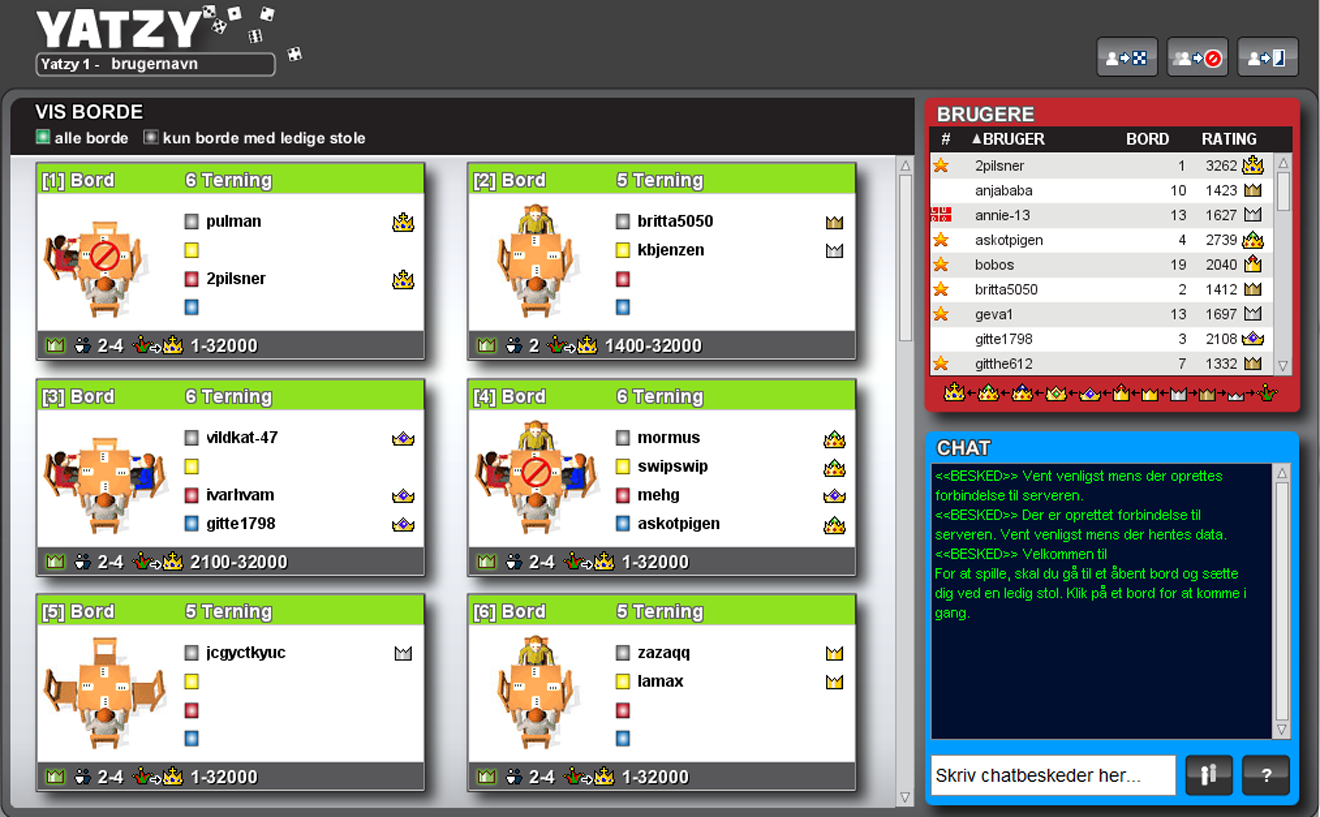
A Yatzy game room showing tables, players, and chat.
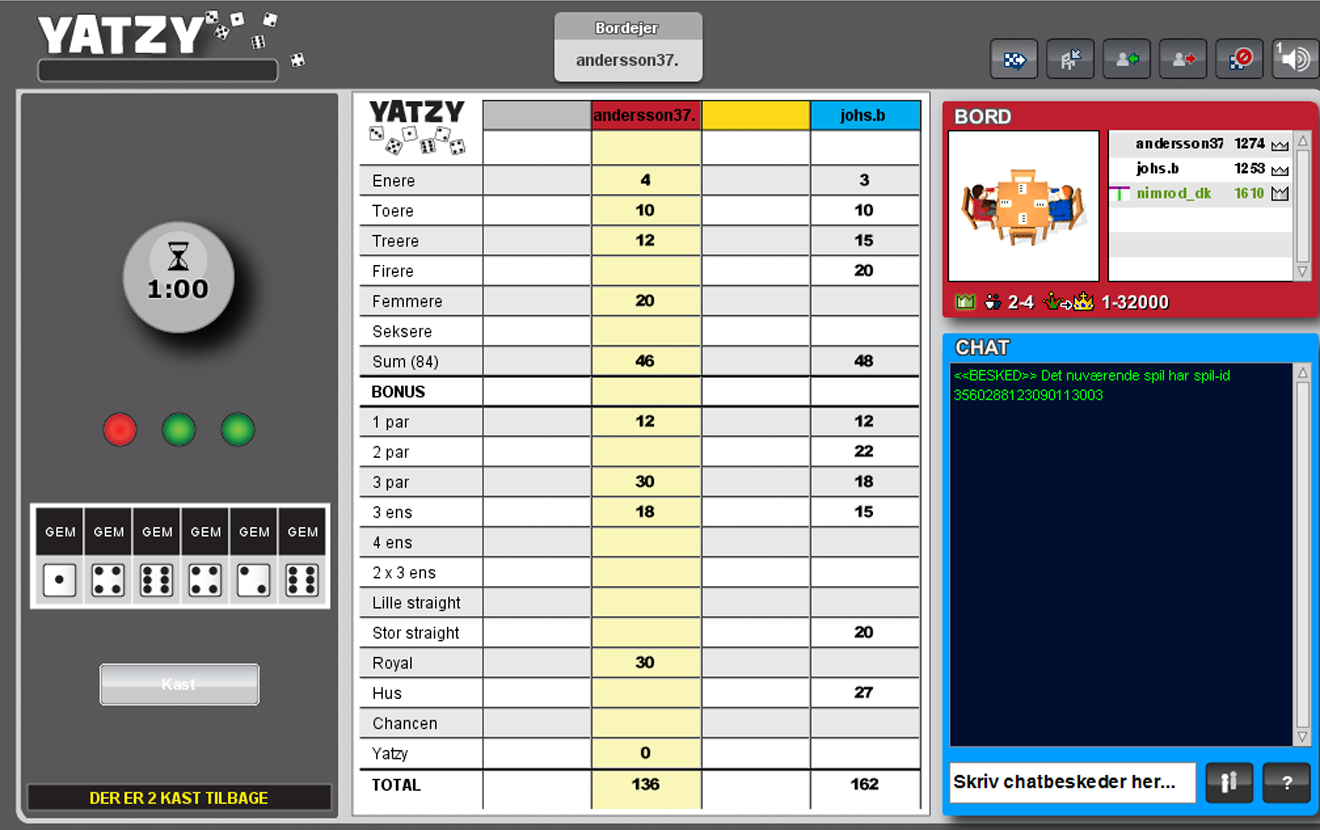
A Yatzy game table showing players, watchers, and chat.
The community was more than 10 years old at the commencement of the study, with many of its members having been present since its early days. This longevity ensured that a well-established community was in place so that social interactions could be observed. The site is appropriate for the study of Hygge because games like whist and yatzy are simple, traditional games that invite Hygge. Although these games were offered on other, similar sites, this one was unique in its lack of computer controlled players, requiring that human players must have some interaction. Ducheneaut et al. (2007) used a similar justification for selecting Star Wars Galaxies that demands interaction between players as a context for studying sociability. As an ethical requirement of the study, the site is not identified by name and logos have been removed from the images. Similarly, the screen names of individual players have been removed to ensure anonymity.
Based on available statistics and attendance at face-to-face meetings of community members, the average age of players is around 40, more than half of whom are female. And these players built strong social bonds over many years, through their pursuit of Hygge. This is reflected in the use of online user names by the players when meeting at a social event in which they play games on physical boards as well as participating in cake baking competitions and other social activities. For many of these users, the value of the social bonds went beyond the simple pleasures of playing games. They gave accounts of the community helping to combat loneliness and give purpose to their lives. Yet while most players described the community’s atmosphere of Hygge, they reported conflicts with other users as disruptive and damaging to their experience. Previous attempts to explain these conflicts by classifying players as social or achievement oriented (Bartle, 2004) failed to explain such conflicts, leading to an attempt at a deeper understanding of what Hygge really means in this context.
Games
We selected two of the available games as the context for this study, Yatzy, a dice game, and Whist, a bidding card game. These are the community’s most popular games, based on numbers of daily users. This means the public chat in these games provides more opportunities to observe interactions. And the differing forms of competition offer a chance to view how the game-related aspects of luck and chance affect these interactions. Yatzy is a dice game where the objective is to score the most points by rolling a fixed number of dice to make certain combinations. It is primarily a game of chance, although players with a given degree of statistical skill can increase their chance of winning by considering probabilities. Players cannot affect their opponent’s game, so communication between players is not required. Whist is a well-known, trick-taking card game, in this setting by four players. The players depend on and compete with their teammates and generally do not select which player they will be teamed with. This creates the potential for conflict to emerge, if the teammates do not cooperate effectively or have different levels of skill.
Analysis
Two researchers participated in the study, offering contrasting backgrounds and interpretive approaches that help to validate the findings. One is Danish and therefore both a native speaker and embedded in the cultural context. This researcher was also employed by the company hosting the community and had several years of experience of interaction with members of the community. The other researcher, being relatively new to the community and to the language, offered an outsider’s perspective. The disadvantages of distance from the community were counterbalanced by an ability to view observed behaviors as manifestations of theoretical constructs and a more critical viewpoint. Both researchers had played video games, including social and/or casual games since childhood as well as engaging in a professional capacity. Both researchers played as participant observers, noting their experience when interacting with community members. In addition, two interviews were conducted remotely, using screen sharing to allow players to walkthrough a typical game instance while answering questions about their perspective on the player community. This enabled them to feel relaxed in their own home and at their own computer while answering research questions. Participants were recruited while attending off-line meetings of community members, during which the researchers were also able to talk to players. As these were time and labor intensive, for both researcher and participant, only a small number of players agreed to be interviewed. The interviews and the off-line meetings were valuable in giving us a background for interpreting comments posted by users online.
The second phase of the research involved analysis of conversations by players through the in-game public chat system. While playing, individuals can exchange messages that are publicly visible and are recorded for a short time to facilitate support and enable investigation of inappropriate behavior, prior to deletion. The chat logs for Whist and Yatzy were examined, searching for instances of the word “Hygge” and allowing the context of its usage to be explored in relation to the theoretical framework arising from the literature. By jointly translating and discussing the comments, the interpretations of a native speaker, more familiar with the nuances of the language, were combined with those of a nonnative speaker, emphasizing the theoretical implications. Validity was achieved by the necessity for both to agree on the plausibility of analytical conclusions reached. As Pearce (2009) argues, the clear articulation of the interpretive framework used is essential for studies of online communities. We believe that our identified constructs of Hygge and Janteloven offer an ideal lens for the interpretation of the observed behaviors.
Kozinets (2002) offers strict guidelines on the ethical approach to netnography, insisting that the presence of the researcher be revealed and the observed individuals be fully informed. Yet he acknowledges that some instances demand more covert methods. And Langer and Beckman (2005) argue that covert methods are required where the subject is sensitive or where the people observed may not give reliable information. For example, they had trouble identifying participants to give reliable information on their experience of cosmetic surgery, due to the moral and social implications. Or while studying racist behavior online, Campbell (2006) was advised to just “lurk around” rather than attempt to interview a racist. In the early part of our research, our identity and the purpose of our research—to understand and seek to improve the player experience—were made clear. The decision to covertly study the chat logs, however, was based on the need to examine conflicts and negative aspects of Hygge, which would have been more difficult to study through direct questioning. For example, we identify racist and homophobic remarks that we explain by identifying often unconscious social boundaries within which Hygge exists. The overt presence of researchers could reduce the likelihood of such incidents, which we believe enhance our understanding.
Findings
The study focused on identifying the nature and implications of Hygge in an online context, due to the recurrence of this word in the early stages of the research. The analysis focused on identifying the positive and negative interpretations and implications of Hygge in the online social-casual games community. Based on the review of literature, we examine belongingness and fairness, using an understanding of Hygge and Janteloven as a theoretical lens through which behaviors are interpreted.
Hygge and Belonging
Hygge is normally associated with aspects of physical space, such as the safety it offers and the people who share it. In the online context, we saw the usage of Hygge as related to the creation of a socially constructed shared space. Players share a sense of belonging to those who they accept within that space and differentiate themselves from those on the outside. We will now examine these shared spaces and the implications of being inside or outside.
Affirming Hygge
The most common use of the word Hygge in users’ conversations was typically upon completion of a game or when departing from the game room. Conversations were often ended with “tfs” meaning “tak for spil” (thanks for the game), in the same way that Danes typically greet each other by saying “tak for sidst” (thanks for the last time we met), normally followed by “it was Hyggelig.” We interpreted this as the affirmation of Hygge, which cannot be seen in this virtual context and so must be explicitly mentioned. The players have shared and intend to continue sharing a collective experience that bonds them and excludes those that did not share in the experience. Remaining within this space means that players are expected to offer a greeting and acknowledge each other, even if they do not converse during a game. This was noted, for example, upon entering a room full of German-speaking players. Due to the language barrier, we remained silent during the game but quickly realized that the other players were offended by the lack of a greeting.
People sharing Hygge in a physical space normally feel relaxed and maintain a continuous conversation (Linnet, 2011), so moments of silence may be awkward. While there is also a lack of physical presence and body language, the importance of exchanging words becomes even more important. To maintain Hygge, players are expected not just to makeup the numbers but to contribute in some way. One example was a game that we observed passing without incident, but in which the players were silent, leading one to complain “this is getting too sad” and to demand that they engage in Hygge. And in another game, the players shared their opinion of one person who they had decided never to play with again. Despite not giving a reason, they shared this intention with the others, clearly excluding the player from their shared space of Hygge. Another player revealed that they have “no opinion on her, she tends to be anonymous and definitely doesn’t contribute to the Hygge.” This appears rather cruel but demonstrates the importance for these users of creating and maintaining an appropriate atmosphere, ensuring that all of those within the community are contributing appropriately. There are, therefore, unwritten rules of politeness associated with the shared spaces created by players in the community. As an absolute minimum, players are expected to greet each other upon beginning a game or entering a room and acknowledge the others when ending a game or leaving the room, to affirm the Hygge that they share.
Controlling Hygge
In addition to affirming Hygge through greetings, players felt a need to control the behavior of others by invoking Hygge. When players argued, or generally became unfriendly with each other, they were told, in no uncertain terms, to “STOP that and find the Hygge again.” This had the effect of sounding like a parent scolding bickering children but was necessary to maintain harmony, a key part of Hygge in any situation. It also gives the impression that Hygge represents a place that can be reached or a thing that can be found, rather than an intangible concept as it seems in the off-line world. Any behaviors that risk losing it once it has been found are severely frowned upon. And in order to remove these risks, sometimes the unwritten rules begin to be codified when players create groups to bring like-minded players together. Such groups are common in social games (Johansson, 2013) for explicitly marking out the boundaries of a subcommunity. We found one group named the Hygge group and noted one of the founders encouraging other players to join, explaining that it contains “Hygge and serious play.” It excludes those who don’t take the game seriously enough and are therefore perceived as a threat to Hygge. The invitation to join came only after playing a game which was problem free, after the player had screened the participants for skill level and personality.
Safety inside the shared space
Hygge is associated with shelter from the outside and the safety that comes from being inside. So, for example, a player bemoaned the lack of Hygge in having to go outside (physically outside of the literal shelter) to smoke. On the other hand, smoking outside with a group of friends means sharing Hygge in a socially constructed shared space, creating a feeling of safety by being among friends. In the online context, the shelter is not literally inside a physical space but comes from such socially constructed spaces and the security they bring. This effect was manifested in examples of players sharing personal and at times relatively intimate details with others in the public chat. For example, one conversation was examined when the players commented on the inherent Hygge of being online at 2 a.m. while most others are sleeping. When one asks what the other’s spouse thinks of them playing so late, the response was to playfully ask them to keep their voice down as the spouse was asleep. In this case, the humor and Hygge are shared in the space they have created, which excludes others who choose to sleep at this time of night. The result is a feeling of safety that allows them to discuss their families in a public forum. One of the most poignant examples we encountered was related to a recent death in a player’s family. Between comments about the scores in the game, one player described the reaction of their children to the death, while the other offered condolences and support. It became clear that they felt safe in this space, and the Hygge in this case was maintained by the support of a fellow player at what is undoubtedly a difficult point in time.
Danger outside the shared space
While being inside the sheltered space enables friendly, supportive, and polite interactions, being on the outside means the normal rules do not apply and rude or abusive behavior can somehow seem acceptable. We noted examples of bullying that occurred when a player was marked out by others as an outsider. For example, two players shared what one referred to as a “little Hyggelig racist joke.” Racism is always directed at outsiders so that while morally reprehensible, it appears to be acceptable in this context. Players appeared to be considered outsiders due to any behavior that marks them out as different, reflecting the ingrained influence of Janteloven. In some instances, this may be as little as poor spelling suggesting they are not Danish. One player, annoyed by their opponent’s playing style, or perhaps inexperience, began to talk harshly. As the exchange became more unpleasant, they ordered the opponent to “learn to spell, my friend” then quickly and unexpectedly become very abusive. The rapid escalation saw the opponent being addressed in upper case text and accused of both not speaking Danish and being homosexual. The irony is that this bullying, which would not normally be considered representative of Hygge, comes from a user with the word Hygge in their username. Yet the apparent conflict is understandable if we consider that the protection, safety and pleasantness of Hygge also involve exclusion and potential negativity toward outsiders.
Despite being seen as egalitarian, Scandinavian society can be cruel to those who are outside or who do not conform. Historically, lacking a death penalty, Scandinavians were subject to exile if convicted of the most serious crimes. They would be considered “fredløs” (literally “peace less”) placing them outside normal society and meaning they could be killed or their possessions taken without consequence (Steenstrup, 1930). This behavior is reflected in the treatment of players who are marked as outsiders and therefore seen as fredløs. The extreme example we observed was countered by many others of Swedes and Danes, overcoming their own language barriers to share Hygge. This suggests that language and nationality alone are not the only prerequisite. Instead, we argue that these examples suggest that players treat each other with fairness if they share a sense of belonging to the same socially constructed shared space.
Competition and Hygge
Having examined the social aspects of Hygge, we turn our attention to the desire for achievement or how competitiveness coexists with Hygge. Having observed socially motivated players, we were struck with their concentration and skill during games and the feeling that everyone is motivated to win, regardless of how social they are. Driven by Janteloven, Danes have a tendency to downplay their achievements and avoid standing out because such behavior would move them outside the socially constructed space. We found they maintained Hygge through fairness in game terms and by downplaying their achievements to retain a balance. The social relations and interactions inherent in these games contribute as much to the meaning as the game mechanics and strategies (Juul, 2009), so we focused on the communication between users, as observed during their games.
Ratings and scores
We examined games of Whist and Yatzy, both of which use the ELO system of scoring, based on Chess. In short, a user has a rating and gains points from or loses points to their opponent after each game. The higher the difference in rating, the more points will be transferred, while a lower rated player gains more from defeating a higher rated opponent than vice versa. Over time, the rating should give an accurate reflection of the player’s level of skill. The scoring system and ratings, however, created a basis for users to view themselves or others as superior or inferior. We observed two forms of snobbery related to these ratings. Higher rated players often avoided the risk and perceived lack of enjoyment of playing against lower rated players. This meant low-rated players, particularly those who had recently joined the community, were excluded from playing against the best players, restricting their ability to participate in Hygge. While some players chose their opponents with the aim of a competitive and enjoyable experience, others simply looked for the easiest way to increase their rating. This explains why we observed a player being told “your rating is not high enough” as a reason for a game being turned down. Alternatively, lower rated players also demonstrated snobbery against the “rating chasers” who they viewed as obsessed with ratings and not Hygge.
Fairness in victory
Both being low in rating and being too concerned with ratings are frowned upon by some players. We observed one game of Whist, in which the players joked that one of them has been “plucked clean” by others who have taken their rating points in victory. This player had suffered a number of successive defeats, reducing their rating drastically and prompting their opponent to joke that “you are so small that we can hardly see you:).” The lighthearted tone continued but attention turned to who has been carrying out this plucking, that is, repeatedly playing against an (inferior) opponent to maximize their chances of winning rating points. Such behavior, while within the (constitutive) rules of the game, is typically regarded as antisocial because it may go against the (regulative) rules of the game community (Foo & Koivisto, 2004). All of the players confessed to avoiding this particular player because “she is a rating-chaser…and we don’t like those” although they also “don’t like pluckers either, do we?” in fact, “we don’t like the game either:).” The lighthearted tone was emphasized by the smileys, while the players pointed out how inherently ridiculous their situation is. If trying to win is frowned upon, then playing the game while not trying to win too much becomes pointless. It becomes almost impossible to reconcile the restrictive behavior imposed by Janteloven with the point of a game being to actually win. Players do want to win, but they are afraid of standing out too much and must maintain Hygge by making light of their victory, emphasizing their fairness. Or as one player in this exchange commented “I just don’t want to be accused of being a rating-chaser once I’ve picked you guys clean:).”
Staying inside
Fairness is considered to be a central aspect of games. This means that for a skill-based game such as Whist, chance must not be a factor in the result, while for a chance-based game such as Yatzy, the chances presented to both players must be equal. In both games, however, we found chance used to justify a defeat or to downplay a victory, depending on whether the players involved wished to include or exclude the opponent from their shared space. During one game of Yatzy, we noted the victor commiserating their opponent by arguing that they were faced with unusually bad luck. They both demonstrated compassion and, in doing so, play down their own achievement to avoid being seen as arrogant. As the game neared its end, the winning player exclaimed “what a bad roll of the dice,” to which their opponent simply “sobs.” Putting the result down to luck is a way of ensuring that Hygge is maintained because it seeks to retain a certain harmony between the players, by preventing from feeling either superior or inferior. In typical Danish style, neither wishes to seem aloof or superior.
Another example was a request by a losing player for their opponent to “hold back a little.” While this was intended as a request to slow down while the player took a comfort break, it was interpreted as a plea for fairness and acknowledgment that the gap between the players has become too large. Remarkably, the winning player was willing to restrict their achievement in order to be fair to their opponent and to maintain harmony in their relations. Their game closed by both affirming the Hygge they have shared, despite the outcome. Bad luck can be used to downplay one’s own achievements, but in Whist, we also saw chance used as a way of justifying defeat or downplaying an opponent’s skill. We saw several examples of players being accused of being lucky as a way of undermining them. And, particularly from disgruntled teammates, we saw the accusation of a “lottery” approach to the game. The importance of predicting a teammate’s movements makes it difficult to win if they are unpredictable. And in a game that tests the players’ skill, accusing them of being lucky means claiming that chance, rather than skill have turned the game. Attributing wins to chance can therefore maintain Hygge by demonstrating fairness or, alternatively, exclude an opponent from Hygge by suggesting an absence of fairness.
Discussion
Games are an important part of the cultural heritage of any society (Barwick, Dearnley, & Muir, 2011) and offer an important context for the study of the sociocultural aspects of those who play them (Pearce, 2009). And while the nature of games in online contexts is an increasingly important area of contemporary research, the acknowledgment of players’ off-line cultural background is an omission in many studies (Eklund, 2015). We focus on a particular cultural context that allows us to interpret the behavior of players by their embeddedness in the context. Based on the assumption that Hygge and Janteloven consciously or subconsciously influence Danes, we identify belonging and fairness as important aspects of Danish social-casual games players’ interactions. By establishing a socially constructed shared space, containing people who are equal and similar, they are able to share Hygge. This fragile space must be maintained by affirming its existence through verbally stating the presence of Hygge and demands behaviors that demonstrate fairness. This may mean downplaying achievements in order to avoid embarrassing or alienating the fellow members of this space. Yet those who fall outside the protection of this space and who therefore do not belong may be subjected to what seems unfair or unpleasant behavior. They are regarded as outside the socially constructed space, either because they mark themselves out as different or because they are not considered to behave fairly. This may mean excessive focus on winning at the expense of others or simply demonstrating a trait that is not appreciated by a player, whether it is poor spelling or a lack of skill. In common with many digital games, the setting examined here has automatically administered constitutive rules. Fairness is guaranteed by a restriction of players’ degrees of freedom in controlling the game (e.g., the numbers on the dice or the order of the cards cannot be influenced by players). Of greater interest, however, are the regulative rules, how these are constructed, and the influence of social values on them.
Hygge is a positive concept to which Danes typically aspire (Schwartz, 1989), but as other authors have found (e.g., Linnet, 2011), it is difficult to examine this concept without looking at the other side of the coin. Although we base our study on Hygge, we have included Janteloven as a related subconcept, which can be seen as the dark side of Danish culture. We make the assumption that these cultural concepts that are inherent in the off-line behaviors of Danish people and that they unconsciously influence their online behaviors. As Eklund (2015) argues, it is typical for online and off-line behaviors to be seen as entirely divorced and very rare for culture to be understood in online contexts. As an example, she mentions that all Swedish players learn about English players’ culture is “every second hour it’s ‘teatime’” (p. 5). This is so superficial that the players probably do not realize “tea” in Northern England may refer to the evening meal rather than the hot drink. Taking a deeper view of off-line cultural concepts and demonstrating their influence on online behavior is therefore a novel contribution of this article.
We argue that these two concepts regulate the behavior of Danes playing social games online and help to explain their positive and negative social interactions. Janteloven drives people to show fairness, by being humble in victory and gracious in defeat. This is at least partly inspired by the desire to avoid aloofness or otherwise to display signs of being different. In this way, both positive and negative motivations drive individuals to construct a shared space where they and the other who belong there live harmoniously and where all those who are excluded may legitimately be treated with suspicion or contempt.
One characteristic of casual games in general and this game in particular is a more even presence of both genders, and in some cases even an overrepresentation of female players who are not generally seen as typical gamers (Vanderhoef, 2013). Given the usual dichotomous definition of games as either casual or hard core, it would be prudent to include issues related to gender in work focusing on casual games. With this in mind, the issue of gender can be seen as an important omission from the present study that demands further investigation. We have demonstrated ways in which race or nationality mark players out as outsiders, who become legitimate targets for offensive humor. Vanderhoef argues from a feminist perspective that gender also marks players as outsiders and a potential “threat.” One feature of Janteloven is that it makes no account of gender, perhaps leading to the perceived gender equality in Scandinavian countries. Further research should, however, examine this issue of gender in social-casual games.
By giving the social context a central role in the analysis, we clearly create subjectivity. This may limit the applicability of the findings, in the worst case, to a small section of the specific online community examined. Or at the very least, the identified behaviors may be characteristic only to Danish users in online contexts. We believe there are two important generalizations to be made from the results. First, we have demonstrated, by studying a community of players from the same geographical area, that geographically bounded cultural concepts have a noticeable presence in online communities. Previous research has examined less geographically bounded concepts such as sociability, demonstrating how they appear in online patterns of behavior. We go further by investigating more specific cultural aspects. Hygge is a specific name used in a specific geographical region, but there are similar concepts in many other countries (Linnet, 2011). Danes share their adherence to Janteloven with their Scandinavian neighbors in Norway and Sweden (Turausky, 2011), while parallels to Hygge have been noted in Germany, the Netherlands, and Canada. This study provides an important contribution by adding evidence that off-line culture must be incorporated into studies of online behavior, something which Eklund (2015) notes is a rarity.
Part of the reason that culture is not always taken into account may be that the Internet reduces geographical boundaries and restrictions, so it may be difficult to identify culturally homogenous online communities. While Danish is spoken by around 6 million people worldwide, had we selected community that communicates in English, the influence of national cultures would be more difficult to identify. The key finding may be seen as the identification of simultaneously inclusive and exclusive subcommunities. While the cultural mechanisms may differ, identifying similar subcommunities in other contexts should be an aim for researchers. The benefit of identifying such subcommunities would be to understand why an individual can exhibit apparently conflicting behaviors. Although they may be obeying the constitutive rules of the game, their behavior appears inappropriate if the regulative rules of a particular subcommunity are not understood. This explains why a player may behave socially with some people, but be very antisocial with others, depending upon whether they interact with someone from within their subcommunity or from outside. In the example of the “Hygge and serious play” group, we observed a screening process alike to those of Massively Multiplayer Online guilds, but which in our settings are more similar to being accepted into the circle of regular customers at the local café. In this way, the group simultaneously eliminates the stranger dilemma (Eklund, 2015) and ensures a similar understanding of the norms that constitute fair play. Previous research has examined guilds and clans as the basis for formation of subcommunities. In this study, we argue that national culture plays a part in creating such communities and in legitimating behaviors.
Conclusion
This article contributes to two distinct bodies of knowledge. First, it adds to the growing number of published works examining Danish society, by examining how social constructs created through the distinctive social, geographical, political, and historical context of that society are represented in the disembodied virtual space of the Internet. Second, it seeks to enhance understanding of online behaviors by examining how players switch between different behaviors in part because of the sociocultural norms that define their communities off-line and online. An appreciation of the positive and negative implications of Hygge help to show that all players can be seen as seeking Hygge, but this means something different to each group or subcommunity. Conflict arises where players fall within or without a particular social sphere. In more general terms, we believe that fairness is exhibited by players when they share a sense of belonging to a socially constructed shared space, but this also permits unfairness, including various antisocial behavior, to those who do not belong. This helps to explain why players can be pleasant in one game and then extremely unpleasant in another.
Footnotes
Acknowledgment
The second author was a full-time employee of the company hosting the player community at the time of data collection. The article was written after the end of this employment and the company had no influence over the reporting.
Declaration of Conflicting Interests
The author(s) declared no potential conflicts of interest with respect to the research, authorship, and/or publication of this article.
Funding
The author(s) disclosed receipt of the following financial support for the research, authorship, and/or publication of this article: We acknowledge the funding of the European Union under the Marie Curie Industry-Academia Pathways and Partnerships (IAPP) program.