







Abstract
This article takes the definition of a sport as “an institutionalized game” under which both “traditional sports” and “E-sports” fall. It takes a comparative analytical approach that examines the historical documentation and cultural output of these two major categories of sports and their early institutionalization. Given the increasing interest in, engagement with and spectator numbers of E-sports, it is worth considering the key similarities and differences between various institutions. This article examines traditional sports institutions from the mid-19th to late 19th century alongside E-sports institutions that emerged from the mid-1990s to the present day. Firstly, the processes of institutionalization are analyzed with these examples in mind and, secondly, are compared to draw out the significant differences and similarities between the factors affecting early institutionalization.
As the arena of sports expands to include E-sports, many of the common definitions of sport are called into question. While traditional sports are commonly associated with athletic or physical prowess, the competitive play of video games (like card games and board games before them) calls this association into question. T. L. Taylor (2012, p. 39) and Witkowski (2012a, p. 14; 2012b, p. 356) have both discussed the significance of physical behaviors in E-sports when defining the field and gray areas exist in the domains of both traditional sports and E-sports. Poker and Chess are popular competitive games but require no physical exertion. Competitive Dance Dance Revolution (Konami & Bemani, 1998), despite being a video game, requires a high degree of physical coordination and stamina to play. Traditional sports are not unique as competitions of physical mastery.
Suits (1988) has defined sports as “simply athletic games institutionalized [sic] in certain ways” (p. 61), and Guttmann (1994, p. 158) notes a key criterion in the formation of “modern sports” is that “A bureaucratic organization [sic] emerges to administer regularly occurring tournaments and continually to adjust the rules and regulations.” Polley (2007, p. 16) states that definitions of sport: “…will always include reference to mutually agreed and bureaucratically enforceable rules” (my own emphasis), and Abanazir’s (2018) comprehensive examination of institutionalization in e-sports further reflects its important role within sports generally. Institutionalization’s status as a necessary requisite for a game to become sport makes it worth examining in detail. Institutionalization occurs when a game’s community universalizes a ruleset (what Abanazir, 2018, p. 5, refers to as the “source”) that all players must abide by for competition, promotes an institutional philosophy, and propagates that game to grow its scene. These three aspects of institutions are a key concern in this first half of the article. In the second part, a variety of factors that affect institutionalization are compared through analysis to identify key similarities and differences between traditional and E-sports institutions.
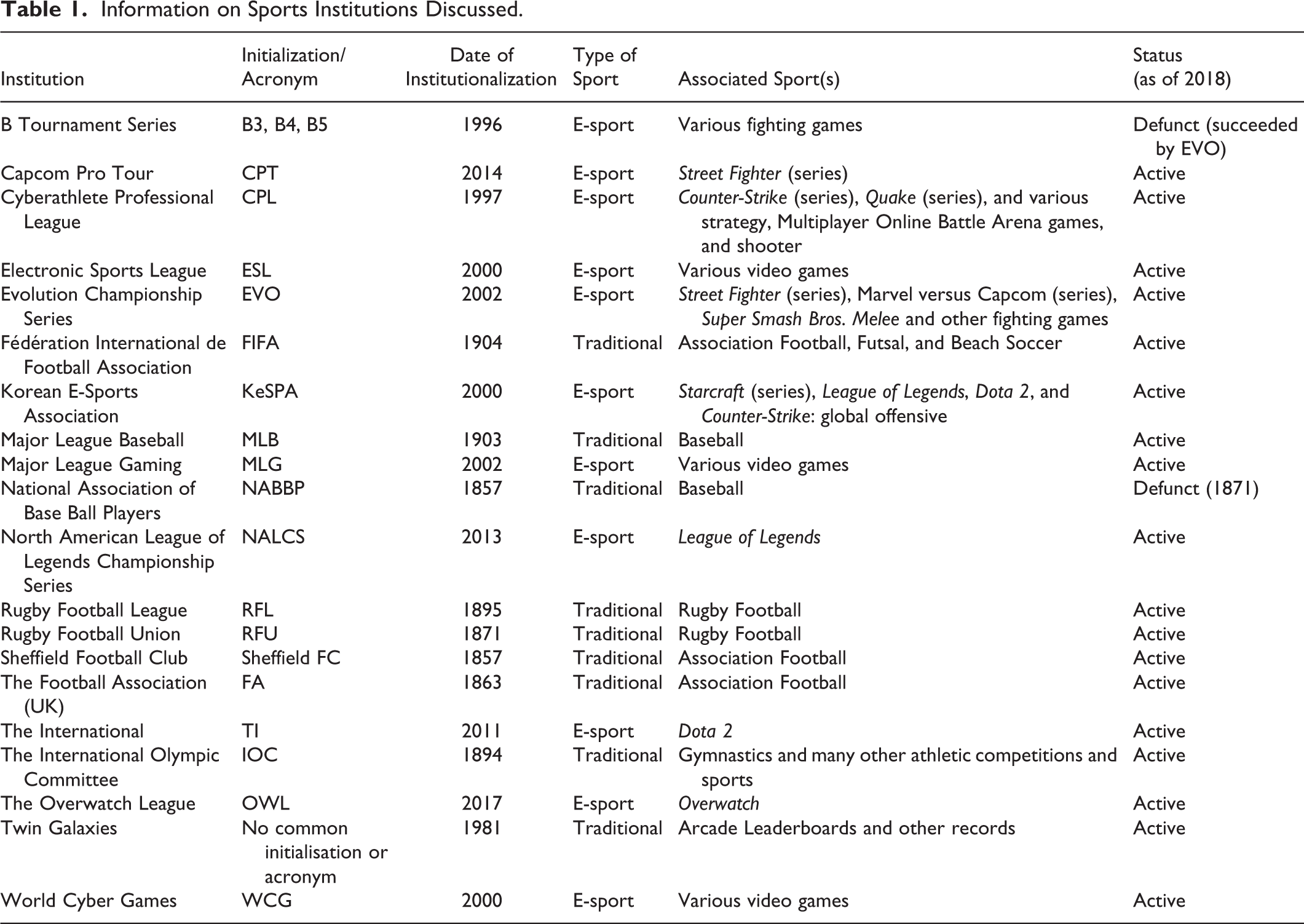
A thorough overview of all sports institutions would be impossible here and so a few significant examples have been chosen to focus the discussion within the limited scope of this article (information on institutions mentioned in this article is collected in Table 1). The Football Association (FA), the International Olympic Committee (IOC), the Overwatch League (OWL), and the Evolution Championship Series (EVO) form the main case studies of this article. These were chosen for their diverse institutional backgrounds within the limits of this article. The FA was an elite institution that initially struggled to wrangle the many codes of football and the IOC were the first large-scale international sporting event which made its institutionalization historically unique. EVO is a community-led institution which is contrasted by OWL which has benefited from corporate involvement from the outset of its institutionalization. Other miscellaneous institutions 1 will naturally be touched upon throughout.
Information on Sports Institutions Discussed.
Early Institutionalization
Universalization
Wigglesworth (2007, p. 158) documents that regulation tends to occur when a sport reaches a certain size. Sports that were previously the sole domain of royalty or upper classes, such as horse racing, would become regulated once they had broadened to the gentry or middle classes. Regulation can be carried out by individual clubs and schools but for there to be a wider sporting community, a bedrock of sports institutions, universalization is necessary. Universalization is the codification of the rules of a game, universally adopted by all competitors under an institution. Informally, this begins prior to institutionalization through the development of communally agreed rules about sporting behavior first created by the community. Then, as T. L. Taylor (2012) puts it, “formal tournaments operationalize many of these bottom-up community practices” (p. 63). The institution’s burden to codify rules is a concern for all institutions, but fewer rules are explicitly stated in E-sports rulesets. The full rulesets of Association Football (Ager, 2005; Traditional, 1863a) or Baseball (Lepperd, 2017; Traditional, 1845) dwarf the rulesets of EVO (Shoryuken.com, 2018a , 2018b) or Overwatch (Blizzard Entertainment, 2016; The OWL, 2018). Comparing the length of these documents shows the enormous amount of regulation achieved by the encoded rules of e-sports, but the source does not end with the video game’s code as Abanazir (2018, p. 6) suggests. E-sports have still developed along similar lines to the traditional sports examined here. 2
Football’s universal codification began under the FA in 1863. 3 Before this, the variety of rules among clubs setup in the 1850s and 1860s made organizing competitive matches very difficult. Journalists would report (in 1863) that losses in such competitions were due to unfamiliarity with very different rulesets used by the home team’s club or school and so the need for universal codification was felt strongly between 1830 and 1859 (Harvey, 2005, pp. 79). Letters to The Times ca. 1863 from various public school alumni supported a universal code outside of public schools for the sake of regulating matches. This led to several interested clubs gathering to form the FA on the October 26, 1863 (Dunning, Malcolm, & Waddington, 2004; Harvey, 2005, p. 42; Mason, 1980, p. 15). They sought cooperation from the public schools and began to publicize the association and its meeting’s minutes. By November 17, 1863, 23 rules had been agreed upon which would be further refined for the rest of the century (Harvey, 2005, pp. 134–139, p. 213).
Harper (2010, pp. 189–190) discusses how fighting game communities come to agreement on rules in a similar way. One example, the Smash Backroom or “SBR” was a private forum on the Smash Boards forums where influential community members established the rules of competitive Super Smash Bros. Melee (hereafter Melee; HAL Laboratory, 2001). Rulesets were disseminated from these private meetings. The SBR has no real authority, it’s up to tournament organizers to follow these rules, but they have a sort of soft authority via the community. SBR’s rulesets for Melee can be considered valuable as a form of institutionalized cultural capital (Bordieu, 1986). The same thing can be seen happening in traditional sport when Sheffield Association adopted the FA’s rules in 1877 despite many considering the Sheffield rules to be superior. This was done to set an example to local associations who had continued to play under their own variations rather than adopt the FA’s (Harvey, 2005, p. 211). The pressure of the community to unite was greater than necessarily having the “best” ruleset. Harper (2010, p. 193) frames EVO founder Seth Killian’s term, “a ‘social collective’ view,” to describe how communities codify rulesets through emergent play which are subsequently refined and universalized by institutions. In this case, there is no real difference between traditional sports and E-sports except the curious case of the OWL which was rapidly institutionalized by Blizzard before a grassroots third-party formalization of Overwatch’s ruleset could happen (Bago, 2016; Sacco, 2017).
A universal code also drove the formation of institutions, so that disputes could be settled as a matter of record. Twin Galaxies is an example of a “proto” E-sports institution that collected and recorded top scores for arcade games in an official capacity during the 1980s (T. L. Taylor, 2012, p. 4). Regional fighting game communities on the east and west coasts of America would brag about regional strength on online message boards in the 1990s. This settling of disputes became an impetus for announcing B3 (Battle by the Bay) (first held in 1996), the precursor to EVO (Harper, 2010, pp. 67–68). The interpretation of one game by many, as well as unresolved disputes, is the problems which institutions aim to solve through universalization.
Institutional Philosophy
Although examinations of institutionalization often focus on codification of rules (Abanazir, 2018, pp. 5–6), the institution also takes on other responsibilities including the establishment of a dominant philosophy that attempts to underpin the character of a sport. IOC founder Pierre DeCoubertin’s motto for the Olympic Games “the most important thing is not winning but taking part, the essential thing in life is not conquering but fighting well” (Miller, 2012, p. 13) reflects much of its aspirational qualities but not so much of the trouble of its early institutionalization. DeCoubertin saw the games as a means of uniting different nations under the moral lessons that sport was thought to provide and these concerns were part of Olympic institutionalization. A prime concern for the Olympic Games was “supporting the amateur ideal” to counter professionalism (Wigglesworth, 2007, p. 55). A congress of 79 delegates on June 23, 1894 “voted to re-establish the Olympic Games; to create an organisation to guide their destiny [the IOC]…and to provide a definition of amateurism” (Miller, 2012, p. 33). This suggests (through the word “reestablish”) a somewhat romantic notion of the games as being a continuation of Ancient Greek ritual despite prior attempts to hold “Olympic” events (Miller, 2012, p. 30; Polley, 2007, p. 24). The IOC was primarily borne from a desire to moralize sport than to codify an existing game(s) and its community. While some of the games included in the initial roster were popular, such as cycling and running, others were included for the sake of fitting an artificially Hellenic character such as the Javelin and the Discus events (Guttmann, 1994, p. 122). The Olympics are presented as continuing a tradition originating from Ancient Greece, but they reflect a middle-class character, requiring international transport, leisure time, physical education, and large institutions to regulate them (Polley, 2007). Miller (2012) writes that there is an inherent contradiction in the ethical goals of the Olympic Games that “the Olympic Spirit is thus subordinated by exaggerated national ambition” (pp. 10–11). Nationalism and classism are often directly at odds with the idealistic worldview attributed to DeCoubertin 4 (Tomlinson, 1999, p. 217).
The institutionalization of many traditional sports involves mythologization, often with the goal of making a sport seem more legitimate, traditional, or national than it really is. 5 A popular practice with sports clubs is consecrating them as “ancient” or proving their age as evidence of the legitimacy of such an institution (Harvey, 2005, p. 8). E-sports institutions simply cannot do this due to the relative recency of many video games and so their argument for wider cultural legitimacy through institutions is more of an uphill battle. Instead, E-sports institutions must develop aspirational philosophies close to those of the early IOC. The World Cyber Games (WCG) were fashioned as an “Olympics” of computer gaming and espoused ideals comparable to that of DeCoubertin with one of its stated goals being “promoting harmony of humankind through E-sports” (WCG, 2008 in T. L. Taylor, 2012, p. 11).
The B series tournament (1996), the predecessor to EVO, began in an influential West coast arcade at Southern Hills Golf Land which, like many arcades, closed in the early 2000s due to the rise of the home console industry (Harper, 2010). Arcades were where competitive fighting gameplay began, and tournaments during this era were almost exclusively grassroots events funded and organized by community members in conjunction with the proprietors of arcades. EVO was created as a means of preserving this environment, so that the community that had grown up in the arcades would not die with them (TheScore Esports, 2018a). EVO (beginning in 2002) was intended to preserve tournament culture, not necessarily arcade culture (i.e., coin-operated games and attractions). In a panel on the tournament’s history Tom Cannon, one of the founding members of EVO, outlined the mission statement of EVO organized under three principles that aspire to preservation:
Preserve and grow the arcade competitive culture.
All competitors are equal, regardless of skill.
The drama of humans under pressure.
Every player’s personal journey to get stronger (Evo2kvids, 2017).
While regulated competition is a concern of the institution, other aspirational moral qualities can also be found underpinning EVO as they are in traditional sports institutions.
Propagation
“Ludic diffusion,” a term employed by Guttmann (1994), refers to the process of a game spreading across geographical areas. By propagating their rulesets and centralizing legitimate competition institutions take on the responsibility of propagation which can be defined as intentional ludic diffusion. If a sport is to propagate then it is worth considering how it can be made to generate income and appeal to the nonplayer, and so commercialization and entertainment can become a concern for institutions over time.
Despite being remembered as the parental institution of football, the FA was dormant between 1864 and 1866 (the years following Football’s attempted universal codification). It had taken an uncodified family of games and rather than creating a universal code, had divided the game and its community between Association and Rugby Football (Harvey, 2005, p. 149). By 1864, Association Football as a game was much more organized, but teams suffered from a lack of opponents who had adopted the rules. The membership of the FA in 1867 consisted of only 10 teams (only one of which was from the provinces, Sheffield Football Club [FC]) despite there being 70 FCs in London (Harvey, 2005, p. 162). This indicates that the FA was somewhat irrelevant at the time. Its remaining members decided that the game should be made more appealing to influential institutions such as the public schools and to balance the existing rules. Dunning, Malcolm, and Waddington (2004, p. 51) isolate three factors of Association Football that are believed to be responsible for its success: simple rules (the offside rule notwithstanding), cheap equipment/requirements, and its spectator friendly nature. The desire to grow Football’s reach led to pressure on teams to adopt a ruleset that was entertaining and easily understood by spectators (Harvey, 2005, p. 154). One major drawback of the FA’s code was the fact that some teams found it hard to understand the FA’s rules. There was also the issue of the offside law “which tended to interfere with the enjoyment of both players and spectators” (Harvey, 2005, p. 156).
The Football League was created in 1888 to address the problem of imbalanced matchups in cup competitions during the 1880s. Prior to this, matches were dull for spectators and resulted in very predictable tournament progression (Mason, 1980, p. 16). League systems in Football grew toward the latter half of the 19th century which eventually led to well-attended matches and the onset of professional sports (Wigglesworth, 2007, p. 43).
E-sports institutions are quick to take up concerns of commercialization and spectatorship for the sake of propagation. The organizers of the first EVO in 2002 were conscious of the fact that during the B series tournaments, which had been held in arcades, there were plenty of other games to play. When planning EVO 2002, thought was given to the structure of the event because there was a concern that players wouldn’t have much to do while waiting for a match. Spectatorship was a concern from the beginning which birthed the tradition of having all tournament grand finals on the final day of the weekend long tournament (Evo2kvids, 2017; TheScore Esports, 2018a). The institutionalization of the OWL in 2017 (announced in 2016—the same year Overwatch was launched; Blizzard Entertainment, 2017a; Liquipedia, 2018) is a case where a developer has managed almost every aspect of a game’s journey into a sport including rapid commercialization and professionalization.
Comparative Analysis of the Factors Affecting Early Institutionalization
Capital
Perhaps the most striking difference between traditional sports and E-sports institutions is the radically different historical contexts they have developed under. One aspect of this is the relatively grassroots institutionalization of early traditional sports compared to the more corporate context of modern E-sports. Bourdieu’s (1986, p. 252) notion of capital, and its conversion, is useful in examining sports institutions. A tension in E-sports can be drawn between social and cultural capital (grassroots legitimacy) and economic capital (corporate patronage). Social and cultural capital, which sports institutions acquire via institutionalization (Bourdieu, 1986, pp. 243, 248) are conversions from economic capital. This division means that economic capital alone cannot prop up an institution alone, the cooperation of a sport’s community is necessary. The sports institution must negotiate a symbiotic relationship between the economic capital required to fund and propagate them and the social capital that makes the widespread play and enjoyment of universalized competition socially and culturally legitimate.
Early football institutions such as clubs in the Sheffield region acquired funds from membership fees and were not seen as commercial ventures (2005, pp. 111–112). If anything, players paid to participate rather than expecting to make money due to the amateur ideal popular among the 19th-century gentry. This, combined with the relative lack of extensive corporate involvement in sport at the time, meant that sports would have generally been grassroots initiatives. Conversely, corporate involvement is prevalent in early E-sports institutionalization. 6 Of the 50 largest E-sports events in 2017, 15 were organized by the game’s developer (Newzoo, 2018a, p. 13). As early as 2008, Blizzard had considered how they might fit into the emerging E-sports landscape, beginning with the development of Starcraft 2 (Blizzard Entertainment, 2010; T. L. Taylor, 2012, p. 163).
The institutionalization documented by T. L. Taylor (2012, pp. 23, 25) and Jin (2010) show that the Korean E-sports Association (KeSPA) and WCG were highly corporate in nature given the source of their funds. The WCG was intended to help South Korea be internationally competitive on the global tech stage and so corporate sponsorship and branding opportunities seemed to form the major appeal for the institution’s founders. The board of KeSPA is made up of corporate executives rather than players or grassroots game community members (T. L. Taylor, 2012, p. 161). Unlike an institution such as the early FA, universalization for the sake of competition seemed to be a secondary concern for the founders of WCG (T. L. Taylor, 2012, p. 23). Corporate support for e-sports in Korea sought to link computer gaming with opportunities to become a customer of the sponsor: “major companies […] sponsor their own popular and well-regarded teams, seeing them as valuable advertising outlets” (T. L. Taylor, 2012, p. 23). Although these practices are not uncommon in modern traditional sports, it is worth bearing in mind that traditional sports did not originally develop under the same conditions as E-sports.
EVO is a comparatively grassroots institution and Cannon stresses that EVO’s success is because it has never relied on giant sponsorships or venture funding because of the precarious situation this would put the tournament in if it grows (Evo2kvids, 2017). Cannon compares other E-sports events, such as The International, to EVO making the point that they are superficially similar but have very different qualities. Everyone in “an E-sports arena” is there as a fan but at EVO, every attendant is a player. Cannon acknowledges that EVO is going against the grain of most other “traditional” E-sports institutions and claims that its unique qualities are exactly what make EVO worth preserving rather than emulating other E-sports tournaments. EVO does not resist professionalization or commercialization, but it is not principally founded on being a sports entertainment event either.
Part of the historical context that E-sports developed in also includes precedent of centuries of institutionalized traditional sports that E-sports institutions aspire to as a template. E-sports’ relationship with partner organizations is still emerging, whereas traditional sports which are heavily formalized in their relationships with other institutions through sponsorship, merchandise, and media rights (T. L. Taylor, 2012, p. 156). However, in the very early history of both types of institution, we can see broad similarities regarding their financial development. The support of a patron was important for the security of early sports (Harvey, 2005, pp. 16–17; Wigglesworth, 2007). DeCoubertin also acknowledged that amateur sport (especially among working class participants) could not exist without patronage (Wallechinsky, 2004, p. 30). Prize money for early traditional sports competitions would have been sourced from wealthy patrons of the elite sectors of society and modern corporations (sometimes the developer of the game) play a similar role in securing large prizepots for E-sports events. Capcom first donated money to the EVO Street Fighter Prizepool in 2006. Since then developers including Nintendo, Namco Bandai, and Arc System Works have financially supported EVO (TheScore Esports, 2018b). Valve has also notoriously propped up “The International,” a Dota 2 (Valve Corporation, 2013) institution, with large prizes (Khan, 2017). According to Newzoo (2018b, p. 13), there are potentials to investing in E-sports, particularly through media rights (the fastest growing revenue stream) and sponsorship (highest grossing). E-sports developers may see themselves as standing to gain from investing in E-sports, but it is not currently a profitable venture (Newzoo, 2018b, p. 22). Some institutions such as the ESL (formerly the E-Sports League) are funded by membership fees, alongside an initial start-up investment, and cooperation with sponsors (T. L. Taylor, 2012, p. 144). This reflects the reliance of early sports institutions, such as the FA or Sheffield FCs, on membership fees to fund the costs of equipment and events (Harvey, 2005, p. 171).
Newzoo (2018b, p. 15) sees the franchising of teams under a traditional sports model as potential area for growth and this has informed the development of E-sport institutions. The similarity to the league structure of American sports is not only framed as being commercially stable but also allows for extensive planning of league tournaments as a reliable form of sports entertainment which has worked well so far for the OWL and the North American League of Legends Championship Series (NALCS; Esports Bar & Newzoo, 2018, p. 11) for League of Legends (Riot Games, 2009). Sponsorship is the largest moneymaker for E-sports, but this is predicted to be overtaken by media rights revenue (Esports Bar & Newzoo, 2018, p.4). Both sources of income are dependent on securing a large and loyal base of spectators and institutions will move to secure this. Historically, developing a spectator sport of any kind relies on several criteria identified by Rowe (2004, pp. 20–21): competitions that award prizes, venues with large crowd capacity, a labor market of professional and semiprofessional players, state funding donated to the development of the sport, Merchandizing sales, sport media, and institutionalization.
While these criteria have been met during the development of successful traditional sports such as Football or Baseball, Criteria 2, 3, and 4 are only partially met depending on the E-sport one is examining. The cost of running events, as well as the associated travel requirements, makes it very difficult to manage sports on a large scale. In the 19th century, traveling sports venues were costly to run (transport, security, and amenities) and so institutions were under pressure to ensure there were guaranteed spaces to play in the form of arenas or stadiums (Rowe, 2004, p. 20). E-sports stadiums have been built by institutions such as KeSPA (T. L. Taylor, 2012, p. 161), but very few E-sports have dedicated spaces to play and events like EVO are unusually dependent on booking the Mandalay Bay Events Center and the Las Vegas Convention Center that are not dedicated E-sports arenas.
Identity and the Institution
Nationalism, classism, racism, ableism, and sexism are rife in the early institutionalization of traditional sports (Guttmann, 1988; Guttmann, 1994, p. 49; Harvey, 2005; Miller, 2012; Roche, 2000; Wigglesworth, 2007, p. 92). Few E-sports institutions make any codified divisions based on race, age, disability, nationality, or gender as many traditional sports institutions do (and have done). E-sports institutions have not developed “paralympic” equivalents, since a physical disability is not a guarantee of a player being disadvantaged. Disabled players, such as fighting game player Mike “BrolyLegs” Begum, can compete with and even train others despite disabilities that would prevent participation in nonparalympic traditional sports (Cross Counter TV, 2014). There’s no reason why players should be separated along these dimensions for competitive play in any E-sport; however, gender division does still happen informally and Caucasian male competitors are predominant. T. L. Taylor (2012), Voorhees (2015), and Witkowski (2012a, p. 129) argue that hegemonic masculinity, which defines the identity of sporting athletes, also primarily defines the E-sports player who sees themselves as an athlete “minus the emphasis on physical qualities” (T. L. Taylor, 2012, p. 116). E-sports have the potential to level the playing field across many sectors of society, but if E-sports institutions aspire to succeed modern traditional sports they may see the adoption of hegemonic masculinity as necessary.
Although the average age of American E-sports players is between 24 and 27 years (EEDAR, 2015, p. 12), there is theoretically no limit for a player’s age for competition in the same way that exists for traditional sport. Players as young as 8 (TheScore Esports, 2018b) or 9 (Lambert, 2007) have competed against much older players without a need to bracket competition. Section 9 of the Capcom Pro Tour specifies a minimum age of 13 years (Capcom USA, 2018), presumably to be compliant with Street Fighter 5’s (Capcom & Dimps, 2016) ratings information (“Teen” under the ESRB (Entertainment Software Ratings Board)). 7
An example of national boundaries being drawn by an E-sport institution is in the regionalization of teams in the OWL. To qualify for a place on an OWL team, Blizzard Entertainment (2017b) does not regulate region locking “in terms of place of birth or home country of any player.” This has led to rampant importation which is highly unusual for the first years of a sport’s life cycle. The current reigning champion team of the OWL, London Spitfire, is exclusively comprised of players from South Korea (ESPN Esports, 2018). While the integration of players who do not hail from a national team’s country is not unusual in traditional sports such as Football, it is strange given the relative recency of Overwatch’s institutionalization. Football’s nationally and regionally oriented teams are legacy artifacts from the strictly nationalistic divisions of the sport’s earlier history. It also speaks to the specific dominance of Korean players in OWL which seemingly counters Blizzard’s efforts to organize competitive teams along national and regional alignments to draw in spectators. This homogeneity of nationality within OWL teams seems to run counter to Blizzard’s stated philosophy on Overwatch’s in-game characters as Hill (2017) identifies, “noting particularly the significance of a line-up that ‘looks like what the world looks like,’ by which he [Nate Nanzer] means racially diverse, multinational, and equitably gendered.” To contrast this with the attitude of early sports institutions, importation was such a serious concern during the 1870s that bounties were announced for anyone who could provide evidence that a player was imported (Mason, 1980, p. 71). Importation was considered counter to the amateur spirit of the game, despite how successful it made some teams, and was regulated by the FA. While there is nothing inherently wrong with a national team including players from outside of its nation, it raises some interesting questions about where the values of E-sports institutions lie and how certain precedents have been set by traditional sports.
Guttmann’s (1994) statement that “receptivity to ‘exotic’ sports has been limited to the more affluent and better educated sectors of the population” (p. 173) is strangely apt when considering the national dimension of E-sports. Institutionalization of many traditional sports occurred in a specifically national context and it wasn’t until the early 20th century that the demands of international play required that major institutions extend globally (or at least across the developed world). Despite E-sports developing in a globalized period of history, it remains the domain of developed nations. A lack of online infrastructure and official game-publishing channels in developing nations limits the likelihood of institutions including or being founded in those nations. The regionalization of Major League Gaming, which fashions itself in the style of American spectator sports, has made it provincial to Northern America (T. L. Taylor, 2012, p. 146). EVO is similarly regionally aligned although EVO Japan 2018 is a recent endeavor to broaden the scope of the institution (TheScore Esports, 2018b). Further national divisions exist between e-sports platforms such as PC/console and mobile which are tied to continental market differences. Newzoo (2018a, pp. 13, 25, 30) identifies Battle of Balls (2016), Honor of Kings (2016), and Vainglory (2014) as top mobile E-sports, but the institutionalization of these E-sports is largely invisible in the West. The OWL’s player base is firmly rooted in the developed nations of North America, Europe, and East Asia and its streamed events can only reach those countries with the proper infrastructure.
Intellectual Property and Media Rights
The day before EVO 2013 began, Nintendo of America, Inc., blocked the video streaming of Melee stating that the tournament organizers did not have permission to broadcast the game (TheScore Esports, 2018b). This is an intellectual property (IP) dispute similar in nature to the case of Blizzard versus KeSPA covered by T. L. Taylor (2012, pp. 162–163). Due to negative backlash, Nintendo backed down and even sponsored the EVO 2014 Melee tournament. Debatably, the developers of E-sports rely on their players and tournaments more than any other developer, but cases like this highlight a strange relationship that does not exist for traditional sports. E-sports all have an extant and traceable author (usually a corporation) that maintains IP rights over the game that is regulated by institutions that are a separate authority to that author. Institutions that run E-sports events but that do not own or publish the game(s) played at the event are referred to as “Third-Party Organizer[s]” (Newzoo, 2018b, p. 12) who must secure rights to broadcast and promote tournaments featuring a developer’s game.
In 2010, T. L. Taylor (2012, p. 163) interviewed Paul Della Bitta (Blizzard representative) who stated: “we’re not in the business of E-sports.” This is interesting given Blizzard’s current standing in E-sports, directly overseeing two of the largest games, Hearthstone (2014) and Overwatch. The reason for Blizzard’s change of approach may have been to do with media rights issues, but it may also have been to do with setting itself aside from its competitors at multigame events as Abanazir (2018, p. 7) suggests. Referring to the OWL, Nate Nanzer, Blizzard’s global director of research and consumer insights, in an interview states: “If we structure a league the right way and put the right investment behind it, we can actually monetize it in a way that’s not too dissimilar from traditional sports” (Hill, 2017). In retrospect, a developer taking on institutionalization, cuts out the middle man with regard to media rights negotiation. Whether a game, an instance of it being played or its assets are fundamentally distinct copyrightable elements has been discussed by Boyden (2011), Burk (2013), and Abanazir (2018, p. 8), who touch upon the unusual difference between traditional games and E-sports with regard to their status as intellectual property. In any case, E-sports can be said to share three “authors” given the sources of their rules: the developer, the institution, and the community (Witkowski, 2012b, p. 354). Yet in traditional sports institutions, the “developer” lacks a true analogue. As Abanazir (2018, p. 8) states, institutions such as Fédération International de Football Association do not “have a monopoly on the source” [Abanazir’s emphasis].
Ludic Diffusion and Longevity
Ludic diffusion occurs at a rapid pace for E-sports due to several factors. Given that E-sports emerged in the mid-1990s and developed alongside the Internet and modern arcades, the ludic diffusion of E-sports has grown in parallel with these locations. T. L. Taylor (2012, p. 9) argues that the initial success of organized E-sports activities was due to the capacity for play over LAN and DWANGO events and later broadband (Chee, 2006). Since latency is still a competitive limitation, teams playing over the Internet would still be somewhat regionally aligned (Rambusch, Jakobsson, & Pargman, 2007, p. 161). The real aid of the Internet to E-sports institutions is how much easier it makes finding and communicating with others who can propagate a niche interest. The ability to find a community that shares one’s interests is expedited the Internet which was key to forming early grassroots E-sports tournaments such as EVO (Harper, 2010, pp. 193) or the Cyberathlete Professional League (King & Borland, 2003 in T. L. Taylor, 2012, p. 8). Similar reliance upon technology expedited the diffusion of Football. The logistics of finding another team or club to play coupled with the time required to travel to a venue were major roadblocks to the diffusion of Football until the expansion of the railway in England during the 19th century (Harvey, 2005, p. 69).
There is no guarantee of a given sport being popular (Guttmann, 1994, p. 172). The phenomenon of gigantism (Chappelet, 2014; Wallechinsky, 2004, pp. 30–31) identified by the IOC describes a problem, whereby the organization of the Olympic Games is so logistically difficult that certain limitations must be imposed. This includes axing certain sports based on criteria such as the sport’s global popularity. The IOC decides the program of the Olympic Games and thus can confer a “ludic legitimacy” (Guttmann, 1994, p. 137) on certain games if they elect to include them. However, practical concerns affect the inclusion of certain sports such as “whether the sport looks good on television” (Wallechinsky, 2004, p. 31) otherwise events like Dressage, Synchronized Swimming, and Canoeing would not qualify for inclusion. Marvel vs. Capcom 2: New Age of Heroes (2000) and subsequent games in the series were a pillar of EVO for more than a decade before being dropped from the roster in 2018 due to diminished popularity (TheScore Esports, 2018b). The longevity of its sport is a concern for any sport institution.
By 1858, Baseball was essentially recognizable as a predecessor to its modern form bar some key differences (Goldstein, 1989, p. 13). Baseball’s major institutions refined these rules over the course of more than a century while still playing one continuous iteration of a single game. It is not currently conceivable how this might happen for a single video game due to their technological and commercial dependencies. There are very few sports that do not include some tool external to the human body, but in the case of E-sports these technologies are subject to rampant change in the games industry—eager to sell new hardware and software to its consumers. Sports institutions must provide the “playing field” for their competitors and, in the case of E-sports, must also specify machines that are up to code (T. L. Taylor, 2012, p. 79). The death of the arcade scene required tournaments like EVO to move many of its games to console versions. Arcade cabinets were still available but were heavy, expensive to rent, required coin operation, and would frequently break (TheScore Esports, 2018a). Harper (2010) and N. T. Taylor (2009) have both discussed how gaming equipment has affected the set-up of competitive events such as the differences in individual arcade sticks or the length of controller cables. Tom Cannon has described the Dreamcast as “Evo’s Nemesis” because of how frequently the console would break during tournaments (Evo2kvids, 2018). Melee’s community has commented on the numerous legacy problems that jeopardize its longevity as the oldest widely played E-sport: the lack of centralized institutionalization, the requirement of obsolete CRT monitors, the lack of direct support from the game’s developer, the unlikelihood of younger players taking up the game, and the lack of financially secure professionalization (Pereira, 2017). These cases point to the precarious nature of E-sports as being subject to the technology that are required to run them. Given that E-sports is still in its early history, comparisons between institutions created in the 19th century and the late 20th are inevitably difficult when judging the longevity of a given game and its institutions (Abanazir, 2018, p. 11). Generally, E-sports face challenges to their longevity compared to traditional sports. One could make an analogy between the different “eras” of Baseball and the different versions of Counter-Strike as being technically separate instances of the same game, but the reality is that E-sports and traditional sports are often treated differently by their institutions in the long term because of their differing dependencies.
Conclusion
Similarities and differences can be generally identified between the institutionalization of traditional sports in the mid-to-late 19th century and E-sports from the mid-1990s onward and much of this is to do with their historical contexts. The development of rulesets happens in much the same way between both sports institutions. The community develops informal game rules that are later codified and universalized by a game’s institution(s). Sports institutions of both types can be seen establishing a moral philosophy that guides the character of the sport and its community as part of the process of institutionalization. Both types also aim to propagate their game through promotional events, dispersal of their universal rulesets and institutional philosophy.
The main difference between the financial considerations of early sports institutions is the rapid integration of corporate enterprise in E-sports. Whereas traditional sports institutions were initially split by ideological differences such as amateurism (Rugby Union vs. Rugby League) or ruleset loyalty (in the case of Rugby and Association Football), e-sports are split between grassroots versus corporate organization (EVO compared to OWL). Traditional sports institutions do not need to navigate IP rights except in the case of broadcast rights and sponsorship. E-sports must additionally consider IP and ratings information. Traditional sports institutions work with a community during institutionalization and regulation, whereas most E-sports institutions are also in dialogue with a game’s developer. Sports institutions tend to be organized along national boundaries and can discriminate in various ways, some of which are institutionalized. Early traditional sports institutions codified divisions between gender, race, age, and ability, whereas E-sports institutions do not formalize such divisions. Instead these informally occur, primarily for gender divisions and, to some extent, age. The ludic diffusion of both types of institution have diffused thanks to developing technologies, but E-sports currently lag behind the mainstream penetration eventually managed by traditional sports institutions. The longevity is a concern for both types of institutions, but E-sports are in a more precarious situation due to various technological and commercial dependencies.
Developing on from this discussion, it would be useful to examine E-sports institutions alongside other niche sporting areas such as leisure sports or extreme sports as these branches of sport may have greater similarities to E-sports in terms of scale and a more comparable historical context. Traditional sports have an extensive record laid out after their early institutionalization which is currently not the case for E-sports. This is a key difference between them and the institutionalization of sports like Football took decades compared to the institutionalization of Overwatch which was almost immediate (Abanazir, 2018, p. 10). Esports Bar and Newzoo (2018, p. 4) see E-sports as being historically similar to the Ultimate Fighting Championship (UFC) and suggest it could indicate the future of E-sports media rights and content distribution. Given the precarious nature of e-sports, it might also be worth examining lessons to be learnt from sports institutions that failed such as those listed by Abanazir (2018, p. 10).
Footnotes
Declaration of Conflicting Interests
The author(s) declared no potential conflicts of interest with respect to the research, authorship, and/or publication of this article.
Funding
The author(s) received no financial support for the research, authorship, and/or publication of this article.
