







Abstract
Most violent video game (VVG) research focuses on aggressive behaviors as the primary outcome variable of interest. Using pro-social behavior as the dependent variable, this study explores factors beyond VVG content as a contributing factor to player outcomes. Participants were randomly assigned to play VVG or non-VVG content with viewing screens obstructed by large pieces of paper to increase difficulty, or unobstructed. Screen condition accounted for 34.5% of the variance in pro-social behavior of helping to retrieve spilled pens. Players in obstructed viewing conditions experienced more in-game losses and engaged in significantly less helping behavior. Fewer pens were retrieved by participants in obstructed viewing conditions while playing either a VVG or non-VVG. The present study cautions against generalized assumptions that VVG content is a primary determinant of behavior and underscores the role of important contextual factors like failure and achievement loss to consider in future studies of this nature.
Video games represent a massively popular entertainment platform. Currently, more than 65% of U.S. adults report they play video games on a weekly basis with an estimated 2.5 billion gamers worldwide (ESA, 2019). Rapid improvements in technology alongside the massive globalization of gaming in general has helped the industry establish a dominant foothold in the consumer market. Becoming more varied, socially inclusive, and accessible, video game sales now surpass the US$43 billion mark and boast larger revenue streams than digital music and blockbuster films combined (SuperData, 2019).
As a massive entertainment platform, video games have also prompted interest across scientific communities, administrative groups, public policy advocates about media consumption, and special interest groups seeking to understand the implications of large-scale gaming on social behaviors and related human factor outcomes. Within this spotlight, establishing the degree of any harmful effects as a result of exposure to violent video games (VVGs) has become a complex and controversial venture. Generating robust causal associations between VVGs and externalizing outcomes has proven difficult as, historically, such efforts stumble due to methodological issues including lack of standardization for measures of aggression to highly subjective interpretations of characterizing what “violent” content in video games entails. Also problematic is the frequent overreliance of youth self-report measures on aggression (Markey & Fergusson, 2017), failure to establish clear patterns of causality, and validity concerns when overlooking critically important environmental influences in VVG research such as peer affiliation and other risk factors associated with exposure to aggressive models (Busching et al., 2015; Ferguson & Kilburn, 2010; Matthews, 2015; Przybylski et al., 2010; Valdez & Ferguson, 2012).
While some maintain the relationship between exposure to VVGs is associated with increases in aggression and violent behavior (Anderson et al., 2010; Arriaga et al., 2011), an extensive body of contemporary literature does not lend support to this perspective (Ferguson, 2015a; Ferguson & Kilburn, 2010; Huesmann et al., 2017; Perrachia et al, 2019; Williams & Skoric, 2005). Evidence demonstrates numerous socio-cognitive benefits for gamers compared to nongamers, such as stronger visual-spatial and cognitive mapping skills (Green & Bavelier, 2012; Uttal et al., 2013), heightened attentional, visual, and cognitive processing capacity (Colzato et al., 2013; Eichenbaum et al, 2014; Mishra et al., 2011; Ray et al., 2017), increases in oculomotor capacity and hippocampal volume (Diarra et al., 2019; West et al., 2017), creativity (Jackson et al., 2012), and stronger task persistence beyond the virtual environment (McGonigal, 2011; Ventura et al., 2013).
While a proportion of all video games can be identified as VVGs, many other genres of massively popular titles do not contain any violent themes, characters, or storylines. While research has largely focused on the negative aspects of violent content in gaming, it is important to also recognize how the application of numerous pro-social games featuring content with positive themes is increasingly being documented, along with the benefits of utilizing “serious games” for therapeutic aid across clinical treatment, disease management, and pain intervention settings (Hoffman et al., 2008; Kato et al., 2008; Patel et al., 2006; Primack et al., 2012), foreign language acquisition (Guillen-Nieto & Aleson-Carbonell, 2012; Romero & Barma, 2015), and simulated virtual learning tools across a range of professional occupations (Annetta, 2010; Durkin, 2010; Kurenov et al., 2009).
Video Games and Pro-Social Behavior
Exploring outcomes associated with playing video games has generated a wealth of research specifically on the impact of games as a reinforcement model for “real world” pro-social problems and behaviors (Ewoldsen et al., 2012; Ferguson et al., 2013; Whitaker & Bushman, 2012). Pro-social behaviors are defined as purposeful or voluntary actions that directly benefit or help other people, and early studies exploring the effects of VVGs on pro-social behaviors initially produced mixed results. Some research groups maintain playing VVGs increases player willingness to blast opponents with loud noises (Anderson & Dill, 2000) and leads to slower response times in assisting injured confederates after exposure to a staged fight (Bushman & Anderson, 2009). However, repeated critiques within studies of this nature underscore recurrent instances of publication bias and other shortcomings when attempting to interpret such claims as scientifically valid (Elson & Fergusson, 2014; Fergusson, 2015b; Hilgard et al., 2017; Przybylski & Weinstein, 2019), particularly with regard to longitudinal analyses in this domain.
Presently, many investigations of video games with cooperative and socially supportive themes explore positive outcomes in virtual environments and how these transition into nonvirtual settings (Gentile et al., 2009). Greitemeyer and Osswald (2010) were among the first to determine participants in pro-social gaming conditions are more likely to assist researchers in gathering spilled pens compared to participants in VVG and non-VVG/neutral conditions. While interesting, the lack of reported differences in pro-social behavior between VVG players and non-VVG players sparked substantial interest in the scientific community. In an extension of this work, Tear and Nielsen (2014) also found pro-social behaviors among gamers do not appear to be negatively impacted by VVG experiences.
Such findings bear important consideration when exploring factors beyond the restrictive lens of focusing on VVG content as the sole determinant of user outcomes, as other factors contribute to the complex tapestry of predicting player behavior. Schmierbach (2010) found participants playing a violent first-person shooter (FPS) game like Halo were more aggressive in a follow-up word completion task when assigned to competitive play compared to participants in solo play and cooperative play. Rather than violent content specifically, Adachi and Willoughby (2011) also established in-game competition as a powerful influence on the production of aggressive outcomes through the role of win–loss ratios on player frustration and satisfaction. Jerabeck and Ferguson (2013) emphasize the importance of taking into account broader social influences in video game studies, such as cooperative versus competitive settings, to create a more inclusive theoretical scope when attempting to predict user outcomes. Breuer et al. (2013) also found positive associations between failure in video games and aggression toward others. Lending further support, Dowsett and Jackson (2019) maintain competitive game environments may impact aggressive affect among players over VVG content.
Such studies consider the extremely competitive aspect of many VVGs as an important contributing factor toward negative affect. This is generated through repeated game-related failure, loss of player agency, death, or loss of achievement commonly used as a usability mechanic in the VVG genre. Research shows encountering repeated failure, especially as a result of difficult challenges that impede perceived competence, is not exclusive to VVGs (Przybylski et al., 2010) and is increasingly recognized as an important catalyst of negative emotion in the scientific literature.
With this in mind, the present study attempts to bridge the gap between VVG research and pro-social behavior gaming studies by considering the situational variable of win-versus-loss experiences across violent and nonviolent video games. Based on prior research, it is expected that factors such as task difficulty and repeated game loss will have a predominant effect on negative player outcomes above and beyond violent game content in ways that impede pro-social behaviors. After controlling for demographic factors including player age and gender, it is hypothesized that independent of video game genre (VVGs vs. non-VVGs), inducing more game-related task failures will predict less pro-social helping behavior (Hypothesis 1). Greater frequency of in-game failure or “death” is further hypothesized to generate a reduction in helping behavior among players in both VVG and non-VVG conditions (Hypothesis 2).
Method
Participants
A total of 43 individuals enrolled at a Pacific Northwest university volunteered for the current study. Participants were recruited through campus announcements posted to student email listservs and flyers posted on bulletin boards. As compensation, enrolled participants were eligible to win prizes from a random drawing that included a PlayStation 4 game console and cafeteria meal cards.
Materials
Two popular video games, Wolfenstein: The New Order and Bit.Trip Runner, were used in the study. Wolfenstein: The New Order is marketed as a violent action-adventure FPS game based on tactical assault combat missions with heavy military themes. Bit.Trip Runner is a nonviolent rhythm-based, arcade-style game where players navigate obstacles and avoid objects by jumping, running, and sliding across the screen. Both video games were configured with an XBOX 360 console assembled to a 42-in. TV screen for player viewing.
Procedure
Participants were randomly assigned to one of four study conditions. Participants assigned to one of the two experimental conditions were asked to play a 10-min segment of Wolfenstein or Bit.Trip Runner that consisted of a large piece of white paper which obstructed approximately 40% of the middle of the viewing screen for the duration of the play session. Participants were not present in the room prior to setting up the screen obstruction, and at no point during the study did the experimenter or research assistant manipulate the viewing screen. In the two control conditions, participants were asked to play a 10-min segment of Wolfenstein or Bit.Trip Runner but under standard viewing conditions without any screen obstruction.
Prior to starting, the experimenter introduced the research assistant as the point of contact to address any technical issues or questions about the XBOX controller that might arise while the participant played. The assistant was then seated in the back of the room and covertly tasked with recording the number of times each player “died” during the 10-min game session or failed to complete in-game tasks.
After the allotted time period concluded, participants were made aware the session was over and a brief exit survey was distributed to collect demographic information. In an adaptation of the classic pen-drop task (Macrae & Johnston, 1998, also see Greitemeyer & Osswald, 2010) just prior to giving the survey, the experimenter pretended to accidentally spill a cup of 20 pens located on the desk approximately 1 ft away from the participant. The experimenter allowed for a 5-s delay for the participant to begin pen collection while unobtrusively recording the total number of pens the participant helped to retrieve. Upon completion of the exit survey, participants were reminded about the upcoming drawing for prizes and escorted from the lab.
Results
The sample consisted of a total of 41 participants with an average age range of 18–21 years (82.9% male, 17.1% female). Subjects were asked to estimate how often they played video games, and the most frequent response was between 3 and 4 hr each week (36.6%), followed by 9 and 10 hr (14.6%) each week (see Table 1). Two individuals from the initial sample requested to terminate their gaming session early for unspecified reasons and were excluded from further analysis.
Time Spent Playing Video Games.
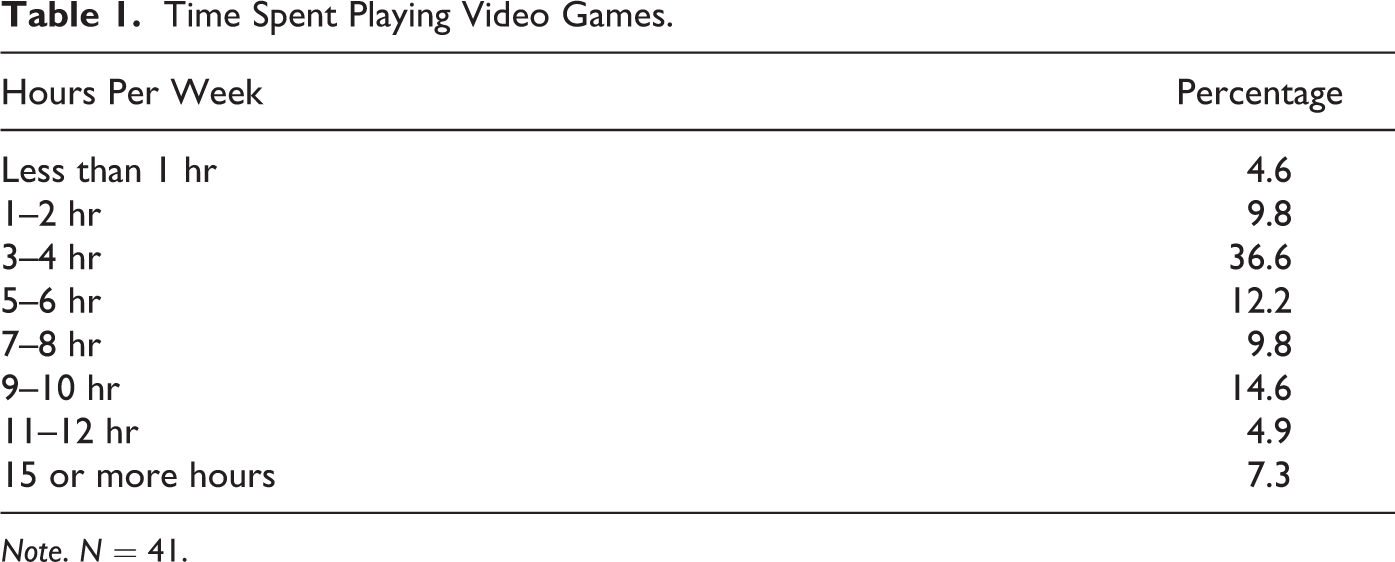
Note. N = 41.
Participants in both video game genres experienced significantly more in-game failure when viewing screens were partially obstructed compared to participants with viewing screens that were not obstructed (t = -6.09, p < .001). On average, players with unobstructed viewing screens failed on game-related tasks only 1.8 times compared to players with partially covered screens who averaged nine failures. As shown in Table 2, fewer pens were retrieved by participants under conditions with paper covering their screens while playing either a VVG (M = 0.80, SD = 1.87) or non-VVG (M = 0.40, SD = 0.97). More pens were retrieved by participants without paper covering their screens while playing either a VVG (M = 3.20, SD = 3.05) or non-VVG (M = 5.27, SD = 3.58).
Summary of Participant Pro-Social Behavior.
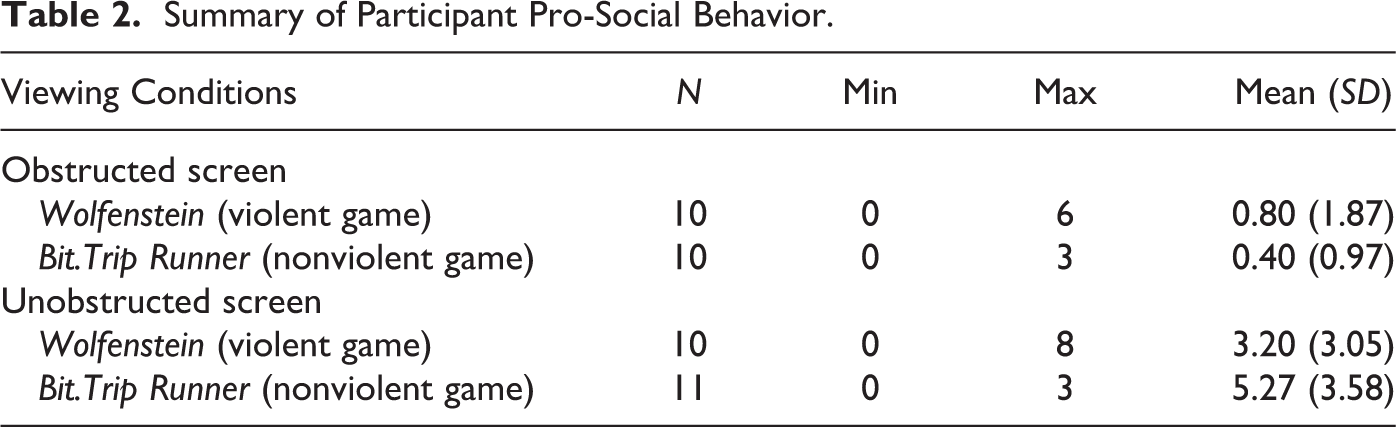
Regression Analysis
Hierarchical multiple regression was conducted to determine whether screen condition would predict pro-social behavior among gamers while controlling for game type (violent game = 1, nonviolent game = 2) and demographic factors including age, gender (1 = male, 2 = female), and the number of hours played per week. The dependent variable of interest was the extent participants helped the researcher retrieve spilled pens on the desk. After controlling for game type and player demographics (see Table 3), screen condition predicted the number of pens participants retrieved (R2 change = .345, F change (1, 35) = 20.62, p < .05). As hypothesized, heightened game difficulty created by obstructed viewing accounted for 34.5% of the variance in pro-social behavior above and beyond variance accounted for by violent or nonviolent game content. No interaction was present between the type of game participants played and the screen condition they experienced.
Summary of Multiple Regression Model.
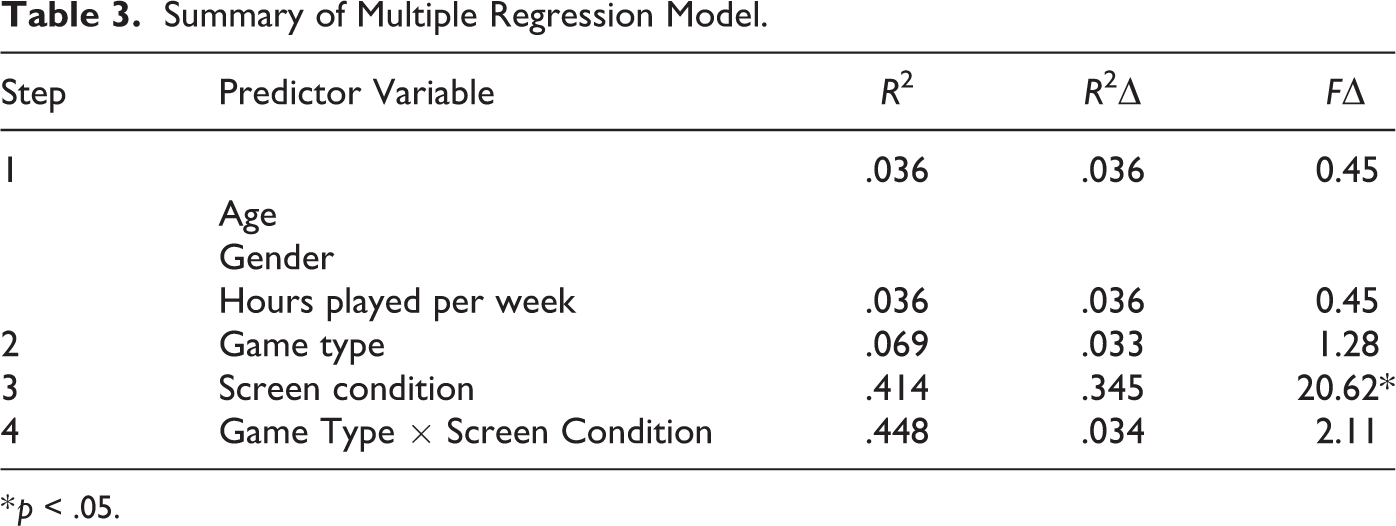
* p < .05.
A similar analysis was performed to address whether greater frequency of in-game “death” in general across both game types (VVGs and non-VVGs) predicts helping behaviors. While controlling for game type and player demographics, the number of times a participant experienced in-game failure, as represented by character “death,” led to less helping behavior in retrieving spilled pens for the researcher (see Table 4). This effect occurred above and beyond what can be accounted for by demographics and game type alone (R2 change = .393, F change (1, 35) = 25.59, p < .05). As expected, game failure accounted for 39.3% of the variance in pro-social behavior above and beyond variance accounted for by violent or nonviolent game content. No interaction was found between the type of game participants played and the amount of failure in predicting pro-social outcomes.
Summary of Multiple Regression Model.
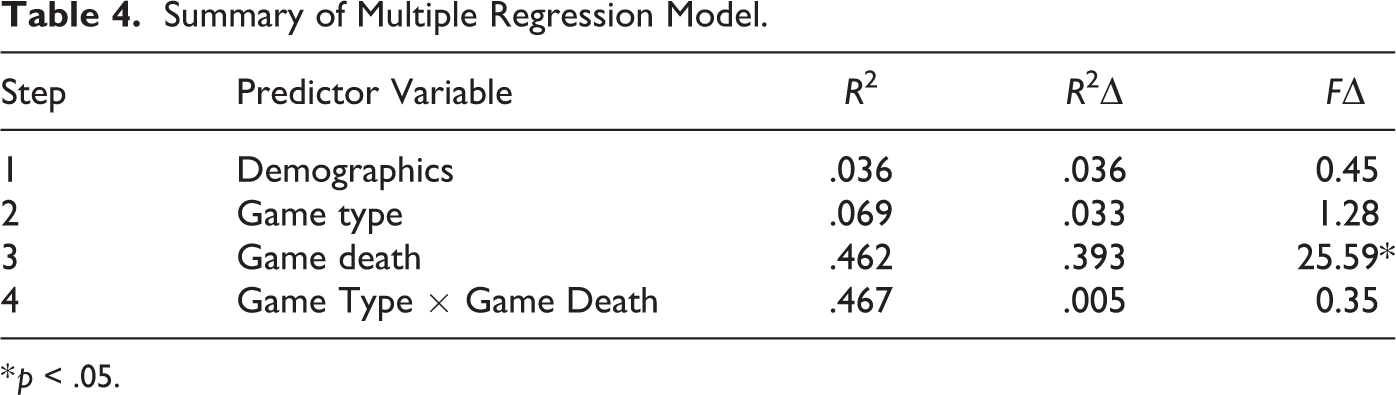
* p < .05.
Discussion
Failure to establish a straightforward link between VVG content and aggressive outcomes has led to a number of research efforts that explore other potentially important factors. While some studies indicate the relationship between exposure to VVGs is associated with increases in aggression, methodological issues abound in terms of lack of control over confounds, unstandardized variables for aggressive behavior and VVG content, and publication bias (see Busching et al., 2015; Ferguson, 2015b; Przybylski & Weinstein, 2019). One commonly overlooked factor edging at the peripheral of current studies is the high degree of task failure and achievement loss commonly found in the VVG genre.
The present research seeks to establish greater understanding toward the role of achievement loss and failure over violent content as more substantial determining factors in predicting player outcomes (see Breuer et al., 2013; Dowsett & Jackson, 2019). Some positive associations are found between failure in video games and aggression (Breuer et al., 2013), and in-game loss is related to levels of player frustration, task persistence, and hostility (Adachi & Willoughby, 2011; Breuer et al., 2013; Shafer, 2012). Even so, game failure and other elements like player competition, which are considered staples across the VVG genre, are not widely applied considerations to research in this domain. As an additional point of reference, much of the current focus on VVGs predominantly uses aggressive externalizing behaviors as the outcome variable of interest. The present study is among the first to bridge the gap in the existing literature by exploring situational variables of loss and failure in tandem with VVG content in an attempt to predict pro-social player outcomes.
This study utilized the classic pen-drop task where the researcher appears to accidentally spill pens to establish helping behaviors in a laboratory setting. It was predicted that repeated game loss, rather than violent game content, would be the more influential variable to impede player pro-social behavior. Participants were randomly assigned to play either a VVG or nonviolent game, and in both experimental conditions half the participants were presented with a viewing screen that was partially obstructed with paper. As expected, obstructed viewing conditions led to more failures with participants averaging nine game losses against players with unobstructed screens who averaged only 1.8 losses. The data confirmed that players in obstructed viewing conditions in both VVG and non-VVG conditions helped the researcher gather fewer spilled pens compared to participants in unobstructed viewing conditions.
Data from the current study suggest repeated loss is negatively correlated with helping behavior when playing VVGs and also when playing games without violent content. Further analyses show frequent game loss through character “death” also predicted the degree to which players engaged in pro-social behaviors. After controlling for demographic variables and game type, higher frequency of player deaths in both VVG and non-VVG conditions contributed to overall less helping behavior in the lab. These findings bear important consideration for factors beyond violent content as an influence on user outcomes, particularly at the pro-social level.
While this research explores the role of commonly overlooked factors that impact player behavior beyond VVG content, future investigations would benefit from utilizing a larger sample size with greater diversity in gender representation and gaming background. It is also possible that more ambitious players interested in console gaming and the PS4 prize drawing could have self-selected into the study over PC gamers or other player types with no particular affinity for console gaming. The current study may also be limited in terms of long-term effects generated by the data over time. Despite these shortcomings, this study sidesteps a number of frequent methodological issues in VVG research by not relying on participant self-report data, which is a common stumbling block in the literature, and offers new insights to the importance of situational variables like game loss and failure on player behavior traditionally overlooked in research of this nature.
Like TV, film, and interactive social media outlets such as YouTube and Twitch, not all massively popular, suspenseful, action-based video games contain explicitly violent content (e.g., Minecraft, Candy Crush, Myst, Animal Crossing, Portal, Journey). Focusing exclusively on the potentially negative impacts of playing video games and player exposure to VVG content disregards an entire domain of study highlighting the myriad of socio-cognitive benefits associated with playing video games and other research signifying the worth of “serious play” as educational tools and professional training interventions to help reinforce learning outcomes (Ewoldsen et al., 2012; Ferguson et al., 2013; Jackson et al., 2012; Whitaker & Bushman, 2012).
The current data provide evidence that important game mechanics associated with failure and loss impact player pro-social behaviors above and beyond violent game content. Taken together, researchers have only begun to consider the role of other factors such as competitive play in VVGs and how winning and losing may impact player frustration, hostility, or task persistence (McGonigal, 2011; Ventura et al., 2013). Greitemeyer (2014) notes factors tied to in-group bias may influence aggressive player behavior toward out-group others, and while this consideration is beyond the scope of the present study, it nevertheless warrants further investigation. Continued insight into this realm will provide deeper understanding toward the role of VVG content and other important situational game factors that influence player behavior over time.
Footnotes
Declaration of Conflicting Interests
The author(s) declared no potential conflicts of interest with respect to the research, authorship, and/or publication of this article.
Funding
The author(s) received no financial support for the research, authorship, and/or publication of this article.
