







Abstract
Although online racism occurs frequently and explicitly in online gaming (e.g., anti-Black hate speeches), no research has examined the psychological impact on racial/ethnic minority players. Thus, the current study examined the mediating role of online racism in the link between time spent in online gaming and psychological distress. Using data from 765 racial minority emerging adults in the United States and with gender controlled, time spent in online gaming predicted greater exposure to online racism, which in turn was linked to higher psychological distress. Post hoc multi-group comparison suggested that the findings were consistent with the Black group but neither the direct nor indirect effects of the model were significant for the Asian and Latinx groups. The results highlight the unjust digital burden and psychological costs of racism in online gaming among racial minority emerging adults, particularly among Black individuals. Limitations and implications for research are discussed.
Introduction
Emerging research has documented the significant prevalence of racism in online gaming (Daniels & Lalone, 2012; Grays & Leonard, 2018; Ortiz, 2019). In the context of pervasive and explicit persistence of racism on the internet (Keum & Miller, 2017, 2018a), online gaming platforms are major online social mediums in which racial/ethnic minority individuals are frequently exposed to violent and hostile racial hate and white supremacist ideologies (Daniels & Lalone, 2012). Racial/ethnic minority emerging adults (ages 18–29; Arnett, 2007), especially Black and Latinx players, spend the most time in online games (Gray, 2015) suggesting that they may be exposed to online racism for prolonged periods. The risk of facing racism in online gaming among racial/ethnic minority emerging adult gamers who are going through a time period of sensitive developmental transition from adolescence to adulthood (Arnett, 2007) is particularly concerning since online racism has been consistently linked to mental health costs and racial trauma (Keum & Miller, 2017; Tynes, Willis, Stewart, & Hamilton, 2019). Yet, no studies have examined the psychological costs associated with racism in online gaming. Doing so would be imperative to establish evidence that can help develop future interventions and prevention initiatives to mitigate the harmful consequences. Thus, the current study examined the role of online racism in the link between online gaming and psychological distress.
Online gaming is meant to include any type of gaming that engages more than one human player in a collaborative, cooperative, or competitive game in a primarily online platform or setting (Ng & Wiemer-Hasting, 2005). For our purposes, this includes Multiplayer Online Battle Arenas (MOBAs), Massive Multiplayer Online Role-Playing Games (MMORPGs), Massive Multiplayer Online First Person Shooters (MMOFPSs), and online one versus one match-ups. Online gaming does not include games that have an online element, but are centered on real-space interactions, such as geocaching. Nor do they include online platforms that do not center gaming as a core feature of the platform or have their own community management teams and standards that are not connected with gaming platform teams, such as Discord, Twitch, or Reddit. While it is true that bullying may happen in these spaces, they are distinct from the type of interactions and expressions that utilize in-game channels of delivery (such as the in-game voice or text chat of Call of Duty, Fortnite, or Final Fantasy XIV.)
Player toxicity is understood to be a colloquial term among members of the gaming industry for a specific subset of disruptive behavior known as “harmful conduct” (Fair Play Alliance & Anti-Defamation League, 2020). Harmful conduct is understood to be expressions or behavior that “that causes significant emotional, mental, or even physical distress to players or people in the player’s life such as family or friends” (Fair Play Alliance & Anti-Defamation League, 2020, pg 14.). Harmful conduct is considered distinct from merely “disruptive behavior,” which may allow for innovative new strategies in types of play that can initially frustrate other players, in part because of its potential to “define or overwrite the norms of a community, creating an environment where egregious and damaging behaviors are seen, accepted and repeated….” Harmful conduct as a lens is used and understood for developers and producers of games to enable shifting perspectives away from “the why” players engage in toxic and harmful behavior and focus on the impact of these behaviors on targeted players (Fair Play Alliance & Anti-Defamation League, 2020).
While the Fair Play Alliance (Fair Play Alliance & Anti-Defamation League, 2020) does not use the term “cyberbullying,” their framework does illustrate several examples of harmful conduct congruent with research identifications of bullying in a virtual/cyber space. For instance, “mobbing” refers to group bullying of another individual (Wachs, Schubarth, Seidel, & Piskunova, 2018); “doxing” which is the act of releasing the name and address of another player (Runcan, 2020); and “swatting” which is the act of releasing personal information of another player to civil authorities and law enforcement with the intent of intimidation or harassment (Runcan, 2020). It is our understanding that some of these behaviors, or the threat of these behaviors, are disproportionately likely to be directed toward ethnic minorities and similarly marginalized groups.
Racial minority individuals are disproportionately affected by contextual-level risk factors associated with bullying, including adverse school and home environments (Xu, Macrynikola, Waseem, & Miranda, 2020). Additionally, research identifies victimization experiences of bullying and cyberbullying as correlated with maladaptive strategies such as substance abuse, crime, and depression later in life (Zych, Ortega-Ruiz, & Del Rey, 2015). Bullying that is based on discriminatory bias and racial bias is more strongly associated with compromised health than general harassment and tends to be the chief form of bullying in adolescents (Sinclair, Bauman, Poteat, Koenig, & Russell, 2012). Cyberbullying, as a permutation of bullying may employ the same bias to proliferate online interactions with the same effects. In effect, player toxicity can become racially motivated.
Although studies have explored the violent and hostile nature of sexism in online games (Beck, Boys, Rose, & Beck, 2012), little empirical attention has been focused on racism. Those that have been explored may under-utilize or completely ignore the role of race in these interactions, and no game studies literature explores whether or not such interactions can be stratified across various ethnic demographics. While it may be reasonably surmised that certain expletives are toxic, there has not been substantive quantitative research produced in games studies about the level of toxicity between player bodies and racial identities, pivoting instead to a nearly exclusive focus on gender and age (Tokunaga, 2010; Entertainment Software Association, 2019). In the literature that has been produced, cited limitations of studies range from acknowledgments that sample populations skew white and male (Ballard and Welch, 2017), illustrating how findings may be a reflection of attitudes of those in society with the power and means of perpetuating toxicity, rather than focusing on those disproportionately enduring the racially oriented toxicity itself. Where the field of game studies does engage the question of race and the body within virtual space, qualitative and theoretical approaches are the norm. Examinations of representation, precarity, and occupied space of nonwhite, cisgender heterosexual figures within games are present, but these considerations are often centered on development and production (Bulut, 2020) and how design elements may or may not influence the player (Phillips, 2018); they do not center player dynamics and play communities within a given game space. Regarding harmful conduct and extremism, gamers as a population have not been adequately studied as social actors in so much as consumers of a product.
Racist expressions are likely rampant in the social dynamics of online gaming particularly because of the salience of online anonymity (Keum, 2017; Keum & Miller, 2018a). Players assume virtual roles of gaming characters and avatars through which they communicate and interact with others without displaying or revealing their actual identity (Gray, 2012). The “virtual courage” afforded by online anonymity has been theorized to give rise to toxic disinhibition (Keum & Miller, 2018a), a condition in which players may freely engage in racist expressions and hostility to others because they feel a lack of accountability and uninhibited from social norms that discourage such expressions in offline settings (Keum & Miller, 2018a). These toxic and blatant racist expressions are commonly referred to as “trolling” or “trash talking” in online games and are found to occur more often in games that emphasize aggressive and violent competition among the players (Adachi & Willoughby, 2011; Gray, 2012).
Studies suggest that “trash talking” in online games frequently involves usage of racist slurs as a way of expressing dominance in an online gaming world that lack social and physical cues (Gray, 2012). The use of racist slurs is likely rooted in beliefs of white supremacy and efforts to re-enact the white social dominance orientations in the online world (Keum & Miller, 2018a). White supremacist ideologies that elevate white bodies, cultural expressions, habits, and histories over nonwhite bodies have been polarizing on the internet (Daniels & Lalone, 2012). White social dominance orientation, in service of white supremacist ideology, is an orientation in which white groups are favored over racial minority groups, their habits and values serving as a template for virtues in a cultural society, while racial minority groups are disfavored and labeled as deviant or in defiance of these habits and values, resulting in higher occurrences of punishments and unfavorable outcomes (Pratto et al. 2000). Social Dominance Theory examines the role of group hegemony in various cultures, as well as factors which preserve and reify the order in which groups are favored or disfavored in those hegemonies (Pratto et al. 2000). In gaming, Male Social Dominance Orientation (SDO) is observed as being a predictor for video game sexism in online interactions and specific masculine norms are identified as predictors of sexist behavior (Fox & Tang, 2014). While differences may be present in the expression and aims of sexism and racism online, as it concerns gaming, sexist movements show parallels with white supremacist ideologies (Etherington, 2018). Whereas male SDOs may lead to sexist expressions in gaming, white SDOs may lead to white supremacist expressions.
The Present Study
For racial/ethnic minority players, persistent exposure to racism in gaming likely has psychological ramifications (Keum & Miller, 2017) particularly in online gaming platforms that do little to address or moderate racist speeches and leave racial/ethnic minority players helpless in the victimization. In fact, a recent qualitative study found that men of color coped with racism in online gaming by staying silent in the face of repeated hate speech and their peers were also less encouraging of confronting the perpetrators because they believed that racism is not real in online games (Ortiz, 2019). Thus, we examined the role of online racism in the psychological distress associated with online gaming. Recent studies suggest that online gaming is associated with psychological costs (Pearcy, McEvoy, & Roberts, 2017; Wong et al., 2020), but no research has quantitatively examined race-related experiences that could explain the increase in psychological distress linked to greater engagement in online games. Among racial/ethnic minority individuals, those who spend more time playing online games are likely to be exposed to more online racism (Ortiz, 2019), which would in turn be linked to greater psychological distress. Hence, we tested a mediation model in which greater number of hours spent per day in online gaming would be indirectly associated with higher psychological distress via greater exposure to online racism.
Additionally, we tested whether the hypothesized mediation model would function equivalently across racial/ethnic groups with adequate sample sizes in the current study (i.e., Black, Asian, and Latinx). Group comparisons are important as the experience of racism may be contextualized differently across racial/ethnic minority groups in the United States. Although all racial/ethnic minority gamers may generally be racially victimized in online gaming, literature has shown that anti-Black hate may be common and pervasive in online games. For instance, a virtual ethnographic study found that Black players often faced anti-Black stereotypes and deviant labeling of Black individuals in online gaming that re-enact the pervasive anti-Black racism in society (Gray, 2012). In comparison, no research has specifically explicated online racism in gaming for other racial/ethnic minority groups (e.g., Asian, Latinx), but their experiences may be defined by unique racist stereotypes. For example, Asians are often stereotyped as perpetual foreigner, invisible, and undesirable beings (Liang, Li, & Kim, 2004), while Latinx individuals are often stereotyped as foreigners, criminals, and illegal immigrants (Chavez-Dueñas, Adames, Perez-Chavez, & Salas, 2019). In all of the analyses, we controlled for gender as prior studies on online racism have found that women reported being racially victimized at higher rates on the internet (Keum & Miller, 2018b), as well as experience unique gendered oppression in navigating a male-dominated online gaming world (Gray & Leonard, 2018).
Method
Participants and Procedure
A total of 779 emerging adults (M age = 20.86, SD = 4.82) participated in the study. About 60% of the participants identified as women and 40% identified as men. About 39% of the participants were Black/African American, 40% were Asian/Asian American, and 21% were Latinx American.
The study was approved by the Institutional Review Board (October 10, 2015; #775818-2). Participants were invited to participate in an online survey consisting of study variable measures and demographic items hosted by Qualtrics. Participants were recruited via convenience sampling by advertising study invitation messages in online groups on social media (e.g., Facebook, Reddit) with significant traffic of racial/ethnic minority individuals. The inclusion criteria for the study were (1) 18 years old or older, (2) self-identify as a racial/ethnic minority, and (3) live in the United States. Informed consent was provided and obtained from all participants. The survey took 15–20 minutes to complete.
Measures
Perceived online racism
The Perceived Online Racism Scale (PORS) was used to assess people’s experiences of racist online interaction and exposure to racist online content and information (Keum & Miller, 2017). The 30 items of the PORS span three domains: personal experience of racial cyber-aggression (e.g., “I have received racist insults regarding my online profile [e.g., profile pictures, user ID.]”), vicarious exposure to racial cyber-aggression (e.g., “I have seen other racial/minority users being treated like a second-class citizen.”), and online-mediated exposure to racist reality (e.g., “I have been informed about a viral/trending racist event happening elsewhere [e.g., in a different location].”). Responses are rated on a five-point Likert-type scale ranging from 1 (Never) to 5 (All the time), and higher scores indicated greater exposure to online racism. The authors established good initial psychometric properties for the PORS with good internal consistency estimates (.90–.95 across the subscales) and construct validity relationships with racism-related stress, psychological distress, and unjust views of society (Keum & Miller, 2017). The Cronbach’s alpha for the total scale score was .95.
Psychological Distress
Participants’ level of psychological distress was measured using the five-item Mental Health Inventory-5 (Veit & Ware, 1983). For the current study, we reverse scored the items so that higher scores indicate higher levels of psychological distress. Participants report on the frequency of the feelings related to mental health over the last month (e.g., “Have you felt downhearted and blue?”). Responses are rated on a six-point scale ranging from 1 (all of the time) to 6 (none of the time). MHI-5 has been linked with stressful life events and decreased social support and life satisfaction. Reliability coefficients for racially diverse populations have ranged upward of .84 (Keum & Miller, 2017). The Cronbach’s alpha in the current study was .85.
Daily Online Gaming
To assess daily engagement in online gaming, we asked participants how many hours they spend playing online games on average per day. Participants were provided text entry space to provide the number of hours. The mean number of hours spent was .93 (SD = 1.87; Range = 0–24).
Data Analysis
Of the 779 total participants, 14 were missing more than 20% of the data and were removed. Two cases were missing up to 20% of the data. Little’s MCAR test was
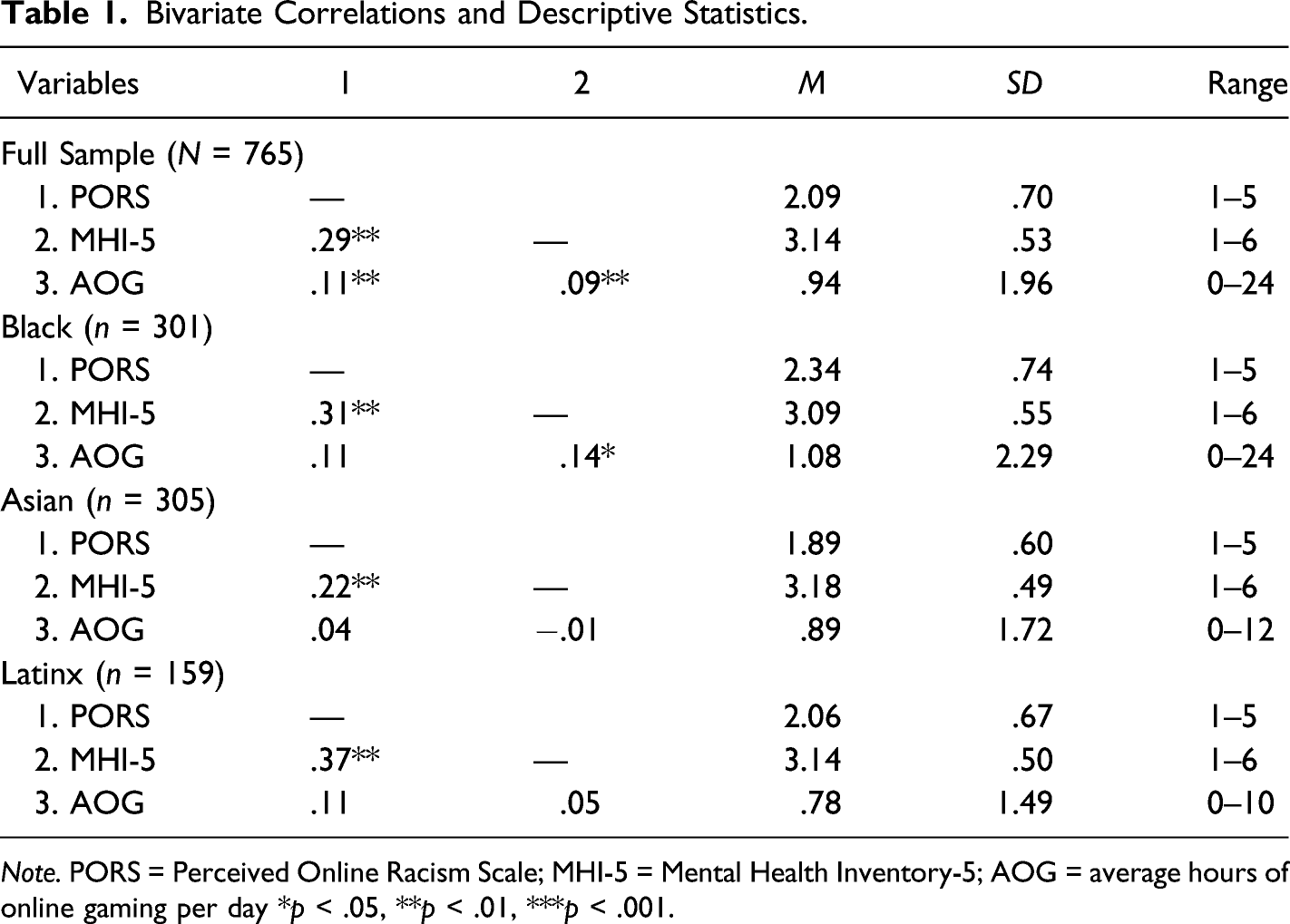
We used Mplus 8.0 (Muthen & Muthen, 2017) to test the hypothesized mediation model (Figure 1). We controlled for gender by regressing PORS on gender given prior research suggesting differences in the report of online racism across women and men. We evaluated model fit using recommended fit indices (Hu & Bentler, 1999): (a) comparative fit index (CFI; > .95 for good fit; .92–.94 for adequate fit), (b) the standardized root mean square residual (SRMR; close to <.08 for acceptable fit), (c) and the root mean square error of approximation (RMSEA; close to <.08 for acceptable fit). To examine specific path coefficients and indirect (i.e., mediation) effects, we followed best practices (Hu & Bentler, 1999) and adopted the bootstrap method using 5000 random samples. We used the 95% CI to assess the significance levels: if the 95% CI did not include a zero, the estimates were considered significant at the p < .05 level. Table 1 lists the bivariate correlations and descriptive statistics for the full sample and for the three racial groups. Mediation model of perceived online racism as a mediator between hours of online gaming and psychological distress. Note. PORS = Perceived Online Racism Scale; MHI-5 = Mental Health Inventory-5; AOG = average hours of online gaming per day. *p < .05, **p < .01, ***p < .001. Bivariate Correlations and Descriptive Statistics. Note. PORS = Perceived Online Racism Scale; MHI-5 = Mental Health Inventory-5; AOG = average hours of online gaming per day *p < .05, **p < .01, ***p < .001.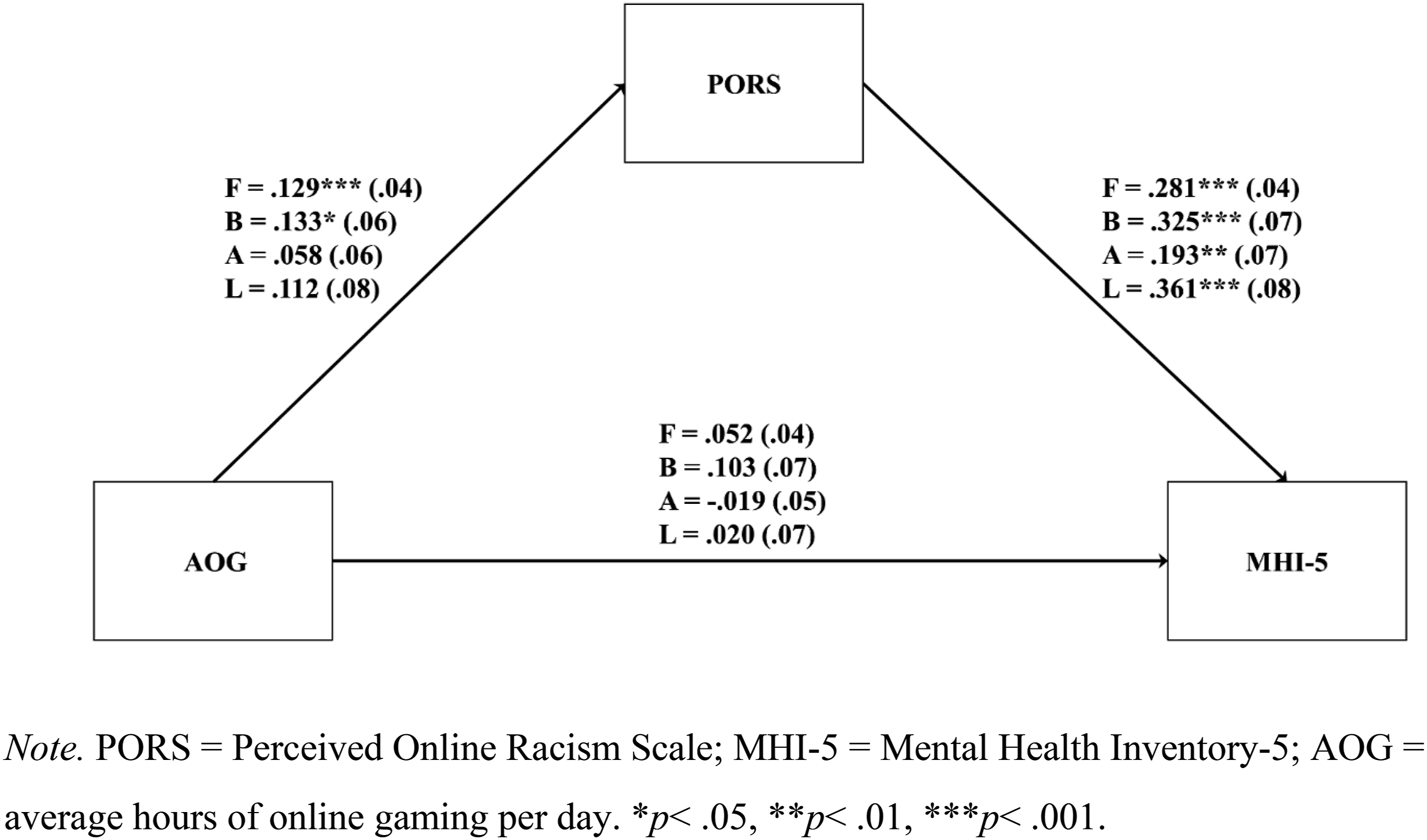
Results
Table 1 lists the descriptive statistics and bivariate correlations for the full sample and across the three racial/ethnic groups examined in the current study.
Base Model with Full Sample
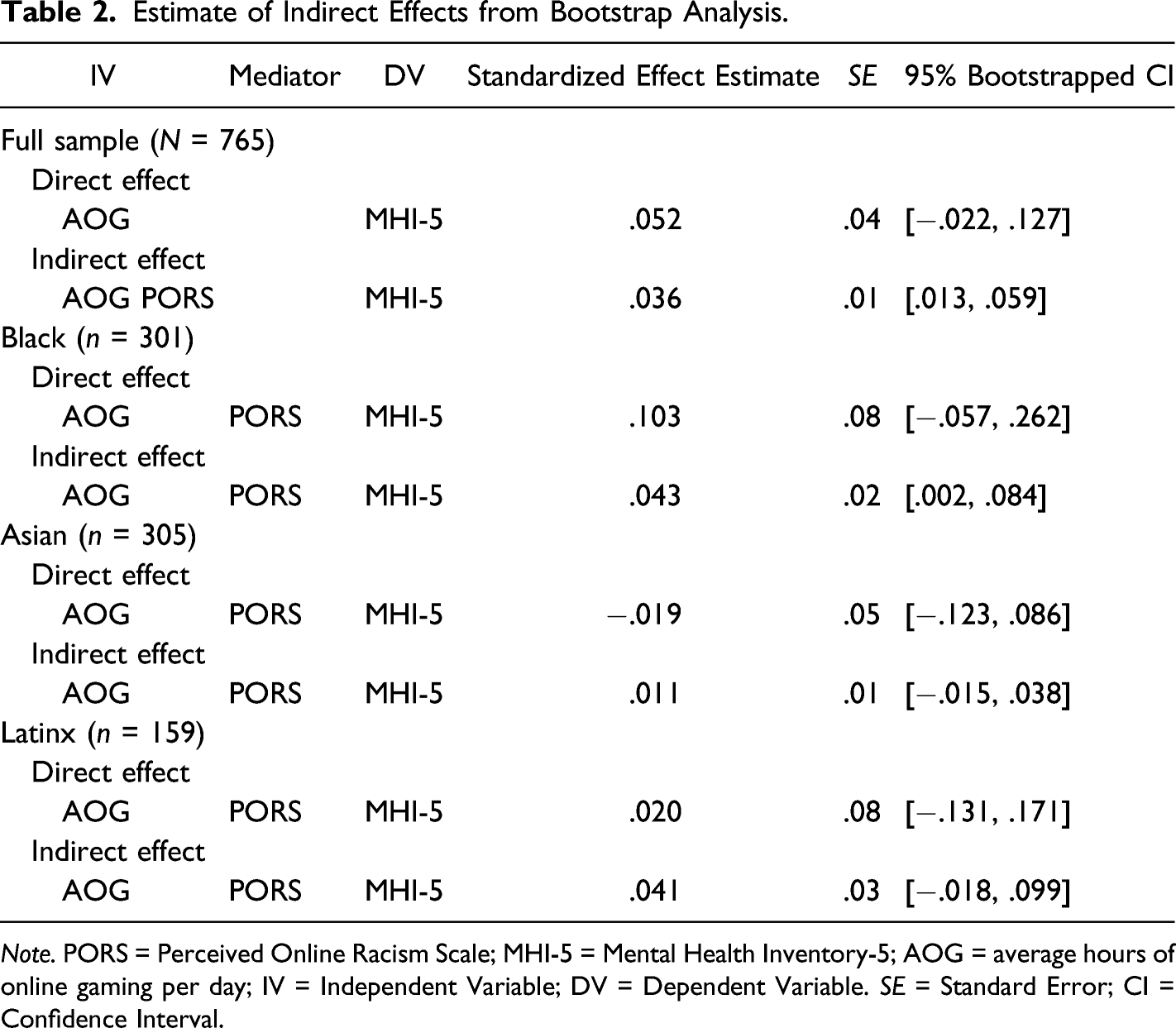
Estimate of Indirect Effects from Bootstrap Analysis.
Note. PORS = Perceived Online Racism Scale; MHI-5 = Mental Health Inventory-5; AOG = average hours of online gaming per day; IV = Independent Variable; DV = Dependent Variable. SE = Standard Error; CI = Confidence Interval.
Multi-Group Analysis Across Racial Groups
To examine the hypothesized mediation paths across the three racial groups (Black, n = 301; Asian, n = 305; Latinx, n = 159), we first tested whether the structural paths were equivalent across the three conditions by conducting a multi-group analysis. Specifically, we compared an unconstrained model that allowed the structural paths to be freely estimated across the three groups and a constrained model that fixed the corresponding structural paths to be the same across the three groups. Model fit indices showed that for the unconstrained model, the overall model fit was adequate: χ2 = 5.843, df = 3, p = .120; RMSEA = .061 (CI = [.000, .135]); CFI = .958; SRMR = .023. The constrained model also showed adequate fit indices: χ2 = 11.443, df = 11, p = .407; RMSEA = .013 (CI = [.000, .068]); CFI = .993; SRMR = .049. Because these two models were nested, we conducted a scaled chi-square difference test: Δχ2 = 5.743, Δdf = 8, p = .676. This indicated that the overall fit for the constrained model was not significantly different than the unconstrained model when we fixed the structural paths to be equal across the three groups and suggested that our hypothesized path model did not show significant differences across the three groups. We retained the constrained model and estimated the bootstrapped (5000 random samples) standardized path coefficients (Figure 1) and the indirect effects for the three groups (Table 2).
For the Black racial group, the direct effect of AOG on MHI-5 was not significant (β = .103, 95% bootstrapped CI = [−.057, .262]). The indirect effect was significant (β = .043, 95% bootstrapped CI = [.002, .084]). In line with our hypothesis, results suggested a complete mediation and the model accounted for 12% of variance in MHI-5. Contrary to our hypothesis, for the Asian group, neither the direct (β = −.019, 95% bootstrapped CI = [−.123, .086]) nor the indirect effects (β = .011, 95% bootstrapped CI = [−.015, .038]) were significant. Similarly, for the Latinx group, neither the direct (β = .020, 95% bootstrapped CI = [−.131, .171]) nor the indirect effects (β = .041, 95% bootstrapped CI = [−.018, .099]) were significant.
Discussion
This is the first study to quantitatively examine the negative psychological impact of online racism linked to online gaming. As hypothesized, with the full sample of racial minority emerging adults and with gender controlled, we found evidence of complete mediation in which time spent in online gaming predicted greater exposure to online racism, which in turn was linked to higher psychological distress. However, when we conducted a multi-group comparison across the three racial groups (Black, Asian, and Latinx), neither the direct nor indirect effects of the model were significant for the Asian and Latinx groups. Time spent in online gaming was significantly associated with psychological distress with exposure to online racism explaining this association only for Black emerging adult gamers. Overall, the unjust digital reality of experiencing psychological distress associated with online racism and gaming may be most salient among Black individuals (Gray, 2012).
The findings reflect the significance of anti-Black attitudes and aggression in online gaming communities (Daniels & Lalone, 2012; Gray, 2012). Coupled with the trend that Black players spend the most time in online gaming (Gray, 2015; Ortiz, 2019), it is likely that the Black emerging adults in the current study may have been at greater risk of facing psychologically harmful racism in online gaming. Notably, they reported a higher average number of hours of online gaming per day and mean perceived online racism scores than Asian and Latinx individuals. Black individuals are likely navigating an online gaming world in which players may re-enact their white supremacy beliefs in society by using anti-Black stereotypes and deviant labeling in their “trash talking” as means to convey a type of dominance in competitive games (Gray, 2012). In this process, Black players may also be targets of scapegoating in which any experience of deviance and negativity (e.g., losing) in online gaming are talked about as if associated with being Black (Gray, 2012).
Contrary to our hypothesis, exposure to online racism was not significant in explaining the link between online gaming and psychological distress among Latinx and Asian emerging adults. Although the results suggested that the hypothesized paths fit equivalently and that online racism likely has a similar function across the three groups, the indirect effect was only significant among Black individuals. Group-specific correlations indicated that average hours spent in online gaming per day was significantly and positively correlated with psychological distress only for Black individuals. Whereas online racism likely made online gaming a psychologically stressful experience for Black individuals, Asian and Latinx individuals did not report distress associated with online gaming. One possibility may be related to the effectiveness and differences in the strategies employed to deal with racism in online gaming and whether the amount of racism encountered appears manageable (Ortiz, 2019). For Black individuals, the pervasiveness of anti-Black racism may make it difficult to constantly manage the racist interactions and messages. The significance of psychological distress may even reflect the psychological toll of employing active and reactive strategies to retaliate against the perpetrator (Carter, 2007). Although not examined in the current study, another possibility may be whether the protective factors such as ethnic–racial socialization (i.e., messages that parents send to their children to manage racism and race-related experiences) played any role in how Black emerging adult gamers in the current study were dealing with racism in online games. For instance, despite some of the protective functions of ethnic–racial socialization messages in coping with racism in the offline settings, Keum and Ahn (2021) found that ethnic–racial socialization messages did not buffer psychological distress and alcohol use severity associated with online racism.
On the other hand, for Asian and Latinx individuals, the amount of racism they face in online gaming communities may be more manageable via active coping behaviors and resistance in the form of a strong ethnic identity. Furthermore, literature suggests that some Asian and Latinx individuals may endorse colorblind racial attitudes and deny the reality of racism and take racism less seriously (Hayes & Scharkow, 2013). Taken together, it is likely that the non-significance for Asian and Latinx groups reflects the dominant narrative of anti-Black hate speeches in online gaming communities (Gray, 2012) that may yield disproportionately worse psychological costs among Black individuals compared to other racial minority groups (Jones, Mitchell, Turner, & Ybarra, 2018).
Despite the noteworthy findings, there are several limitations for the current study that inform future research. First, although the current study tested a mediation model, given the cross-sectional design, the results do not establish causality. Future studies would need to incorporate longitudinal designs to assess the temporal process of the findings. Second, the multi-group analysis was limited to Black, Asian, and Latinx participants due to sample size limitations. Hence, we cannot generalize the findings to other racial minority groups (e.g., Middle Eastern, Native Indians, etc.) and future studies should replicate and expand empirical investigations of psychological costs associated with online racism in gaming. Third, although we controlled for gender in the current study, it would be important for future studies to examine women of color gamers’ experiences specifically as they likely experience disproportionately greater psychological costs associated with racism in games than men of color. Literature suggests that women of color gamers face the compounding of racism and sexism in games (Gray & Leonard, 2018). Women of color have also been found to experience online racism at higher rates than men of color (Keum & Miller, 2018b) and online racism was associated with alcohol use severity via social media–related stress for women of color but not for men of color (Keum & Cano, 2021). Fourth, in operationalizing online gaming experiences, we assessed participants’ average hours spent per day on online gaming. Other relevant personality characteristics and online gaming tendencies such as problematic online gaming (Király, Nagygyörgy, Griffiths, & Demetrovics, 2014) may have provided additional context to how online gaming may be associated with online racism. Relatedly, we did not assess any additional variables that could contextualize the non-significant findings among Latinx and Asian individuals. Future studies should examine variables such as colorblind racial attitudes and coping strategies for a more nuanced understanding of the racial differences. Future studies should also test other relevant psychosocial outcomes such as loneliness, depression, and anxiety to understand additional dimensions of the psychological impact. Last, the findings are based on self-report data subject to rater bias and should be interpreted with caution.
In conclusion, racism in online gaming is an unjust digital burden among racial/ethnic minority emerging adults, particularly for Black individuals. The results suggest that Black players are at greater risk of experiencing psychological distress associated with online gaming and racism compared to Asian and Latinx individuals. Findings from this study may help inform the development of interventions to mitigate the harmful psychological impact. The findings can also inform structural and policy level initiatives to address the pervasive anti-Black racism in the online gaming world at the systemic level.
Footnotes
Author’s Note
Brian TaeHyuk Keum, Department of Social Welfare, University of California, Los Angeles, Los Angeles, California, United States and Maynard Hearns, University of California, Santa Cruz.
Author Contribution
Brian TaeHyuk Keum, PhD, is the sole contributor for this article.
Declaration of conflicting interests
The authors declared no potential conflicts of interest with respect to the research, authorship, and/or publication of this article.
Funding
The authors received no financial support for the research, authorship, and/or publication of this article.
