







Abstract
With the proliferation of technologies and digital platforms, contemporary game development firms’ value propositions have become more complex. While on a global scale a considerable share of the game industry’s revenue is captured by a few dozen firms, we are also witnessing the emergence of local and regional hotspots. In this context, legitimacy is of utmost importance if new competitive advantages are to become institutionalized as an industry. This paper extends studies which have offered temporal snapshots to the regional or local formation of game industry by focusing on the Finnish context. The concept of resilient values is introduced as legitimizing how the game industry is shaped and how the values are interpreted to develop the industry further. Our findings suggest legitimacy is intertwined with resilient values, thus resulting in the industry evolving over time through three different stages: (1) incubation period, (2) growth phase, and (3) institutionalized legitimacy.
Introduction
With the proliferation of technologies and digital platforms, contemporary game development firms’ value propositions have become more complex (Zackariasson & Wilson, 2013). At the same time, as Kerr (2017) has observed, a considerable share of the video game industry’s global revenue is captured by a few dozen firms, but apart from this consolidation there are numerous local and regional hotspots where game development firms of various sizes are creating games with diverse esthetics and value propositions (e.g., Jørgensen, 2019; Keogh, 2019b; Sotamaa, 2021). Building on this, Keogh (2019a) posits that the hype surrounding the rapid increase of video game industry’s global revenues has meant that the field’s local settings and practices have received less attention. Thus, to better understand the dynamics of video game production, we need more studies looking at the local institutional settings that shape and are shaped by actors embedded in those settings.
Contributing to our understanding of local video game production (e.g., Kultima, 2018), this paper looks at the Finnish video game industry from an institutional theory’s point of view to study the industry’s formation and legitimation ever since its inception in the early 1990s. Extant research on industry formation (Aldrich & Fiol, 1994) and institutional theory (e.g., Bitektine & Haack, 2015; Battilana, Leca, & Boxenbaum, 2009; DiMaggio, 1988) argues for the importance of legitimacy in institutionalizing practices, firms, and industries. More specifically, while earlier studies on the video game industry have mostly focused on technology as driving and enabling change (e.g., Aoyama & Izushi, 2003; Schilling, 2003), we join Keogh (2019b) in shedding light on the video game industry formation at a local level by drawing attention to how resilient values (e.g., Kraatz, Flores, & Chandler, 2020) as a founding myth for the industry legitimize the emergence of the Finnish video game industry. Here, founding myth is understood as a collectively shared narrative aimed at rationalizing the industry’s existence (Meyer & Rowan, 1977). In addition, we understand resilient values as a multilevel construct (spanning individuals and institutions) that are shaped by and shape individual and collective actions. Following Kluckhohn (1951, p. 395), value is understood as “a conception, implicit or explicit, distinctive of an individual or characteristic of a social group, of the desirable that influences the selection from available modes, means, and ends of action,” and a value can become resilient when it stands the test of time.
By going beyond temporal snapshots (e.g., Cohendet, Grandadam, & Simon, 2010; Hirsch, 1972; Keogh, 2019b) or single organizations (Drori & Honig 2013) of industry formation, this paper highlights the importance of the institutional dimension as the industry is shaped over time. To this end, we ask the following research question:
How do resilient values as a founding myth legitimize the institutionalization of the Finnish video game industry over time?
We argue that creative industries differ from other industries based on their strong foundations in values (Kraatz et al., 2020). Competitive advantages do not come only from traditional factors of competitive advantage such as price, location, and speed but also from esthetic judgements when developing games (Salen & Zimmerman, 2003; Schell, 2008). Answering Sotamaa’s (2021) call for studies combining both the macro and the micro level, with this longitudinal study we contribute to the existing body of knowledge that looks at video game production in geographically situated contexts (e.g., Jørgensen, 2019; Keogh, 2019b). We do so by drawing on institutional theory to explain how the video game industry in Finland seems to have been developed by embedded actors that utilize resilient values as a discursive strategy, first to demarcate the boundaries of the industry and later to expand those boundaries.
The rest of the paper is structured as follows: First, we discuss how game design as a practice is related to design more broadly, after which we cover literature on firm agglomerations. Next, we introduce the research context and methodology, after which findings are presented and discussed. Finally, the concluding section marks the end of this paper.
Literature Review
Research on Firm Agglomerations In and Outside Creative Industries
While in popular and professional discourse, the “ecosystem” concept has been gaining currency as a way to conceptualize collaboration across firms and other organizations, in academic literature there are several overlapping concepts on a firm agglomeration such as cluster (Lazzeretti, Boix, & Capone 2008), value creation network (Ramírez & Mannervik, 2016), ecosystem (Moore, 1996), and community (Hirsch, 1972). Although the purpose of this paper is not to resolve fuzziness between the concepts, we wish to highlight that clusters and networks for instance are often understood as coordinated agglomerations of firms where the “sum is bigger than its parts” (e.g., Porter, 1998), whereas ecosystems focus more on future-making, agency, and intentionality. In addition, given that ecosystem as a concept was initially coined in biology (Costanza et al., 1997), in managerial parlance it also has a certain organic tone to it, and thus it seems to be less about direct profit-seeking and more about exploration through cooperation or coopetition (Bengtsson & Kock, 2000). What is more, in our research context the practitioners often refer to the video game industry in Finland as an ecosystem, so keeping in line with the research context, we will be using the word ecosystem throughout this paper.
Research on firm agglomerations has predominantly focused on activities that directly add value to firms’ activities. For instance, the open innovation paradigm has highlighted the importance of diversifying the sources for new ideas and pathways to the market (Chesbrough, 2006), and research focusing especially on multinational corporations (MNCs) has argued for clustering to bring about benefits in terms of performance or access to local knowledge pools. Building on this, being physically close to clients or suppliers can also give rise to new innovations or knowledge through cross-pollination (Chesbrough, 2010). From a more strategic perspective, agglomerations can help firms evaluate their strategic positioning and value chains (Chesbrough, 2006, 2010), thus drawing attention to clustering as a dynamic process.
In terms of how ecosystems are organized, studies have conceptualized them as firm-centric (Basole, 2009), product or service oriented (Ceccagnoli, Forman, Huang, & Wu, 2012), or based on a geographic location (Cohendet et al., 2010). Iansiti and Levien (2004, 74) further granulate the picture by categorizing actors into niche players, keystones, and dominators. What is worth noting here is the underlying tone in agglomeration research that highlights the profit-driven agenda. Few exceptions exist, however, and Porac, Thomas, and Baden-Fuller’s (1989) classic study on Scottish knitwear manufacturers reveals how a shared identity amongst managers helped in establishing boundaries for the manufacturers as a community. Similarly, Cohendet et al. (2010) and Lazzeretti et al. (2008) draw attention to the peculiarities in creative industries; design-driven firms do not seem to cluster because of knowledge and profits per se, but instead value creation relies on the production of cultural signs and symbols (Lash & Urry, 1994). Given that the agglomeration dynamics seem to differ between design-driven firms and other industries, this paper sheds light from a longitudinal practice how this agglomeration happens based on shared values (Kraatz et al., 2020).
From the perspective of the video game industry, we still know relatively little of the dynamics through which companies and other actors come together in geographical contexts. As Kerr (2017) and Keogh (2019b) posit, the global monetary value of video games has risen remarkably over the last two decades or so. Yet, we often seem to ignore the industry-level peculiarities as video game industry clusters are now found not only in the US and Japan, but also in the UK, Canada, China, Poland, and Finland, to name but few examples (e.g., Jiang & Fung, 2019). Thus, although on a global level we are witnessing a consolidation of revenue, at the same time the industry is becoming more complex and nuanced on a national level (Keogh, 2019b). As such, more studies are needed to understand the formation of the video game industry in local institutional settings. Here, we turn to institutional theories as a potential way forward in theorizing on the institutional logics of video game industry formation.
Institutional Theory and Entrepreneurship: The Role of Actors in Change and Status Quo
Research on legitimacy has become one of the central areas for theory development in organization and management studies (Battilana et al., 2009; Bitektine, 2011; Bitektine & Haack, 2015). Institutional theory is concerned with how organizations shape and are shaped by institutions (DiMaggio & Powell, 1983; Scott, 1987, 2014). Earlier work (e.g., DiMaggio & Powell, 1983; Selznick, 1957) focused on the relationship between an organization and the surrounding environment, as well as how organizations within a specific industry come to resemble each other. More contemporary studies have focused, for instance, on how institutional theory explains the formation of new industries (Aldrich & Fiol, 1994) and how actors—institutional entrepreneurs (DiMaggio, 1988; Eisenstadt, 1980)—engage in changing or shaping those institutions in which they are embedded. As Suddaby, Bitektine, and Haack (2017) note, legitimacy as a theoretical construct has been plagued by ambiguity, and for conceptual clarity, they break down legitimacy as property, process, and perception. Similarly, Human and Provan (2000) highlighted legitimacy’s complex nature by showing how it changes over time. In their study on educational organizations, Dowling and Pfeffer (1975) found that an incongruence between the organization’s values and the surrounding society’s values downplayed the former’s legitimacy. Here, incongruences in values can serve as a sounding board for industry-level development, especially when the industry itself is experiencing stable growth in terms of revenue.
Despite the diversity of approaches to institutional theories, they all seem to understand institutions in a more or less similar fashion. Scott (2014, p. 56), for instance, defines institutions as comprising “regulative, normative, and cultural-cognitive elements that, together with associated activities and resources, provide stability and meaning to social life.” Here, the notion of stability is essential as it is the homogenization of a field that enables actors to rationally deal with uncertainties and constraints (DiMaggio & Powell, 1983). As a consequence, prior studies on institutional theories have explained institutional change or emergence to occur either through external shocks (e.g., Battilana et al., 2009) or (lack of) legitimacy (e.g., Aldrich & Fiol, 1994; Bitektine, 2011). More recently, however, a growing body of empirical evidence also suggests that institutional change can be enacted by actors embedded in said institutions and literature has defined these actors as institutional entrepreneurs (Battilana et al., 2009; DiMaggio, 1988; Hardy & Maguire, 2008).
Thus, drawing attention to the micro and macro foundations of institutions as a multilevel construct, Bitektine and Haack (2015, p. 50) argue legitimacy to be one of the key dimensions through which institutions are maintained and changed. In line with Suchman’s (1995, p. 574) work on legitimacy, we understand it as follows: “a generalized perception or assumption that the actions of an entity are desirable, proper, or appropriate within some socially constructed system of norms, values, beliefs, and definitions.” As such, while legitimacy of a given industry or organization is a collective perception, legitimation as a process takes place between institutions and individual actors (Bitektine & Haack, 2015). More specifically, looking at existing institutions, Bitektine and Haack (2015) theorize legitimacy to emerge from institutional validity and individual propriety. While the former is a collective consensus of an organization’s or industry’ legitimacy, the latter is an individual-level judgment that shapes and is shaped by institutional validity. For example, media, government, or the judicial system can influence legitimacy, and similarly public opinion also matters here (Bitektine & Haack, 2015). In other words, whether or not an industry or an organization is seen as legitimate, is a complex process between the micro and the macro levels and often with competing legitimacy judgments (arguments for and against joining the European Union or criminalizing loot boxes in video games are prime examples of competing legitimacy judgments).
Above, we have shown how legitimacy is created from the interplay between micro and macro level, but we also need to understand what the conditions for organizations and industries are to emerge as legitimate. Given that established industries already enjoy the benefits of a “social space” (Delacroix & Rao, 1993), emerging industries can draw on the legitimacy of established institutions or organize collective lobbying efforts (Aldrich & Fiol, 1994). Building on this, Battilana et al. (2009) show how external jolts and shocks, heterogeneity, and degree of institutionalization can enable institutional change. They (Battilana et al., 2009) continue by discussing strategies through which actors (either individually or collectively) can support institutional change (i.e., increase legitimacy): here, issues pertaining to social positioning are crucial, and Battilana et al. (2009, p. 79) suggest motivational framing as one crucial strategy for legitimizing change. More specifically, motivational framing aims at creating a vision for change and this, in turn, enables to mobilize both allies and resources—both elements being crucial when it comes to enacting change.
In line with the above, we argue resilient values (in line with Kraatz et al. 2020) to be a critical component when it comes to mobilizing allies and resources needed for institutional development and change. As Battilana et al. (2009) argue, in heterogenous settings (i.e., the formation of new industries) discourses for institutional change need to resonate with the values and interests of multiple stakeholders. In this context, and drawing on the ecological perspective of resiliency (Clapham, 1971; Westman, 1978), we understand resiliency as an absorptive and elastic capacity to endure uncertainty and ambiguity. As such, resilient values form a critical element in the emergence of new industries as well as developing their legitimacy, both on the micro and the macro level.
To conclude, extant research has greatly increased our understanding of institutions and how they shape actors and behavior, and more recently Bitektine and Haack (2015) have called for a multilevel theorizing of the interrelated relationship between the macro and the micro level. In addition, institutional entrepreneurship (e.g., Battilana et al., 2009; DiMaggio, 1988; Eisenstadt, 1980) posits that actors embedded in the institutions can drive change, and similarly Aldrich and Fiol (1994) show how emerging industries build up their legitimacy. In essence, legitimation is a process that contributes to institutionalization that, in turn, takes place between institutions and individual actors. More specifically, by looking at a non-traditional context (i.e., outside Japan and the US, as per Kerr, 2017), our study sheds light from a longitudinal perspective how video game development matures into an industry by drawing on resilient values as one of the main discursive strategies (as per Vaara & Tienari, 2008).
Research Context
The founding myth of the Finnish game industry is often traced to Future Crew, one of the most well-known Finnish demogroups, that was established in 1986 (e.g., Lappalainen, 2016). Demogroups are loose collectives aiming at creating computer-based audio-visual demos that illustrate the hardware’s capabilities. Although commercial video games were released in Finland prior to 1986 (Jørgensen, Sandqvist, & Sotamaa, 2017), in academic and popular accounts Future Crew is often mentioned as one of the most important foundations of the Finnish game industry as many of Future Crew’s core members went on to establish some of the earliest video game companies in Finland.
For its members, Future Crew provided a safe space to focus on their hobby (Jørgensen et al. 2017; Saarikoski & Suominen 2009; Lehtonen, Ainamo, & Harviainen, 2020): getting familiar with computers and exploring what could be done with them. During the last two decades of the 20th century, playing computer games or being interested in computers was seen as a fringe activity, something nerdy, and some parents of the Future Crew’s members were concerned about their children’s future. Thus, for the members of Future Crew, establishing a shared identity based on common interests and values was seen as a way to cope with the pressure and prejudice coming from the external environment.
Future Crew’s future and legitimacy was boosted by both international recognition as well as organizing Assembly (1992-), one of the globally most well-known demo scene and gaming events. While Assembly and Future Crew were gaining recognition amongst hobbyists and computer enthusiasts not only in Finland but globally, transitioning from a hobby to a legitimate profession was still seen as far-fetched in the Finnish context. In 1995, some of the Future Crew members established Remedy Entertainment, a company focusing on video game development, and although their first game, Death Rally, was a commercial success, their second game, Max Payne, solidified their status in Finland as the game not only turned out to be a remarkable success commercially speaking, but it was also converted into a Hollywood film in 2008.
Despite Remedy Entertainment’s commercial successes, the Finnish game industry was relatively nascent throughout the 1980s and the 1990s. Nokia, as a Finnish mobile phone manufacturer, started investing heavily in mobile games in the beginning of the 21st century, and thus several Finnish game development studios acquired outsourcing projects from Nokia. Although Nokia’s success with mobile games was rather minuscule, its investments in the Finnish game industry nonetheless had far-reaching influence as one of their subcontractors, Relude (Rovio Entertainment), released the Angry Birds game for iPhones in 2009. Angry Birds’ global commercial success implied for the Finnish game industry increasing interest not only from media outlets but also from venture capital firms, potential employees, and platform owners Apple and Google.
In many ways, Angry Birds’ success in 2009 was a watershed moment for the Finnish game industry as the number of firms established, investments, number of employees, and foreign acquisitions has increased ever since. Rovio’s success with Angry Birds, however, was by no means an exception to the rule. Supercell has become one of the most profitable mobile game companies globally, and similarly companies such as Frogmind, Small Giant Games, Housemarque, and Next Games illustrate how the Finnish game industry has been able to solidify its status as one of the leading countries in the mobile game industry.
Methodology
Data for this longitudinal study spanning nearly one decade was collected in two phases in order to explore the concept of ecosystem in the video game industry. In addition, due to the longitudinal research design, this study focuses on rather senior informants. This has allowed us to investigate how individuals embedded in the context have experienced and made sense of the developments taking place in the industry. We chose to focus on Helsinki specifically as almost every second game development company is located there (Neogames, 2017, 2019) and the historical origins of the Finnish video game industry are also situated in the capital region (e.g., Lappalainen, 2016; Sotamaa, 2021).
Previous studies (Arnheim, 1972a, 1972b; Davison, McLean, & Warren, 2015; Höllerer et al., 2018; Meyer, Jancsary, Höllerer, & Boxenbaum, 2018; Steyaert, Marti, & Michels, 2012) have shed light on the analytical and methodological power visual methods have, and their use is justified especially in contexts where the respondents are invited to reflect on changes in themselves and their surroundings over time (Bryans & Mavin, 2006, p. 14; Lehtonen, 2020). In other words, while verbal communication tends to focus on more cognitive and articulated sense-making, visual focuses more on the selusive or difficult to articulate aspects (e.g., Toraldo, Islam, & Mangia, 2018), and their combination can reveal something that otherwise would remain unnoticed (e.g., Lefsrud, Graves, & Phillips, 2020). For instance, Venkatraman and Nelson’s (2008) photo-elicitation study showed how visual methods can help the respondents explore their subconsciousness (see also Zaltman, 2003); instead of simply generating visual data, talking about the drawings with the researcher enables the respondent to explore meanings and thoughts even further (Renaud, Comeau-Vallée, & Rouleau, 2021). Having said that, due to the relative novelty of drawing-based research methods (Steyaert et al., 2012), most studies—including this one—have devised a bespoke approach to collecting and analyzing data involving visual material.
Building on the above, since this paper deals with values and ecosystems, we decided to complement interviews with drawings because the latter have the potential to explore elusive and unconscious thoughts (e.g., Toraldo et al., 2018; Vince, 1995). Between 2012 and 2014, we interviewed 15 individuals working in the game industry in Helsinki, Finland, and at the end of each interview, we asked the participants to draw the Helsinki game industry ecosystem. Between 2018 and 2020, we repeated the drawing task with the same respondents, and in the interview part, we focused on how the drawings had changed as well as possible reasons behind these changes. In the second phase of this study, we showed to the participant their previous drawing once they were done with the second one, thus allowing them to reflect on what had happened between the drawings. In line with the first study, in the second phase we invited the respondents to draw the ecosystem by asking the same question: “Could you draw the game industry ecosystem in Helsinki from your perspective?”. By collecting drawings, we have been able to enrich interviews by contextualizing them as well as allowing the participants to focus on matters we might have otherwise ignored (as per Renaud et al., 2021).
List of respondents and when data was collected.
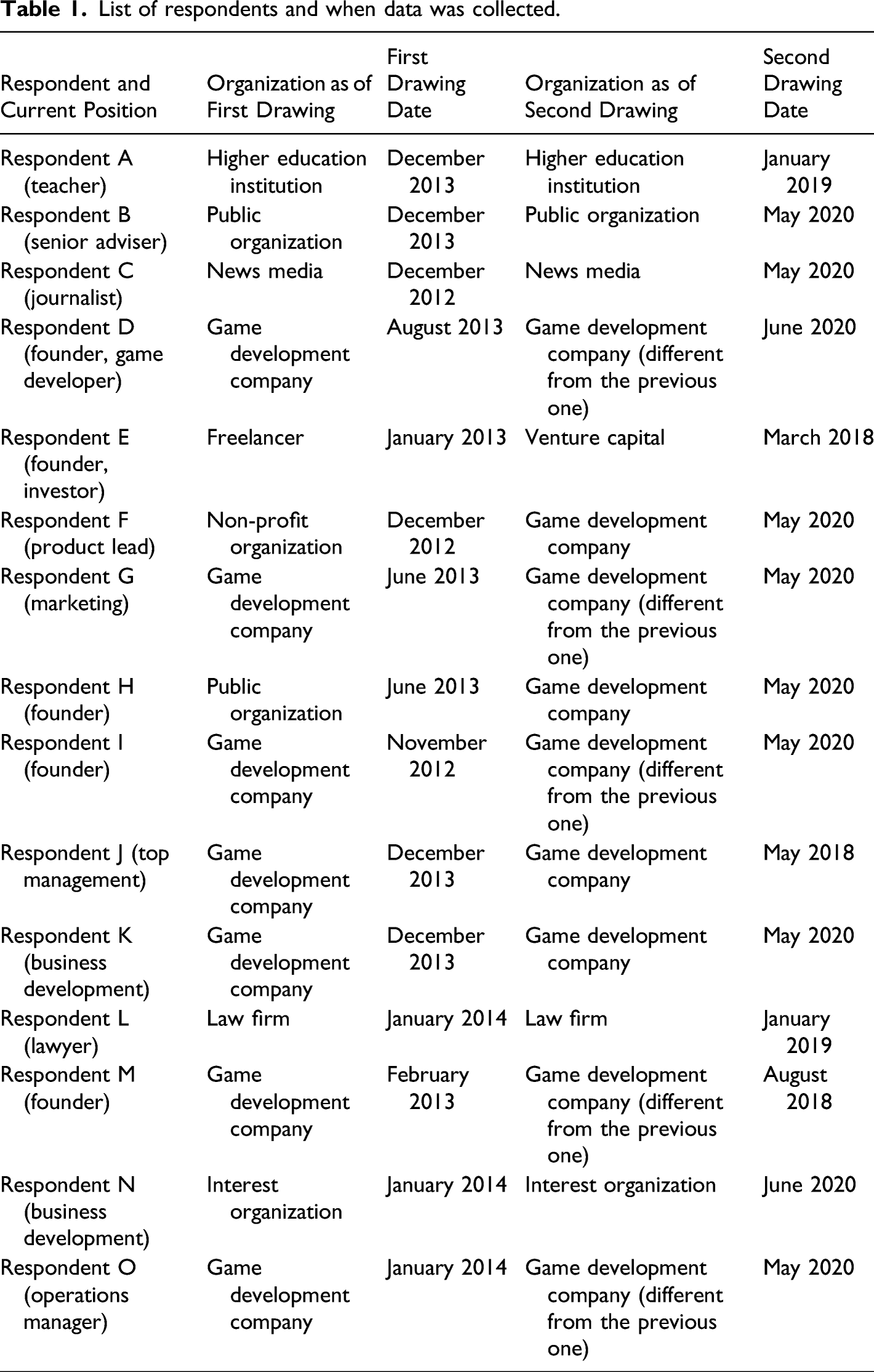
On average, each interview lasted about 60 minutes and they were conducted in either English or Finnish. In addition, interviews were transcribed verbatim to allow us to analyze them in a more granulated fashion. Moreover, during the second round the interviewees were told in advance they would be doing the drawing task once again. Data in the first phase was collected by the first author, and the first and the second author conducted data collection in the second phase as well as collectively analyzed the data from both phases. The third author, being part of the first study and data analysis process, provided a fresh pair of eyes to the second dataset. After each interview, we uploaded the drawings and the transcripts into a cloud folder so each author would have access to the dataset.
Data Analysis
Instead of analyzing the drawings and verbal accounts as static representations of ecosystems, we draw on Kress and van Leeuwen (2006, p. 59) who understand drawings as dynamic illustrations or narratives: “narrative patterns serve to present unfolding actions and events, processes of change, transitory spatial arrangements.” In addition, our data analysis also borrows from Renaud et al. (2021) in the sense that the analysis process was abductive in nature. More specifically, while we entered the field with our theoretical understanding in mind, due to the elastic nature of the drawings we could also analyze the informants’ perceptions by not imposing any theoretical frameworks on the data. To frame the analysis process, we created a table with rows consisting of the respondents (e.g., informant’s both data collection instances grouped together to allow for comparisons) while columns had four themes (values, actors, legitimacy, and changes). In each cell, we included excerpts from the interviews and elements from the drawings that we felt revealed something about the column in question. Here, we guided the analysis process by asking ourselves three questions (i.e., How are the narratives connected/contrasted? What does the informant want to highlight? and How does the data relate to what we already know?) as we went through the drawings and the transcripts.
This standpoint lends itself to two notions. First, there are certain visual symbols (e.g., lines and arrows) that indicate spatio-temporal movement and second, utilizing drawings in a longitudinal study enabled us to explore such movements in a more granulated fashion. For example, instead of only relying on our analysis of the drawings, we could ask the respondents not only about the individual drawings but their relationship. Building on this, analyzing changes in the drawings as well as how the respondents talk about the changes (or lack thereof) helped us better understand to what extent the initial values in the ecosystem were still present in the data collection phases.
Findings and Discussion
Our data reveals how the game industry’s legitimacy is built on resilient values as a founding myth: values that do not seem to disappear and whose purpose changes over time from incubation to growth and ultimately consolidation, thus indicating how the founding myth and its affordances are elastically renegotiated to support the institutionalization process. More specifically, values guiding the development of the game industry in Finland have been defined by the practitioners as (1) openness (in terms of sharing connections and knowledge, for instance), (2) collaboration (across firm boundaries), and (3) sense of belonging (e.g., jointly celebrating individual successes) (see also Jørgensen et al., 2017; Sotamaa et al., 2019). These have been mentioned not only in our dataset but also in public discourses focusing on the industry (Lappalainen, 2016). While there is nothing unique in the values promoted by the Finnish game industry, how they have been utilized to develop the ecosystem is something theoretically relevant since the industry has developed not only based on monetary value, but by utilizing the founding myth to rationalize and legitimize “specific structural elements” (Meyer & Rowan, 1977, p. 347). Moreover, the Finnish game industry’s strong value-based ethos has attracted commercial success, thus ensuring a symbiotic relationship between growth and values. In other words, as long as the industry is growing, values are resilient because there is no need to question growth.
Our findings suggest legitimacy is intertwined with resilient values, thus resulting in the industry evolving over time through three different stages: (1) incubation period, (2) growth phase, and (3) institutionalized legitimacy. In the first stage, legitimacy was inside-out (as per Human and Provan 2000) to protect the industry’s fledgling identity, while in the second stage, legitimacy was built based on differentiating from similar hotspots globally as well as external actors acknowledging the industry’s existence. More specifically, public organizations, for instance, assumed the game industry to have commercial potential (and for good reasons, as Kerr, 2006, 2017 has illustrated), which is why they explicitly started supporting it. Finally, in the last stage, institutionalized legitimacy, the industry has reached a tipping point with diversification and consolidation taking place. What is more, physical manifestations (e.g., an internationally awarded museum of games, an example of a cultural symbol referred to in the literature review) also highlight the industry has achieved institutionalized legitimacy. Below, we will cover the phases separately, after which we bring them together by discussing the overarching development.
First Stage: Incubation Period
The initial stage was characterized by inside-out legitimacy, meaning that a shared identity was crafted to demarcate the community from the rest of the environment. This was not consciously an excluding act, but rather a result of people with similar interests coming together. One of our respondents has been regarded as one of the founding members of the Finnish video game industry, and during our interview they reflected on their decision to become an entrepreneur as being an outcome of many of their relatives being entrepreneurs. As studies have shown (Dyer & Handler, 1994), having entrepreneurs in the family can positively contribute to the person becoming an entrepreneur themself, and given that several of the founding members went on to establish firms, it could be argued that their proactive desire to identify and seize opportunities also contributed to the community moving on to lay the foundations for the industry.
In addition to internal identity-forming, external market demand also helped in providing the community with market opportunities. This was aptly illustrated in respondent C’s drawings and verbal account (see Figure 1). When the industry has grown, of course there have become maybe two generations and I’m a little bit worried about the development because in 2012, from 2012 to 2014, there was this golden startup age.Maybe I should draw actually a timeline to you too. Need to check things but, I skipped the prehistoric things here, and if I start from the rise of Supercell and Rovio, so it would be 2010. So rise of Supercell and Rovio embarked the international money flowing to the Finnish games industry. And it also sparked dozens of start-ups booming here in Helsinki. So from 2012 to maybe 14, there was a startup boom, then the stock listings and acquisitions were kind of a follow-up to the startup boom, because the best startups that raised millions of Euros were able to grow, they were able to grow because of the best talent that has been here in Nordics and has roots in nineties, that’s prehistoric age of Finnish games industry. (respondent C) Respondent C’s ecosystem visualizations.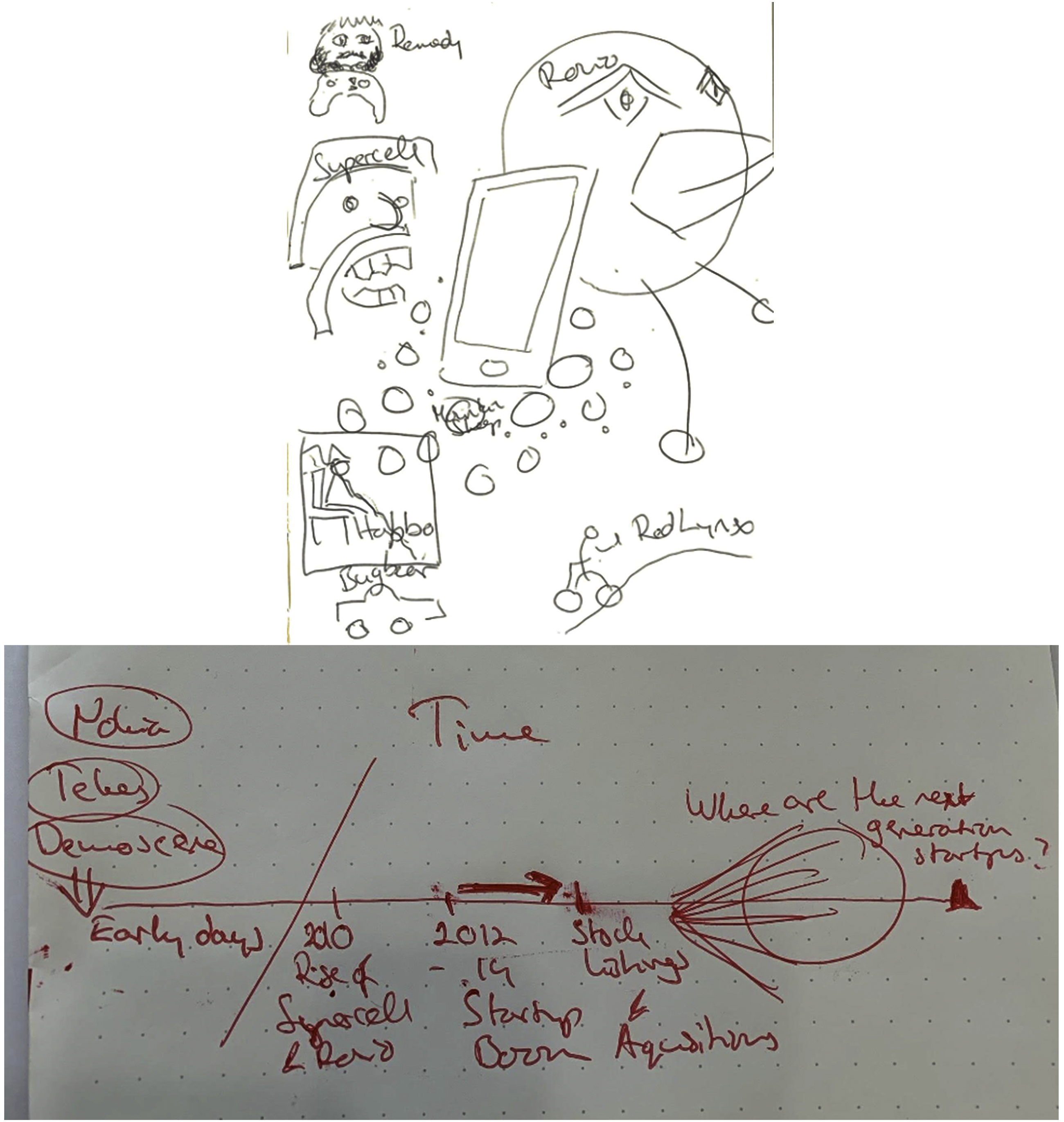
As the bottom (latter) visualization shows, Nokia’s (hardware manufacturer) role in supporting the nascent video game industry in Finland was tremendous, and as a result, in the top (former) visualization a game company (Remedy) is drawn as a seemingly old man, thus illustrating how companies established in the first phase are still active. Companies like Nokia indirectly supporting the growth of the Finnish game industry are seen as external recognition of the industry’s capabilities. In a similar vein, industry-specific events (such as Assembly) are understood as internally reinforcing the shared values; here, events are manifestations of the resilient values in the sense that they serve two purposes: first, they help in materializing and articulating the values, and second, they demarcate the industry from other, neighboring fields.
Given that emphasis in this first stage is on incubation, who or what manifests the values in the industry level is somewhat coordinated and based on internal legitimacy of the actors. For instance, members of the Future Crew were behind Assembly and some of the first Finnish game development companies. While this might resemble centralized planning, we understand the logic here to resemble Hirsch’s (1972) analysis of gatekeepers in the creative industries: those actors with more cultural and social capital are better suited to create institutionalized ventures and similarly their capabilities also play a role in materializing values through events and organizations. In other words, while access to financial capital also matters, in the incubation period those who were regarded as the primus motor are well suited to coordinate and steer the development. Thus, in the incubation phase, values not only help in framing the budding industry, but they can also be harnessed to enact and reinforce power relations between actors.
Finally, transitioning from the first to the second stage does not happen overnight, but instead it happens gradually when firms and interest organizations are being established. As such, first game development companies in Finland were established during the early 1990s and Neogames, an interest organization representing the Finnish game industry, was established in 2003.
Second Stage: Growth Phase
Whereas the previous stage was characterized by the core actors developing the ecosystem, in the second stage, growth phase, emphasis starts to shift from few actors to diversified growth and increased external recognition. In this stage, values are used to differentiate the ecosystem from other ecosystems to attract external recognition and strategic positioning (Figure 2). Consider the following account by respondent M, for instance. When we attended Slush [a major startup event] eight years ago, it was a tiny event in Cable Factory [Helsinki, Finland] with approximately 200 people attending the event. Growth here amongst startups and game industry, as well, has been tremendous. Already back then the Finnish game industry was strong, but only insiders knew this. If you attended GDC in San Francisco, people would recognize Finland and they would also know Finns develop games. But when Supercell and Rovio became famous around 2011-2012, the Finnish game industry became a national thing and soon everyone knew they develop games in Finland. It was no longer an insider thing. And after Supercell’s success there was yet another wave of success in the form of new game studios being established. One of Finland’s strengths has definitely been diversity. There are many developers here with courage to do new things. We do not want to start copying others. If someone is developing a certain game, there is no way we would start developing something similar. For single companies this might be risky, but for the ecosystem this is clearly a strength. There are always companies and people in the ecosystem who find the ‘right’ thing and when to make it happen. (respondent M) Respondent M’s ecosystem visualizations.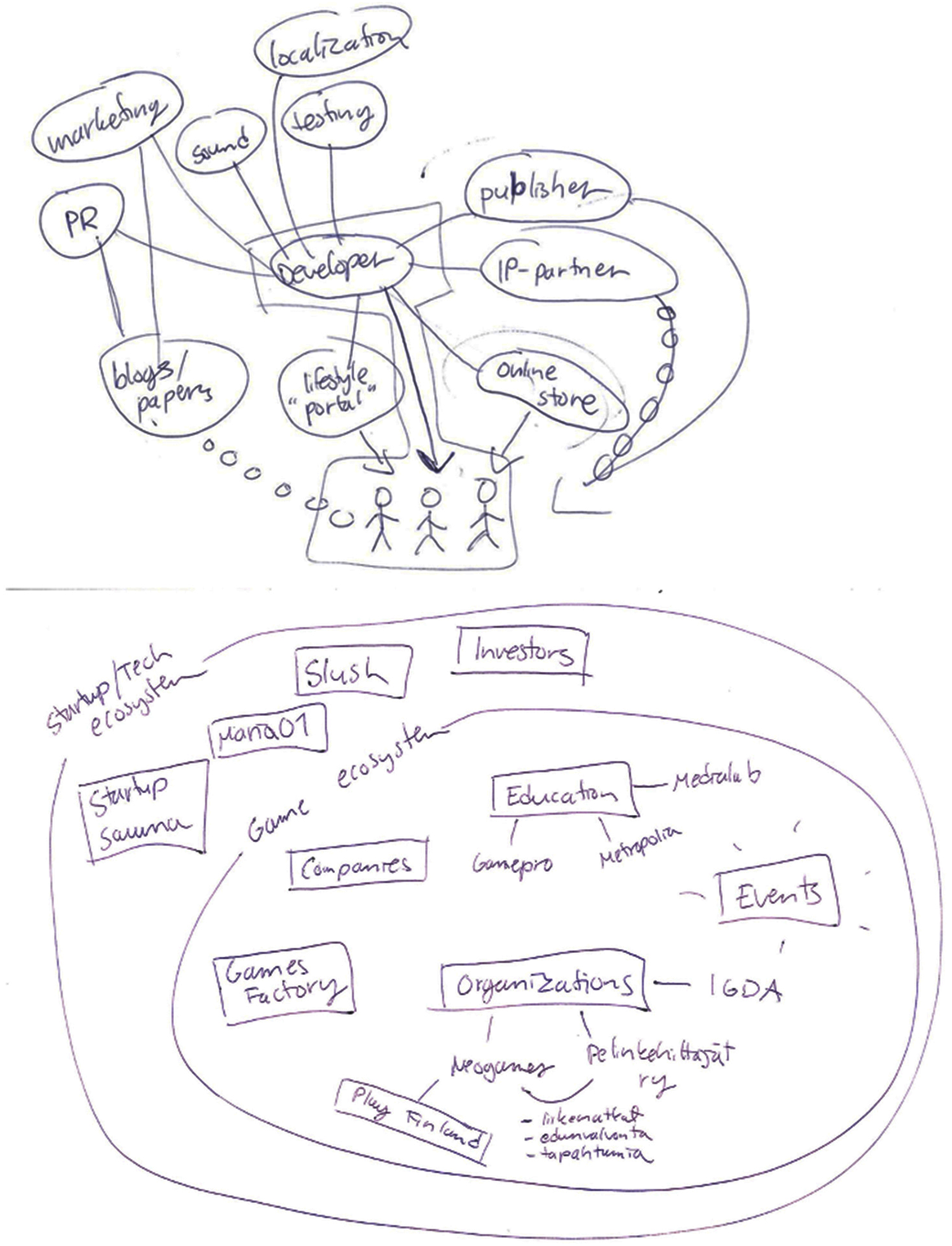
The drawing on the top (former) has centralized the respondent’s firm, whereas the bottom drawing (latter) has zoomed out to visualize the ecosystem in general. Here, the circling line around the game ecosystem signifies a border between the ecosystem and the surrounding startup/technology ecosystem, thus illustrating how the Finnish game industry ecosystem is positioned locally. Moreover, since the circling line does not form a closed loop, this implies interaction to take place between the ecosystems. In addition, the six short lines around events signify their importance that has been carried over from the first stage.
Given that values alone do not push the ecosystem forward, but instead through an intertwined relationship with commercial success, in this second stage values symbolize differentiation from other, similar contexts to attract external resources. In a similar vein, commercial successes serve as validation for external actors to invest their resources in the ecosystem. For instance, funding from the public sector significantly increased during the second stage and similarly venture capital from actors located outside Finland. For instance, several of our respondents mentioned the importance of attracting the interest of platforms (e.g., Apple and Google) and how game companies in the ecosystem openly shared these contacts with other firms. While to some extent these firms could be understood as direct competitors, the strong value-based ethos transcended competition by claiming the small size of the domestic market to shift attention from competing in the domestic market to collaborating domestically to compete internationally. Here, actors in the ecosystem acknowledged the importance of shared, resilient values as allowing the ecosystem to compete in the international markets. When one wins, everyone else can join the celebration because their turn might be next and because as part of the spirit of the Finnish scene, one company’s victories are seen as victories for the entire community.
Third Stage: Institutionalized Legitimacy
While the first stage revolved around demarcating the budding community from the external environment and the second stage focused on utilizing the first stage as a springboard for commercial success and growth, our findings show how the third stage, institutionalized legitimacy, was characterized by the establishment of institutional legacy and diversification of the ways through which the values were interpreted. This stage implies that commercial growth rests on sustainable foundations in the sense that previous successes carry firms over through turbulent times (e.g., whilst Rovio has not released a similar hit as Angry Birds, they are still generating profits)—here, the resilience of values plays a significant role as they give a sense of direction not only to individuals and firms, but also to the ecosystem as a whole. Resilient values have become so ingrained in the day-to-day activities in the ecosystem that they not only continuously reinforce the foundations of the ecosystem but also help in diversifying how they are manifested (Figure 3). Respondent G’s ecosystem visualizations.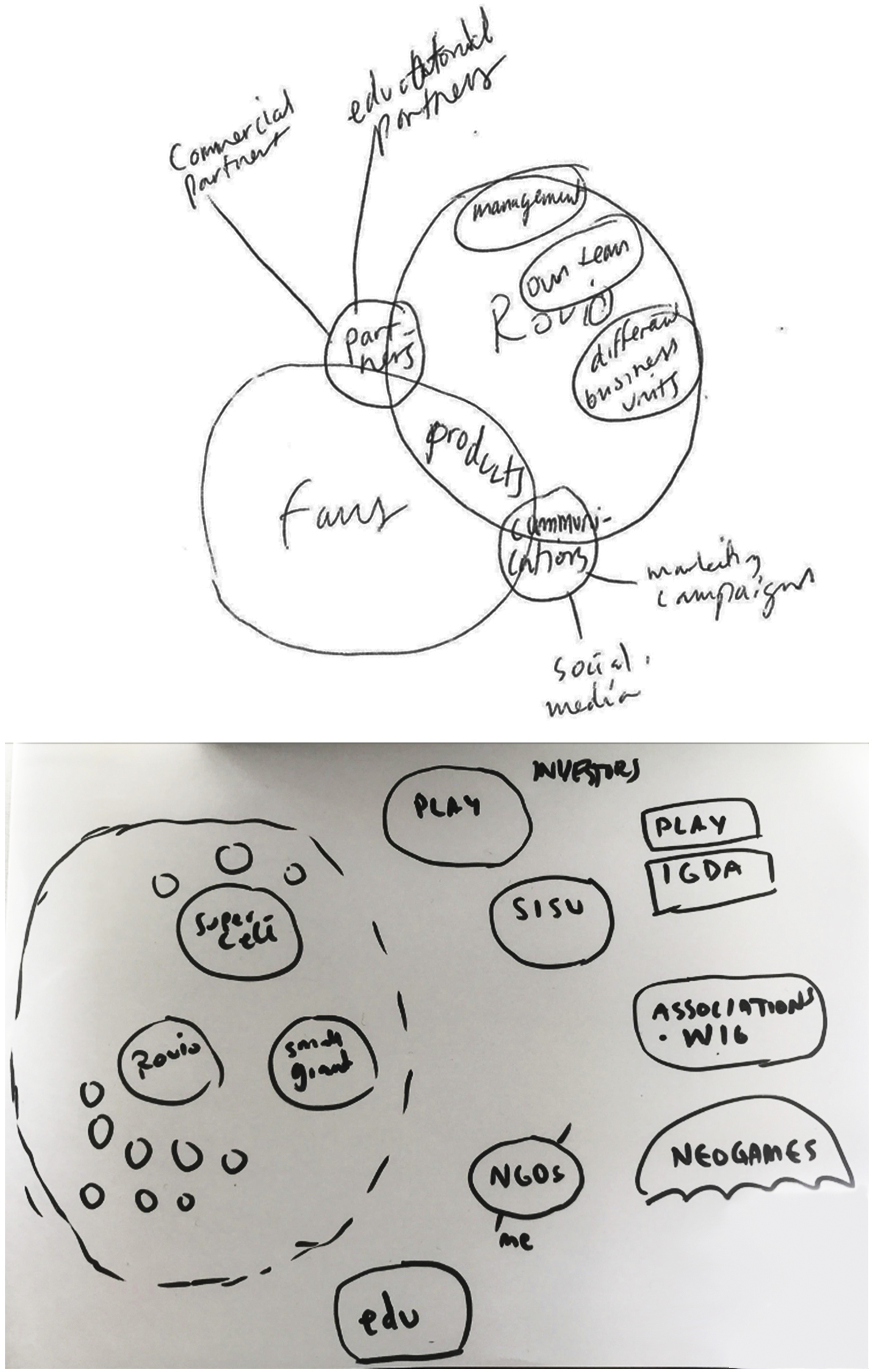
For example, the account below by respondent G illustrates how values have been interpreted in novel ways. There’s a lot of sharing that is happening right now and I really enjoy that industry learning from each other and I think that’s why the educational stuff popped up as well… And I really like the Women in Games idea as well for exactly the same, that let’s make it easier for girls to enter because we know how tough it can be. It’s really tough if you’re shy, and you don't know anybody, and you’re a young girl who doesn't really dare to enter the event. We do free drinks before the events, so you can meet up with the other girls and go together with them. You have to make the friends five minutes before, but at least you have somebody to hold on to at the event. It feels easier. You’re holding hands with somebody and much easier to enter a whole new, scary world. That has worked really well. People have really good experiences with that. (respondent G)
Attention has broadened from a company-centric perspective to a vantage point that covers the ecosystem in a more inclusive and broad fashion. The three circles inside the partly dotted circle on the left show three firms seen as central to the development of the ecosystem and on the right, “associations—wig” provides us with an example of how values are being reinterpreted through diversifying the interest groups. “Wig”—Women in Games—is a non-profit organization aimed at promoting inclusivity and diversity in the video games industry, and as such its establishment illustrates how the ecosystem has peaked in the sense that commercial success is no longer the only driving factor supporting the ecosystem. Because the ecosystem is already financially stable, more room is given to initiatives that aim at further diversifying the ecosystem.
Building on this, some of our respondents also mentioned The Finnish Museum of Games during the interviews: this further legitimizes the industry by showing its maturity. Given that museums are not seen as vehicles driving commercial growth, but instead preserving and presenting the past, it could be argued that establishing a museum with public funding is a sign that an ecosystem has reached a tipping point where commercial success no longer is the only driving force, but focus is also shifting to how might we preserve the cultural heritage to educate future generations of the industry’s journey.
In a similar vein, individual actors in the ecosystem have also become more active in the political scene by lobbying for the easing of recruiting foreign workforce outside Finland. While such lobbying will benefit the companies these individuals are part of, discourses around foreign workforce have revolved around the well-being of the country in general, thus highlighting how these individuals no longer need to try to legitimize the ecosystem because it is already perceived as a legitimate entity on its own by other industries and policymakers, and as such the resilient values can be harnessed to benefit the country in general.
Having said that, not all actors in the ecosystem engage in promoting the welfare of the whole country, and herein lies one of the potential pitfalls of this institutionalized legitimacy stage. Given that some of these individual actors have become prominent thought leaders also outside their industry, they are almost unconsciously expected to “lead” the ecosystem because of their social standing. As such, given that the ecosystem has gone beyond achieving commercial stability, individual actors become even more important in influencing policy-making as the political climate (e.g., how willing the country is to open its doors to foreign workforce) becomes a factor that either limits or enables the development of the ecosystem. In other words, the ecosystem has entered the political domain by pitting commercial growth against national homogeneity.
Synthesizing the Stages
As the findings above reveal, the Finnish video game industry seems to have evolved through three different stages that we have identified from our longitudinal dataset. What started as a strategy to demarcate the community from the rest of the society has grown, through commercial successes and emergence of cultural symbols (e.g., the museum of games, reputation and brand of Finnish games abroad), into a political entity that could potentially influence decision-making on the national level. This, in turn, has the potential to create pressure in the ecosystem as the focus no longer is not only on commercial success (and thus preserving and generating employment opportunities) but also on taking a stance on what kind of policies the Finnish government should enact in order to promote Finland as a competitive nation.
Politics aside, our findings reveal how the ecosystem seems to have grown and developed to a large extent characterized by resilient values. While more traditional industry life cycles focus on profits, entry barriers, and disruptions, the video game industry (and design-driven industries more broadly) do not seem to fully follow the same logic as consumer demand is not based on existing demand but on generating future value propositions. Thus, it could be argued that since values are strongly present in game development (i.e., balancing between artistic freedom and profitability) (Tschang, 2007), their presence is also extended to the industry-level given that institutions “are locations where values emerge, get articulated and codified, and are subsequently transmitted to new participants” (Kraatz et al., 2020).
More specifically, we identified distinct antitheses for each of the legitimization phases from micro, meso, to macro level. In the first stage, values epitomized an antithesis for individuals questioning games as an actual profession, while in the second stage, values served as a differentiator from other game companies globally, and in the third stage, the narrative had questioned other industries. In this last stage, the game industry seems to have realized they have agency within the national context, thus serving as a fruitful ground for developing the story of resilient values. While in the initial stages values almost unconsciously demarcated the community from the external environment by creating a strong sense of belonging, especially in the third stage values were utilized almost in an emancipatory way to diversify the ecosystem. This diversification makes sense as it illustrates how actors no longer feel the need to protect or frame the ecosystem as the ecosystem has already grown so much that it is already recognized as a legitimate industry.
Finally, although we have covered the stages in a linear fashion, we are not claiming ecosystems in the video game industry to advance deterministically. As we have shown, conscious effort is crucial in terms of advancing the ecosystem, and not all ecosystems want to open up their borders. In other contexts, ecosystem development might be hindered by an unfavorable political climate or competing ecosystems with fully or partially conflicting agendas. As such, more research is required to better understand how and why video game industry evolves from closed-up communities to politically influential entities. For example, the research design we devised for this study could be replicated in other contexts to generate additional insights on whether all video game industry ecosystems develop similarly or whether there are other factors not covered in this paper shaping the industry. Focusing on informants that have been active in the research context in question since its inception would be one possible approach, but equally relevant would be to draw on historical research methods, for instance (e.g., analyzing archival records).
Conclusion
In this paper, we have explored the Finnish game industry ecosystem from the perspective of values and how they contribute to legitimizing and institutionalizing the industry over time. While previous industry-level studies have yielded temporal snapshots (e.g., Keogh, 2019b; Sotamaa, 2021), findings from this study contribute to the current body of knowledge by highlighting the importance of values in developing, sustaining, and transforming local and regional hotspots. This was highlighted in the respondents reinforcing the values and abiding by them even when they switched employers or established new companies. As such, values seem to drive the development of the ecosystem and this, in turn, feeds into the profitability of the actors in the ecosystem, not the other way around.
As with any other academic inquiry, this study also comes with its limitations that could also be seen as opportunities for further inquiries. First, our study included respondents who have been involved in the industry since 2012, thus excluding informants with less experience in the industry. As such, consecutive studies could either replicate the methodology from this paper with other informants or utilize methods that would generate larger data sets. Second, although Helsinki’s role in the Finnish game industry is remarkable, findings reported in this paper might be influenced by a certain regional positionality. In terms of future research, we still need to understand to what extent values can limit growth, diversity, and collaboration. Our findings reveal how values were reinterpreted, at times, rather loosely since there were no governing authorities in the ecosystem, but what happens when financial realities start dictating how values are ought to be interpreted? Similarly, whilst we have briefly touched upon cultural signs and symbols in our findings, consecutive studies could focus more explicitly on how such signs and symbols materialize and perform institutional legitimacy in the video game industry in particular, and in creative industries more broadly.
Finally, another aspect that warrants further inquiries is the extent to which the national context influences the industry formation process. For example, future studies could investigate similar contexts elsewhere and by comparing those findings to the ones presented in this paper, we might be able to develop theoretically more nuanced an understanding of what factors might be universal and more contextually specific. Or in other words, does the industry take shape through a linear path or can we identify multiply trajectories?
Footnotes
Acknowledgments
The authors wish to thank all the participants for their continuous support to this research project, and Harviainen would like to thank the INUSE group at Aalto University School of Arts, Design and Architecture.
Declaration of Conflicting Interests
The author(s) declared no potential conflicts of interest with respect to the research, authorship, and/or publication of this article.
Funding
The author(s) received no financial support for the research, authorship, and/or publication of this article.
