







Abstract
Honor of Kings (HOK) is currently the most popular yet controversial mobile game in China. It is deeply inspired by Chinese history and culture, while its heroic backstories have been criticized for potential distortion of historical views. Drawing upon Systemic Functional Linguistics, this study explores the reconstruction in ideational and interpersonal meanings through comparing heroic stories with historical accounts. It reveals that HOK game stories have (1) significantly reconstructed activity processes while largely preserved spatial circumstances; (2) partly fabricated social relationships among characters, which result in the distortion of historical timeline; (3) retained core judgements on characters. It further explains how the reconstruction of heroic stories is embedded in the social context of game discourse, as far as entertainment, sociality, and cultural identity are concerned. The findings may shed light on discourse semantic interpretation in game studies and provide pertinent suggestions for future in-game story writing.
Honor of Kings (transliterated from Chinese as Wang Zhe Rong Yao) is a multiplayer online battle arena (MOBA) mobile game developed by TiMi Studios. Its publisher Tencent Games has released Honor of Kings (henceforth HoK) in 2015 and it has become the most popular MOBA game in Chinese mainland. By 2017, the daily active players and monthly active players in HoK have reached over 80 million and 200 million, respectively, (“South China Morning Post”, 2017). Currently, HoK has over 100 million daily active players and it is the second highest-grossing mobile game worldwide (“TechCrunch”, 2020; “Statista”, 2021). As of 2020, TiMi Studios has designed 104 game characters (also called heroes). These heroes originate from Chinese history, mythological or literary works, as well as fictional in-game heroes which are originally created based on HoK’s internal folklore.
Despite the huge commercial success of HoK and its value in forming a popular social network for gamers, HoK has raised serious concerns and controversies in society. People’s Daily has accused HoK as poisonous and addictive for young people, criticizing its content as “a twist of values and historical views” (“People’s Daily”, 2017), provoking a wide range of discussions about whether HoK can affect gamers’ historical and cultural memory (Li and Zhao, 2021). As a result of the criticisms from Chinese mainstream media, there have been increasing worries that digital games would have a negative impact on the historical view of young people. The popular mobile game HoK is the most criticized target of such worries (He and Li, 2020, p. 51) because of its reconstruction in history and culture. The heroic stories reconstructed for each game character seem to deviate from historical information. Unlike some historically themed games that focus on stimulating historical world with a specific historical background such as Crusader Kings 2 (Paradox Development Studio, 2012), Rome: Total War: Barbarian Invasion (Creative Assembly, 2004), the backstory of HoK is not set in any specific historical period but rather in distant future. The historical and cultural elements utilized in HoK are essentially intended to spice up game content, strengthen gaming community, and evoke cultural memory (Zhu and Lin, 2021; Li and Zhao, 2021). While HoK heroic stories may not be historically accurate, is it truly a distortion of historical views or a hazard to young generation’s historical knowledge? To seek for a balanced assessment, a linguistic approach is proposed to examine the reconstruction of HoK heroic stories since they are composed and presented through language. Furthermore, this study makes an attempt at explaining the context where the reconstruction of history and culture is embedded in.
History, Culture, and Game Discourse
History is an interpretation rather than a fixed record (Kappell and Elliot, 2013). It is the “curated representation of the past,” which is portrayed by historians through the selection of sources (McCall, 2020). It implies the subjectivity of history and the necessity of sources to interpret history. While written documents and speech are dominant forms of communication for representing history, they are not the only media to communicate the past (McCall, 2020). Games and digital media are becoming significant modes of exposure to present past, and they borrow ceaselessly from history, myths, and culture to constitute themselves, while influencing our relationship with the past (Hong, 2015; Huyssen, 2001). As Schut (2007) has argued, digital games can immerse gamers in history, bringing people to experience history visually and aurally, which has made it an ideal medium in building historical knowledge. Digital games, if used properly, can be effective educational tools. It is suggested that good digital games are able to “make meanings situated, to help create motivated, tailored, and incremental discoveries, and to encourage social sharing of knowledge, among other things” (Schut, 2007; Gee, 2003). The impact of digital games is a rather complicated question, which requires a critical view of their strengths and limitations.
Games have been rising to a culturally significant position in modern society (Hong, 2015). The emergent gaming culture is redefining the complex relationship among games, players, and developer (Pearce, 2009; Taylor, 2006). Historical game designers make meaning out of the past and their produced histories are referential evidence of the past (Chapman, 2016). Designing games requires not only imagination but also reconstruction/reappropriation of the past. Content is one main aspect in reconstruction, alongside with form and system (Gazzard and Peacock, 2011). The reconstruction at micro level is associated with the textual changes in the game stories (O’Hagan and Mangiron, 2013), while this micro-level research is still underexplored. Although rewriting game stories can be laborious, it is highly profitable (Dong and Mangiron, 2018) since the cultural and historical adaptation of games have positive influence on users’ game-playing experience and habitual acceptance.
While People’s Daily has used the term “content” not in a problematic way, it seems too ambiguous as “content” is a complicated and multifaceted concept. Game content involves many aspects such as storyline, music, colors, mechanics, and character design (Dong and Mangiron, 2018). So far, although HoK has become a hot social phenomenon and has achieved great success with its massive number of users, there has been very few academic research related to HoK. One particular study by He and Li (2020) has empirically explored whether HoK has affected players’ attitudes and understandings about historical figures through questionaries for 312 HoK players, claiming the impact on historical cognition is not significant. The methodological design, however, is questionable as it only considers players’ individual perceptions, while there is no in-depth analysis of the historical content in the game.
Language is the medium of communication between games and players, as well as the foundation of how in-game texts make meanings and reconstruct meanings. However, the discourse semantic dimension of game stories has been rarely examined in game studies. Therefore, this study conducts a micro-level analysis of the heroic stories reconstructed in HoK from a linguistic perspective. In order to seek for a balanced evaluation on the strengths and weaknesses associated with the construction and reconstruction of history and culture in HoK, this study scrutinizes the ideational and interpersonal meanings that have been reconstructed in HoK heroic stories through discourse semantic tools, including activities (events), circumstantial elements (space and time), attitudes, and social relationships among characters. Furthermore, based on the comparative analysis, it discusses the contextual factors and underlying motives that have brought about the reconstruction in game stories, and provides pertinent suggestions on future reconstructions in game discourse.
Theoretical Framework
Language is the fundamental medium in constructing and reconstructing meanings. To explore what have been reconstructed in heroic stories of game characters as well as the underlying motives, elucidation of the relation between language (discourse) and its social context is essentially required. Systemic Functional Linguistic (henceforth SFL) attaches great significance to the understanding of language and context. “Language as social semiotic” (Halliday, 1978) has demonstrated that language is embedded in social context, or, how meaning-making practices are strongly connected with social context. Eggins (2004) has characterized language use as “functional, semantic, contextual, and semiotic”. In SFL, language is a stratified system which comprises discourse semantics, lexicogrammar, and phonology. The relationship among the three strata is called realization, where discourse semantics that is, the highest stratum in the linguistic system is realized by the middle stratum lexicogrammar, which is further realized by the lowest stratum phonology.
Discourse semantics is the interface between language and context. Any texts simultaneously realize three strands of meanings—ideational, interpersonal, and textual. Ideational meaning is concerned with the representation of experience; interpersonal meaning deals with the enactments of social relationships; textual meaning is the organization of representations and enactments (Martin and Rose, 2007). This study particularly focuses on the ideational and interpersonal reconstruction of heroic stories in game discourse.
The ideation system at the discourse semantic level provides resources for analyzing participants, activity, and attendant circumstantial elements such as space and time. It offers the present study a framework for identifying what aspects have been reconstructed in heroic stories and what have been maintained from history, which further reveals the discourse patterns of game stories and how the trade-off between accuracy and creativity in constructing experiences might affect gamers’ historical view and cultural identity.
Systemic functional linguists have approached interpersonal meanings at discourse semantic level under the heading of appraisal (Martin and White, 2005; Martin and Rose, 2007). Appraisal is concerned with “the attitudes that are negotiated in a text, the strength of the feelings involved and the ways in which values are sourced, and readers aligned” (Martin and Rose, 2007, p. 25). Within the appraisal system, attitude involves three semantic regions: affect (the expression of emotion), judgement (the evaluation of human behavior), and appreciation (the evaluation of phenomena).
The comparison between HoK heroic stories and historical materials draws particularly on the systemic functional interpretation of ideation and appraisal at the discourse semantic level. The appraisal system is mainly concerned with the type of attitude embedded in texts, that is, positive or negative evaluation of things, people, and phenomenon. Evaluation is a crucial part of history discourse since historians often make evaluations on historical figures and historical events and this is often how future generations interpret the key characteristics of a historical figure. Appraisal analysis of heroic stories allows us to know whether game storywriters have made dissimilar evaluations on historical figures and how it might shape gamers’ evaluation on historical figures. Based on a comparative analysis of heroic stories and historical materials, the ensuing sections aims to identify the “changed” and “unchanged” representation and evaluation, exploring the contextual demands on the reconstruction of historical figures in game discourse.
Classification of Game Characters in HoK
As an MOBA game, the core game pattern of HoK is for gamers to choose a game character with specific abilities and enter the battlefield. Since the release of HoK in 2015, it has designed 104 game characters (also called “heroes”). The majority of game characters in HoK are originated from historical figures, mythological figures, and protagonist in literary works. In other words, they have respective prototype figures, while the rest of them are originally created by TiMi Studios. Specifically, the choices of HoK game characters largely derive from Chinese historical figures. Although it brings in a few western historical figures, it accounts for a very small proportion, and there are only 16 characters originated from mythological and literary works in total. Figure 1 shows the general composition of game characters in HoK and the proportion of Chinese and western historical figures. The composition of game characters in HoK (left) and the composition of historical figures (right).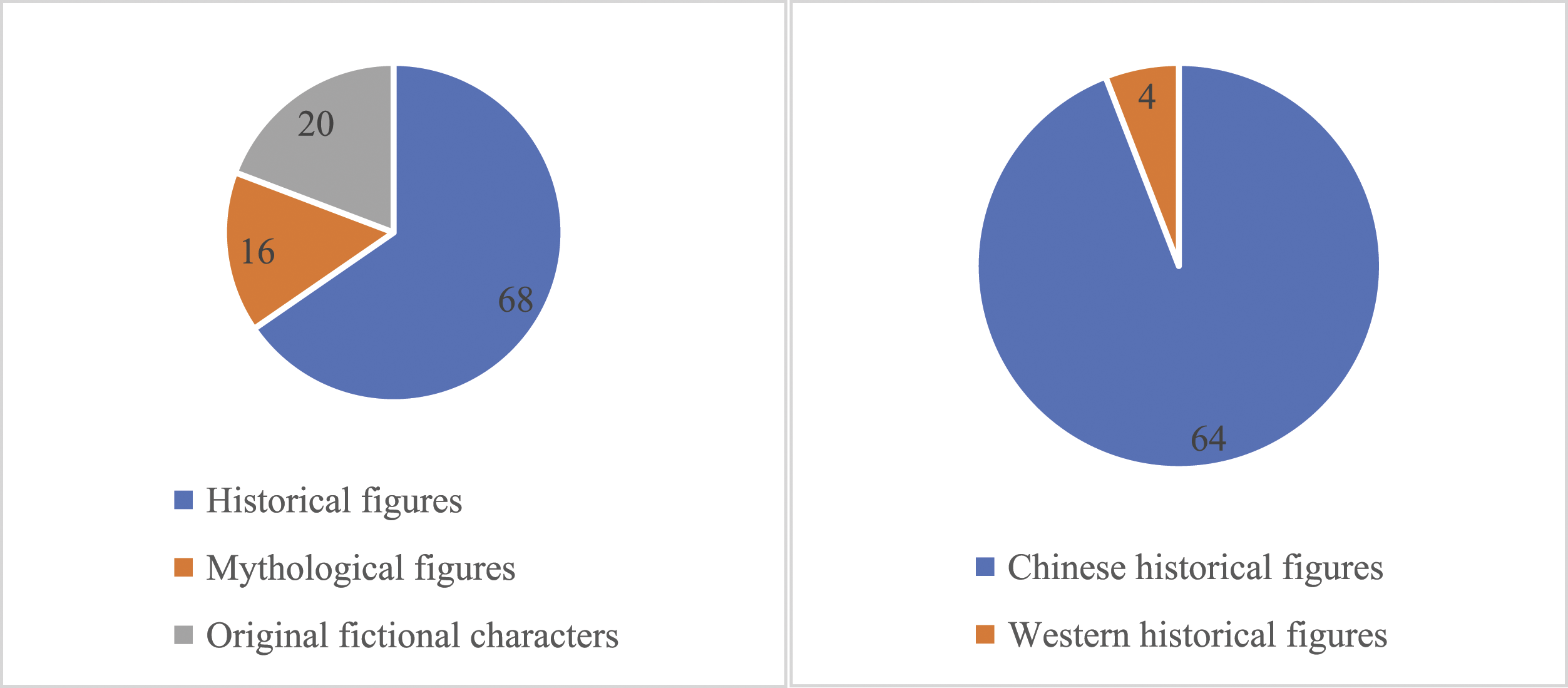
It can be seen that the choice of prototype characters is deeply rooted in Chinese history and culture, and it covers a wide range of classification such as famous Chinese warriors, emperors, thinkers, poets, and talented women. It not only adds familiarity for gamers but also creates emotional connection with the game. The game developer has written an exclusive heroic story for every character, which can be accessed through the official website of HoK and in-game interface.
Data Description
This study compares HoK heroic stories with historical information in terms of the experiences of historical figures and evaluations from historians and mainstream contemporary interpretation. Thus, the data used in this study involves heroic stories (written texts) collected from the HoK official website and historical materials drawn from primary sources such as ancient poems and annals, historiographical works including narratives and interpretations written by historians, and public history materials such as website articles produced for non-academic audience. As history is subjective interpretation, it is necessary to note that the terms used in this paper, “accurate” and “accuracy”, refer to mainstream-accepted information on Chinese history.
The database of our study is a collection of 104 heroic stories in HoK. However, due to the inter-similarities of the discourse patterns in reconstructing heroic stories, as well as the constraints of space, four heroic stories have been selected for a close and detailed examination and discussion. They include the heroic stories for Li Bai, Wu Zetian, Lian Po, and Lao Fuzi (Confucius). Furthermore, since it is unrealistic for a text to provide exhaustive accounts of and evaluations on a historical figure, our approach is to collect information from a variety of sources. In addition to academic interpretation of the Chinese past, the study compares the historical facts and evaluations presented by HoK with mainstream contemporary interpretation about the Chinese past (see this type of analysis in Kline, 2014; Houghton, 2021) which is a crucial way to form historical view and cultural memory.
A scrutinization of the data reveals that the heroic stories of game characters significantly reconstruct the activities/experiences of historical figures, largely maintained spatial circumstances in historical materials, and partly fabricated social relationships among characters and twisted timeline, while keeping the core judgements of historical figures unchanged in the reconstruction of game characters. The subsequent analysis focuses on how the ideational experiences of prototype figures in history have been reconstructed and how attitude and social relationships are presented in heroic stories.
Reconstructing Ideational Experience
An example of activity analysis.

In a sense, the composition of heroic story in HoK is essentially the combination of characters, processes, and locations (both temporal and spatial). When constructing and reconstructing heroic stories, one critical issue is how much accurate historical information should be remained and what kind of ideational content should be recreated to fit into gaming discourse. This trade-off between accuracy and creativity has a major impact on how gamers would emotionally react to the character they play and how they might shape understandings of Chinese history through reading the heroic story. It is thus significant to examine and compare what ideational experiences have been remained from historical materials and what have been adapted, in order to reveal potential positive and negative impacts and to propose crucial considerations in composing gaming stories in future practice. In terms of ideational content, the following sections are devoted to analyzing two aspects of the construction of an activity: (1) participant and process; (2) circumstantial elements.
The Reconstruction of Nuclear Elements: Participant and Process
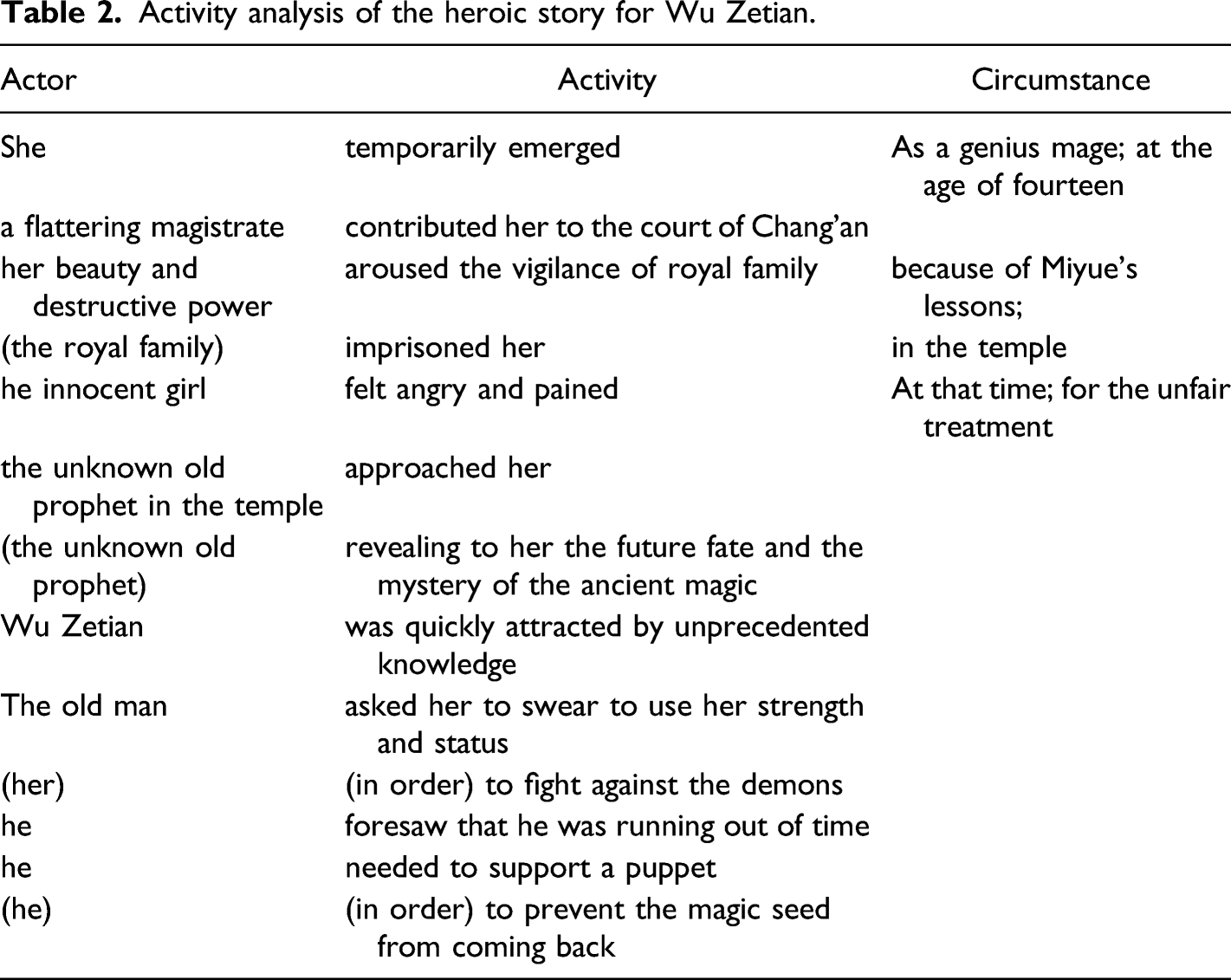
The nuclear elements in constructing activities are participant (people/things) and process, that is, who did what. The participants in each heroic stories are its protagonist hero and a few other game characters. The reconstruction of processes is dramatic in HoK game discourse. The activities constructed in these stories are originally composed, having no connection with historical figures’ real experiences. In addition, there is a universal pattern throughout these stories that the activities in each plot are representing and shaping a magical world. The following paragraphs are extracts from the heroic story for Wu Zetian. The original text in Chinese: 身为天才法师, 她在十四岁时暂露头角, 并被谄媚的地方官贡献给长安的宫廷˳ 但因为芈月的前车之鉴, 她的美貌以及破坏性法力引起了王室的警惕, 将她囚禁在寺院中˳ 彼时天真的少女为不公平的待遇感到愤怒和痛苦˳ 然而寺院中无名的预言老人接近她, 向她揭示了未来的命运与古代魔道的奥秘˳ 武则天很快被前所未有的知识吸引˳ 老人要求她发誓运用力量和地位对抗魔种˳ 因他预知自己时日无多, 需要扶持一个傀儡来防止魔种卷土重来˳ Translated text in English: As a genius mage, she temporarily emerged at the age of fourteen and was contributed to the court of Chang’an by a flattering magistrate. But because of Miyue’s lessons, her beauty and destructive power aroused the vigilance of the royal family and imprisoned her in the temple. At that time, the innocent girl felt angry and pained for the unfair treatment. However, the unknown old prophet in the temple approached her, revealing to her the future fate and the mystery of the ancient magic. Wu Zetian was quickly attracted by unprecedented knowledge. The old man asked her to swear to use her strength and status to fight against the demons. Because he foresaw that he was running out of time, he needed to support a puppet to prevent the magic seed from coming back.
Activity analysis of the heroic story for Wu Zetian.
The Reconstruction of Circumstantial Elements
While the nuclear processes (activities) are originally composed to feature a magical world, the circumstantial elements surrounding these activities are to some extent maintained from historical facts. Circumstance is concerned with the environment where an activity takes place. It not only involves spatial circumstance (place) but also temporal circumstance (time). Circumstantial elements are fundamental linguistic resources in constructing history discourse since a historical event is usually associated with time and space.
Heroic stories in HoK largely employ circumstantial elements to create space-time in a game world. Some of the circumstantial elements in HoK conform to historical information, while some are completely made up. This raises a serious issue for gamers (especially children and young adults) in acquiring historical knowledge and differentiating accurate information from inaccurate information. It is thus worthwhile to identify what circumstantial elements have been adapted or preserved through a detailed analysis of spatial and temporal locations in these heroic stories and compare them with historical materials.
The classification of places in the heroic story for Li Bai.
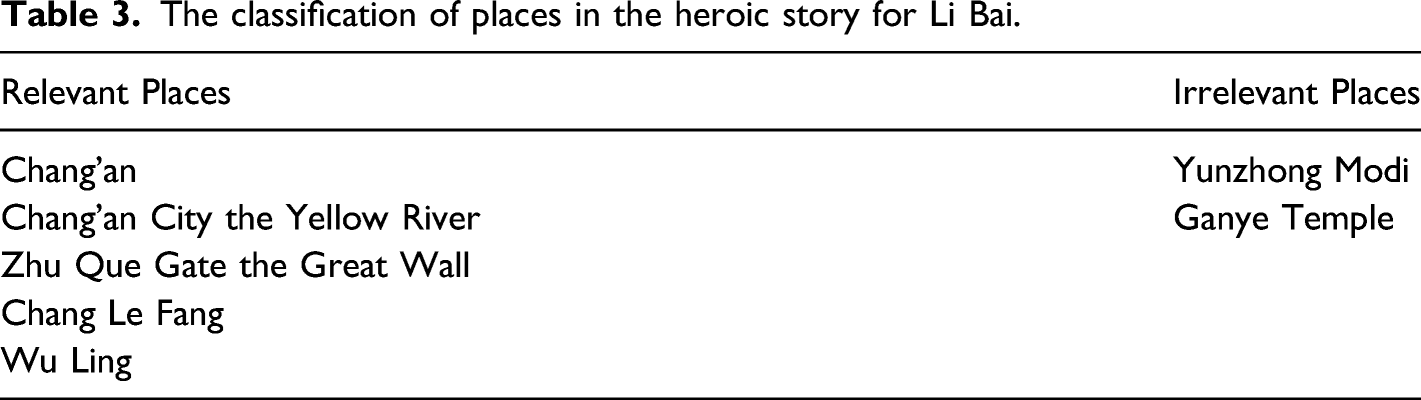
According to Wu’s study of Tang Dynasty poetry (1972) and Li Bai’s poetry anthology (see, e.g., Xue, 2017), the spatial locations related to Li Bai in history include place where Li Bai had lived in—Chang’an; place where he had traveled to—the Yellow River; and places which had appeared in his poems—for example, the Yellow River, Zhu Que Gate, the Great Wall, Wu Ling. Chang Le Fang was allegedly where Li Bai often went for liquor; although there is no historical record confirming the connection between Chang Le Fang and Li Bai, it is a popular historical conception among the public (Li, 2021). As for the two places irrelevant to Li Bai as historical figure, Yunzhong Modi is a fictitious space which never exists in reality. The other irrelevant place is Ganye Temple. While it exists in history and modern society, there is no historical information showing its connection with Li Bai. A further examination has explained the reason to include Ganye Temple in the heroic story for Li Bai. This particular spatial location aims to build ideational and interpersonal connection with another game character Wu Zetian, where Ganye Temple is a core spatial location in the heroic story for Wu Zetian.
Wu Zetian, the only female emperor in Chinese history, is another historical figure who has been adapted into a game character in HoK. In the heroic story written for Wu Zetian, spatial locations include Chang’an City (长安城), Chang’an (长安), Temple (寺院), and imperial palace (皇宫). Based on verification from Zizhi Tongjian (Sima, 1084), a pioneering reference work in Chinese historiography, all these spatial locations in the heroic story for Wu Zetian are relevant to her experiences in history. It is noteworthy to mention that the temple here is essentially Ganye Temple where Wu Zetian had lived in for a few years. The reconstruction of spatial locations in HoK heroic stories is minimal, where historical locations related to the character are largely preserved. In addition, it is found that most spatial locations in HoK heroic stories are concrete sites rather than abstract sites. There are also a few special cases, for example, in the heroic story for Lao Fuzi (Confucius), there is only one abstract spatial circumstance, that is, “He was locked
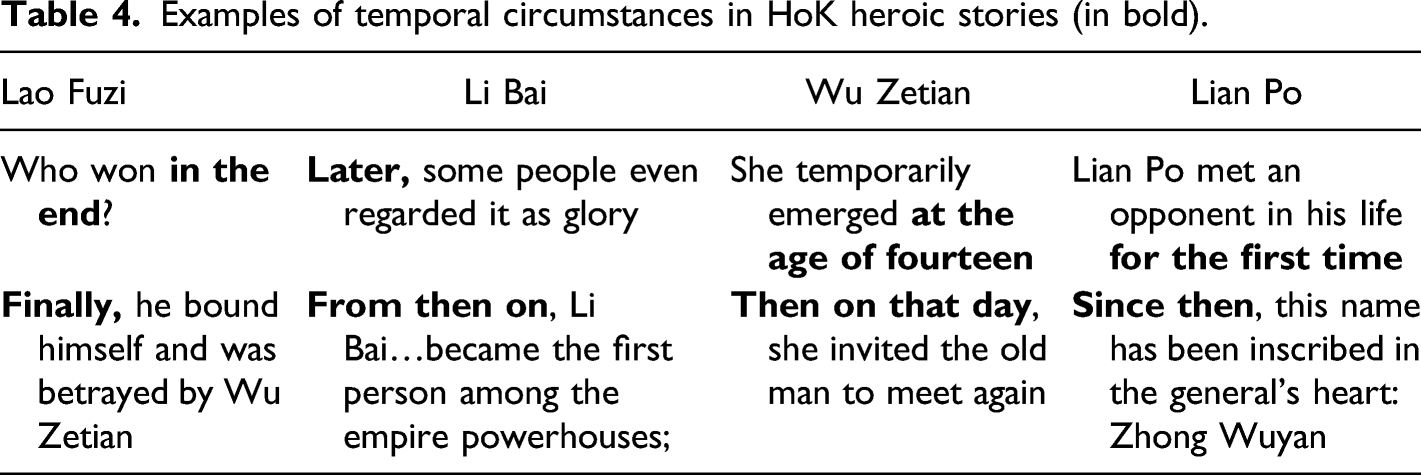
Examples of temporal circumstances in HoK heroic stories (in bold).
Reconstructing Interpersonal Meanings
The interpersonal meanings are concerned with using language to interact, to enact social relationships, to show attitudes, and to influence viewpoint and behavior. In this section, we will explore the attitudes expressed in the heroic stories, especially attitudes associated with evaluations on the game characters/historical characters, as well as the social relationships reconstructed in these texts. Appraisal is a discourse semantic system of negotiating evaluations in a text. It indicates the attitudes embedded in texts, which are often reflected in purposeful lexical choices. Attitudes include feelings about things and people (affect), judgements of people’s character and behavior (judgement), and evaluations on things or phenomenon (appreciation). The evaluations made in heroic texts will influence how gamers construe these characters and how they might develop understandings about historical figures and the historical events associated with them.
The Reconstruction of Attitude
In historical narratives, apart from ideational information of the historical figures’ experiences or activities, there are evaluations on them made by historians and mainstream contemporary media. Their evaluations are important sources for later generations to build historical views. The focus of attitude analysis is whether HoK heroic texts have reconstructed the evaluations on historical figures and their behaviors. Accordingly, the attitudes being investigated are mainly judgements of target characters. It does not suggest that there are no attitudes related to things/phenomena, on the contrary, affects showing the emotions of characters and appreciation demonstrating evaluations on things frequently appear in our database. In this section, attitude analysis will focus on the polarity of judgements (positive or negative) and target of judgements (who and what behaviors are judged).
Consistent appraising items in heroic stories and historical evaluations.
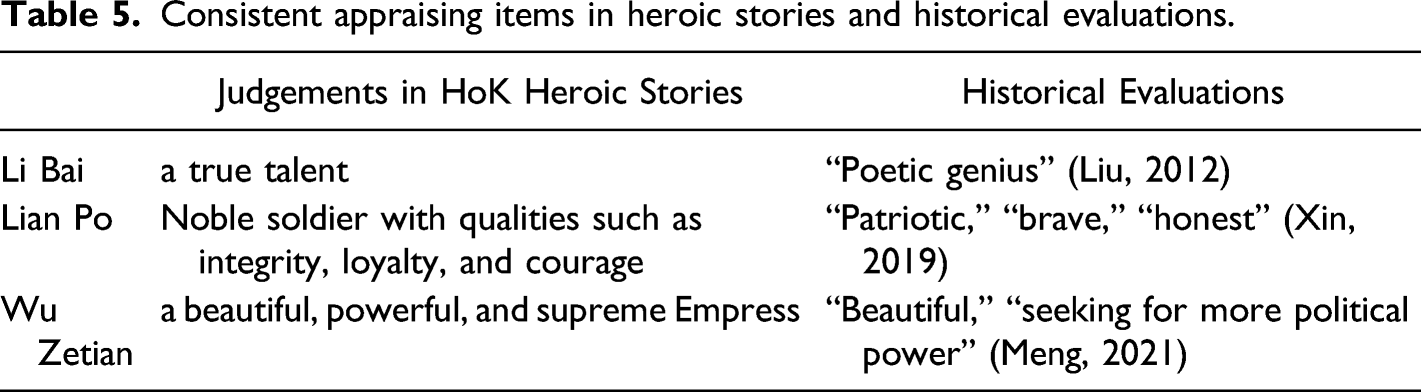
Discourse semantics is closely related to social context. Words are not isolated lexis, but meaningful choices based on context. The same lexis in different contexts may have differing meanings and opposite polarity. For example, Bednarek (2008) has noted the term “surprise” can be expressed as a negative or positive emotion based on corpus evidence, depending on the social context in which the word is embedded. It is also observed in our data, for instance, Lao Fuzi (Confucius) is described as perverted education freak. If examined without context, the word “perverted” and “freak” would be identified as negative judgements. However, knowing the identity of Confucius, one of the most renowned and respected educators of all time (Qi, 2019; Liu, 2009), these two adjectives only reflect his passion and rigor in education career, raising the intensity of positive judgements.
The Reconstruction of Social Relationship
Social relationship reflected in a text can be approached from two different perspectives: one is the social relationship enacted between reader and writer, the other being the in-text social relationship among story characters. In this section, we will discuss how the in-text social relationships built between game characters are constructed and reconstructed in game discourse from both context and semantics perspective. The reason why in-text social relationship matters is because HoK heroic stories tend to create certain social relationships between game characters and reconstruct them in almost every single heroic story. Furthermore, as aforementioned, the social relationships reconstructed in these stories serve as a clue to reveal how the HoK game world has staggered and distorted historical timeline.
In HoK, the story written for a specific character is not simply about the character himself/herself. There is a strong tendency for each heroic story to include other historical figures and game characters, creating some connections among them. When examining the social relationships of game characters in history, we can observe that some of the characters did have connections in history. However, some of the social relationships are completely fabricated. In the heroic story for Li Bai, for instance, the Empress Wu Zetian appears several times as an important protagonist. Original text in Chinese: 当治安官狄仁杰欲以破坏长安的罪名逮捕他时, 爱才的女帝拒绝了˳ 帝甚至下令保留朱雀门上饱含剑意的诗痕˳ Translated text in English: When the sheriff Di Renjie wanted to arrest him (Li Bai) on charges of sabotaging Chang’an, the Empress Wu Zetian who cherishes talents refused. The Empress even ordered the preservation of the sword-inspired poems on Zhu Que Gate made by Li Bai.
Based on historical information, when Empress Wu Zetian died, Li Bai was only 4 years old; hence, there is no possibility for them to have the connection as superior and subordinate. Another case in point is the game character, sheriff Di Renjie, who served as a chancellor during the reign of Empress Wu Zetian and is regarded as one of the most celebrated officials in Tang dynasty (Du, 2000; Zhang, 1983). Sheriff Di Renjie and Empress Wu Zetian are contemporaneous historical figures. Their social relationship is correctly represented in their heroic stories, while the relationship between Di Renjie and Li Bai is also invented. In the heroic story for Wu Zetian, Li Bai also appears as an important character, creating interconnections in the whole storyline of HoK.
Similarly, in the heroic story for Lao Fuzi, a series of other historical figures/game characters appear, including Jiang Ziya (military strategist and politician), Zhang Liang (military strategist and politician), and Wu Zetian (the sole Empress in Chinese history). The story has characterized Lao Fuzi and Jiang Ziya as good friends for a lifetime, while Zhang Liang and Wu Zetian have been adapted as Jiang Ziya’s apprentices. However, the four characters belong to different dynasties, with no social connections in history at all. The purpose of adding other game characters in an individual heroic story is to establish the inextricable connections among heroes in the game, making the entire backstories of HoK more interrelated and integral. The same social relationships can also be found in the individual heroic stories for Zhang Liang, Wu Zetian, and Jiang Ziya, which maintains consistency in the reconstruction of social relationships.
Another salient and typical phenomenon is the reconstruction of romantic relationships in HoK game stories. For example, in the heroic story for Lian Po, there is another character Zhong Wuyan who is a female politician (also a game character). No historical evidence is found in historiography or other online resources which demonstrates personal connection between the military general Lian Po and Zhong Wuyan, yet the heroic story has reconstructed a fictitious intimate relationship between them, positioning them as a couple in the game. Original text in Chinese: 在抵挡齐国的战场上, 廉颇第一次遇到生平的对手:手执大锤的野蛮女人, 却如此威风凛凛˳ 当铁锤与巨拳碰撞, 酣畅淋漓的快感震慑了他的全身˳ 自此以后, 这位将军的内心便铭刻下了这个名字: 钟无艳˳ Translated text in English: On the battlefield against Qi, Lian Po met his rival for the first time in his life: a barbarian woman holding a sledgehammer, while so majestic. When the hammer collided with the giant fist, the hearty pleasure shocked his whole body. Since then, this name has been inscribed in the general’s heart: Zhong Wuyan.
In fact, the establishment of romantic relationship is a common practice in HoK. Among these relationships enacted, some of them are real couples in history, but others are fabricated. The underlying motivation is to increase sociality of the mobile game. So far, HoK is not simply a mobile game which focuses on battles, but a popular social media where gamers can communicate and interact with each other. There have been gamers who develop romantic relationship with one another when playing HoK, and it is reported that the game characters in a romantic relationship are often the characters/heroes these gamers would choose to play (“BaiJiahao”, 2019, 2020). The social relationships reconstructed in HoK essentially strengthen social bonding in gamer community, which consequently enhances user stickiness to the game.
Further Findings
In addition to the above analysis of ideation, attitude, and social relationship, there are two significant findings in the reconstruction of heroic stories. In the heroic story for Lao Fuzi (Confucius), the entire story takes the form of a dialogue between Lao Fuzi and one of his unknown apprentices. Its prototype historical figure, Confucius, is renowned for his dialogue rich in pedagogical implications. He is widely considered as one of the most influential individuals in human history, whose teachings and philosophy deeply influenced East Asian culture and society (Liu, 2018). Analects of Confucius, a collection of thoughts and sayings, was compiled by Confucius’ s followers and takes the form of dialogues between Confucius and his apprentices. The entire heroic story for Lao Fuzi (Confucius) has also borrowed the form of dialogue, and this is the only story completely written in dialogue in the HoK story database. This textual organization illustrates the influence of history and literature on the reconstruction of HoK heroic story. The contextual influence of history and literature can also be further seen in the citation of a verse from Li Bai’s famous poem in his heroic story (in bold). Original text in Chinese: 他初次见到滔滔黄河时, 心中的剑意迸发而出, Translated text in English: When he first saw the surging Yellow River, the sword in his heart burst out,
Discussion
This study has employed discourse semantic tools in exploring the reconstruction of history and culture in HoK heroic stories. The ideational and interpersonal reconstruction has resulted in the changes of processes (activities), circumstantial elements (space and time), and social relationships. Meanwhile, the stories have transferred core evaluations on the historical figure to its corresponding game character. They even retain most spatial locations related to the historical figure for the game character, as well as some textual organization mode. Detecting the “changed” and “unchanged” reconstruction in history is a prerequisite to explore more complex and meaningful questions. The mainstream criticism related to HoK as a historical media almost solely focuses on the accuracy issue in its historical representation; however, this factual accuracy is only one way to judge historical media. Games are sometimes decried for inaccuracy (Chapman, 2012; McCall, 2020), but it is more important to contemplate why a game deviates from historical records and what are the effects (Kappell and Elliot, 2013). The theoretical framework and analytical tools employed in the study provide a novel approach for game studies, particularly games with historical content. It effectively exhibits HoK’s reconstruction in ideational and interpersonal dimensions, furthermore, elucidating the contextual factors causing the reconstruction.
In essence, the rules and objectives of HoK are far from “historical”. It does not seek to simulate historical process or to achieve historical purpose, yet it largely borrows elements from Chinese history and culture. The underlying motives can be explained from at least three facets: entertainment, sociality, and cultural identity, which all contribute to broader user coverage and higher user stickiness. As game is entertainment media (Romera, Ojeda, & Velasco, 2018), in order to make gamers feel entertained and interested in playing the game, HoK has rewritten the heroic stories in a fascinating way, creating a magical world where power, magic, victory, and glory are the excitements players can easily acquire in the virtual battlefield. Although replacing the historical figures with completely fictional characters will not affect the plot, it will lose the opportunity of utilizing historical and cultural familiarity which creates strong emotional connection between gamers and the game. The design of HoK is deeply inspired by Chinese history and culture, it can be seen not only in the choices of game characters but also in music, art, and cosmetic skin design. The fact that HoK was quickly accepted by the public from its emergence and gained huge popularity in Chinese game market is closely related to the strong historical and cultural atmosphere in it (Zhao, 2018). These familiar and approachable elements enable Chinese gamers to easily fit into the game, which facilitates to understand the connotation of traditional Chinese culture in interactive scenes and strengthen cultural identity. In addition, it will potentially evoke a group of gamers’ interests in learning more about Chinese history and culture, which makes a positive educational impact. The imperative of sociality is also very relevant to account for the reconstruction in social relationships among game characters. Digital games have become a lifestyle of young users and one of the most important ways of socializing (Tian and Chi, 2018). HoK took the liberties to create intertwined character relation, which help build an intimate social circle within gamer community, strengthening its attribute as a new social media.
While traditional Chinese cultural and historical elements can be flexibly used in game contexts, there is some room for a better reconstruction. For instance, although there is barely any reconstruction in temporal locations, the heroic stories distort historical timeline through the fabrication in character relationships. It indicates that ideational and interpersonal meanings sometimes alternately overlap in discourse semantics, just as the temporal circumstances realizing ideational meanings are better understood in the examination of interpersonal relationships among characters. For future game story writing, our analysis suggests that HoK heroic stories could avoid distorted historical timeline through constructing correct social relationship between historical figures, replacing fabricated relationships with the accurate ones. It will not affect young gamers’ history knowledge; meanwhile, appropriate reconstruction of game stories reinforces the entertainment function of digital games, increasing its social media value in forming intimate gamer community. Furthermore, it has the potential to be powerful medium in building historical views and cultural identity.
Footnotes
Declaration of Conflicting Interests
The author(s) declared no potential conflicts of interest with respect to the research, authorship, and/or publication of this article.
Funding
The author(s) disclosed receipt of the following financial support for the research, authorship, and/or publication of this article: This study has been supported by Guangdong Province Social Science Fund (Grant No. GD19CYY20) and the Project of Humanities and Social Sciences, Ministry of Education, People's Republic of China.
