






Abstract
This article investigated whether it is possible to establish correspondences between game mechanics and particular cognitive stimulations. There are many challenges to prevent and treat cognitive decline with aging or neurocognitive disease. Observing difficulties to establish such correspondences in the scientific literature, we proposed to move away from “classification by genre” or any other type of taxonomy that deviates from the framework of the “Rules/Formal schemas” and the “set of rules” component of the gameplay. Thus, we proposed the Gameplay Bricks model as a theoretical framework for Video Game (VG) and Serious Games (SG). We jointly relied on a framework on fractionated executive functions, memory, and attention. The Gameplay Bricks model currently identifies 14 major Metabricks (game mechanics) through seven Metabricks of obligations and seven of prohibitions. We have proposed first correspondences accompanied by examples from the VG-SGs. The limits and perspectives of these first matches were then discussed.
Introduction
During the last decade, the interest of Video Games (VG) and Serious Games (SG), including those with physical activity (exergames and Serious (exer)Games), has extended to the fields of prevention as well as the management of cognitive disorders associated with aging (Anderson-Hanley et al., 2012; Anguera et al., 2013; Ben-Sadoun et al., 2016; Boot et al., 2013; Maillot, Perrot, & Hartley, 2012; West et al., 2017). The idea is to stimulate the cognitive functions of the older persons, including those with cognitive disorders, by using VG-SGs, in particular through aspects of their gameplay that are called game mechanics. The therapeutic goals are to promote neuroplasticity and improve or limit the decline of cognitive functions, particularly the executive functions, which allow us to regulate our thoughts and actions during goal-oriented behavior (Friedman & Miyake, 2017). To date, there is a significant number of scientific studies questioning and showing the effects of VG-SGs on cognitive functions in young and old people (Bavelier & Green, 2019; Powers, Brooks, Aldrich, Palladino, & Alfieri, 2013; Toril, Reales, & Ballesteros, 2014; Xu, Liang, Baghaei, Wu Berberich, & Yue, 2020). However, one question still remains at this moment:
Can we establish correspondences between game mechanics and particular cognitive stimulations?
Several studies, reviews and meta-analysis have attempted to precise what VG characteristics or VG stimulation programs can induce particular cognitive stimulations (Baniqued et al., 2013; Bavelier & Green, 2019; Bediou et al., 2018; Bedwell, Pavlas, Heyne, Lazzara, & Salas, 2012; Powers et al., 2013; Toril et al., 2014; Xu et al., 2020). The results are very nuanced and it is difficult to conclude due to the strong heterogeneity of the methodologies used between the VG studies, and due to the use of different methods for categorizing VGs (e.g., Powers et al., 2013; Toril et al., 2014). Also, the focus of certain reviews on a single category of VGs makes it difficult to generalize their results (Baniqued et al., 2013; Bediou et al., 2018). Finally, the use of a theoretical framework for analyzing SGs including empirically a large variety of gaming attributes (action language, assessment, conflict/challenge, control, environment, game fiction, human interaction, immersions, rules/goals, Bedwell et al., 2012) makes it difficult to establish correspondences with cognitive functions accurately.
Bavelier, Green and their collaborators are the major contributors of knowledge on the effects of VGs on cognitive functions during the last two decades (see review of Bavelier & Green, 2019, with around 180 references including more than 30 as authors). Nevertheless, they have focused on a single category of VGs which they have named “Action video games” (AVG). Their approach offers an interesting perspective. It focuses on the cognitive analysis of a set of VGs to create a category of VGs based on their required cognitive skills. However, their works indirectly contributed to the birth of a taxonomy in the scientific literature opposing AVGs (reference framework presented above), “Non-action video games” (NAVG, the others), and sometimes even “Puzzles” (problem solving mini-games) and “Mimetic” games like exergames (Powers et al., 2013). It seems obvious to us that this taxonomy is hazardous. The components of high sustained attention, division of attention, and high information processing speeds, identified in AVGs, can also be found in NAVGs. For example, Super Hexagon (Cavanagh Terry, 2012), a 2D mini-game, requires the player to control a triangular cursor that rotates clockwise (right arrow on the keyboard) or counterclockwise (left arrow on the keyboard) around a hexagon placed in the center of the screen. The player must avoid the geometric shapes (the walls), coming from all sides of the screen, to touch his cursor. The difficulty of this VG is due to the quasi-random sequences of arrival of the geometric shapes, their very high speed of movement, the rotation and the changes of rotations of the scenery and the changes of scale of the scenery. Different from the First and Third Personal Shooter (FPS and TPS) in 3D AVGs, Super Hexagon, probably classifiable in NAVGs or Puzzle games, seems to place the player in cognitive demands comparable to those of AVGs.
Finally, this taxonomy reminds us the “classification by genre” established by the VG industry, which classifies VGs by highlighting one or more particular characteristics, such as the theme or the specificity of the scenario (e.g., action, survival horror, adventure or simulation games), the cognitive component (strategy games, puzzle games), the temporal component (e.g., real time or turn-based strategy games), the player’s perspective (e.g., FPS, TPS), or the level of the player’s motor activity (e.g., exergames). Such categorizations are more related to marketing needs (e.g., to guide players in their desires through VG stores and online distribution platforms like Steam and GOG) than scientific studies needs in cognitive neuroscience. Since no correspondence between VG genres and particular cognitive stimulation could be established with this taxonomy, it was recently discarded (Bavelier & Green, 2019; Ben-Sadoun, Manera, Alvarez, Sacco, & Robert, 2018).
From these observations, to establish correspondences between game mechanics and particular cognitive stimulations, we must deviate from empirical taxonomies such as: (i) that of the VG industry which is based on any characteristic of the VG or the player without theoretical construct, (ii) those which are based essentially on the cognitive skills required by the player and therefore minimizing the game mechanics, or (iii) those including too many varied gaming attributes (objective and subjective) in their theoretical framework. Such taxonomies fit into cultural or experiential systems as described by Salen and Zimmerman (2003). VG and their mechanics are thus analyzed by researchers, designers, commercials and players according to their perception and interpretation filters which continually lead to various subjective assessments (e.g., cultural references, social norms and values, economic issues, gaming motivations). To avoid such free and various interpretations, we must position ourselves in an objective system (i.e., using mathematical, logical or Boolean approaches) where human subjectivity has little or no influence. Such system is called “Formal” by Salen and Zimmerman (2003). To do this, we must mobilize a VG model that takes into account the diversity of game mechanics at this formal level of analysis. The advantage of such approach is to compare VGs or to categorize sets of VGs according to stable and intrinsic game mechanics through an objective taxonomy. We thus propose the Gameplay Bricks model (Alvarez, 2018; Djaouti, Alvarez, Jessel, Methel, & Molinier, 2008), which seems the only one to fall precisely within this scope of “formal system” analysis. It can be confronted with consistency to fractional models of cognitive functions (i.e., memory processes, attentional processes, executive functions), trying themselves to escape as much as possible from certain forms of subjectivity of the individual in action (e.g., affective, emotional, and motivational dimensions). These cognitive models are also those used in previous attempts to match VG with cognitive functions (Baniqued et al., 2013; Bavelier & Green, 2019; Bediou et al., 2018; Powers et al., 2013; Toril et al., 2014). We thus hypothesized that Gameplay Bricks model can offer us an interesting correspondence grid between VG mechanics and cognitive functions stimulated. Concretely, this grid would directly link each game mechanic identified on the formal level to one or more intrinsically solicited cognitive functions.
If such correspondences prove to be conclusive or at least conceivable, then the scientific perspectives would be promising to improve the prevention and the management of cognitive disorders associated with aging. They would give therapists a grid for reading VGs to select the types of VGs relevant to the identified cognitive disorder. Also, SG designers would be able to choose which game mechanics to embed in their SG based on the cognitive functions they are willing to stimulate (Ben-Sadoun et al., 2018).
Methodology
To verify our hypothesis of correspondence between Gameplay Bricks model and cognitive functions to establish a correspondence grid, this article first proposes to specify the theoretical positioning of the Gameplay Bricks model in order to present the different game mechanics and understand its framework. These last introduced, we will study their possible correspondences with the executive functions. The limits and perspectives of this article will then be discussed.
Theoretical Positioning of the Gameplay Bricks Model
Positioning with regard to the formal system
Before describing the Gameplay Bricks model, we will specify its theoretical positioning with regard to the formal system and the gameplay.
Salen and Zimmerman (2003, chapter 10) propose a theoretical framework for analyzing and understanding the VG information according to three levels of schemas, named “Rules, Play, Culture.” Schemas can be integrated into each other and they can represent knowledge at different levels of abstraction. The “Rules schemas” (or “Formal schemas”) represent the first level and focus on the intrinsic mathematical games structures. Then, “Play schemas” (or “Experiential schemas”) emphasize the interaction of the player with the game and with other players. Finally, the “Culture schemas” (or “Contextual schemas”) highlight the cultural contexts in which any game is integrated. Among these three levels of schemas, it is therefore advisable to place oneself at the “Rules” or “Formal schemas” level to work with stable and intrinsic game mechanics leading to identify an objective taxonomy and, thus, to take distance with the levels “Play” and “Culture.” These last two represent the player’s views at the individual (user experience including affective, emotional and motivational dimensions) and societal (cultural references, social norms and values, economic issues, gaming motivations) levels, which leads us to many subjectivities to determine a relevant taxonomy as mentioned in introduction section.
If we take the example of the VG industry taxonomy, we observe that it is not positioned on a specific level. Based on the game classes mentioned by the Steam distribution platform, the “Point and Click games” class is positioned at a “Rules” level, the “social games” class is positioned at the “Play” level, while the “horror games” class is positioned at the “Culture” level. This taxonomy focused on VG genres thus embraces the set of levels proposed by Salen & Zimmerman (2003) and cannot therefore claims formalism to classify VG-SG gameplays. This is why we agree with the conclusions of Bavelier & Green (2019) as well as of Ben-Sadoun et al. (2018) that it is not possible to derive a relevant model from it. The same analyses can be taken with the taxonomies sometimes employed by cognitive neuroscience researchers (e.g., Powers et al., 2013) or sometimes by VG researchers (Bedwell et al., 2012; Gunn, Craenen, & Hart, 2009).
To our knowledge, the Gameplay Bricks model seems to be the only one to be positioned within the desired theoretical framework, exclusively at the level of the “Rules schemas” proposed by Salen & Zimmerman (2003).
Positioning with regard to the gameplay
What can the “Rules” schemas refer to in gameplay? Gameplay is a polysemous term essentially associated with VG and can mean: “Game part,” “Game description,” “Game principle,” “Game control modes,” “Game device,” or even “Game interface” (Alvarez, 2021). This polysemy is found in authors like J.N. Portugal. According to him, the notion of gameplay concerns the following five points: (i) A set of rules: the game’s rules, the general and local goals attributed to the player, the means of action and freedom granted to the user in the virtual universe, (ii) the command modes, (iii) the spatial organization, (iv) the temporal organization, and (v) the dramaturgical organization (Portugal, 2006, summarized by Alvarez, 2007).
However, many of these characteristics cannot be taken into account when looking for enrolling in a formal system only. The command modes and the dramaturgical organization imply a pragmatic and cultural approach. The only components compatible with a formal system are therefore the spatial and temporal organizations and the set of rules.
Regarding spatial and temporal organizations, there are immediately groupings that we can identify. Each game has its own duration. It is impossible to avoid it. Therefore, only the way of organizing the time or more precisely the sequencing of a part, constitutes a characteristic. This leads us to define, for example, how long a level of play will last or the number of periods of play which will structure a game. But, this organization falls within the perimeter of the game rules. Thus, the temporal organization can fall within the “set of rules” component of the gameplay. The same goes for spatial organization. Most games require a surface, the playground. Different types of playground are available depending on the game: chessboard, game board (e.g., Ticket to Ride, Small World, edited by Asmodee Digital in 2008 and 2013), sport field (e.g., FIFA, NBA live, edited by Electronic Arts in 1993-2021 and 1994-2010), open world (e.g., Grand Theft Auto, Red Dead Redemption, edited by Rockstar Games in 1997-2022 and 2010-2019), closed world (e.g., Uncharted, The Last of Us, edited by Naughty Dogs in 2007-2022 and 2013-2022), etc. Of course, there are also games that can be played without a specific surface, such as guessing games. However, when a playing field is summoned, it also uses rules to delimit it. For example, the surface of a football field is precisely marked out. Even VG titles with open worlds may appeal to the need to determine precise playing surfaces. For example, Days Gone (Sony Computer Intertainment, 2019) invites the player to stay within a given perimeter to complete certain missions. Otherwise, the warning “You are leaving the mission area” is displayed. This indicates to the players that if they persist on walking away, they will have to start the mission again. Thus, the spatial organization can also be part of the “set of rules” component of the gameplay.
Although the “set of rules” inevitably encompasses the temporal and spatial organization of the game, what exactly does the “set of rules” component of the gameplay represent? The presence of rules in VGs is the only component recognized almost consensually by a large body of authors attempting to define VG-SGs (Alvarez, 2007; Frasca, 2004, chapter 10; Juul, 2005, chapter 5; Salen & Zimmerman, 2003, chapters 7–8; Zyda, 2005). The rules can be defined by the set of objectives that the VG offers and the means made available to meet them. These characteristics constitute the logic of a VG and inevitably refer to the “Formal schemas” (“Rules schemas”) of VGs. Thus, this link confirms that we can fit into an objective taxonomic model using the “set of rules” component of the gameplay.
Once again, to our knowledge, the Gameplay Bricks model seems to be the only one to position itself at the level of the “Rules schemas” (Salen & Zimmerman, 2003) and to take into account the “set of rules” component of the gameplay of J.N. Portugal.
Now, we will detail this model.
The Gameplay Bricks Model
Initial version
The version of the Gameplay Bricks model proposed between 2006 and 2008 reports 10 Gameplay Bricks (Djaouti et al., 2008). They refer either to rules of objectives to be reached for the player (Figure 1, central part), or to rules offering the player means to achieve these objectives (Figure 1, part on the left). Each Gameplay Bricks is associated with a textual definition with a flowchart formally specifying how it functions formally (Alvarez, 2018, p. 22–24; Djaouti et al., 2008). A summary description is given in Table 1. The combination of a Mean Brick (MB, also named Play Brick) and an Objective Brick (OB, also named Game Brick) constitutes a Metabrick representing a minimal gameplay challenge (Figure 1, right part). For example, the KILLER Metabrick is made of the Shoot MB and the Destroy OB. The player must shoot to destroy a target. Thus, the different VG-SGs can be characterized by the Metabrick(s) that it is made of. In total, this model identifies 24 typical Metabricks (challenges) that can appear in VG-SGs. Representation of the Gameplay Bricks model as proposed in 2008. On the left, the Play Bricks, in the center, the Games Bricks, and on the right, two examples of Metabricks. Illustrations taken from Djaouti et al. (2008). Glossary of Gameplay Bricks as proposed in 2008.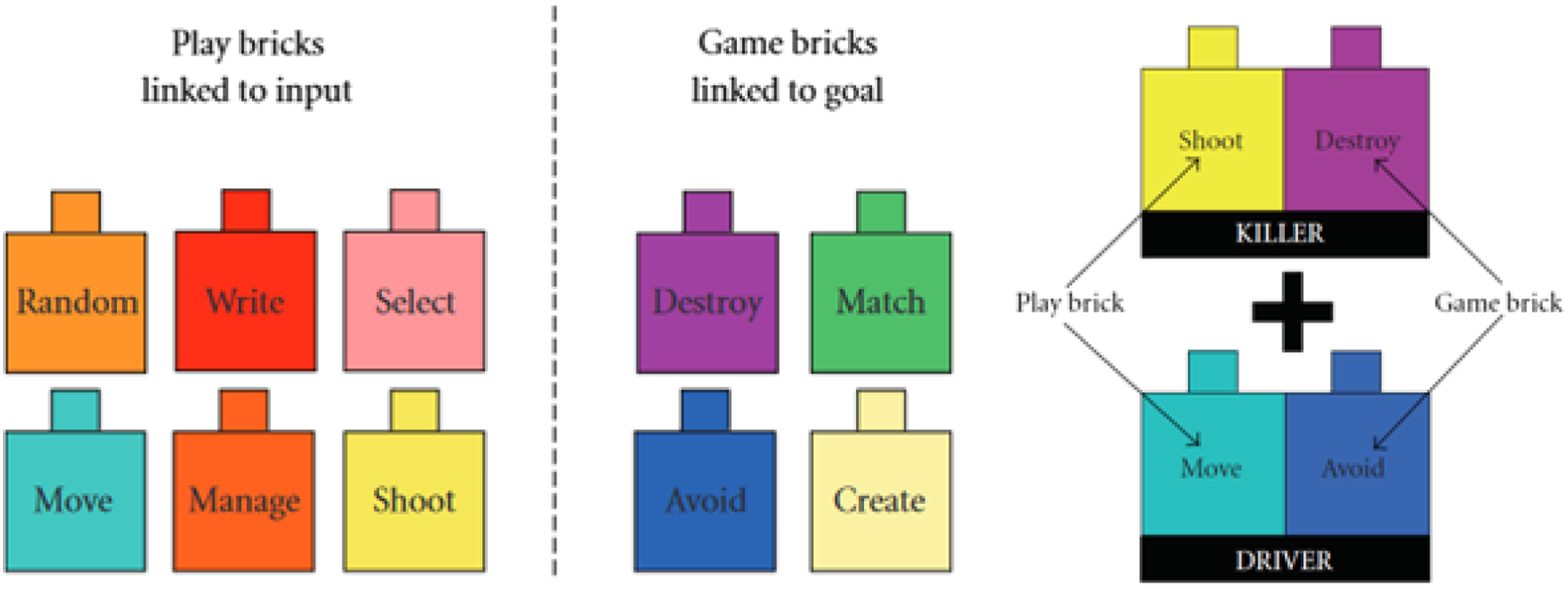

Actual version
The current model from 2018 (Alvarez, 2018) now offers 11 Gameplay Bricks divided into four categories of Bricks called “families”: OB, MB, Result Brick (RB), and Condition Brick (CB). Each family thus has a precise number of Bricks: two OBs (Figure 2, orange Bricks), seven MBs (Figure 2, blue Bricks), two RBs (Figure 2, green Bricks), and one CB (Figure 2, purple Brick). This model update also offers a new representation of Bricks. It includes more formal descriptive elements in order to avoid any subjective interpretation than a simple symbolic representation may induce. As shown in Figure 2, with the Match OB (top right of the figure), each Brick is now assigned a set of seven properties in a nomenclature: name, family color, symbol, number, relation to variables and instances (characteristic function), links with the other Gameplay Bricks, and the antagonistic Bricks (if applicable). This representation is inspired by the periodic table of elements by D. Mendeleev (1889). Thus, the description of the Bricks is more precise and complete. A summary description is provided in Table 2. A full description is presented in Alvarez, (2018, p. 180–186). As for the initial version of the model, the Metabricks are the association between MBs and OBs. Thus, this model identifies 14 typical Metabricks (challenges) that can appear in VG-SGs (Table 3). Representation of the Gameplay Bricks model as proposed in 2018. Illustration from Alvarez (2018, p. 179). Glossary of Gameplay Bricks as proposed in 2018. List of the 14 Metabricks proposed in 2018 that can constitute the challenges of VG-SGs Alvarez (2018, p. 108).


With this new representation, this model makes it possible to make associations between the different Gameplay Bricks to form real “molecules” representing the properties displayed by the different VG-SGs with regard to their mechanics. The identification of Gameplay Bricks within such program representation then allows us to deduce a formal taxonomy of the various VG-SGs thus deconstructed and analyzed. The Figure 3 illustrates the program of the VG Pong (Atari, 1972). Representation of the entire Pong VG at the Gameplay Bricks analysis level. Illustration from Alvarez (2018, p. 169).
To analyze the program Pong at the Gameplay Bricks analysis level, the program is read from left to right and associates, for all Gameplay Bricks, white rectangles expressing the different values associated with the variables and constants necessary for the settings and operation of the game. In addition, all of the MBs or OBs are based on pedestals called “trigger” or “launching” (Figure 3). These last allow us to launch or not a part of the program. To analyze the program Pong at the taxonomic level, it only demands to identify the main Gameplay Bricks involved and associated, then to list the representative Metabricks of the game. Concerning the VG Pong, we count three Match OBs, three Move MBs, one Transform MB and one Create RB. Furthermore, the Match OBs and Move MBs are mostly associated (especially during ball exchanges). Thus, the Gameplay Bricks most representative of VG Pong are the Move OB associated with the Match MB, which corresponds to the Metabrick SOLITARY (Table 3). To facilitate the identification of the VG Pong at the taxonomic level, we can present it by the following equations
* PONG is the equation name.
* (VG) denotes the nature of the equation name (i.e., “video game”).
* (OB) means that MATCH is an OB.
* (MB) means that MOVE is an MB.
* (Meta) means that SOLITARY is a Metabrick.
* The square brackets indicate the main challenge of the gameplay.
Note that this method of analysis is applicable regardless of the complexity of the rules of a VG-SG. It can also allow us to group sets of VG-SGs into families according to the Metabricks listed by the VG-SGs. For example, most AVGs studied in neurocognitive sciences, such as Medal of Honor (Electronic Arts, 1999-2020; Green & Bavelier, 2003), God of War (Sony Computer Entertainment, 2005-2022), Halo (Microsoft, 2001-2020), Unreal Tournament (GT Interactive, 2003-2022), Grand Theft Auto (Rockstar Games, 1997-2022), Call of Duty (Activision, 2003-2022), etc. (Dye, Green, & Bavelier, 2009), present strong similarities according to the taxonomic level of the Gameplay Bricks model. In these VGs, the player must move to match items in the game or simply aim or target items (such as opponents), which refers to the SOLITARY Metabrick (Table 3). Furthermore, the player must shoot to kill enemies and to avoid shooting allies or the police, which respectively refers to the KILLER and MINE Metabricks (Table 3). Finally, the player must avoid being shot, and sometimes avoid having a car accident and dying while driving, which refers to the DRIVER Metabrick (Table 3). Therefore, AVGs correspond to VG-SGs listing at least four Metabricks: SOLITARY, DRIVER, SHOOTER, and KILLER.
Obligation and prohibition Metabricks in the actual version
It is important to specify that all of the Metabricks related to Match OB are related to actions or challenges to be met. They are therefore “obligations” in the sense stated by Hurel (2011, “What the player should do,” p. 32). This concerns the Metabricks: PUZZLE, SOLITARY, ADVENTURE, SAFE, JACKPOT, KILLER and KARAOKE (Table 3 column Match). Conversely, the seven Metabricks linked to Avoid OB constitute “prohibitions” in the sense stated by Hurel (2011, “What the player must not do, i.e. what is possible but prohibited to do,” p. 32). This concerns the Metabricks: QUIZ, DRIVER, HANGMAN, BOMB, ROULETTE, MINE, and WAVE.
Finally, the 14 Metabricks and their significations (obligation or prohibition) are the famous gameplay characteristics representing the “set of rules” according to J. N. Portugal’s gameplay definition that falls in the formal system (“Rules schemas”) according to the theoretical framework of Salen and Zimmerman (2003). Thus, they represent the game mechanics that we will put in correspondence with particular cognitive stimulations.
Identification of Correspondences Between Game Mechanics and Cognitive Functions
Theoretical framework associated with cognitive functions
Prior to these correspondences, we will specify the theoretical framework relating to cognitive functions, in particular for executive functions. Alongside previously proposed frameworks established by Peterson, King, Cohen, & Horak (2016) and Bavelier & Green (2019) on executive functions in the attentional control, we designed a framework specifically focused on the most popular executive functions, and their relationships with attention and memory. Executive functions are based on the correct information selection from our environment, the choice and the regulation of the commitment put into our actions, and constitute our capacity for reasoning and adaptation to our environment (Sacco, 2018). Thus, these functions are part of high-level attentional and memory functions. However, to date, there is still no clear consensus on the modeling and the number of executive functions (Friedman & Miyake, 2017; Packwood, Hodgetts, & Tremblay, 2011; Sacco, 2018). We propose to summarize, using a diagram in Figure 4 and a glossary in Table 4, all the executive functions that can be found in the scientific literature and their relationships with attention and memory. Framework focused on executive functions. Distribution of executive functions with regard to their attentional and memory components. The placement of executive functions in the left and in the right inside the blue area refers to the levels of attention and memory involvement. Common EF, in the center of the blue area, is assumed to be an inherent factor in all executive functions (Friedman & Miyake, 2017; Baddeley, 2012). Glossary proposing short definitions of cognitive functions presented in Figure 4. See the references cited after each function to find an exhaustive definition of it.

Matching between Gameplay Metabricks and stimulation of Executive Functions
Metabricks to be discarded
List of the 14 Metabricks that can constitute the basic game mechanics of VG-SG (Alvarez, 2018, p.108) and the first hypotheses for matching with executive functions.

VG-SGs listing only obligation metabricks
For the other 12 Metabricks, when a VG-SG identifies one or more obligation Metabricks (i.e., involving the Match OB, Table 3), the player must act on the basis of relevant information to be processed. However, the errors of actions are “authorized.” Under these conditions, it seems very likely to us that the player must focus on specific elements on the screen and act by the means made available until the objectives are achieved. This definition of action seems to us to be close to the selective attention function (i.e., focusing on what we choose and disregarding the rest). Also, the player must use his own knowledge stored in long-term memory (referring here to the access function), to rework it in working memory according to the objective to be reached or his level of progress in the game (referring here to the updating function which is part of the working memory processes, see Figure 4 and Table 4). The involvement of selective attention seems to us to be predominant for the VG-SGs listing the SOLITARY and KILLER Metabricks (Tables 3 and 5). The player must move his avatar (Move MB) or one of its parts (Shoot MB) to reach a specific area. For example, in the VG Journey (Sony Computer Entertainment, 2012), the player simply explores a vast world to discover the history of an ancient and mysterious civilization. If he does not find the next area, he just cannot progress but does not lose the game. The stimulation of player’s access and updating functions seems to us to be predominant for the VG-SGs identifying the PUZZLE, ADVENTURE, SAFE, KARAOKE Metabricks (Tables 3 and 5). The player must answer right to win using his knowledge (if he answers wrong, he cannot go on). We can generally take as an example the “hidden object” VG-SG type in which the player looks for objects to go on in the scenario. For example, in the VG The Room (Fireproof Games, 2014), the player must open a mysterious chest by successively open sub-compartments following a specified order. He must select (Select MB) hidden objects or correct solutions to successively solve problems that allow progression in the scenario, which requires seeking certain knowledge and procedures in long-term memory (referring here to the access function) to solve the problems while updating them in working memory with regard to the particularity and the novelty of the problem to be solved at the time as well as the state of progress in the scenario. If he does not find the solution, he just cannot progress but does not lose the game.
VG-SGs listing only prohibition Metabricks
When a VG-SG identifies one or more prohibition Metabricks (i.e., QUIZ DRIVER, HANGMAN, BOMB, MINE, WAVES, Tables 3 and 5), the player must often “act to avoid doing” or “not act,” the error being strictly prohibited, even eliminatory. Under these conditions, he may need to focus his attention, use his knowledge with efficiency and update it in working memory as for the VG-SGs listing the obligation Metabricks.
But other cognitive functions seem to us to be stimulated with much more predominance. The player must mainly resist his thoughts or memories that are superfluous or undesirable with regard to the actions or responses to be given. Also, it must resist the proactive interference of information acquired earlier in the game, which would automate a good action or typical response but would mislead the player if it turns into a false action or response (referring here to the cognitive inhibition function). Finally, he must not act impulsively or let his emotions guiding him (referring here to the self-control function, see Figure 4 and Table 4). We can take as an example the “Yes/No” games, listing only the HANGMAN Metabrick (Table 3). In this type of game, if the player answers “Yes” or “No,” he immediately loses. Therefore, he must concentrate to give the answer, resist to all forms of thoughts and memories that may disturb the answer to be given (e.g., in response to yes/no question) and not act impulsively. As another example, the VG Super Hexagon requires the player to move his triangular cursor (Move MB) clockwise or counterclockwise to avoid touching the walls appearing following specific combinations. The player must avoid them as long as possible to increase his score represented by his total time without being hit by a wall. If his cursor touches a wall, he loses immediately. Therefore, he must concentrate to move in the right direction, resisting all forms of thoughts, memories or forms of impulsive actions (e.g., inhibit movement choices and/or combinations previously requested several times which can thus become persistent).
VG-SGs listing either obligation and prohibition Metabricks
When VG-SGs identify obligation and prohibition Metabricks, we assume that they will at least request more intensively the functions mentioned above compared to VG-SGs only composed of obligation or prohibition Metabricks. For example, in Guitar Hero (Activision, 2005-2015), the list of music notes to select (the score) automatically moves in the game (throughout the music). The player has to choose the correct note when requested and is prohibited from choosing another note. If the player quickly accumulates bad choices, then the music stops abruptly and the player loses. This game is defined by the PUZZLE (obligation) and QUIZ (prohibition) Metabricks, therefore based on the same Select MB (Table 3). Under these conditions, the player finds himself strongly stimulated and under pressure, at the level of selective attention (playing the right notes on the guitar to select the right ones on the screen), access and updating (learning and restitution of partitions in real time), cognitive inhibition and self-control (not selecting notes other than those requested and keeping calm, Table 5).
These first correspondences seem to answer our research question.
A summary of matching is presented in Table 5.
Limits of This Study
The originality of this study is to propose relevant theoretical frameworks regarding VG-SGs (Gameplay Bricks model) and regarding cognitive functions to establish correspondences between game mechanics and specific cognitive stimulations. The objective of this study was to explore in a first work if matchings were possible and justifiable. We have proposed correspondences accompanied by examples from VG-SGs. However, we have intentionally limited the number of examples for the sake of clarity of the manuscript. Due to the absence of this type of matching in the scientific literature, we believe that this study is necessary before undertaking other large-scale studies (e.g., interventional studies or Meta-analyzes).
We have chosen to stay at the taxonomic analysis level to establish the first correspondences, as simple and robust as possible. Consequently, we were only able to propose three correspondences, based on the two main families of game mechanics: rules of obligation and prohibition. We thus have a first correspondence grid. Furthermore, we were not able to exploit the whole theoretical framework of executive functions presented in Figure 4. To do this, we could position ourselves at the Gameplay Bricks analysis level, which is more precise. To return to our Pong example (Figure 3), it appears that the game program describes “a ball,” “rackets,” that these objects are in motion and that the player plays against a robot according to the same rules. Therefore, this level reveals a certain amount of additional information relating to the VG-SGs’ object, in particular their characteristics such as their sizes, positions, displacements, labels, or interactions. Thus, they partly inform us about the object significances, their spatial and temporal organizations. We are aware that such information can influence the cognitive stimulations induced by the VG-SGs. In addition, this level of analysis describes in more detail the unfolding of the game phases, in particular through the sequencing of the different Gameplay Bricks (i.e., MB, OB, RB, and CB). This information (the object characteristics associated with the rules and the progress of the game phase) would probably help us to establish, with greater robustness, other correspondences with executive functions. For example, we believe that we have sufficient details at this level of analysis to question divided attention (i.e., situation where the player must take into account information sufficiently distant by their significance and/or location on the screen, giving him the feeling of monitoring or doing several things at the same time) or even mental flexibility (e.g., by inhibiting the usual response, which has become irrelevant, and then by loading the new response into the working memory, which has become relevant enough to carry out the action of switching or set-shifting in the VG-SGs, Figure 4 and Table 4; see also Diamond, 2013).
Also, the “necessary resources” defined through the Manage CB (Table 2) can refer to a multitude of resources that the player must monitor and fulfill to initiate his actions (e.g., number of attempts, quantity of money, minerals, ammunition, land available, time made available to act, etc.). Such conditions to manage could modulate the involvement of the number and types of executive functions, as well as the intensity (alerting vs. sustained attention) or selectivity (selective attention, orienting vs. divided attention, switching, see Figure 4) of the attentional processes. But here again we can explore its influences only at the Gameplay Bricks analysis level.
In summary, the next studies should be part of prospective experimental design (e.g., cognitive training study by VG-SGs) or retrospective (e.g., Meta-analyzes) and be positioned at the Gameplay Bricks analysis level.
Conclusion and Perspectives
This article investigated whether it is possible to establish correspondences between game mechanics and particular cognitive stimulations. Establishing matches would better prevent and combat cognitive decline related to age and/or the presence of neurodegenerative diseases. They could allow us to design SGs or choose VGs with regard to their game mechanics because of the particular cognitive stimuli that they can induce. Establishing correspondences would better prevent and combat cognitive decline that may be related to age and/or the presence of neurodegenerative diseases. It could allow us to design SGs or choose VGs with regard to their game mechanics according to cognitive stimulation needs.
Observing difficulties to establish such correspondences in the scientific literature, we proposed to move away from “classification by genre” or any other type of taxonomy that deviates from the framework of the “Rules schemas” and the “set of rules” component of the gameplay. Thus, we proposed the Gameplay Bricks model (Alvarez, 2018; Djaouti et al., 2008) as a theoretical framework for VG-SGs. The Gameplay Bricks model currently identifies 14 major Metabricks (game mechanics) through seven Metabricks of obligations and seven of prohibitions. The game mechanics of VG-SGs can thus be defined by the presence of one or more of its Metabricks. We have designed a first correspondence grid. We assume that the presence of obligation Metabricks alone would tend to require selective attention, access, and updating predominantly. The presence of prohibition Metabricks alone would rather tend to require cognitive inhibition and self-control predominantly. Finally, we assume that VG-SGs listing both obligation and prohibition Metabricks would tend to require all of these functions more intensively. These first matches are very encouraging. To strengthen and enrich them, a number of perspectives should be considered for the future.
In terms of future experimentations, on the one hand, it would be interesting to carry out another Meta-analysis to study the effects of VG-SGs on executive functions. In this new Meta-analysis, the VG-SGs used in the studies would be redefined according to the Gameplay Bricks model, then classified into large families of VG-SGs according to different properties, for example, by type of Metabrick, presence or absence of prohibition Metabricks, number of Metabricks, but also by type of constraints imposed by the Manage CB, and/or other formal characteristics of the objects. This kind of work would be very challenging but quite possible.
On the other hand, it would be interesting from future prospective studies on VG-SGs’ cognitive effects to use the Gameplay Bricks model as a basis to characterize the VG-SGs used. This strategy could be relevant for studies with several arms, each corresponding to particular game mechanics. It could also be relevant in the context of cross-sectional studies comparing cognitive performance in novices and experts VG-SG players.
In term of future uses, it would be interesting to update this first attempt of correspondence grid to organize all the information at the Gameplay Bricks analysis level (as in Figure 3). Alvarez’s (2018) exhaustive work allows a detailed methodical analysis of a VG-SG. However, the use of our correspondence grid by therapists and engineers will require a minimal theoretical training on Gameplay Bricks model and executive functions in order to select an existing VG-SG or design a SG targeting executive functions. At the same time, the construction of a database seems necessary to facilitate the understanding, use and appropriation of our correspondence grid. It could look like the one used in https://www.gameclassification.com which already deconstructs VG with the Gameplay Bricks model. It would just have to be adapted to integrate the mappings with the executive functions.
Finally, to update and precise our correspondence grid and the database, it will be necessary to conduct the studies described above (meta-analysis and prospective studies) and, to test its utility, it will be necessary to scientifically assess their usability.
Footnotes
Acknowledgments
We thank Elodie Prin for reviewing and correcting the English.
Declaration of conflicting interests
The author(s) declared no potential conflicts of interest with respect to the research, authorship, and/or publication of this article.
Funding
The author(s) received no financial support for the research, authorship, and/or publication of this article.
