







Abstract
The development and consumption of video games have experienced a significant boom in recent decades. Recently, attention has been paid to the impact they can have on young people and how extremist and radical groups are using them to recruit and reinforce hateful ideas and behaviors. It would be innovative to use this powerful tool to prevent and educate on values and rights, thereby reducing prejudices toward the outgroup. Therefore, the present systematic review aims to gather and systematize existing knowledge on video game-based interventions to reduce and prevent extremism and violent radicalization in young people, following the PRISMA method, analyzing a total of six articles. The results indicate that such interventions can reduce prejudiced behaviors toward outgroup individuals and increase resilience, empathy, and prosocial interactions. However, further exploration in this field is necessary to better understand the mechanisms involved and improve video game designs for preventive purposes.
The relationship between video games and violent extremism is a relevant topic that has received little attention to date. In recent decades, the video game industry has experienced exponential growth, becoming one of the pillars of entertainment and generating economic turnover (Hartgers & Leidig, 2023; Ripoll & Muñoz, 2023; Robison & Whittaker, 2020; Stern Center for Business and Human Rights, 2023). Video games, in addition to being an entertainment resource, have become a tool with a propagandistic power used for political purposes by different social, cultural, and governmental agents (Aouragh, 2016), but also by terrorist organizations and structures (Moreno, 2022). This expansion and popularity have provided new opportunities for violent extremism to adapt, using games and related iconography. While the internet remains a key medium for the propagation of terrorist propaganda, extremist, and radical groups have found a new refuge in video game platforms.
The wide distribution and impact of video games has generated new forms of recruitment, interaction, and creation of online communities for extremist and terrorist groups (Hartgers & Leidig, 2023), using the empathetic potential, influence, and reach of this medium to recruit people (Moreno, 2022; Sicart, 2014). There are government reports denouncing the communications that various extremist groups maintained through this type of space (Elliot & Mazzetti, 2013; Moreno, 2022). According to a multinational survey conducted by New York University (Stern Center for Business and Human Rights, 2023), approximately half of respondents reported encountering extremist statements while playing online multiplayer games, and 36% experienced acute harassment in the past year. Thus, the radical narratives promoted in the video game world are having real repercussions.
The relationship between video games and violent extremism poses challenges that need to be adequately addressed. It is essential to delve into these dynamics and develop effective strategies to counteract the negative effects and promote a safe and responsible gaming environment.
Most of the literature on video games and extremism is based on the use of video games as propaganda, which is understood as “a form of communication intended to influence the opinions and/or behaviour of its target audience toward some kind of goal: political, social or military” (Wilcox, 2005). This method of recruitment through propaganda aims to engage “normal” individuals in these activities through iconography and the gaming experience itself. However, several authors argue that this type of propaganda does not promotes new ideas, but rather encourages the action of those who already had those ideas previously and are already involved in the movement, by reinforcing their beliefs and behaviors (Robinson & Whittaker, 2020) and by exploiting the biases of the target audience (Ellul, 2006) as for example prejudice, discrimination, and group polarization (Moyano, 2019).
Video games have an interactive capacity, which allows the player to feel as being part of the video game, obtaining a greater immersion and experience. This fact turns video games into potential instruments of persuasion. This persuasive power derives from the rules of the game itself, which establishes which actions can and cannot be carried out within the game, which allows the game experience to be created, as well as its meaning. Video games allow for the creation of spaces that users can explore through the process of experimentation. In turn, this experimentation can be used as a metaphor to extrapolate the rules or norms of the game to society in a critical way (Bogost, 2008).
Extremist and terrorist video games, as well as their modifications (“mods”), do not present alternatives to violence, providing little visibility to more democratic actions with the intention of securing the group's objectives and deeply involving the player in the cause. To achieve strategic communication with users, the game or mod must be “realistic,” ensuring context fidelity, that is, be immersed in a social and political struggle that is in line with the player's own. Arguably, the strategic value that video games bring to extremist and radical groups is to provide a space for sympathizers to engage with and reinforce the core message of the game, where it is often conveyed that violence is justified to achieve certain objectives (Gee, 2003).
Even if video games could persuade the player, it would be necessary to influence the player's ethics, morality, and capacity for reflection. Thus, users are not passive recipients of the message provided by the game but rather active, moral beings who interpret their own conduct and behavior within the game from an ethical perspective (Sicart, 2011).
For this reason, the rules involved in video games can actively affect the ethical behavior of players through moral values, so players use ethical thinking and reflection to play computer games. Video games are complex cultural objects that contain rules that guide behavior, create game worlds with values, and enable players to interact with other players who like to explore morals and forbidden actions in society (Sicart, 2011). That is, gamers are not morally passive people, exposed to unethical content, but rather interact and create ethical reflections. Therefore, incorporating these ethical agents into the game design is crucial. In video games such as Deus Ex (Storm, 2000), ethical thinking and responsibility are strategies that are put into practice by players, encouraging reflection on the missions and their meaning.
Violence within video games is understood as a requirement for advancement and success, and these actions are representative of real life. Players can retain the thoughts provoked by the game and create subjective value judgments. This is why terrorist groups need to use the interactive capacity of video games effectively to enhance the appeal of video games to young people and their ability to persuade and reinforce specific ideological thoughts. It is worth noting that the age group with the highest consumption of video games is young people (Hartgers & Leidig, 2023) between the ages of 6 and 34 years (Ripoll & Muñoz, 2023).
Considering the importance and impact that video games can have on young people today, they could be used as a potential educational tool (Cipagauta & Gómez, 2019; Miranda-Palma et al., 2023). In the world of video games, young people can experience and face different challenges in a controlled context, including more complex threats such as extremism and radicalization (Gurlesin et al., 2020). Furthermore, the literature shows that the use of these educational games helps to increase and improve decision-making and conflict resolution, creativity, information seeking and assimilation, digital literacy, spatial representation and sociability (Ripoll, 2022), as well as social learning: relational, normative, and cognitive (Flood et al., 2018).
Educational video games can expose players to new experiences where they can interact with other contexts and social groups, which can promote tolerance and reduce prejudice (Breves, 2020). The video game can be a powerful ludic tool that encourages prosocial behavior and dialogue and serve as a peace-building tool (Martínez-Cano et al., 2019). Prosocial behavior is referred to a broad category of intentional behaviors that benefit others and favor the development of social relationships that promote coexistence and wellbeing in healthier social contexts (Cuadrado & Tabernero, 2015), as for example altruism, helping, cooperation, volunteering, and solidarity (Penner et al., 2005). Then, it refers to a construct that could help to reduce radical attitudes and behaviors or violent extremism.
In the field of video games, prosocial behavior does not have a real cost for the helping person. However, people evaluate, the virtual cost depending on the social reality of the video game configured through elements such as social norms, cost-benefit, decision processes, learning, emotion (empathy), and consistency between attitudes and behaviors (Martínez-Cano et al., 2019). As in the video game Reconstruction (Pathos Audiovisual et al., 2017), dynamics for promoting prosocial behavior can be generated, by involving the player in situations in which a dichotomy between helping or not is created to generate reflection with the aim of increasing these positive behaviors toward others (Martínez-Cano et al., 2019).
This can turn video games into a good resource to promote diversity and social inclusion. Video gamers can establish one-sided emotional relationships with different interracial characters, that is, parasocial interaction in which players form beliefs and attitudes about interracial real people or fictional characters they meet through the game, where they can learn about their customs, values, and culture. Schiappa et al. (2006) and Breves (2020) have compared parasocial and interpersonal interactions, since the human brain processes media experiences in the same way as real-life experience. Thus, as in real life, in video games people form positive or negative attitudes toward other people (regardless whether they are fictional or real people in the game).
This social contact with interracial people through video games has been shown to be effective in reducing prejudiced behaviors (Banas et al., 2020; Schiappa et al., 2006). However, some players may have negative reactions to these interactions due to stereotypes or prejudices (whether conscious or nonconscious) or due to violent actions of other players during the course of the game, resulting in disengagement and reduced prosocial behaviors (Breves, 2020; Goff et al., 2008). Nevertheless, those players who are successful in regulating these emotions will show less prejudice toward the interracial group (Steele et al., 2019). Video games that allow players to explore and question their own identity can play an important role in preventing radicalization and violent extremism. According to Rydell et al. (2010), players who can experience and adopt identities different from their own reduce their discrimination and prejudice toward the outgroup. In addition, this mimicry with other identities could allow young people to identify their strengths, which may subsequently lead to a positive self-identity and better development of social and emotional skills (Caulfield & Wilson, 2012; Cohen et al., 2005).
Another important aspect of reducing radicalization and extremism is the ability of individuals to use their strengths as protective factors in the face of adverse situations or environments, known as resilience (Fletcher & Sarkar, 2013). Resilience refers to the capacity to grow and develop under difficult circumstances (Panizo-Lledot et al., 2022) and to maintain or recover mental health, as a form of positive adaptation or protective mechanism, in the face of adversities or stressors (Herrman et al., 2011). This construct is a variable of interest for this study, since interventions can be implemented through video games that favor resilience as a protective factor against extremism. In this sence, Panizo-Lledot et al. (2022) argued that the implementation of educational video games based on challenges where psychological skills training associated with emotional intelligence and resilience is applied, report positive results on people's ability to face the challenges of any psychological crisis in real life.
In addition, games that involve social interactions can satisfy the need to connect with other people, in addition to providing entertainment that can foster a state of mental relaxation that can favor distance from stressors, increase affective wellbeing or emotional state and in the long term can favor the development of protective factors that promote resilience (Bowman et al., 2022). Studies such as Pusey et al. (2022) report data on players with resilient behaviors and enjoyment of video games when needs such as autonomy, competence, and relationship were satisfied, so the use of the video game as an educational tool that encourages the achievement of these elements in order to be motivating for players is proposed. Lippe et al. (2022) report results suggesting that online gaming as an intervention tool is successful in improving (digital) resilience and critical thinking. An example of such games in the educational setting is the game called Shimpai Muyou! (Paracha et al., 2013) created to reduce Islamic bullying in schools.
While its presence does not entirely eliminate the likelihood of developing extremist or radical behavior in the future, its absence along with other risk factors is an ideal mix for the development of maladaptive behavior, including radicalization, as resilience can act as a “shield” against radical ideas. Video games have a great influence on personal wellbeing at the psychological and social level and, as was mentioned above, can influence and affect the attitude, behavior, and emotions of the people who play them (Torregrosa et al., 2018). Video games, especially those that allow players to adopt roles and interact and experiment in controlled spaces, are a totally valid educational tool capable of developing, even at an early age, skills that enable and reinforce prosocial behavior, resilience, decision making, teamwork and empathy, among others, thus serving as a preventive tool for maladaptive behavior. In fact, empathy is a construct related to emotional intelligence and helps people to develop a correct understanding of the emotions of others. Furthermore, according to Sánchez-Queija et al. (2006) this construct is related to perspective taking, which involves adopting the cognitive point of view of the other person, sympathy as concern or interest in the other person, and personal discomfort as uneasiness in interpersonal situations involving other people and their needs.
In video games, sometimes real-life situations or problems are recreated in which players must make decisions and resolve conflicts, facing the consequences both for their avatar and for that of other players or even for the development of the story. Therefore, players must put into practice psychological skills such as empathy, which will influence the recognition of emotions and favor processes such as decision making or conflict resolution (Panizo-Lledot et al., 2022).
This systematic review aims to pool knowledge on video game interventions to reduce or prevent violent extremism and radicalization. The specific aims of the study are to: (1) pool the existing literature on video game interventions, (2) examine the effectiveness of the interventions, and (3) to discuss the available knowledge on this topic in order to propose possible lines of research and applied implications.
Method
Eligibility Criteria
The inclusion criteria for the selection of studies were: (1) video game interventions to prevent or reduce extremism and radicalization that have been evaluated, (2) youth and young adult (under 35 years of age) population, (3) publication date between 2012 and 2022, and (4) articles written in English or Spanish.
The following were excluded from the review: (1) single case studies, (2) studies whose sample consisted of people over 35 years old, (3) thesis studies, and (4) articles related to extremism and violent radicalization in social networks, as well as cyberbullying and cyberhate, as this is not the central theme of the systematic review.
Resources and Search Strategy
The method and protocol used for the systematic review was the updated PRISMA guide (Page et al., 2021). The search of the scientific literature was carried out in the following databases: Web of Science, Scopus, Google Scholar, and APA PsycNet.
The following terms were searched for in titles, abstracts, and subject headings: radicalization OR violent radicalization OR extremism OR violent extremism OR racism OR discrimination OR cyberhate OR online hate OR Islamophobic OR anti-Semitism AND Videogames OR video games OR online games OR gaming OR games AND Prevention OR intervention OR preventing OR fight OR program OR intervention program OR countering AND Teenagers OR adolescent OR youth OR young people OR young adults OR children OR child.
The time period used to search for studies was December 2022 to March 2023 and the search was conducted in both English and Spanish. A total of 75 articles were found. The titles of those studies that were not relevant or concordant for the review and duplicate studies were automatically eliminated. Relevant articles were selected with their respective abstracts. The interventions were then screened to ensure that they met the inclusion criteria. Details of the study selection process are detailed in the PRISMA flowchart (Figure 1).
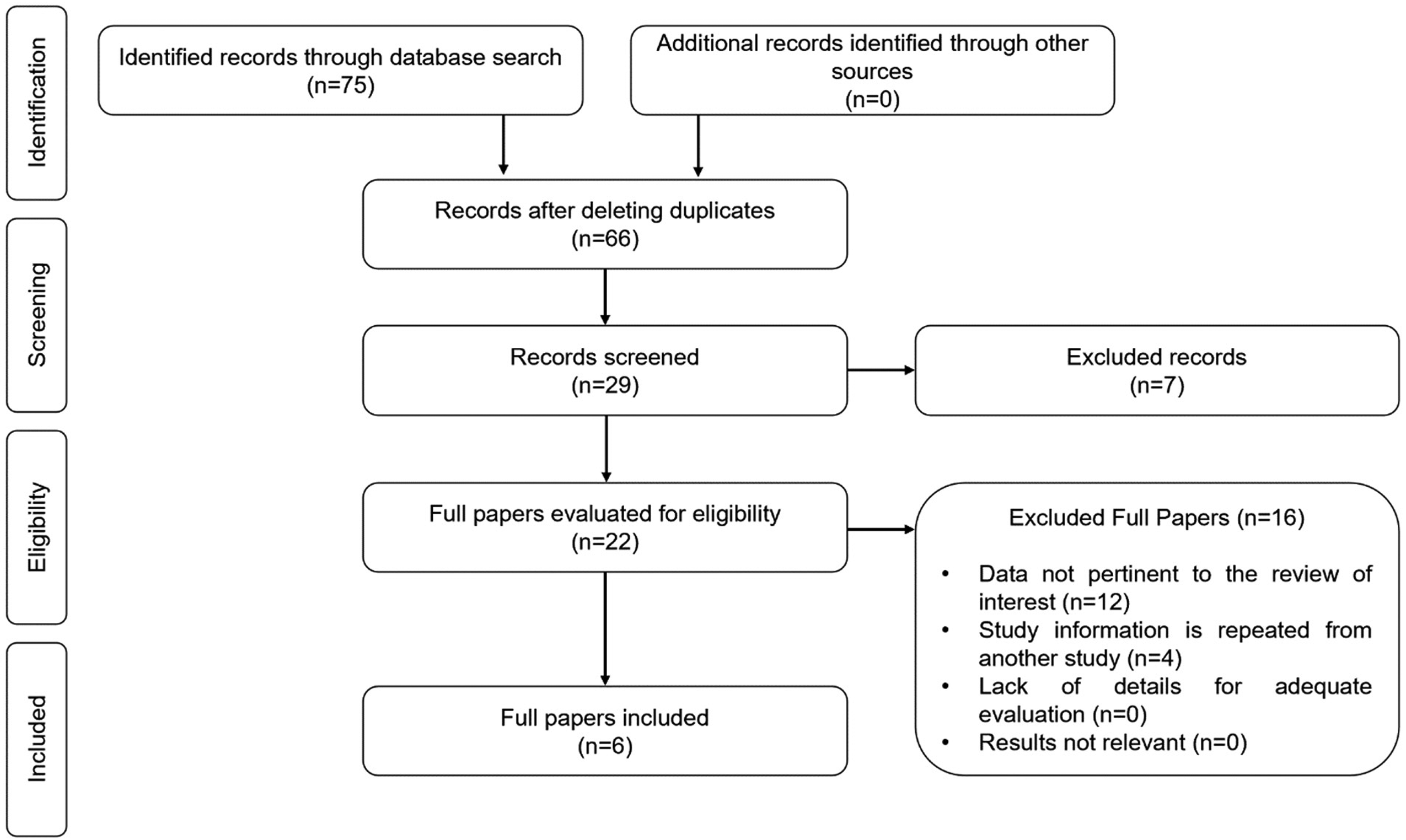
PRISMA flowchart on study selection.
Selection of Studies
The identification and selection process were performed by blinded peer review, where two independent reviewers used the aforementioned search strategies, identifying only scientific articles and avoiding books, book chapters, conference proceedings, and reviews. After performing this procedure in the four databases, 75 studies were identified (Web of Science, n = 14; Scopus, n = 21; Google Scholar, n = 37; and APA PsycNet, n = 3) but nine duplicate studies were eliminated so a total of 66 studies were selected. The papers selected by the two reviewers were compared and doubtful cases were resolved by consensus or by a third reviewer.
After examining the title and abstract of each of the 66 studies, 37 of the articles were excluded because they did not fit the initial topic of the present systematic review, so that a total of 29 were selected. After an in-depth analysis, seven were eliminated because they did not fit the research topic. Therefore, a total of 22 studies were selected for the eligibility phase, of which 16 were eliminated, because the sample data were not relevant to the review of interest according to the established exclusion criteria (n = 12) or the study information was already included in another study with the same findings (n = 4). Following all these procedures, six articles were included in the present systematic review.
Data Mining
To carry out this process, a double-entry table was designed to collect and categorize the characteristics and interventions of each study. To this end, the following data were extracted from each study, if available: (a) study objectives; (b) type of intervention; (c) evaluation design; (d) country; (e) sample and sample characteristics; (f) instruments and/or variables; (g) data analysis; (h) results; and (i) limitations.
Therefore, the characteristics of each study included in this review were extracted, considering the limitations and strengths at the methodological level and the overall quality of the studies. For the latter, the categorization system of León and Montero (2020) was used to organize the documents according to the type of study. This categorization enabled the subsequent application of an instrument to assess the quality of the studies.
Quality of Studies
The methodological quality of the studies was assessed independently by two authors using a 27-item checklist (Downs & Black, 1998). The characteristics assessed by this checklist fell into five dimensions: (1) general information, consisting of 10 items, which assessed whether aspects such as objectives and hypotheses, study measures, procedure and interventions, confounding factors, main results, adequate statistical estimates and true probability values, sample characteristics and limitations were correctly and clearly described; (2) external validity, assessed through three items, testing the extent to which the study results could be generalized to the population from which the studies were drawn; (3) internal validity and biases, consisting of seven items, assessing possible biases in the measurement of the intervention and the interpretation of the results; (4) internal validity and confounding variables, through six items assessing biases in the selection and allocation of participants; (5) power, assessed through one item, testing the extent to which the results of a study could be due to chance. Responses to the different items were either 0 or 1, with the exception of item 5 of the general information dimension, which scored from 0 to 2, and item 27 on power, which scored from 0 to 5, therefore the maximum score is 32 points.
The studies were scored according to the degree of compliance with the characteristics assessed through the checklist, with studies with higher scores indicating a higher-quality index. Both reviewers found agreement in the assessment of most of the studies and in case of disagreement it was resolved by examining the articles and by consensus.
Results
As con be seen in Table 1, the objectives of the different interventions carried out through the use of video games in the analyzed studies were diverse: to educate about radicalization and increase resilience by influencing attitudes and behaviors; to increase resilience and emotional intelligence in the face of extremism; to assess the effect of the video game itself on young people vulnerable to radicalization; to assess the prosocial effects of video game use; to test the relationships between attitudes and racial identities through video games in terms of social presence and narrative interpretations; or to examine whether immersion in virtual reality (VR) in violent conflicts from the perspective of the outgroup promotes positive emotions and attitudes in order to reduce intergroup tensions.
Summary of interventions and findings.
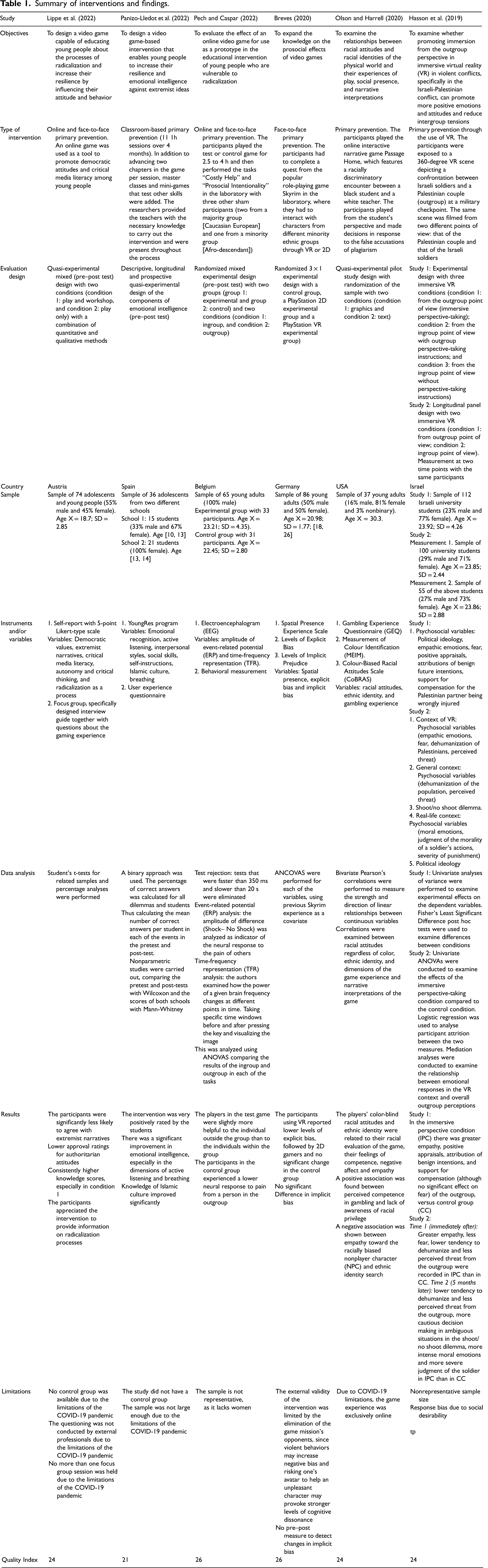
In reference to the interventions carried out by the different studies, these were mainly focused on primary prevention (online or face-to-face), implementing online games, offline games, mini-games, narrative games from different perspectives or immersive VR.
In terms of methodology, three of the studies analyzed implemented an experimental design with postintervention measures (Breves, 2020; Hasson et al., 2019) or including pre–post measures (Pech & Caspar, 2022). In the case of Hasson et al. (2019), in addition to conducting a first experimental study, a second longitudinal panel study was performed. The other three studies implemented a quasi-experimental design with either pre–post measures (Lippe et al., 2022; Panizo-Lledot et al., 2022) or only postintervention measures (Olson & Harrell, 2020). Study participants came from different countries (Austria, Spain, Belgium, Germany, the United States, and Israel), with varying ages between 10 and 30 years and sample sizes ranging from 36 to 112 participants. The measurement instruments used were diverse, such as scales, self-reports, focus group, validated or had hoc questionnaires and even psychophysiological and behavioral measures. The data analyses and statistics carried out by the different studies were in accordance with the designs implemented and the measures collected, performing Student's t-tests for related samples, percentage analyses, nonparametric tests such as Wilcoxon's and Mann-Whitney tests, event-related potential analyses, time-frequency, test rejection, analysis of variance (ANOVA), analysis of covariance (ANCOVA), Pearson's correlations, and logistic regression.
Regarding the obtained results, studies indicate that video game interventions can be effective in preventing radicalization and violent extremism by reducing agreement with extremist narratives and authoritarian attitudes, improving cognition and emotional intelligence, and fostering empathy toward different groups (Lippe et al., 2022; Panizo-Lledot et al., 2022). In addition, positive effects were found on the perception of ingroup and outgroup individuals, as well as on the reduction of explicit prejudice (Pech & Caspar, 2022; Breves, 2020). The usefulness of video games as preventive tools in countering extremism and promoting more empathetic and sympathetic attitudes is also supported (Olson & Harrell, 2020). Immersive perspective interventions were particularly promising, showing positive long-term results in terms of reduced fear, dehumanization, and more cautious decision making in ambiguous situations (Hasson et al., 2019).
The limitations reported by the different studies refer to the absence of a control group or pretest–post-test measures, the lack of representativeness of the sample, limited generalisability or low external validity, social desirability bias in the responses, and limitations in the procedure derived from the COVID-19 pandemic.
Finally, following the assessment of the quality of the studies through the applied instrument, the scores ranged between 21 and 26 out of a total of 32 points, indicating that the studies selected for analysis met between 65.63% (Panizo-Lledot et al., 2022) and 81.25% (Breves, 2020; Pech & Caspar, 2022) of the quality criteria. More specifically, the results of the checklist to assess methodological quality showed that general information was in general properly provided in all the analyzed studies. Nevertheless, the study by Panizo-Lledot et al. (2022) does not clearly include important information (characteristics of the participants and of the participants lost during the experiment, distributions of the main confounders in each group, the actual probability values). Olson and Harrel (2020) also failed in describing the characteristics of the participants lost. Regarding external validity, although all studies are conducted in representative settings (not laboratories, but more natural contexts), only the sample of Olson and Harrell (2020) could be considered as representative of the whole population. Moreover, although the quality of the analyzed studies in term of internal validity and bias was also correct, only the papers by Pech and Caspar (2022) and Breves (2020) blind participants to the intervention, and no study blinds the investigators who conducted the interventions. Also, although the checklist analysis regarding internal validity and confounding variables shows correct results, the study by Panizo-Lledot et al. (2022) does not randomly assign participants to the different groups; the studies by Lippe et al. (2022), Olson and Harrell (2020), and Hasson et al. (2019) did not consider the loss of participants; and none of the studies hide the assignment to the intervention groups from the participants or investigators. Finally, all studies report sufficient statistical power to detect significant effects where the probability value of differences by random are <5%.
Discussion
In general, it has been observed that video games can be a very useful tool for reducing prejudiced behavior and increasing prosocial attitudes and behavior (Lippe et al., 2022; Pech & Caspar, 2022; Breves, 2020; Olson & Harrel, 2020; Hasson et al., 2019), thus promoting diversity and social inclusion. The literature consulted reports potential benefits of using video games for learning and the acquisition and improvement of different skills (Breves, 2020; Hasson et al., 2019; Lippe et al., 2022; Olson & Harrell, 2020; Panizo-Lledot et al., 2022; Pech & Caspar, 2022). Specifically, Panizo-Lledot et al. (2022) show that the use of video games can improve knowledge about another culture (in this case, Islamic), also significantly improving emotional intelligence, especially in the dimensions of active listening and breathing. On the other hand, in the study of Pech and Caspar (2022), it was observed that, when participants of an intervention group were exposed to a video game in which they were exposed to implicit messages with the objective of reducing prejudicial attitudes towards the minority, they presented a larger number of costly helping behaviors (e.g., to lose a gain of money or to endure physical pain to prevent the other person from receiving it) toward individuals from the outgroup, and they also experienced a higher neuronal response to the pain of a fictious character from the outgroup that they though he was a real gamer, in comparison to the control group (who played to the same video game but without any implicit message).
The use of nonplayable characters, that is, those characters that cannot be controlled by the player, of different ethnicities within video games, interacting with other contexts and groups different from those of reference, has shown a decrease in discriminatory behaviors and attitudes toward people from the outgroup, favoring tolerance (Breves, 2020; Olson & Harrell, 2020). Specifically, in Breves’ (2020) study, in addition to the fictitious character that the player can control, nonplayable characters of different ethnicities groups or races appear during the game and interact with the player by VR or 2D. In the intervention carried out through video game, positive relationships are promoted toward nonplayable characters that could be generalized to the real world, thus reducing prejudiced attitudes. On the other hand, using fictional characters of other races or ethnicities seems to have positive effects on attitude and behavior. This is another relevant point since the fact that a character changes the player's attitudes and behavior in the real world (proteus effect) has great potential as an educational tool. This effect produces a sense of deindividualization that makes the participants change their self-perception and adhere to their new identity (that of their character) and therefore change their behavior and attitudes. The study also reports a greater reduction in the improvement of explicit biases when the intervention is performed using VR video games than using 2D or control group gamers.
This means that, people can maintain this social contact and learn about customs, values, and culture other than their own through video games as a play tool, which has been shown to be effective in reducing prejudiced behavior (Hasson et al., 2019; Lippe et al., 2022; Panizo-Lledot et al., 2022; Pech & Caspar, 2022). Reducing explicit biased attitudes, experienced by people toward those of different ethnicity, can lead to improvements in intergroup relationships (Breves, 2020; Hasson et al., 2019; Olson & Harrell, 2020). Although explicit bias can be reduced by social interaction through video games, the same results have not been obtained with implicit biased attitudes. This could be understood by assumption that social contact affects implicit and explicit biases by two different routes. Explicit attitudes are strongly influenced by deliberate actions (such as helping an outgroup member), while implicit attitudes might be changed by more indirect behavior (such as thinking about an outgroup member), so these are much more subtle and difficult to change and require more interaction to change them (Breves, 2020).
Another factor that may play in favor of tolerance and prosocial behaviors toward outgroups is cognitive dissonance; this theory states that, when a person performs a positive or favorable action toward someone for whom there is a tension or negative attitude, the person will be more willing to interact positively afterwards to justify the cooperative behavior and reduce that cognitive dissonance (Breves, 2020). In Breves’ study (2020), situations were established in which the participant had to risk the life of his own character to help someone he disliked (a character of a different race), which could provoke a high level of cognitive dissonance. According to the authors, this has a psychological effect, since by experiencing this dissonance produced by the emission of a positive or helpful behavior as opposed to the previous negative attitude, the participant had to regulate this state of tension, thus reducing the negative or biased attitudes.
One of the obstacles that can be encountered in the use of video games is that people exhibit lower physiological arousal and emotional response to fictional social interactions compared to real social interactions as reported by studies reviewed in Pech and Caspar (2022). Since all the interventions in this review were computer-based, it could be assumed that playing with other people might reduce prejudice attitudes to a greater extent compared to playing with the AI characters alone (Pech & Caspar, 2022). Similarly, having digital interactions with other people would enhance the gaming experience, making it much more satisfying. However, the advantage of using fictional characters is that the game can be adapted to any situation and demand that the group or environment requires, which could generate a greater impact, allowing the game to offer a wide range of democratic alternatives to fight against injustices and a better deconstruction of extremist and radical roles (Lippe et al., 2022; Pech & Caspar, 2022). Similarly, using video games as a teaching tool allows for controlled learning situations that include challenges and threats, such as extremism and radicalization, by extrapolating the rules of the game to society in a critical way (Lippe et al., 2022; Panizo-Lledot et al., 2022). As has been observed in other works reviewed in the study of Pech and Caspar (2022), extremist and radical groups have made use of the fame of video games to create “mods” where there is no alternative to violence to achieve goals and progress in the game's story. It is therefore interesting to use this tool to break down the barriers of prejudice and increase resilience in those who are most vulnerable.
Similarly, virtual experiences have been shown to be effective in reducing fear of the outgroup and increasing empathy, as can be seen in the study by Hasson et al. (2019), who reported that these benefits are imminent and appear to be long-lasting over time. In this study, a video game was used through immersive VR with different points of view. The authors of the study claim that perspective taking is important for improving intergroup relations, so they examined the effects produced by this intervention in an imagined armed conflict. Participants (Jewish-Israelis) viewed a VR scene of a confrontation between Israelis and Palestinians from different points of view; from the outgroup, from the ingroup imagining the perspective of the outgroup (by instructing the participant to imagine being a person from the outgroup) or from the ingroup with no imagined perspective. Participants in the outgroup point of view condition in VR perceived Palestinians more positively (with more empathy) than participants in the ingroup point of view condition and even than those in the ingroup imagining outgroup perspective. These results were maintained even 5 months after the VR intervention. The authors conclude that perspective-taking VR can be an effective tool for promoting peace and increasing empathy, positive attitudes and emotions in conflict situations which would be useful to reduce extremism and violence.
In short, video games have a great influence on people's attitudes, behaviors, and emotions, affecting both psychological and social personal wellbeing (Breves, 2020; Hasson et al., 2019; Lippe et al., 2022; Olson & Harrell, 2020; Panizo-Lledot et al., 2022; Pech & Caspar, 2022). Therefore, the use of video games as a tool to prevent extremism and violent radicalization and to favor the acquisition of skills that reinforce prosocial behaviors, empathy and tolerance in young people is a promising idea, although further research is needed to better understand their effectiveness and how they can be designed to achieve positive results.
Applied Implications
In terms of implications for professional practices, it would be advisable to: (1) use the integration of video games in educational programs, where they would be used as complementary tools to foster prosocial behaviors, reduce prejudice and promote empathy among young people; (2) design video games with diverse nonplayable characters, being aware of the importance of adequately and respectfully representing ethnic diversity in the characters and promoting positive attitudes toward outgroups, as well as tolerance and respect; and (3) promote democratic alternatives in video games, avoiding the glorification of violence and offering options for peaceful conflict resolution.
Overall, these implications suggest the importance of using video games strategically and ethically in the professional practice to address extremism and violent radicalization, fostering prosocial attitudes, empathy, and intergroup tolerance.
Limitations and Proposals for Future Research
The following limitations were found in this systematic review. Firstly, the sample size was very small, with only six articles included. This may affect the representativeness of the results and limit the generalizability of the conclusions to a wider population. Secondly, the quality of the studies was heterogeneous; thus, although they have similar objectives, may have different levels of methodological quality, including rigorousness, design and sample obtained, which may affect the reliability of the results and the validity of the conclusions. Finally, the number of longitudinal studies is very small; due to the limited knowledge in this area, there are very few longitudinal studies assessing the long-term effects of video game-based interventions. This makes it difficult to understand the durability of the effects and the long-term effectiveness of the interventions themselves.
In line with the abovementioned, further studies are needed to better understand the effectiveness of video games in preventing radicalization and violent extremism in young people. It would be necessary to investigate which features of video games have a positive impact on reducing prejudiced behaviors and increasing prosocial attitudes and behaviors. Furthermore, it is important to explore how to carefully design video games, in order to maximize their effectiveness in preventing extremism. To this end, comparative and longitudinal research evaluating different types of video games and their long-term effects on reducing extremism among young people is suggested. In addition, a promising area of research is to examine the impact of social interactions in video games on reducing prejudiced attitudes. The use of online multiplayer video games to promote tolerance and prosocial behaviors toward outgroups could be investigated. Moreover, it is necessary to explore how virtual experiences can influence the decrease of fear toward the outgroup and the increase of empathy. Studies comparing the impact of interactions with fictional characters and interactions with real players on reducing extremist and radical attitudes are suggested.
However, it is important to note that research on the effects of video games in preventing extremism and violent radicalisation in young people is limited and more studies are needed to better understand their effectiveness. Moreover, not all video games are equally effective, and they need to be carefully designed to have a positive impact. These research proposals could contribute to expanding the existing knowledge on the use of video games to prevent extremism and violent radicalization, as well as to inform the design and implementation of more effective interventions in this field.
Conclusions
In conclusion, this systematic review achieved the proposed objectives of (1) pooling the existing literature on video game interventions, (2) examining the effectiveness of the interventions, and (3) discussing the effectiveness of the interventions, with the aim of discussing the available knowledge on this topic, in order to propose possible lines of research and applied implications.
The use of video games in interventions to prevent radicalization and violent extremism in young people shows great potential. Video games can be an effective tool to reduce prejudiced behavior and encourage prosocial attitudes and behavior. The inclusion of nonplayable characters of different ethnicities in video games has been shown to be effective in decreasing discriminatory attitudes toward outgroups, suggesting that video games can play an important role in promoting diversity and tolerance. Furthermore, cognitive dissonance theory supports the idea that video games can influence prejudiced attitudes by providing positive experiences with fictional outgroup characters. This can lead to positive changes in attitudes and behaviors toward others in the real world.
Virtual experiences in video games have been shown to be effective in reducing fear and increasing empathy toward outgroups. These benefits may endure over time, suggesting that video games may have a lasting impact on reducing extremism and violent radicalization. Despite these promising results, more research is needed to better understand the effectiveness of video games in preventing extremism and violent radicalization. It is important to further explore how to design video games in an optimal way to achieve positive outcomes and adapt to the needs of the environment and the target group.
Overall, the evidence supports the idea that video games can be a valuable tool in interventions to prevent radicalization and violent extremism in young people. However, it is essential to continue to research and develop effective strategies, to maximize their potential and ensure positive outcomes.
Footnotes
Authors’ Contribution
All authors contributed to the study conception and design. Material preparation and methodology were performed by [Fatima Lopez Naranjo], [Miguel Ángel Maldonado], [Esther Cuadrado] and [Manuel Moyano], data collection was realized by [Fatima Lopez Naranjo], [Esther Cuadrado] and [Manuel Moyano] and analysis was performed by [Fatima Lopez Naranjo] and [Miguel Ángel Maldonado]. The first draft of the manuscript was written by [Fatima Lopez Naranjo], [Miguel Ángel Maldonado], [Esther Cuadrado] and [Manuel Moyano], the rewiew and editing were performed by [Miguel Ángel Maldonado] and supervisión was realized by [Esther Cuadrado] and [Manuel Moyano] and all authors commented on previous versions of the manuscript. All authors read and approved the final manuscript.
Declaration of Conflicting Interests
The author(s) declared no potential conflicts of interest with respect to the research, authorship, and/or publication of this article.
Funding
The author(s) disclosed receipt of the following financial support for the research, authorship, and/or publication of this article: This research was conducted as part of project PID2020-116646RB-I00 funded by MCIN/AEI/10.13039/501100011033 and as part of the project DigiPatch funded by the European Union's Horizon 2020 Research and Innovation Program under Collaboration of Humanities and Social Sciences in Europe European Research Area-NET (101004509).
