







Abstract
Video games have emerged as one of the most ubiquitous forms of media globally, exerting a considerable influence on our perceptions of other cultures. However, contemporary video games have perpetuated negative stereotypes about Brazilian favelas and their residents, prioritizing aesthetics and themes that fetishize poverty, precarity, and violence. This essay critically examines the (mis)representations of Brazilian favelas in video games, exploring their far-reaching implications for global perceptions of favelas and their residents, and their role in perpetuating negative stereotypes.
During the twentieth and twenty-first centuries, literature and cinema have been the most important vehicles for disseminating foreign knowledge and aesthetics around the world, as exemplified by epic historical films such as Quo Vadis (LeRoy, 1951), westerns as For a Few Dollars More (Leone, 1965), or Akira Kurosawa's Seven Samurai (Kurosawa, 1954). By reading an English or German novel or watching a Japanese or Dutch film, individuals can learn a little more about the culture represented in that cultural artifact, albeit in a superficial way.
From household items to cultural phenomena, videogames are now responsible for disseminating identities and cultures, and some productions can be very effective at representing historical, cultural, linguistic, and social fragments, from Aztec ruins (Assassin's Creed IV: Black Flag, 2013) to the French Revolution (Assassin's Creed Unity, 2014); from prehistoric times (Far Cry Primal, 2016) to space exploration (Starfield, 2023). However, even with this newfound reach, old issues in media representation persist. In recent videogame productions, it is evident how some negative stereotypes are still the near-exclusive representation present.
Although the videogame industry has changed since its inception in the 1970s, both in terms of audience as well as in terms of production, some patterns repeat themselves, and still affect the perception of the audience regarding what they are being shown. That creates a space in which certain tropes, such as precariousness and violence, are part of the main discourse, even if what it represents is clearly distant from reality. Certain representations of geographical spaces emphasize prevailing stereotypes in media, and in some cases, these aesthetic choices reduce entire communities to a handful of negative aspects, as in the case with Brazilian favelas.
Brazilian favelas arose out of a series of economic and sociological changes in Brazil in the early 1900s, such as internal migration, the end of slavery, as well as the public policies implemented in large urban areas allegedly promoting public health. They evolved since their first establishment at the turn of the nineteenth to the twentieth centuries and are now home to millions of people in Brazil (and other parts of Latin America), present in most urban centers throughout the continent. Despite the precariousness experienced in these spaces, particularly in Rio de Janeiro, there is also an infrastructure that is an extension of the larger urban area: banks, hairdressers, supermarkets, pet shops, newsstands, churches, etc. However, most examples of Brazilian favelas found in videogames reduce the space into one that is usually familiar to the audiences, one that reflects assumptions and prejudices about the place, constantly referring to the marginal, the violent, the precarious, and the criminal. My research uses the first definition of fetish as enchantment to analyze Brazilian and foreign perspectives on favela portrayals in games and to address the questions of why negative depictions of favela are predominant, and why positive counters are absent.
Fetishism as an Analytical Tool
Several branches of clinical, philosophical, and social studies use the concept of fetish (and fetishism) in different ways, but for this analysis I recur to Charles De 1 Brosses’ first use of the term, in 1860, which implies an attribution of mystical or enchanted features to a religious totem or a natural entity (Morris et al., 2017). It is important to highlight two aspects: first, De Brosses’ terminology refers to the religious condition or the cult and adoration of any deity, using for this purpose a totem, a material artifact that is related to this deity; second, at this moment there was still no understanding of fetishism as a mechanism operating in between subject and object, as it has been later developed in different fields. For example, Karl Marx and Friedrich Engels propose that this mechanism would also operate in economic relationships, shifting social aspects of production/exchange from individuals onto the things themselves (Marx & Engels, 1990). Even though the focus (capitalism and its relationships) is fundamentally different form the original concept of fetish, the moment in which we have the social switch from individuals’ relationships into a relationship in between things is a moment of enchantment, a moment in which the perception of reality itself shifts. Sigmund Freud also suggests a similar movement of (dis)enchantment on a 1927 text on fetishism, in which he defends that the idealization of a penis in the mother becomes a moment of disenchantment for young boys (Freud & Strachey, 1950). As in Marx, Freud's context (sexuality) is largely different than the one De Brosses proposes, but the mechanism operates in an analogous manner: idealization and the underlying delusion it implies. In other words, fetishism, or the mechanisms under which the fetish (spell) develops, determine the moment of enchantment, or fetishization, be it for Portuguese sailors in relation to the religious practices of Africans, be it in relation of production, sexuality, or perception of geographical spaces. As David Harvey summarizes, fetishism is: “the habit humans have of endowing real or imagined objects or entities with self-contained, mysterious, and even magical powers to move and shape the world in distinctive ways” (Harvey, 2003, p. 3).
In De Brosses’ case, fetishism operates in a two-fold manner: on the one hand, European sailors establish for themselves the concept of universality in the broad cultural sense, the reference with which other cultures should align themselves, and from which these same cultures would be judged, interpreted, and categorized. On the other hand, and simultaneously, they establish that African religions are alien in relation to their own, and consequently, exotic. The presupposition that European Christian cultural and religious values are universal, and therefore inherently normal, while African culture is particular and deviant, creates a space in which hierarchies of culture function. That mechanism is fundamental to the construction of the favela as a product that an allegedly “superior” and civilized culture can consume.
There is a fetishizing aspect in the construction of certain environments and identities represented in videogames, namely, Brazilian favelas and their inhabitants. To avoid an extended discussion on religious practices—which deviates from the main point—let us imagine the distinction in between the resurrection of Christ and African totems. The resurrection of Christ would sound as exotic to a non-Christian civilization as African totems seemed to Europeans. This analogy highlights the fact that what individuals consider exotic is often simply what is different from one's own culture. One can assume that cinema directors and videogame producers fetishize the favela precisely because in doing so, foreigners consume it as an exotic place, not as an analog of poverty they may be familiar with in their own countries and daily lives. The repetition of these stereotypes of violence, poverty, and precariousness has in turn become the expected aesthetic representation of Brazil and persists today.
The Fetish and the Fetishistic Mechanism in the Representation of the Favela
Even though the favela environment already existed as a geographical space, and its relationship with marginality and stereotyping were already in some way exposed, the term “favela” had not yet been applied to the place at the beginning of the twenty-first century. As Lícia do Prado Valladares defines, the actual space of the favela existed prior to the coinage of the term as we use it today (Valladares, 2005, p. 26). Even without firsthand experience, the audience grasps the essence of this place: its violence, its precariousness, and its marginality. In a reverse movement, one can assume that, given the more recent and popular favela depictions abroad (City of God, 2002; Elite Squad, 2007),2, 3 be it in movies or videogames, most audiences will have a notion of what to expect, even before being presented to a real favela. A place in which violence and precariousness are predominant, and that serves the marginalized population in Rio de Janeiro.
From the late nineteenth century onwards, government policies and literary portrayals (e.g., Aluísio Azevedo's O cortiço, 1890) established a dominant aesthetic of favelas, characterized by spatial segregation, poverty, and violence. This representation has exerted a powerful influence on the international perception of favelas, creating an expectation for Brazilian cinema to portray them with specific tropes and aesthetics—precarious infrastructure, violent social relations, and an exotic tropical backdrop. There is a need to repeat these tropes precisely to satiate a need to fulfill these expectations, a mediatic strategy which Theodor Adorno and Max Horkheimer first discuss in the 1940s.
Horkheimer and Adorno state in Dialectic of Enlightenment that consumers “demand reproduction processes which inevitably lead to the use of standard products to meet the same needs at countless locations” (Horkheimer & Adorno, 2002, p. 95). The authors’ analysis supports the thesis that the first representations of the favela and its residents establish a set of expectations regarding these representations. These expectations continue to influence the production and global reception of favela-related media, shaping the worldwide imaginary about the place. Furthermore, Horkheimer and Adorno explain how cinema interrupts creative processes of representation and merely reinforce existing stereotypes and prejudices: “Far more strongly than the theater of illusion, film denies its audience any dimension in which they might roam freely in imagination” (Horkheimer & Adorno, 2002, pp. 99–100), and one can extrapolate from that that the use of the favela in videogames follows the same pattern. These constant reproductions of the exotic, the violent, and the sensual in the favela fulfill the expectations of the audience. There is, however, a fundamental difference between Horkheimer and Adorno's articulation and the fetishist mechanism when it comes to the representation of the favela in videogames. They propose that “[t]he familiar experience of the moviegoer, who perceives the street outside as a continuation of the film he has just left, because the film seeks strictly to reproduce the world of everyday perception, has become the guideline of production” (Horkheimer & Adorno, 2002, p. 99). I concur that the moviegoer—or the videogame player in this case—recognizes many aspects of what is being represented in the screen, such as violence, death, corruption, and these connections make the game seem more realistic, even when they depict a futuristic scenario, a fantastical world, or a historical period.
The second proposition is, however, insufficient for this analysis. For complex and problematic situations such as urban violence, poverty, and the lack of infrastructure, which are more than likely present in the spectators’ lives, the representation must be at the same time exotic and familiar. By emphasizing the exotic aspects of any place, be they imagined or authentic, audiences can consume these representations in a less problematic and traumatic way, and somehow still absorb the human suffering contained therein without feeling uncomfortable or threatened. Why do audiences accept certain examples of exotic without any consideration for their historical and sociological backgrounds, and consider other examples “normal”? Why should audiences consider the favela alien when many aspects present in those environments are also present in the places that feel most fascinated with this exotism, such as Europe and the USA? I argue that there is a movement of hierarchizing and fantasizing (i.e., enchanting) the other in this consumption of favela, much like the one Portuguese sailors articulated in confronting the other, the African. Safatle articulates in Fetichismo: Colonizar o outro (2010), the idea of the individual “confronting” oneself with reality. Contrary to what Horkheimer and Adorno claim, the simple continuation of real life in movies—or videogames—would not be enough, as these problems represented in the videogame would become too real and threatening for a comfortable consumption. In other words, no one takes pleasure in confronting themselves with their own precarious realities. For audiences to consume favela representations without problems, movie directors and videogame developers need to present it as somehow distant or exotic, yet familiar. Borrowing from Randal Johnson and Robert Stam analysis of Brazilian cinema, I claim that favela fetishism “is like looking into a distorting mirror. The image is familiar enough to reassure but alien enough to fascinate” (Johnson & Stam, 1995, p. 17) The allegedly realistic depiction of favelas in media fulfills the two requirements for fetishism to take place.
The fetishization of favelas, fueled by exoticization and alienation, aims to make them palatable for a broad audience, transforming them into consumable objects of entertainment and desire. This process works through a contradictory lens, simultaneously presenting the favela as both familiar and foreign, catering to preconceived notions while simultaneously weaving an enchanting narrative of otherness. What we have in representations of favelas, particularly in new media such as videogames, is therefore neither accurate nor authentic, but an aesthetic experience that provides a sense of familiarity for players of FPS or third person shooting games, and at the same time, a sense of exotism in the images and scenarios represented therein.
When the favela is turned into a product for consumption, it becomes then a place of subalternity, a place to be colonized by whomever is consuming it; in other words, consumption allows one individual to dominate another, and by reducing the favela to its most negative aspects, videogames allow for this domination to take place almost without any consideration for the historical and socioeconomic issues around the favela and its origin. Players “conquer” the maps, and in a way, they conquer a favela as well.
Favela in Videogames
In his 2016 book on videogames and Latin America, Phillip Penix-Tadsen argues that videogames are by nature, limited representations of the environment they aim to portray. Hardware and software limitations impose choices on what developers can include, and they often recur to mechanism semiotics 4 to achieve their goal within a limited set of data (Penix-Tadsen, 2016). By recurring to a set of symbols, images and aesthetics that elicit some measure of knowledge about Brazil (or an idea of what Brazil looks like), developers can market any game as an “authentic” representation of the space even if the authenticity of said representation relies on the repetition and emphasis of a handful of negative aspects. And these representations have been a constant for decades. Undeniably, certain aspects present in these representations are accurate, and as Penix-Tadsen points out, “visual, linguistic, sonic, and spatial signs” contribute to the authenticity of the environment (Penix-Tadsen, 2016, p. 163). However, many other examples do not escape a critical scrutiny, since Brazilian flags, for example, are absent in most houses, except during the World Cup. The examples of aesthetics that convince audiences are the ones which have already made into their minds, namely those already present in other media.
Since its first major appearance in the movie industry in 1959, with Marcel Camus’ Black Orpheus, the Brazilian favela has received attention from sociologists, economists, artists, and politicians worldwide, and it has become, for better or worse, one of the identity markers of Brazil, both as a country as well as a society. The representation of the favela, and of its resident, is still by and large a simplified display of a precarious environment, violence, and hypersexuality, with little to no consideration of the social and historical contexts in which these phenomena exist. To measure the impact of these representations, it is worth mentioning that even former US President Barack Obama recognizes the favela aesthetic. Obama points out the problematic representation of Brazilian favelas in Black Orpheus (Camus, 1959), a movie he watched with his mother: “set against scenic green hills, the black and brown Brazilians sang and danced and strummed guitars like carefree birds in colorful plumage” (Obama, 2007). That description could easily serve as the synopsis of the games that share the setting of a Brazilian favela, such as Max Payne 3 (henceforth MP3), or Call of Duty: Modern Warfare 2, both of which I analyze in this article. But a French director made that representation, and both French (Godard, 1959, as cited in Fléchet, 2009) as well as Brazilian critics (Bandeira & de Andrade, 1986) point out how Black Orpheus did not truly represent Brazil, nor the favela in Rio, accurately. The emphasis of negative, exotic, or precarious aspects of the favela has become the almost exclusive representation of the environment in media, and more recently, in videogames.
Movie directors depict Favela aesthetics since the 1950s as an urban phenomenon in most capitals and large urban areas of Brazil. However, each favela is an integral part of the urban space in which it is situated, which means that, in general, the favela in São Paulo is a distinct space from the favela in Rio de Janeiro. For example, the funk genre, which originated in the favelas of Rio de Janeiro, is more prevalent in Rio, while rap is more popular among the same demographic in São Paulo. There is, however, a prevailing pattern in the representation of favelas in media that revolves around the favelas of Rio de Janeiro, their geography, cultural, and demographic particularities. The idea of a specific aesthetic in favela representation—as well as other representations of Brazil in foreign markets—is present in movies, music, literature, and videogames. According to the ESA (Entertainment Software Association, 2023) and judging by the number of videogame players in all demographics in the United States, it is safe to assume that millions of people have their only access to a favela through these (mis)representations.
“Riocentrism” and Desire of Precariousness
Max Payne 3, a third-person action game released by Rockstar Games 5 on May 15, 2012, is one of the most notable examples of Brazilian favela representation in videogames. The game follows the titular former New York police detective as he tries to clear his name after being wrongly accused of murdering his wife and daughter. MP3 is a violent and dark game that features shootouts, dramatic moments, and various gunfight scenarios. In the third installment of the series, the protagonist travels to Brazil to work as a security guard for a real estate mogul in São Paulo. However, he soon becomes embroiled in a conspiracy that takes place, in part, within one of the Brazilian favelas. James Orry, from the Videogamer website, claims that Rockstar sold over four million copies of the game in the first few weeks after its release (Orry, 2013). This suggests that at least four million players have experienced the favela aesthetic through the game's depiction of the Nova Esperança favela, and that some player's only exposure to favelas has been through this representation. It is important to point out that there is a real favela named Nova Esperança in São Paulo, and that it is geographically situated within a landscape usually associated with Rio de Janeiro, the Mata Atlântica area. However, different than what the videogame shows—a place of precariousness, violence, and death—the real favela Nova Esperança has recently featured the news as a place of sustainable development and community engagement (“Vila Nova Esperança,” 2020). There are community-led initiatives, such as a theater-circus, a shared kitchen to prepare meals for people experiencing food insecurity, and initiatives that promote environmental awareness. Presenting those positive aspects would contribute to a less stereotyped representation of the place, even if depicted briefly in the game.
Among the inconsistencies presented by Rockstar Games, its website introduces the country in these terms: “Brazil, one of the world's most populous and geographically vast countries, is also one of the most diverse, with distinct Portuguese language dialects and significant cultural differences from city to city or province to province [emphasis added]” (From NYC to São Paulo, Rockstar Games, 2012). To say that Brazilian Portuguese has a variety of “distinct dialects” is, at the very least, simplistic, even though it is semantically correct. Every language has its regional differences, and nobody thinks that the English spoken in New York (which differs from the one spoken in, say, California) is a dialect, but simply English, albeit with a variety of specificities particular to that state and region of the country. In terms of the country's geography, stating that the so-called dialects vary according to the “province” (a striking inaccuracy, since Brazil has states, not provinces) is somewhat lazy on the part of the producers, especially considering that, according to Rockstar's own website, research was conducted to support the accurate depiction of space, culture, and Portuguese language in the game.
In addition to these equivocated and uninformed blurbs on the country's language and geographical organization, the game also presents a simplified and problematic depiction of the favela. There is from the very outset of the game's introduction an association of the favela with violence, and producers compare the game to the feature film Elite Squad by José Padilha. As Henry Winchester of the popular gaming website PCGamer notes, in some stores sold the game alongside Padilha's film, which Winchester considers “utterly awesome” (Winchester, 2012), and Rockstar's own website recommends the film (as well as its sequel Elite Squad 2, 2010), in advertisements for MP3. The website's description is a clear illustration of the process of fetishism in the construction of the favela, emphasizing “assault rifles and Uzis as part of daily life—whether recreationally at baile funk parties and while playing foosball, or during police payoffs and drug transactions with middle class drug peddlers [emphasis added]” (“Rockstar recommends”, Rockstar Games, 2011, para. 7).
The description of the favela in MP3 implies that violence is not only part of the favela's “everyday life” (which is not accurate), but also an inseparable part of its aesthetics. While firearms are present, they are almost exclusively in the hands of drug dealers and most of the local population does not use them. Furthermore, imagining that someone would play foosball while carrying a semi-automatic weapon like an Uzi is an unnecessary exaggeration. I do not deny the possibility of seeing such a scene in the favela, but I question how developers trivialize the association between urban violence and favela residents. What the reader infers from these descriptions is that the favela aesthetics directors and developers emphasize over the years is, for better or worse, fascinating, because they are exotic and violent. As Rockstar recommends Elite Squad, it sums up the setting of its upcoming MP3: “the fascinating, beautiful and often very volatile land of Brazil” (Rockstar Recommends, Rockstar Games, 2011, para. 1) And this fascination is an essential element in the composition of the place, especially as a product for consumption.
MP3 explores this fetishized aesthetic exhaustively, and the first mention of favela in the main story mode is in less than three minutes of game, when Max stares at a big generic favela surrounded by more urban areas. Although the setting looks familiar, favelas are situated on the outskirts of urban areas, and not within them. It seems real, and that is enough for a less informed player. The need to make this environment a reproducible and recognizable environment anywhere supports Horkheimer and Adorno's proposition about the exhaustive reproducibility of marketable products (Horkheimer & Adorno, 2002). Movie directors and game developers transform favelas into a commodity for foreign consumption, and they present it in a generic way, like the images advertised for sandwiches in fast food chains: identical images wherever they are, thus easily recognizable anywhere. It is exactly this type of reproducibility that players have access to in MP3, which puts on the scene a generic space, allegedly in São Paulo, but which goes back, almost in its entirety, to those represented by Fernando Meirelles, Kátia Lund and José Padilha in feature films that focus on Rio's favelas. Even if the distinction between a favela in São Paulo and a favela in Rio is evident in several ways—such as in language, geography, culture—the aesthetic that remains marked in the world's imagination is the generic one, the carioca one. This predilection for the Rio favela can be associated with a phenomenon of what I call Riocentrism, that I define as the assertion that Rio is the only place in Brazil with enough value to be present in the media. Vanessa Lee's highlights this criticism on a review on the website Canaltec, in which she points out numerous inconsistencies present in the dubbing, the accent, the aesthetics, and the landscape in the game, and also stresses out how the reproduction of this particular aesthetic prevails even when that favela is not in Rio de Janeiro (Lee, 2012). This is due to the game's inclusion of elements that are more characteristic of Rio, such as the Mata Atlântica vegetation, hillside favelas, and other specific elements such as police officers who resemble BOPE 6 officers, which act in Rio, instead of GATE officers, who are from São Paulo. This suggests that the game developers conducted insufficient research on São Paulo, or that they deliberately chose Rio aesthetics instead, perhaps for reasons of cultural significance or visual appeal.
Lee argues that the representation of the favelas in MP3 is generic, but it is also an attempt to reproduce the aesthetics established by their most popular representations. However, even this attempt at an authentic Riocentric representation is a mere caricature. Any individual can deconstruct this precarious aesthetic using software such as Google Maps. In many favelas, there are banks, beauty salons, supermarkets, bars, restaurants, clothing stores, and other types of commerce that characterize the local community. In the game, however, there is only a bar, as if that were the only commercial space available.
Another constant component in the aesthetic representation of favelas is trash, and it seems to be everywhere. There is trash on the streets, in houses, in bars, everywhere, and the place looks more like a representation of an Eastern European Civil War film than the actual favela. On the streets, players can see abandoned and ruined buildings, and many of the passersby in the scene are carrying bottles. Players can assume, judging by these NPCs wobbly walking, that these are alcoholic beverages (see Figure 1). Once again, the aesthetic presented in videogames seems to echo the ones initially depicted in Black Orpheus and in O cortiço, and both benefit from, as well as sustain the notion of precariousness associated with the place.
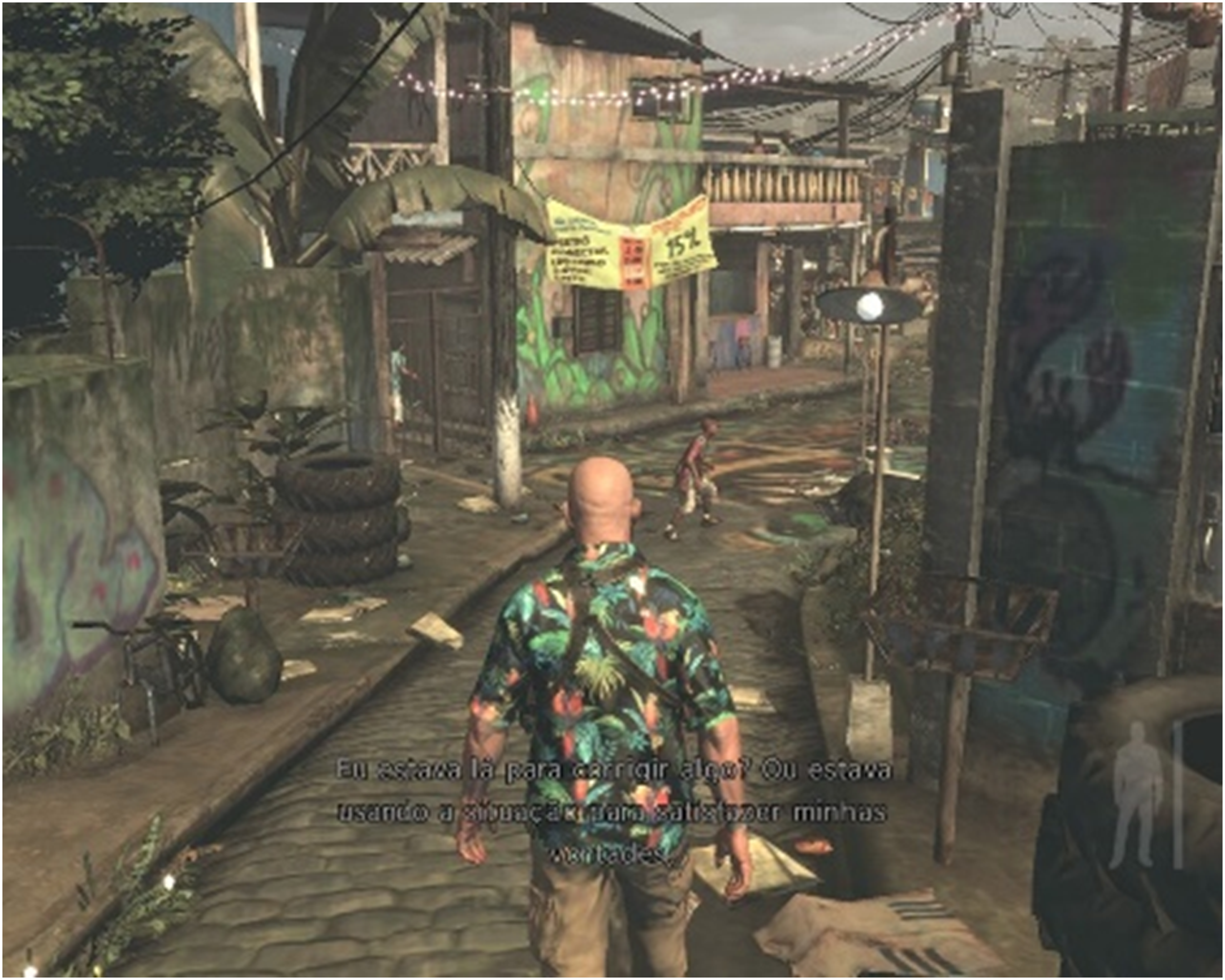
Bem-Vindo à Favela Nova Esperança (2014), screenshot from the game Max Payne 3.
In addition to the aesthetics of precariousness, the dialogue in Portuguese is clearly unnatural, sounding more like a language teacher repeating words slowly than Portuguese native speakers of the favela. Lee points out that the game's Portuguese dubbing is of uneven quality, but if the player does not speak Portuguese, the dubbing passes as authentic (Lee, 2012). Verb conjugation in most dialogues is grammatically correct, and even criminals use the plural for “nós” (we), although Brazilians rarely use that form of plural. It is necessary to emphasize that, to most foreigners, different accents in Brazilian Portuguese may be almost impossible to differentiate, but given the research made to produce the game, developers clearly missed the mark. As a side note, other writings that developers should have translated to Portuguese are written in English, such as the milk carton in Max's kitchen counter that should have leite written on it, and not “milk.” Those trivial details pile up, and as Phillip Penix-Tadsen reminds us, those out-of-place details destabilize the representation of Brazil and Brazilian favelas “as a semiotic domain” (Penix-Tadsen, 2016, p. 164).
Another aspect worth noting is the commodification of the favela. The main character narrates at one point that “Slums had become tourist attractions, places where yuppies could gawk at the endless spirit of the poor from the safety of their bulletproof buses,” emphasizing the marketability of favelas. Even if one concedes that the favela has indeed become a tourist attraction, the emphasis on certain aspects neglects the myriad of identities and possibilities that are present in the place. The street party that Payne refers to is clearly an exaggeration, as funk events typically take place at night, and these are most times organized as concerts or balls, and these events are usually not limited to a shabby stage set up next to a tiny bar. Additionally, the game conveys the idea that there are no working hours in the favela, as players can see people leaning against walls and walking aimlessly, regardless of the time of the day. There are no shops except for a bar, and no social interaction except for the people dancing funk, the drug trafficking, and insinuated prostitution. This representation of the favela is problematic because it reinforces negative stereotypes about marginalized communities. Favelas are not merely places of violence, marginality, and precariousness. They are also vibrant communities with a rich cultural heritage. The game's representation of the favela erases this complexity and reduces it to a one-dimensional caricature.
Back to Lee's point, her critique is important because it highlights the ways in which videogames can perpetuate harmful stereotypes about marginalized communities (Lee, 2012). Her critique also serves as a reminder that videogame developers have a responsibility to represent marginalized communities in a fair and accurate manner, and avoid harming these communities even further by emphasizing these stereotypes, and not only in Brazil. As Max says during a shootout: “This place is like Baghdad 7 with g-strings,” managing, at the same time, to emphasize the violence and the sexualization of Brazil, and the notion of violence in the Middle East. The reduction of these geographical spaces, groups, and countries into a handful of negative aspects evokes Safatle's notion of fetishism as a form of colonization, and thus allows for a consumption of these places as places of subalternity, inferiority, as a Global South that not only permits such violence but would require American intervention to address its issues.
I do not seek to minimize the myriad of socioeconomic problems that affect favelas in Brazil. Rather, I argue that the focus on only certain negative aspects of favelas, combined with the commercialization of a stereotypical aesthetic, further stigmatizes these communities. The massification of the favela aesthetics for global consumption merely reinforces stereotypes that negatively affect the identity of the resident and stigmatizes it further.
Less Context, More Trash—Multiplayer Mode and Further Fetishism
It is important to distinguish between the representation of the favela in the game's single-player mode (where there is a story and some nuance, albeit minimal, regarding the place) and the one in the multiplayer mode, which provides no historical, demographic, or narrative context. As a result, multiplayer modes do not offer gamers any of the context (albeit minimal) in single-player mode, and their only experience of the environment is through virtual “war.” Several scenarios available take place in Brazil, and the Nova Esperança favela is the most prominent. As Vanessa Lee's review demonstrates, the geographical and aesthetic space of Nova Esperança is different than what a favela in São Paulo usually looks like and does not correspond to what the real Nova Esperança community looks like (see Figure 2). In-game, the contrast between an alleged sense of authenticity and the obvious delusion of what a favela is in reality immediately strikes a person who has been to one. In the Nova Esperança map, there are train tracks and wagons inside the favela, even though that is not a reality in any favelas in Brazil, given both the geographical location and the very infrastructure of the place. On top of that, developers design the houses in the game as if to convey a sense of continuity, with shabby tin roofs connecting one house onto the other, which is also inaccurate. Players can see posters of half-naked women offering sexual services inside the buildings, and the vegetation takes over a staircase inside a big warehouse. Everything seems out of place, contributing to a fantasized idea of favela, and even if these aesthetic choices do not correlate with the reality of a favela, the overall experience convinces, because certain elements are present: the brick houses, the graffiti in the walls (albeit very few resemble Brazilian Portuguese, and one particular graffiti strikes more like a Meso-American or Mexican painting than a drawing that could be found in favelas), and the looming Mata Atlântica, which can be seen from everywhere in the map. The idea of reproducibility in mass media prevails: once cinema introduced favela aesthetic more widely in the 1960s, it became easily reproduced anywhere, in different media, different decades, sharing same patterns of precariousness, violence, and exotism. Not only have consumers become accustomed to these images, but they expect them to be present in representations of favela. It is also worth noting that the best-selling videogame series of all time is Call of Duty, a first-person shooter series that frequently features favelas in its multiplayer maps. Call of Duty: Modern Warfare 2, released by Activision in 2009 and remastered in 2022, is the most successful game in the series (see Figure 3). BusinessWire claims numbers show that Call of Duty's remaster generated $800 million in revenue in its first three days of release in 2022, and the game sold millions of copies worldwide (Business Wire, 2022). The success of the series compares to that of the James Bond film franchise. Since the release of the first feature film in the 1960s, James Bond has grossed over $5 billion dollars. Call of Duty, on the other hand, has grossed over $3 billion in sales in just 13 years (Slater, 2009). Phillip Penix-Tadsen also compares Max Payne's sales with another movie, City of God, and the numbers of viewers versus players are roughly the same (Penix-Tadsen, 2016, p. 165). This suggests that the representation of favelas in Call of Duty is particularly influential, and considering the ease of access videogames offer today, the representations therein surpass other forms of media over the past five decades. Millions of people around the world see the game's negative and stereotypical depictions of favelas, daily.

Vegetable garden in the favela Nova Esperança, São Paulo. Soares (2017).
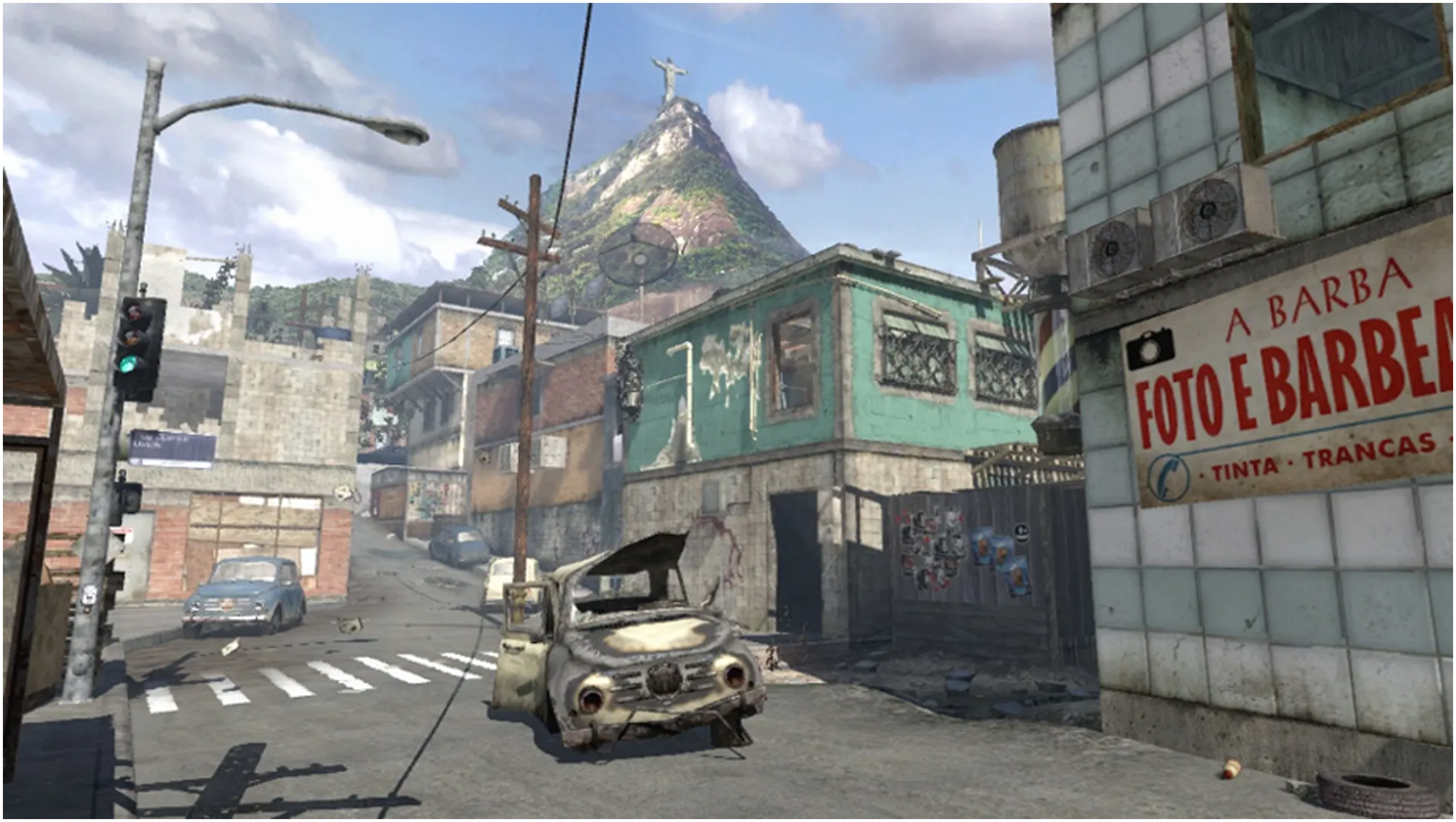
Call of Duty: Modern Warfare 2 favela map. Call Of Duty Maps (2009).
It is important to be aware of the potential negative impact of these representations. Favelas are vibrant and diverse communities, but videogames often portray them as places of violence, poverty, and crime. As we can see in the images of the real Nova Esperança, while it does suffer the consequences of an inequitable wealth distribution—which affects most (if not all) nations in the world—it does not translate immediately into violence, precariousness, and marginalization. The repetition of these aesthetics merely reinforces negative stereotypes about favela residents and makes it more difficult for audiences to see and treat them with respect.
Rapper and social activist MV Bill, who was born in the Cidade de Deus community, depicted in the homonym film City of God, stated in an interview after the film's release that the movie did not benefit the favela in any way, socially, morally, or humanly. He argued that the film exploited the image of children in City of God and increased the stigma that they will have to carry throughout their lives (Bill, 2003). Bill accused the film of stereotyping the favela and its residents, and of selling this stereotype as truth, without providing any benefit in return. This is another example of how the fetishistic mechanism works in these representations, which reduce favelas to environments that inevitably have a negative impact on their residents. Bill's perspective is particularly insightful, as he demonstrates how the fetishistic mechanism operates, even without explicitly stating it. He also suggests that the film's makers were only interested in exploiting the favela for commercial gain, which we can also claim about the representations contained both in MP3 as well as in the series Call of Duty.
To have another example as to how far the representations of favela in Call of Duty could reach, Dean Takahashi stated that the number of players of Call of Duty: Modern Warfare 2 was the largest in the world at that time—“In fact, that virtual army is bigger than the top five real armies in the world combined”—and indeed, the number is staggering: eight million players daily (Takahashi, 2009). According to the website BusinessWire, Modern Warfare 2 took just ten days to generate a billion dollars for the company (Business Wire, 2022). These numbers confirm the position of videogames as major entertainment products with a significant sociocultural impact worldwide. Unfortunately, the representations contained therein can be extremely harmful to the perception of the other's identity, as is the case with representations of favela residents.
Like MP3, Call of Duty: Modern Warfare 2 features single-player and multiplayer modes, the latter being the most interesting for this analysis. Even though Moder Warfare 2 offers a single-player campaign, it is the multiplayer mode that appeals to many gamers, skipping the single-player mode entirely (Penix-Tadsen, 2016). The game includes a scenario called Favela Tropical, which, by its name alone, indicates the level of factual (un)realism in the representation of the place. Although players can see the statue of Christ, the Redeemer far up on the hill, the actual favela is, due to software constraints, limited in its depiction. That leaves a false impression on the size of the communities within the favelas, and when one considers the broader picture—violence, precariousness, trash—the conclusion is that it is indeed a warzone. Penix-Tadsen's analysis supports the idea that, by relying on certain images to elicit authenticity within the scenario, developers make sure that the environment is easily recognizable, even if not entirely accurate (Penix-Tadsen, 2016). Similar enough to convince, but not accurate enough to present any idea of development beyond the precarious.
The reduction of the favela to an environment devoid of any urban attributes is problematic, and the lack of context about the location makes this representation just what audiences see: a portrait of tropical misery. Palm trees and banana trees flank almost every house in the scenario, and there is an excess of trash, just like in MP3. Everywhere there is rubbish on the ground, old tires, papers, cups, and pieces of bricks, as well as ruins of some previous structure. At this point, I turn once more to Horkheimer and Adorno, who support the broad commodification of this aesthetic through the reproducibility of the environment (Horkheimer & Adorno, 2002). There is, ironically, a tiny, abandoned soccer field between the houses (another stereotype about Brazilians), and it is evident that not even five people could play in that space at the same time. I also revisit Vladimir Safatle's work, and his observation about the colonization of the place through its fetishization (Safatle, 2010). In a way, developers fetishize (i.e., enchant) the environment, so that foreign markets can recognize it and consume it more easily. Players already expect precariousness, and developers emphasize these elements in the limited scenarios the games present, and thus add alleged authenticity to the favela presented therein.
By transporting the favela to the middle of a jungle, the “exotic” aspect of the place is even more emphasized. Exoticization removes the problem of poverty and structural precariousness from any analysis at the local level. For example, a Call of Duty player in Detroit can experience and consume this “exotic,” “tropical” favela without confronting the more problematic reality of poverty in their own city, even though Detroit has gone through a massive economic crisis and consequently has regions facing precariousness as the favela represented in the game. While most players in other precarious areas would accept the exotism present in these representations, we can assume that they would not feel the same way about their own environments, which could also be precarious, but not perceived as exotic.
The mechanism of creating a generic favela as an exotic object erases the socio-structural issues of real favelas, and therefore, players’ contact with this place is superficial. The reduction of the favela environment to a commodity turns it into an exotic, precarious, miserable environment lacking “civility,” defined here as the presence of urban elements. In turn, it demeans the resident, even if they are not present in the game, to a position of inferiority. This analysis highlights the harmful effects of stereotypical representations of favelas in videogames. It is important to be aware of the potential impact of these representations and to challenge them accordingly. Even more recent examples of favela in videogames insist on the reproduction of these negative aspects. The now defunct page of 2023's Only up 8 summarizes the objective of the game: “You are a young teenage Jackie from the ghetto who wants to get out of poverty and embark on a journey of learning about the world and yourself” (Only up, 2023). The goal of the platform game is to climb to the top of a scenario that clearly references other representations of favelas, almost copying the scenario one can see in MP3 or COD: precarious, dirty, full of shacks piled on top of one another. Ironically, calling the scenario a ghetto brings about a certain measure of familiarity with the concept of poverty: “familiar enough to reassure but alien enough to fascinate” (Johnson & Stam, 1995, p. 17). The delusion of what a favela is, it seems, continues to fascinate foreign audiences.
Another game that portrays a negative representation of the Brazilian favela and its residents is Papo & Yo, released in 2012 by the studio Minority Games. Contrary to the other examples on this article, it is not a shooting game, and does not deal primarily with violence. However, the game's designer, Vander Caballero, is a Colombian developer, and in its title, they use the Spanish personal pronoun “Yo” instead of the Brazilian “Eu,” which is already misleading and inaccurate, when giving the idea of a game within a Brazilian favela. The game's narrative revolves around a young boy whose goal is to escape the favela and his abusive father, an example which also is less than complimentary of the population that resides there. The stereotype of alcohol consumption in the favela is also present in Max Payne's representation of the residents. Although the game goes beyond the idea of drug trafficking, and crime-related violence in a favela, it makes me wonder why recur to a Brazilian one and not the ones in Medellín (see Figure 4), which look almost identical to each other. I can assume that, given the abundance of examples related to the Brazilian favela, associating the game aesthetic with the semiotic domain addresses the issue of familiarity with the environment. Although Colombia has (as most if not all Latin American countries) a similar urban space as a Brazilian favela, the Colombian ones do not benefit from the previous examples in media to support the notions of authenticity usually associated with the Brazilian counterparts. In this example we can see how even Latin Americans emphasize and market the fetishism of favelas.
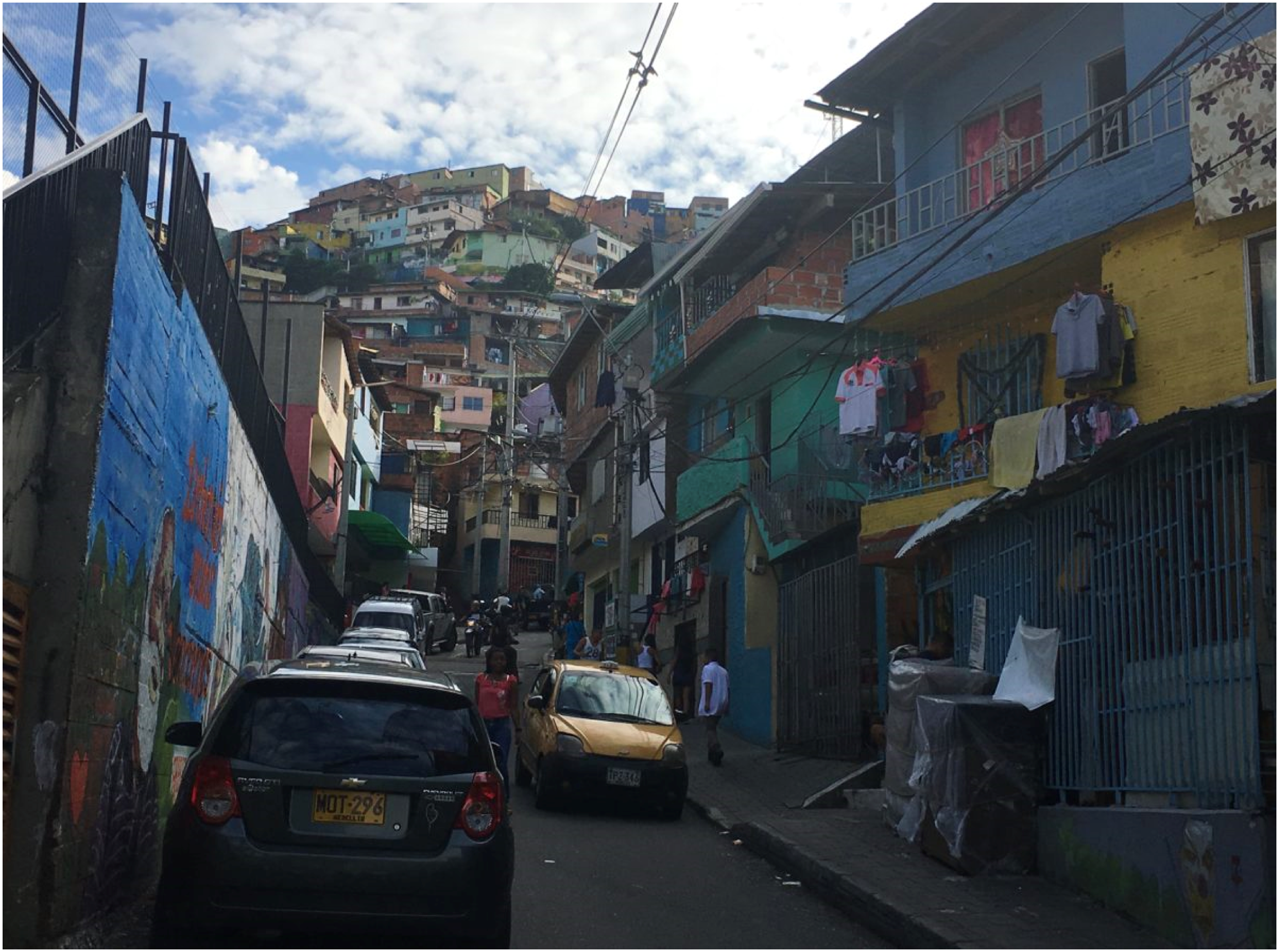
Medellín's comuna escalators (Action Press, 2016).
To give the devil his due, it is imperative to address the role and responsibility of Brazilians themselves (and as in the case of Papo & Yo, other Latin Americans as well) in the construction, maintenance, and propagation of negative stereotypes about the favela. During Max Payne's short tour of the favela in MP3, one of the residents shouts, “We’re not at the zoo, you shitty tourist!” This denunciation of foreigners who take tourist tours inside the favela would have some effect if the commodification of certain aspects of the favela, carried out by Brazilians, did not support exactly the opposite: the representation of the favela as an environment that is almost exclusively precarious, marginal, and at war, in which the resident is almost always a criminal (or accomplice) and where women are always available for sex.
In conclusion, I argue that a large part of the responsibility for the historic reduction of the favela and its residents to products for consumption abroad lies with Brazilians themselves. By portraying the United States and Europe as the norm and Brazil as the exotic, Brazilian and Latin-American content producers effectively maintain this hierarchical social structure; even more problematic, Brazilians also consume these examples, even within the favela itself. This creates a positive feedback loop, in which residents themselves support and consume the idea of a marginal favela, and in turn, as MV Bill argues, start to see themselves as marginal (Bill, 2003).
It is important to highlight that, even under enormous pressure from international markets to repeat the same scenarios, the same aesthetics, and the same stereotypes about the favela and its residents, there are recent examples that deal with the place in much more depth, nuance the relationships and identities contained there, but these are, unfortunately, not cultural products with wide reach in the Brazilian and foreign markets. 9 Of all the videogames researched for this article, none presented the favela beyond the stereotype of violence, marginalization, and precariousness. Until the national and international market puts aside its interest in the exotic and the colonizing logic in the cultural relationship ends, there is little hope that the perception of Brazilians and foreigners about the favela and its residents will change.
Footnotes
Declaration of Conflicting Interests
The author(s) declared no potential conflicts of interest with respect to the research, authorship, and/or publication of this article.
Funding
The author(s) received no financial support for the research, authorship, and/or publication of this article.
