







Abstract
Combining a historical perspective and game studies and using information from the BoardGameGeek online database, we analyze how board wargames simulate the Indian wars and represent Native North Americans. Based on 125 games published between 1960 and 2023, first, we identified the main historical moments reproduced, followed by an iconographic and formal analysis of these games. The conclusions reveal that, like other cultural products (novels, films, or video games), the focus is on the mythical founding moments of the history of the United States, mainly the late 19th-century war on the prairies and conflicts between European powers to gain control of the continent. Despite everything, it is observed that board wargames do not avoid traumatic themes such as raids on settlements and that in recent years there have been dynamics that offer new themes and perspectives dealing with the subject.
The Indian Wars: The Construction of the Myth
The Indian wars have been a privileged topic for different cultural artifacts through which a depiction and an image have been consolidated that move, on the one hand, between the idealization of those who fought against the Indians, considering them to be civilizing agents of wild land for conquering, and, on the other, the vindication of the North American Indians and the denunciation of the injustices to which they had been subjected (Cozens, 2016, p. XXVII).
Starting from how the concept of the Indian wars has been constructed throughout history, this article analyzes how board wargames that have appeared since the mid-20th century to the present depict them. For the purposes of this article, we will consider the Indian wars as being the conflicts that took place between the first or indigenous nations of North America and the European powers or settlers (British, French, and Dutch in the northwest, and Spanish in Florida and the southwest) and, subsequently, with the governments of the United States, Mexico, Canada and the settlers of these territories. We will place them between 1513 (the first confrontation of Juan Ponce de León's expedition with Calusa natives) and 1898 (the year of the battle of Sugar Point, considered the last military conflict between troops and Native North Americans). We will leave aside the struggle for the conquest of Mexico in the 16th century, which would require a separate analysis.
The accumulated depiction of the Indian wars in cultural products such as chronicles, novels, the world of entertainment, comics, video games, and mainly film, has created and maintained its own ideological universe that has served for the construction of European identity through the encounter and definition of the “other” (Todorov, 1987). But this process also served for what is known as the invention of the “Indian,” the definition of the natives through the eyes and beliefs of those who describe them (Kilpatrick, 1999, p. 1), and for the delimitation and establishment of the national myth of the United States and the foundational scenarios of Americanness (Fuchs & Rabitsch, 2019), based mainly on the ideas of frontier and the conquest of the west. This symbolic domination generated through representing or describing the other has been examined in depth by cultural studies (Hall, 2001) and Orientalism (Said, 1978), which considered it basic for understanding the relationship between the West and the colonized peoples, and their ability to maintain and restructure their authority over them. In fact, for Spivak (1994), imperial violence lies largely in the absence of texts in which subaltern subjects can respond to Western historical narratives.
The first examples are found in the Spanish “Chronicles of the Indies” on the various expeditions carried out in the region and their encounters with Native Americans (Hernández, 2008), such as the report by Álvar Núñez Cabeza de Vaca on his journey between 1527 and 1537 through the southwest of today's United States and northern Mexico, or the report by Pedro de Castañeda on the failed expedition of Francisco Vázquez de Coronado between 1540 and 1542 to Arizona, New Mexico, Texas, and Oklahoma. These writings mix the chronicle of events with fantastic situations and elements and lay the foundations for the subsequent stereotypes that the natives were to define for Europeans: their representation as the peaceful and generous “good savage” and, at the same time, as a cruel, hostile and cowardly, somewhat animal-like being (Hernández, 2008, p. 217; Garduño, 2010).
From the Spanish chronicles, we move on to the Anglo-Saxon “captivity narratives” which focused on the experiences of Europeans who were kidnapped and held in attacks by the Indigenous peoples that circulated in book format, but also through the sermons of Puritan ministers (Castro, 2008; Fitzpatrick, 1991). They were highly popular in North America and Great Britain as of the late 17th century, and one seminal example of them is the autobiographical account of Mary Rowlandson (1682) in which she explains the 11 weeks she spent captive during King Philip's War. This case was followed by many others that shaped a genre of its own throughout the different conflicts between colonists and Native North Americans (Figure 1).
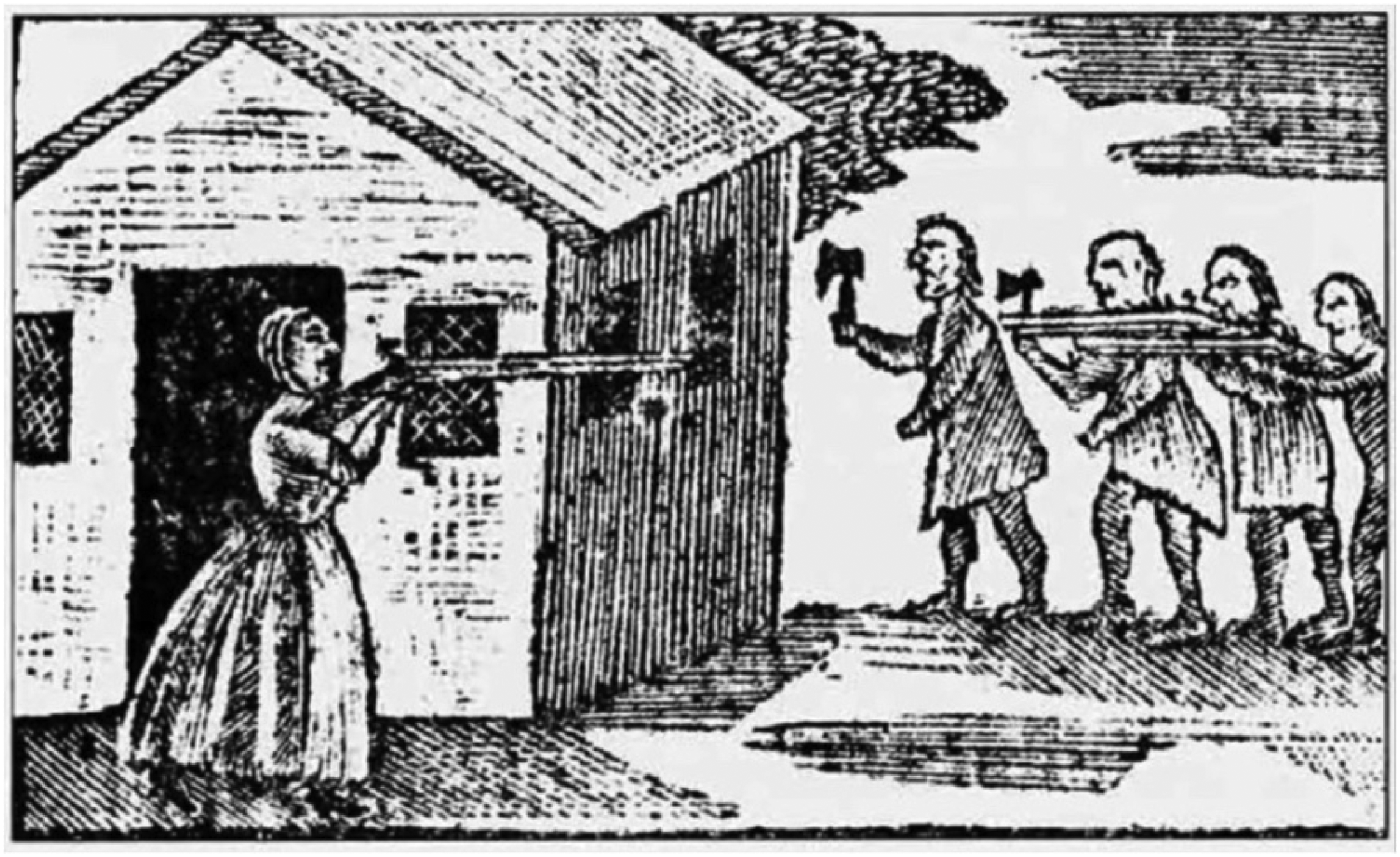
Recreation of the raid on Mary Rowlandson's settlement featured on the cover of the edition of her account published in 1772. (Source: public domain).
In these accounts other characteristic elements of Puritanism are added that have become rooted in the U.S. imaginary and national identity (Fitzpatrick, 1991, p. 3). The first is the sexual threat of the natives to the purity of the captives who find refuge in faith and are redeemed thanks to flight or rescue. The second is the incorporation of the wilderness as a new character, formed by the forests of the new world, a “virgin” space that when conquered forges a new type of men and women. The last is the definition of the frontier as a place under siege, susceptible to raids by the natives, which shapes the culture of fear in the face of the “Indian threat” with their “savage” practices, like scalping the fallen.
In the 19th century, we find the publication of dime and pamphlet novels (Ramsey & Derounian-Stodola, 2004) that, for a very reasonable price, offered sensationalist or adventure stories in which the Indian wars were a recurring theme and continued reproducing and grounding the basis of the myth. The novels by James Fenimore Cooper are a classic example of this, The Last of the Mohicans (1826) being the most emblematic case. It consolidates the long-used stereotype of good, noble tribes and bad, bloodthirsty ones, and romanticizes one of the most significant conflicts in the consolidation of the United States’ border, the French and Indian War (Kilpatrick, 1999; Figure 2).
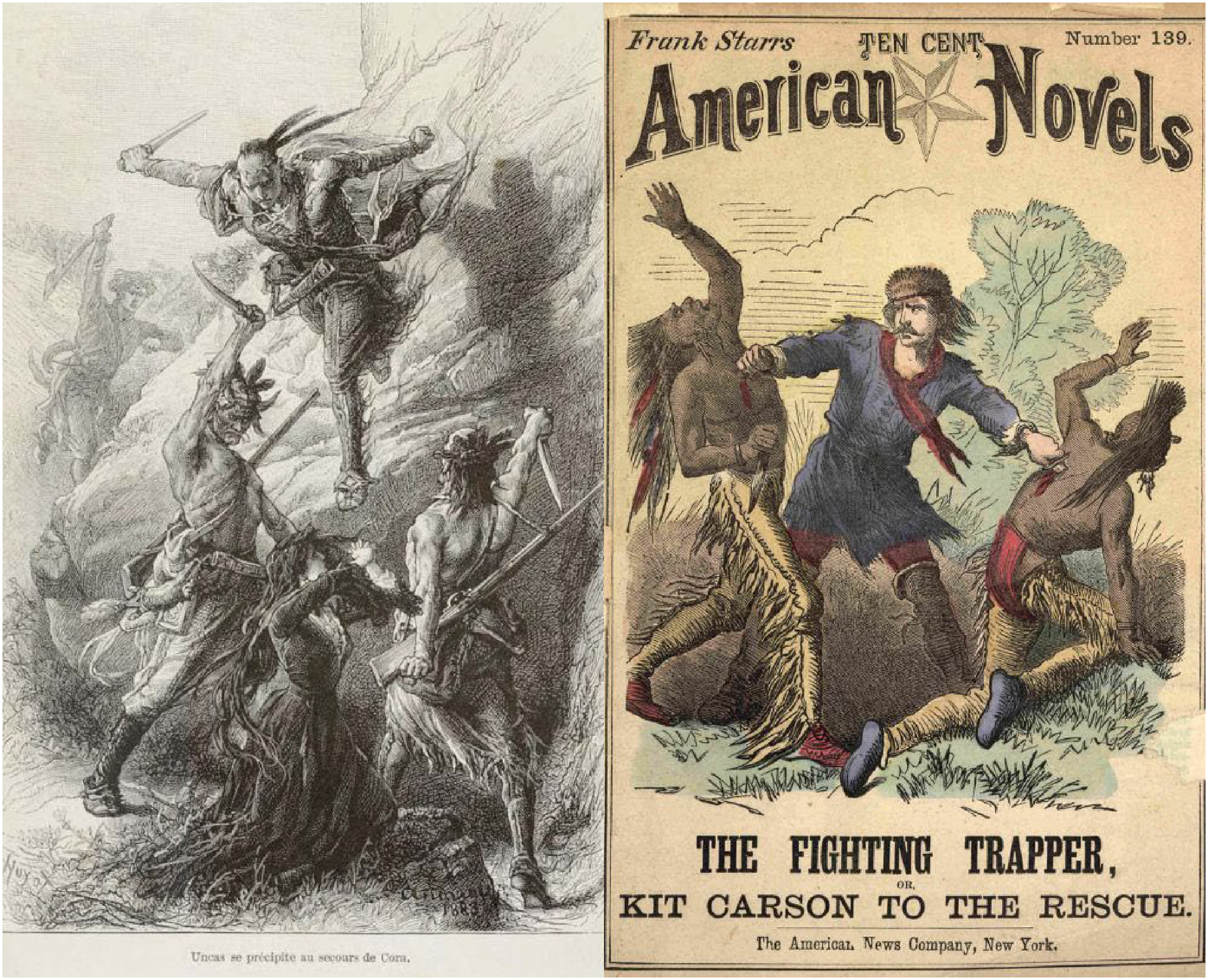
Illustrations from The Last of the Mohicans (1884), and from Edward S. Ellis’ “dime novel” The Fighting Trapper, or Kit Carson to the Rescue (1874). (Source: Wikimedia Commons).
This expansion of the popular novel is joined by the role and influence of a growing mass-circulation press and the participation of journalists in military campaigns, a practice that was consolidated during the American Civil War. In the wars against the North American Indians in the second half of the 19th century, officers and journalists enjoyed a symbiotic relationship (Knight, 1993, p. xii). The journalists integrated the units they followed and became one combatant more. One classic example of this is Mark Kellogg, an associated press correspondent who accompanied Custer and was killed at the Battle of the Little Bighorn. That confrontation is a good example of the extensive media coverage of the clashes with the Indians (Figure 3).
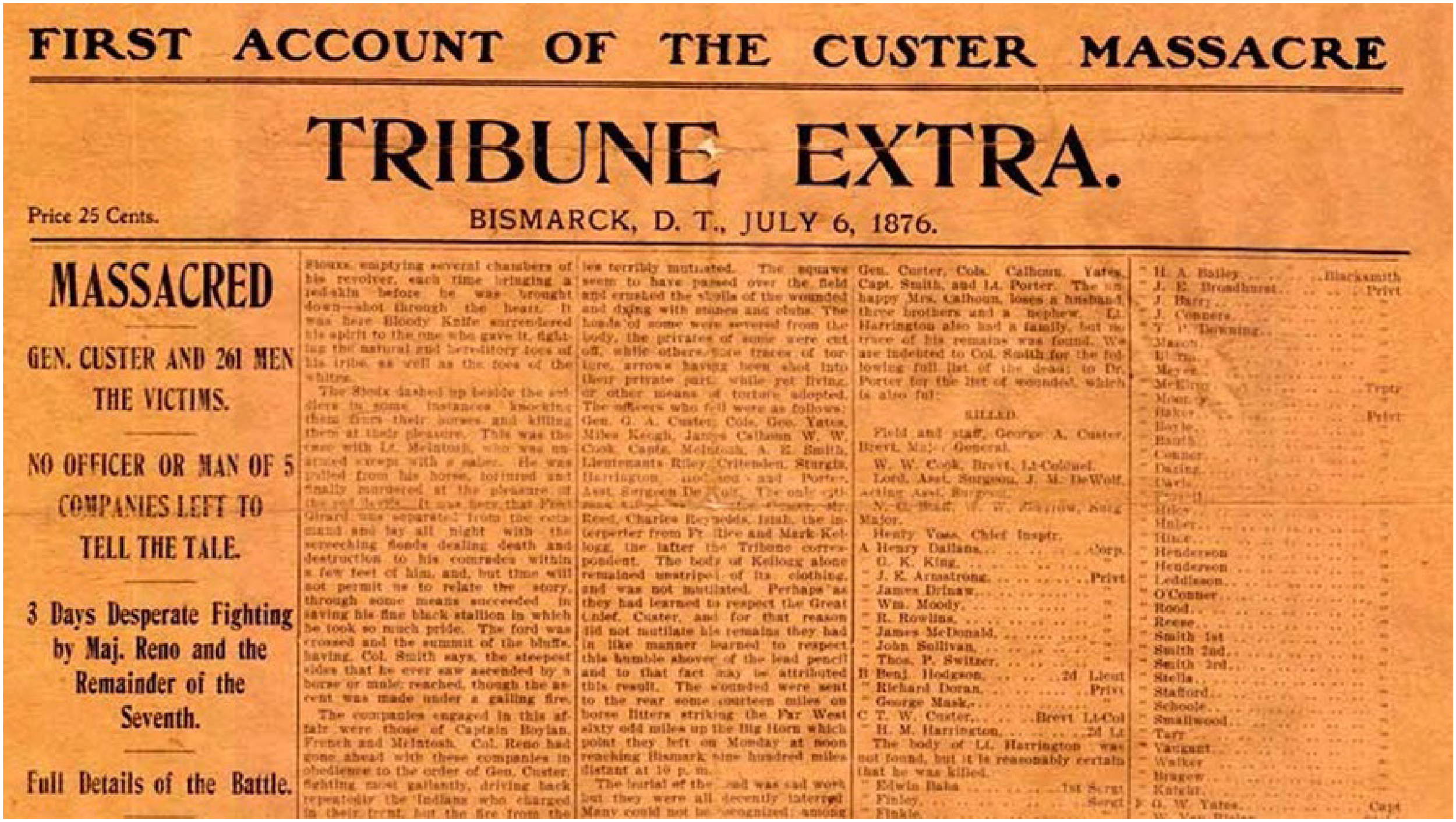
Edition of the Bismarck Tribune of Thursday, July 6, 1876, with the first list of casualties from the Battle of the Little Bighorn (Source: State Historical Society of North Dakota).
Along with the expansion of the press came the development of techniques to reproduce images, led mainly by lithography, which allowed the more widespread distribution of illustrations and gave importance to photographers and cartoonists such as Ridgeway Glover (who died in 1866, precisely covering the campaign against the Arapaho), Charles Schreyvogel, Frederic Remington, and Charles Marion Russell, among others. These images would set a new stage for the Indian Wars (the conquest of the western prairies of the United States), new enemies (war parties of horse-mounted Indians), and a new strategy (cavalry columns traversing endless hostile territory; Figure 4).
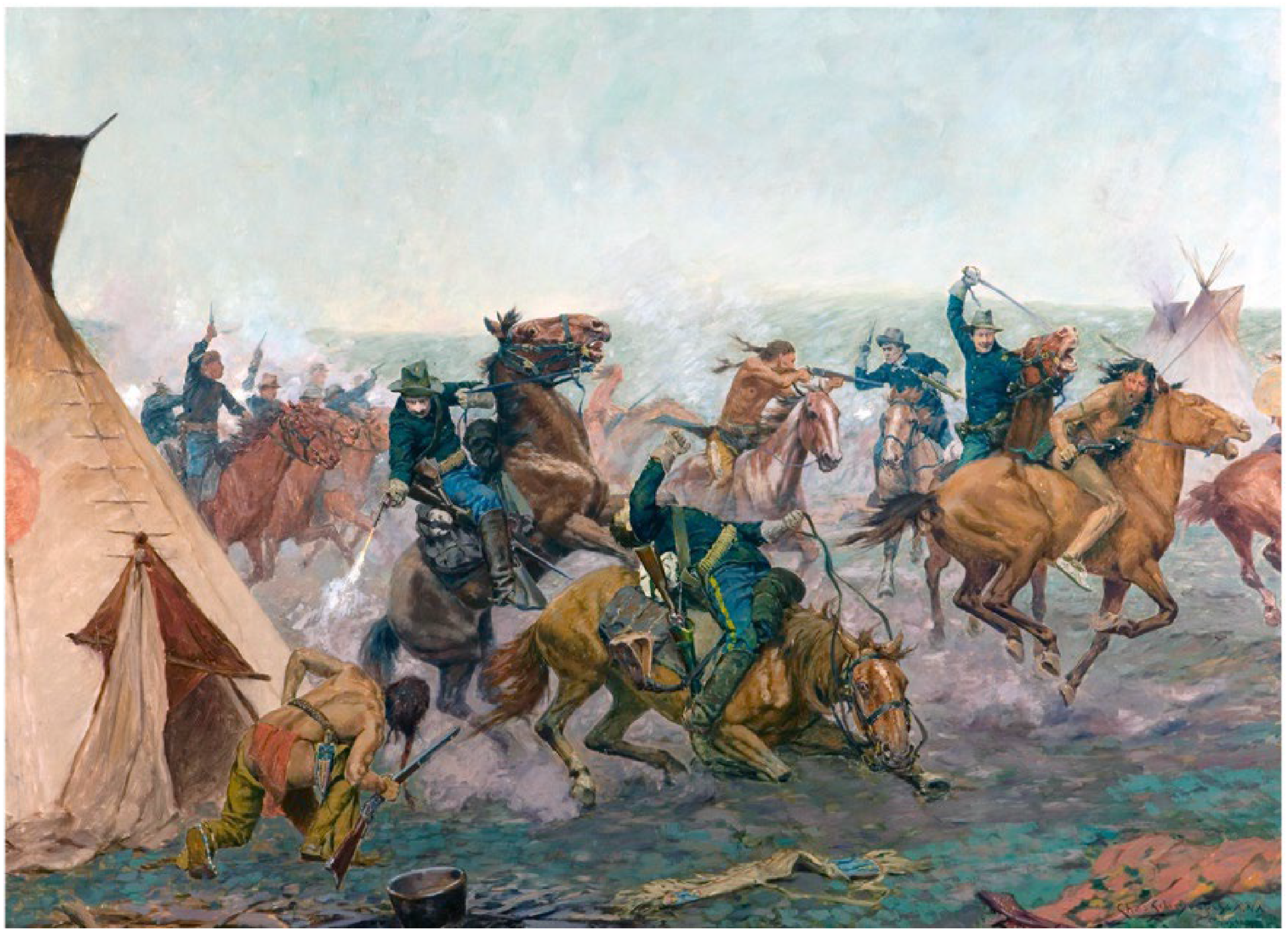
Early Dawn Attack by Charles Schreyvogel (1904). (Source: Gilcrease Museum).
The most emblematic example of the mass distribution of these images is also related to the Battle of the Little Bighorn. In 1896, the brewer Anheuser-Busch used Otto Becker's lithograph based on Cassilly Adams’ painting Custer's Last Fight to promote its Budweiser beer. This illustration would turn the scene of Custer fighting saber in hand surrounded by his troops in a last stand into the classic retroplace of the battle, understood as the event (or recreation thereof) that was frequently reproduced in the mass media and ended up evoking a historical moment (Venegas, 2020, p. 128). In fact, the mass-circulation press, the cheap novels, along with Buffalo Bill's Wild West circus shows and, finally, film, would turn George Custer and his last battle into myths and scenarios of the founding of the American nation.
Edison introduced his kinetoscope in 1894, 4 years after the Wounded Knee massacre. Among his first short films, he recorded Sioux Ghost Dance (1894) and Buffalo Dance (1894), starring Indian members of Buffalo Bill's show. From that moment on, film became the medium with the greatest influence on the construction of our gaze on these conflicts. Beyond Edison's quasi “anthropological” examples, the quintessential film genre was the western. Kidnapping by Indians dating from 1899 is considered the first scripted film on the subject, 4 years before Edwin S. Porter's classic The Great Train Robbery (BBC, 2019). It is emblematic that the first film in the genre is about an attack and kidnapping by natives. From here on, westerns were to become the most popular genre until the 1960s. There are countless films on the subject, with some representative cases such as Stagecoach (1939), Northwest Passage (1940), They Died with Their Boots On (1941), Broken Arrow (1950), Apache (1954), and, above all, John Ford's cavalry trilogy comprising Fort Apache (1948), She Wore a Yellow Ribbon (1949), and Rio Grande (1950). These films form the basis of a romantic and bittersweet vision of chivalry, as a spearhead or last defense of civilization.
With the arrival of television, westerns were introduced to the new medium through serials such as Rin Tin Tin (1954), Gunsmoke (1955), and Bonanza (1959). Among these, we find Brave Eagle (1955) which, for the first time, reflects the Native American viewpoint and has an American Indian as its lead character.
The subject of the Indian wars entered a process of review during the 1960s and 1970s through claims by the American Indian Movement and its criticism of the destruction of Native American cultures and societies. This stance emerged in cultural products such as literature (A Century of Dishonor, 1881; Indian Country, 1953; Little Big Man, 1964; Bury My Heart at Wounded Knee, 1970) and in film through the subgenre of the twilight or revisionist western (Cheyenne Autumn, 1964; Soldier Blue, 1970; Little Big Man, 1970; A Man Called Horse, 1970; Jeremiah Johnson, 1972). Precisely, film gave rise to a movement of response to the traditional gaze through films and documentaries written, directed, and performed by Native Americans.
The 1970s would also see the appearance of the first video games that used the American West as a setting for action, such as Gun Fight (1975), Boot Hill (1977), and Express Raider (1986). According to Heikkinen and Markku (2015), the games presented a popular iconography centered on the Far West that drew from dime novels, classic Hollywood and spaghetti western conventions offering a violent and stereotypical scenario of duels and combat against gunfighters, Mexican bandits, or hostile Indians. The “progress through violence” was a perfect narrative that fitted with the linear structure of the games (Wills, 2008, p. 302) and the financial profitability of action games (Heikkinen & Markku, 2015). In these recreations of a Wild West, Indians are depicted as secondary characters and enemies to be eliminated in games such as Wanted (1984), Blood Bros. (1990), and Custer's Revenge (1982), a puerile attempt at retribution through a game for adults where players reincarnate a pixelated George Armstrong Custer avoiding falling arrows and, finally, raping a naked squaw. This game sparked enormous controversy and served to identify the limits of accepted violence in video games (Wills, 2019, p. 70). In the 1990s, video games migrated toward other themes such as space or zombies, but applying many of the codes inherited from the Far West (Figure 5).
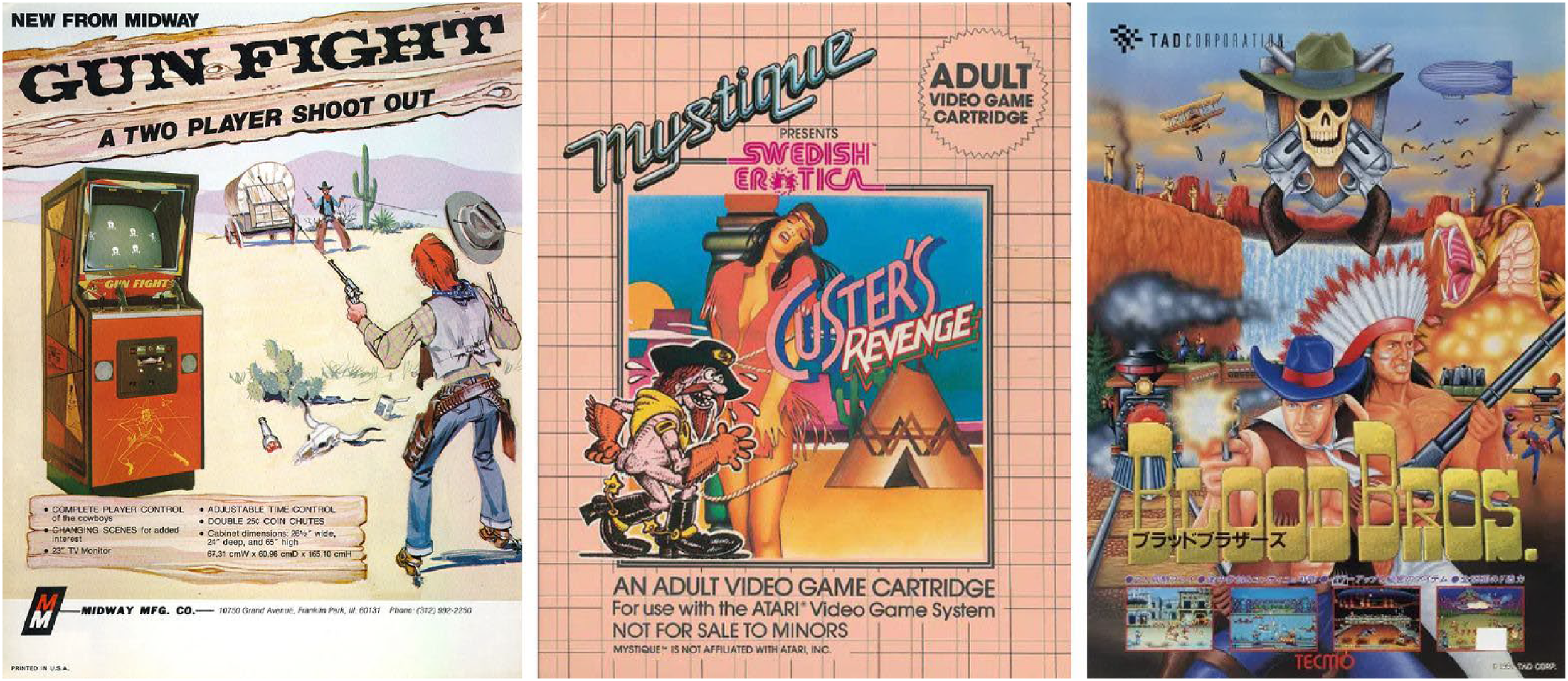
Images of Gun Fight (1975), Custer's Revenge (1983), and Blood Bros (1990). (Source: Wikipedia).
Video games would not offer more diverse and alternative approaches until titles such as the series Desperados (2001, 2006, 2009), Red Dead Redemption (2010, 2018), and the game This Land is My Land (2019). Some authors consider that they offer a new narrative scenario about the classic West, but they are cautious about using them as a true revision of the past (Wright, 2021). Instead, there are critical voices about the representation they offer, considering them reductionist and even harmful (Bird, 2023).
Because most video games focus on the 19th century, there is no diversity in showing the broad and complex range of Indian wars. Only more complex strategic games like Europe Universalis (Paradox) or the new versions of Civilization (Firaxis Games) offer the possibility of playing as indigenous nations over the centuries. This option suggests changes in the proposals, although the games maintain a Eurocentric view of colonization and the evolution of humanity (Carpenter, 2021).
The Indian Wars in Board Wargames
Seeing the impact that different cultural products have had on the construction of the image of the Indian wars, in this article we ask ourselves: what role have board wargames played in this process? In more detail, this research has sought to identify how many board wargames have been published since the mid-20th century up until 2023 and how they have evolved over time. Secondly, it aims to find out which are the main eras or themes that have been represented, identifying whether they reproduce the founding moments of the history of the United States and the most recurrent iconography of cultural products on the subject. Thirdly, it examines the role played by Native Americans in the games. Finally, it explores the existence of revisionism in wargames and through which aspects it manifests itself.
We start from the basis that these games are cultural artifacts that adopt design decisions that impact the way they reproduce history (Uricchio, 2005). The great difference from other products is their playful dimension that requires incorporating variations on the reproduced model, a set of rules, a certain degree of uncertainty about the outcome and, above all, that allows players to make significant decisions that can influence events (Frasca, 2003; Juul, 2001). In this sense, historical game studies (Chapman et al., 2017; Kapell & Elliot, 2013) have created an entirely theoretical and practical corpus to study historical representation through video games, not only focusing on which historical elements they show but also considering how the mechanics affect what is being shown (Chapman, 2012). In addition, game studies analyze the ideological bias of historical video games (Schut, 2007), how playing relates to nostalgia for a precise moment and its mythification (Taylor & Whalen, 2008), its impact on cultural memory (Sterczewski, 2021; Šisler, 2016) or, from postcolonialism, how colonial structures are reproduced through representing “otherness” and the experience of playing with the “subalterns” (Mukherjee, 2016).
In parallel, interest in the same topics has grown from analog game studies (Booth, 2021; Trammel et al., 2014). From this field, the playful construction of historical moments such as the Spanish Civil War (Kuschel, 2023), the Cold War (Ambrosio & Ross, 2021), the Vietnam War (Alonge & Fassone, 2023), or the conflict against global terrorism (Ambrosio & Ross, 2022) has been analyzed, and also the structural metaphors they use to construct the past (Planells, 2021), and the impact that formats such as Eurogames have on the reproduction of history (Borit et al., 2018; Robinson, 2014). However, an analysis of the Indian wars is lacking.
To conduct the study, we have reviewed 125 commercial boardgames tagged as wargame on the BoardGameGeek website, chosen for being a simulation of a conflict between two sides with at least some concern for accuracy or “realism” (Sabin, 2012, p. 4), for being historical structured games that integrate “narrative, gameplay and in-game freedoms consistent with historical events, processes and actors” (Ambrosio & Ross, 2021), and in which Native North Americans are represented in some way, either in the form of a counter, a card or mechanics. Although there are Eurogames (Oregon, 2007; Lewis & Clark: The Expedition, 2013; Western Legends, 2018 or Manitoba, 2018) and miniature games (A Formidable Enemy, 2014 or Black Powder: A Dark and Bloody Ground, 2019) on the subject, they have been left aside because they would require their own analysis.
Focusing on the temporal evolution, Figure 6 shows that the subject began to receive some interest as of the 1970s, with 20 games published between 1972 and 1985, curiously just when the revisionist Far West trend emerged and about 20 years after the appearance of the first publishers of commercial wargames (Avalon Hill was created in 1954).
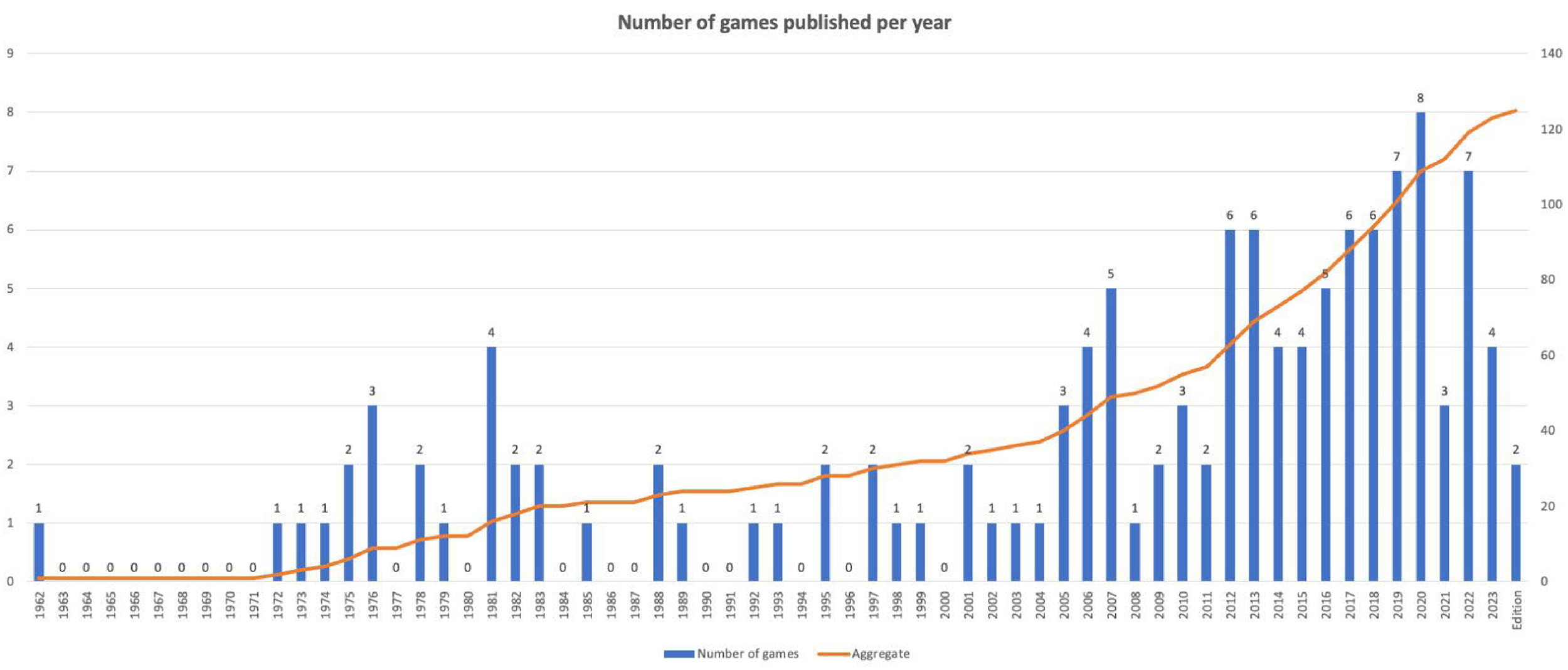
Number of games published per year. (Source: author's own).
The issue suffered a lack of interest during the 1990s and began to grow exponentially after the turn of the century. This increase in publications coincides with the boom undergone by board games in recent decades. We are probably facing an increase in game publishers and a commitment to offering a greater diversity of topics to fans. A similar growth pattern as in other historical board games and the same Anglo-Saxon origin of games and designers are detected, but accumulating a significantly lower number than those dedicated to other periods such as the medieval or the Second World War (Rubio-Campillo, 2022, p. 8).
Figure 7 shows that the main conflicts simulated in these games are the French and Indian War of 1754–1763 (33 games), the American War of Independence (27 games), the War of 1812 (16 games), and the Great Sioux War of 1876 (15 games). These four account for 91 titles and almost 73% of all published games. If we add to the last one all those that are related to the conquest of the west in the 19th century (the Prairie War of 1850–1890 and the Navajo, Comanche, Apache, Nez Percé and Red Cloud wars), we find 27 games dealing with this period. It is emblematic to note that of the 15 games about the Great Sioux War, 14 deal with the Battle of the Little Bighorn.
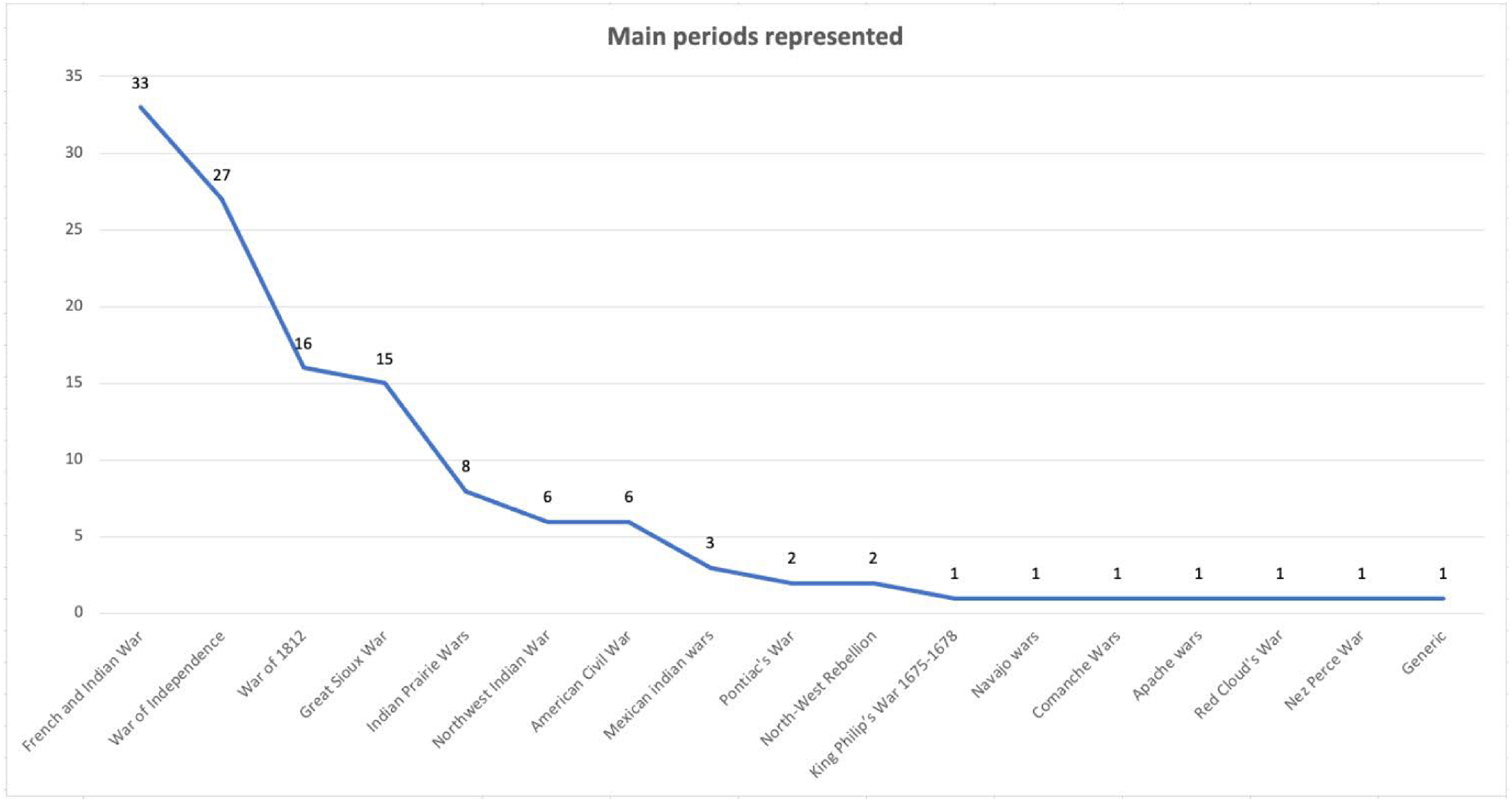
Main periods represented. (Source: author's own).
Thus, there is a tendency to equate the Indian wars with the foundational and iconic moments of American history reproduced in other cultural artifacts and represented by the colonial wars on the frontier (French and Indian War, War of Independence, and War of 1812) and the Indian Prairie Wars of the late 19th century, with the campaign or battle of the Little Bighorn being a paradigmatic case. This aligns with the tendency of classic board wargames to reproduce the conventional wars of the 19th and 20th centuries (Eagle, 2019, p. 17) and to focus on the official story and hegemonic memory (Fuchs & Rabitsch, 2019; Sterczewski, 2021; Venegas, 2020).
The first block also shows that the main interest does not lie so much in the Indian wars as in the simulation of the major clashes between the European powers or between the latter and the settlers of North America. Due to the nature of these conflicts and the high level of abstraction of the simulation, the Native Americans appear mostly as secondary actors or, simply, as auxiliaries to the interests of others. This simplification does not consider their own interest and that they intervened in these conflicts with the intention of placing themselves on the winning side with the possibility of preserving their territories, not only with the aim of favoring the European power. For example, the Shawnee leader, Tecumseh, entered the War of 1812 a year after to continue his own resistance against the expansion of the United States and as a way of finding, in Great Britain, an ally against their common enemy. We only find a couple of exceptions in the case of Liberty of Death. The American Insurrection by Harold Buchanan (2016), which we will discuss later.
That is not only seen in the themes of the games but also appears in the iconography of the covers. The indigenous people are missing from most game covers from these eras or only appear as auxiliaries to the colonial troops (Figure 8).
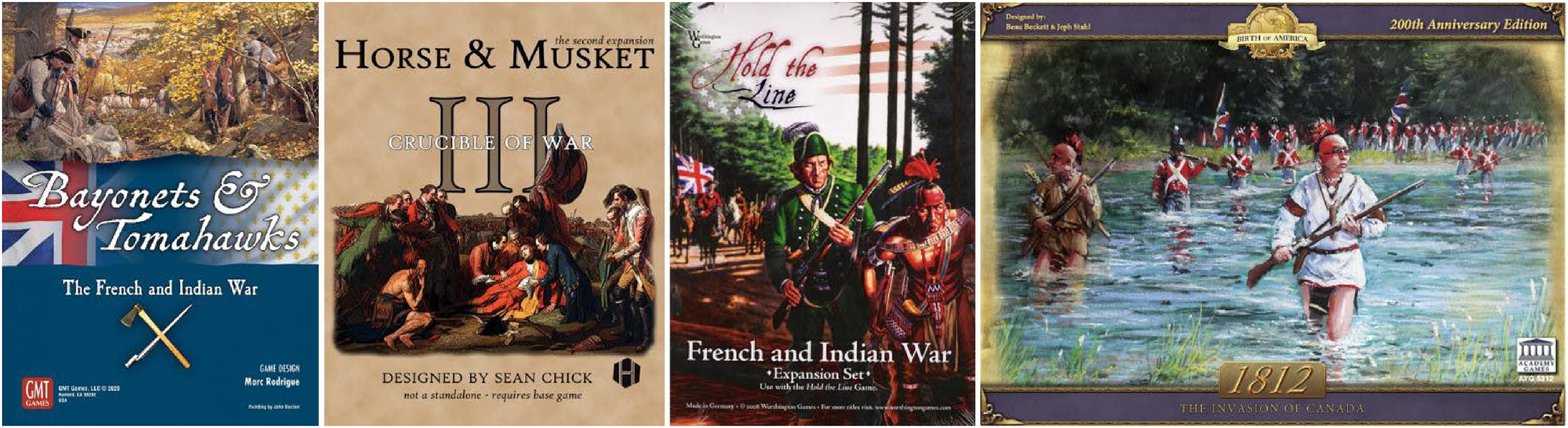
Some covers where Native Americans are depicted alongside colonial troops. (Source: BoardGameGeek).
Despite the above, and in spite of a significant number of moments during the Indian wars with very few, or even no games, we see the emergence of more diverse options from the last decade coinciding with the rise of game publishing which allows us to intuit a certain interest in new topics. In this regard, we must consider the role of small publishers and the personal interests of some authors who have expanded the number of games on topics little explored by wargames or the specific role of natives in colonial conflicts. Examples of this are King Philip's War game (Poniske, 2010), the Battles for the Old Northwest series dedicated to the Northwest Indian War (1785–1795), and the War of 1812 (Rohrbaugh, 2017/2020), or games about Fort Jefferson, Cahokia, and St. Louis attacks (Kling, 2022) and the battles of Newtown and Oriskany (Hanle & Miklos, 2013), all during the American Revolutionary War, in which natives played a significant role. These new interests are also identified on many covers, as seen in Figure 9.
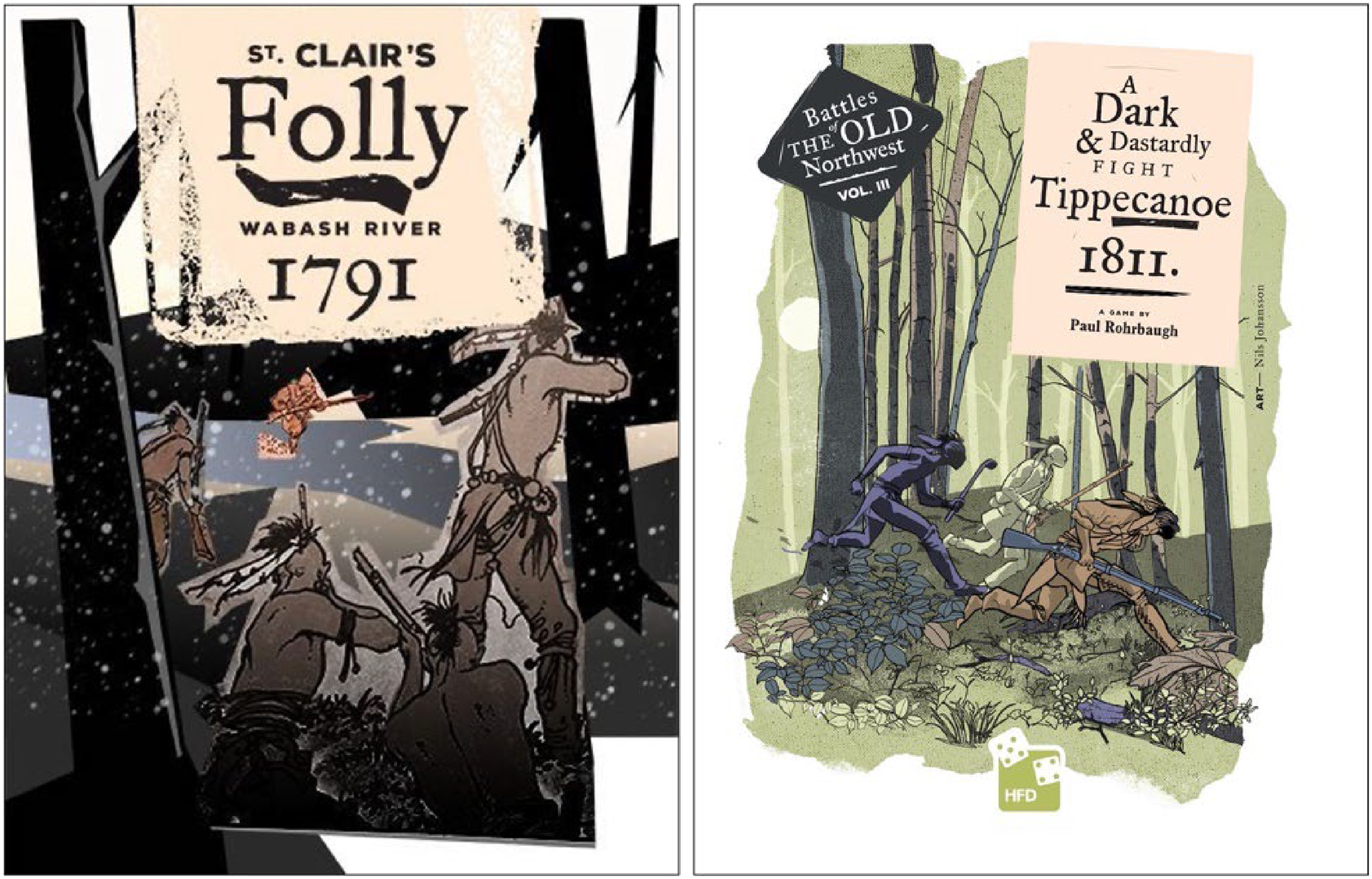
Two covers from the Battles for the Old Northwest series (Rohrbaugh, 2017/2020) whose illustrations focus on Native Americans. (Source: BoardGameGeek).
Custer and the Battle of the Little Bighorn
By the 1850s the United States had grown more than a million and a half square kilometers thanks to the annexation of Texas in 1845 and the recognition by Mexico of the Rio Grande as an international border. This, coupled with the discovery of gold in California in 1848, on the one hand, produced huge movements of settlers from the east to the west of the continent, crossing the Indian territories located behind the Permanent Indian Border and, on the other, the recognition of the doctrine of “Manifest Destiny” as a moral theory that justified the expansion of the United States toward the Pacific.
Most Indian territory in the early 19th century was in the Great Plains of the west, an area of land located between the west of the Mississippi River and the east of the Rocky Mountains which extends in a straight line that crosses the U.S. states of New Mexico, Texas, Oklahoma, Colorado, Kansas, Nebraska, Wyoming, Montana, South Dakota, and North Dakota. This is the scenario where the so-called wars of the great prairies took place between 1850 and 1890, within a much broader process of the “conquest of the west” or “frontier myth.”
These struggles have grabbed the attention of most depictions from the 19th century until now and have come to be assimilated with the global concept of the Indian wars. In the case of board wargames, we can see the same thing happening. Beyond the themes that focus on colonial conflicts, the war in the prairies is represented in more than 20 games.
But although these conflicts include different campaigns, the one that has received the most attention is that of the Great Sioux War of 1876, or the Black Hills War, since it includes the most iconic and most reproduced historical moment: the Battle of the Little Bighorn and the destruction of much of the 7th Cavalry led by lieutenant colonel Custer. Let us recall that this episode has become one of the scenarios of Americanness through its dissemination in cultural products of all kinds, with the film They Died with Their Boots On (1941) as the main reference.
The covers of games dealing with the Battle of the Little Bighorn maintain the classic iconography, inherited from vintage reproductions, of the cavalry's last stand with Custer at the center of the final defense. They even retrieve images such as that of Otto Becker used in the Budweiser campaign (see Figure 10).
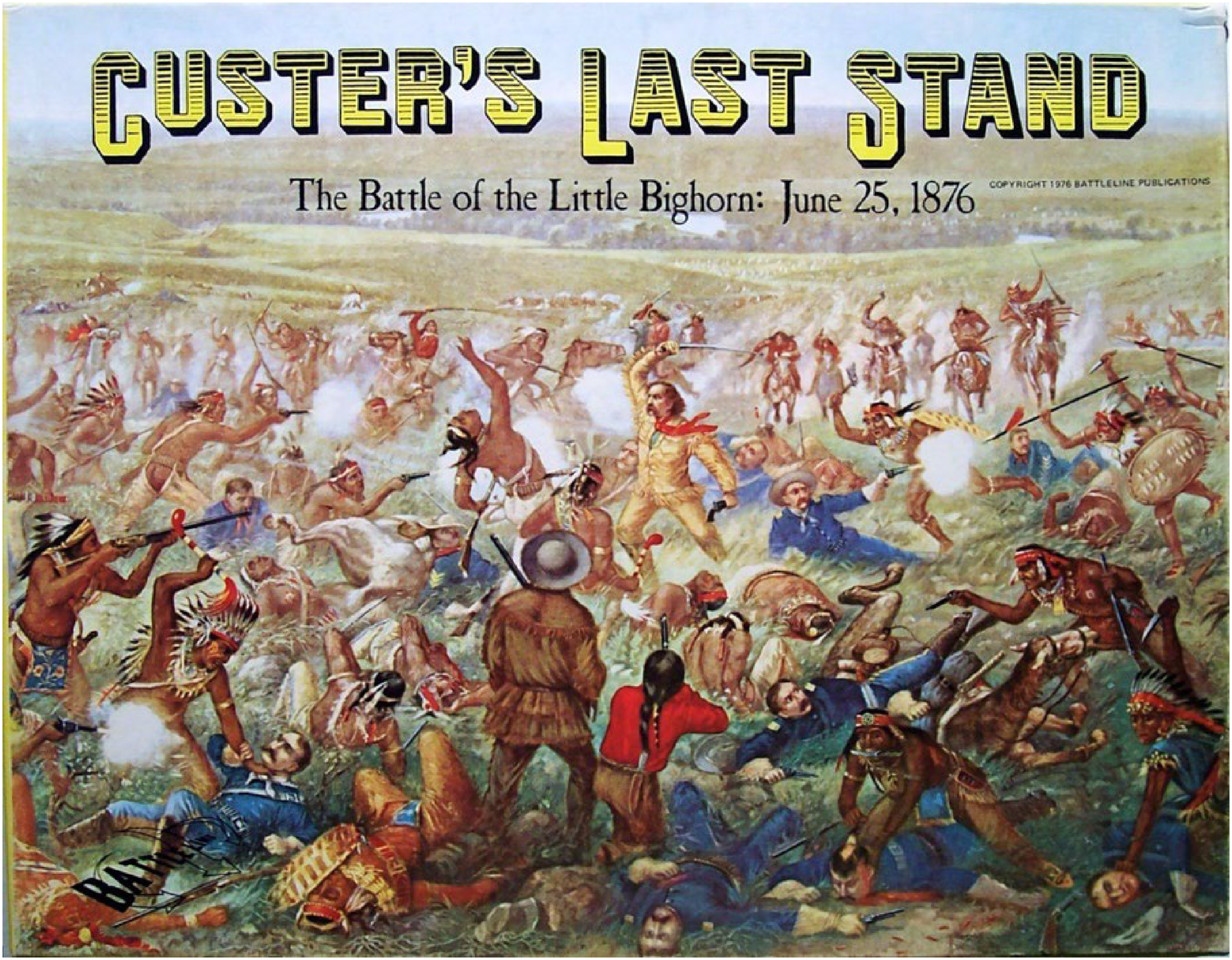
Custer's Last Stand (Zalud, 1976) with the image of Otto Becker. (Source: BoardGameGeek).
It is emblematic that Indians appear in almost none of them, and if they do, they are in the background and even blurred. The main figure is Custer, whose aura extends up until the present (see Figure 11).
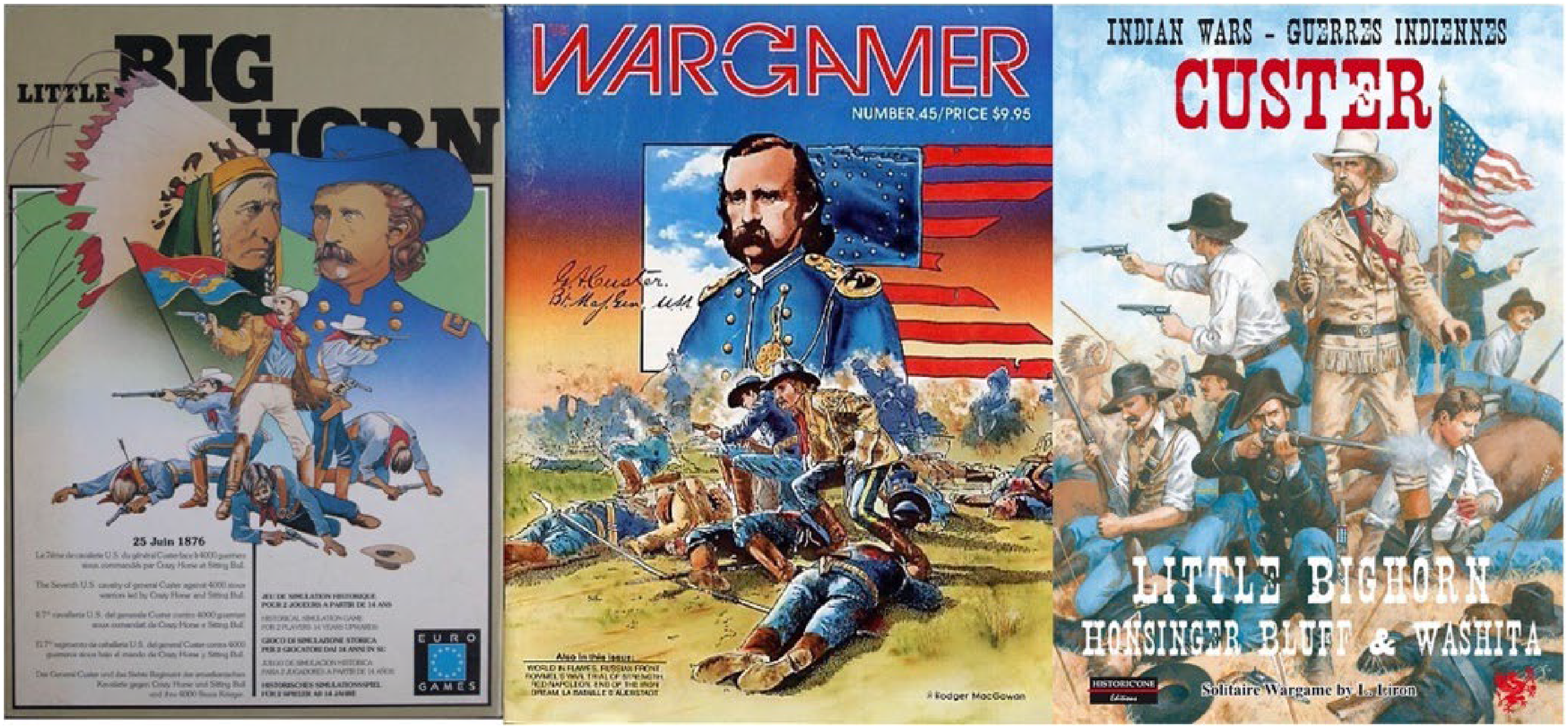
Covers of the games Little Big Horn (Mannucci, 19811981), Custer's Luck (Close, 1985) and Indian Wars: Custer (Liron, 2019). (Source: BoardGameGeek).
One interesting fact is that some of the games also depict traumatic and far-from-honorable situations of this unit, such as the massacres of Washita,appearing in Indian Wars: Custer (Liron, 2019), and of Wounded Knee, reproduced in 7th Cavalry (Casciano, 1976). Both instances offer scenarios to play alone directing the U.S. cavalry.
But the more the degree of fidelity and simulation of the games about this conflict increases, the more we get into the controversial and uncomfortable aspects of an attack like this. Historically, the Battle of the Little Bighorn took place because, in view of reports of the existence of a large Indian settlement, Lieutenant Colonel Custer decided to attack it with his column without waiting for support from General Crook (who had been held back at the Battle of the Rosebud), unaware of the large number of warriors who had gathered there.
This is depicted in games in different ways. In some, like Little Big Horn (Mannucci, 1981), the camp appears on the board as an area of yellow hexagons; this space becomes the objective of the game. In addition to destroying the Indian leaders, the cavalry wins if it manages to eject the warriors and occupy the hexagons. In other games, such as Custer's Last Stand (Zalud, 1976) or Custer's Luck (Close, 1985), the camp takes on its own entity through counters that simulate concentrations of teepees, which, when attacked and destroyed, give victory points to the player. The third way of recreating the attack is to additionally incorporate counters that represent women, the elderly and children, as in The Battle of the Little Bighorn (Taylor, 2005) or Indian Wars: Custer (Liron, 2019). These counters can move and flee from cavalry attacks, but they can also be eliminated or captured by means of mechanics to open fire or start hand-to-hand combat. Both sides earn points for the number of their opponent's units destroyed (including defenseless ones); the natives also get points if they manage to get them off the board, which simulates their flight (Figure 12).
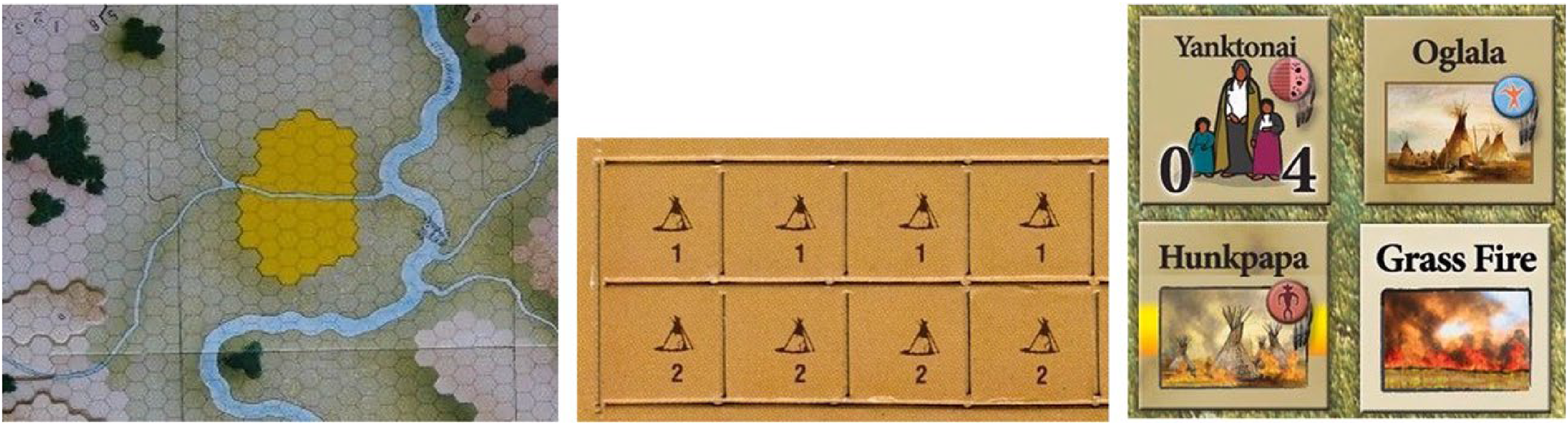
Three levels of simulation of the attack on the settlement through mechanics and graphics in the games Little Big Horn (Mannucci, 1981), Custer's Luck (Close, 1985), and The Battle of the Little Bighorn (Taylor, 2005). (Source: BoardGameGeek).
The incorporation of this dimension may be surprising because we are talking about games, but let us recall that we are analyzing wargames, whose objective is insofar as possible, to try to recreate the historical situation they are dealing with; therefore, the recreation of traumatic events is part of their essence and sometimes disregards some aspects of play.
The Reenactment of Trauma: Raiding as a Weapon of War
The attack on the Lakota camp that led to the Battle of the Little Bighorn is a clear case of one of the most recurrent practices in the Indian wars by all sides: raids against settlements. The Indian wars are not just a set of military clashes between armies and warriors, but a deliberate set of attacks and looting against the settlements or territories of the opponent with the aim of taking captives and resources, but also of causing their expulsion under the permanent threat of fresh raids. Violence against civilians is a tool of war and permanent terror from the outset of these fights (Figure 13).
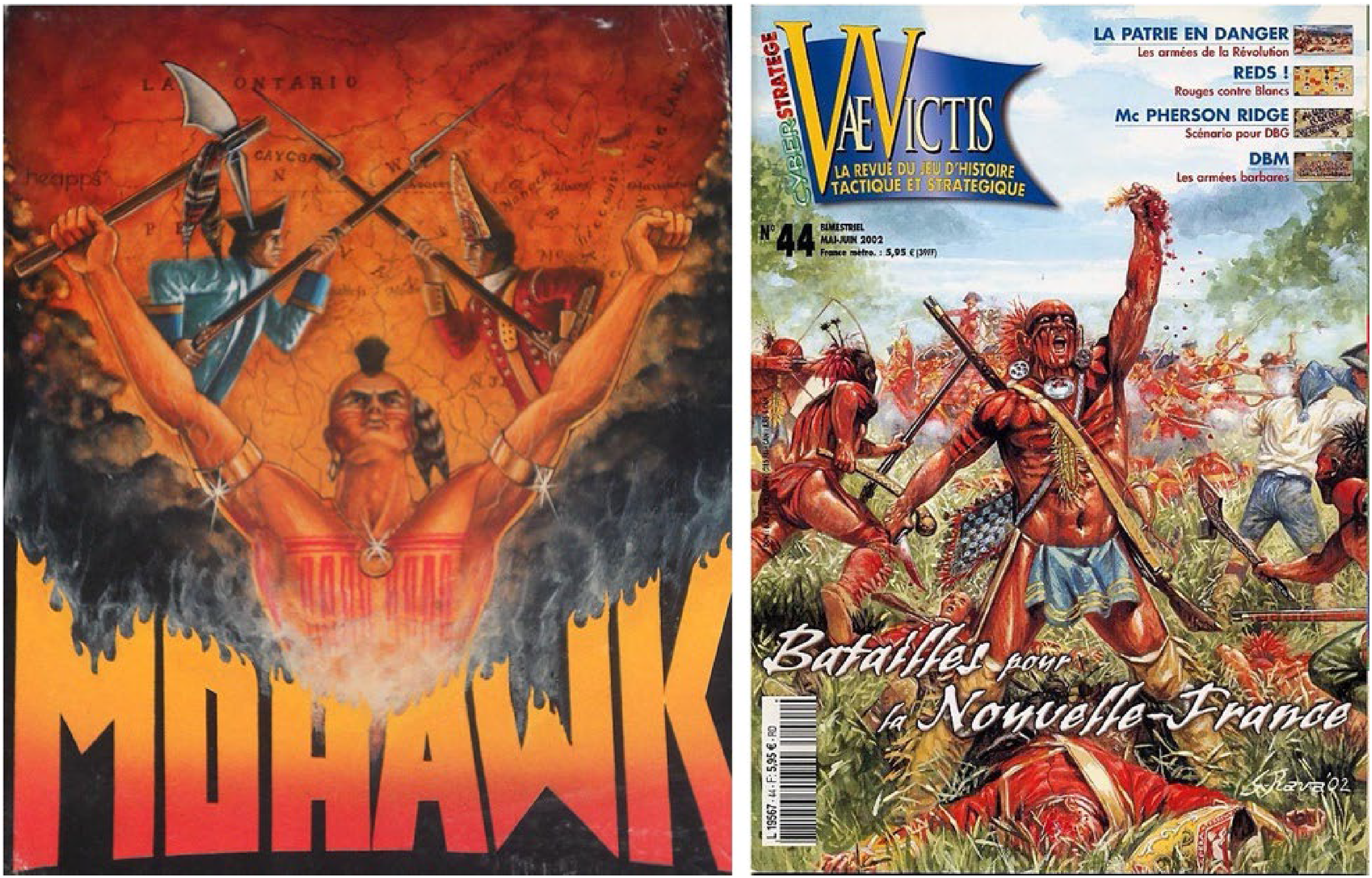
The iconography of frontier violence through the games Mohawk (1983) and Batailles pour le Canada (2002). (Source: BoardGameGeek).
Although Eagle (2019) considers that certain aspects related to body trauma remain outside of conventional wargames, raids appear as mechanics in games such as Wilderness War (Ruhnke, 2001) and Bayonets & Tomahawks (Rodrigue, 2021), about the French and Indian War, and Liberty or Death: The American Insurrection (Buchanan, 2016), which simulates the U.S. war of independence. In the first two, they accumulate and are used to obtain victory points. In an asymmetrical war where the growing British army overwhelms the French troops and their allies, the attacks become an alternative strategy to unbalance the frontier and win the war. The narrative generated by these games is that a total military victory by France is almost impossible, so the player must commit to the collapse of the territories under British rule. Therefore, there is a certain tendency to link this strategy as a practice mostly carried out by the Native North Americans, when it was common on both sides.
Other interesting cases rightly focus their mechanics on simulating extreme violence by all participants. The system of the games King Philip's War (Poniske, 2010) and Blood on the Ohio: Washington's Indian War 1789–1794 (Poniske, 2018) is based on destroying the maximum number of the opponent's settlements to achieve the victory goals (Figure 14). In King Philip's War, a brutal war that raged in New England between 1675 and 1676, the number of indigenous nations that would be added to the alliance depended on the ravaged colonial populations and, on the other hand, as the number of destroyed Indian settlements increases, the tribes will gradually surrender.
The exercise of recreating a conflict rooted in the memory of the natives of the northeastern United States as an especially traumatic event brought about protests (CBS News, 2010) that led its creator to add some notes at the end of the instruction booklet: “The purpose for this game simulation has never changed: it has always been my hope to increase knowledge and interest in this little-known, but highly influential, chapter of our country's history. In publicizing King Philip's War, perhaps we, MMP, native protestors and myself, will raise awareness and understanding of the continuing and vital native cultures in our country” (Poniske, 2010, rulebook).
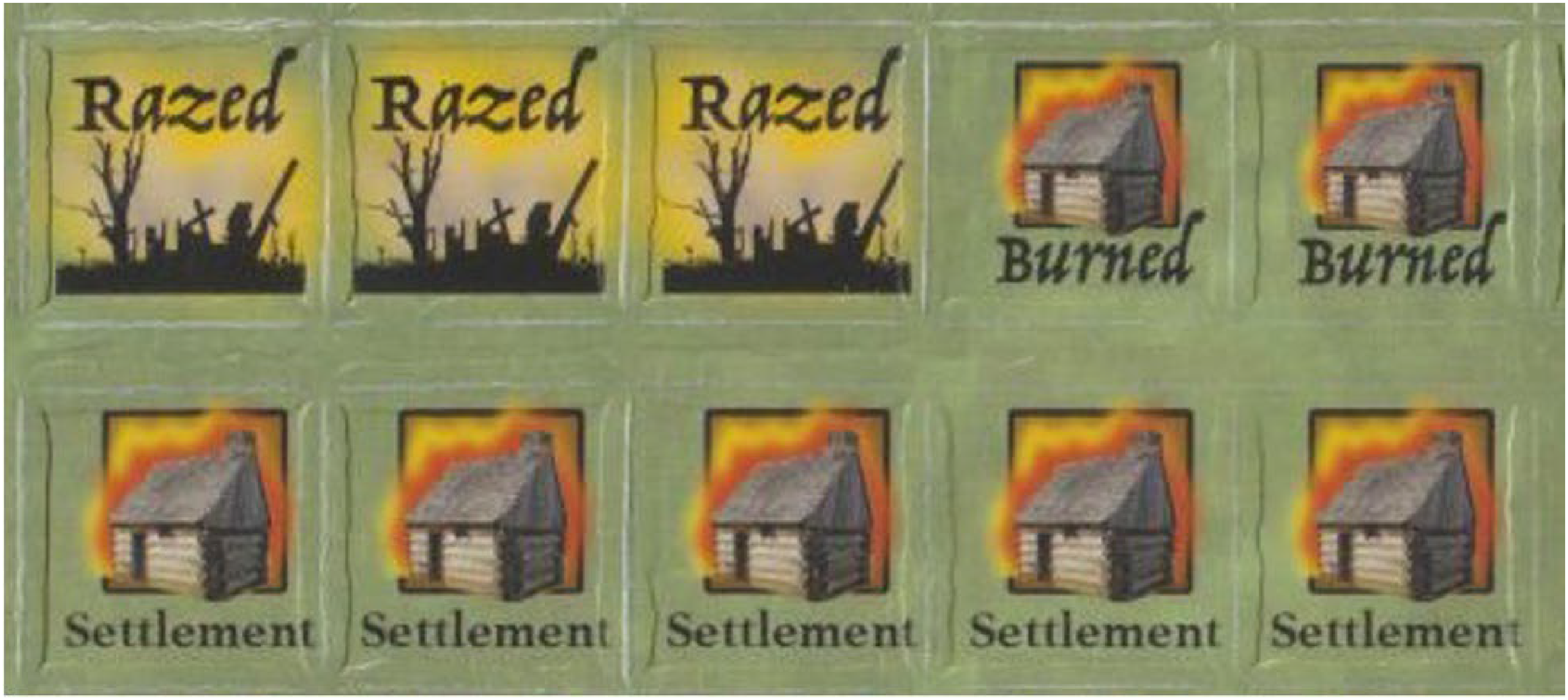
Counters from Blood on the Ohio: Washington's Indian War 1789–1794 (Poniske, 2018). (Source: BoardGameGeek).
These games also simulate how unstable and fickle the alliances between the different native nations were. Tribes can join and leave the war, but also, in the case of Blood on the Ohio, ally with U.S. troops to fight the Western Alliance.
The importance of this form of warfare has meant that, in smaller-scale simulations, it has become the central theme of games like The Battle of Adobe Walls (Taylor, 2009), which focuses on the attack of the Cavalry against Comanche and Kiowa camps in 1864, or The Historical Game Company's series of games about the 1780 attacks on Fort Jefferson and the Clarksville community, and St. Louis and the village of Cahokia (Figure 15).
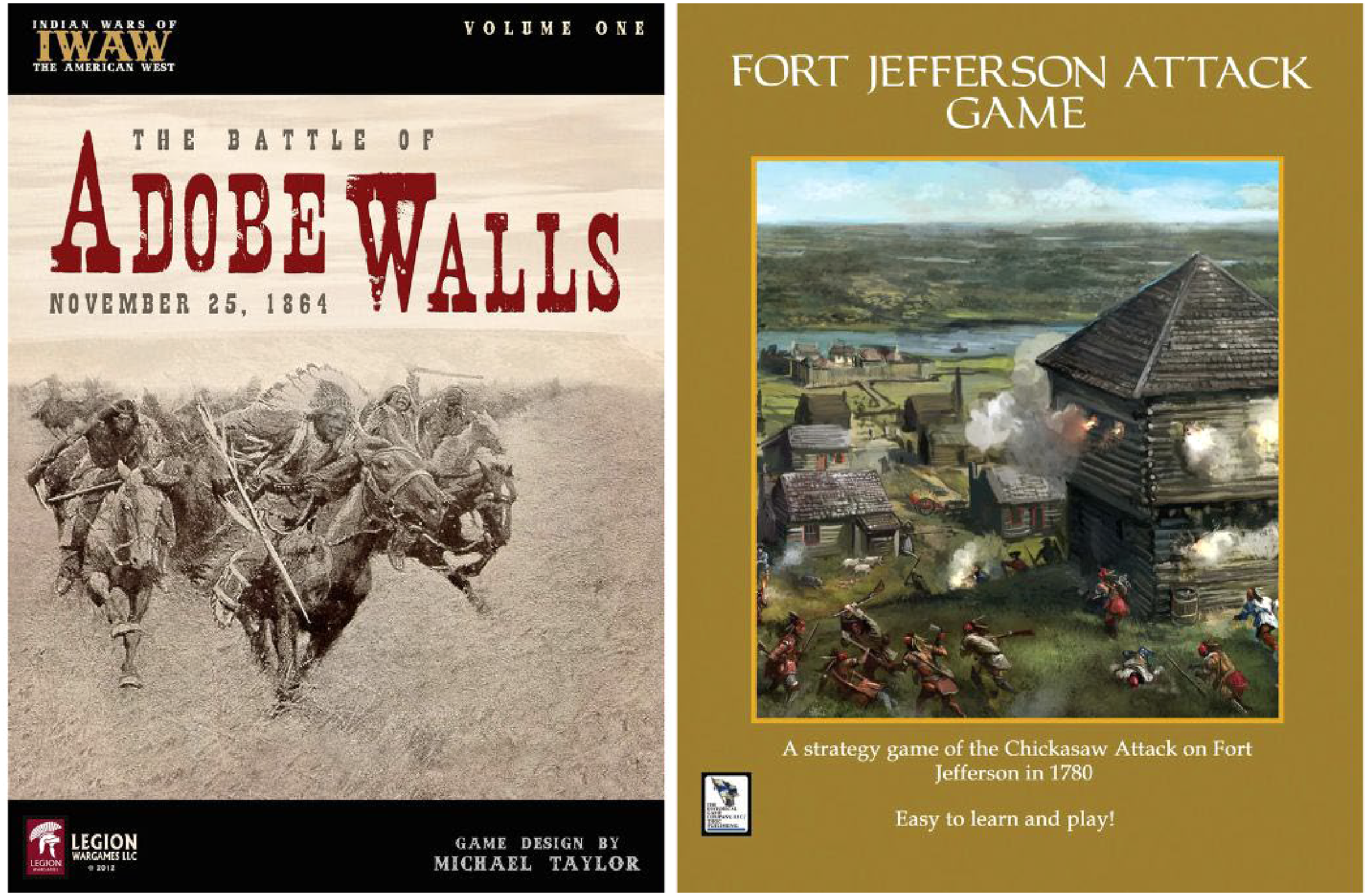
Covers of The Battle of Adobe Walls (Taylor, 2009) and Fort Jefferson Attack Game (Kling, 2022). (Source: BoardGameGeek).
Hybridizations and New Simulation Mechanics
Despite the above cases, most of the wargames analyzed use classic mechanics that simulate conflicts through counters that represent the various contenders, with their movement capabilities and combat power. These values allow maneuvering around the board and comparing the strength of the counters in the event of resolving a confrontation. Therefore, most games generate the narrative of a battle where each side seeks to defeat the other by eliminating them or achieving certain strategic targets. In these cases, the agency of the natives can be summarized by becoming one of the contending sides, which reduces their “agenda” mainly to the particular interests of the colonizing factions or to winning a battle that is decontextualized from the global conflict.
This has changed over time. The growth in the publication has been accompanied by the production of other formats such as Eurogames that offer greater gameplay and more diverse topics, but they tend to avoid conflict or direct confrontation between players (Wood, 2012). Curiously, these new formats have had an impact on wargames by generating new hybrid categories (known by fans as Waros, Weuros or Eurowars) in which classic mechanics are intermingled with new ones. But what happens when a game that does wish to represent violence uses Eurogame parameters? Some authors have deemed that the incorporation of these systems into the simulation of history creates less profound and more banal products (Robinson, 2014). However, if we analyze what these new board wargames have contributed to the simulation of the Indian wars, we find elements that offer new perspectives and more diverse and profound ways of recreating these conflicts along with other more banal ones.
Some initial examples include Geronimo (Berg, 1995), in which the Native North Americans generally have to avoid the advance of settlers and the army in the western United States, and I will fight no more, forever, first published in 1979 and reissued in 2016, which reproduces the great march of the Nez Percé toward Canada (Newberg, 1979). The latter incorporates combat mechanics, but the most important ones simulate a kind of cat and mouse with the Indigenous people maneuvering to avoid confrontation and save most of the members of the tribe, and some U.S. troops looking for a way to force fighting to impose their firepower. In fact, victory by the Nez Percé is achieved by getting the largest number of settlements to survive, with those that have reached Canada scoring the highest. The covers of this game refer to the noble Indian, in contrast to the savages of Figures 14 and 16.
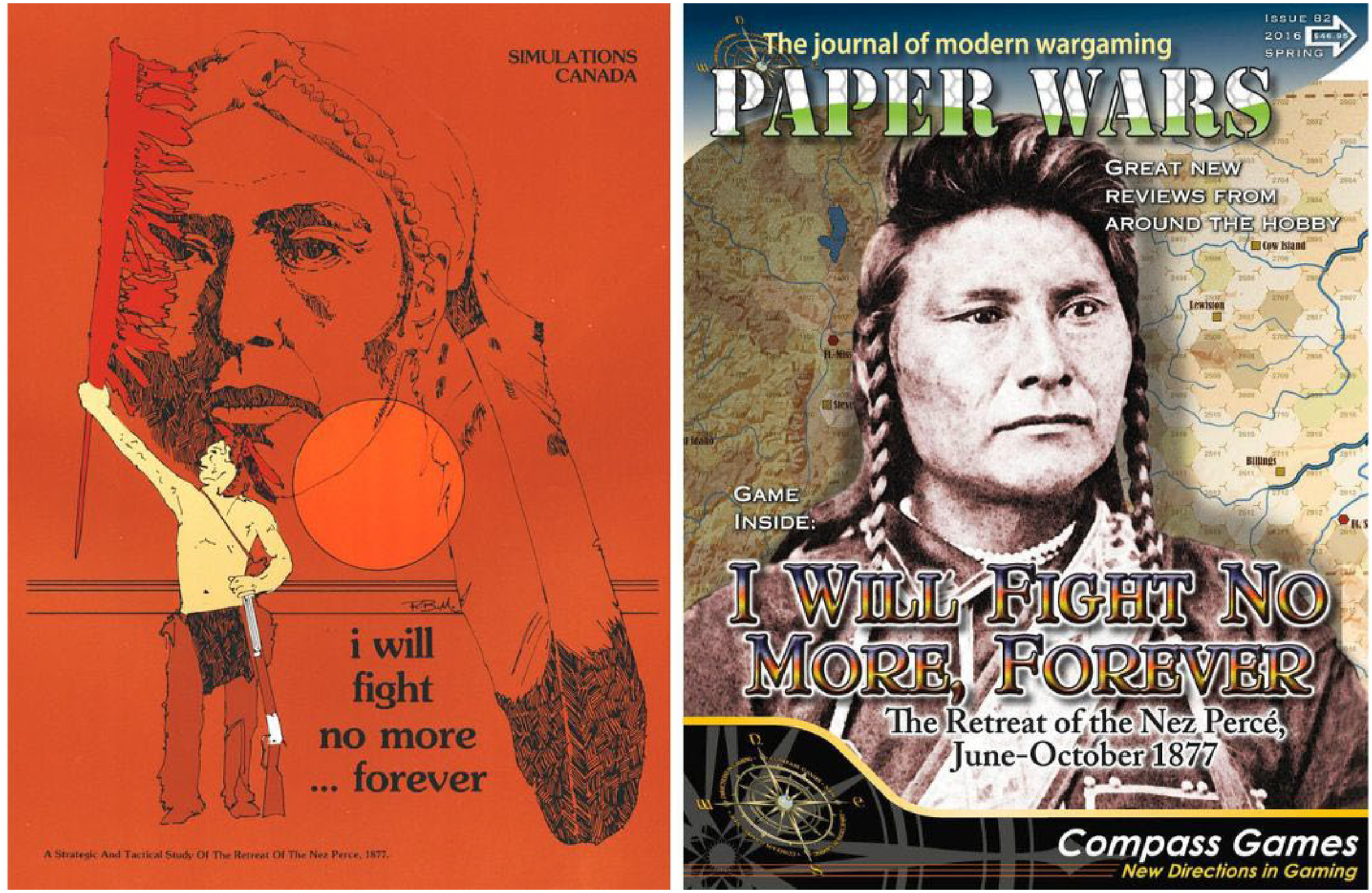
Covers of I will fight no more, forever (Newberg, 1979). (Source: BoardGameGeek).
As current examples, we have Navajo Wars (Toppen, 2013) and Comanchería (Toppen, 2016), two games published by GMT Games, that enable adopting the role of each of these nations through solitaire game mechanics. They are the product of the personal experience of the author who, living among the Navajo, faced contradictions of his own and decided to create games from the point of view of the indigenous people (Figure 17).
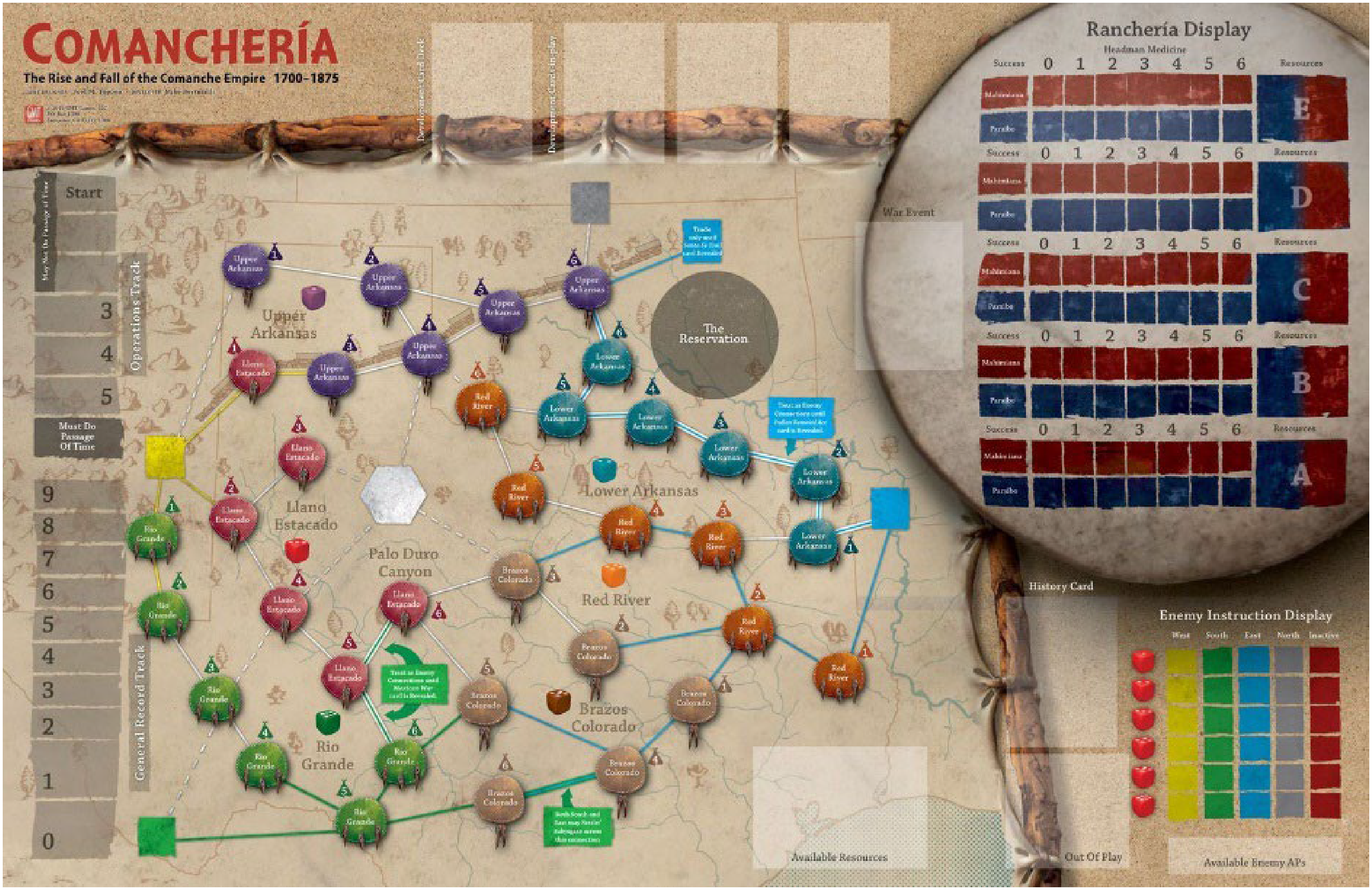
GMT Games’ Comanchería game board. (Source: BoardGameGeek).
By setting the action in a very broad period of time, they allow a more complete overview and the possibility of getting a global idea of what happened. In the case of the Navajo, a campaign can be played spanning from 1595, with the first Spanish raids, to 1864 and subjugation at the hands of the U.S. army. In Comanchería we can steer the Comanche empire between 1700 and 1875. The games depict the various highs and lows of these people based on the general mechanics of the States of SiegeTM system. This series generates a story in which the player is surrounded by enemies who want to wipe them out and before whom they must make decisions to avoid it. They are usually very difficult to win and, in general, end in the disappearance and defeat of the player. The boards are organized around a central point from which the Indian nations expanded in their early eras and to which they retreated under the pressure of the colonial powers. This generates a narrative of “siege,” a structural metaphor of rising waves of increasingly powerful invaders, and of the inevitability of defeat that fits very well with the fate of both nations.
But this is not the only thing that makes them special. The different actions that players can choose from show the complex dichotomy of people who were both aggressors and victims. The Indigenous nations can not only fight against different enemies (both the colonizing powers and the neighboring tribes), but also grow corn, hunt, carry out raids to get horses, firearms or captives, and trade with their neighbors. It is interesting to see how when playing Navajo Wars, the player can be raided by the Comanches or the Utes.
Another example would be Liberty or Death: The American Insurrection (Buchanan, 2016), a game about the War of Independence, but for four players: patriots, Great Britain, France, and Native North Americans. The mechanics involve a certain unspoken alliance between two pairs of players (Patriots and France vs. Great Britain and the natives), but only one of them can achieve the final victory. It is not one side but one player that wins. This system, surely for the first time, allows the reenactment of this conflict with the incorporation of an Indigenous faction that not only acts as an auxiliary to the British troops but has its own agency and objectives. A narrative is generated about the struggle to consolidate and maintain an independent territory, separate from the colonial powers. This occurs thanks to the use of the COunterINsurgencies system created to recreate asymmetric conflicts, especially contemporary ones. This series of games simulates clashes between regular and irregular troops that combine open-field clashes with ambushes and raids (Alonge & Fassone, 2023). The player who controls the native tribes faces militarily more powerful factions but has sufficient tools to expand their territory (building new settlements) and prevent all other sides from achieving their goals (including their “ally,” the British). These three games meet the conditions that Suckling (2023, p. 22) specifies for a postcolonial wargame: to give agency to the colonized people at a strategic level, represent complex asymmetries at different dimensions, and simulate the conflict asymmetries at operational and tactical levels.
There are also examples from Eurowars that put us in the opposite scenario. The combination of historical simulation with simplicity and agility in Plains Indian Wars (Poniske, 2022) allows it to approach a more diverse audience but denies the conflict of details. The design abstracts and simplifies as much as possible what it represents (violence, the participating factions, the differences between them, or the victory conditions), which almost strips them of specificities.
Conclusions
The debate on how to approach a conflict of such dimensions and characteristics as the Indian Wars is still open today. As we have seen, although their numbers of fans or consumers are not as high as those of video games or the cinema, board wargames are another cultural artifact to consider when trying to understand how consumer products shape our vision of history.
As we have seen, since the 1970s moderate attention has been paid to the subject of the Indian wars by wargame designers and publishers, which has grown at the same time as the industry and the hobby itself have grown. From the beginning, board wargames have reproduced the same stereotypes and myths that have endured over time in relation to what the Indian wars were and how they developed. Most of the games end up depicting the great conflicts between the colonial powers (which suggests that the interest does not lie in the Indian wars), or the wars that occurred in the westward expansion, with the Battle of the Little Bighorn as the high point. Thus, these games not only result in the scenes most repeated by the cultural industry but also tend to reproduce the official story.
Despite everything, a revision of the topic has been identified in the last two decades that opens new spaces of interest and makes the board wargame partially more transformative than, for example, video games. On the one hand, the search for new topics that attract the attention of fans means that some publishers, especially the smaller ones, are exploring new, antihegemonic scenarios of the Indian wars. On the other, the analysis of the game mechanics shows a change in focus and in how the conflicts are framed. Some simulations do not prevent the incorporation of traumatic and controversial but historically correct options as part of design decisions, such as raids and the destruction of the opponent's populations or the death of civilians. The disappearance of these actions ends up shaping games that may be more popular, but which obviate a fundamental element of these wars that is necessary to understand them.
The new mechanics arising from the hybridization of wargames and Eurogames, rather than merely simplifying and trivializing history, result in different games that allow exploring conflicts from other perspectives that we could even consider anticolonial (Suckling, 2023) and address the topic from the contested memories (Šisler, 2016). Board wargames are opening spaces of uncomfortable representation that allow us to open the focus. We are not just talking only about military conflicts or specific battles, but about recreating the whole process of the rise and fall of a nation, as in the cases of the Navajo Wars or Comanchería. In addition, the rulebooks and accompanying material include complementary content that provides the historical context and allows us to understand design decisions. Despite everything, the proposals created by the natives themselves that Spivak (1994) claims are almost nonexistent.
In this regard, some interesting spaces remain for study in the wake of this article. Where will these new approaches and hybridizations continue to evolve? For example, Burn the Fort (Benally, 2023) is a newly crowdfunded game created by Klee Benally, the only Native American designer identified. It defines itself as being “A game of Indigenous resistance” and a way to “face history in challenging and empowering ways.” The game uses mechanics and dynamics from Eurogame, but the objective of the players, who represent great historical warrior leaders, is to destroy the wagon trains that flow through their territory to avoid mass colonial invasion.
Finally, what motivates players when choosing a topic such as the Indian wars? Might players consider reversing history and destroying the U.S. cavalry an act of justice and revenge (Carpenter, 2021, p. 47)? Or, conversely, it is rather related to dark play (Mortensen et al., 2015)? Or do they play just for the sheer pleasure of playing without considering the moral options? These are questions that must be resolved by analyzing players’ practices and reflections.
Footnotes
Declaration of Conflicting Interests
The author(s) declared no potential conflicts of interest with respect to the research, authorship, and/or publication of this article.
Funding
The author(s) received no financial support for the research, authorship, and/or publication of this article.
