







Abstract
In this study, the authors problematize the use of slogans when it comes to leading major organizational change. Specifically, they outline the slogans that Border University leaders used to explain and justify the university’s transition from a regional, primarily teaching-focused university to an aspiring nationally recognized, Tier One research university. They argue that Border leaders used slogans built out of dominant and attractive logics, which led to the silencing of important questions and critiques that faculty members had about the change, but failed to voice aloud. Educational leaders who are interested in administering a democratic and discursive organization will find the insights in this study useful.
Background
In 2000, Texas state leaders made a commitment to invest in the field of higher education. Specifically, legislators adopted a plan called “Closing the Gaps,” which consisted of four major components. The first three components addressed access, improvement, and completion of undergraduate education. The fourth component concerned the research capacity of Texas higher education. Framing research as an economic engine, legislators outlined goals toward the improvement of the state’s research productivity, the procurement of externally funded research dollars, and the improvement of graduate education.
While a number of interventions were immediately put in place to address the first three components of the state’s plan, the fourth component was discussed from 2000 to 2008. Over this period, various parties, including higher education administrators, state legislators, local level representatives, and other higher education stakeholders dialogued about the best way to build research capacity among the state’s public research universities. As a result, in the fall of 2008, the legislature passed House Bill 51 (HB51, hereafter). Simply put, this piece of legislation established benchmarks for seven public universities that the state had identified as “emerging Tier One Research” universities. Per HB51, any of these seven emerging universities would become eligible for additional pools of state funding once it met particular Tier One benchmarks.
Among the seven emergent universities was Border University 1 (BU, hereafter). BU is a Hispanic serving institution situated on the Mexican–U.S. border. In this case study (Stake, 1995), we describe and critically examine slogans (Scheffler, 1961) put forward by BU’s leaders as they communicated and justified BU’s aspirations to compete for Tier One research status, and thus to revise its regional, primarily teaching-focused mission.
Although we acknowledge that the deployment of slogans is a common strategy to build support for organizations (Wangenge-Ouma & Langa, 2010), we were compelled to critically assess and study these slogans because they were offered up as such key clues to organizational constituents about the how and why behind Border’s transition. Thus, through the use of multiple data sources, including extensive field notes, participant observation, and faculty interviews regarding Border’s transition, we show that these slogans were not as helpful or inspirational as they were probably intended to be. Furthermore, we show that the slogans were a source of frustration. In spite of the frustration that faculty ascribed to the slogans, and the concerns that they had about the transition, we were puzzled that we found very little vocal and/or systematic attempt to critique the transition aloud among faculty members at Border.
To this end, in this case study, we share about the role and consequences of “sloganeering for change” at BU, and we invite leaders to critically reflect on the slogans that they might use to steer change in their own settings. Particularly, we would like administrators to consider if and how their own slogans can be offered up for both organizational member learning as well as critique; how transparent the slogans that they use are—in terms of implementation, benefits, but perhaps most importantly, consequences; and finally, how leaders have opened themselves up for interrogation and transparent sense making. By problematizing the utilization of slogans, we hope that leaders across all educational settings will consider that although slogans can enable learning and sense making, if they are not open to critique, if they are built out of so many competing and compelling logics, then they can also easily, and perhaps inadvertently, become a tool that silences critique and concerns among organizational members who fear disrupting what seems to be a logical and normal trajectory.
Immediately below, we present contextual details to describe the case setting. Then, we use multiple sources of data to construct a short history of BU, its unfolding transition, the role that slogans have played throughout this abbreviated history, and how faculty members helped us understand the import of slogans at BU. We close this case study by offering theoretical analyses and practical implications.
Case Setting: BU
Situated on the border of Mexico and Texas, BU has long served its community by preparing individuals for labor opportunities in industries tied to the natural resource base of the area and also those in the public sector, especially in education. Grounded in a strong tradition of teaching and public service, De los Santos and Daudistel (1996) stressed that the BU 1985 strategic planning process was oriented by the university leaders’ “commitment to creating educational opportunities rather than erecting educational barriers for students” (p. 217). As a result, today, BU is an open-access institution that enrolls more than 22,000 students who largely reflect the composition of the region: mostly Latino (~85%), mostly working class, and mostly first-generation college students (50%+). To this end, at commencement ceremonies, one of BU’s most significant rituals is played out when the president asks all first-generation college students to stand. Unfailingly, more than half of the graduates proudly rise to a standing ovation.
While serving as a critical access point and building a strong reputation for teaching and public service, BU sought to increase graduate programming and research activity. For example, in the last 20 years, BU increased the number of doctoral programs from 1 to 18 while building pockets of high research activity, especially in engineering and science as well as in Border health and K-16 education. Furthermore, since 2008, BU generated enough external research funding to place it in the top five of the state’s universities. Thus, along with its commitment to regional access and service, BU has slowly added research and graduate education to its portfolio, qualifying it as a regional comprehensive research university with high activity (http://classifications.carnegiefoundation.org/descriptions/).
In spite of these multifaceted successes, around 2003-2004, BU’s leaders began to discuss the need to enhance the university’s research and grantsmanship profile. As noted in the introduction, it was also around this time that state legislators and other stakeholders began to dialogue about the best way to support the development of additional research universities for the state.
To ensure a spot in the unfolding Tier One competition, an external evaluation was conducted on BU’s research capacity in 2003. Soon after, a select group of BU administrators, faculty, and other stakeholders completed a strategic plan based on the evaluation. With increasing frequency, BU leaders talked about Border as “on the move” or in “transition.” Our research suggests that in 2006, leaders definitively and consistently described Border as a “Tier One” aspirant university. Still, conversations about Tier One seemed to come in and out of fashion. The passage, however, of HB51 in 2008, dramatically hastened and heightened BU’s aspirational journey.
For example, soon after the external evaluation, BU’s Office of Research and Sponsored Projects was reorganized, and a new director was appointed. In 2007, faculty members reported that the tenure and promotion criteria for research and scholarship production increased. In addition, in 2007 and 2008, monthly meetings for junior faculty were held at the college level where the provost stressed the new promotion criteria regarding research and scholarly production. During interviews, administrators suggested that junior faculty members whose records of teaching and scholarship might have gained them tenure just a few years earlier had been denied in recent time, and in their place, new faculty members with very attractive research agendas from highly prestigious universities were hired. At the same time, college deans and department chairs were hired with the expressed charge to increase research activity and external funding to support the increased research activity.
As we have demonstrated, BU administrators implemented several structural and practice-oriented changes to facilitate the Tier One transition. However, as participant researchers and scholars on higher education, what was most intriguing to us was the creative discourses that BU leaders used to communicate and justify BU’s evolving mission and research aspirations over time. As noted in the introduction, we argue that BU leaders created and used attractive slogans (Scheffler, 1961) to build support and justify the change to constituents. Scheffler (1961) defined slogans as “rallying symbols of the key ideas and attitudes of educational movements” (p. 64). Scheffler also noted that slogans are inherently ambiguous and can express seemingly incompatible assertions and interpretations, making them free of the usual constraints of other kinds of assertions (e.g., specific policies).
In the following section, we begin by showing how one slogan was put to rest by BU leadership early on, and consequently replaced with other slogans throughout the years, leading up to Border’s Tier One aspirations. We show that with the onset of BU’s Tier One aspirations, slogans were stretched out to include compelling yet competing ideas about the compatibility of access, regional groundedness, markets, and market niches, competition, and excellence. With our various data sources, especially faculty interviews, we show that although slogans were intended to inspire, more often, BU’s slogans led to frustration and doubt, but interestingly little, if any, out loud critique.
BU—Slogans Over Time
Throughout the 1970s and 1980s, vehicles around the Border region bore bumper stickers that read Harvard on the Border. The incoming president commented on the problems with such Harvard–BU comparisons:
When I arrived [at BU] . . . we had bumper stickers that said, “BU: Harvard on the Border.” Now, that’s amusing, but there’s also certain pathos in it. There’s a certain desire to be something that you’re not, to turn your back on your surroundings, to isolate yourself, to be an ivory tower, to be something that you couldn’t possibly be, or shouldn’t want to be. (President Address to University Community, mid-1990s, n.d.)
Rather than mimic Harvard, the president sought to create a university that served the locale and, with the support of many faculty, developed what would be Border’s long-standing mission, captured in the short slogan: Access and Excellence. The president was aware that some viewed the two notions of access and excellence as incompatible, and so the slogan was unpacked constantly for audiences. For example, in the president’s 2006 fall convocation speech, she or he stated,
There are few U.S. universities that are as well-positioned [as BU] to demonstrate that the goals of access and excellence . . . can be achieved simultaneously and successfully . . . . We are here to serve as a resource to this region, creating educational opportunities for those who come to us with their dreams and aspirations, and fostering their success . . . to serve as their partners in fulfilling their educational dreams . . . understanding and accommodating the needs of students whose educational aspirations are often accompanied by personal and employment obligations . . . . Once students entrust us . . . we have a responsibility to provide them with a high-quality experience. (Fall Convocation Speech, 2006)
Surely, BU’s leaders are not the first to claim access and excellence as its university mission and driving slogan. Yet, BU managed to bring the tenets of access and excellence to bear in ways that earned it a reputation for “branding” its own “kind of excellence” (Kuh, 2004; see Table 1 below for examples of how BU branded its own kind of excellence).
BU’s Approach to Access and Excellence
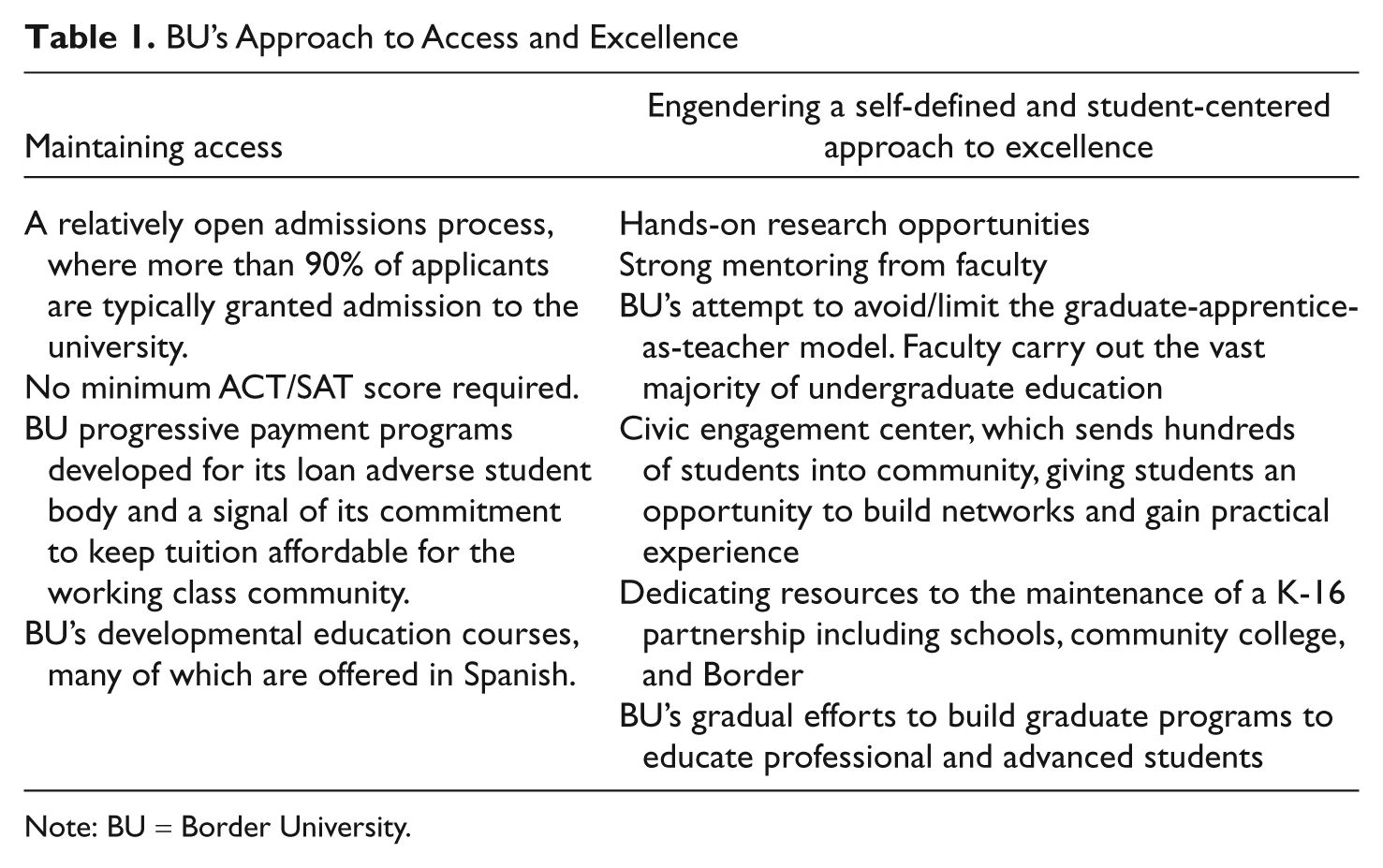
Note: BU = Border University.
During interviews and fieldwork, several professors mentioned how the mission of access along with a different kind of excellence heavily influenced their decision to apply and take a position at BU. For example, one professor, hired in 2006, said,
When I started here—on that very 1st day—when they give you that whole introduction and picture and orientation . . . I remember distinctly the president standing up there and saying “We are a mainly Hispanic university. We’re focused on being one of the best Hispanic universities.” And I felt like “Wow, this is really good. It’s something that I can contribute to.” I’m not going to bring millions of dollars into this university but I can help a Hispanic student [and] because we already talked about all of my own experience [as a first generation, Latina student], I thought at least I can work toward that happening. (Faculty Interview, 2009)
Another faculty member said that she sought a position at BU in the early 2000s because it presented an opportunity to have a well-balanced career, and one where teaching would be valued. Speaking about her first impressions of BU, this professor noted,
I thought [BU] was teaching oriented because the website had emphasized access. You know, teaching and access, and graduates who were the first in their family to graduate. That was the whole mantra. (Faculty Interview, 2009)
Clearly, both professors were interested in BU because of its expressed interest in increasing access while also pursuing a kind of excellence defined by teaching, service, and local outreach. The professors’ assessments were quite accurate. They entered a university that valued teaching, local service, applied as well as pure research, but above all, they entered a university that took its commitment to access and student-centeredness deeply serious. For instance, in a speech to an external funder that supported the university’s K-16 work, the president said,
We have to recruit faculty members who understand from the very beginning what our expectations are about . . . it’s very important that [BU] faculty think about that . . . We care about young people . . . who come to us with their dreams and aspirations . . . we have a responsibility to provide them with the best possible opportunity to succeed . . . we try real hard to have [this as a] consistent message [to prospective faculty]. (Presidential Speech, 2006)
Just a few years later, though, BU’s president and top administration began to suggest that it was time for Border to strive for a new kind of excellence, but would not do so by reneging on the regional access mission.
Sloganeering for Change: Tier One the Border Way
As noted earlier, throughout the years 2003 to 2007, the notion that BU was moving toward a research mission floated about the BU community. By the mid-2000s, most organizational constituents knew that increased scholarly productivity and external research monies were important to the university, especially because grants and external research dollars were one of the key benchmarks for any aspiring research university.
In the fall of 2008, as the state legislature finalized the details on HB51, the BU president used the fall convocation to definitively announce and explain the university’s Tier One aspirations. The president began the annual fall convocation with a story about a young man who we will call Joe. Joe had earned his degree at BU, and like many Border students, he had come from a humble socioeconomic background and was the first in his family to graduate. Joe, the president told the audience, had gone on to work for a prestigious national newspaper. He was one of the very few Latino writers for the newspaper. On arrival to his new job, Joe attempted to adopt the literary approach of his peers, all from highly prestigious universities, and mostly privileged backgrounds. Consequently, the newspaper’s editor called Joe into his office. The editor told Joe that he should recognize and use the valuable and distinct vantage point that his personal and cultural histories afforded him rather than adopting the perspectives and voice of others at the paper. Then, the president applied Joe’s story to Border’s transition. The president stressed that Border, like Joe, should seek to capitalize on its unique identity and history as a Hispanic Serving Institution that sits on the U.S. Mexico border. Of this, the president stated,
We are at our best when we are who we are, doing what we do in our own way, rather than trying to imitate others. We clearly aren’t Harvard on the Border, nor should we ever aspire to be that. We are no longer the small . . . school of our origins, no longer the self-deprecating regional institution into which we evolved. (Convocation Speech, 2009)
The president went on to stress that, although the university was on its way to Tier One status, it would not conform to the dominant research university approach. The president assured that BU would not adopt practices like selective admissions, exclusionary tuition costs, a narrow faculty focus on scholarly production, or evaluative structures that reward scholarship at the cost of teaching. Instead, the president proposed that BU would become a Tier One research university on its own terms and introduced a key slogan that we heard throughout our study:
Our primary challenge is to be confident in creating a new model, to transform [Border] into a Tier One University by leveraging our authentic strengths . . . doing Tier One the [Border] Way. We must attain the expected level of research and graduate program excellence while at the same time never losing sight of our commitment to undergraduate student access and success, and to the future human and economic development of this region. Although there will surely be skeptics, and those who will identify us as underdogs, we know that we can become a truly successful Tier One university only by doing it our way. (Convocation Speech 2009, italics added)
Tier One the BU Way and Doing it our Way are both appealing slogans. On one hand, they suggest the opportunity to break boundaries by maintaining access and regional relevance while providing nothing short of excellence (see Lamont, 2010, for insights about how people construct understandings of excellence). On the other hand, many faculty members were confused by the idea of doing Tier One the BU Way. For example, education professor, Dr. Estrada, pondered,
It’s so abstract. I mean what does being creative mean and what does Tier One the [BU] way mean? I mean if a model doesn’t yet exist, we have nothing to follow . . . you know, even the founding fathers, when they were writing The Constitution, they modeled somewhat after France. I mean, [pause] I don’t know . . . . It’s a little frustrating to be in a situation where you feel like not even the administration knows what the model is or how to get there or can even provide means to get there. (Faculty Interview, 2009)
The doubt expressed by this professor was felt by many others as well. Another education professor, named Dr. Rivera said,
I have a problem with the expression [Tier One the Border Way] because there is no such a thing as our own Tier One. It’s a national concept that universities apply . . . It’s a national concept, you know, you can’t reduce it to a local concept. (Faculty Interview, 2009)
Meanwhile, a liberal arts professor, Dr. Lamar, strived to understand and believe in the slogan, but struggled, nonetheless,
I understand it to mean that [we] are not going to sacrifice access for excellence . . . . Now, if we’re successful about the Tier One thing, that may not last forever because more people will be applying here. You know, right now, we mainly serve the population in this region. If [BU] gets enough of a reputation that more people want to come here from elsewhere, then open enrollment probably just won’t be feasible because we’ll have too many people applying . . . . the fact that we don’t have a cutoff SAT score to come here, if they ever try to change that, I hope students and faculty are marching in the street. I certainly would be. (Faculty Interview, 2009)
Similarly, education professor, Dr. Muñoz, theorized what a successful transition to Tier One would mean to local students.
That [the transition might impact open-access] worries me. That really worries me because [Border] is an important viable option for this community, but I think, also, it will have repercussions that can be positive for this community . . . . I think it could be beneficial in that it will raise educational standards at the level of K-12 and at the university. But, I don’t know that we will end up serving the entirety of this community anymore. I think we would serve some students in this community, but not all students. That will mean that most of our students in our community would be left without an opportunity to attend a university. They would have the community college, most likely. I don’t know. I don’t know. I think it’s something that people do not want to address. (Faculty Interview, 2009)
Unwilling to “buy into” the notion that BU might achieve Tier One status without compromising its regional commitments, Professor Muñoz struggled to reconcile what she believed to be the true benefits and costs associated with a successful transition. Of all faculty interviewees (N = 34), she was one of the few who had vocalized her concerns to senior colleagues in the department. When asked directly what she thought about phrases like “Tier One the Border Way” or one of its variant forms “We will be, but not like,” Dr. Muñoz said,
Really, this is kind of motivational talk: “doing it our way”; [it’s] like “We will have our cake and eat it too” . . . People want to evade or escape the hard considerations the hard decisions that need to be made. It is not that people have not thought about them. They are just trying to avoid them. “We will worry about those details later, okay? Don’t start asking those questions right now about those things.” That is something that we should be having a conversation about, but administrators don’t want to talk about that. (Faculty Interview, 2009)
Like Professor Lamar, Dr. Muñoz believed that Border’s aspirations could very well lead to tighter admission requirements (i.e., the addition of a minimal SAT score). In fact, among 34 interviewees, 29 were highly doubtful that Border could assert itself as a serious Tier One university without adopting the practices and norms of already established major research universities. This led to a number of frustrated, worried, and confused faculty members who rejected the slogans and their plausibility. Yet, as we have noted throughout, systematic or vocalized critique was rare.
Some faculty participants adamantly but quietly rejected the slogans, arguing that BU was not going to build a new kind of model or seek a new level of excellence on behalf of the local community, but that it was after national prestige and fiscal resources. For example, liberal arts Professor Chavez sharply critiqued, “Well, it would be great to be a Tier One university if you like, if you’re into the whole bragging rights kind-of-a-thing. To me, I don’t really think it’s worth the effort” (Faculty Interview, 2009). Dr. Chavez explained that she had seen similar transitions before, and she believed that invariably, such shifts lead to a de-evaluation of teaching, student mentoring, and public service. However, when asked “what are you doing or what will you do about this transition?” The tenured professor said “Nothing. I am not changing anything. I am just going to do what I have always done” (Faculty Interview, 2009). While Dr. Chavez’ inaction is a form of quiet resistance, by carrying on as she always has, an opportunity to ignite a more deliberative and public conversation about the concerns and implications that Dr. Chavez associated with the transition was missed.
Then, in 2010, perhaps to counterbalance those who, like Dr. Chavez or Dr. Lamar, did not believe in the plausibility of Tier One the Border Way, the president introduced another slogan. Rather than solely capitalize on the notion of doing Tier One on its own terms, the president appealed to a long-held belief about the economic connections between a university and its surrounding region. Aiming to soothe and attain the support of any doubters, the president and administration affirmed Border’s commitment to the region and particularly to the mobility of the Hispanic population from a more economic angle.
We must attain the expected level of research and graduate program excellence while at the same time never losing sight of our commitment to undergraduate student access and success, and to the future human and economic development of this region. Although there will surely be skeptics, and those who will identify us as underdogs, we know that we can become a truly successful Tier One university only by doing it our way . . . . Working hard, working smart, and working together, we will complete our journey toward national prominence as the first Tier One University in the U.S. with a 21st century student demographic. (Fall 2009, italics added)
Then, again, in early spring 2011, the president stressed the economic and labor market angle in terms of Border’s aspirations when she or he stated in a news conference,
We are fortunate to be able to call upon [name’s] deep and abiding commitment to BU . . . to provide leadership . . . success will be critical to reaching our goal of becoming the first national research university with a 21st century demographic. I look forward to working with him on the Campaign and on many other initiatives that will enable Border to achieve its full potential to serve as a catalyst for the human and economic development of the region. (News Conference, 2011)
In these slogans, it is apparent that the president sought to seek support by emphasizing that the Tier One transition was not only about providing a new kind of excellence to poorly served demographic (the growing Latino population), but also about economic mobility and vitality for the population and region.
Despite the critique and worry that faculty often expressed in the interviews, there were not, and have not since, been any organized or widely distributed invitations for faculty members to explore the concerns and questions that they expressed to us through our interviews. At the same time, there has been little movement among the faculty, themselves, to gather together around issues and concerns of common interest. In fact, at the conclusion of our interviews, most of the faculty asked if there were others who felt as they did. Simply put, faculty hesitated—at least publicly—to disagree with slogans that promised innovation, access, excellence, and economic benefits.
We argue that these attractive slogans, built out of such compelling ideas hampered authentic opportunities to exercise deliberative forms of democracy where dissent and support, worries and hopes, and excitement and skepticism might have been aired, reflected on, and culled into a more democratic plan that constituents might accept (Dryzek, 2000). In other words, by discussing the change through such appealing slogans, the change becomes difficult and perhaps awkward to counter or challenge. As one administrator told us, “Access and excellence—Well, it’s kind of hard to be against either!” (Administrator Interview, 2009). And while we acknowledge that faculty, like most working people, have many priorities, many tasks to tend to, and while we view the change as one that has been narrowly engineered from atop, we theorize that the lack of faculty engagement can be linked to reasons other than busy work-lives or the tight administrative control of information. Below, we offer a theoretical lens that can be used to reflect on why and how slogans can be problematic during organizational change. We close with lessons for practice.
Theory for Practice
We have shown that faculty members at BU were worried and frustrated by the slogans used to lead Border’s mission change. We have described how, despite their concerns and questions, faculty members rarely critiqued or interrogated the Tier One transition in a vocal, public, and/or systematic way. Below, we offer an explanation as to why faculty members did not articulate their questions or concerns in a more systematic and/or public way. We hope that our theoretical explanation is useful to administrators, planners, and/or any individual involved in educational administration. Specifically, we hope that our critical analysis engenders a willingness among leaders to interrogate the words and ideas that they ask members to work with and through at times of deep significant transitions.
We see slogans, such as “do it our own way” or “Tier One the Border Way” as anchored in major institutional logics, which are dominant configurations of ideas, rules, and ways of seeing and reasoning regarding major institutions. In many ways, logics are how individuals come to see and label normal as normal, appropriate as appropriate, excellence as excellence, and so on. Thornton and Ocasio (2008) outlined logics attached to various major institutions, including the state, the economy, and the collective good. For example, when it comes to the economy, the dominant logic, particularly in the West, prescribes neoliberalism (Harvey, 2007): free markets, deregulation toward global marketplace, competition, and profit maximization. The logic of neoliberalism has been manifested via policy, media, and other elites as the best way to make economies work.
Thus, logics are powerful trains of thought, ways of seeing or not seeing. Building slogans out of logic makes them difficult to question because they are so taken for granted and normalized. To this end, we argue that the slogans at Border are made up of at least three major logics, which are so pervasive and normalized that they are difficult to question, even if and when they point higher education in decidedly different directions. These three logics include collective good/access (Gumport, 2002), neoliberalism/conservative modernism (Gildersleeve, Kuntz, Pasque, & Carducci, 2010; Gumport, 2002; Harvey, 2007), and the pursuit of an unquestioned kind of excellence (Lamont, 2010; Thornton & Ocasio, 2008). In the Table 2 below, we make a case for how these difficult-to-reconcile and equally compelling logics are embedded in Border’s slogans.
Logics Embedded in BU’s Slogans

The Border leaders have put forward slogans that, in their totality, are frustrating to faculty because the tenets of collective good/access and neoliberal/conservative modernism point higher education, and specifically BU, in very different directions. Specifically, the access promised to the regional population is symbolic of the collective good logic, which promises social justice achieved through a communal effort, and the notion of social responsibility. However, the pursuit for excellence rests on the desire to compete, and furthermore, out-compete others to earn status and position. Also important to note is that when entering a wider and more competitive marketplace, the regional, nuanced contexts and rich cultural histories that might inform “doing Tier One the Border way” may be lost as competing organizations strive to make themselves more attractive to larger, wider market audiences. Yet, when Border leaders suggest that the university seeks to enter a kind of market sector associated with excellence (albeit, uninterrogated), it is difficult to raise objections. When Border leaders frame the transition as a promise to fulfill the regional mission by providing the kind of excellent education everyone deserves, countering such ideas seems just plain wrong. After all, who does not desire excellence? Who does not want to offer those from the most marginalized backgrounds an opportunity to rise to excellence, to compete to be the best? The desire to create a niche and be among the “most excellent,” even if excellence is an uninterrogated myth (see Bastedo & Bowman, 2009; Lamont, 2010; Meyer & Rowan, 1977) is a venture difficult to question, and thus, it often went uninterrogated at Border.
Only by pointing to the powerful hold that logics and ideology have on us, can we interrupt that hold. Thus, although our intention is not to prescribe Border’s aspirations as either right or wrong, it is necessary to point out that logic-loaded slogans can handily color over the complexities, challenges, and consequences associated with aspirations. This particular case offers critical insights as to how slogans can hamper opportunities for critique and shared reflection by their sheer attractiveness and dominance. Thus, while we acknowledge that the slogans are appealing, compelling, and inspirational, we also see how they accentuate possibilities and downplay issues of power by playing on logics that few were willing or able to critique aloud.
Teaching Opportunities
We offer the following activities as teaching opportunities based on this study.
Educational leadership students might be asked to further define the logics that we named and also to name their relation to major institutions, including their own settings.
Students might be asked how, in their experience, initiatives or reforms have been “pitched” with slogans and to delineate the “logics” in those slogans (see Gaffkin & Perry, 2009).
Ask why and in what ways the slogans in our study (or others that they may identify) hamper opportunities for a more democratic discussion and shared reflection. To what extent, students might be asked, do slogans allow for interrogation? Students might be asked what kinds of complex and problematic phenomena are “colored over” when slogans are used to lead?
By using the data we have displayed as jumping-off points, students might be asked to describe how organizational members feel when change is engineered via slogans. For example, Gonzales (2010) found that members expressed practical concerns as well as deep, emotional struggles to interpret the meaning of such appealing, yet confusing slogans.
The faculty members in this study were quite helpful in illuminating the potential risks and benefits associated with this change, but their theories of consequences went unheard. Students might be asked to theorize the potential consequences (both manifest and latent, both positive and negative), which stem from a particular kind of organizational change, especially one that seems so appealing, logical, and unproblematic (such as striving for more excellence).
As Dryzek noted (2000), not everyone will use their voice. Some individuals are shy, some might prefer the written word, some might prefer to assemble data and present their own arguments. Also, not everyone enters with equal stores of power. These facts must be accounted for and injustices, accordingly, protected against, so that all voices—exercised in whatever form—matter and are held up for contemplation, reflection, and problem solving. Students might be asked to provide a multidimensional and safe approach to collecting data toward a more democratic planning of organization change.
Finally, students might be asked to reflect on what might differ if only all constituents would be brought together through a more democratic planning process. Thus, even if it takes time and energy, what are the benefits to unpacking slogans and reflecting collectively about the transition?
Footnotes
The author(s) declared no potential conflicts of interest with respect to the research, authorship, and/or publication of this article.
The author(s) received no financial support for the research, authorship, and/or publication of this article.