







Abstract
An urban middle school goes through the transformation of becoming a university-supported lab school. Drawing upon design thinking principles, the planning team cultivates a sense of shared empathy, creative problem-solving, and an ethos of curiosity and learning in a collaborative environment.
Introduction and Context
Principal Maria Estrada pushed “send” on her smartphone and nodded to the seventh-grade science teacher, William Brown, as she stepped out of his classroom and into the hallway. “Seven walk-through observations done,” she muttered to herself, proud that she had exceeded her daily goal by three. Her area superintendent had challenged all principals to log four 5-minute walk-through observations a day and thus 20 a week. Multiplied over a 36-week school year, the math would add up to a lot of administrator presence in the classroom, relevant feedback, and a better awareness of the instructional climate of the classrooms. Principal Estrada had risen to the challenge and found that her middle school teachers especially appreciated the open-ended feedback portion of the electronic walk-through form. In fact, she would notice that after she left the classrooms, they would glance at their e-mail to see what she had noticed, often replying to her reflective questions or words of encouragement.
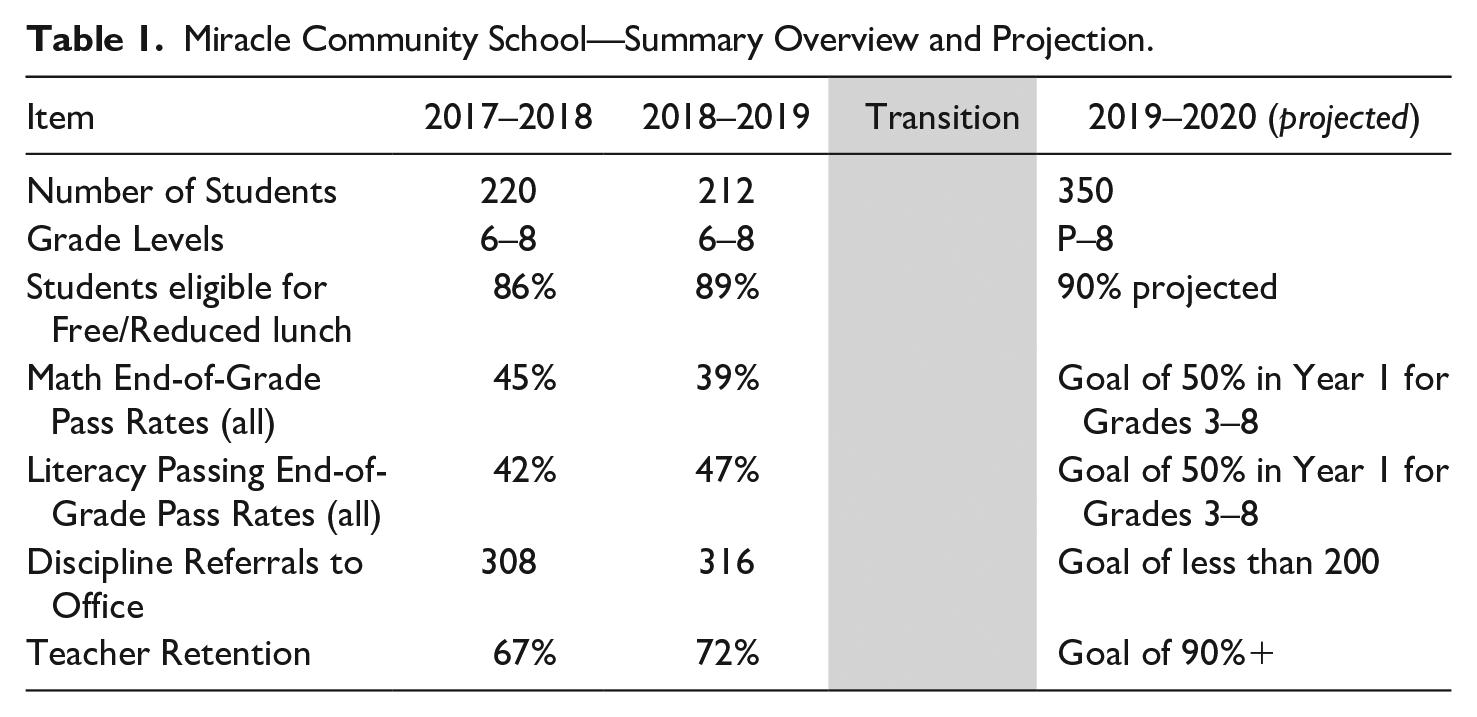
And encouragement was exactly what Miracle Middle School (MMS) needed at this moment. The aging campus was situated in the heart of the downtown city, located in the industrial center of the state. Recent economic shifts had caused declining population and stagnating wages. Teacher wages had followed the economics, and the urban district fought to keep teachers past the “statistic” of 3 years, with little success. Moreover, recent “Lab School Legislation” had compelled Mountain State University (MSU) to enter a 10-year effort to partner with the school district to administer the daily organizational operations of the school which, significantly, would transition from a 6 to 8 middle school of 215 students to a PreK to Grade 8 school of nearly 350 students, as the university and the district shared the goal of maintaining family togetherness and focusing on consistent academic achievement. Moreover, there would be no planning year, so the MMS leadership team and the MSU planning teams met for “MMS-MSU Dinner Conversations” three nights a week, which usually meant pizza-fueled discussions and hectic planning sessions in which the university and school district teams mapped out transitions for shifting the school from a district-run middle school to a university-supported P–8 Miracle Community School (Table 1).
Miracle Community School—Summary Overview and Projection.
Admittedly, there were a lot of sleepless nights for all involved. On the university side, ensuring community buy-in was essential; this could not be seen simply as a university or legislative mandate. In fact, without the local district families behind the Miracle Community School plan, it would be doomed for failure. The legislation had been passed without ample on-the-ground conversation and little transition time. The school would have 2 months to go from a historically 6 to 8 school supported by the local school district of 10,000 students to a PreK to Grade 8 school supported by a Research 1 university of over 25,000 undergraduate and graduate students. Principal Maria Estrada and MSU Professor Clarence Walton, a former district superintendent who had taught leadership and technology at the university for 15 years, spearheaded the Miracle Community School Planning Team. Estrada was a former doctoral student of Walton’s and the two had worked together on projects ranging from school improvement to technology integration over the past decade, so trust was established. The two often had conversations between meetings, ensuring action and continuity from their respective school and university systems—not an easy task.
Got a second to chat? The text from Maria dinged on Clarence’s phone. He was walking across campus to go to lunch, and it was the perfect time. “Hello, Principal Estrada, how many walk-throughs are we up to today?” he asked with a hint of mischief in his voice. “Well, you don’t happen to know how to fix a kiln do you?” Maria replied. “A what?” asked Clarence? “That’s right, our middle school art teacher’s kiln just went kerplunk, and we have some disappointed 6th graders with clay vases that need firing up—come take a look, tech wizard.” Clarence chucked and said, “Um, that might be one for the ‘Dinner Conversation’ squad?”
“In all seriousness, Clarence, I have been thinking,” Maria said, and Clarence could tell she had something in mind. “Ever heard of design thinking?” Clarence had, but he admitted that he wasn’t an expert or anything. “I really think it could shape the work we are doing in a meaningful way,” offered Maria, explaining she had come across the topic and examples via Twitter, and that she had been studying design thinking in schools. “Let me share with you what I know,” she said, “and let’s think about how this might impact our work in planning ahead for Miracle Community School.”
Design Thinking in Schools
Design thinking in schools, observes Nash (2019), aligns with the notion that educational leadership is transformative in nature, in making “the transition from the experiences students are having now and the experiences students could be having” (p. 9). This notion resonated with Maria, particularly that “it’s a way to fully capture what students need, what your community needs, and to create real fixes” (Nash, 2019, p. 9). Design thinking is exceptionally relevant for today’s educators who face problems in practice that are “complex, diverse, and often difficult to address” ranging from curriculum development, student engagement, parent and community issues, and innovations (Henriksen et al., 2017, p. 140). Design thinking is now used to redesign school models and systems, support changes in school culture, shift how educators collaborate, and craft supports for student development of 21st-century skills (Diefentahaler et al., 2017).
Merging P–8 and higher education challenges together in the form of a state-mandated lab school required significant work for the planning team. A risk in the foreground of the lab school initiative was a potential clash of cultures, beliefs, and ways of working within both the P–12 and higher education context. If either group became entrenched in “their best way,” the success of the lab school would be at risk. What the group needed, Maria began to surmise, was a third way, which would allow both groups to focus on the needs of the school’s community. Design thinking was that way.
The affordances provided by design thinking offered key advantages to the MMS/MSU team, including ways to focus on the stakeholders’ experiences, especially those of students, to create models to examine the complexities of the problems they face, use prototypes to explore solutions and fail safely, fail safely, and exhibit thoughtful restraint (Kolko, 2015). Design thinking allows educators a way to embrace the ambiguity and complexity of tough challenges, such as school redesign, by bounding the challenge in a step-wise process. However, the bounding afforded by the process does not box out new voices, ideas, and solutions. Ironically, the constraints of the process stoke creativity.
Cook and Bush (2018) adapted the following components from the Institute of Design at Stanford University (n.d.):
Human-centeredness (developing empathy for the people for whom you are designing);
Bias toward action (spending more time doing and making);
Radical collaboration (bringing together innovators with diverse backgrounds and viewpoints);
Culture of prototyping (building to think and learn from multiple iterations);
Show, do not tell (communicating vision in an impactful way to your audience); and
Mindfulness of process (knowing the goals and stages of the process) (p. 95).
As Maria and Clarence reviewed these aspects, they realized how their Miracle Community School Design Team could benefit from focusing on empathy for those who would be impacted by this incredible shift, focusing on action (which wasn’t really a choice at this point, but was so critical given the different speeds of P–12 and university), focusing on radical collaboration (as no one had ever fused the two entities together like this), being willing to think and learn as you build, showing vision, and being mindful of the process. Some, they realized, were already happening (such as the action and collaboration). Others, like empathy and mindfulness, needed some deliberate work.
Student Engagement and Design Thinking
Here’s how Maria went about using design thinking to tackle the challenge of improving student engagement with an eye to reducing discipline referrals (as noted in Table 1). First, Maria formed a design team, inviting members from the School Planning Team, including William the seventh-grade math teacher, Clarence from the university, and three students—one each from sixth, seventh, and eighth grade. In all, there were nine people on the team, six adults and three students.
While there were several challenges Maria could tackle in the school, she talked with the design team about what felt pressing and at the same time feasible. “Sure, teacher morale is important, but what is behind that low morale?” Maria asked the team. William chimed in, “There’s a lot behind that, but I can’t help but think student behavior and overall engagement play a part in that. It’s a double-edged sword: teachers and students feel a loss of agency.”
“Interesting,” said Clarence. “We could take a stab at morale, but if there are root causes behind the morale problem why don’t we work on those first?”
“Good point, Clarence,” said Maria. “We could shine a light on student engagement, agency, and discipline. If we worked on a piece of that and find some success, we can scale the process to other challenges.”
Roberto, the eighth grader on the team, added to this. “I agree, Ms. Maria. The students know a ton about what works and does not work in the school. If students were treated like experts, everyone could learn more about how to improve the school.” Sarah and Leticia, the seventh and sixth graders, nodded in agreement.
“Then the question before us could be ‘How might we use student voice to improve student engagement at Miracle Middle?’”
“Nice, but how do we answer that? What’s the plan here, Maria?” asked William.
“We begin with empathy,” Maria said.
The team embarked on a series of steps, conducted in phases, to develop new ways to improve student engagement. They started with understanding what the lives of students and teachers were like.
Empathy Stage
Maria utilized an empathetic conversation template (Nash, 2019) that served as an interview protocol for the design team. Each member of the team was tasked with using the protocol to talk with five other people with the goal of attaining 45 interviews. The protocol allowed each person conducing an interview to be able to get to know the person they were talking to as a human being, understand their wants and needs, and hear specific recommendations on the challenge at hand: increasing engagement.
In addition to empathetic conversations, the team had another strategy. Something struck the adult members of the design team as they go to know fellow student team members Roberto, Sarah, and Leticia. As the students talked about what their days were like and all that they had going on in their lives, it made the adults realize how little they know about what the students at school do all day.
Maria added student shadowing to the team’s toolkit. Using a student shadow safari template (Nash, 2019), the adult design team members each selected two students from whom they received permission to shadow. Following them through their day, the team members kept their distance but were able to understand what class was like, how passing in the hall felt, what the lunch experience was like, and where the student seemed engaged, excited, frustrated, and so on. At the end of their shadow experience, the team member would debrief with the student.
“Wow!” William remarked. “The shadowing is way different from the walkthroughs,” he observed after his first shadow safari. While he was a seventh-grade teacher, he had shadowed an eighth grader that day. “I had no idea how little is asked of students across our curriculum. It’s no wonder our teachers say we have low student engagement—we don’t engage them!”
Defining Stage
The design team nearly met their goal of 45 interviews, holding conversations with 39 students and teachers. They also shadowed eighth-grade students. In a team meeting, the members shared the highlights from each of the conversations and shadow safaris. As each person shared, the other team members captured the highlights on sticky notes. Once all the stories were shared, hundreds of sticky notes covered the table in the meeting room. They sorted the notes into affinity groups, finding commonalities across all the engagements with the teachers and students. What they discovered surprised them. They named a large affinity cluster of notes that related to “Instructional Differentiation.” William observed, “Students are really wanting to be seen as individuals, not a one-size-fits-all group.” Another they named “Student voice.” Maria said, “Students want to be heard, and to help lead their learning. How can we ensure that they have agency in their learning?” And it happened that both teachers and students wanted the same thing: each other to succeed. Roberto chimed in, “We really want to see our teachers succeed—believe it or not! If they are enjoying their work, chances are we are learning and engaged.” Seeing these commonalities allowed them to reframe the challenge from the perspective of the students and teachers and ask the following question: How might we help both students and teachers be mutually engaged, collectively successful, and speaking the same language when it comes to learning?
Brainstorm Phase
The following week after sharing stories and clustering the findings, Maria called the team together for a brainstorm. Embracing the mindset of radical collaboration, Maria invited outsiders to the brainstorm. These included students who had been interviewed in the empathy phase, and other people who engaged with students but who were rarely asked their thoughts, such as the custodian from the eighth grade wing and two line staff from the cafeteria. Maria posted the team’s “How might we. . .?” question on the wall and gave the instructions.
“We are about to spend 20 minutes brainstorming solutions to this question,” explained Maria: Remember, we are looking for a lot of ideas, and they don’t have to be good ideas—we’ll evaluate our ideas later. Right now we want to build on each other’s creativity and come up with as many radical solutions as we can to this question: How might we help both students and teachers be mutually engaged in the work?
The team followed the tenets of good brainstorming (IDEO, 2020) by deferring judgment on whether any team member’s idea was good or not; encouraged each other to make their ideas wilder and wilder; used encouraging phrases after an idea was given, like “Yes! And. . .”; stayed focused on the question at hand; and went for quantity.
Clarence served as scribe and captured each ideas on chart paper affixed to the wall. Maria used idea-stoking strategies when the team started to slow down. “Okay, William, how would your significant other solve this problem?” Maria would shout out. William was thrown into a whole new frame of mind. He’d never considered what his partner, who was an infectious disease scientist, would suggest here. William rattled off a litany of ideas. Maria then said, “Folks, how would your favorite sport team handle this?” Jules, from maintenance, was an NASCAR fan—he had long been fascinated by the pit crews and how they have a silent language, work fast, and support each other. Jules listed a slew of solutions that might work which were inspired by the work of race car crews.
In the end, the team came up with 52 ideas on how to bolster student engagement. “This is fabulous,” Maria said. “Now, we have to harvest this brainstorm. We’ll use dot voting.” Maria handed out three sticky dots to each person in the brainstorm. “You may put from one to three of your dots next to any idea on the sheets of chart paper. The top vote getter will be considered as the solution we take forward.”
In the end, the team selected the following idea to test: prioritizing student voice in learning.
Prototyping and Testing Phase
William thought that testing out an idea like prioritizing student voice in learning was going to be impossible. “How can we possibly prototype prioritizing student voice in learning?” he asked. Maria told him, “We don’t have to actually run this live; we just have to create a scenario where our folks can suspend belief and see themselves in the solution. You’d be surprised how simple it is—we can use storyboarding.” Clarence chimed in, “Storyboarding? Like that which they use in making movies?” “Yes,” said Maria. “In fact, I have a cool tip from the filmmakers at Pixar which we can use to make a simple but powerful storyboard. It’s called the story spine.”
A story spine (Pixar Studios, 2019) is a technique for creating storyboards in which a team fills in the blanks on series of statements which, in the case of the design challenge at Miracle Middle, would convey how a student or teacher found themselves in an undesirable situation and, thanks to experiencing the solution derived by the team, found themselves in a much better situation. The story spine goes as follows:
Once upon a time. . .
Every day . . .
Until one day . . .
Because of that . . .
Because of that . . .
Because of that . . .
Until finally . . .
And ever since then . . .
The moral of the story is. . .
The team created the story of a Miracle Middle student named Rita who was continually frustrated in her middle school science classroom because she struggled to understand the larger concepts and never felt heard by her teacher or peers. She found it challenging to complete labs, she couldn’t find a reliable lab partner, was starting to show up tardy and get discipline referrals, and she was failing the class. Until one day, her teacher, Mr. Brown, began each classroom with an interactive meeting that provided students to share about themselves, engage in an icebreaker activity, and then preview the learning objectives. Because of that, Rita was able to share about her life and interests and, because of that, made a few new friends in the class section. And because of that, she had friends whom she could study with, and her interest in science increased. Whenever Maria visited the eighth-grade science classroom and asked Rita what she was learning, she would share about the content and how it mattered in her life. Ever since, she succeeded in the science course and in multiple subjects, and did not receive a single discipline referral. The moral of the story was that being intentional about engaging students in their learning made a huge difference for Rita, and for the tenor of the classroom.
Roberto, Leticia, and Sarah quickly volunteered to draw the storyboard. Roberto had a flair for richly describing Rita’s story, Leticia had a gift for illustration, and Sarah’s handwriting was impeccable. Over a weekend, they developed the first version of the storyboard on poster size paper.
Maria posted the storyboard on a wall in a busy corridor in the school and team members took turns throughout the day “staffing” the storyboard by engaging with anyone who would stop by to hear the story of Rita. Once someone had heard the entire story, the team member would ask them what they thought of the solution described in the story. What should be turned up? What should be turned down? In the course of a day, dozens of students, teachers, staff, and even a few parents had heard the story of Rita and given their feedback.
Maria convened the team to collect the feedback: We sure learned a lot. Engaging students early in the classroom was on the right track, but the “teacher for a day” concept was a bit off base. And I could have seen us going down the path of the teacher for a day based on my own thinking. I’m glad we tested this prototype.
“Agreed,” said William. “I think we could redraw the story to reflect this new learning and then get one more round of feedback. And then, if you like, I would be willing to try this out live in my classroom for a week.”
“That would be great,” said Maria. “Depending on how that goes, we can take this to the planning team and determine how much wider to implement this idea.”
Design Intervention and Process Design
Practical Implications
Design thinking holds powerful potential in seeking to bolster lab school partnership efforts. Here are a few additional examples of how the Miracle Community School Design Team can foster leaders and stakeholders as designers that involves a process of searching, not just planning, by involving stakeholders, looking beyond apparent resources, and finding time to make the process a priority (Nash, 2019).
Curriculum design and innovation
Bringing the school and university together had tremendous upside for designing the way teachers taught and students learned. In the same way the design team had focused on student engagement, they leveraged their joint efforts on curricular design and instruction. Mr. Brown, the seventh-grade science teacher, co-chaired the collaborative curriculum alignment committee (CCAC) with a literacy professor who was an expert on applied learning. Brown’s experience with the design team provided him with the perspective to co-lead this effort in a human-centered way. Together, they worked with local teachers to identify key curricular strands that needed a “boost” in terms of teaching and learning. Here, design thinking was key in impacting teaching and learning. CCAC worked to coordinate partnerships between the K–8 teachers and the university faculty to collaborate through four steps:
The teacher and professor would plan together;
The professor would visit Miracle School and they would co-introduce the topic to students;
The teacher would work with the professor to design ongoing activities and modules that conveyed a “culture of prototyping” (Cook & Bush, 2018, p. 95); and
Culminating in an on-campus field trip where students learned about how universities worked and began to see themselves as a lifelong learner.
This ongoing relationship would provide interdisciplinary experiences as an important component (Carroll et al., 2010) that kept students engaged in new ways and fostered synthesis between learning organizations.
Outdoors education and health & wellness
A goal of the design team and the CCAC that emerged, with student input, was focusing on outdoors education and health & wellness. Involving the community was key; the design team surveyed both the current middle school students and parents/guardians and potential incoming new P–5 parents/guardians about their perspectives and hopes. One question was phrased as follows: Dream big. Imagine your dream school. What would you like to see, do, or be a part of? Dream and share “outside the box” as much as possible.
Responses from the survey transformed the discussion and direction of the design team. Students wanted more time outdoors, and given the sprawling, hilly campus, ideas emerged for revitalizing the grounds with natural materials playground equipment, a learning tree house classroom, and even zip lines. The design team and the CCAC worked to study examples of the U.S. Department of Education Green Ribbon Schools (ED-GRS) recognition and considered ways of fostering health & wellness, outdoors education, and greening learning spaces by upgrading rain barrels, making recycling containers more prevalent, and incorporating green efforts into their school improvement team in an intentional way (Sterrett et al., 2016). The design team sought input from students, parents, and staff through face-to-face meetings and through online surveys in envisioning what this could look like at Miracle.
Empowering teacher leadership and community presence
As plans for a new school were increasingly becoming a reality, community presence, teacher leadership, and empowerment of both important stakeholder groups were deemed necessary for the plans for opening the school. The design team and the CCAC were challenged to seek community input as the local school board grappled with requirements of the legislation. During the initial planning efforts, areas of responsibility were developed for the laboratory proposal; they included team leadership, an operations coordinator, curricular programs, teacher preparation and development, principal preparation and development, legal services, human resources, finance, family/community/partner engagement, and many others. Team members comprised of school personnel and university faculty would meet to create a vision, mission, and commitments of the proposed laboratory school that would initiate a whole-school, whole-community, and whole-child model. As community and design team meetings were occurring, the design team was also developing with a goal of carrying out both the predictable and unpredictable tasks that impacted the school daily through its bidirectional relationship with the school at large and the university.
The design team would meet weekly to discuss various goals as outlined by the lab school legislation and to create opportunities for Miracle Community School to be viewed as a true university school through intentional partnerships and effective planning. It is in such meetings that effective, collaborative relationships from local and school community members and groups were established via an initial engagement survey. Teacher leaders were able to discuss opportunities from their perspective of the possibilities for the school’s unique population and teacher engagement. University staff were able to provide input that may include providing details around key professional contacts, faculty expertise. It is during those meetings that the leadership supported Principal Estrada to make decisions based on the required principal leadership standards such as strategic, instructional, cultural, human resource, managerial, external development, micro political, and academic achievement leadership (North Carolina Department of Public Instruction, 2013). It is also during those meetings that teacher leaders were encouraged to share ideas, concerns, and contribute to the decision-making for the school. In all discussions, there would be a direct correlation to the school’s three established guiding topics of literacy and language arts, positive behavior supports, and school community relations. And twice a month on Fridays, they would lead a discussion with fellow staff members and stakeholders to discuss the information disseminated and discussed in the weekly design team meetings. Finally, a former technology teacher at MMS and advocate for the Miracle Community School also led a monthly Miracle Community School Advisory Board to allow the school leadership and staff to meet the needs of its whole-school, whole-child, whole-community mission. Specifically, the group was designed to work closely to bridge community organizations with school needs as defined through various avenues.
Conclusion
Miracle Community School was embarking on transformation through radical collaboration and a bias toward action (Cook & Bush, 2018; Stanford University Institute of Design, n.d.). Transitioning from to an established inner-city middle school into a university supported P–8 school would require vision, attention to detail, and a sense of design thinking to realize what students and staff need now, and to find ways to get there together. From curriculum and instruction to organizational leadership, and from community involvement to school–university collaboration and partnership, design thinking served as an important driver in helping realize success together.
Teaching Notes and Activities
As Haag (2017) observed, the notion of a lab school has been in place since at least the 17th century and was made notable by John Dewey’s late 19th-century collaborative in Chicago, and continues today, in locations ranging from University of California, Los Angeles (UCLA) to Washington, D.C., with varying levels of focus on training, research, and service. Some states have had collaboration as a legislative mandate. For example, in North Carolina, the General Assembly passed legislation requiring selected universities to open laboratory schools that would serve students in Grades K–8. The General Assembly hoped that lab schools could “redefine and strengthen university partnerships with public schools, improve student outcomes, and provide high quality teacher and principal training” (University of North Carolina System, n.d., para. 2). Partnerships between schools and universities have existed to bolster collaborative efforts in a mutually collaborative way.
The notion of design thinking in schools holds promise for tackling evolving and complex challenges facing schools and universities today. As Nash (2019) observes, “all schools face challenges” and whether or not the challenge is simple or complex, the process of design thinking can help “leverage co-design with the people most affected by the problem, or with those who are traditional left aside” (p. 144) in the discussion and in the work. The first two questions in this section provide a deeper look at the case, and the next three questions should be addressed as a small group.
Overview Questions
Review the “practical implications” addressed by the Miracle Community School Design Team above (curriculum design, outdoors education, empowering stakeholders). What other ideas or implications come to mind? Are these more university-focused, school-focused, or both?
Research suggests heterogeneity in a design team contributes to better outcomes (Wilde, 2007). This pertains to the mindset of radical collaboration. In MMS/MSU case, one form of radical collaboration would be to bring different people’s voices to the table that are generally not part of the educational design process. How could an educator-only team stifle the ultimate set of solutions created by the MMS/MSU team? How might culture of not respecting the opinions of noneducators, for example, parents, students, and paraprofessionals, and community members create a school design that is not well liked?
Activities—Discuss and Generate
3. Consider the notion of outdoor learning and design thinking principles. As of 2019, the ED-GRS award had honored “some 420 schools, 76 districts, and 44 postsecondary institutions” with “close to fifty percent of the ED-GRS serving majority disadvantaged populations” (p. 2). Review examples of schools from the ED-GRS website. Share insights within a small group: What are some exemplars that speak to you? What are some ideas that might emerge for a design team to embrace? How might they leverage shared leadership and ownership of this work?
4. Cook and Bush (2018) write that design thinking “goes beyond scientific inquiry by adding creativity and value to decision makers” (p. 101) which can foster a sense of empathy and perseverance and allow them to engage in society. In a small group setting, discuss and outline possible lessons in which to engage students in grades P–8 in this regard.
5. Given that “. . .design thinkers try to get on the same level as those who actually experience the problems they are trying to solve” (Nash, 2019, p. 139), what are some ways the MMS/MSU team members could “get on the same level” as the students and parents of the new PreK to Grade 8 school? Role-play a discussion based on the characters in the case: How might the team members walk in the shoes of students to better understand what their lives are like so as to design a better school experience for them? How might noneducators, such as parents, be on the team as co-designers? Consider the following student-focused questions adapted from Nash (2019): What’s the biggest problem in your school (or grade, subject-area, etc.)? (After the response, ask, “Why do you say that?”) What do you wish the teachers knew but don’t about what happens in school? (After the response, ask, “Why do you say that?”) What do you wish your principals at school knew but do not? (After the response, ask, “Why do you say that?”) If you could give the adults in the school some advice, what would it be? (After the response, ask, “Why do you say that?”)
Supplemental Material
sj-docx-1-jel-10.1177_1555458920975442 – Supplemental material for Imagination Into Action: A School–University Collaboration With a Design Thinking Imperative
Supplemental material, sj-docx-1-jel-10.1177_1555458920975442 for Imagination Into Action: A School–University Collaboration With a Design Thinking Imperative by William L. Sterrett, Sabrina Hill-Black and John B. Nash in Journal of Cases in Educational Leadership
Footnotes
Authors’ Note
This case study described here—as well as any and all case characters—is fictitious and not representative of any one school or leadership scenario.
Declaration of Conflicting Interests
The author(s) declared no potential conflicts of interest with respect to the research, authorship, and/or publication of this article.
Funding
The author(s) received no financial support for the research, authorship, and/or publication of this article.

Author Biographies
References
Supplementary Material
Please find the following supplemental material available below.
For Open Access articles published under a Creative Commons License, all supplemental material carries the same license as the article it is associated with.
For non-Open Access articles published, all supplemental material carries a non-exclusive license, and permission requests for re-use of supplemental material or any part of supplemental material shall be sent directly to the copyright owner as specified in the copyright notice associated with the article.
