







Abstract
COVID-19 prompted unprecedented disruptions to schools with challenges particularly severe for high-poverty remote rural schools. This case study recounts the story of a rural school that had participated in a research–practice partnership (RPP) multi-year improvement effort prior to the pandemic and documents the ways the RPP and the school-based improvement team worked to navigate pandemic-related disruptions. This case study provides educational leaders with insights into ways to surmount challenges and innovate especially during times of significant disruption and provides prompts to consider with regard to the use of RPP support and improvement science-based processes and tools.
After weeks of growing uncertainty around the COVID-19 pandemic, on March 16, 2020, New York’s Governor ordered that all K–12 schools in New York state shift to remote instruction in 2 days. A subsequent announcement required remote instruction for the remainder of the 2019–2020 academic year. These shifts were particularly problematic for leaders and educators in rural areas already struggling with inequities exacerbated by economic, technological, and social disadvantages (Schaefer et al., 2016; Showalter et al., 2019).
Elevated needs for hope, assistance, supports, resources, and networking opportunities were apparent in rural school communities before the pandemic as just over 85% of U.S. counties challenged by persistent poverty are rural, and approximately one in six rural students lives in poverty (Schaefer et al., 2016; Showalter et al., 2019). In addition, and in terms of educational outcomes, recent research indicates that graduates from rural high schools are less likely than their urban and suburban counterparts to immediately enroll in college and return for a second year (National Student Clearinghouse, 2016). These disparities, combined with the challenges of geographic distance from colleges and universities had earned some rural communities the moniker “higher education deserts” even before the pandemic (Farrigan, 2017; Tieken, 2016; Van Gundy et al., 2016).
Alongside these challenges, rural school leaders and educators also entered the pandemic with a range of resources typical in rural school settings. These included students’ and staff’s stronger sense of belonging and higher levels of parental involvement to support educators’ efforts in comparison with their suburban or urban counterparts (Bauch, 2001; Jimerson, 2006).
As the pandemic persisted, however, rural communities in New York State like others around the United States faced a number of issues that exacerbated the impacts of the pandemic on their students, staff, and families. Most notably, poor technology infrastructure to support remote or hybrid (i.e., combined use of in person and remote) learning was paramount. Throughout the pandemic, news media reported on issues regarding disparities in access to high-speed internet in rural communities across New York state. These reports highlighted the politically heated discussions associated with rural–urban resource allocation disparities focusing on who would pay (and when) for the distribution of broadband in more remote areas (e.g., Jacobs, 2021). Despite the dissemination of hotspots and one-to-one computing devices, the rural technology gap affected rural youth’s access to a quality education disproportionately as a large number of students’ only opportunities for instruction during remote learning throughout 2020 and into 2021 was via their oftentimes spotty internet connections.
Another pandemic-related disruption consequential for rural young people was with regard to adult supervision and social supports. These issues disproportionately affected youth living in poverty and children and youth whose family members were required to work outside of the home. Those family members faced the challenge of needing to leave their children in the care of older siblings or other adults like grandparents when school was remote, and those caretakers were not always effective at helping students stay on top of their assignments. In rural areas, few if any, resources were available to fulfill this child care and academic support need. In addition, the social isolation of being miles from peers and others with whom to interact was particularly challenging for young people living in the most remote rural settings and those most susceptible to mental health issues. This potent combination of adversities held implications for rural youth’s learning and social and emotional well-being and with multiplier effects as shifts from in-person to completely remote instruction due to COVID-19 outbreaks persisted for much longer than expected.
The Context
Prior to the pandemic, our research–practice partnership (RPP) collaborated with rural Fort Plain Central School District (FPCSD) in facilitating and guiding the use of improvement science-based tools and processes (explained in more detail below) to address several aims their teams identified (Wilcox & Zuckerman, 2019). While RPPs have been defined and configured in a variety of ways (Coburn & Penuel, 2016), what most share in common is a commitment to the generation and use of research to guide practice and policy and with a priority placed on multi-way mutual learning among and across partner organizations (Wilcox et al., 2017).
To foreground FPCSD’s journey through the pandemic, I provide relevant background about the school context and detail about our RPP and then I describe how our collaboration for improvement and mutual learning began there. This sets the stage for our case narrative focusing on how leaders and educators at one rural school in collaboration with the RPP navigated through pandemic-related disruptions. This case is guided by the following overarching question: What can be learned about how rural school and district leaders can leverage relationships with RPPs and use improvement science-based resources and tools to promote adaptation and innovation during significant disruption?
The School Setting
The site of this case study is Fort Plain (identified with Institutional Review Board approved consent procedures), which is located in the Mohawk Valley region of upstate New York. This rural community was incorporated in 1832, and being situated along the Mohawk River made it an attractive location for textile production in its early days. Now the community is the home to about 3,000 residents. Employment opportunities are limited in Fort Plain itself, and the school district acts as a major employer. Yet the community is connected to towns and cities by a major highway, so residents are able to live in Fort Plain and commute to jobs outside of the community within an hour’s drive. Several large universities and smaller colleges are also within about an hour’s drive of Fort Plain. Adding to the local flavor, Fort Plain is the home to a number of Amish families who migrated to the community in the late 20th century from Pennsylvania, who tend farms in the surrounding hills of the valley.
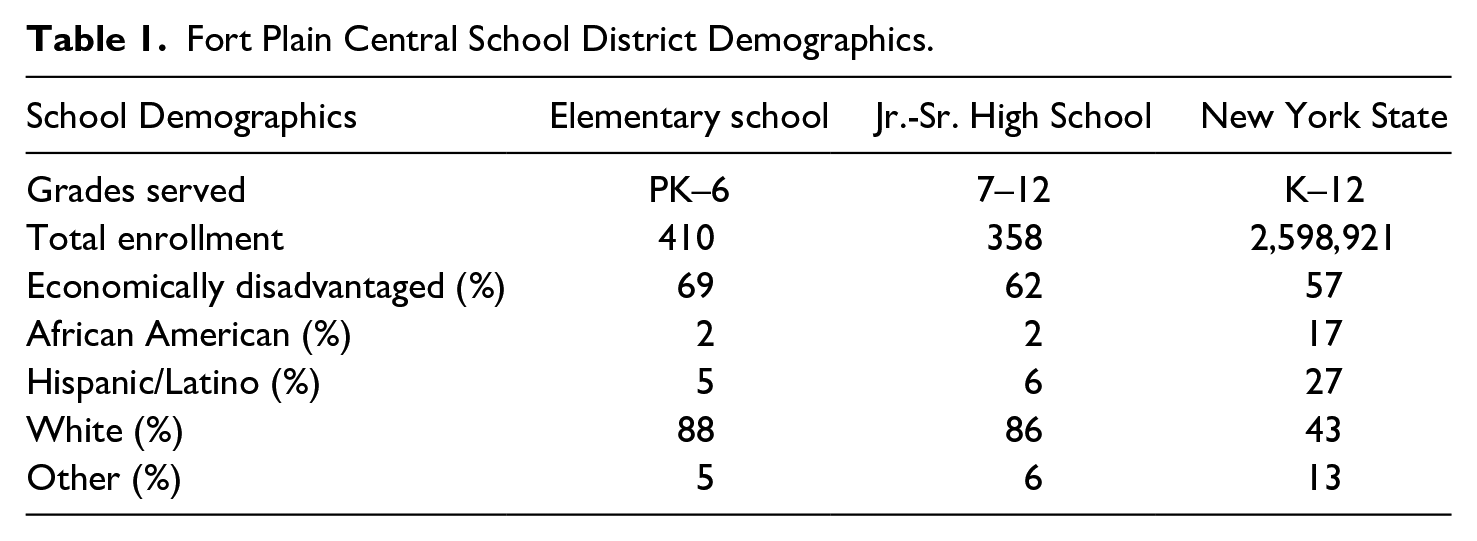
While the community has some ethnic and cultural diversity, including Black/African American and Hispanic/Latino students, the majority of students at FPCSD are White. The school also serves a greater than state average of youth growing up in poverty (see Table 1). The district is comprised of two schools: the Harry Hoag Elementary School (PK–6) and the Fort Plain Junior-Senior High School (Jr.-Sr. HS; 7th–12th grades).
Fort Plain Central School District Demographics.
The RPP
Funded by the state of New York since 2005, the RPP is housed in a School of Education at a large state university about 1 hr’s drive from FPCSD. One of the RPP’s priorities is to engage in positive outlier (or positive deviant) research. This entails designing studies that rely upon complex sampling procedures (e.g., multiple regression analysis) to identify schools that achieve better than predicted student performance outcomes taking into consideration demographic characteristics such as levels of poverty and ethnic and linguistic diversity. The RPP research team then compares, through qualitative field study methods, those schools identified for consistently better than predicted student outcomes and other schools with similar or less socioeconomic, ethnic, and linguistic diversity yet predicted student performance outcomes. The case studies the research team produces from these field studies facilitate identification and description of those characteristics and specific practices and policies that might be promising for others to consider in their own improvement efforts.
The RPP team uses its own positive outlier case studies and other related research in a process called COMPASS (an acronym) to provide direct improvement support to schools with whom we partner. COMPASS is a process developed in collaboration with the RPP’s advisory board members which include the largest professional associations in the P–12 education sector in the state such as the New York State Council of School Superintendents (NYSCOSS) and the School Administrators Association of New York State (SAANYS). COMPASS is informed by positive deviance study designs (see Pascale et al., 2010) and improvement science (Bryk et al., 2015).
The COMP component calls for improvement teams to “compare” their processes, practices, policies, and outcomes with those of positive outlier schools. Here, attention is paid to important demographic characteristics, including differences between schools in rural versus suburban or urban contexts and those serving different student populations by ethnicity and socioeconomic status. Next, the “A” stands for “assess,” and this prompts school improvers to evaluate the possible causes for their outcomes, their local priorities, resources (human and fiscal), and any constraints for improvement in their setting. This step is crucial in that it encourages improvers to stay “user-centered” and “problem-based” (core improvement science principals), and ultimately take into account the systems surrounding their improvement efforts. Next, the “Ss” represent “Setting SMART goals and near-term aims” and “Selecting levers to improvement.” This involves improvement team members delving into research—both extant (from the RPP’s positive outlier studies and other studies) and their own data (through focus groups, empathy interviews, self-assessment surveys, and other performance measures).
These steps are followed by a continuous improvement process wherein school-based improvement teams develop an action plan based on the improvement team’s theory of improvement, initiate the plan, and monitor progress. The RPP’s support of the team includes continual formal and informal interactions informed by performance adaptation theory (Baard et al., 2014). Performance adaptation theory posits that adaptive process mechanisms (e.g., cognitive, behavioral, and affective/motivational) and task complexity change features (e.g., coordinative and dynamic tasks that require linkages and sequencing of cues and actions to meet changing demands and aims) help explain how a system functions in adapting and innovating.
The Jr.-Sr. HS’s Improvement Journey
The RPP’s journey with Fort Plain began with the superintendent who had come from a nearby district and had engaged with the RPP’s research and improvement science-based direct support in the past. The superintendent was passionate about using positive outlier research and engaging in COMPASS’ systematic approach to school improvement when he took the reins. Therefore, he introduced the RPP facilitators (university faculty researchers and study council professional development facilitators) to the FPCSD Board and to the elementary and Jr.-Sr. HS principals.
In this case study, I focus on the Jr.-Sr. HS’s work as they consistently interacted with the RPP over a 5-year period. Their COMPASS team included the school principal, teachers from different grade levels, and the school counselor. After engaging in the first steps of COMPASS (e.g., causal analysis), they decided to focus their attention on the emotional well-being and academic engagement of their most at-risk students. These students were often tardy or absent from school and often were facing social and emotional challenges as well as academic ones. The COMPASS team conducted student focus groups and decided from these that a safe and inviting place in the school was needed in addition to other academic supports.
The RPP guided and monitored the effort over a couple of years. This included collecting baseline data on tardiness, absences, and summer school attendance. To what extent their approaches were successful was measured by such data points as reductions of summer school attendance and more at-risk students staying on track for graduation. With these early wins behind them, the COMPASS team became a fixture at the school and the principal consistently kept in contact with the RPP facilitators through periodic goal-setting and action planning meetings.
Leading up to the pandemic, several pivotal events occurred in the district affecting FPCSD and the partnership. Most notably, the district superintendent accepted a position as superintendent of a regional Board of Cooperative Extension (BOCES). The Fort Plain district then hired an interim superintendent who was in the position for a couple of years and then hired a new superintendent in the 2020 school year. At each of these junctures, the RPP facilitators continued to engage with the Board and the new superintendents as well as both school leaders—although more with the Jr.-Sr. HS.
As the pandemic continued to disrupt schooling in the fall of 2020—forcing periodic shifts from in-person to remote instruction, the COMPASS team at the Jr.-Sr. HS was affected significantly: They stopped meeting with the RPP facilitators, and several new team members did not have the opportunity to meet the RPP facilitators for several months. Finally, in the late fall of 2020, the Jr.-Sr. HS principal and RPP facilitators reconnected again and set to the task of reconvening the COMPASS team. What followed were a couple of months of what the principal described as “chaos” with periodic opening and closing of the school due to COVID-19 outbreaks. This inhibited the principal and the COMPASS team from refocusing their efforts on planning forward for their school. It was not until January of 2021 that the COMPASS team met again with the RPP facilitators.
During this same time frame, the RPP research team had been engaging with a university-wide initiative to investigate and address minority health disparities in relation to the pandemic and had developed a survey of frontline educators’ stress, job satisfaction, and adaptation that was being prepared for state-wide distribution. One objective of this research was to identify positive outliers (i.e., those schools that showed signs of mitigating job-related stress, maintaining pre-pandemic job satisfaction, and adapting and innovating their systems) to in turn offer potential promising practices for leaders and improvement teams in navigating through disruptive events.
The RPP offered the survey to Fort Plain and the Jr.-Sr. HS staff completed the survey (69% response rate) in late January 2021. Their survey responses revealed that relatively large percentages of staff members were feeling the stress of the pandemic (see Table 1), and their responses to four particular questions regarding stress were significantly concerning in comparison with educators’ responses in another 18 schools where educators had completed the survey at that time (Figure 1).
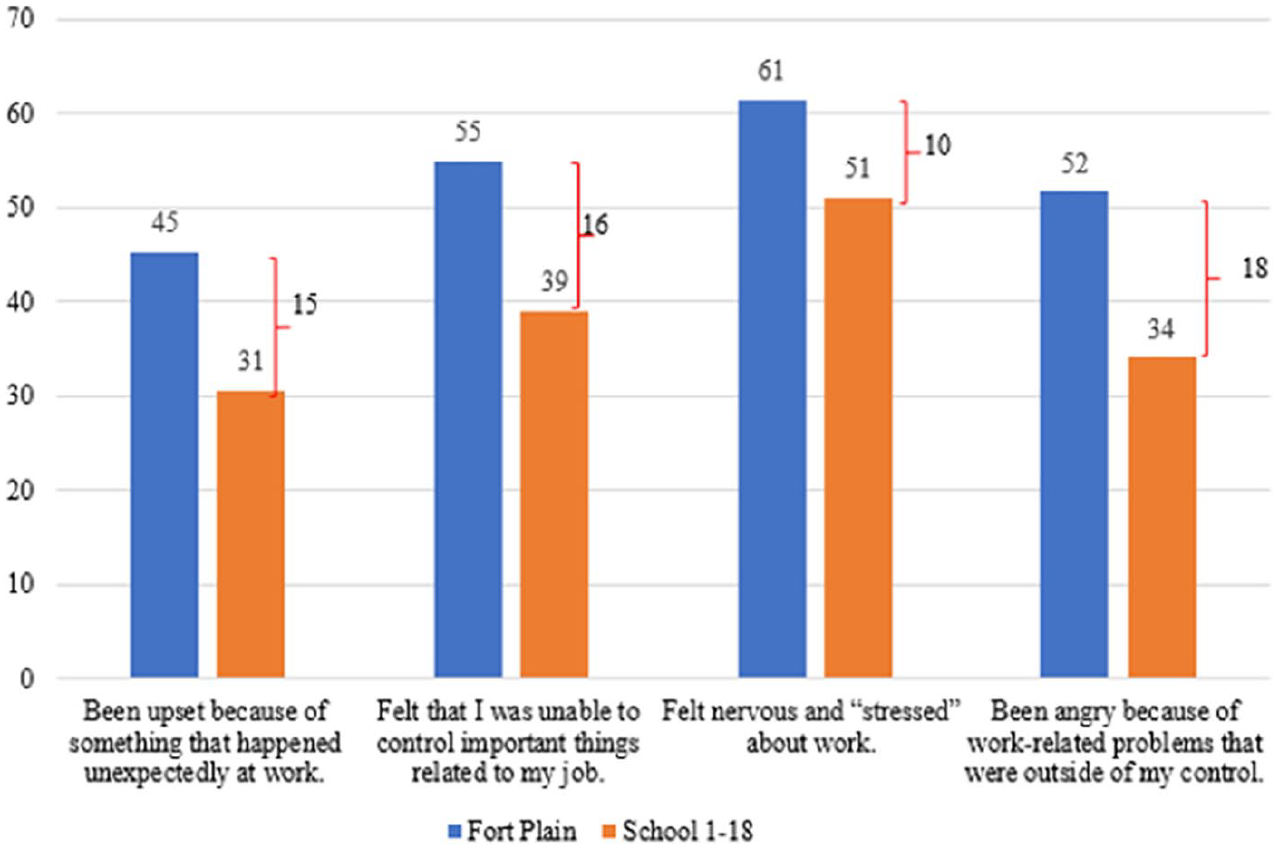
Comparison of teachers’ responses of “frequently” experiencing stress.
These data along with other data sources COMPASS team members had been collecting (e.g., student social emotional well-being surveys) were discussed in the COMPASS team meetings. From these data and discussions around them, the COMPASS team generated some initial ideas about what they wanted to do for the remainder of the school year. These are displayed in an initial theory of improvement in Figure 2. The team’s main concerns were engagement and well-being of students and teachers (notes in italics are those from the RPP facilitator).
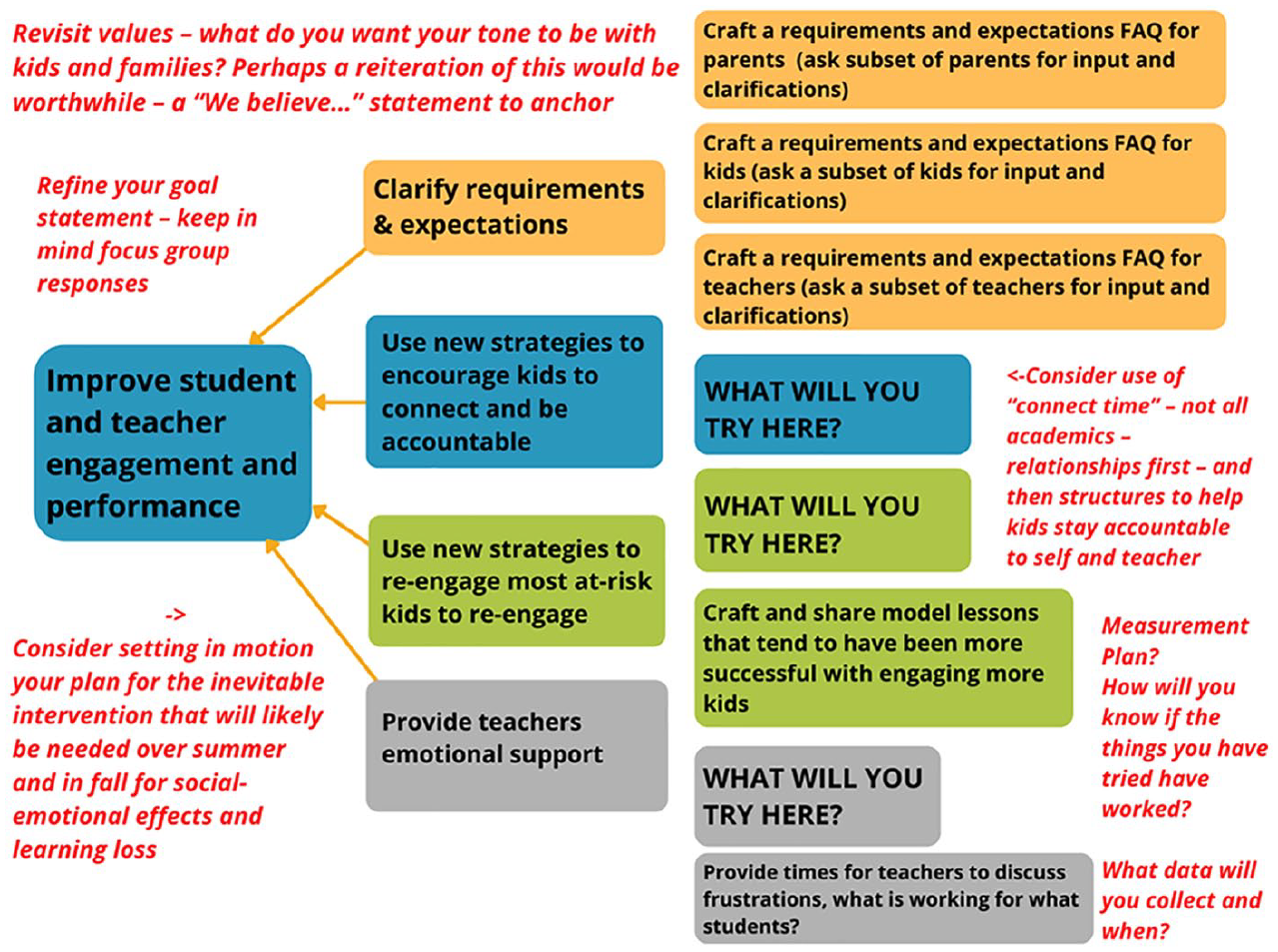
Initial theory of improvement (February 2021).
As the COMPASS team proceeded with trying some of their ideas including a “faculty feud” (fun game for staff) and compliment cards for kids, the RPP facilitators recommended the team continue to come back to improvement science principles in planning and doing their improvement work. Particular principles were highlighted: (a) being “user-centered” (i.e., focusing on how students and staff’s experiences would be improved and how) and (b) “problem-focused” (i.e., what exactly would be targeted in their efforts to engage and take care of each other), as well as attending to variability (Bryk et al., 2015). In response, the team decided that conducting focus groups with students, staff, and parents would be a good idea. The RPP facilitators and a BOCES coach developed focus group protocols and then conducted focus groups with students from 7th to 12th grades, 7th to 12th grade teaching staff, support staff, and parents.
In alignment with an improvement orientation, the RPP team looked to answer the following questions from the focus group data: What are the key problems to address? Who has been most affected? What systemic factors are affecting students, staff, and parents in variable ways?
Kids’ Voices
The focus groups revealed that kids’ connections to other kids had been affected by remote learning—particularly those kids who relied upon sports and other extracurriculars for interaction. This finding indicated a need for social emotional support and a carefully designed fall re-entry plan to reconnect them. As one student remarked, “After quarantining—my friends have changed. They’re not the same. We don’t hang out as much.”
The young people who participated in these focus groups also shared that they had needed to learn to engage with teachers and in their learning in different ways. In some cases, this built new self-regulation strategies and in others new avoidance tactics, and these were variable across grade levels. As one student noted regarding attendance and participation, “teachers understand who is trying to make an excuse and who has a legitimate reason for not getting work done.” The seventh- and eighth-grade students in particular found the monotony of logging on to their computers every day—the “every day the same thing” (as one student put it)—challenging their abilities to stay on task. At the same time, some students experienced unlearning some of the routine ways they had engaged in school pre-pandemic. This included unlearning the routine of getting up and out of the house every morning and then engaging in a relatively consistently structured school day. This too indicated a need for fall re-entry planning in terms of “how we do school” now. The unlearning routines and norms also indicated a need for adaptations for the use of virtual learning technologies going forward as some aspects of these technologies (e.g., the assignment tools in Google Classroom) were beneficial for some in terms of keeping on task and hitting deadlines.
Some students also indicated that they benefitted from being relieved of the social interaction challenges they faced pre-pandemic (e.g., those who had experienced bullying or were marginalized in some way), and still others benefitted from time available when they were not getting instruction in school on their remote days. They used this time to engage in other activities like work. As one student reported, “ With only four classes—I can leave school. I used to have to stay all day. Now I have an opportunity for a job.” Such opportunities indicated a need to consider what advantages remote instruction offered to some students and what might be adjusted or maintained going forward in light of these advantages.
Teachers’ Voices
Teachers across grade levels and of different content areas participated in focus groups as well and although there were some marked differences in their perspectives on students’ learning by grade level taught (with those in seventh and eighth grade of high concern) and by content area (greatest concern with math), they shared many similar views. They shared a sensitivity to being flexible with kids and keeping their senses of humor, yet at the same time holding kids accountable to keep learning: as one teacher joked, “True story. One of my students told me the other day, ‘My dog ate my Chrome Book.’” Teachers also shared concern for taking care of kids’ social and emotional well-being and a desire to integrate kids back into in-person instruction as quickly as possible for this reason above all.
One common and clear refrain from teachers was with regard to the “sheer mental exhaustion” of this care-taking role and having to prepare new ways of engaging kids as they continuously shifted from in-person to remote instruction. Another teacher remarked, “I can’t do this another year.” The instructional adaptations they were making to accommodate fully remote or hybrid learning were not always sitting well with their expectations for their own practice either, and this left some with a sense of unease. As an example of this widespread sentiment, one teacher admitted, I am cutting down on content and depth—to make sure they (students) understand the stuff they need for the Regents (state’s high stakes exit) exam—some would call it teaching to the test—I would call it survival at this point.
Parents’ Voices
Parents of children of different ages participated in the focus groups and overall shared the feeling that teachers had made the transition to remote learning “pretty seamless.” They also appreciated the newfound ability to see their children’s assignments and their progress in the online portal. As one parent remarked, “being able to see their assignments—I can say ‘. . . is this done?’ . . . is great.” These parents shared variable perspectives about whether their children had experienced, what some have referred to as, “learning loss” (e.g., Kuhfield & Tarasawa, 2020) and in what subjects. However, all shared concerns related to the lack of extracurriculars and sports and as one dad asserted, “physical activity relieves a lot of stress and anxiety.” Some parents also expressed concern for social integration issues with one parent expressing that bullying had become “absolutely terrible” for her child during the pandemic and most expressing a desire for leaders’ transparency about what they were doing to prepare for in-person learning in the fall of 2021.
As the team digested this information, they worked together with the RPP facilitators to generate a new theory of improvement as displayed in a revised driver diagram (see Figure 3). In this diagram, it is evident that the team had many creative change ideas and as the principal recounted, the tricky part for the team was to decide what to focus their attention on first and with what measures to assess their progress.
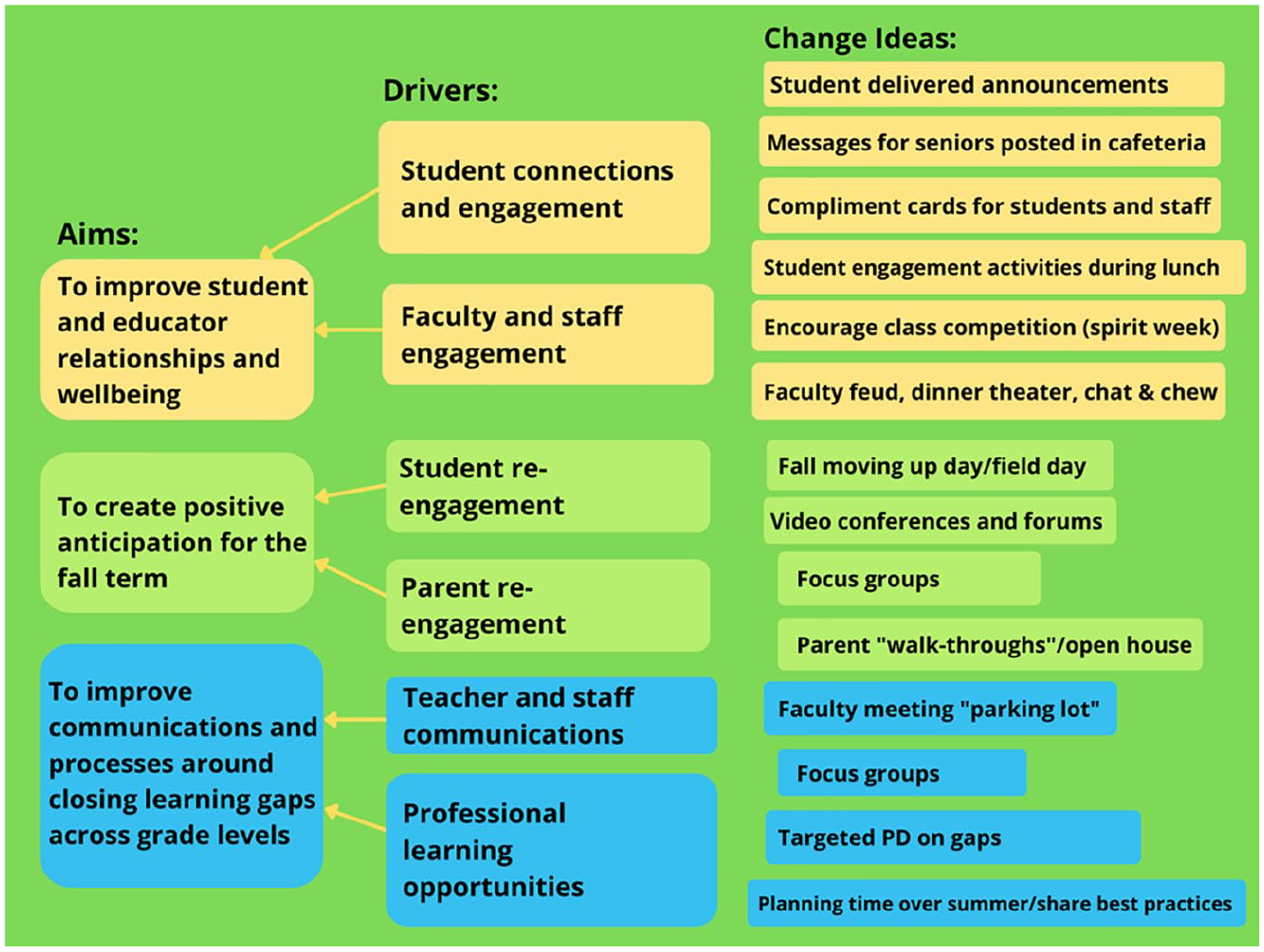
Revised theory of improvement (April 2021).
In summing up Fort Plain Jr.-Sr. HS’s improvement journey, the RPP provided tools (surveys and focus group protocols), strategies (theory of improvement mapping), and a support structure (co-facilitated meetings) during this particularly disruptive time to help the Jr.-Sr. HS principal and improvement team navigate challenges posed by the pandemic. Perhaps most importantly, the RPP worked with the COMPASS team to capture diverse perspectives in their improvement planning and directed the team’s attention to the cognitive, behavioral, and social-emotional and motivational aspects of children’s and educators’ experiences of the pandemic.
Conclusion
As we conclude this description of Fort Plain Jr.-Sr. HS’s journey through the pandemic, we note that the literature on improvement science (Bryk, 2020; Bryk et al., 2015) and performance adaptation (Baard et al., 2014) provide lenses through which leaders can approach understanding effects of disruptive events in their schools and communities. These literatures also point to the ways working with a RPP can assist them in their continuous improvement journey.
In relation to just two improvement science principles (e.g., focusing on variability and seeing the systems that produce outcomes), it was clear that sensitivity to different FPCSD “users’” (e.g., children’s, family members’, and staff’s) variable experiences of the pandemic was key to understanding what different people might need. In the Fort Plain Jr.-Sr. HS case, the COMPASS team along with support from the RPP facilitators sought to understand this variability through ongoing team discussions, focus groups with key stakeholders, and school-wide staff surveys. This information gave the COMPASS team opportunity to see problems from multiple perspectives and solidify their shared commitments to make high-leverage system-wide changes (see Figure 3) to meet the challenges the children in their care, parents, and staff were encountering.
Next, and in relation to performance adaptation theory, while it was notable that the improvement team’s work with the RPP generated a sense of hope, this did not diminish the real concerns staff were feeling about the future and their shared sense of “exhaustion.” In this regard, and in relation to performance adaptation theory’s attention to the relationships of affect/motivation, cognition, and behavior, Fort Plain like other schools in the RPP’s study of educators’ responses to the pandemic, was showing concerning signs of stress and job dissatisfaction predicting educator performance declines and even attrition (Rosenberg, 2010). Yet, to their benefit, Fort Plain drew upon its relationship with the RPP for support in navigating through the dynamic challenges their systems were not designed to tackle alone. This support gave them opportunity to pause and take account of multiple stakeholders’ experiences as they also drew from existing research and their own data to generate a shared theory of improvement. From there, the RPP and COMPASS team could develop a clear message about their plans to in turn galvanize other educators around shared aims with attendant affective and motivational benefits. Concurrently such collaboration promoted the cognitive and behavioral learning needed to tackle dynamic challenges and promote innovation in instruction and programming across their school.
In closing, at this writing, the RPP and the Jr.-Sr. HS COMPASS team has the pandemic response surveys, focus group data, and student social emotional well-being surveys from the spring of 2021 as baseline data to help them assess their progress toward their aims to improve students and educator relationships and well-being and create anticipation for the 2021–2022 school year. And as the 2021–2022 school year proceeds, they will draw upon a variety of change ideas and student academic and social emotional measures to orient their communications and adapt their staff professional learning programs and practices to close learning gaps. Although Fort Plain has faced many challenges in confronting the pandemic that are not unlike other rural schools around the United States and world, what is on the horizon for the school is context specific requiring the continued building of improvement infrastructure within their school and across networks like those the RPP provides.
Teaching Notes
This case can be situated in the improvement science and performance adaptation literature. One suggested book (recommendation Chapter 6 in particular) and one article to anchor the following discussion in this literature are Bryk (2020) and Baard et al. (2014), respectively. Also recommended for teacher and leader preparation is Perry et al. (2018).
Discussion Prompts
Consider what FPCSD’s experience of the pandemic tells us about leading through disruption—what do school and district leaders need to know and be able to do to support frontline staff?
Consider how the RPP worked to mitigate the negative consequences of disruptions in FPCSD—what insight does this example offer in terms of connecting research and practice in partnerships with other organizations?
How does the rural context pose particular facilitators and challenges for school and district leaders attempting to maintain improvement work during disruptions? What resources can a rural school or district leader leverage to navigate disruptive events?
Footnotes
Acknowledgements
This work would not be possible without the leadership of principal Deborah Larrabee and the Fort Plain Jr. Sr. High School COMPASS team.
Declaration of Conflicting Interests
The author(s) declared no potential conflicts of interest with respect to the research, authorship, and/or publication of this article.
Funding
The author(s) received no financial support for the research, authorship, and/or publication of this article.

ERIC Descriptors
school improvement, leadership, rural school