







Abstract
This case was specifically written for practicing school leaders, as well as educational leadership preparation programs, to help create a nuanced conversation about how to decenter whiteness in the practices and policies of rural schools in the United States. The work is challenging, particularly given how race is baked into social institutions throughout the United States, including but not limited to financial, health care, and education systems. Educators reading this case should examine the historic factors that contribute to a racialized rural United States, as well as what can be done within rural education systems to help decenter whiteness.
Case Narrative
Summit High is a public school building supporting 450 students in a Northern rural state. It is the only high school in the town of Summit, and the demographics mirror that of the school district, which is 95% White. The Northern rural state where Summit is located is also one of the whitest in the United States. The population of Summit is roughly 6,000 citizens, and it is one of many other towns and small cities that coalesce around each other that comprise a population hub in the area. There are four of these population hubs throughout the state that function as service centers for health, education, and economic development. In total, the population hub that Summit sits in is roughly 125,000 people, which is about 9% of the total state population. The rest of the state is mostly defined as rural by the National Center for Education Statistics (NCES), which is one of the most rural in the United States, with some of the least populated tracts of land east of the Mississippi. In these rural areas, there is great economic division, with pockets of immense wealth in and around bodies of water that house the social elite of the state and those who come to vacation in the summer months, as well as pockets of immense poverty defined by intergenerational trauma, opioid drug use disorder, and alcoholism.
Summit High has a rich history of school pride, with particular success in athletics. However, the community has changed drastically in the last three decades. The impact of globalization was felt strongly in the mid-1990s when the paper mill company left the community, leaving behind a gigantic economic crater that was never filled. With the vacancy of manufacturing jobs, many parents and students went from a middle-class existence to living in poverty conditions within months. During this time, Summit has experienced the phenomenon of “brain drain,” where students choose not to come back to Summit because of a lack of economic, social, and cultural opportunities.
As many of Summit’s citizens have moved away, Summit High School has tried to remain a source of pride for the town. The football team, a perennial powerhouse in Class III schools, helps bring the community together on Friday nights, regularly drawing a one third of the town to the well-kept field. Teachers who deeply care about the school and Summit continue to promote a sense of community, putting on small theater productions and maintaining a well-funded music program. While it is small and suffering financially, there is a sense of community that is missing from many larger schools and school districts. Here people care for one another. There are traditions. Roots run deep. And together, even if life is tough, a group of people eke out an existence, surviving the long cold winters by banding together and taking on a world that had been less than kind as the effects of a globalized economy continue to erode what was once a strong and vibrant establishment.
Summit High Welcomes Mr. Emmit
Nate Emmit, the principal of Summit High, was hired 3 years ago and came into the Summit School District from another district in the state. Nate was someone who knew the challenges of Summit but also had experiences in other parts of the country that helped him think differently about school leadership. He had grown up in a small, mostly White, Northern rural community like Summit and knew the economic and social challenges facing rural communities that had lost large economic bases due to globalization. A White male himself, Nate also considered himself lucky to have lived in several other states in the United States where he had worked in diverse communities and with historically marginalized groups. Prior to moving to Summit, he had worked in the Midwest, the Mountain West, and South, where he had gained experiences working with Black, Brown, and Indigenous students and parents. These experiences as an educator made a profound impact on him, and during that time, he was exposed to various professional development (PD) efforts that helped him question his own power and privilege as it relates to whiteness. He had been able to use these learning experiences to help him think differently about how schools contribute to the oppression of historically marginalized groups, and in many ways, it gave him a perspective that his counterparts at Summit High just did not have—and he considered that an advantage as he moved back North.
When he was hired at Summit, Nate focused on building strong relationships with the Summit High staff. He worked hard to develop peer feedback structures that engaged the faculty in discussing pedagogical practices, something that had never been done previously at Summit. He also helped lead Professional Learning Community (PLC) discussions about how to leverage more community resources to address the needs of high school students, which resulted in more career and technical internships, as well as social-emotional supports that were brought in from the community and incorporated into the daily school schedule. Perhaps most importantly, Nate created monthly “hot stoves” where a group of dedicated educators brought parents and teachers together, served food, and had open conversations about what could be done to make Summit a more attractive community for young people to stay—not contributing to the “brain drain” phenomenon but somehow pivoting to a “brain remain” reality. Although he was seen as “from away”—a social capital reference to someone who was not born in the Northern state and thus always perceived as an outsider—Nate was well-liked by students and parents, but especially by teachers. He understood them. He knew them. And he knew how to navigate the often conservative nature of Summit local politics but also plant the seeds of more progressive ideas and action. In short, he gave teachers hope for the future and even a revitalized Summit High.
Over the course of his 3 years, Nate Emmit had experienced a tremendous amount of success. Although Summit represented fairly strong libertarian political ideologies—it sat on the edge of a congressional district that was increasingly conservative and had voted for Trump in both the 2016 and 2020 presidential elections—Nate had managed to maintain what he thought was a progressive leadership style for the area. Through his hot stove meetings with the community, he had persuaded the town to accept a mandatory mask policy that helped keep students in school with minimal disruptions to learning and work schedules due to COVID-19. The social-emotional support structures he brought in attracted the attention of a small liberal arts college who, with the agreement of the community, was now studying the efforts and presenting the promising preliminary findings at national educational conferences. He had even been successful in helping spearhead a political campaign to increase the school district tax levy, which passed by a 70% margin and was the first time a levy had been approved since the local paper mill shut down and left the country.
One thing he had not been able to do, however, is help Summit talk more about issues of race. Whenever he tried having these conversations in smaller groups, either with teachers or within the community, he got blank stares. He noticed that while the community liked to pride itself on being tight knit—insular, even—he rarely saw parents of color existing in the spaces created by Summit High School. Not only did people not know how to talk about race, but they appeared unable to tolerate questions about the lack of diversity, which seemed highly visible to Nate at sporting events and potluck suppers. It gave him the sense of a “pseudocommunity,” something he had learned about in his time working in the Midwest.
Thinking back to the PD he had taken part in prior to coming to Summit on how whiteness gave him power and privilege in the United States, he reflected on how it helped him to think about education vastly differently. Perhaps the most profound takeaway was, prior to becoming an educator, he had not been taught how to question systems of oppression or to be more aware of the suffering of historically marginalized people in the United States. However, even though Nate had the opportunity to work with Black, Brown, and Indigenous students and families prior to coming to Summit, and even though he had received much more PD to help him question his own power and privilege as it relates to whiteness than his Summit counterparts, he still had limited experience in leading other educators to question, examine, and critique their own sociocultural identities. What resulted was an individual level of awareness for Nate, specifically his own increased awareness about how whiteness replicates itself in social structures such as the education system, as well as a moderate amount of awareness for culturally responsive teaching practices. And, as much as he understood the need to address his own feelings about power and privilege from his whiteness, he had little experience leading other educators in this realm, and certainly not in a predominantly White school or community.
By and large, many of the White middle-class Summit teachers had been able to ignore issues of race and class most of their respective lives, and Nate knew this was an issue. Summit High, which, while not completely White, only had 13 students (3%) identify as Native American and 9 students (2%) identify as Black. For the rest of the Summit community, whiteness just seemed normal. Nate knew it was a problem to address, and even if Summit struggled to engage in issues of race in their mostly White community, he thought he was the leader who would be able to change that reality. After all, how difficult could it be to just talk about race in White, rural America?
Responding to a Racialized Reality
Prior to going into his fourth year as principal, Nate Emmit spent the whole summer planning PD efforts for Summit High. Using the results of an equity audit that an outside consulting firm conducted the previous spring semester, Nate started pooling PD resources to address the findings of the report that confirmed what Nate was concerned might be true. The equity audit found lower achievement for students of color, statistically significant lower achievement and attendance rates for those receiving free and reduced-price lunch, a graduation rate for all students as well as for students of color that was lower than the national average, and a curriculum that included almost no literary or social studies materials that addressed the perspectives and lived experiences of historically marginalized groups in the United States.
In addition, Nate had recently started an EdD in educational leadership program that summer that asked students to pick a problem of practice to address an issue of inequity that would lead to changes in practices and policies. Everything he had learned from the equity audit seemed to be a natural fit for him to explore further and begin to address immediately. Based on the initial EdD coursework, specifically the work of Mansfield (2014), Lac and Mansfield (2017), Forman et al. (2021), Wright (2022), and Stanley and Gilzene (2022) to use student and community voices to disrupt inequity perpetuated by whiteness, he decided he would invite Summit High students of color to take part in focus groups to learn more about their lived experiences and what could be done to make Summit a more inviting and inclusive community. His EdD program helped make it clear that socially just educational leaders need to include student voices in their practice, specifically how student voice is either privileged or silenced. He even began to share some of what he was assigned to read in his EdD coursework with teachers who he thought would be open to thinking more critically about education at Summit High, which included concepts such as culturally relevant leadership, culturally responsive literacy, and decentering whiteness in education. If he were to become a scholarly-practitioner like his program suggested, he would need to figure out how to bridge the gap between theory and practice that would ultimately lead to more equitable outcomes for students in Summit.
As the school year started once again in the fall, Nate asked students who identified as Black, Brown, or Indigenous to take part in focus groups to hear more about their lived experiences at Summit High. With the permission of their parents, he spoke with them and asked them what they thought about the education they were receiving. At first, the focus groups would begin with a minute or so of uncomfortable silence and looking around, but inevitably one of the students would open up and share. At one focus group a student shared, “Everything we learn about is from the perspective of White people—the only books I’ve read by authors of color have come from suggestions from my parents.” At each of the focus groups, other students shared similar details of everyday occurrences, including White students “jokingly” using the n-word, refusing to call the holiday Indigenous People’s Day and still calling it Columbus Day, and no one questioning why the school calendar was built only around Christian holidays and there not being any acknowledgment whatsoever of Muslim or Jewish holidays. Perhaps most poignant was when one particularly quiet student spoke up and said,
Mr. Emmit, why is it that every year we watch 9/11 videos where thousands of people die at the World Trade Center, but we were not allowed to watch the first woman and woman of color be inaugurated in the White House because of the fears of white supremacists threatening violence or because it would piss of conservative White people? If I am forced to watch 9/11 videos where we know thousands of people died, isn’t that more traumatic than the potential for violence watching the first woman of color be sworn into the Oval Office?
At the end of each focus group, Nate thanked the students for attending. He also made sure to share with them that he was genuinely sorry for their experience and would do better to make sure they felt more represented at Summit High. Using this information, Nate set out to align PD in his school for the rest of the year with his EdD coursework. He would provide PD for culturally responsive teaching (Gay, 2018), set up a book study with the administrative team and read Culturally Responsive School Leadership (Khalifa, 2018), and be much more vocal about ensuring equity-focused practices were relevant in his school building (Radd et al., 2021). Given the equity audit by the outside consulting firm, as well as what the focus groups of students who come from historically marginalized communities told him, Nate was sure he would be able to show his staff how the school was part of a system of oppression.
Decentering Whiteness or Defiant Protection of Privilege?
It was at the October faculty meeting that Mr. Emmit officially began speaking publicly about his plan to address how he would help lead the effort to decenter whiteness at Summit High. He opened with his experience working with historically marginalized students in other parts of the country, and while there was less diversity at Summit it was no less important to address how schools historically have provided Eurocentric curricula that led to the disenfranchisement of students of color. Nate also shared what he heard from the focus groups he had conducted with Summit High students who identified as Black, Brown, or Indigenous, stating that even if one student feels marginalized because of how Summit approached instruction, that was one too many. When he asked for input from the faculty, most of the teachers agreed there was a need to address these concerns. Some were visibly shook and embarrassed that they had never considered how their approach to teaching might lack cultural sensitivity. Nate went on to share the results of the equity audit report and gave an overview of the interventions he was suggesting to the faculty, including anti-racism training and the creation of a new committee that would look at diversity, equity, and inclusion PD that would help address implicit biases. When Mr. Emmit asked if the faculty would support these efforts, several teacher leaders spoke up and provided their support for these efforts moving forward. No one voiced any opposition. Given the focus of the conversation, no one seemed to see Mr. Harrison, the U.S. History teacher, recording the conversation in the back of the room on his tablet.
Nate went home feeling like he had really accomplished something. He had begun the process of helping his faculty discuss the lived experiences of students of color in his school and had gone beyond just talking about addressing inequities to putting a plan of action into motion. And, he was beginning to do real work, addressing a problem of practice that would change the policies and practices of the school he helped lead. He was, in his mind, being a scholarly-practitioner, and he was proud of himself.
Two days later, Nate received a text message from his superintendent that simply read, “I need to speak with you now.” When he called the central office, Nate was flabbergasted with what he heard. The entire faculty meeting had been posted online, with over 100 comments from what mostly seemed like Summit High parents. In the comments, parents accused Summit High, but more often than not Nate Emmit, of demanding teachers use Critical Race Theory that would teach White students to hate themselves and their country. Others called out the school for being racist against White people and for contributing to reverse racism and deepening racial division in the United States. Nate’s superintendent was not pleased and shared he should not have been blindsided by this effort, stating Nate should have gotten his approval before covering such contentious PD at a faculty meeting. At the end of the call, the superintendent told him to get his house in order and to figure out who recorded the meeting, as well as start to figure out how to make this right with the community.
The issue, however, did not go away. Two seats on the school board were open, and with the November election around the corner, the controversy took off. One person running for the school board contacted the host of a news show from one of the national conservative news networks, setting off a firestorm of coverage that landed Nate and Summit High at the center of the conflict. Over the course of the next couple weeks, the conflict only seemed to create deeper division and polarization among Summit faculty, staff, and citizens. The students Nate had spoken with about their experiences of marginalization confided in him they felt uncomfortable. One told him he felt betrayed by Mr. Emmit and had received threats from kids at Summit High who were tired of being labeled racists. The Summit High staff were also incredibly fractured from the national news media coverage. Some were more energized than ever to decenter whiteness at Summit High and be “equity warriors” as they called themselves and, at times, that label was used by others to mock them. Some were part of the “silent majority” who had not spoken up at the faculty meeting and who had a mix of emotions—anger, confusion, guilt, anxiety—about waking up white and realizing their perspective was not the only one that mattered when considering how to best teach a diverse student population in the United States. The rest of the Summit High faculty were just embarrassed by all the attention, at the local level, with coverage across the state, and at the national level.
Nate Emmit, who was attempting to address a problem of practice through his EdD coursework, felt overwhelmed, scared, and distraught. He knew what he was doing was right—To decenter whiteness at Summit High, or any school in the United States, was the ultimate work if the United States would ever have equitable outcomes for all students. That said, he was not prepared for the community to have such a difficult time addressing race. He had navigated libertarian politics before, helped a community that had voted for Trump twice address issues that were politically contentious, and had avoided disruptive issues around mandatory masking policies to help keep kids in school throughout the COVID-19 pandemic. He had even convinced the community to increase their tax levy to provide greater funding to their community. Why was it, then, so difficult to address issues of race in the United States and to support students who felt marginalized by the education system? And, with the impending school board election in just a few weeks, how would he be able to lead his school in the efforts to decenter whiteness with such a vocal opposition to addressing race in the rural United States?
Teaching Notes: Education in the Rural United States, a Racialized Society Built on the Racial Contract, and Efforts to Decenter Whiteness
Education in rural areas of the United States is often characterized in popular media and literature, and as such people often have preconceived notions about what they think when they hear the term “rural schools” (Gallo, 2020). Frequently stereotyped as poor, rural schools and the students they serve lack a variety of resources, suffer from spatial isolation, and lack cultural capital. As such, rural education in the United States is nuanced in terms of lived experiences of students, parents, teachers, and community stakeholders, and increasingly deserves greater attention, particularly as the country continues to experience racial and ethnic diversification (Biddle & Mette, 2017). The NCES highlights 28% of all schools in the United States are classified as rural (Klar & Huggins, 2020). Of those that are classified as rural, racial distributions are categorized as 72.4% White, 12.2% Hispanic, 9.3% Black, 1.6% Asian/Pacific Islander, 2.1% Native American, and 2.4% two or more races (NCES, 2013). Neoliberalism and globalization have greatly impacted school age populations in rural areas, causing huge economic and demographic shifts as populations decrease with the departure of manufacturing jobs (Argent, 2016), as well as an influx of people with school age children to more rural areas as a new wave of people leave urban areas to escape rising home costs, increased cost of living, and to have greater access to outdoor activities (Popken, 2020).
Sometimes referred to as the “rural problem” (Tieken, 2014), rural communities and their school systems are often described as backward and are isolated from accessing cultural experiences readily available in urban areas. Places like Summit are often considered “fly over” country—eroded by economic decline and outmigration of educated people—that often is populated by vulnerable populations that lack social, economic, and cultural capital (Tickamyer et al., 2017). Lack of access to resources in rural areas leads to underqualified child care prior to prekindergarten, as well as greater exposure to “childhood trauma, abuse, and neglect” than children living in communities defined as town, suburban, or city by NCES locale codes (McHenry-Sorber, 2019, p. 63). Pop culture references to the rural U.S. existence most recently have included Dopesick (Levinson, 2020) and Jacinta (Earnshaw et al., 2021), which explores intergenerational trauma, crime, and opioid use disorder. Further complicating rural poverty are the racial inequities that exist in rural areas in the United States, with rural people of color experiencing rates of poverty several times higher than that of their rural White counterparts (Harvey, 2017).
Given these economic and racial issues, there are additional professional challenges rural educators face, including lack of instructional resources, high turnover among educational professionals, lack of work–life balance, and personal and professional isolation (Oyen & Schweinle, 2021; Pendola & Fuller, 2018). While there is evidence to suggest rural areas that are closer in proximity to urban areas have better economic development than more remote rural areas (Johnson, 2017), understanding the role spatiality plays in rural educational outcomes is critical. Additionally, there are social and racial implications that need to be more closely studied and analyzed within rural communities and how rural school systems tend to ignore the historic oppression of marginalized groups throughout the US.
Many rural U.S. communities, specifically those that are predominantly White and spatially isolated from cultural capital that is concentrated in cities, can often be identified or labeled as harboring white nationalism. They lack the benefit of racial and ethnic diversity, which increasingly can be explored through geographic representations to help examine communities that are spatially and racially isolated (Mann et al., 2021), particularly what that means for rural identities (see Figure 1). As such, there is a need to more closely study how turbulent narratives in predominantly White, rural communities reinforce identities that are in direct opposition to racial diversity and that simultaneously create narratives about whiteness that are “mute, meaningless, unfathomable, point-less, frozen, veiled, curtained, dreaded, senseless, implacable” (Morrison, 1992, p. 59). As such, racial segregation is both spatial and psychological, impacting the way White people in the United States view dividing lines that impact perspectives on geography, political ideology, and society (Feagin, 2020). This in turn influences the narratives White people perpetuate regarding racial progress, which assumes a singular history about U.S. racial equality, specifically the narratives supported by many White U.S. citizens (Kendi, 2017).
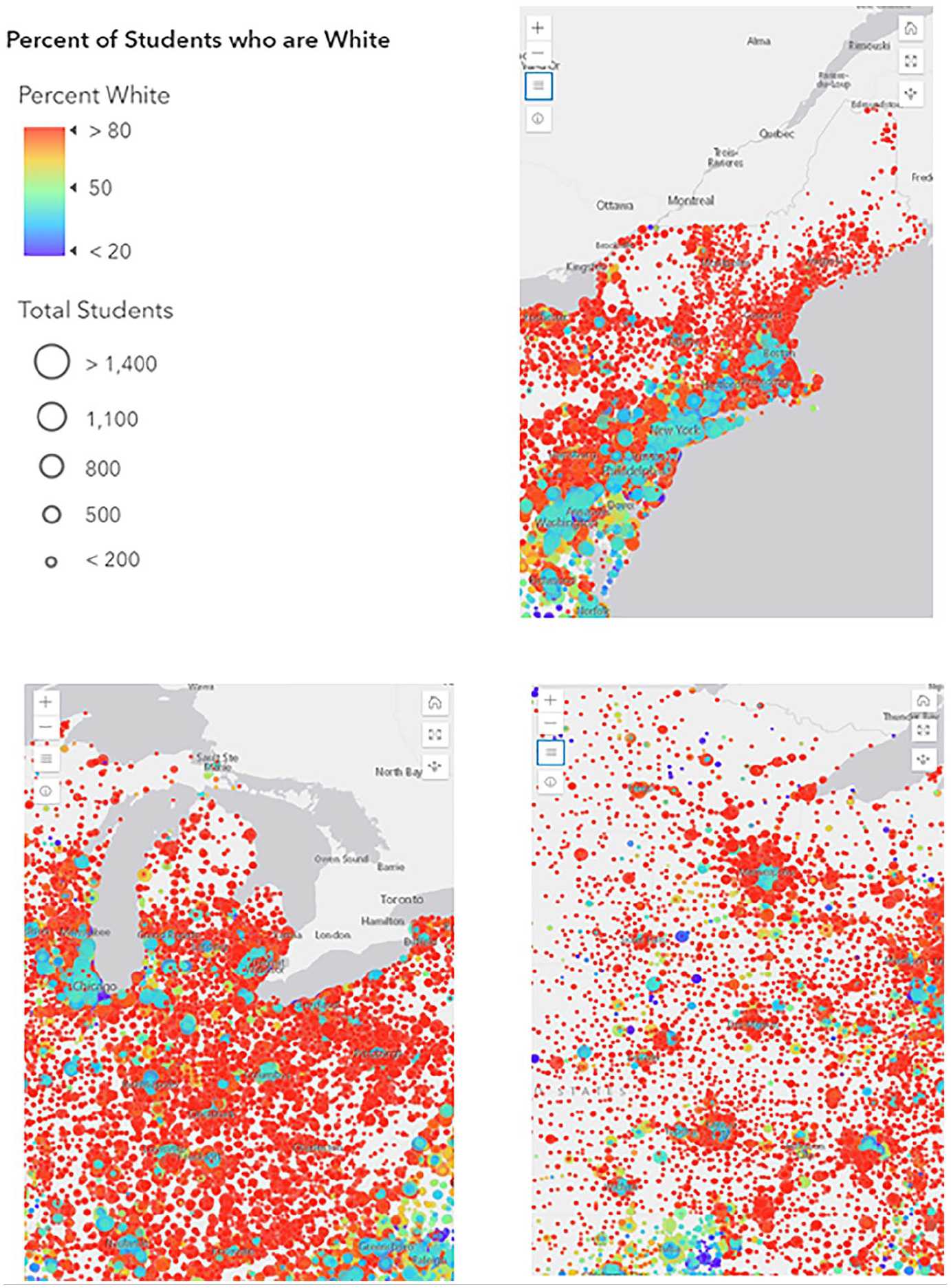
Geographies of Education (from https://geographyedu.org/) (Mann et al., 2021).
On one hand, rural communities are economically deprived. They are seen as in-between space that lacks cultural capital and reinforces the message to young rural youth that it is better to learn to leave for an urban area than it is to stay in the void of rural America (Corbett, 2007). They are also the grounds that have historically been used for resource extraction that benefit the development of cities (England & Brown, 2003) and they have directly felt the economic impact of globalization that further contributed to economic decline when manufacturing companies in the United States left for cheaper global labor. On the other hand, however, they are part of the interactive force that keeps racial segregation concentrated in cities, including Black populations in cities outside of the rural South (Mills, 1997), and they have also contributed to white supremacy through historic colonization initially in the Eastern Seaboard and continuing through westward expansion (Battiste, 2013). As such, whiteness as a system is often expressed and reinforced in predominantly White rural communities in terms of normalizing whiteness as we see social and political systems today in the modern United States, and therefore deserves much closer study to understand how these forces impact rural education systems throughout the United States, as well as what must be done, in practice and through educational policy, to deconstruct these narratives. Examples of white anger or white resistance in the Summit case are abundant in rural areas of the United States—and developing education systems that can counter these racialized responses is pivotal to moving the U.S. society forward.
A Racialized United States Built on the Racial Contract
To unpack whiteness as a social construct, and more importantly to help educators, particularly White educators, wrestle with the history and construct of race in the United States, requires a framework that can help White people see how whiteness is perpetuated through various systems of oppression. One notable theory is what Mills (1997) calls “the racial contract,” which prevents White people from acknowledging or even being (sub)consciously aware of the role of race in the United States. Menakem (2017) uses this idea as the basis for understanding race as a social construct, which has its birthplace in the United States as well as the Caribbean. It was during the mid-1600s that the foundation of the racial contract (Mills, 1997) emerges as a social construct, where powerful White landowners distributed small parcels of land, as well as voting rights, in exchange for less privileged White people to serve as plantation managers of enslaved Black people. Not only did this create a buffer between ultra-powerful White people and enslaved Black people, but it also created a caste system that required less-powerful White people to manage their fear of more powerful White people by contributing to the violent control system of Black and Brown people to give themselves a position in the hierarchy of whiteness (Painter, 2010; Wilkerson, 2020).
Whiteness has largely been based on the demarcation of freedom—freedom to own land, freedom to vote, and freedom to demarcate visual (racial) differences between who is White and who is “off-White” as a basis for enslavement, and what can be exchanged to become part of white America (Roediger, 2018). What the racial contract affords White people is a system that suggests it is easier to support whiteness (and avoid incredible suffering and trauma) by shifting pain and suffering toward Black, Brown, and Indigenous people and away from White people, even poor ones (Menakem, 2017). By developing a hierarchy, White people benefit from, and consequently hold onto, whiteness because of the fear of what a system might do to them if they do not hold up their end of the racial contract. The fear of being a race traitor (Mills, 1997) prevents alliances between poor White people and poor people of color from concretizing into formal political coalitions, as suggested by Fred Hampton and other Civil Rights activists in the 1960s (Hampton, 1969). White flight out of urban hubs and into the suburbs in the United States have helped to inoculate racial segregation and solidify the U.S. racial caste system that continues to disadvantage people of color based on the inequitable distribution of resources. Spatial segregation has also contributed to more nuanced forms of whiteness that have expanded de facto segregation based on school boundaries, the expansion of the prison industrial complex and the school to prison pipeline, and increased documentation of police brutality on Black and Brown people (Bell, 1992; Rothstein, 2017).
If a true democracy is to be attained, one where Black, Brown, and Indigenous people are to be seen as welcomed contributors to the system—not one where the “American Dream” is perpetuated—there will need to be “a radical moral imagination” (Laymon, 2018, p. 238) where white society in the United States finally learns to shed whiteness, white supremacy, and contributes to the liberation of all children—Black, Brown, Indigenous, and White—from our history of violence, oppression, and anti-Blackness. As such, the challenge is for school leaders, specifically White school leaders who benefit from whiteness but rarely understand it, to acknowledge the racial contract the United States is built upon (Mills, 1997). However, there can often be a struggle for school leaders of any race or identity who have found themselves bound by and perpetuating a system of oppression (Khalifa, 2018) to become intentional and vigilant about how our schools implement policies and practices in PK–12 schools, as well as make democratic decisions in and on behalf of historically marginalized communities (Watson & Miles Nash, 2021).
One way to increase the implementation of democratic input is to increase student and community voice in educational leadership decisions. There is a wide variety of literature supporting the inclusion and centering of student voice (Lac & Mansfield, 2017; Mansfield, 2014), and increasingly there is evidence to suggest community engagement and voice improves outcomes for students who come from historically marginalized groups (Stanley & Gilzene, 2022). Educational leaders seeking to increase student voice, particularly students who identify as Black, Brown, or Indigenous, are more able to critique the traditionally privileged norms and ideologies of White, Eurocentric leadership paradigms (Wright, 2022). Educational leadership approaches like this not only improve the well-being of historically marginalized students, but they also help address more race conscious approaches to teachers who may be resistant to acknowledging how whiteness privileges them in their approaches to teaching. If the United States is ever able to truly democratize itself, it will likely need to come from educators who are able to address our racialized society head-on, discuss whiteness in our systems, reject ahistorical assumptions about education in the United States, and use these reflections to drive improvement efforts to ensure our schools liberate, heal, and reimagine.
Efforts to Decenter Whiteness
Theoretically, it should not be difficult to talk about race in White, rural America; however, it has proven to be a divisive issue and a politically polarizing topic in the early 21st century (Meckler & Nathanson, 2021). In places that are spatially and racially isolated, many White students, parents, and educators lack frameworks to question how systems of oppression are created based on race and how these systems perpetuate the suffering of historically marginalized people in the United States. One reason is that in rural places in the United States that are predominantly White, there is a lack of diverse racial representation for people to consider and observe firsthand—in other words, many people in these predominantly White spaces do not have to look for, or do not know how to look for, how systems of oppression are perpetuated along racial lines (DiAngelo, 2018). A second reason is that in these spatially and racially isolated areas, many predominantly White communities are struggling with issues of intergenerational trauma and poverty, increasingly noted in media as struggling with decades of opioid drug use disorder (Showers et al., 2021). As such, it is difficult for these communities and education systems to decenter whiteness because of the lack of paradigms to consider an existence outside of whiteness, as well as the inability to conceptualize beyond their own economic and social hardships that define their existence.
The resistance of decentering whiteness in predominantly White rural communities can be related to the idea of interest convergence (Bell, 1980). In a place like Summit, interests in the name of all students, namely those of White students who comprise a majority of the student body, were advanced by mandatory mask policies that kept students in-person for instruction during the pandemic, increased access to social-emotional support structures, and included financial levers that increased funding to ensure high-quality instruction and extracurricular programming was maintained. However, without intentional planning and structures, whiteness can often be recentered through improvement efforts (Gooden & Dantley, 2012), particularly when White people are asked to accept and identify their privilege in the United States based on race, as well as the variety of emotions that come with these reflections on whiteness, including anger, confusion, guilt, and anxiety.
Even with the use of equity audits—reports that provide robust feedback about how a school is and is not providing equitable outcomes for all students—school systems often struggle to decenter whiteness in practices, policies, and outcomes. These struggles include efforts to decolonize curricula (Battiste, 2013), deconstruct supposed “race neutral” policies (Watson & Miles Nash, 2021), and engage in achievement gap conversations that perpetuate deficit views about race and achievement. Despite efforts to address diversity, equity, and inclusion, many of these efforts stall when educators struggle to address their own implicit biases. There are also a wide array of examples highlighting how communities and states are actively preventing conversations about race, passing legislation or local ordinance that prevent discussion of anti-racist efforts or Critical Race Theory (Schwartz, 2021). Not only do these actions prevent a decentering of whiteness, but they recenter the needs of whiteness within education systems and contribute to the notion of education being a system of oppression (Mealy, 2020).
Discussion Questions and Teaching Activities
Using the Summit case, as well as the theoretical frameworks that help examine the case, consider the following discussion questions and teaching activities to engage in a deeper conversation about decentering whiteness in socially and politically charged environments. Current school leaders, as well as aspiring school leaders in preparation programs and teacher leaders in buildings, can use this case to critique the racial, social, political, spatial, and economic factors that create challenges for rural education systems in the United States to decenter whiteness in policy and practice. Suggested readings are provided to give additional resources for teachers, principals, central office administrators, and community members to more deeply consider how whiteness exists, and is often unnoticed, in predominantly White rural communities.
Discussion Questions
Given the geospatial context of the Summit community, how might school leaders help predominantly rural White communities address turbulent narratives about whiteness and opposition to decentering whiteness? How do race and spatiality impact these discussions? What process might a school leader want to consider when engaging faculty members, students, and community members in this work?
Considering the phenomenon of brain drain, where the brightest leave rural areas for cities that offer a greater concentration of economic, social, and cultural capital, how might the narrative of rural versus urban be reframed? For rural communities suffering from spatial and racial isolation, what happens on a social level when rural communities experience outmigration of well-educated students? What implications does this have for not only rural areas of the United States, but also the geopolitical impacts when considering state statues and laws that actively prevent the teaching of anti-racist concepts?
How might Summit school leaders reengage with a politically charged environment and help teachers and students engage in the idea of acknowledging whiteness? How might school leaders help teachers and community members move beyond feelings of anger, confusion, guilt, and anxiety? Specifically, what type of structures and supports must be considered and planned for before implementing efforts to decenter whiteness in a school system or building?
Reflect on the inclusion (or lack of) student and parent voice in Mr. Emmit’s efforts to decenter whiteness at Summit High. On one hand, he tried to create a safe space for students of color to share their lived experiences. On the other hand, he knew that parents of color were disengaged from Summit High community, creating something Grossman et al. (2001) labeled as a “pseudocommunity.” How might Mr. Emmit have sought to more deeply understand the problems students of color encountered? How might he have advocated for greater student voice to address their concerns (Lac & Mansfield, 2017)? How could Mr. Emmit have sought to more deeply understand the lived experiences of parents of color (Stanley & Gilzene, 2022)? How could he use voices of parents of color to help Summit begin the process of moving away from a “pseudocommunity?”
Consider the actions of Mr. Emmit in his efforts to decenter whiteness at Summit High School, which many would label as naive or at the very least lacking understanding of the complex leadership endeavor he attempted to implement. How might an educational leader like Mr. Emmit better prepare himself to address the possible changes that would need to occur while leading a community that is predominantly White? Why is it important for a leader to recognize how whiteness operates on many levels, including but not limited to the community, the student body, the teaching faculty, and within Mr. Emmit himself? How might he need to prepare for the possible backlash to his efforts, both politically and socially, given the notion of “the racial contract” (Mills, 1997)? Specifically, what can an educational leader do within the context of a predominantly White community, to move educators beyond the response of “feeling bad” for being White or maintaining a sense of whiteness that is inherently “good” and “innocent?”
Despite the naivete that Mr. Emmit might have shown in the Summit High case, this should not mean that leaders do not engage in work to decenter whiteness in schools. Given this reality, what can be done in predominantly White schools (rural or not) to cultivate “a radical moral imagination” (Laymon, 2018, p. 238)? How and in what ways might educational leaders cultivate interdependence to help students, teachers, parents, and community members acknowledge systemic racism? How might educational leaders who exist in spatially isolated areas move away from false binaries of whiteness (e.g., us vs. them; awakening vs. resistant; embarrassment vs. ignorant; etc.) to help reimagine predominantly White rural communities to be more acceptant of racial diversity?
Teaching Activities
The role of a rural principal to address whiteness
In small groups, educators should discuss the impact spatial and racial isolation has on rural education communities in the United States. Using the Geographies of Education website (https://geographyedu.org/) developed by Mann et al. (2021), educators should use the interactive maps to discuss two conflicting ideas that are related to spatial and racial isolation. In this discussion, educators should consider how on one hand many young people in these rural communities leave for more populated areas and contribute to “brain drain,” particularly in rural areas that are economically deprived and have historically been used as resource extraction for urban gain. On the other hand, educators should consider how patterns of migration have historic roots, particularly how whiteness has been used to keep racial segregation concentrated in cities, especially Black populations outside of the rural South. To unpack these concepts more deeply, it is suggested that educators reference portions of Rural Poverty in the United States (Tickamyer et al., 2017), The White Racial Frame: Centuries of Racial Framing and Counter Framing (Feagin, 2020), and Caste: The Origins of Our Discontents (Wilkerson, 2020). Using these resources, educators should discuss how outmigration of rural young people to urban areas contributes to, and is primarily caused by, lack of economic opportunities to stay in rural areas. Educators should also address how globalization influences rural areas feeling “left behind” and how this often contributes to people struggling to recognize oppressions other than the economic hardships they endure (as seen in the Summit High case). Specifically, educators should engage in a discussion about how outmigration is related to class status, racial awareness (or lack thereof), and how this creates interconnectedness to global economic decline. In addition, educators should discuss why there are historic patterns of racial and spatial isolation to begin with, particularly what this means for predominantly White rural communities where whiteness is normalized and reified in modern day social and political systems in the United States.
Exploring the concept of “The Racial Contract” in the United States
Educators should discuss how whiteness is perpetuated in social structures so as to prevent White people from acknowledging or being consciously aware of how race impacts experiences and understanding of society in the United States (Mills, 1997). Facilitators of this discussion should ask groups to engage in three distinct conversations to address (a) the historical perspective of whiteness and the political, social, and moral actions that supported enslavement and colonization of others, (b) modern social systems that reinforce fear within White people, even poor ones, of what these systems might do if they do not uphold their end of the racial contract (i.e., being labeled as “race traitors”), and (c) how “a radical moral imagination” (Laymon, 2018, p. 238) is required to learn how to shed whiteness, white supremacy, and contribute to the liberation of all children—Black, Brown, Indigenous, and White—from our history of violence, oppression, and anti-Blackness. To engage in meaningful and more informed conversations, educators are encouraged to read excerpts from The Racial Contract (Mills, 1997), My Grandmother’s Hands: Racialized Trauma and the Pathway to Mending Our Hearts and Bodies (Menakem, 2017), and Heavy (Laymon, 2018), respectively. Specifically, the conversations, which should occur over an extended period of time, should focus on identifying how whiteness is perpetuated in social systems throughout the United States, why it is important to reject ahistorical and apolitical assumptions about education in the United States, and how these reflections can be used to create schools that are reimagined to be liberating and healing.
Merging theory with practice
At the heart of much conflict within the profession of education is the disconnect or gap between theory that is taught in preparation programs and the practices that are implemented in school buildings. While it is critically important that EdD on PhD in educational leadership programs strategically develop leaders on how to consider racial and social justice work, it is a much harder concept to support leaders as they learn to apply these concepts in action, particularly preparing them for the ugly underbelly of white supremacist responses as seen in the Summit High case. One way to better bridge the gap between theory and practice is to help scholarly practitioners be more aware of the sociological factors influencing change within specific communities. Individual educators reading this case should conduct a social analysis of their own community’s willingness to decenter whiteness where they take into account (a) social factors, (b) cultural priorities, (c) demographic trends, (d) economic conditions, (e) awareness of the influence of globalization and interconnectedness, (f) spatial trends and histories, (g) political preferences, and (h) local support for the school system. In this activity, educators should consider how they understand systemic racism and white supremacy, as well as how they should prepare for the considerable resistance that might be met when decentering whiteness in a school system, especially a community that is predominantly White. Educators completing this task should collect find their own literature supporting their analyses based on the factors listed above; however, they can also pull from the concepts provided in Working Towards Whiteness (Roediger, 2018), Race Conscious Pedagogy: Disrupting Racism at Majority White Schools (Mealy, 2020), and The Color of Law: A Forgotten History of How Our Government Segregated America (Rothstein, 2017). Specifically, individuals should develop a roadmap of how they plan to navigate decentering whiteness in their own communities given this social analysis as well as the lessons learned from the Summit High case.
Moving beyond performative equity exercises
For many school systems that are attempting to decenter whiteness in their policies and practices, critics often point out that these efforts often come across as performative in nature and/or are surface-level adjustments that lack systemic overhauls that are necessary to produce more culturally responsive schools. Facilitators should read What the Indian Caste System Taught Me About Racism in American Schools (Pendharkar, 2021), and specifically debate if school systems are capable of making systemic changes on their own. Conversations should focus on what happens when there is community pressure to change policies and practices, but also what happens once public pressure to address racial inequities subsides. In addition, the debate should include how school districts should respond to legislative efforts to block anti-racist efforts being implemented in the classroom. Educators should reference 8 States Debate Bills to Restrict How Teachers Discuss Racism, Sexism (Schwartz, 2021), Culturally Responsive Teaching: Theory, Research, and Practice (Gay, 2018), Culturally Responsive School Leadership (Khalifa, 2018), and Brown v. Board of Education and the Interest Convergence Dilemma (Bell, 1980). Moreover, these debates should include topics like efforts to decolonize curricula (Battiste, 2013), supposed “race neutral” policies (Watson & Miles Nash, 2021), and how efforts to decenter whiteness must be structured and designed specifically to prevent responses that seek to recenter whiteness (Gooden & Dantley, 2012).
Footnotes
Declaration of Conflicting Interests
The author(s) declared no potential conflicts of interest with respect to the research, authorship, and/or publication of this article.
Funding
The author(s) received no financial support for the research, authorship, and/or publication of this article.
