







Abstract
This case examines how a school district leader in the U.S. Midwest navigates the tensions in supporting immigrant communities’ dignity through radical care while adhering to federal and local policies and practices. It narrates how a superintendent aims to collaborate with a high school team of teachers and administrators to help immigrant and newcomer adolescents graduate, but this work is affected by drastic anti-immigrant policies, discourses, and regulations. This case explores a dignity leadership and radical care framework and what this can look like in praxis, providing resources to school leaders on how to prioritize immigrants’ dignity amid walls of resistance.
Introduction
This case narrative examines the tensions that a school superintendent faces between full compliance with recent anti-immigrant policies and practices and his genuine desire to support immigrant students in graduating from high school. In early 2025, the United States intensified immigration-related policy pressures, and by 2026,
[immigrant] students spoke to [school] counselors about their fears of going to school when their families might not be home when they got back. In January and February [of 2026], students had to sometimes have recess inside because U.S. Immigration and Customs Enforcement agents parked in school pickup lines. (Najarro, 2026, para. 3)
This context makes the superintendent’s navigation of demands more significant than ever!
After presenting the case narrative, we share teaching notes grounded in a framework for dignity work and radical care to help immigrant communities feel and be safe and supported in school districts. We aim to share a case narrative based on real-life incidents and challenges that educational leaders face when supporting their school community in a constantly changing political environment. We remind leaders that they are not alone in this work and provide reflective questions and practical resources to support them. This case invites readers to consider: How can we remain compliant while navigating practices that may harm vulnerable communities?
Case Narrative
October 2024
A month remains until the presidential election determines the future direction of U.S. immigration policy. In Redfield, a rural school district in the Midwest, the stakes feel critical to Superintendent Wellspring. The district is home to a growing immigrant population, consisting primarily of families from Mexico and Central America, many of whom have come seeking safety, employment, education, and stability. These families have arrived with varied legal statuses; some have official documentation to live and work in the United States, while others are pursuing asylum. This demographic shift in Redfield reflects a decades-long transformation. Once predominantly white, Redfield now has significant growth from Latin America, but white, middle-class residents continue to hold all leadership positions in government, business, and education—including the Redfield school board. Although more than 60% of Redfield High School students are Latino—and new immigrant adolescents enroll every month—district graduation policies have not kept pace. Newcomer adolescents who arrive at age 17 or older face steep challenges to meet graduation requirements before aging out of the education system at 21. Many have experienced interrupted education and must rapidly acquire academic English while carrying full course loads and family or work responsibilities. Families support their children’s educational aspirations, and students remain determined to succeed, but the combined pressures of exhaustion, stigma, school barriers, and competing responsibilities often drive them toward leaving school early. Only 54% of immigrant newcomer adolescents at Redfield graduated in June 2024.
Five years earlier, Superintendent Wellspring raised concerns about these graduation barriers and brought a proposal to the school board calling for more flexible graduation pathways for newcomer students. Some of the recommendations included revised credit requirements, expanded language support, and alternative routes to graduation already approved by the state. The school board rejected the proposal, framing flexibility as unfair to other students. “Graduation policies are not flexible,” they insisted, saying immigrant students do not need “special treatment” and should “work harder to meet requirements.” After hearing these responses over and over again, Superintendent Wellspring stopped raising the issue publicly and in private conversations. However, the district’s inflexible stance has had consequences. Redfield now has the lowest graduation rate for immigrant students in the state, while graduation rates for white students remain high.
A few months later, in the wake of his failed attempts with the school board, Superintendent Wellspring created an initiative he called Diploma Dreamers, framed as a community-driven effort but designed largely by himself. He personally selected a group of high school teachers, building leaders, and central office staff who he believed were reasonable and noncontroversial and would allow him to move forward faster with practical changes. He did not extend invitations to any immigrant students, families, or community organizations who could share both how they encouraged newcomer students’ educational dreams and the strategies they used to support them. Wellspring was afraid of raising public expectations at a moment when he was unsure of being able to meet them. Consequently, some members viewed Superintendent Wellspring as trying to protect the initiative from political backlash that could derail the group’s work, but were also concerned the initiative would fail without the representation from the communities the initiative sought to help. Superintendent Wellspring was aware of this risk but decided to try it out for a while, and he did not view the initiative as contradictory to the board’s position, as it would not represent additional funding or for designated English learners. He remembered the pressure from white families and board members who say, “We’re already investing enough in immigrant students with English language programs.”
By October 2024, the Diploma Dreamers group included 20 members. Only three members of the group were Spanish and English learner teachers with Latin American heritage, and were well acquainted with the path immigrant families and students navigate between hope and fear. At the classroom level, concerned for newcomers’ well-being, Latino teachers use Spanish to answer students’ questions and provide academic support at lunch; these teachers often stay after school to help students navigate coursework, the U.S. school system, and their continued adjustment to a new environment. Yet, at the Diploma Dreamers’ meetings, members disagree: some argue that Spanish support hinders English learning and delays immersion, while others stress its importance in easing adjustment, supporting culturally responsive learning, and students’ well-being. Superintendent Wellspring agrees with bilingual support as long as it does not require additional funding.
Despite its initial promise, the progress of Diploma Dreamers stalled. Superintendent Wellspring, once hopeful that the group might provide a way forward, now finds himself hesitant and increasingly withdrawn from the group as it appears aspects of the initiative will need an additional outlay of funding and resources to better support newcomers. His leadership, once marked by conviction, now appears risk-averse—constrained by the very systems he set out to challenge. What began as a creative response to the lack of support from the school board has become a space of quiet stagnation, with the superintendent caught between competing visions of justice, fears of resistance, the management of professional relationships across levels, and the daily burdens of leadership and administrative tasks.
January 2025
Within days of returning to the office, the U.S. president issued a series of sweeping executive orders targeting immigrant communities through restrictive immigration policies. These include classifying undocumented immigrants as national security threats, revoking protections at schools and churches from potential immigration enforcement, stripping asylum status from select groups, and declaring English the official language of the country. Tensions intensified in the Redfield school district. Anti-immigrant sentiment has spread quickly and openly. Like other school communities across the United States, many parents from Central America started keeping their children home from school, fearful that showing up to school could lead to any of their family members’ disappearance, detention, or deportation, as they see in the news.
At Redfield High School, 17-year-old Susana, newly arrived from Honduras, has missed several days of school. Susana’s father has been detained by immigration enforcement, leaving Susana to care for her two younger siblings while her mother works long hours at a local factory. When Susana’s absences are flagged in the system, Principal Brooks sends home a standard district attendance letter. The Spanish-translated notice reads,
Regular attendance is required by state law and district policy. Continued absences may result in academic consequences or referral to alternative placement services. If your child is unable to meet the expectations of Redfield High School, please contact us to discuss next steps.
For Susana’s mother, the meaning feels unmistakable. Receiving a letter from the school that speaks of “state law,” “academic consequences,” and “alternative placement,” she fears more trouble will follow. She worries the school may put the whole family at risk. The next morning, she arrives at the school, fighting back tears. She is holding the letter; her voice is shaking as she asks the school counselor whether her daughter is still allowed to attend.
The school counselor, concerned, contacts Principal Brooks, who is meeting with Superintendent Wellspring. Immediately, Superintendent Wellspring and Principal Brooks meet with Susana’s mother in the school conference room. Through a bilingual liaison, Susana’s mother explains the family’s situation and how the letter felt threatening.
Superintendent Wellspring listens carefully. “Susana is welcome here,” he says firmly but gently. “We’ll figure this out together.”
Afterward, Superintendent Wellspring and Principal Brooks chat. “I know this wasn’t your intention,” Superintendent Wellspring says, “But we made that family feel unwelcome, and it raised questions about whether their daughter still had a right to come to school.”
Principal Brooks, a seasoned and generally responsive leader, nods. “I didn’t know what was going on. I just saw the attendance alert, and my team sent the standard notice. I feel terrible about the letter.” “I get it,” Superintendent Wellspring replies. “But we’re working in a moment when everything feels uncertain; things are changing quickly, especially for immigrant families. We have to be thoughtful about what we say and how it might be received by our immigrant community.”
They agree to revisit their communication protocols with staff. Together, they draft a plan to meet with school counselors and family liaisons to learn more about how immigrant school families are navigating the broader sociopolitical environment and to discuss more responsive outreach strategies. They also draft a message to school leaders, encouraging them to reach out personally to families before sending formal letters home if a student is absent for a prolonged period. It is not a new district policy but a step toward adjusting how the district responds in real time to unfolding events. Still, pressure is mounting within the school community. Inside the Diploma Dreamers group, tensions deepen among the members. As news of increased immigration enforcement across the country pervades, some members call for immediate action—developing plans to protect students, creating visible resources for immigrant families, and offering staff training on ways to respond. Others argue the district should focus on compliance with federal law, even if that means cooperating with immigration enforcement on school grounds.
Faced with increasing scrutiny from the board, growing division within the Diploma Dreamers group, and uncertainty from district teachers and administrators about how to respond to various pressures, Superintendent Wellspring feels concerned about the rising tensions and attention and decides to pull back. He feels pressured by all the conflicting demands at this precise moment, especially from the board. He is unsure about outwardly advocating for immigrant students, though he knows that federal law stipulates that each child is to receive a free, public K–12 education. As a result, he begins issuing top–down directives and decides to cancel Diploma Dreamers. When members reach out with questions or suggestions, they do not hear back.
When Gabriela, a Latina teacher, hears about the Diploma Dreamers cancellation, she goes to Superintendent Wellspring’s office that afternoon and finds he is on a break between meetings. She speaks softly but surely of what she sees and hears every day from the immigrant families she serves: fear in the parents’ and students’ eyes, and the declining morale of the other two teachers from Latin America and their allies. Superintendent Wellspring sits still and quietly while listening carefully to Gabriela. Then, he responds, “I hear you, and I am with you on this. Let me figure things out and get back to you pretty soon.”
At his desk later that night, he rereads a short note he received from Susana’s mother a few days after their meeting. She had written: “Gracias por habernos ayudado. Dios me lo bendiga,” translated in English as, “Thank you for having helped us out. May God bless you.” He quietly folds the note and places it in the back of his drawer and contemplates the next steps.
Teaching Notes
Reflecting on the Context
As of April 2025, more than 122 million people worldwide have been forcibly displaced due to war, poverty, political instability, and climate crises, and this number continues to rise (UNHCR, 2025a). The United States leads the world in refugee resettlement, with more than 3 million refugees resettled since 1975, including 105,000 in 2024 alone (UNHCR, 2025b). These global migration patterns are reflected in local schools, and schools are often among the first U.S. institutions newcomer families encounter (Orellana et al., 2002), making them central sites of integration and belonging.
In early 2025, the United States intensified immigration-related policy pressures. In January, the President issued executive actions classifying all undocumented people as a public safety threat and repealed “sensitive location” guidance, giving Immigration and Customs Enforcement (ICE) authority to operate in schools, churches, and hospitals (Benenson & Mattey, 2025; Pearson, 2025; The White House, 2025). This elimination of safe zones obstructed immigrant families’ access to schools, health care, and other essential services (Pearson, 2025). Immigrant families have kept children home out of fear of detention or deportation (Brundin & Villegas, 2025). Research in California found that immigration raids resulted in a 22% increase in daily student absences (Dee, 2025). However, by the fall of 2025, it is unclear whether districts will see similar or even worse immigration-related absences (Seshadri, 2025).
In addition, Executive Order 14224 (2025) declared English the official language and eliminated federally mandated requirements for translation and interpretation services. While civil rights protections remain, the removal of federal support curtailed access to essential services for immigrant families and reinforced exclusionary English-only norms (Stevens, 2025). These policies echo long-standing state-level English-only provisions in Redfield’s Midwestern state, amplifying barriers for linguistically diverse families. The issue was compounded for students and families across legal statuses in May 2025 when the Supreme Court upheld ending a humanitarian parole program for 500,000 immigrants from Cuba, Haiti, Nicaragua, and Venezuela (Gerstein, 2025); some state and local “anti-sanctuary” measures also mandated cooperation with federal enforcement (Missouri Revised Statutes § 67.307, 2023; Oklahoma Attorney General’s Office, 2025; U.S. Department of Justice, Office of Public Affairs, 2025). Together, these shifts place school leaders in difficult positions whereby they are caught between policy compliance and ethical and still-current legal obligations to safeguard students’ rights and dignity (Hofstetter, 2025; Plyler v. Doe, 1982).
In terms of rights, all children, regardless of immigration status, should have access to a free K–12 public education under U.S. law (Plyler v. Doe, 1982; Refugee Act of 1980, 1980), and they are to have access to equitable language support (Lau v. Nichols, 1974). Yet newcomer students often face inconsistent support, insufficient infrastructure, and unprepared educators to meet their unique needs (Arar, 2021; Crawford, 2023). Many arrive with interrupted schooling, unfamiliarity with U.S. systems, and the compounded weight of trauma and displacement (Arar, 2021). Despite strong educational aspirations and motivation (Hos, 2020), systemic and structural barriers can make achieving these goals difficult. In districts like Redfield, a pseudonym for this case narrative, newcomer adolescents arriving at age 17 or older must meet the same graduation requirements as peers with uninterrupted education and English exposure, despite facing steep challenges (Sugarman, 2021). These dilemmas highlight the tension between equality (i.e., holding all students to the same requirements) and equity (i.e., providing differentiated support so students have a fair opportunity to succeed) (Kalchos et al., 2022).
Leadership is pivotal in shaping school responses to these tensions and challenges. Schools mirror the norms and values of those who lead them (Lindahl, 2006), and leaders are responsible for fostering a climate of belonging, trust, and ethical commitment to student well-being (Crawford, 2017; Scanlan & López, 2012). Leaders are legally and ethically responsible for ensuring newcomer families’ rights and affirming their sense of belonging (Arar & Örücü, 2022; Crawford, 2017; Brezicha & Miranda, 2022). However, educators frequently lack awareness of how immigration policies and political climates directly shape families’ opportunity to engage in schools (Yammine & Lowenhaupt, 2021); they, too, can feel “waves of stress” due to changes to immigration policy (Rodriguez et al., 2022, p. 6). Superintendent Wellspring’s Diploma Dreamers initiative in Redfield shows both leadership initiative and creativity—but also shortcomings when immigrant families and students are excluded from decision-making around the policies that impact them. Finding paths to better engage with immigrant families is critical at this sociopolitical juncture, and educational leaders are well-positioned to serve as bridges to bring together families, schools, and communities (Lowenhaupt & Montgomery, 2018). Leaders can strengthen their efforts to buffer their school communities and families’ sense of welcoming in schools. Enhanced parental engagement occurs when schools and leaders prioritize building reciprocal, trusting relationships with families, ensuring families’ access to information and knowledge, and cross-sector collaboration (Ishimaru, 2019). Finding partners external to the school district can supplement and support these efforts (Lowenhaupt & Montgomery, 2018).
Leaders Responding With Ethics of Dignity and Radical Care
The Redfield example illustrates how leaders like Superintendent Wellspring face the dual challenge of advocating for equitable policies (like flexible graduation pathways) while navigating competing priorities and political pressures. The case shows the impact on decisions about resource allocation, divided and increasingly polarized staff, and community perspectives on equity. The dilemmas reflect the broader national educational landscape: school leaders are contending with forces far beyond the school walls that profoundly shape newcomer students’ access to education, belonging, and safety. Educational leaders are likely wondering how to navigate similar contexts and tensions in their schools and districts when supporting immigrant communities and their dignity. A fundamental part of being human, and a defining feature of collective human existence, is a need for dignity, meaning “we all want to be treated in ways that show we matter, and when we are not treated this way, we suffer” (Hicks, 2018, p. xi). Yet, preserving the dignity of others seems to be a delicate and complex task to navigate in the current sociopolitical moment. In contexts where immigrant and newcomer students face exclusion, uncertainty, and policy-driven harm, school leaders must navigate deep tensions between compliance and justice. This case employs two intersecting frameworks—Donna Hicks’ (2018) Leading with Dignity and Rosa L. Rivera-McCutchen’s (2021a, 2021b) Radical Care—to provide a robust theoretical lens to help leaders think critically about how to ethically and effectively respond to competing pressures.
Leading With Dignity
Organizational theorist Hicks (2018) defines dignity as the intrinsic value and worth all individuals possess. Many leaders, Hicks argues, lack “dignity consciousness”—a holistic awareness of one’s own dignity, the dignity of others, and the fragility, violations, and psychological impact (p. 6). Dignity consciousness entails a sense of responsibility, particularly for leaders. Schools are complex organizations where leaders must balance ethical leadership with workplace culture, tensions, and demands from different stakeholders. To foster a healthy school environment for all, leaders must respect and honor the dignity of those they serve. Leaders can serve as “dignity agents” upholding dignity by accepting people as they are, recognizing their contributions, actively listening to them, and working to foster a sense of safety, inclusion, and belonging. Hicks also states that leaders-as-dignity agents respect individuals’ autonomy and take responsibility for their actions. As an example, High (2017) highlights the importance of educational leaders enhancing students’ dignity by creating spaces where students feel valued and heard. Therefore, facilitating safe spaces and dialogues for students to share their experiences, fears, and the impacts of shifting immigration policies helps foster a sense of belonging and community, which helps leaders build school communities rooted in dignity, while enriching a collective understanding of dignity (Kleindienst, 2022).
The dignity framework is relevant in the current political climate. Leaders like Superintendent Wellspring are caught between mandates that target specific family and student populations and having professional, legal, and ethical obligations to serve all students with dignity (National Policy Board for Educational Administration PSEL Standard 2, 2015). In schools where newcomer students face barriers to equal educational opportunities (Lasso & Soto, 2005), Hicks’ (2018) framework offers a powerful model to guide leaders on creating school cultures that honor each student’s inherent worth and humanity, regardless of legal status, background, or identity. Hicks’ dignity framework offers a universally humanizing foundation, but racially and linguistically minoritized communities do not experience violations of dignity in isolation, and the framework still does not explicitly address the deeply racialized and systemic nature of educational inequities.
Leading With Radical Care
Rivera-McCutchen’s (2021a, 2021b) Radical Care framework extends Hicks’ dignity framework by explicitly naming intersecting systems of oppression. Its five interconnected components—(a) adopting an antiracist stance, (b) cultivating authentic relationships, (c) believing in students’ and teachers’ capacity for excellence, (d) leveraging power strategically, and (e) embracing a spirit of radical hope—demand leaders move beyond recognition to action, from performative care to radical care. This means taking deliberate action to resist harmful narratives, challenge exclusionary policies, and create conditions in which immigrant students are affirmed and genuinely supported through authentic relationships. Radical care deepens and operationalizes dignity into action; it foregrounds the experiences of students and highlights the necessity of leadership practices that are equity-driven, transformative, and joyful, creating a sense of safety and belonging that helps students thrive beyond academics (Alvarez Gutiérrez et al., 2022).
In Redfield, this dual framework helps leaders make sense of the events that transpired: teachers with Latin American heritage provided bilingual support despite pushback from their colleagues, showing their efforts at authentic relationship-building and a belief in students’ excellence while preserving dignity. Some white colleagues defended the use of home language and extended support. Superintendent Wellspring and Principal Brooks revised communication protocols after Susana’s experience to prevent further harm. Yet radical care was absent when teachers and board members insisted immigrant students “work harder,” or when Superintendent Wellspring, under pressure, withdrew from collaboration and issued top–down directives. Leaders should be aware that dignity work may require more resources and strong personal connections and networks as they navigate competing pressures and priorities to support immigrant students and families in their districts.
We argue that basic recognition of students’ inherent dignity, while essential, is not sufficient for the complex, racialized, and policy-driven harms many immigrant and newcomer communities face. Dignity names the moral imperative (Hicks, 2018), but educational leaders must move beyond performative to radical care (Rivera-McCutchen, 2021a, 2021b): taking purposeful action, cultivating authentic relationships, affirming high expectations, and leveraging power strategically to disrupt inequities. In integrating these frameworks, we pair the why of humanizing leadership (dignity) with the how of justice-oriented practice (radical care). As depicted in Figure 1, our model merges the Leading with Dignity and Radical Care approaches and operationalizes dignity—represented by elements from the two outer rings—into concrete, relational, and structural leadership moves, represented by elements from the three inner rings. This model highlights that honoring students’ worth requires radical care centered on the individual and that dignity violations increase the farther one moves away from the individual. With this model, and the following teaching activities and resources, we invite readers to explore this framework in their everyday practice.
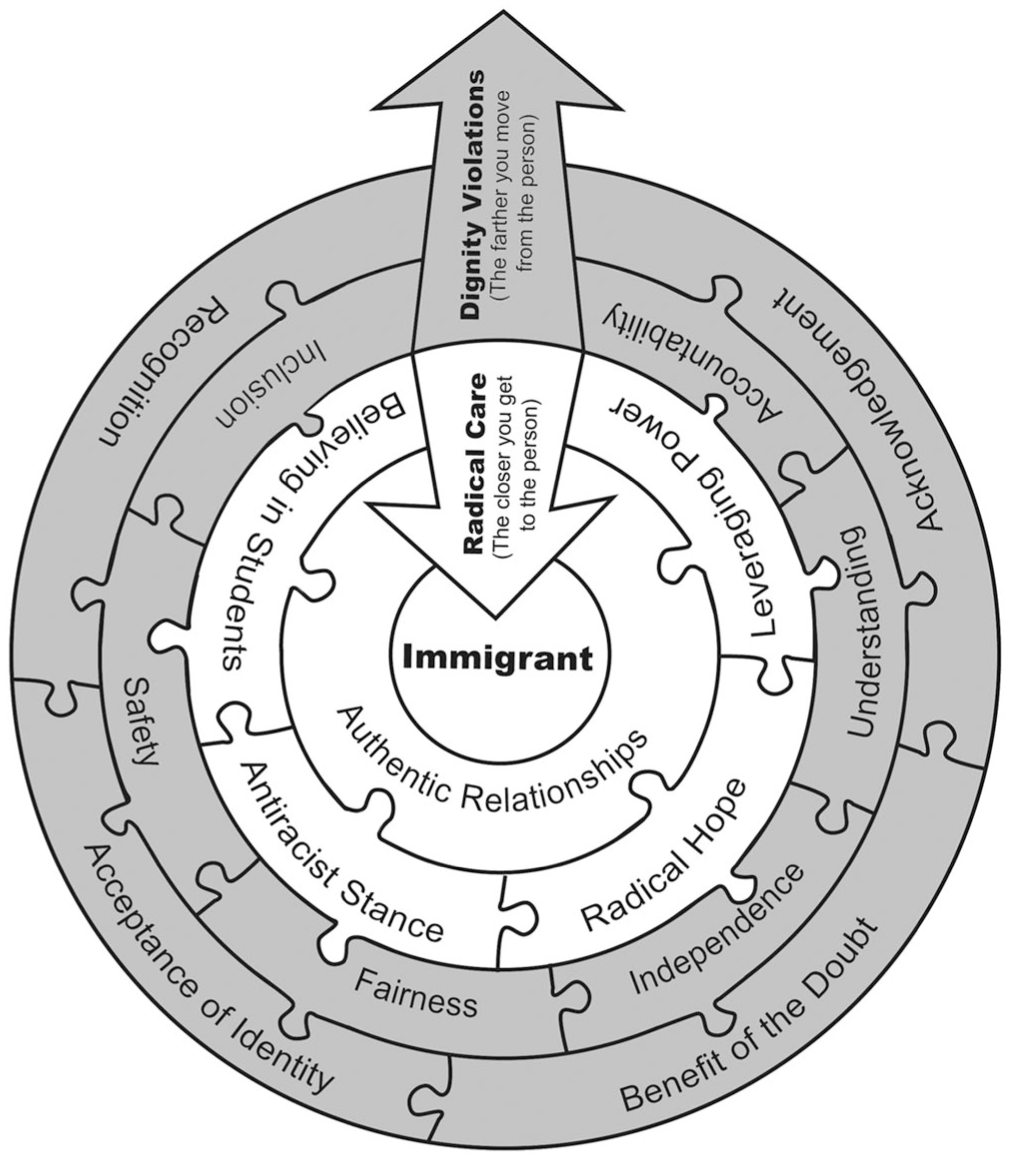
Model of ethics of dignity and radical care.
Questions for Reflective Discussion
1. As an educational leader, if asked to enforce laws or policies that conflict with the ethical obligations to students, what strategies would you use to balance organizational survival—maintaining compliance, resources, and political support—while also upholding justice and human dignity?
2. Integrating the Model of Ethics of Dignity and Radical Care for immigrant communities in schools, if you were the superintendent in Redfield, how would you navigate the different tensions and priorities from different stakeholders? Specifically: (a) How would you have addressed the expectation to focus on compliance with federal law, potentially cooperating with immigration enforcement on school grounds? (b) Would you have created and led the Diploma Dreamers group differently? If so, why? (c) How would you choose which battles to take with the board following the model? (d) Why do you think the superintendent did not share with the board about the Diploma Dreamers group?
3. In Redfield, board members and some teachers framed differentiated support for newcomer immigrants as “lowering expectations” and “discriminatory to traditional students.” Reflecting on Figure 1, how would you have responded, considering equity and equality?
4. Superintendent Wellspring initially advocated for a community-based group to discuss how to support immigrant students in graduating from high school through Diploma Dreamers, but after being pressured by the district and the school board, he decided to close the group. (a) Why do you think Superintendent Wellspring decided to close the group and change his communication style with his team? Could he have done something differently? If so, what? (b) What are the costs—to students, educators, staff, and the community—when leaders decide to reduce communication and provide top–down orders during conflicting times? (c) How does Susana’s family’s reaction to the attendance letter illustrate the importance of radical care through communication tone, translation, and timing? What principles should guide schools when communicating with immigrant students and families?
5. How can Wellspring and other Redfield leaders demonstrate “dignity consciousness” in their everyday interactions with students, families, and teachers—even in small acts?
(a) What practices would signal to immigrant families that they are seen, heard, safe, and valued? (b) How can the Model of Ethics of Dignity and Radical Care be integrated in your district to promote a dignity culture? (c) How can you support your team to recognize the immigrant communities’ need for safety, belonging, and thriving?
Classroom Activities
Activity A. Dignity and Radical Care Mapping Workshop
Introduce the Model of Ethics of Dignity and Radical Care.
In small groups, participants should map moments in the Redfield narrative where dignity was upheld or violated.
Each group selects one violation of dignity, then reimagines how leaders could have responded differently while moving toward radical care, noting specific strategies they would use.
Discuss how a dignity-conscious approach might shift school culture and support radical care for newcomer immigrant families.
Debrief: Invite groups to reflect on the barriers that might prevent the practice of dignity and radical care, and on how leaders could overcome them.
Activity B. Role-Play Policy Simulation: Redfield School Board Meeting
Assign roles: superintendent, newcomer immigrant parent/student, resistant board member, Latino teacher advocate, community business leader, and a neutral board member, etc.
Stage a simulated board meeting where a proposal for flexible graduation pathways for newcomer students is on the agenda. Each role must argue their position, drawing on data, values, or lived experience.
After the debate, the “board” must vote on whether to pass the proposal.
Debrief: Reflect on how power, rhetoric, and values shaped the outcome, supporting or challenging the ethics of dignity and radical care. What arguments were most persuasive? What might shift minds in real-world policymaking spaces?
Resources for Further Learning
Breiseth, L. (2025). How school leaders can support immigrant students and families. National Association of Secondary School Principals. https://www.nassp.org/2025/01/17/how-school-leaders-can-support-immigrant-students-and-families/
Crawford, E. R., Mann, B., Bittel, M., & Rumpf, R. (Eds.). (2026). Leading for refugees and newcomers: Cases for K-12 schools. Harvard Education Press.
Crawford, E. R., & Dorner, L. (Eds.). (2019). Educational leadership: Case studies in times of change. Routledge.
Hicks, D. (2018). Leading with dignity: How to create a culture that brings out the best in people. Yale University Press.
Greenberg Motamedi, J., Porter, L., Taylor, S. (2021). How to support newcomer immigrant and refugee students in secondary school. Institute of Education Science. https://ies.ed.gov/learn/blog/how-support-newcomer-immigrant-and-refugee-students-secondary-school
NCELA. (n.d.). Webinars and toolkits. https://ncela.ed.gov/webinars
Rivera-McCutchen, R. L. (2021). Radical care: Leading for justice in urban schools. Teachers College Press.
The School Superintendent Association. (2025). Immigration support for school leaders. https://www.aasa.org/resources/resource/immigration-supports-for-school-leaders
Footnotes
ORCID iDs

Ethical Considerations
Not applicable. This paper does not involve human participants or human data.
Consent to Participate
Not applicable.
Consent for Publication
Not applicable.
Funding
The authors received no financial support for the research, authorship, and/or publication of this article.
Declaration of Conflicting Interests
The authors declared no potential conflicts of interest with respect to the research, authorship, and/or publication of this article.
Data Availability Statement
Not applicable.