






Abstract
This case examines faculty burnout as an organizational outcome within a shared governance environment, highlighting the vulnerability of non-tenured faculty in leadership roles. Using the Social Ecological Model (SEM), the case follows Professor Ivy Bennett, a mid-career, non-tenured faculty member whose expanding responsibilities, amid systemic failures and limited administrative support, create sustained role strain. As demands intensify, she faces a critical decision: remain in a leadership role dependent on informal labor or step away to reestablish professional and personal boundaries. Designed for graduate and doctoral-level courses, the case invites analysis of leadership accountability, shared governance, invisible labor, and ethical decision-making under structural constraint.
Organizational Context
Midland State University (pseudonym) is a public institution with a long-standing mission centered on student success, access, and community engagement. The university serves a diverse student population from both urban centers, including Memphis, Chicago, Atlanta, and Nashville, and rural communities across the state. Historically, the institution has emphasized high-quality teaching, mentoring, and service as core faculty responsibilities.
The university operates under a shared governance model outlined in its faculty handbook, in which faculty, department chairs, and academic administrators share responsibility for curriculum, assessment, and academic quality. In practice, this model relies on consistent participation, clear communication, and accountability across roles.
In recent years, Midland State University achieved R2 research classification, introducing increased expectations for scholarly productivity, external funding, and program expansion. Within the College of Health Sciences, the Department of Public Health launched new graduate and doctoral programs to support these goals.
These developments occurred during a period of ongoing financial constraint. Hiring for administrative and support positions lagged behind program growth, and key operational functions, including recruitment, contract processing, and program coordination, became increasingly strained. While expectations expanded, the infrastructure needed to support those expectations did not keep pace.
As a result, faculty were often required to navigate competing demands across teaching, research, service, and administrative responsibilities. Many operational tasks that were not formally assigned or recognized became necessary to sustain program function. Over time, the gap between formal structures and day-to-day practice created conditions in which responsibilities were unevenly distributed, and accountability was not always clearly enforced. In this environment, responsibilities were often addressed informally, with the expectation that faculty would step in as needed to prevent disruptions to students and programs.
The Protagonist: Position, Precarity, and Promise
Professor Ivy Bennett is a mid-career faculty member in the Department of Public Health, hired at the rank of Associate Professor in recognition of her prior experience and accomplishments at another institution. Despite her advanced rank, tenure at Midland State University is institution-specific and contingent upon years of service. As a result, Professor Bennett had not yet achieved tenure and remained in a probationary position without the full protections afforded to tenured faculty.
Colleagues and administrators viewed Professor Bennett as dependable, organized, and highly responsive. Early in her appointment, she demonstrated a willingness to support students and colleagues during periods of transition, often stepping in to address gaps in coordination and communication. Her ability to manage complex tasks and maintain program continuity positioned her as a natural candidate for leadership.
When a program leadership role became available, Professor Bennett was asked to oversee multiple public health programs. Her responsibilities included curriculum coordination, assessment oversight, student advising, recruitment, and faculty onboarding. While the role was framed as an opportunity for professional growth, expectations regarding decision-making authority, administrative support, and workload boundaries were not clearly defined.
This positioning created a distinct form of professional precarity. While her rank signaled experience and leadership capacity, her non-tenured status limited her ability to decline additional responsibilities or challenge organizational practices without potential career consequences. Informal expectations of collegiality, such as being responsive, flexible, and willing to “step in when needed,” further shaped how she navigated her role.
At the same time, the leadership role represented an opportunity. Visibility within the department, demonstrated administrative competence, and contributions to program stability were widely understood to support future promotion and tenure decisions. For Professor Bennett, the role carried both promise and risk: an opportunity to advance professionally, and an expectation to perform at a level that exceeded formally defined responsibilities.
Invisible Labor and Role Expansion
Over time, Professor Ivy Bennett’s responsibilities expanded beyond her formal leadership role as she increasingly addressed operational challenges necessary to maintain program function. As administrative processes stalled or failed, she became the default point person for resolving issues that were not clearly assigned but required immediate attention.
One recurring challenge involved delays in graduate assistant contracts and payroll. Despite paperwork having been submitted months in advance, students reported not receiving compensation. In response, Professor Bennett initiated repeated follow-ups with administrative offices, tracked submission timelines, and communicated updates to affected students, efforts that were essential to maintaining student trust but fell outside her formal responsibilities.
Her role also expanded into coordinating program activities with limited institutional support. After organizing a successful departmental open house, she was asked to lead a college-wide recruitment event. The initiative required extensive planning, outreach, and logistical coordination, yet lacked adequate marketing support. To ensure the event could proceed, Professor Bennett personally covered some associated costs. Despite these efforts, the event generated minimal engagement, raising concerns about the effective use of time and resources.
In addition, Professor Bennett frequently intervened when faculty responsibilities were not fulfilled. Missed deadlines for assessment reporting, gaps in student communication, and incomplete course-related tasks required her to step in to ensure continuity. Much of this work occurred behind the scenes and was neither formally recognized nor reflected in workload expectations.
While these efforts sustained day-to-day operations, they also obscured underlying structural challenges. Tasks that were essential to program function remained undocumented and uncompensated, reinforcing a pattern in which individual effort compensated for systemic gaps. Over time, this reliance on informal labor shifted from an occasional necessity to an implicit expectation.
Escalating Demands and Systemic Strain
As Midland State University expanded its research profile following its R2 classification, expectations for faculty evolved. While the institution continued to emphasize teaching, mentoring, and service, faculty were also encouraged to increase scholarly productivity and pursue external funding. However, teaching loads, workload policies, and evaluation practices remained largely unchanged, reflecting a teaching-intensive model.
For faculty, this created competing demands that were not clearly reconciled. Decisions about how to allocate time across teaching, research, service, and administrative responsibilities carried increasing professional risk, particularly for those in leadership roles without tenure protection.
At the same time, operational challenges within the department intensified. Graduate assistants experienced delays in contract processing and payroll, creating financial strain and uncertainty. Departmental funds designated for recruitment, advertising, and staffing were difficult to access, limiting the department’s ability to respond to enrollment and programmatic needs. Several administrative positions remained unfilled, despite ongoing discussions about workload and capacity.
Faculty participation in shared governance responsibilities was inconsistent. Some faculty did not meet deadlines for assessment reporting, course coordination, or program-related tasks, while others assumed that responsibilities would be addressed informally. In many cases, these gaps were not formally addressed by leadership. Instead, responsibility for resolving issues was often redirected back to the faculty.
As a result, Professor Bennett’s role increasingly extended beyond coordination to active problem-solving. She frequently addressed gaps in communication, ensured that required tasks were completed, and navigated logistical challenges that affected both students and faculty. These responsibilities often required immediate action, leaving limited time for her own teaching, research, and professional development.
As pressures mounted, interpersonal tensions began to surface. Missed deadlines, unclear expectations, and uneven participation contributed to growing frustration among faculty. Disagreements over responsibility and authority became more frequent and, in some cases, increasingly personalized.
Professor Bennett found herself navigating these tensions without clear authority or formal support. While working to maintain program continuity and protect student progress, she also faced increased scrutiny from colleagues regarding decisions made under constrained conditions. Her visibility in addressing ongoing challenges made her both essential to operations and more exposed to criticism.
Her non-tenured status further intensified these dynamics. While her leadership contributions were visible, her ability to set boundaries or decline additional responsibilities was constrained by concerns about how such decisions might be perceived in relation to collegiality and future advancement. At the same time, disengaging from informal leadership carried its own risks in a culture that implicitly valued those who ensured that programs continued to function despite ongoing challenges.
The Critical Incident
The comprehensive examination, a high-stakes milestone required for student progression in the graduate program, was scheduled to begin on Wednesday following spring break and conclude on Friday. The exam was designed to be administered in a hybrid format, requiring coordination among multiple faculty members responsible for distinct exam sections, as well as in-person and virtual proctoring.
In the weeks leading up to the exam, Professor Bennett confirmed participation and availability with all faculty responsible for contributing exam content and assisting with proctoring. Each faculty member was responsible for uploading their portion of the exam by a designated deadline and for being present during the administration of their section.
On the first day of the examination, several breakdowns occurred simultaneously. Upon arrival, Professor Bennett discovered that the assigned classroom was inaccessible, and no facilities or administrative staff were immediately available to resolve the issue. As students began arriving, she informed them of the situation and provided two options: remain on-site while she attempted to secure an alternative space or return home and complete the examination virtually. Students elected to transition to the virtual format.
Compounding the situation, none of the faculty members assigned to assist with proctoring were present at the start of the exam. Despite prior confirmation, Professor Bennett was left to administer and proctor the comprehensive examination independently.
As the exam progressed, additional issues emerged. Several exam components were inaccessible due to a combination of proctoring software malfunctions, improperly placed files within the learning management system, and missing exam materials that had not been uploaded by faculty prior to the established deadline. Students experienced delays and uncertainty as they attempted to access required materials. Several students expressed concern about whether the disruptions would affect the fairness of the evaluation process.
In response, Professor Bennett made a series of real-time decisions to maintain continuity and protect the integrity of the examination process. She transitioned all students to a fully virtual format, distributed updated instructions and access links via email, and documented each modification. Faculty members were included in all communications sent to students, including the revised examination schedule and virtual access details.
At the conclusion of the first day, students were again given the option to continue virtually for the remainder of the examination period. Students elected to remain in the virtual format for the duration of the exam.
Following the conclusion of the examination, concerns were raised by a faculty member who had not been present during their assigned proctoring period. The faculty member alleged that the modifications made during the exam administration had compromised its integrity. Additional claims emerged suggesting that Professor Bennett had altered exam settings and failed to communicate key logistical changes.
In response, the Dean’s Office convened a meeting with all involved faculty. During the meeting, Professor Bennett provided documentation, including classroom reservation confirmations, communication records, and the email correspondence sent to both students and faculty outlining the transition to a virtual format and updated schedule. Despite this documentation, faculty members who had failed to attend or submit their materials asserted that they had not received the relevant information.
The Dean, who had been copied on the communication, was aware that the information had been distributed. However, these discrepancies were not formally addressed during the meeting. Responsibility for the incident remained centered on Professor Bennett, despite evidence of broader systemic and individual failures.
For Professor Bennett, this moment marked a critical turning point. The responsibilities she had assumed to preserve student progress and maintain academic integrity now intersected with increased professional risk, raising questions about accountability, leadership, and the sustainability of her role.
Burnout, Reflection, and the Decision Dilemma
In the months leading up to and following the comprehensive examination, the cumulative strain of Professor Bennett’s responsibilities became increasingly difficult to ignore. What had initially felt manageable as short-term problem-solving began to take a sustained physical and emotional toll. Long hours spent responding to urgent issues, coordinating unresolved tasks, and navigating ongoing conflict left little time for recovery or focus on her own teaching and scholarship.
Despite these challenges, Professor Bennett continued to meet expectations across her roles. Program operations remained functional, students progressed, and immediate crises were addressed as they arose. However, the consistency of these outcomes depended heavily on her continued intervention.
As part of a professional development activity, Professor Bennett completed an emotional intelligence assessment. The results indicated diminished wellbeing and reduced quality of life, even as her professional performance remained strong. The findings prompted reflection on the sustainability of her current role and the conditions under which she was operating.
Stepping back from her leadership responsibilities, however, did not present a straightforward solution. Remaining in the role would allow her to maintain stability for students and ensure that essential functions continued without disruption. It would also reinforce her visibility as a dependable and committed faculty member – an important consideration given her non-tenured status. At the same time, doing so would likely require continued absorption of responsibilities beyond her formal role, with ongoing personal and professional costs.
Alternatively, stepping away from the leadership role would allow Professor Bennett to reestablish boundaries and prioritize her wellbeing, while potentially bringing greater visibility to the structural challenges within the department. Yet, this decision carried uncertainty. Program disruptions could affect students, colleagues might interpret her decision as a lack of commitment, and the long-term implications for her professional trajectory remained unclear.
She also considered the precedent her decision might set, both for how leadership responsibilities were distributed within the department and for what was expected of those who stepped into similar roles in the future.
As Professor Bennett prepared to make her decision, the question was no longer simply whether she could continue, but under what conditions continuing would be possible and at what cost.
Teaching Notes
Case Purpose and Positioning
This case is designed for use in doctoral-level and advanced master’s-level courses in educational leadership, higher education administration, public health, and public sector leadership. It examines faculty burnout as an organizational outcome within a shared governance environment, with particular attention to the role of invisible labor and the structural dynamics affecting non-tenured faculty in leadership positions.
The case is particularly suited for courses focused on leadership, organizational behavior, governance, and workforce sustainability in mission-driven institutions. It may also be applied in interdisciplinary contexts, including public health and nonprofit leadership, where distributed authority and resource constraints are common.
Learning Objectives
By the end of this case, students will be able to:
Apply the Social Ecological Model (SEM) to analyze burnout as a multi-level organizational outcome.
Evaluate how shared governance structures can both support and obscure accountability.
Identify the role of invisible labor in sustaining organizational function and masking systemic issues.
Assess leadership decision-making under conditions of professional precarity.
Examine the ethical implications of sustaining versus withdrawing from informal leadership roles.
Theoretical Foundations
SEM
The SEM provides a framework for understanding how individual experiences are shaped by interactions across multiple levels, including individual, interpersonal, organizational, and policy environments (Bronfenbrenner, 1979; McLeroy et al., 1988).
In this case, Professor Bennett’s burnout is not the result of individual inadequacy but rather the cumulative effect of pressures operating across these levels.
Burnout as an Organizational Outcome
Burnout is commonly defined as a response to chronic workplace stress characterized by emotional exhaustion, depersonalization, and reduced sense of accomplishment (Schaufeli et al., 2009). Research demonstrates that burnout is most likely to occur in environments with high demands, limited support, and unclear accountability structures.
This case illustrates how sustained reliance on individual effort to compensate for organizational gaps can create conditions in which burnout becomes a predictable outcome rather than an individual failing.
Invisible Labor
Invisible labor refers to work that is essential to organizational functioning but is not formally recognized, compensated, or included in workload expectations. In this case, examples include:
Managing graduate assistant contract and payroll issues.
Personally coordinating recruitment efforts and covering associated costs.
Completing or compensating for missed faculty responsibilities.
Maintaining communication and continuity during system failures.
While invisible labor stabilizes operations in the short term, it can obscure systemic deficiencies and delay necessary organizational intervention.
Shared Governance and Accountability
Shared governance is intended to distribute decision-making authority among faculty and administrators. However, research indicates that its implementation often varies, particularly in relation to accountability and enforcement (Raza et al., 2024).
This case highlights how shared governance can shift from a collaborative structure to one in which responsibility becomes diffuse. When expectations are not enforced, and participation is inconsistent, informal labor may fill the gaps, redistributing responsibility to those most willing or able to act.
Non-Tenured Faculty and Leadership Precarity
A distinguishing feature of this case is the protagonist’s non-tenured status. This positionality introduces unique constraints that shape decision-making:
Limited job security.
Heightened sensitivity to perceptions of collegiality.
Reduced the capacity to refuse informal labor.
Increased risk when absorbing organizational failure.
Instructors may wish to prompt discussion about how leadership expectations differ for tenured versus non-tenured faculty and how institutions often rely disproportionately on the labor of those with the least structural protection.
SEM Application to the Case
Instructors may encourage students to begin by identifying observable events in the case before mapping those events to SEM levels. Instructors may guide students to analyze the case across SEM levels (Table 1):
SEM Levels Applied to the Case.
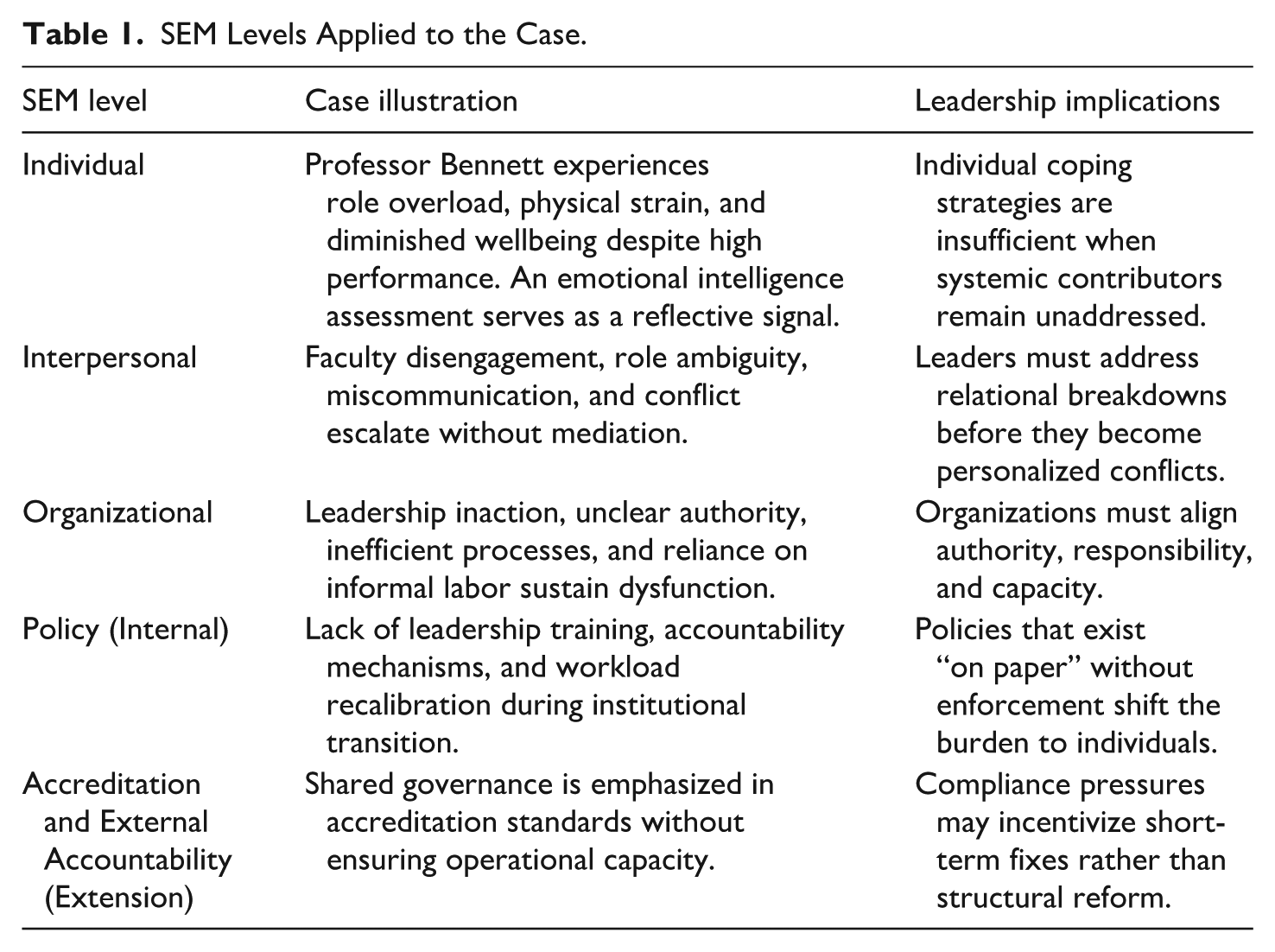
Accreditation and External Accountability (Instructional Extension)
Accreditation standards often reinforce shared governance principles by emphasizing faculty participation, administrative effectiveness, and continuous improvement. However, accreditation processes primarily assess compliance and documentation rather than daily operational capacity.
This dynamic mirrors findings in shared governance research, which suggest that external accountability mechanisms may reinforce governance ideals without ensuring their functional enactment (Raza et al., 2024). As a result, institutions may appear compliant while internal systems remain strained, increasing reliance on informal labor to maintain performance.
This level of analysis allows students to explore:
How accreditation language may reinforce governance ideals without addressing resource inequities.
How compliance pressures may incentivize informal labor to “keep things running.”
Why burnout can increase during accreditation cycles or institutional transitions.
Discussion Questions
At which SEM level(s) did intervention fail most significantly in this case?
How did shared governance structures both enable and constrain leadership action?
In what ways did Professor Bennett’s competence unintentionally sustain organizational dysfunction?
What responsibilities do department chairs and deans have when informal labor becomes essential to operations?
To what extent should Professor Bennett have been responsible for defending the integrity of the examination process, given the documented failures of other faculty and systems?
What accountability mechanisms should have been enacted in response to missed responsibilities and inaccurate claims during the post-examination meeting?
How does non-tenured status alter the risk calculus for faculty leaders?
At what point does invisible labor transition from collegial contribution to ethical liability for the institution?
What are the potential consequences, both intended and unintended, of stepping away from informal leadership roles?
Suggested Assignments
Option 1: SEM Mapping Exercise
Students map the case across SEM levels and propose one intervention at each level, distinguishing between individual, organizational, and policy-level strategies.
Option 2: Leadership Decision Memo
Students write a memo from the perspective of:
Professor Bennett.
Department Chair.
Dean.
Each memo should justify a course of action using evidence from the case and theoretical frameworks.
Option 3: Governance Redesign Exercise
Students propose a revised governance structure that:
Clarifies roles and responsibilities.
Establishes accountability mechanisms.
Reduces reliance on informal labor.
Transferability Beyond Higher Education
The dynamics presented in this case are not unique to higher education. Similar patterns emerge in public health departments, nonprofit organizations, and other mission-driven environments where distributed authority, limited resources, and compliance pressures intersect.
This makes the case particularly relevant for public health faculty, department chairs, program directors, deans, Doctor of Public Health (DrPH) programs, Doctor of Education (EdD) programs, Master of Public Administration (MPA) programs, Master of Public Health (MPH) programs, and other interdisciplinary leadership programs.
Instructor Takeaway
This case reframes burnout as an organizational outcome rather than an individual failure. It challenges students to examine how leadership systems, governance structures, and institutional expectations interact to shape individual experiences.
A key takeaway for future leaders is that when organizational systems rely on individual effort to compensate for structural deficiencies, both the individual and the organization bear long-term consequences.
Footnotes

Ethical Considerations
This manuscript is a teaching case based on professional experience and does not report research involving human participants, human data, or human tissue. As such, ethical approval from an Institutional Review Board was not required. All identifying details have been anonymized, and the case has been written to prevent identification of individuals or institutions.
Author Contributions
The author was solely responsible for the conceptualization, case development, theoretical framing, and manuscript preparation.
Funding
The author received no financial support for the research, authorship, and/or publication of this article.
Declaration of Conflicting Interests
The author declared no potential conflicts of interest with respect to the research, authorship, and/or publication of this article.
Data Availability Statement
No datasets were generated or analyzed for this manuscript. As a teaching case derived from professional experience, data sharing is not applicable.
ERIC Descriptors
Shared Governance.
Faculty Burnout.
Non-Tenured Faculty.
Burnout.
Higher Education.
Leadership.