






Abstract
Informed consent is central to conducting ethical research with human participants. The present study investigated differences in consent form reading in relation to conscientiousness, procrastination, and the point-of-time (PT) effect among undergraduate participants at a U.S. university. As hypothesized, conscientious participants and those who signed up to participate in a research study more days in advance and for earlier sessions (PT effect) read the consent form more thoroughly. However, procrastination was not related to consent form reading. Most importantly, consent form reading in general was poor, with 80% of participants demonstrating that they had not read the consent form. Conscientious participants were more likely to self-report reading the consent form, irrespective of their measured consent form reading. The article closes with suggestions to improve the process of obtaining informed consent with undergraduate participants.
Over 25 years ago, Taub (1986) identified shortcomings of the informed consent process and their implications for future research. Taub commented that although the problem of uninformed consent was apparent, the solution was less clear. Eight years later, Mann (1994) found that participants signed consent forms without understanding important dimensions of the study. Mann also observed that most of the existing empirical data on informed consent were found in medical, rather than psychological, literature. Even today, with a growing body of empirical literature offering numerous possible solutions, the systemic problem of uninformed consent persists (Pedersen, Neighbors, Tidwell, & Lostutter, 2011).
In part, this lack of understanding or of careful reading of consent forms may occur because few participants see signing the form as a “decision point” for participation and therefore do not take it seriously (Brody, Gluck, & Aragon, 1997). McNutt et al. (2008) described two studies in which researchers observed participants as they read and signed consent forms of varying lengths. Based on the average reading speed of U.S. high school graduates (Krashen, 1993), McNutt et al. estimated that an appropriate amount of time spent reading the consent form should have been no less than 3 min for the first study (665 words) and 7 min for the second (1,462 words). However, the majority of participants in both studies read the form in less than 30 s, suggesting that they were not carefully reading the consent forms.
To investigate participant characteristics that might be related to consent form reading, we examined conscientiousness, procrastination, and the point-of-time (PT) effect among undergraduate students. We chose to examine conscientiousness because conscientious persons are more likely to be careful, well-organized, scrupulous, and reliable (McCrae & Costa, 1987), and are more likely, for example, to report reading a manual, double-checking work, reading directions completely before assembling a new purchase, and proofreading writing (Jackson et al., 2010). We also reasoned that procrastination is worthy of investigation due to this variable’s well-documented inverse relationship with conscientiousness (Fee & Tangney, 2000; Johnson & Bloom, 1995; Lee, Kelly, & Edwards, 2006; Schouwenburg & Lay, 1995; Watson, 2001), as well as its possible connection to the PT effect. We included the PT effect—the point at which individuals participate in a study, either early or late in the sign-up period—because in many undergraduate studies, participants are recruited through introductory psychology courses and participants choose when to schedule the time for participation in the study. Previous research (Stevens & Ash, 2001) has shown that students who signed up for sessions earlier in the semester were more conscientious than those who participated later in the semester.
Method
Study Sample
Participants consisted of 60 undergraduate students enrolled in introductory psychology courses at a comprehensive, mid-sized southeastern university in the United States. Participation was voluntary and students were compensated with one research credit in their class. A total of 12 men and 48 women participated, ranging in age from 18 to 47 years (M = 20.48 and SD = 5.35). The sample was predominantly White (90%). The most common major was Music Business (30%).
Study Procedures and Data Collection
Eighteen sessions were held, with a maximum of five participants in each session. Each session lasted approximately 30 min. Upon arrival, participants were asked to read and sign the consent form. The consent form described a “personality” study that investigated “the relationship between conscientiousness and procrastination.” This consent form was used to obtain participants’ informed consent to participate in the study; it also served as the consent form used to evaluate participants’ reading. To assess how carefully participants read the consent form (hereafter, the degree of consent form reading), three instructions were embedded within the three sections of the consent form. The first section of the consent form included information on the purpose of the study, the participant’s role in the study, and the benefits and risks of participation. We embedded within this section an instruction for participants to “write the word ‘consent form’” as the answer to the first question on the following demographics form. In the second section of the consent form, which described maintaining safe conditions throughout the study, participants were instructed to “write the word ‘participation’” as the answer to the second question on the demographics form. In the last section of the consent form, which focused on confidentiality and the participant’s right to withdraw from the study, participants were instructed to “mark an X on the back” of the demographic form upon completion. As the embedded instructions were spaced equally among the three sections of the consent form, we believed that it would be unlikely that participants who read the consent form carefully would miss all three instructions.
Immediately after signing the consent form, participants completed an eight-question demographic form, which included a consent form quiz measuring participants’ ability to follow the instructions embedded within the consent form. The first two questions on the demographic form asked, “What is your favorite color?” and “How many pets do you have?” Based on instructions provided in the consent form, participants were to answer with the words “consent form” and “participation,” respectively, which served as indicators for which parts of the consent form the participants had read, as explained above. The words “consent form” and “participation” were chosen so that they would not be easily noticed when scanning the consent form. At the end of the demographic form, participants were asked to self-report whether they had read the consent form. Following the completion of the demographic form, two scales measuring conscientiousness and procrastination were administered in a counterbalanced order, in that each participant was handed the two scales together, arranged in alternating order. Participants were then debriefed, thanked for their time, and compensated with one research credit.
Measures
Conscientiousness was measured using the Mini-markers scale (Saucier, 1994), an abbreviated version of the Neuroticism-Extraversion-Openness Personality Inventory, Revised (NEO-PI-R; Costa & McCrae, 1992). This self-report assessment contains 40 common human trait adjectives presented in a nine-point Likert-type scale format. For the purposes of this study, only the eight traits measuring conscientiousness were utilized. Several adjectives included in the Mini-markers scale are “systematic,” “efficient,” “organized,” and “sloppy.” For each item, participants were asked to rate how accurately each trait described them personally, ranging from extremely inaccurate to extremely accurate. Higher scores indicate a greater degree of conscientiousness.
Procrastination was measured using the Procrastination Scale for Student Populations (Lay, 1986). This self-report assessment consists of 20 items to which participants responded on a five-point Likert-type scale from extremely uncharacteristic to extremely characteristic of them. Sample statements from the scale include the following: “I generally return phone calls promptly” and “I often find myself performing tasks that I had intended to do days before.” Higher scores indicate higher levels of procrastination.
The PT score was calculated based on the number of days prior to the session that a participant signed up for, and at which point during the semester the session occurred. PT scores could range from 0 to 100 with higher scores indicating that participants signed up fewer days before the session and for a session taking place later in the semester. The complete explanation of how we calculated this variable is available in the online Supplemental Material, available at jre.sagepub.com/supplemental.
Data Analysis
We assessed three hypotheses:
We hypothesized the latter because a greater PT effect suggests a strategy of waiting until the last minute to participate in a study.
We assigned scores ranging from 0 to 3 to represent how thoroughly participants read the consent form, based on how many of these instructions participants followed. Participants who did not follow any of the instructions were assigned a score of 0. Participants following one, two, or all three sets of instructions were assigned a score of 1, 2, or 3, respectively, with higher scores reflecting a more careful reading of the consent form. Data were also collected on which particular instructions the participants followed.
As a test of our three hypotheses, we conducted three independent sample t tests for mean differences among our three variables (conscientiousness, procrastination, and PT effect) between participants who answered at least one question correctly on the consent form quiz and those who did not. We also conducted an exploratory analysis for self-report of reading consent forms, and conducted a one-way ANOVA for self-report of reading the consent forms on conscientiousness. Finally, we used Pearson’s correlation coefficient to perform correlational analyses on each continuous variable (conscientiousness, procrastination, and PT effect). We report only statistically significant correlations.
Ethics
The Belmont University Institutional Review Board reviewed and approved this study prior to data collection.
Results
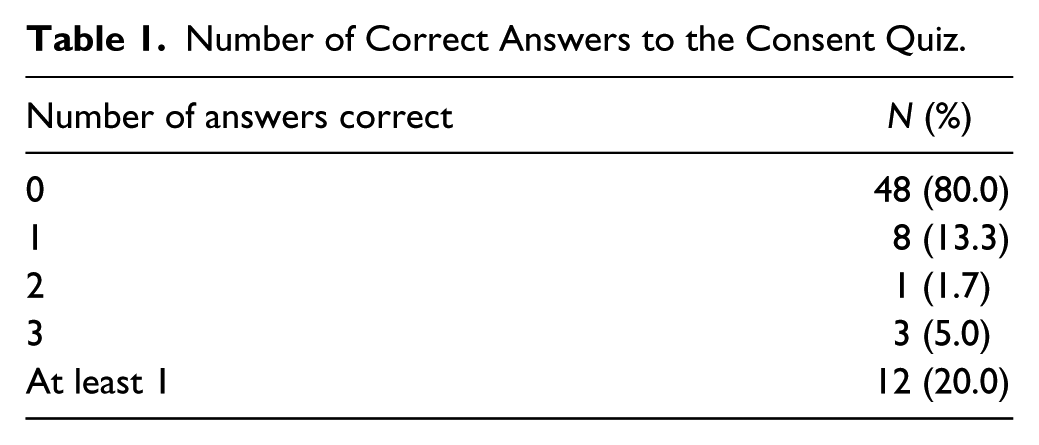
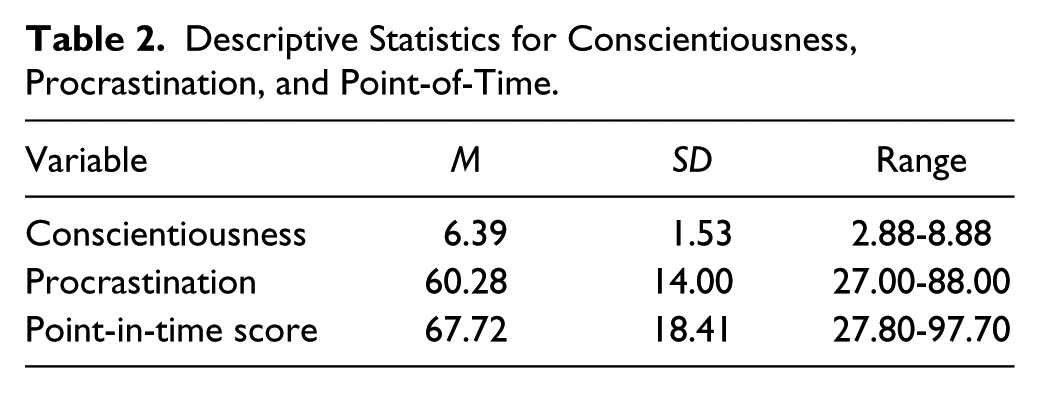
Of the 60 participants, 12 correctly answered at least one embedded consent form question (Table 1). Descriptive statistics for conscientiousness, procrastination, and PT are provided in Table 2.
Number of Correct Answers to the Consent Quiz.
Descriptive Statistics for Conscientiousness, Procrastination, and Point-of-Time.
A t test of our first hypothesis (conscientiousness and consent form reading) revealed a significant difference with participants who answered at least one question correctly having higher conscientiousness scores than those who did not, t(58) = −2.30, p = .03. The t test regarding our second hypothesis (procrastination and consent form reading) did not reveal a significant mean difference, t(58) = 0.72, p = .47. Finally, the t test of our third hypothesis (PT effect and consent form reading) yielded a significant difference with participants who answered at least one question correctly having lower PT scores than those who did not, t(58) = 2.33, p = .02. Lower PT scores indicated that participants signed up for earlier sessions and more days in advance.
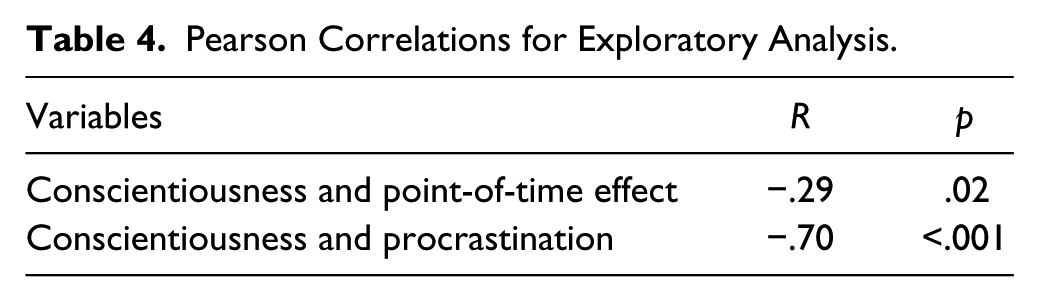
When participants were asked whether they had read the consent form, 72% claimed that they read the consent form, 18% claimed that they partially read the consent form, and 10% indicated not reading the consent form. In contrast, our measure of actual consent form reading indicated that 80% of participants did not adequately read any section of the consent form, 13% read only one section, 2% read two sections, and only 5% read all three sections. We found a significant difference between mean conscientiousness scores for participants who self-reported that they did read, partially read, and did not read the consent form, F(2, 59) = 3.57, p = .04. We also found a significant difference between those participants who said that they did not read the consent form and those who said that they did read it. On average, participants who self-reported reading the consent form had a higher conscientiousness score than those who did not (Table 3). Finally, Pearson’s correlations between procrastination and conscientiousness as well as conscientiousness and PT scores revealed significant, negative associations (Table 4). There was no significant correlation between procrastination and PT scores.
One-Way ANOVA for Self-Report of Reading Consent Forms on Conscientiousness.
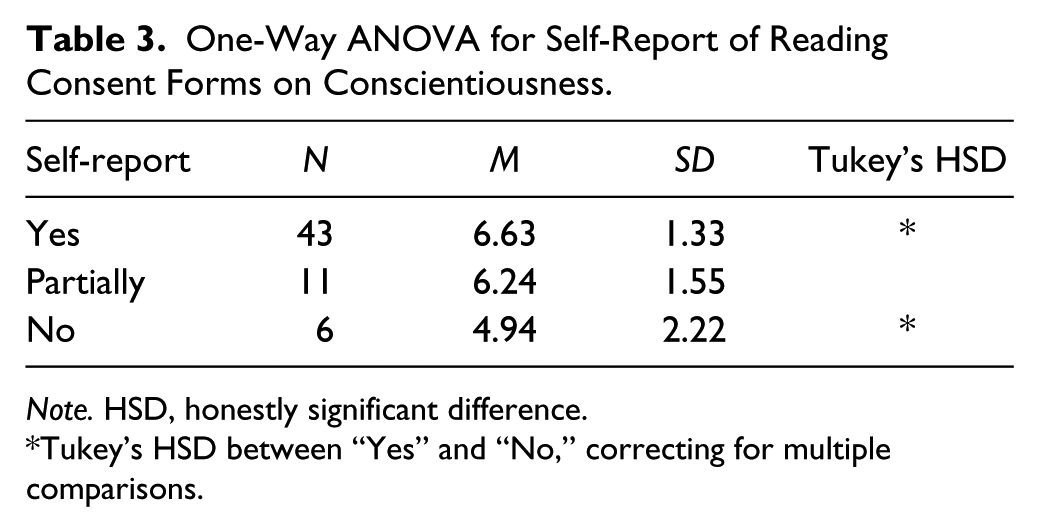
Note. HSD, honestly significant difference.
Tukey’s HSD between “Yes” and “No,” correcting for multiple comparisons.
Pearson Correlations for Exploratory Analysis.
Discussion
Our first hypothesis was supported in that conscientious students demonstrated a higher degree of consent form reading. The results did not support our second hypothesis that procrastinators would demonstrate a lower degree of consent form reading. However, our third hypothesis was supported in that students who signed up more days in advance and for earlier sessions demonstrated a higher degree of consent form reading than those who signed up fewer days in advance and for later sessions. Importantly, our results indicated that 80% of the students likely did not read any part of the consent form. This finding supports the belief that many undergraduate students who are enrolled in introductory psychology are not adequately informed when they give consent to participate in research.
On exploratory analysis of conscientiousness and self-report reading of the consent form, we found that participants who self-reported reading the consent form were more conscientious on average than those who self-reported not reading the consent form. However, only 28% of participants who reported reading the consent form correctly answered at least one question on the consent form quiz.
As conscientiousness has been found to be related to social-desirability (Ones, Viswesvaran, & Reiss, 1996), it makes sense that conscientious participants would be more apt to report reading the consent form, regardless of whether they actually did. As our data show that participants’ actual reading of the consent form (as measured by adherence to embedded instructions) differed from the self-reported reading of the consent form, assessments of consent form comprehension that ask participants to indicate whether they understood the consent form should be avoided. Furthermore, our exploratory analyses showed that conscientiousness was negatively related to PT. This suggests that participants who signed up more days in advance and for earlier sessions were more conscientious than those who signed up fewer days in advance and for later sessions. These findings support previous research by Wang and Jentsch (1998) as well as Stevens and Ash (2001). A clear implication of these findings is that participant characteristics are not equally distributed across the study sign-up period. It may be important, therefore, for researchers to keep this trend in mind as they collect data. Participants who sign up for early data collection sessions may differ in potentially important ways from participants who sign up for later sessions. Finally, in support of previous research, we found a strong, negative relationship between procrastination and conscientiousness.
Our finding that 80% of participants did not appear to read any portion of the consent form, or at least did not read carefully enough to recall the embedded instructions, may reflect a flawed perception that consent forms are a mere formality in the research process. As noted earlier in this article, the body of empirical literature on informed consent in psychological science is limited, but it has a consistent message over time: Research participants do not appear to read consent forms or, if they do, they do not read carefully enough to understand what is written. A clear implication of these findings is that researchers should take concrete steps to increase and improve consent form reading and therefore comprehension.
Although federal law and American Psychological Association (APA; 2002) ethical guidelines only require a signature from participants or guardians as indication of consent, medical research on informed consent has used several innovations in conjunction with the standard consent form. However, a review by Flory and Emanuel (2004) of several innovative practices used in medical research showed that such practices yield limited and inconsistent benefits. Among the innovations reviewed, extended discussion of the consent form with participants seemed to achieve the greatest increase of informed consent comprehension when compared with the standard informed consent procedures.
Our study contained several limitations. First, regarding the relationship between procrastination and the PT effect, there was a limited number of participants who could participate per session because later sessions reached capacity a few weeks in advance. Future studies may benefit from using a week-by-week sign-up model (i.e., participants would be able to sign up for a session at the beginning of each week), similar to the Stevens and Ash (2001) design, while still accounting for the number of days that participants signed up prior to the session. This would allow for a consistent number of days that participants would be able to sign up for a session as well as prevent later sessions from reaching capacity well in advance.
Second, our sample was overwhelmingly White, contained only undergraduates, and was relatively small. Future studies of consent form reading and personality correlates should seek to have a larger and more diverse sample across a broad array of demographic characteristics (Arnett, 2008).
Third, the use of self-report measures alone for personality characteristics may be problematic. For example, procrastination as measured by the Lay (1986) scale was not significantly related to the PT effect, which, as noted earlier, can be construed as a behavioral measure of procrastination. Therefore, future studies of correlates of consent form reading should utilize measures other than self-report alone and also include measures of social desirability.
Finally, as we did not directly measure comprehension of the consent form, we cannot ascertain whether participants simply read the entire consent form without attending to the three embedded instructions. As previous research (Mann, 1994; McNutt et al., 2008) has demonstrated that participants’ consent form reading and comprehension is poor overall, it makes intuitive sense that participants’ attention to novel information (i.e., the embedded instructions) in the consent form would be just as poor.
Informed consent is central to ethical psychological research using undergraduate participants (APA, 2002) and yet a small but growing body of evidence consistently suggests that this foundational research practice is not implemented effectively in psychological science. The bottom line seems to be that consent form reading is poor and, therefore, the notion of informed consent can still be called into question in many studies. Perhaps a few simple alterations in the informed consent process, which we outlined above, can contribute to enhanced informed consent.
Best Practices
In contemporary culture, downloading and using software applications is a common activity that typically involves endorsing an agreement to the terms and conditions of the software use. The user is asked to read and agree to these terms before installing the software. Take, for example, the iTunes software agreement, which is approximately 15,000 words long. Few people, when they agree to the terms of usage, probably realize that they have agreed not to use iTunes for “the development, design, manufacture, or production of nuclear, missile, chemical, or biological weapons.” The length and complexity of this agreement are overwhelming, as most of these agreements are, and most persons simply click “agree” and move on. This common practice may contribute to a “just sign here” cultural ethos as a way to simplify the complexities of everyday living. The implications of this ethos are important as it may spill over into the informed consent process in human subjects research. When presented with an “agreement,” such as an informed consent document, participants may be inclined to sign, but not read, the document to expedite the research process. After all, they may think, this research has been reviewed by an institutional review board, and therefore they may feel protected from any unwanted effects. Couple this attitude with Brody et al.’s (1997) observation that consent form signing is rarely seen as a “decision point” in the research process and the challenges are clear.
To reduce the impact of a “just sign here” mind-set, we offer several recommendations arising from the findings in this article. Sullivan and Lashley (2009), for example, offered suggestions for classroom exercises designed to help educate students (who are future research participants) in the informed consent process. The exercise consisted of administering consent forms and questionnaires to undergraduates in class, followed by a surprise consent form quiz. Although students performed poorly on the quiz in class, consent form attention measured during subsequent actual research was greater than that of students who had not participated in the exercise. Similarly, Flory and Emanuel (2004) noted that extended discussion of the consent form shows the most promise in consistent consent form comprehension improvement. Taken together, these types of activities may work against the “just sign here” ethos and help participants engage meaningfully in giving informed consent.
Finally, regarding the undergraduate participant recruitment process, our research suggests that researchers should spend more time in explaining informed consent to those participants who signed up for the study later, rather than earlier, in the semester. Those who sign up later seem to be at a greater risk for not carefully reading consent forms. Our findings also suggest that consent form comprehension should not be measured solely, if at all, on the participant’s self-report of reading the consent form.
Research Agenda
Further research should continue to focus both on the extent to which participants read and comprehend consent form information, and which aspects of the consent form the average participant pays more or less attention to. A practical and innovative way of measuring this information would be to use an eye-tracking device in conjunction with an electronic consent form. Eye tracking devices are typically unobtrusive and could readily be incorporated into the informed consent process if an electronic consent form is used. This strategy would be particularly useful when participants are run one at a time, rather than in groups.
Future research should also study the effectiveness of some of the innovations mentioned in this article. Specifically, researchers could study the implementation of extended discussion of consent form content with participants. Continuing research on the PT effect may benefit from using a week-by-week sign-up model (i.e., participants would be able to sign up for a session only at the beginning of each week), similar to the Stevens and Ash (2001) design, while still accounting for the number of days that participants signed up prior to the session. This strategy would allow for a consistent number of days that participants would be able to sign up for a session as well as prevent later sessions from reaching capacity well in advance. Any of these suggestions could be used as manipulations in an experimental procedure to ascertain the degree to which they affected consent form reading and comprehension.
Educational Implications
There are clear implications from our findings for educational practices related to teaching students about research ethics. A discussion of research ethics is typical in research methods courses at all levels of training, including both the undergraduate and graduate levels. Investigators may typically but erroneously assume that participants read and comprehend consent form material. Therefore, this process may be treated superficially by research trainees, so that the “real” research procedure can get underway. Our data, as well as data from other studies we cite in this article, suggest otherwise, however. Many participants do not carefully read consent forms and therefore are not actually giving informed consent. These issues and possible solutions should be discussed explicitly with research trainees at all levels of education. The suggestions we offer above for enhancing informed consent could easily be incorporated into courses on research methods, any lab courses where data collection is part of the course, or whenever undergraduate or graduate students are mentored in research activities.
Footnotes
Acknowledgements
The authors thank Mary Faulkner, Elizabeth Gaston, and Sarah Walker for help collecting, scoring, and entering data for this study. They also thank Dr. Amy Corneli and several anonymous reviewers for their helpful comments in revising this article.
Declaration of Conflicting Interests
The author(s) declared no potential conflicts of interest with respect to the research, authorship, and/or publication of this article.
Funding
The author(s) disclosed receipt of the following financial support for the research, authorship, and/or publication of this article: This study was funded by The Department of Psychological Science at Belmont University.
Author Biographies
References
Supplementary Material
Please find the following supplemental material available below.
For Open Access articles published under a Creative Commons License, all supplemental material carries the same license as the article it is associated with.
For non-Open Access articles published, all supplemental material carries a non-exclusive license, and permission requests for re-use of supplemental material or any part of supplemental material shall be sent directly to the copyright owner as specified in the copyright notice associated with the article.
