







Abstract
Most ethical and social research is focused on disease-oriented biobanks, while healthy donors’ motivation toward population biobanking is scarcely explored. We investigated willingness to donate biological samples for research and attitudes toward donation by a mail survey among 4,894 twins enrolled in the population-based Italian Twin Register. We compared responses in different socio-demographic categories and estimated, by the twin design, environmental and genetic components of this attitude. More than 80% of respondents expressed willingness to donate. A prevailing collaborative attitude to donation emerged. Attitude was mainly influenced by individual social and cultural factors. Education was important in shaping motivation and willingness to donate. Future surveys of the general population are desirable to continue investigating attitude toward donation and concerns about biobanking.
Keywords
Introduction
Biobanks for research allow the linkage between genetic, health-related, and personal data of donors, presenting important social, legal, and ethical challenges. Understanding the preferences and attitudes of stakeholders is important for the ethical conduct of research (Freeman et al., 2012). However, most of the ethical and social research on biobanks has been conducted on disease-oriented biobanks (Beskow et al., 2011) because of their major impact on patients’ needs, while there is less knowledge about healthy donors’ behavior and concerns with respect to population-based biobanking. Investigating the willingness to donate biological material and the attitude toward donation of members of the healthy general population is a key step in forging a strong alliance between people and public health research enterprise, and in providing policy makers with specific knowledge in this regard. Gathering knowledge to fill the gap in this field is timely. Moreover, research biobanking has in itself the aim of encouraging international networking, and thus knowledge about willingness and attitude to donation in different national settings is a requirement to support the work of the ethics boards of emerging international biobanking projects (e.g., Biobanking and Biomolecular Resources Research Infrastructure [BBMRI]; http://bbmri.eu/).
We conducted a KAP (knowledge, attitude, and practice) survey of the twins enrolled up to 2012 in the Italian Twin Register (ITR; Brescianini et al., 2012). The ITR is a population-based epidemiological register established at the National Institute of Health in Italy in 2001, which operates in the field of genetic epidemiology. The ITR group has started a population biobank (Toccaceli, Nisticò, et al., 2009), which is developing experience in terms of capability to design and implement technical and ethical procedures. The whole survey addressed potential donors’ knowledge of biobanks for research, their willingness to donate biological samples, their concerns about several topics related to biobanking, and their attitudes toward donation. The present work focuses on the results derived from two specific items of the research questionnaire aiming to ascertain (a) the theoretical willingness to donate biological samples (agreement of donor on the potential use of his or her biological samples for scientific purposes) and (b) the type of attitude toward donation. For the last item, we presented different non-overlapping categories of attitude plus one category, which indicates no interest in donation and another to declare no opinion on donation. The distinction among types of attitude is based on the reasons behind the potential donation: one based on a strong sense of moral duty to help others, perhaps mostly deriving, in our Latin culture, from an underlying Christian/Catholic education; a second centered on a pragmatic position toward research where the donor takes into account both the donation as a possible contribution by participant and, on the other side, the obligation of researchers to provide their expertise; a third reason relied on spontaneity of the donation as evidence of an unspecified acceptance to donate and help others. Moreover, given that the survey is conducted on twins, we applied a specific method of investigation, generally referred to as “the twin study design” (Boomsma, Busjahn, & Peltonen, 2002), to assess the relative contribution of environmental factors, in this case social and cultural determinants, versus genetic factors in shaping the attitude to donation.
Even though it is quite a new area of investigation, similar categorizations of the attitude to donation can be variously found in literature. In a context of patients not previously involved in genetic research, Pulley, Brace, Bernard, and Masys (2008) have categorized respondents, trying to distinguish between on one hand more general interest in research and donation (“the passive supportive”) and on the other hand more conscious and pragmatic donation (“the supportive”). Among relevant results of similar studies, there are those of Critchley, Nicol, Otlowski, and Stranger (2010) who found that reasons other than concern for improved health care and its benefits and beliefs, such as trust and confidence in research, are important in determining the public’ s willingness to participate in biobank research. Kettis-Lindblad, Ring, Vibirth, and Hansson (2005) also suggested that participation in biobank research could be based on altruistic motives and a sense of duty to assist future generations. “An act of public altruism” was also described by Michie, Henderson, Garrett, and Corbie-Smith (2011); they observed that the donors expected a sort of duty of the researchers. The Gift Theory (Mauss, 1925/1954), in fact, provides a framework for this interpretation: donation entails a relationship between donors (givers) and researchers (receivers), and an obligation on the part of the researchers. One of the motivations to donate adopted in our survey suggests similar ideas of social solidarity and collaborative position.
A pilot survey has already been conducted by our group in 2009 (Toccaceli, Fagnani, et al., 2009) on attitudes toward donation, based on the same theoretical scheme of interpretation of the present work, whose findings were deemed worthy of deeper investigation of larger samples. The results of the pilot study showed a prevailing collaborative attitude that motivated donation for research among ITR-enrolled twins, and also suggested that genetic influences might underlie this type of attitude. In the present study involving a larger sample, our hypothesis was that the collaborative attitude would be widespread among potential donors. Furthermore, given that we are dealing with a sample of twins, we are in the position of exploring on a larger sample the environmental and genetic influences that might play a role in shaping this attitude, by means of the twin method. Previous twin research has been conducted on traits related to empathy and pro-social behavior (Gregory, Light-Häusermann, Rijsdijk, & Eley, 2009; Knafo, Zahn-Waxler, Van Hulle, Robinson, & Rhee, 2008); however, the specific trait “attitude toward donation for research” is a novelty that has never been explored with the twin design.
The present study can be considered one of the first large surveys of healthy individuals on this topic in Italy. As the survey is conducted on a sample of twins, there is a need for clarification on the generalizability of results to the general population. In this regard, it has to be pointed out that twins as individuals were often shown not to be different from non-twin individuals with respect to some social and behavioral characteristics (e.g., Klemmensen, Hobolt, Dinesen, Skytthe, & Nørgaard, 2012); it is reasonable to think that our results might hold also for the general population, though this hypothesis should be tested on a general population sample. Moreover, we consider worth underlining that, although twins could be a biased population with regard to interests in biomedical research, the biases are likely to affect both monozygotic (MZ) and dizygotic (DZ) twins to the same extent; consequently, all the results pertaining to the twin method, which is based on the comparison between the two zygosity groups, should be unbiased.
The present study was conducted according to the requirements of the Italian legislation to protect personal data for research purposes (Legislative Decree 196, June 30, 2003). A specific consent form was sent to potential respondents together with a coded questionnaire and an informative letter describing the survey and the scientific aims of the study. Participants were asked to send back the consent form signed, separately from the questionnaire to avoid direct identification.
Method
Research Questionnaire
The research questionnaire included a section on socio-demographic and job variables and a 14-item instrument specifically developed to assess willingness to donate biological samples, concerns about several topics related to biobanking and attitude toward donation. The instrument had been developed after having examined the relevant literature (Hoeyer & Lynöe, 2006; Hoeyer, Olofsson, Mjörndal, & Lynöe, 2004, 2005; Kettis-Lindblad et al., 2005; Kettis-Lindblad, Ring, Vibirth, and Hansson, 2007; Pulley et al., 2008) and having discussed draft versions with a group of experts that included two psychiatrists and one psychologist (A.G.) working at the Mental Health Unit, and one sociologist, expert in research ethics (V.T.), working at the Genetic Epidemiology Unit of the National Institute of Health. A test–retest study carried out in a convenience sample of 18 students (M age = 21.1 years; 5 males) and 16 workers (M age = 44.69 years; 7 males) showed that the instrument is reliable, with values of Cohen’s kappa statistic coefficient ranging from 0.5 to 0.8 for most items and not lower than 0.3 for any item.
The present report considers two of the questionnaire items which deserve a specific critical analysis: (1) subject’s agreement on the potential use of his or her biological samples for scientific purposes—(A) “Yes, I definitively agree” (i.e., unconditional willingness); (B) “Yes, but only if results regarding my health or predisposition to diseases will be given to me”; (C) “Yes, but only if results regarding my health or predisposition to diseases will not be given to me” (B + C: conditional willingness); (D) “No, I do not agree”; (E) “I do not know”; (2) subject’s attitudes to donation—(F) “I think we have to donate to help others”; (G) “I think donation is a way to personally contribute to medical research while doctors/researchers give their contribution and expertise”; (H) “I think donation is a natural and spontaneous act to help others”; (I) “I think donating is not interesting”; (L) “I don’t know, at present I don’t have a clear opinion.” Cohen’s kappa was 0.71 for the first of these two items and 0.76 for the second.
In total, 4,894 questionnaires were sent by mail in March 2012 to twins aged 18 to 65 years, resident in Italy, and enrolled in the ITR, whose contact addresses had been updated in December 2008.
Statistical Analyses
Descriptive statistics
We performed descriptive analyses on twins as individuals considering socio-demographic characteristics of respondents (i.e., age, sex, education) and the two questionnaire items that were targeted in this report, that is, subject’s agreement to the potential use of his or her biological samples for scientific purposes (willingness to donate), and type of attitude toward donation for research. Differences in counts were tested using the Pearson’s chi-square test for association.
Genetic and environmental influences on attitude toward donation for research
To optimize the potential offered by our sample of twins, we used the twin design to disentangle the environmental and genetic components of human attitude toward donation for research (see supplementary material, available online at jre.sagepub.com/supplemental).
The twin design is based on the comparison between MZ and DZ twin pairs with respect to the degree of twin resemblance observed for a given phenotype. In our study, phenotypes are represented by willingness and attitude to donation. A higher resemblance (i.e., the extent to which the twins in a pair tend to choose the same answer) for MZ compared with DZ pairs is consistent with genetic influences on the expression of the phenotype. If, instead, the degree of resemblance shows only slight or no difference between MZ and DZ pairs, environmental factors are likely to play a major role; these factors can be shared by twins within family (e.g., common cultural upbringing) or can be unshared, namely, individual-specific (e.g., personal educational attainment; Boomsma et al., 2002). This method is based on the “Equal Environments Assumption” which states that environmental exposures that are relevant for the trait under study are shared by MZ and DZ twins to the same extent (see supplementary material).
Moreover, by fitting structural equation models, it is possible to decompose the total variance of the phenotype into quantitative estimates of a genetic component (“heritability”) and of the contributions due to the “shared” and the “unshared” environment (Neale & Maes, 2002). This makes the twin study unique compared with other family designs (see supplementary material).
Monozygosity and dizygosity were determined with a standard questionnaire (administered to twins during the enrollment in the ITR) aimed at assessing the degree of physical similarity of the twins during infancy; this is a well-established method in twin studies, which is known to be over 90% accurate.
For the purposes of the analysis, the nominal questionnaire item regarding the type of attitude toward donation for research was split into three dummy variables identifying what we labeled as “religious/moral obligation” (“I think we have to donate to help others”), “collaboration” (“I think donation is a way to personally contribute to medical research while doctors/researchers give their contribution and expertise”), and “spontaneous altruism” (“I think donation is a natural and spontaneous act to help others”), whereas the other two response categories (“I think donating is not interesting”; “I don’t know, at present I don’t have a clear opinion”) were considered as “absence” of the three above mentioned types of attitude; these variables were subjected to the estimation of twin correlations (i.e., the statistical measure to assess resemblance within the twin pairs) in MZ and DZ twin pairs, and to structural equation model fitting, with age and gender as covariates, using the software Mx (Neale, Boker, Xie, & Maes, 2006).
Results
Descriptive Statistics
Of the 4,894 questionnaires sent by mail, 1,677 were returned by Summer 2012, giving a response rate of more than 34%. Respondents and non-respondents did not significantly differ across age, sex, education, and geographical area of residence, providing at least partial reassurance against possible selection biases as regards socio-demographic profile. For this work, we analyzed 1,244 questionnaires from 622 complete twin pairs (314 MZ, 292 DZ, 16 of unknown zygosity). The mean age is 37.5 years. Of the 1,244 respondents, 476 (38.3%) are males, around 50% have completed high school and 58% have never married. Sample descriptive is shown in Tables 1 and 2.
Percentage Distributions of Willingness to Donate Biological Samples, According to Sex, Age, and Education.
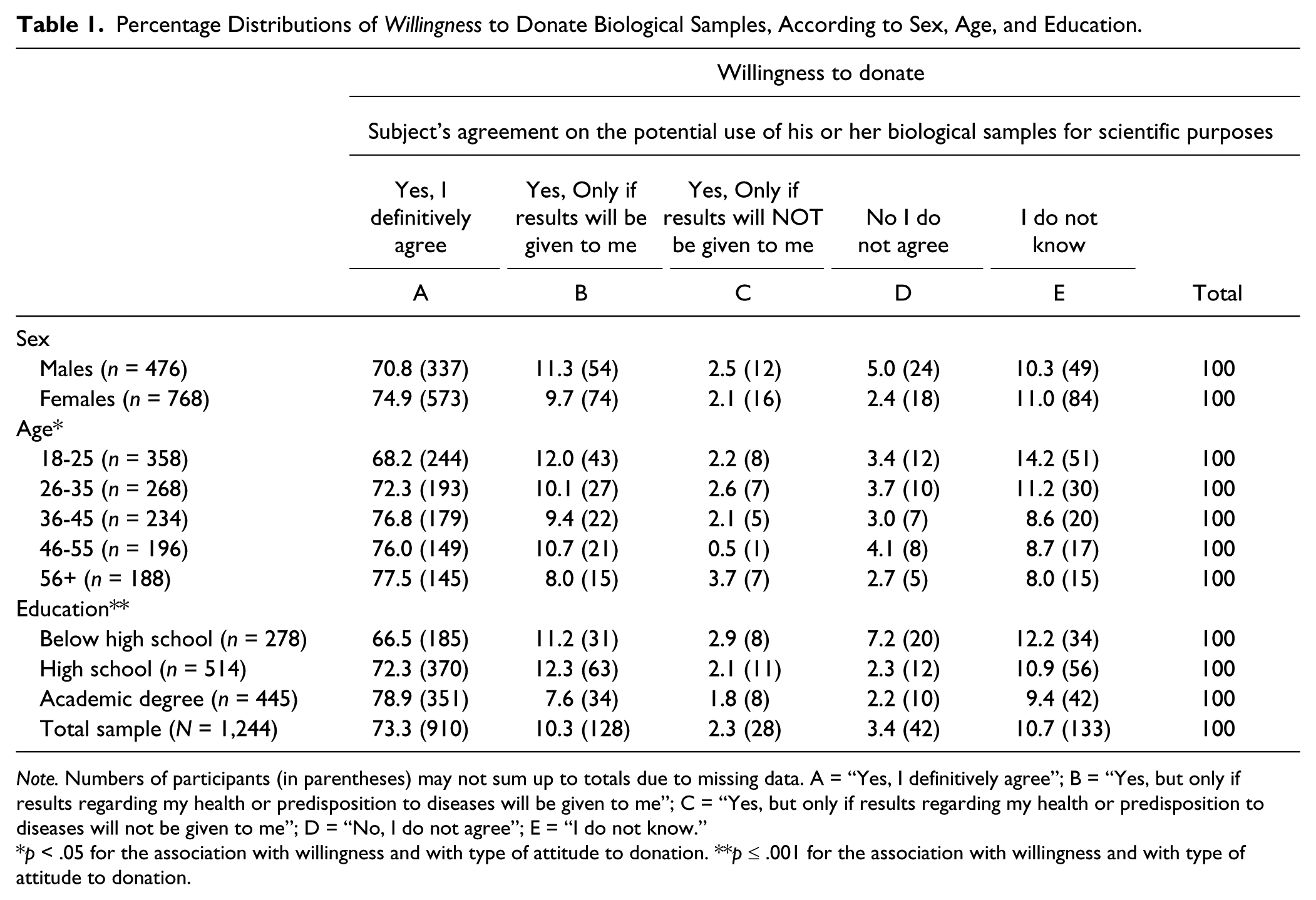
Note. Numbers of participants (in parentheses) may not sum up to totals due to missing data. A = “Yes, I definitively agree”; B = “Yes, but only if results regarding my health or predisposition to diseases will be given to me”; C = “Yes, but only if results regarding my health or predisposition to diseases will not be given to me”; D = “No, I do not agree”; E = “I do not know.”
p < .05 for the association with willingness and with type of attitude to donation. **p ≤ .001 for the association with willingness and with type of attitude to donation.
Percentage Distributions of Type of Attitude to the Donation, According to Sex, Age, and Education.
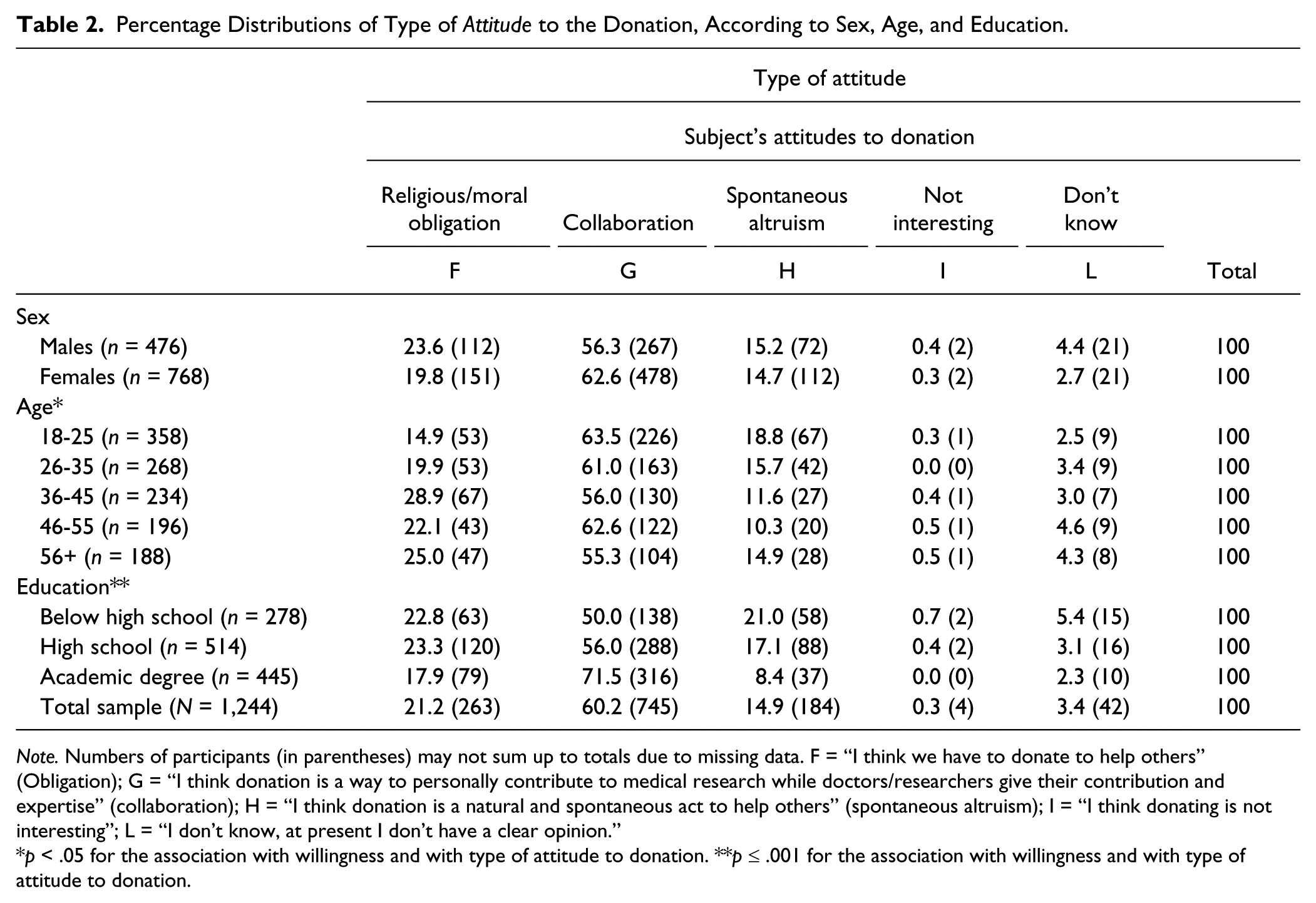
Note. Numbers of participants (in parentheses) may not sum up to totals due to missing data. F = “I think we have to donate to help others” (Obligation); G = “I think donation is a way to personally contribute to medical research while doctors/researchers give their contribution and expertise” (collaboration); H = “I think donation is a natural and spontaneous act to help others” (spontaneous altruism); I = “I think donating is not interesting”; L = “I don’t know, at present I don’t have a clear opinion.”
p < .05 for the association with willingness and with type of attitude to donation. **p ≤ .001 for the association with willingness and with type of attitude to donation.
As regards willingness to donate (subject’s agreement on the potential use of his or her biological samples for scientific purposes), more than 80% of twins expressed an overall willingness to donate within each demographic category (unconditional plus conditional willingness, that is, summing columns A, B, and C in Table 1). For the total sample, 73.3% of respondents declare unconditional willingness, whereas for 10.3% of them, the agreement is conditional to the communication of individual results which may be useful in terms of health care or disease prevention; conversely, for 2.3% of the subjects, the agreement is conditional to no communication of any individual results regarding health status or disease predisposition, 10.7% are uncertain about donation, only 3.4% of the sample would not donate.
No significant differences emerged for gender. Younger or less educated respondents were found less likely to donate unconditionally and more likely to donate only with personal benefit than older or more educated ones (p = .04 for age and p = .001 for education).
Regarding the type of attitude toward donation for research (Table 2), 21.2% of respondents consider donation as a religious/moral duty toward the others (“religious/moral obligation”), 60.2% of subjects see donation as a way to make their contribution to research effort in collaboration with researchers and institutions who contribute their skills and expertise (“collaboration”), whereas for 14.9% donation is the result of a spontaneous human predisposition to help others (“spontaneous altruism”); 3.4% of respondents do not have any opinion about donation and only 0.3% of respondents were not interested. Type of attitude has been found to be associated with age (p = .025) and to differ between individuals with and without an academic degree (p < .001). The collaborative attitude toward donation appears to be the prevalent choice for both sexes (56.3% of males and 62.6% of females), all age groups (more than 55% in each group), and all education levels (at least 50% in each group). In particular, it is chosen as the response by higher percentages of younger ages and higher education levels; 23.6% of males and almost 20% of females consider donation as a religious/moral duty, whereas nearly 15% of both sexes consider donation as a spontaneous act. Older respondents tend to see donation more as a religious/moral duty and less as a spontaneous act compared with younger ones, whereas those more educated are less likely to consider donation as a moral duty or a spontaneous act.
Genetic and Environmental Influences on Attitude Toward Donation for Research
Table 3 shows twin correlations for “religious/moral obligation,” “collaboration,” and “spontaneous altruism” attitudes toward donation for research in MZ and DZ pairs. The correlations were only slightly higher in MZ than in DZ pairs, suggesting a modest, if any, contribution of genetic factors and, consequently, a substantial influence of environmental factors in the expression of these attitudes.
Twin Correlations for Religious/Moral Obligation, Collaboration, and Spontaneous Altruism Attitudes Toward Donation for Research.
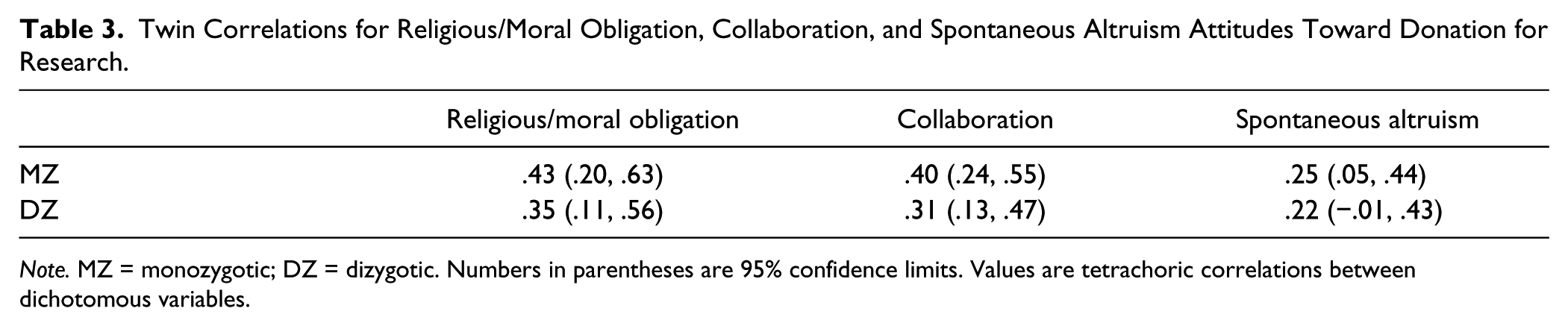
Note. MZ = monozygotic; DZ = dizygotic. Numbers in parentheses are 95% confidence limits. Values are tetrachoric correlations between dichotomous variables.
Genetic and environmental components of the three attitudes, as estimated with structural equation models, are depicted in Figure 1. We found a heritability of 17% for “religious/moral obligation” and “collaboration” attitudes, and 5% for “spontaneous altruism.” Shared (familial) environmental factors accounted for one fifth to one quarter of the variance of the three attitude categories. Unshared (individual-specific) environmental influences played a predominant role, explaining from 57% to 75% of the attitude variance.
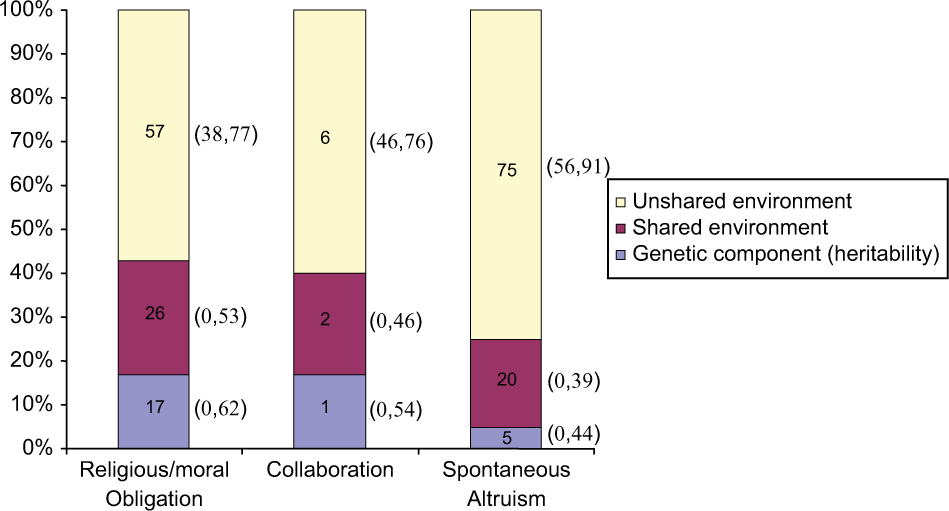
Genetic and environmental components of religious/moral obligation, collaboration, and spontaneous altruism attitudes toward donation for research.
Discussion
The results of the present survey confirm the collaborative attitude to donation for research as prevalent in this large sample of potential donors. Furthermore, the twin design results show that genetic influences on the attitude might be only modest, while social and cultural factors experienced individually, more than those shared early in life within the family, might have a predominant role in shaping motivation to donation for research.
Little knowledge has been produced on these topics so far; nevertheless, it is possible to raise a few points by considering these findings in light of previous research in the field. The studies mentioned in the introduction showed similar results. In particular, Michie and colleagues (2011, p. 10) highlighted the donors’ expectation of a sort of obligation on the part of the researchers; they wrote, “a sense from many participants [was observed] that researchers are obligated to them in some sense”; a similar expectation, can be found in our study, in the large number of respondents who characterized their willingness to donate with a collaborative motivation, addressing the researchers’ duty of contribution in terms of expertise and skills.
Moreover, within a perspective of critics, Johnsson and colleagues (2010) underlined that “altruism” and “trust” are important to factual donors (people who have really donated) and less influential in hypothetical donors (potential donors). Our findings show the presence of “trust” in a framework of theoretical willingness as an important element for potential donors; in particular, we think that “trust” is an intrinsic element in the choice made by a great majority of our respondents who are willing to donate, the ones who chose the “collaboration” motivation. Moreover, in our opinion, together with trust there is a certain idea of social solidarity. Donors and researchers are linked within a relationship of “reciprocity.” “Reciprocity” here has a broader meaning, developed within the ethical debate in the post genomic era on research biobanking (Knoppers & Chadwick, 2005), where the notion of benefit is not the classical one, but encompasses instead a series of guarantees given to donors (e.g., privacy protection, information on the use of sample, guarantee of withdrawal at any time, etc.). This enlarged concept of reciprocity has to be seen within the theoretical framework of altruism (Willow, 2009): In fact, the cooperation between donors from general population and researchers will benefit third parties (i.e., patients, future generations, etc.).
A less recent study of Nakajama, Muto, Yoshiike, and Yokoyama (1999) investigated motivation for donation in the same framework as in our investigation, namely, participants in observational studies for not yet defined research; they too detected a pretty good percentage of pragmatism and altruism in donating blood (“I wanted to contribute to the advancement of medicine”), even if the major motivations were related to “the idea of a personal benefit” or “no particular motivation.” Finally, Treloar, Morley, Taylor, and Hall (2007), in a pilot study on motivation to participation in a large genetic-epidemiological research project, provided results of the use by respondents of an altruistic framework to describe their participation to the study. The results of these studies, though obtained with different designs, receive a confirmation by our investigation, strengthened by the power of our much larger sample of respondents compared with Nakajama’s study and by our quantitative estimates as opposed to Treloar’s methodology.
Even if “altruism,” “unconditional willingness” to donate, “trust,” and other positive features emerge from this survey, the percentages of potential donors who are uncertain about donation or would donate only if there is a benefit for themselves are noteworthy and have to be considered from a social perspective. A proportion of more than 10% is not negligible, considering that our target population is composed by individuals who are enrolled in an epidemiological register and, thus, who have already showed an overall positive attitude toward research. It may be hypothesized that more information about biobanking for research is needed and that “conditional willingness” has to be taken into account as a constituent element behind contribution of part of the individuals.
Our analysis shows that sex is not a significant element to explain differences whereas age and education seem to play a significant role in defining willingness and attitude to donation. The higher the education level and the older the age of respondents, the higher their willingness to donate and the more unconditional the choice of donation. It is also interesting to note that younger individuals chose more the “collaboration” and the “spontaneous altruism” motivations to donation compared with the “religious/moral obligation,” and that among high-level educated (i.e., academic degree), the attitude is driven mostly by the collaborative motivation. Along with these findings, the twin design reveals that social and cultural factors, particularly those pertaining to individual life and not strictly to family life, might be relevant in shaping different attitudes toward research and biobanking. These factors, if better identified, could allow strategies, such as education, information campaigns, and so on, to improve research and biobanking participation.
In our opinion, it is fundamental to gather more knowledge in the area of healthy population biobanking for research. Where there are no direct benefits (financial as well as related to diagnosis and treatment) for donors, it is important to investigate willingness and motivations more deeply and any possible concerns and “barriers” to this type of biobanking to provide policy makers, ethics boards, and the public with relevant knowledge. This will help to establish ethically sound strategies to increase compliance to population biobanking. We envisage an ethical goal also in the increase of compliance. To obtain unbiased population samples and to avoid affecting the statistical results, it is important to try to maximize the participation rate: The more individuals are included, the better the representativeness of each category under study and the better the soundness of the study.
Best Practice
The relatively high percentage of willingness to donate for research among potential donors should enhance stakeholders’ commitment to biobanking. The prevailing collaborative attitude among potential donors implies the expectation of increased responsibility on the part of researchers and other professionals involved in biobanking research.
Ethics boards of emerging international biobanking projects might benefit from the results of this type of survey. They have to be informed about trends, opinions, socio-demographic features of different population groups that are potential or factual participants in biobanking. They will be facilitated in producing recommendations and advice which take national population profiles and ideas into account.
The response rate obtained is in line with and actually higher than the average rate of other surveys conducted among ITR-enrolled twins. However, it is not possible to completely exclude a different distribution of opinions and choices among non-respondents. This would not be due to socio-demographic characteristics analyzed in this work, given that they do not differ between respondents and non-respondents. It is desirable to increase the response rate for this kind of survey; for this purpose, other modes of participant contact, such as telephone interviews or online questionnaires, could be considered.
There are two other main limitations to the generalizability of these results. First, twins participating in this study are enrolled in the ITR, which is a research-oriented database, and have given consent to be contacted for future research. For this reason, their willingness and attitude toward research participation and biobanking might differ from the general population. Second, the survey was conducted only on individuals between the ages of 18 and 65 years, and thus the results might not apply to children or elder people.
Research Agenda
We consider it of great importance to continue to conduct KAP surveys on large samples of the general population, not already involved in research activities, to investigate on people’s concerns about research biobanking. Moreover, it would be interesting to explore the relationship that might exist between attitude to donation and other fundamental psychological and behavioral traits such as empathy, altruism, and psychological well-being. Using a multivariate twin design, it would be possible to investigate whether these traits are associated and share the same environmental (i.e., family background, individual-specific social experiences, etc.) or genetic factors; this could give hints on how and why people’s psychology and behavior drive their mind-sets on biomedical research. In this respect, part of these studies is already feasible as our twin sample was simultaneously administered two other well-validated psychological scales: the Empathy Quotient (EQ; Baron-Cohen & Wheelwright, 2004) and the Satisfaction with Life Scale (Diener, Emmons, Larsen, & Griffin, 1985). A collaborative effort at international level, especially among twin researchers, would be desirable and would also allow comparative studies across different cultures.
Educational Implications
From the study results, it emerges that there are a relatively high number of individuals already involved in research activities who are willing to donate biological samples for research; the prevailing motivation seems to be based on a collaborative motivation and a new reciprocity relationship: on one side, donation of biological samples by healthy people with a series of guarantees regarding privacy and information; on the other side, expertise and skills provided by researchers for the advancement of health care and prevention. Consequently, responsibility by stakeholders is increasingly required as well as a high standard quality assurance. Education is a significant factor in shaping motivation toward research biobanking and in determining conditional or unconditional willingness to donate. There is, as well, a not negligible proportion of potential donors who need more information about biobanking for research; this is clearly shown by our results and by the percentage of non-respondents that is relatively high for an opinion survey.
Footnotes
Acknowledgements
We are grateful to all the twins who took part in the study. We thank Dr. Emanuele Tarolla and Dr. Ilaria Lega for discussion and revision of the draft questionnaire. We acknowledge Antonio Arnofi, Sabrina Alviti, and Miriam Salemi for their skillful assistance in the Italian Twin Register (ITR) database management, and we really appreciate the professional English language supervision kindly offered by Dr. Stephen M. Weiss.
Declaration of Conflicting Interests
The author(s) declared no potential conflicts of interest with respect to the research, authorship, and/or publication of this article.
Funding
The author(s) declared receipt of the following financial support for the research, authorship, and/or publication of this article: This research was supported by the funds of the Istituto Superiore di Sanità dedicated to the ITR research activities.
Author Biographies
References
Supplementary Material
Please find the following supplemental material available below.
For Open Access articles published under a Creative Commons License, all supplemental material carries the same license as the article it is associated with.
For non-Open Access articles published, all supplemental material carries a non-exclusive license, and permission requests for re-use of supplemental material or any part of supplemental material shall be sent directly to the copyright owner as specified in the copyright notice associated with the article.
