







Abstract
There has been a call to identify populations who are at-risk for harassment. At our institution, participant-perpetrated harassment led to the development of an institution-wide program called Cultivating Respect in Research Environments (CuRRE). In this article, we describe the proactive and multipronged approach used to promote and implement the CuRRE program. We describe a policy created to set guidelines and expectations for research participants and discuss the educational and skills-based trainings delivered to principal investigators and research staff members. Research staff members completed anonymous surveys before and after the training. Over half of the attendees reported having been harassed by a participant/patient. Attendees responded favorably to the training; they felt more confident and better equipped to address participant-perpetrated harassment at the conclusion of the training. Given the dearth of literature in this area, we offer our experiences to encourage others to address this issue within their own research environment and institution.
Keywords
Description of the Problem and Corresponding Ethical Issues
Consider the following scenario: Sam is a Research Technician at an academic hospital, and often interacts with research participants to take vitals and collect other data. On several occasions, participants made inappropriate comments to Sam, such as:
Sam is embarrassed and does not know how to respond in these situations. She hesitates to tell her Principal Investigator (PI) because recruitment has been challenging for this study. Plus, she plans to apply to medical school and hopes her PI will write her a strong recommendation letter. Feeling isolated and disrespected, she wants to quit.
Retention of participants is top-priority in human subjects research. Researchers devote substantial thought and energy to cultivating a comfortable environment for participants in an effort to recruit and retain them in studies. Although most participant interactions are positive, some are interpersonally challenging and at times research staff members—like Sam—experience harassment (e.g., sexual innuendos, negative comments about race, ethnicity). Unfortunately, study team members who are most at risk for participant-perpetrated harassment are those who have the most contact with participants, and these staff members are often young, relatively inexperienced, and least likely to be trained in how to respond.
There has been a call to improve the culture of academic research and medicine (Bates et al., 2018; Benya et al., 2018; Clancy et al., 2014; DeFilippis, 2018; Hutchinson & Jackson, 2015; Jagsi, 2018; Jagsi et al., 2016; Tenbrunsel et al., 2019) and reform inadequate policies that address peer-to-peer and supervisor-to-supervisee harassment in research environments (Benya et al., 2018; Clancy et al., 2014). To that end, since February 2018 the National Science Foundation has required grantee organizations to fully investigate complaints of harassment, report findings of harassment involving grant personnel, and make accessible the means for reporting violations (Cordova, 2018). Moreover, conclusions from an intensive study on sexual harassment in academia highlighted the importance of implementing organizational changes to reduce and prevent sexual harassment (Benya et al., 2018). Organizational climate was found to be the most potent predictor of sexual harassment, and organizations were encouraged to make system-wide changes to reflect organizational values related to the harassment. The National Academies report focused on reinforcing respectful behavior between all individuals from students to staff members to professors, scientists, and physicians (Benya et al., 2018). However, the fact that research participants can be a source of harassment in academic and medical settings remains largely unaddressed.
Sociocultural models of power differential theories of harassment propose that individuals who are lower in comparative power in the context of social and cultural factors (e.g., young, racial minorities, women) are at higher risk of harassment (Harned et al., 2002). In the context of academic medical research settings, the research participant (who has the information needed for the research) and the PI (who is the supervisor) both have power over the research staff during these interactions. Thus, pleasing both the participant and the supervisor may drive research staff members to self-silence when they are the target of harassment. It is plausible that the powerful sociocultural factors contribute to dynamics at play in participant-perpetrated harassment, and that the organizational climate and job context of the medical research setting inadvertently discourages the reporting of participant-perpetrated harassment. Discussions related to the power dynamics between researchers (i.e., PI) and research participant have been published (Boser, 2007), but none have addressed the triadic relationship between research staff, participants, and investigators.
Although harassment is not exclusive to the research community, there are aspects about the context that are unique and should be highlighted. In research settings, participants are educated on any foreseeable risk associated with their participation in a study, and Institutional Review Boards (IRBs) require researchers to consider and address all potential risks in advance of study approval. Although IRBs certainly consider blatant risks to research staff members (e.g., wearing protective equipment), they have yet to recognize participant-perpetrated harassment as a risk. Therefore, as part of the IRB protocol approval process, PIs have not been required to integrate a plan to address participant-perpetrated harassment of research staff members. Research staff members are often the individuals who have the most contact with participants, and often bear the pressure to recruit and retain research participants. Combined with the fact that they are often in positions of less power and may need to rely on PIs for advancement in their field, research staff members may believe that they should not respond assertively in situations where participants behave inappropriately. Reports from the staff at the Veterans Affairs Boston Healthcare System (VABHS) have shown that participant-perpetrated harassment of research staff is common, damaging, and often invisible to PIs who are often unprepared to respond. As this issue has not been addressed in the literature to date, a description of the experiences and efforts to improve the research environment at VABHS is presented. The VABHS Research and Development Committee (R&DC), which oversees the IRB at the institution, was consulted. This work was determined to be a program evaluation; it was approved to be submitted for publication as nonresearch.
Case Study
The issue of participant-perpetrated harassment became apparent when a group of beleaguered research assistants asked a PI for help managing research participants' inappropriate behavior. The PI in turn contacted colleagues in the Psychology Department (due to the distress reported) to provide staff members with training in negotiating difficult interpersonal interactions. This grassroots effort became the nidus of a comprehensive program designed to educate the entire spectrum of faculty and staff engaged in human studies research at VABHS. Quickly, it became evident that these harassment experiences were not isolated events; research staff in other laboratories routinely experienced difficult and uncomfortable participant interactions, and often were reluctant to report them to their supervisors. Most PIs were unaware of these events and had not prepared staff for the possibility of harassment by participants or developed protocols for managing these situations. In response, the R&DC at VABHS formed a working group to promote an environment of mutual respect in research settings through a proactive and multipronged approach.
Methods
Development and Implementation of the Cultivating Respect in Research Environments Program
An educational program called Cultivating Respect in Research Environments (CuRRE) was created to provide separate training for research staff and PIs. It was important to provide research staff members with a comfortable, safe, and confidential environment for research staff members to openly discuss their experiences without worrying about the reaction or impressions of the PI. Thus, the decision to develop and deliver separate trainings to the research staff members and the PIs was made. The overarching goal of the CuRRE program is to convey the message that the safety and well-being of study staff are a priority. With the research administration's support, the curriculum was developed and information about the trainings was disseminated at hospital-wide research service meetings.
Informing and Educating Research Participants
The first steps were to inform and educate the community about the issue and to create a policy regarding expectations of research participant behavior. A code of conduct was created that delineates expectations of mutual respect in all interactions between participants and staff (see Figure 1). Researchers were encouraged to display the code of conduct in participant waiting and procedure rooms, and to explicitly review the code of conduct with participants during the informed consent process so as to provide clear guidelines and expectations to research participants.
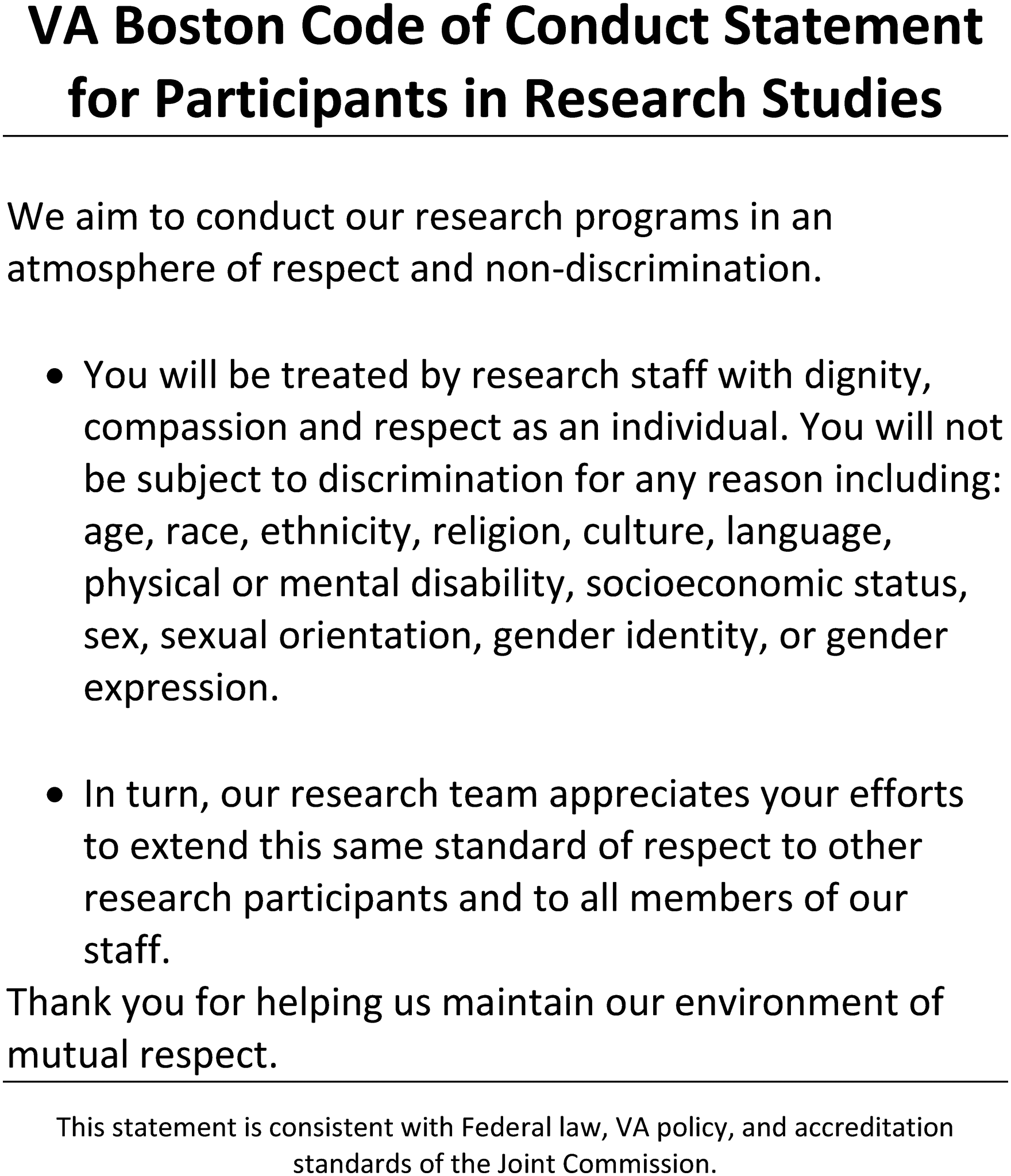
Veterans Affairs (VA) Boston code of conduct statement for participants in research studies.
Training and Educating PIs
A parallel effort was focused on educating PIs about the prevalence of participant-perpetrated harassment of research staff, the nature of the training that was delivered to research staff members, and strategies for promoting a safe and respectful research environment. This training was given in-person at mandatory PI meetings, and materials and resources were distributed electronically to the entire research community. PIs were charged with discussing the code of conduct with all lab staff and developing formal lab protocols/standards regarding disruptive/disrespectful behaviors. They were encouraged to consider measures to maximize staff and participant safety, such as not allowing staff to meet with participants alone or after hours, ensuring that study rooms are configured to allow an easy exit, and installing police alert buttons. Leaders in research administration reinforced the importance of maintaining a safe and respectful environment and provided support and training for investigators who were interested in further addressing these issues in their lab.
Training and Educating Research Staff Members
More intensive trainings were offered to help entry-level research staff members manage challenging participants. Specifically, research staff members of all disciplines were invited to participate in a 90-minute group training. This training was designed to discuss strategies for responding to challenging participants and to reinforce the institution's “zero-tolerance” stance on harassment. To create a safe environment for junior staff members to share experiences, postdoctoral psychology fellows in nonevaluative positions facilitated the trainings, and PIs were discouraged from attending. As this training was conducted within a VA Medical Center, education about the veteran population was provided to encourage research staff members to be sensitive to the veterans' life experiences. In order to promote mutual respect between the research staff members and the veterans, a brief review of the differences in military eras as well as military culture was provided.
The majority of the training was interactive, such that staff members were provided with opportunities to apply assertive communication skills during group and partnered role-plays. At the end of the session, a senior R&DC member delivered a message of support to attendees and provided clear instructions on how to report harassment and access the institution's resources for counseling and support. These instructions included pathways of reporting harassment perpetrated by participants, staff, and supervisors. The safety of research staff was communicated as an institutional priority, no matter the source of the harassment.
Results
Before and after the training, staff members responded anonymously to a survey about their experiences with participant-perpetrated harassment and rated their confidence in responding to such harassment. In 11 group cohorts, a total of 115 attendees completed a pretraining survey and 119 completed a posttraining survey. Attendance was not tracked and all surveys were optional and anonymous. Therefore, the exact number of individuals trained is not available though it is believed that most participants completed both pretraining and posttraining surveys; similarly, the four individuals who completed the posttraining survey only cannot be identified.
The majority of attendees were women who were recent college graduates in their first paid research position and had a desire to pursue an advanced degree; other demographic data were not collected. Notably, 52% of respondents reported having been personally harassed by a participant/patient, whereas 60% reported having witnessed a participant/patient harass a colleague. Almost two-third of attendees reported never having received any training about coping with disrespectful behavior or harassment in the workplace, aside from the required online training given to all VA employees. Many (72%) attendees reported they were not fully confident in their knowledge of the VA's stance on harassment, or how to report these events. Nearly all attendees (90%) reported an interest in learning techniques for responding to disrespect and harassment.
During the training, attendees shared examples of harassment they experienced while working in their current positions. Like the case example above, examples from attendees included unwanted or disparaging comments from research participants about staff members' age, weight, appearance, marital/relationship status, presumed religious affiliation, or racial/ethnic background. Attendees disclosed uncomfortable interactions where participants made sexual innuendos, asked them out on dates, requested their personal phone number, and called them by “pet” names (e.g., honey, babe). Some attendees reported inappropriate touching by participants, as well as requests from participants to be touched in inappropriate ways.
Attendees responded favorably to the training (see Figure 2). On a 5-point Likert scale, anonymous responses posttraining suggest that attendees felt more confident and better equipped to address participant-perpetrated harassment directed toward themselves and colleagues. After the training, attendees were better informed of VABHS' policy on harassment and discrimination.
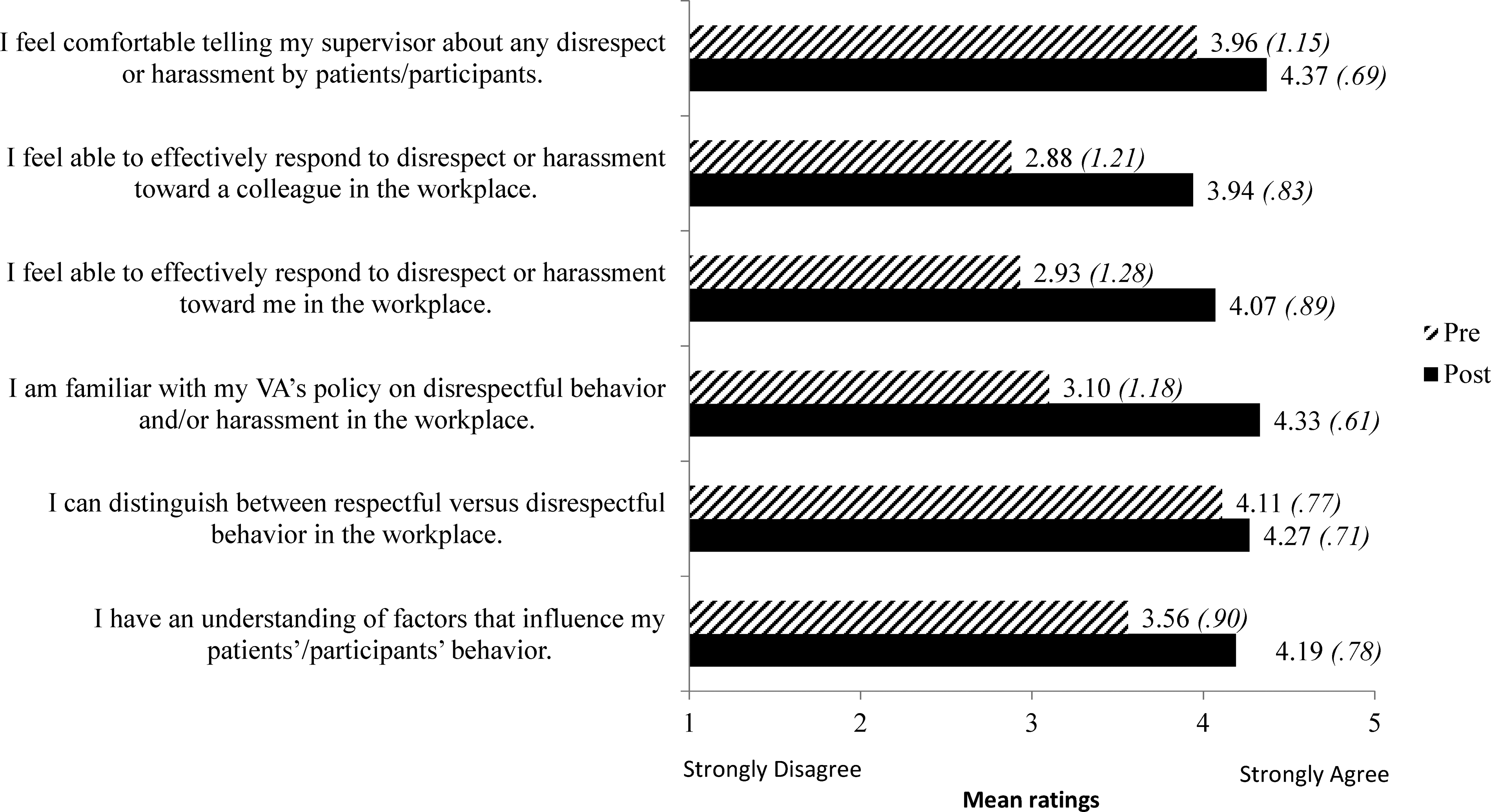
Mean (SD) values of anonymous research staff member responses to questionnaires before and after the Cultivating Respect in Research Environment (CuRRE) training.
Attendees enjoyed the interactive format of the training and the skills-based discussion. They expressed appreciation for the opportunity to hear they were not alone in their experiences of harassment and reported feeling validated. They appreciated the opportunity to role-play scenarios, such as “in-the-moment” responses to disrespectful comments and initiating conversations about disrespectful events with their supervisors. The curriculum was iteratively adjusted to incorporate suggestions. Attendees recommended that the curriculum be expanded with additional vignettes and “pocket phrases” for responding to different participant scenarios. For example, they requested more education on how to respond in situations involving the harassment of a colleague (e.g., bystander intervention). Additionally, they found the opportunity to consult with peers to be a helpful aspect of the training because many felt isolated in their small research labs. As a result of the training, two research staff members established and maintained a quarterly peer-led group for research staff with the full support of the administration.
Discussion
It is important that investigators and administrators recognize the insidious nature of participant-perpetrated harassment and take action to prioritize the safety and well-being of staff members over the need to retain research participants. Consistent with that suggested in previous reports (Benya et al., 2018) the CuRRE program demonstrated that a safe and respectful research environment can be promoted by setting clear guidelines for reporting harassment and providing access to resources and trainings that directly focus on adaptive strategies for addressing harassment.
The cultural, age, gender, and education gaps between researchers and participants may contribute to rates of harassment, and these same gaps between PIs and research staff members can influence one’s decision to respond or report such events. Inexperienced research staff who directly interact with participants may be particularly susceptible to harassment, and may have fewer coping resources to manage difficult interpersonal situations (Clancy et al., 2014). Moreover, research staff members working in VA Medical Centers may experience harassment at higher rates than others.
Recent evidence has suggested that rates of harassment at VA Medical Centers are much higher than that of other hospital settings (Klap et al., 2019). A recent study revealed that men and women veterans attribute stranger-harassment in VA settings to military norms bleeding over into veteran culture (Dyer et al., 2019). In that same study, many men veterans reported confusion in defining and identifying harassment. Most notably, the men reported confusion when well-intentioned comments were misinterpreted as harassment. Thus, it is possible that research staff members working in VA settings are more likely to experience harassment, and more likely to encounter participants who may not recognize that their behavior could be experienced as harassment. Generational, service era, and regional differences are likely to influence the veteran's perceptions of harassment.
Research communities tend to be small, and staff may be concerned that directly addressing participant-perpetrated harassment could jeopardize their reputation or employment. Those in early-career positions may be reluctant to take active steps against harassment, fearing this will impact their ability to obtain recommendations for advancement in their field (e.g., graduate/medical school admission, tenure, grant funding). Furthermore, the hierarchical nature of research, combined with the stress of recruiting and maintaining participants, can complicate one's decision to report harassment (Keashly & Neuman, 2010).
The programmatic changes instituted at VABHS occurred because a group of research staff members stepped forward to report their experiences and requested assistance in addressing inappropriate participant behaviors. That plea was taken seriously by a PI who then advocated for change within the system. The extent to which investigators—including those who consider themselves strong advocates of employee rights—were caught off-guard by the research staff's reports of harassment underscores the hidden nature of participant-perpetrated harassment, despite the prevalence. Interestingly, some investigators commented on the existing educational programs to teach clinical trainees how to address patient-perpetrated harassment and were surprised it took so long to recognize similar needs in research settings. Once the issue was raised, PIs recognized staff members could feel pressured to tolerate harassment in service of recruitment and retention, and these same forces may sway investigators to overlook or minimize harassment.
With the initiation of the #TimesUp and #MeToo movements, support for uncovering and intervening upon harassment at all levels of academia and medicine has increased. Recently, most of the developed initiatives have focused on sexual harassment. Although the examples provided in this manuscript are focused on sexual harassment, participants noted gender-, race-, sexuality-, and religious-based harassment as well. It is important that institutions consider the full range of harassment when initiatives, trainings, and regulations are developed and implemented.
The CuRRE program represents an initial step toward changing the culture in research settings. The descriptions of this program development and evaluation efforts are offered to bring attention to the power dynamics unique to the human-research setting. As with all program evaluation work, there are limitations to these results. Although research staff members completed pretraining and posttraining surveys, information on the research participant's experience either before or after implementing CuRRE programing was not collected. Therefore, the research participants' reaction to the code of conduct cannot be described. The focus of the CuRRE program was on improving the experience of the research staff. Accordingly, anecdotal reports from research staff members who participated in the CuRRE program suggest that the presence of the code of conduct in clinical research settings serves as a reminder of institutional support to respond assertively to inappropriate behavior.
Secondly, responses were not formally requested from research staff members beyond the posttraining survey. Therefore, comments cannot be made on the long-term benefits of participating in the CuRRE program training; future work should include these evaluations. However, as a testimony to how helpful research staff found this training, they developed an ongoing peer-led program that met quarterly as a direct offshoot of this program. This group provided research staff with the opportunity to give and receive peer support as well as the opportunity to consult and network with peers on issues of professional development. In addition, months after the CuRRE training, research staff have approached research service leadership and CuRRE trainers to thank them for addressing their concerns and have shared instances of using the skills taught in the training with participants. Lastly, all data reported in this manuscript was part of a program evaluation project at one institution, and thus the generalizability of the findings is unknown.
As described, the CuRRE program was developed through and is sustained by, a combination of grassroots efforts by employees and top-down implementation of programmatic changes by research administrators. Consistent with theoretical models for managing sexual harassment in the workplace (Bingham, 1991), CuRRE aims to prevent and manage participant-perpetrated harassment of research staff by addressing the problem on multiple levels (e.g., organization, group, individuals). Even with these comprehensive efforts, changing deeply entrenched cultural norms in research environments can take time. Cultural change within a single institution can be undermined by numerous internal and external forces, such as inattention to—or denial of—the problem; or the tacit acceptance of harassment, racism, and sexism in the broader culture. At VABHS, leaders will continue to take action to raise awareness among investigators, advocate for structural and systemic changes to increase the safety of research staff and empower individuals to address harassment as it occurs. The experiences described here are offered as a call to action for individuals and institutions who may be seeking new ways to tackle this issue.
Best Practices
Cultural norms within research settings must change. Research institutions are encouraged to consider the prevalence rates and effects of participant-perpetrated harassment on research staff members. Although most research participants are respectful, it is important to prepare staff members on how to respond to those who are disrespectful, and to create an environment that is safe and minimizes the likelihood of putting research staff in vulnerable positions (e.g., working alone without a procedure to maximize safety, etc.). In our setting, research staff expressed benefitting from the opportunity to role play and prepare for potentially difficult interactions. Further, institutions are encouraged to discuss openly the expectation of respect of all persons (research staff members, PIs, and participants) in the context of research settings. To that end, institutions may benefit from the development of a code of conduct, such as the one shown in Figure 1, to set clear boundaries between participants and research staff members. A code of conduct can provide both research staff members and participants with a tangible document that helps to define what is meant by disrespectful behavior and can be referred to with the goal of creating a respectful research environment. Clearly communicating to research staff their rights and the institution-specific process and contacts for reporting harassment was another important best practice. Institutions should consider implementing a similar top-down program, even if no complaints related to participant-perpetrated harassment have been made.
Educational Implications
Enhanced training on identifying and responding to harassment is warranted at all levels of research, including research staff members, PIs, and IRBs. As our work was conducted at a VA Medical Center, we thought it was important to provide education on the unique histories of veterans with our research staff members. Others are encouraged to provide research staff members with information that pertains to their participant populations. Our preliminary results show that research staff members are open to receiving this intervention. Also, their knowledge about the problem and how they can respond increases. Many of the communication skills presented in the research staff member groups are common practices among psychologists and therapists. Therefore, such providers may be a resource when developing and instituting similar programs.
Research Agenda
There is a dearth of research exploring rates of participant-perpetrated harassment, the effects of this harassment on the staff member, and interventions to address the same. Our initial results suggest that research staff members are experiencing participant-perpetrated harassment and that they desire skills to respond to disrespectful participants. Our data were collected in the context of a quality improvement project. Future projects may consider evaluating employee satisfaction and reports of participant-perpetrated harassment before and after implementing a similar intervention.
Footnotes
Authors’ Note
All authors have read and approved this manuscript and believe that the manuscript represents honest work.
Declaration of Conflicting Interests
The authors declared no potential conflicts of interest with respect to the research, authorship, and/or publication of this article.
Funding
The authors received no financial support for the research, authorship, and/or publication of this article.
Ethical Approval
The VABHS R&DC that oversees the IRB at the institution was consulted. This work was determined to be a program evaluation; it was approved to be submitted for publication as nonresearch.
