1Senior Compliance Research Coordinator, Division of Research, Human Subject Protection Program, Texas A&M University, 1186 TAMU, College Station, TX 77843-0000, USA
2Assoc. Prof. Emeritus, Texas A&M University, College Station, TX 77840, USA
3Assistant Research Scientist, Institute for Science, Technology and Public Policy, The Bush School of Government and Public Service, Texas A&M University, College Station, Texas, USA
Corresponding Author: Jyothi Naidu, MS, CIP, Senior Compliance Research Coordinator, Division of Research, Human Subject Protection Program, Texas A&M University, 1186 TAMU, College Station, TX 77843-0000, USA.
Email: Jyothi.naidu@tamu.edu
Abstract
University student convenience samples raise IRB concerns regarding voluntariness and incentives. In Fall 2024, a representative sample of 2,362 students was surveyed. Participation was compared between classes that offered class credit and those without. We find that class credit was the strongest motivator for participation (M = 6.11 on a 7-point scale), yielding a 74% participation rate compared to 9% in non-incentivized classes. Students prioritized voluntariness, risks, and confidentiality, yet viewed consent forms with “lukewarm” importance (M = 3.99). Class credit effectively drives short-term student recruitment.
Keywords
Nehemia Geva, Jyothi Naidu, Rotem Dvir, student convenience samples, class credit as incentive, student enrollment, IRB voluntariness incentives, human subject research program
Background: External validity is a major concern in research with human participants. However, for many reasons, researchers often must rely on convenience samples, including university students. In these cases, IRBs are particularly concerned with voluntariness of participation (lack of undue inducement and coercion), and the impact of and nature of incentives.
Methods: In Fall 2024, we invited a representative sample of 2,362 students enrolled at an institution, to participate in an online, confidential survey. Randomly, half of the students received class credit for participation in this study, while the others did not receive credit for taking part in this study. Sample demographics reflected a representative sample of students, including their home departments, class status (Freshman – Senior), gender and race. 74% of the students in classes with incentives participated, while only 9% joined the study from the non-incentive classes. Of those 899 students who completed the survey only 19% participated previously in Human Subjects Research (HSR). The survey targeted students’ knowledge and sentiment towards participation in HSR, and for class credit. The statistical analyses included basic descriptive measures and analysis of variance (ANOVA) to examine relationships between variables.
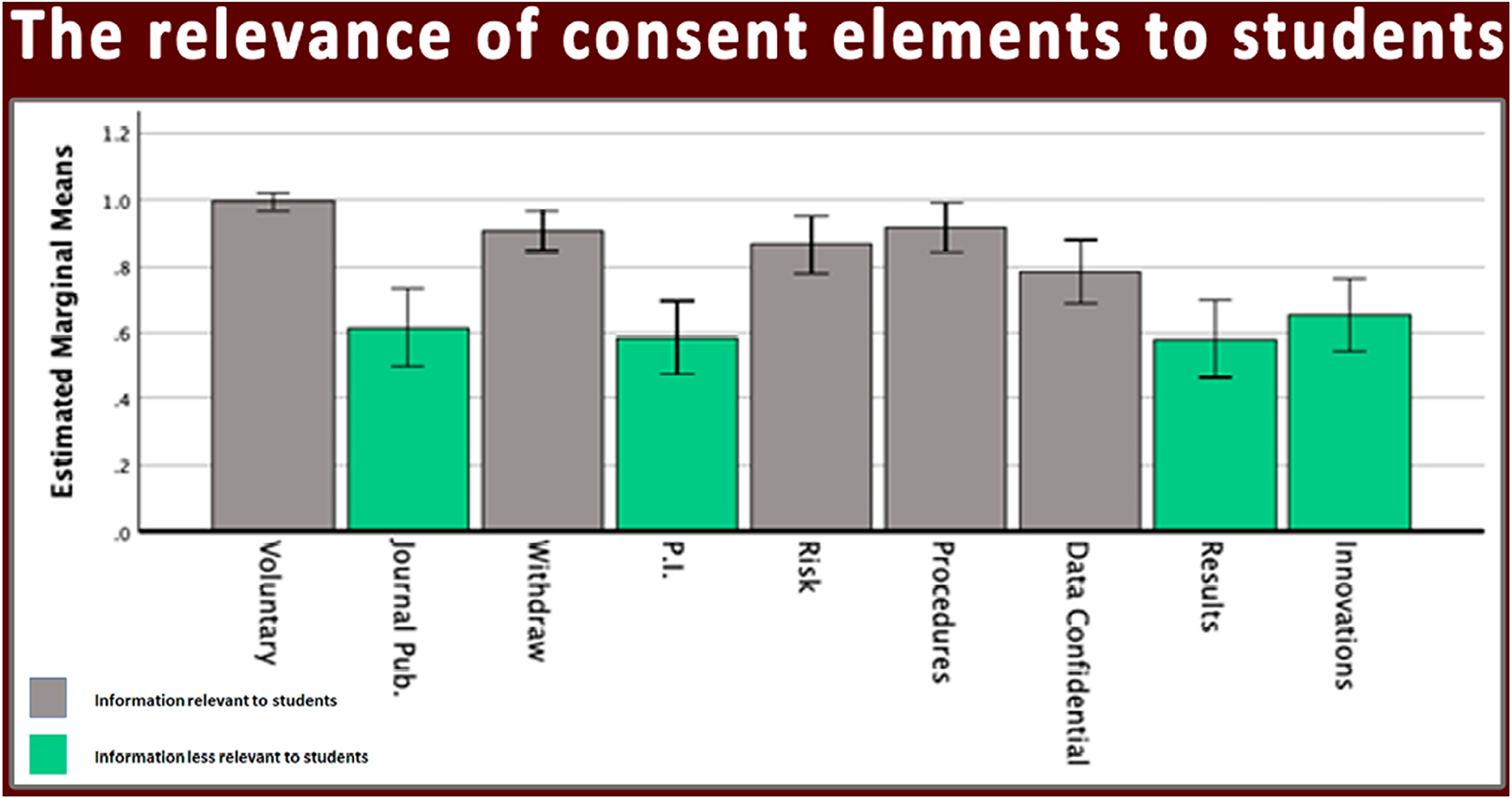
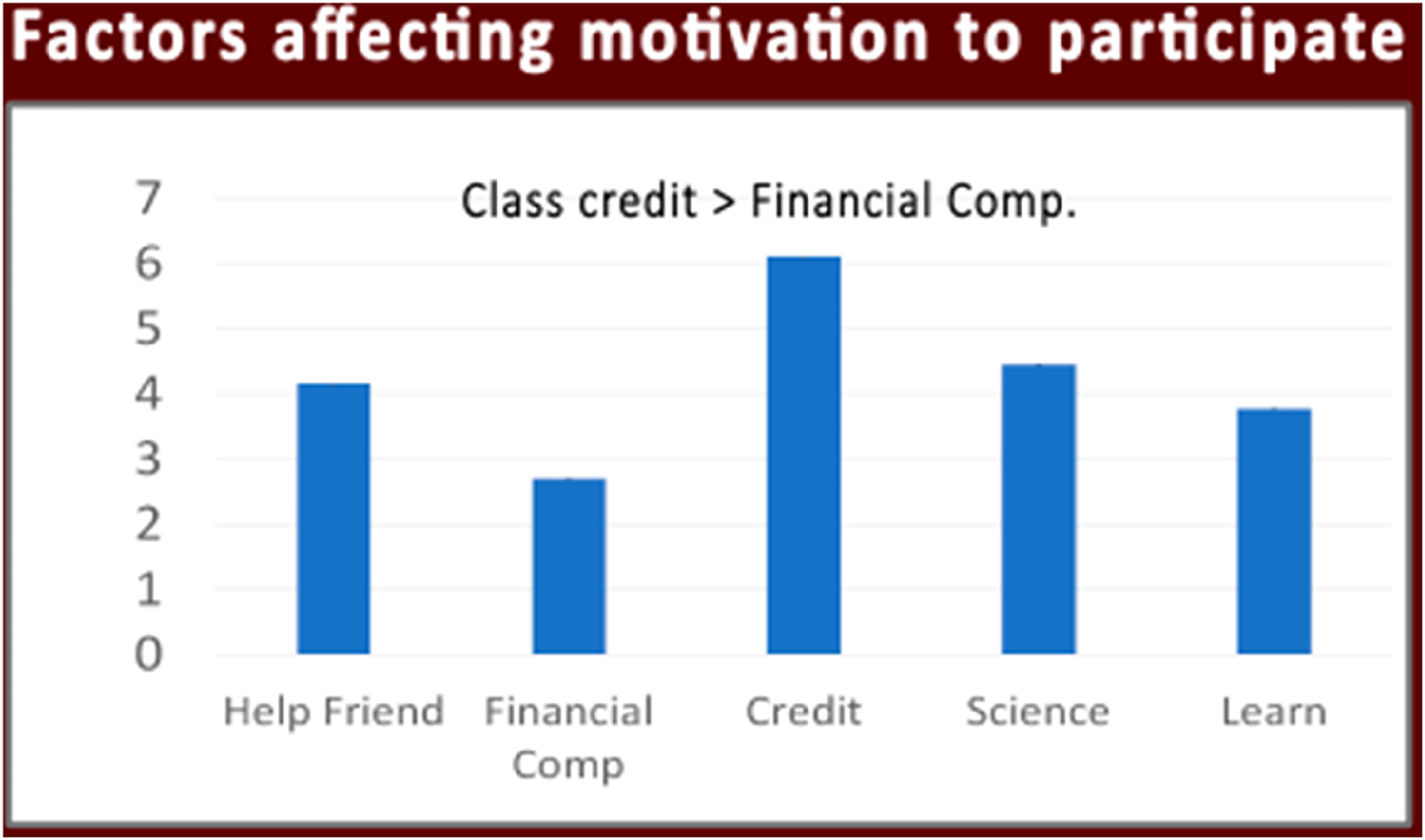
Results: The role of incentives – even a minimal type such as class credit - is critical in motivating students to participate. 74% of the students in classes with incentives participated, while only 9% joined the study from the non-incentive classes. We observed that class credit was the strongest motivator to participate (M = 6.11) (on a 7 points scale) in comparison with tangible incentives (M = 2.71), scientific merit (M = 4.46), helping a colleague, (M = 4.16), or pure learning (M = 3.78). The differences were statistically significant and were not affected by class status or gender. Student concerns and reflection in “Consent Forms": The students cared more about voluntariness, associated risks, withdrawal from the research, expected procedures, and confidentiality of their data than other parameters. And yet, in separate questions the students were “lukewarm” concerning the importance of the Consent form (M = 3.99; 7 points scale), and whether they consider it as a mere formality (M = 3.86; 7 points scale).
Limitations: Further investigation is required in the context of what students internalize from the informed consent information. The popularity of incentivizing students with financial rewards suggests that more research is necessary to assess what brings students into the study along with the amount of time and other demands of the expected participants. In this study females, more than males, valued helping a friend and participating in research to advance science. This requires further investigation.
Discussion: The feedback from 899 student participants suggests that class credit is an important incentive to recruit students for short study. It also suggests that students care about the same research parameters that IRBs deem critical. We perceive our data to be useful to researchers to improve student enrollment, speed of enrollment and retention. Secondly, these findings are relevant to Human Research Protection Program (HRPP) to streamline educational outreach activities and satisfy Association for Accreditation of Human Research Protection Programs (AAHRPP (1.4B Element). This preliminary study supports further exploration of the pulse of participants including faculty, staff and community along with students on human subject research at an institution.