







Abstract
Background:
Orthopedic surgery is one of the least diverse medical specialties. Other medical specialties have employed diversity-related initiatives to increase the number of students underrepresented in medicine (URM). Furthermore, with the suspension of visiting student rotations during the COVID-19 pandemic, medical students used residency program Web sites as a main source of program-specific information.
Aims/Purpose:
The purpose of this study was to measure the extent to which orthopedic surgery residency program Web sites describe diversity and inclusion initiatives.
Methods:
The Electronic Residency Application Service (ERAS) was used to identify U.S. orthopedic surgery residency programs. The programs’ Web sites were reviewed, and data on commitments to diversity and inclusion were collected. Descriptive statistics of these data were generated.
Results:
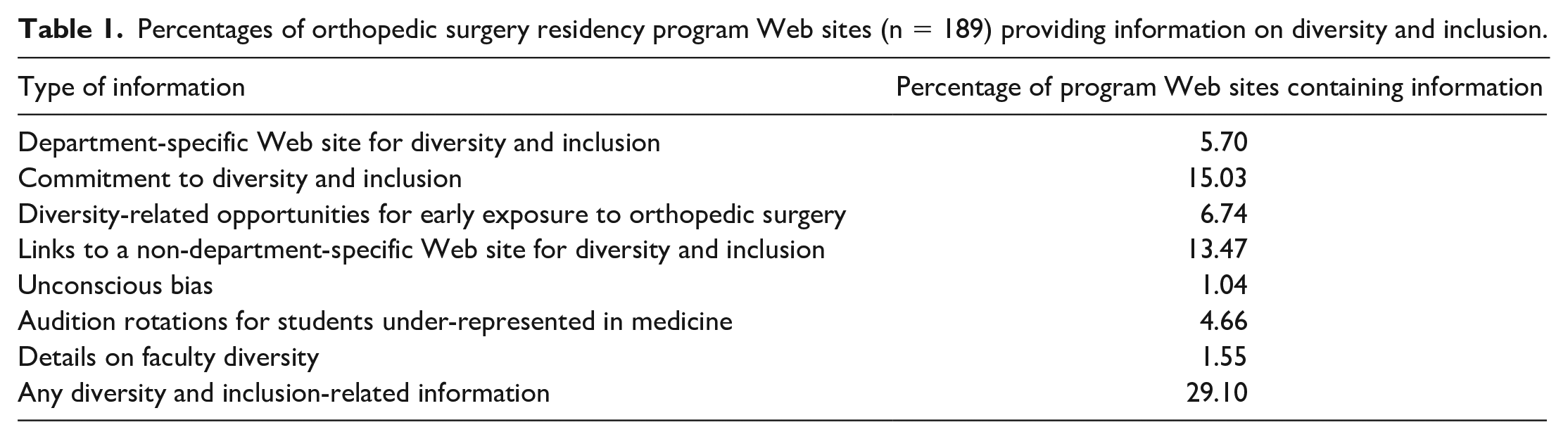
There were 192 residency programs identified and 3 were excluded from the analysis due to lack of Web sites. Of the remaining 189 residency program Web sites, only 55 (29.10%) contained information on diversity and inclusion. Information on a commitment to improving diversity and inclusion was the most prevalent data point found among program Web sites, although it was found on only 15% of program Web sites.
Conclusion:
Orthopedic surgery residency programs rarely address topics related to diversity and inclusion on their program Web sites. An emphasis on opportunities for URM students and initiatives related to diversity and inclusion on program Web sites may improve URM outreach and serve as one method for increasing URM matriculation into orthopedic surgery.
Keywords
Introduction
Despite modest improvements in the diversity of the physician workforce in the United States over the years, change has progressed slowly in orthopedic surgery, a specialty that has been dominated by white men [8,10]. In other medical specialties, placing an emphasis on diversity and inclusion (D&I) was found to increase the number of matriculated underrepresented in medicine (URM) medical students in future residency classes [20]. Okike et al [14] has defined URM as applying to “an individual who self-identified as Black or African American, Hispanic, Latino or of Spanish origin, Native Hawaiian or Pacific Islander, or Native American or Alaskan Native, alone or in combination with any other race/ethnicity.” In 2012, URM physicians comprised 3% of all orthopedic surgeons [13,19]. The need for a more diverse workforce has been recognized in various surgical specialties such as neurosurgery and thoracic surgery [2]. Orthopedic surgery remains less diverse than these 2 surgical fields [7,15].
In a national survey on the impacts of the COVID-19 pandemic on medical students’ career choices, approximately 20% of respondents voiced concern that the pandemic will affect their choice of specialty [3]. Furthermore, away rotations for medical students are now suspended or severely limited due to COVID-19 [1], removing a main source of students’ program-specific information and forcing them to rely more heavily on information provided on program Web sites. To our knowledge, no prior study has assessed the D&I content on U.S. orthopedic surgery residency program Web sites. Given that orthopedic surgery is consistently among the least diverse fields within medicine [7,15], we hypothesized that there would be a paucity of content related to D&I on the orthopedic surgery residency Web sites.
Methods
This study did not require approval from an ethical review committee. We used Okike et al’s [14] definition of URM as a guideline for assessing program Web sites. The Electronic Residency Application Service (ERAS) was used to identify U.S. orthopedic surgery residency programs, and the Web sites were reviewed in June 2020. Each Web site was evaluated by 2 authors for the inclusion of the following variables: (1) a department-specific webpage for D&I, (2) information on the program’s commitment to D&I (such as a mission statement including information on improving D&I), (3) diversity-related opportunities for early exposure to orthopedic surgery (such as scholarships/funding, shadowing), (4) a link to a non-department-specific D&I webpage (such as an office of D&I at the affiliated university), (5) information on unconscious bias, (6) information on URM faculty in the department, and (7) information on audition rotations for URM students. These variables were discussed among the authors and agreed upon to include. Yes/No responses were collected for the presence of each variable for each program Web site included, and the prevalence of each variable in percentage among these program Web sites was then calculated. All program Web sites were reviewed by the same 2 authors, who conducted data analysis using Microsoft Excel.
Results
Of the 192 allopathic and osteopathic orthopedic surgery residency programs identified, 3 were excluded from the study because they did not have Web sites. Of the remaining 189 programs, there were 110 university programs, 53 university-affiliated programs, 19 community programs, and 7 military programs.
Eleven programs (5.70%) contained a department-specific webpage for D&I (Table 1); 29 (15.03%) had information on their commitment to D&I, 13 (6.74%) offered D&I-related opportunities for early exposure to orthopedic surgery for medical students, and 26 (13.47%) provided links to a non-departmental D&I Web site associated with a graduate medical education webpage. Two programs (1.04%) provided information addressing unconscious bias, 9 (4.66%) included information on audition rotations for URM students, and 3 (1.55%) contained information about URM faculty in their department. The percentage of programs with D&I-related information separated by geographic division is displayed in Fig. 1.
Percentages of orthopedic surgery residency program Web sites (n = 189) providing information on diversity and inclusion.
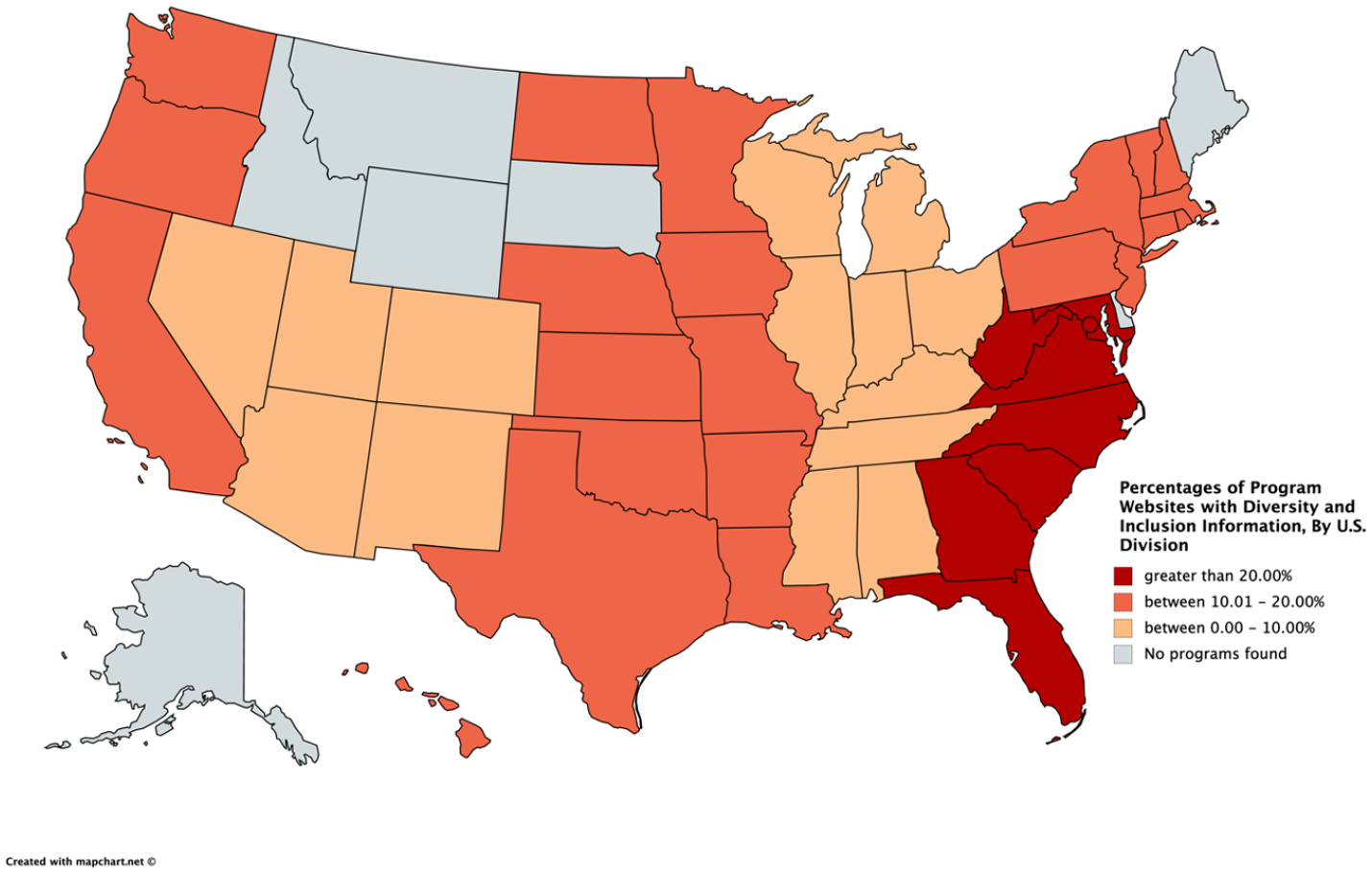
Map showing percentages of U.S. orthopedic surgery residency program Web sites with diversity and inclusion information by geographical divisions according to the U.S. Census. (Census regions and divisions of the United States. Available at: https://www2.census.gov/geo/pdfs/maps-data/maps/reference/us_regdiv.pdf.)
Discussion
The results of this study show that U.S. orthopedic surgery residency program Web sites rarely address D&I, despite the benefits of a diverse, inclusive physician workforce being well described in the literature. Differences in race and ethnicity have often been described as barriers to a strong, trusting patient-physician relationship [5]. This is important in orthopedic surgery, as the specialty is historically practiced and led by white male physicians despite a very diverse patient population [6].
There were some limitations to this study that assessed both allopathic and osteopathic U.S. orthopedic surgery residency programs. All data collection and analysis were performed and reviewed by 2 of the investigators, which may affect validity of data if certain variables were present on a program’s Web site but not found by the investigators who reviewed and collected the data. It is possible that a department used other methods of communication to describe their commitment to D&I. In addition, applicants may want to know the number of URM residents or the residents’ demographics of each program, information not included in our analysis. This study also did not address gender diversity, an issue that could be the focus for a future study investigating orthopedic residency program Web sites. The U.S. Medical Licensing Examination (USMLE) Step 1 examination will also be transitioning to a pass/fail format in 2022, which may affect several aspects of the application process for orthopedic surgery residencies, including the number of applications received, the value of other components of a student’s application, and the demographics of future residency classes. Prior literature has evaluated the emphasis orthopedic surgery residency programs have historically placed on competitive USMLE Step 1 scores and its potential effect on lower enrollment rates of URM students into these programs [17]. Future studies may also consider conducting interviews with department chairs and residency program directors to assess their level of commitment to improving URM students in orthopedic surgery. Anonymous surveys with residents can also be used to evaluate a program’s commitment to racial and ethnic diversity.
Programs in other specialties have created initiatives to improve D&I. One study [20] describes a plan created by the Boston Medical Center Family Medicine Residency Program (BMCFMRP) to improve recruitment of URM student applicants. After a plan focused on improving outreach to URM applicants and modifying the interview process to minimize bias was implemented, a retrospective analysis showed the number of URM applicants at BMCFMRP increased by 80% from 2014 to 2017. Tools they used to increase outreach were to have every URM applicant interviewed by at least 1 URM resident and also receive a follow-up e-mail from a URM faculty member. These measures can be replicated by orthopedic surgery programs during the interview process. In the Department of Radiology at Vanderbilt University Medical Center (VUMC), several opportunities exist to maintain a diverse and inclusive residency program including unconscious bias training for faculty members and Grand Rounds acknowledging the achievements of URM radiologists [18]. For URM medical school students, VUMC offers the following opportunities: visiting externships with a URM faculty member and a second look weekend [18]. From 2017 to 2020, URM residents in the VUMC radiology program increased from 9% to 30%.
While many orthopedic surgery departments have 1 or more URM surgeons on their faculty, it is significantly lower than the overall number of faculty members [4]. Furthermore, our study found that only 3 program Web sites highlighted their URM faculty specifically, a disappointing outcome considering the evidence that early exposure to orthopedic surgery may increase the level of diversity in the field [9,11,16]. McDonald et al [12] described a survey distributed to orthopedic surgery residency program directors that assessed their beliefs on the current barriers to improving diversity in their programs. The barrier that program directors most commonly selected (69.3%) was that their programs do not have enough minority faculty, which may dissuade applicants. Among nearly 12,000 URM medical students who graduated from 2014 to 2018, only 5.4% applied to an orthopedic surgery residency program; also, high URM faculty and resident representation at an institution was associated with higher odds of URM students at that same institution applying to orthopedic surgery [14]. Both the impact of the presence of URM faculty on URM student application rates and the acknowledgment of the lack of URM faculty at programs have been established. Therefore, programs have the ability to utilize their Web sites to highlight their URM faculty and residents, which may serve to improve outreach to a larger URM applicant pool.
McDonald et al [12] also report that about half of the programs that participated in their survey do have an outreach program to attract more URM students. One of the more common programs used was The Nth Dimensions program for promoting racial and ethnic diversity in their residency programs, and there was a significantly higher number of URM faculty found in the programs who participated [12]. However, our study found only 15.89% of programs contained any type of D&I-related information on their Web sites. While residency programs may be utilizing these URM outreach programs, there is a severe lack of this promotion on their Web sites, and therefore, students may not be aware of these measures that programs are taking to improve D&I. McDonald et al [12] also noted that one-third of the program director respondents said they were not specifically trying to recruit URM applicants. This was the only barrier in that study that was found to have a statistically significant relationship to their resident demographics. Programs that acknowledged an effort to specifically recruit URM applicants had a significantly higher number of URM residents at their programs than programs that did not make this effort. If more residency programs can begin to address the initiatives they are taking to improve diversity in orthopedic surgery on their Web sites, URM applicants may acknowledge these efforts and be more inclined to apply to their programs.
Fig. 1 displays the percentage of program Web sites that contained D&I-related information by geographic division according to the U.S. Census. Overall, the Web sites of programs in the South Atlantic division contained the most D&I-related information. The East North Central, East South Central, and Mountain divisions contained the least. However, the figure was designed based on percentage ranges, and the percentage of program Web sites with D&I-related information in the South Atlantic division was only barely above the 20% cutoff indicated in the figure. The larger conclusion obtained from this figure is that approximately 20% or less of program Web sites in any U.S. geographic division of the country contained D&I-related information.
In conclusion, orthopedic surgery residency programs rarely address topics related to D&I on their program Web sites. Promotion of D&I-related content and opportunities on program Web sites represents an opportunity to strengthen outreach and potentially increase matriculation of URM students into orthopedic surgery.
Footnotes
Declaration of Conflicting Interests
The author(s) declared no potential conflicts of interest with respect to the research, authorship, and/or publication of this article.
Funding
The author(s) received no financial support for the research, authorship, and/or publication of this article.
Human/Animal Rights
All procedures followed were in accordance with the ethical standards of the responsible committee on human experimentation (institutional and national) and with the Helsinki Declaration of 1975, as revised in 2013.
Informed Consent
Informed consent was not required for this study.
Required Author Forms
Disclosure forms provided by the authors are available with the online version of this article as supplemental material.