







Abstract
Background:
Women continue to be underrepresented in orthopedic surgery and in orthopedic fellowship programs, especially in orthopedic trauma.
Purpose:
We aimed to assess sex diversity among faculty and trainees in orthopedic trauma surgery fellowship programs and investigate whether the presence of female faculty in those programs is associated with the recruitment of female fellows.
Methods:
This was a cross-sectional analysis of 63 orthopedic trauma surgery fellowship programs. Information regarding program faculty (as of October 2023) and fellows from 2018 to 2024 was gathered. For programs without publicly accessible information, fellowship coordinators were e-mailed for de-identified sex breakdown of fellows categorized by year. The sex of each fellow and faculty member was categorized as male or female and determined by inference from the fellow’s first name and confirmed via Internet search using photos, biographies, and preferred pronouns when available.
Results:
Of 63 programs with 323 orthopedic trauma faculty, 30 (47.6%) programs had at least 1 female faculty member, with only 4 (6.4%) programs having female fellowship directors. Women made up 12% (n = 39) of orthopedic trauma faculty. Of 399 total fellows identified over the 6-year period, 67 (16.7%) were women, with a notable increase in the representation of female fellows over time, from 10.8% in 2018 to 25.4% in 2024. Although programs with female faculty had a similar proportion of female fellows over the 6-year period as those without, in the most recent fellowship year (2023–2024), programs with female faculty had a higher proportion of female fellows than those without (38.2% vs 13.5%, respectively).
Conclusion:
This cross-sectional, observational study suggests that female surgeons remain underrepresented in orthopedic trauma fellowship director roles, although we observed an increasing number of female trainees entering orthopedic trauma surgery fellowship programs in recent years. In the most recent fellowship class studied, programs with female faculty had more than double the proportion of female fellows compared to programs without any female faculty.
Plain Language Summary
This study evaluates sex diversity among fellows and faculty among orthopedic trauma surgery fellowship programs. Findings suggest an increasing number of female trainees entering orthopedic trauma surgery fellowship in recent years.
Introduction
In spite of recent improvements in the proportion of women matriculating into medical schools, there continues to be a lack of representation of women in several surgical subspecialties, including orthopedics. Women comprised merely 18.1% of orthopedic surgery residents in the United States, according to the 2023 Report on Residents by the Association of American Medical Colleges, marking the lowest proportion of women among all surgical specialties [1,6]. This has been the case within select orthopedic subspecialties, with one investigation of fellowship applicants between 2010 and 2014 reporting a 3% rate of female applicants to spine, in contrast to pediatrics, which had the highest makeup of female fellowship applicants at 25% [3]. In orthopedic trauma, women made up 9% of fellowship applicants.
A cross-sectional study of 2020 to 2021 membership listing of the Orthopaedic Trauma Association (OTA) reported 14.1% representation of women [15]. However, several other studies have demonstrated discrepancies in the rate of women in leadership and speaker roles in orthopedic trauma. For example, one analysis of the Journal of Orthopaedic Trauma editorial board found only 3.8% women on the editorial board compared to 10% women OTA members between 2021 and 2022 [18]. Gerull et al [7] investigated female speaker representation across various orthopedic annual meetings, finding that women were overall proportionately represented, but this was not the case for the OTA; women made up only 5.5% of all speakers at the 2018 OTA meeting compared to 10% female society membership . We therefore sought to evaluate recent trends according to sex among orthopedic trauma surgery fellows and fellowship programs.
The objective of this study was to analyze sex-related diversity among faculty and trainees in orthopedic trauma surgery fellowship programs. To achieve this, we set out to characterize the percentage of female orthopedic trauma faculty at these programs, including the percentage of female fellowship directors and the percentage of female orthopedic trauma surgery fellows within the last 6 years. In addition, we sought to evaluate whether the programs with female faculty were associated with recruitment of higher rates of female fellows than programs without female faculty.
Methods
We conducted an observational cross-sectional analysis of orthopedic trauma surgery fellowship programs in the United States. Baseline information collected directly from the OTA fellowship directory on the OTA Web site included geographic location, fellowship director, and number of available positions. All other data on program leadership and faculty were collected from both the program directory and institutional Web sites. Data on fellowship programs were collected in October 2023. Fellowship program locations were categorized per U.S. Census Bureau regions into West, Midwest, Northeast, and South regions [21].
Data on current and past fellows were collected for each fellowship class year utilizing official fellowship program Web sites when available. For programs without publicly accessible rosters of current and/or past fellows, fellowship coordinators were contacted directly via e-mail asking for de-identified sex breakdown of fellows categorized by year. Fellowship match data for a total of 6 years were collected, starting with the 2018–2019 fellowship class and ending with the 2023–2024 fellowship class. Match statistics provided by the OTA were used to determine the total number of fellows matched annually. Number of fellows accounted for in our study were then compared to the number of matched fellows from OTA match statistics to infer completion rates of data collection. The sex of each fellow and faculty member was categorized in a binary manner (male or female) and determined by inference from first name and confirmed via Internet search using photos, biographies, and preferred pronouns when available.
Descriptive statistics were utilized to analyze program, faculty, and fellow demographics. Pearson’s χ2 test of independence and Fisher’s exact tests were employed for comparison of categorical variables, including the number of female fellows and/or female faculty by geographic region, and comparison of programs with versus without female faculty. Pearson correlation coefficient was used to assess the correlation of female fellows over the 6-year study period. All analyses utilized fellowship faculty data collected in October 2023 which were extrapolated across all 6 years of fellowship classes. Statistical significance was defined as P < .05.
Results
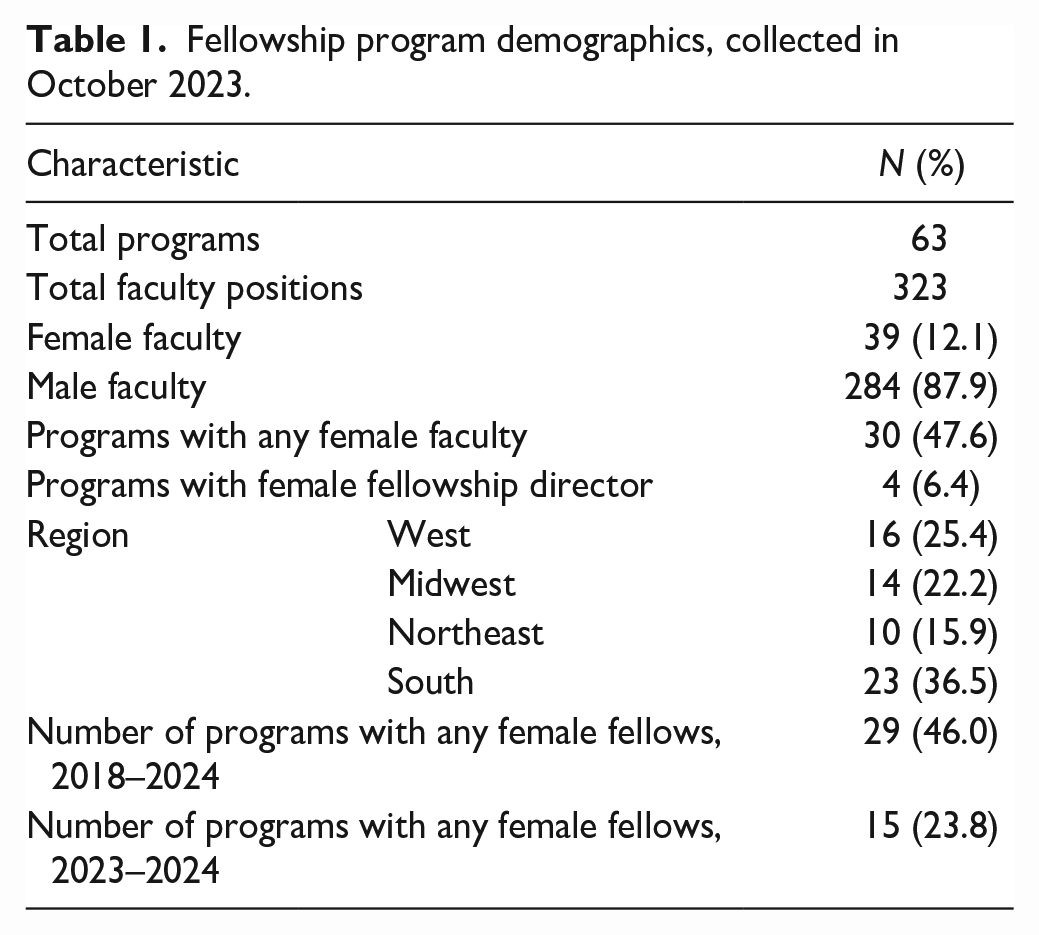
A total of 63 orthopedic trauma surgery fellowship programs with 323 orthopedic trauma faculty (as of October 2023) were identified. One program was excluded due to it being a dual subspecialty fellowship (arthroplasty and trauma). Women constituted 12% (n = 39) of orthopedic trauma faculty overall. A total of 30 (47.6%) programs had at least 1 female faculty member, whereas only 4 (6.4%) programs had a female fellowship director. There were 10 (15.9%) programs in the Northeast, 23 (36.5%) in the South, 14 (22.2%) in the Midwest, and 16 (25.4%) in the West. There was no significant difference in geographic distribution between programs with and without female faculty. Table 1 provides a summary of fellowship program demographics as collected in 2023.
Fellowship program demographics, collected in October 2023.
A total of 399 fellows were identified for the 6-year study period, with an estimated data collection completion rate of 80%, which was inferred by comparison to OTA-provided match statistics. Among the fellows identified, 16.7% (n = 67) were female, with an increase in the representation of female fellows from 10.8% in 2018 to 25.4% in 2024 (R = 0.96, P = .02; Table 2).
Fellow demographics, 2018–2024.
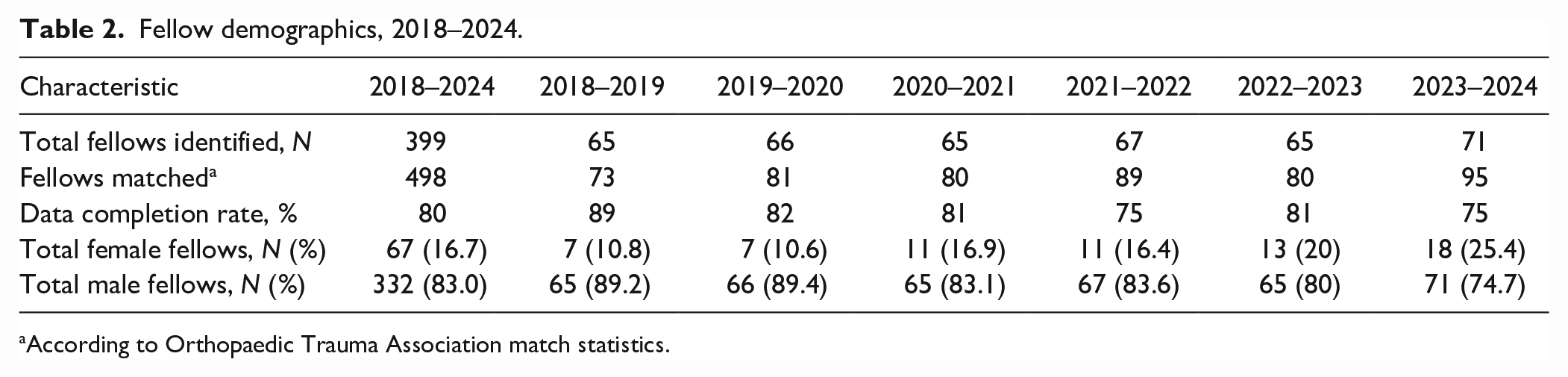
According to Orthopaedic Trauma Association match statistics.
When stratified by presence versus absence of female faculty, fellowship programs with female faculty had a similar proportion of female fellows over the 6-year period compared to programs without female faculty (18.8% vs 13.4%, respectively; P = .06). However, in the latest fellowship year evaluated, 2023–2024, programs with female faculty had a higher proportion of female fellows compared to programs without female faculty (38.2% vs 13.5%, respectively; P = .02). Comparison of fellowship programs with and without female faculty is detailed in Table 3.
Comparison of fellowship programs with female faculty versus without female faculty.
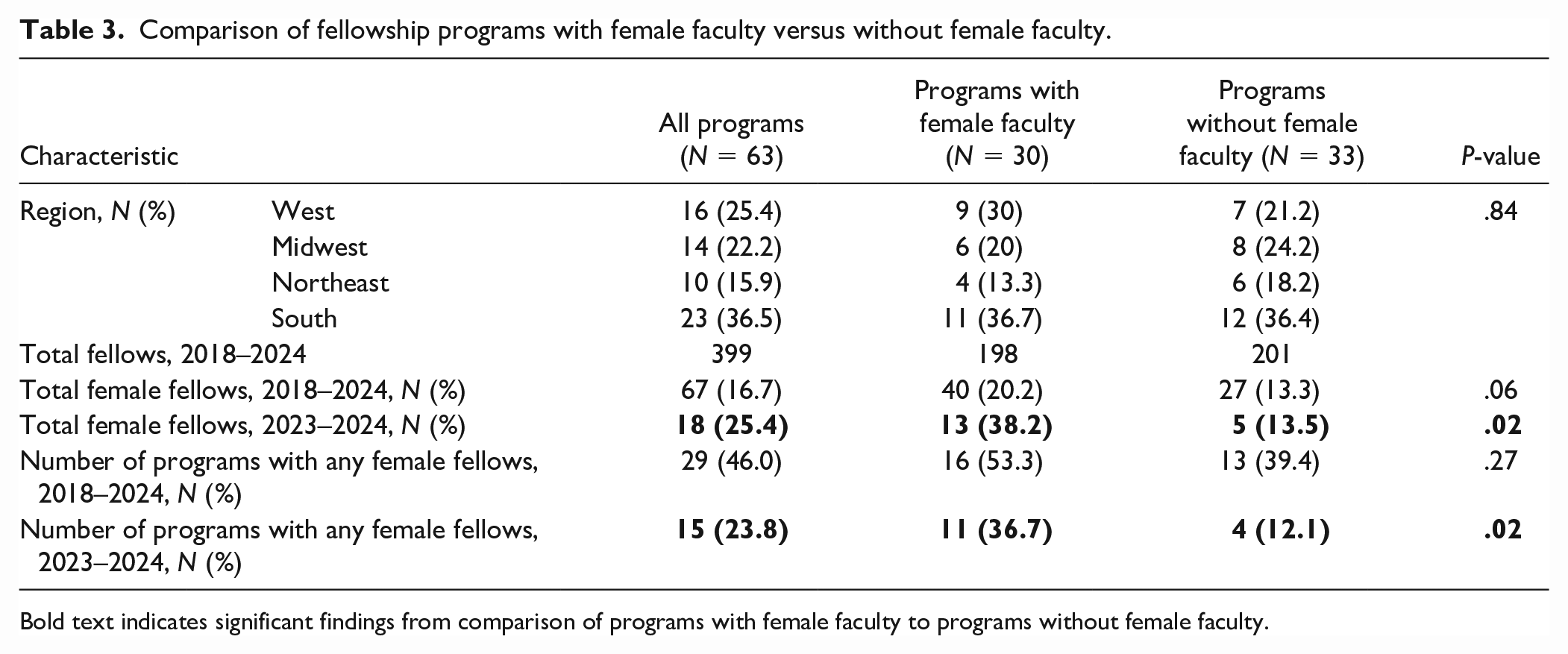
Bold text indicates significant findings from comparison of programs with female faculty to programs without female faculty.
Discussion
In analyzing sex diversity among faculty and trainees in orthopedic trauma surgery fellowship programs, we found that despite women making up only 12% of faculty, they were well distributed across programs: nearly half (47.6%) had at least 1 female faculty member. Only 6.4% of programs had a female program director. From 2018 to 2024, we observed an increase in the number of women entering orthopedic trauma surgery fellowship programs. In the most recent fellowship class year (2023–2024), we observed a higher proportion of female fellows in programs with female faculty.
The strengths of this study lie in its comprehensive analysis of women as recent orthopedic trauma surgery fellows and fellowship faculty. However, there are several limitations to consider. The cross-sectional nature of this study involved a single snapshot of fellowship program demographics and faculty rosters, and we therefore could not account for changes in faculty and leadership at fellowship programs, including the impact of fellow retention, within the 6-year study period. Moreover, given the match system in place, our findings may not fully account for the preferences of trainees or fellowship programs, which limits the ability to draw conclusions from these data. Despite our best efforts, data collection challenges resulted in missing data for several programs, potentially biasing the study sample and findings. As this study focused solely on orthopedic trauma surgery departments with fellowship programs, estimates of female faculty and women in leadership positions other than fellowship director may differ. It is also possible that our study was underpowered to detect differences among all variables. Finally, we inferred sex based on first names (confirmed by Internet search), utilizing binary categories (male/female), and it is possible that misclassifications may have occurred. Future research should consider fellows’ self-identified gender, including non-binary identities.
Although the number and trend of female trainees entering orthopedic trauma surgery fellowship programs are not known given lack of publicly available data for all matched fellows, our findings suggest an upward trend of female orthopedic trauma fellows in the 6-year study period, with a strongly positive correlation (R = 0.96) observed. Prior evaluation of fellowship match rates among female versus male orthopedic residents found that from 2010 to 2014, of 7 orthopedic subspecialties, trauma tied for third from last for percentage of female applicants, at 9%, compared with 9% for sports, 6% for adult reconstruction, and 3% for spine [3]. Interestingly, this study also found that female applicants had higher match rates than men, which introduces the possibility of discrepancy in sex breakdown of applicants who match versus those who do not match. The proportion of female fellows identified in our study was 25.4% in the 2023–2024 fellowship class, and 16.7% when averaged over the 6 classes. A comparison to the previous statistic of 9% further suggests an overall growth of female trainees entering orthopedic trauma surgery fellowship programs.
While previous studies have demonstrated a positive correlation between the presence of female faculty and female trainees, other studies have discounted the influence of female mentorship in women’s fellowship subspecialty choice [2,8 –11,14,16,20]. We found no association between female trainees attending fellowship programs over our study period and the presence of female faculty at those programs, with similar rates of female trainees at programs with and without female faculty. However, evaluation of the most recent fellowship class year, 2023–2024, showed that programs with female faculty had more than double the proportion of female fellows at those programs, suggesting that there may be some influence of female mentorship, whether from the applicant or the program perspective. We speculate that this finding was significant only in the most recent fellowship year perhaps because of the increase in female fellows seen and the resulting increased effect size. At the same time, investigation of the most recent fellowship class year may be the most accurate in answering this research question, given that female faculty were captured for the corresponding year. Nonetheless, this finding suggests that diversifying orthopedic trauma departments and fellowships may be an important element in promoting sex diversity among its applicants.
Female orthopedic trauma surgeons made up only 6.4% of fellowship directors, in contrast to 12.1% of female faculty across all fellowship programs. Prior investigation of fellowship director trends found a similar rate of 7% women among orthopedic trauma fellowship directors in 2020 [12]. A more recent investigation by Silvestre et al [19] found a participation-to-prevalence ratio of 0.8 for women fellowship program directors in orthopedic trauma, falling at the border of what they considered to be underrepresentation (<0.8) versus equitable representation (0.8–1.2) of women. Still, in the rates of female fellowship program directors, orthopedic trauma trails behind other orthopedic subspecialties including oncology (19%), pediatrics (14.6%), hand (12.6%), and foot and ankle (8.2%) [4,19]. However, our finding of an increasing proportion of women entering orthopedic trauma surgery fellowship programs reflects a positive trend that may not be reflected in leadership for years to come, due to the effect of academic seniority and career duration [5,22]. Orthopaedic Trauma Association membership data from January 2024, provided to us for this study, corroborate the growing female makeup of the specialty (Table 4); women constitute 24.9% of candidate members and 11.7% of clinical and active members of the OTA in 2024, compared to 18.7% and 9.1% for these respective categories in 2021 [15]. Murphy et al also demonstrated comparable gender representation among OTA committee members, which they attribute to recent efforts in the OTA to improve its diversity [15,17].
Sex breakdown of OTA members by member type.
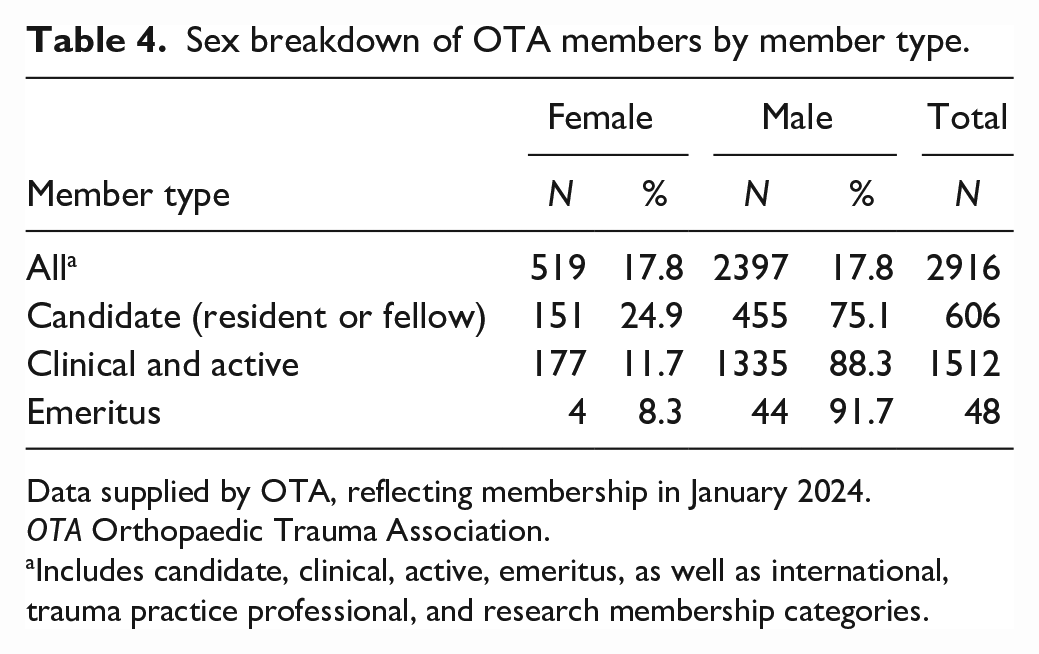
Data supplied by OTA, reflecting membership in January 2024.
OTA Orthopaedic Trauma Association.
Includes candidate, clinical, active, emeritus, as well as international, trauma practice professional, and research membership categories.
In conclusion, this observational study suggests that in recent years an increasing number of women have entered orthopedic trauma surgery fellowship programs and that women surgeons remain underrepresented in orthopedic trauma fellowship director positions. We also observed that, in the most recent fellowship class studied, programs with female faculty had more than twice the proportion of female fellows compared to programs without female faculty. Encouraging diversity within orthopedic trauma departments and fellowship programs may play a vital role in promoting sex diversity among applicants to the subspecialty. Initiatives like Nth Dimensions, the Ruth Jackson Orthopaedic Society, and the Perry Initiative may play crucial roles in fostering sex diversity in orthopedics prior to the fellowship stage [13].
Supplemental Material
sj-docx-1-hss-10.1177_15563316241272424 – Supplemental material for Analysis of Sex Diversity Within Orthopedic Trauma Surgery Fellowship Programs
Supplemental material, sj-docx-1-hss-10.1177_15563316241272424 for Analysis of Sex Diversity Within Orthopedic Trauma Surgery Fellowship Programs by Elizabeth Cho, Samantha E. Bialek and Ashley E. Levack in HSS Journal®
Supplemental Material
sj-docx-2-hss-10.1177_15563316241272424 – Supplemental material for Analysis of Sex Diversity Within Orthopedic Trauma Surgery Fellowship Programs
Supplemental material, sj-docx-2-hss-10.1177_15563316241272424 for Analysis of Sex Diversity Within Orthopedic Trauma Surgery Fellowship Programs by Elizabeth Cho, Samantha E. Bialek and Ashley E. Levack in HSS Journal®
Supplemental Material
sj-docx-3-hss-10.1177_15563316241272424 – Supplemental material for Analysis of Sex Diversity Within Orthopedic Trauma Surgery Fellowship Programs
Supplemental material, sj-docx-3-hss-10.1177_15563316241272424 for Analysis of Sex Diversity Within Orthopedic Trauma Surgery Fellowship Programs by Elizabeth Cho, Samantha E. Bialek and Ashley E. Levack in HSS Journal®
Footnotes
Declaration of Conflicting Interests
The author(s) declared no potential conflicts of interest with respect to the research, authorship, and/or publication of this article.
Funding
The author(s) received no financial support for the research, authorship, and/or publication of this article.
Human/Animal Rights
All procedures followed were in accordance with the ethical standards of the responsible committee on human experimentation (institutional and national) and with the Helsinki Declaration of 1975, as revised in 2013.
Informed Consent
Informed consent was not required for this study.
Level of Evidence
Level IV: cross-sectional, observational study
Required Author Forms
Disclosure forms provided by the authors are available with the online version of this article as supplemental material.

References
Supplementary Material
Please find the following supplemental material available below.
For Open Access articles published under a Creative Commons License, all supplemental material carries the same license as the article it is associated with.
For non-Open Access articles published, all supplemental material carries a non-exclusive license, and permission requests for re-use of supplemental material or any part of supplemental material shall be sent directly to the copyright owner as specified in the copyright notice associated with the article.
