







Abstract
The purpose of this article is to present a gender-sensitized approach to Institutional-Anomie Theory (IAT) that recognizes the pervasiveness and import of gender at the institutional and cultural levels. Drawing on feminist literature, we discuss the gendering of the family and the economy, and the implications of such gendering for understanding the social organization of American society and the “institutional balance of power,” as explicated by Messner and Rosenfeld in Crime and the American Dream. At a cultural level, we propose that the tendency to conceive of men as normative helps reconcile two seemingly incompatible premises in IAT: the claim that there is a dominant form of social organization that characterizes American society and the empirical observation that cultural orientations and institutional involvement actually differ dramatically for males and females. From a social structural perspective, we describe the varying ways that institutions are by their very nature gendered and how the gendering of institutions can promote and sustain economic dominance—a particularly criminogenic institutional order. Based on these insights, we conclude by proposing some testable hypotheses about the interconnections among gender stratification, institutional structure, and societal levels of crime.
Keywords
Introduction
In his Presidential Address to the American Society of Criminology, Richard Rosenfeld (2011) used the metaphor of a pendulum to call attention to a recurrent pattern in the history of criminological thought. He argued that the primary focus of attention in the prominent criminological theories at a given historical moment has swung back and forth between explaining individual involvement in criminal behavior and accounting for variation in aggregate rates of crime. Rosenfeld also lamented the tendency for the pendulum never to stray very far from a distinctively micro-criminological focus. He observed that even research directed toward explaining rates of crime has typically been informed by theoretical perspectives that restrict their analytic focus to the immediate social settings, such as communities or neighborhoods. While acknowledging that there is much merit in individual- and community-level approaches, he went on to issue a plea for “more systematic and sustained attention to the big picture” (Rosenfeld, 2011, p. 2). This “big picture” refers to features of social systems and, more specifically, to the prevailing cultural and social structural patterns that are linked together and manifested in the major social institutions of society.
Institutional-Anomie Theory (IAT) represents an attempt to conceptualize and explain crime with explicit reference to the “big picture” of social systems. 1 The central ideas of the theory were initially advanced by Messner and Rosenfeld (1994/2007) in their book, Crime and the American Dream. The authors set out to account for the comparatively high levels of serious crime observed in the United States with reference to the dominant cultural ethos of the society—the American Dream—and its companion institutional structure—a structure characterized by the dominance of the economy. Moreover, this explanation was formulated with a self-conscious eye toward attaining sociological “completeness” (Messner & Rosenfeld, 1994/2007, p. 57, Chapter 4). Messner and Rosenfeld argued that most of the prior criminological theorizing had highlighted the role of either culture or social structure; a sociologically complete explanation of crime requires that both components of social organization be incorporated systematically in the theoretical framework. IAT accordingly attends to complementary cultural and institutional processes. The subsequent research that has applied and assessed IAT, often with data that extend beyond the boundaries of the United States, has not been entirely consistent, but the accumulated evidence has offered sufficient support to promote continued interest in this macro-sociological perspective. 2
The purpose of the present article is to begin to rectify what we consider to be an important limitation of IAT—its underdeveloped treatment of the concept of gender. Criminological implications of gender are not ignored in Crime and the American Dream, but they are considered only in the context of compatibility of the arguments advanced therein, with the widely observed gender differential in crime—the lower levels of criminal involvement on the part of females than males for most types of offenses. Gender from this vantage point is implicitly treated simply as a demographic attribute, similar to other demographic attributes such as race that can condition the interpretation of the American Dream and influence the level of participation in different institutional roles.
The interpretation of the gender differential in offending that is put forth in Crime and the American Dream is quite plausible, but two interrelated issues arise that have not been yet been adequately addressed. First, we detect an unrecognized tension between the conceptualization of social organization that informs arguments about the overall crime rate and the premises underlying the interpretation of gender differences in offending. The former implies an all-encompassing social organization in society, whereas the latter presupposes pronounced differentiation in cultural orientations and institutional involvement. Second, as currently formulated, the overarching framework of IAT remains “sociologically incomplete” in a critical respect—it neglects a key insight that has been central to much feminist scholarship, namely, that gender is built into the very organization of a society.
In this article, we seek to promote the further development of IAT by incorporating gender into its basic analytic framework. 3 Drawing upon the feminist literature, we argue that culture and institutional structure are themselves gendered in critical ways. Our attention focuses on the two institutional domains wherein the impact of gender is most directly relevant to the theoretically strategic causes of crime—the economy and the family. We maintain that a “gender-sensitized” formulation of IAT is not only more coherent and sociologically complete but also yields some fruitful and potentially testable hypotheses about the interconnections among gender stratification, institutional structure, and societal levels of crime.
The Place of Gender in Crime and the American Dream
IAT evolved from a more modest effort to provide an explanation of a particular case, that is, an effort to formulate a sociological account for the relatively high crime rates observed in the United States in comparison with other advanced post-industrial societies. 4 It is thus useful to begin our elaboration of IAT with a summary of the main arguments in Crime and the American Dream and the application of these arguments to the gender differential in offending.
Reflecting their interest in the “big picture,” Messner and Rosenfeld directed attention to the basic features of the social organization of American society—its dominant cultural orientations and institutional arrangements. They argued that at the cultural level, the ethos of the American Dream generates intense pressures for success, understood largely in monetary terms, while promoting an “anything goes” mentality with respect to the means for pursuing success. Such a combination of cultural goals and means leads to anomie, a situation in which action tends to be governed by considerations of pure technical expediency. The anomic pressures of the American Dream, in turn, inhibit the development of strong internal constraints against crime.
Messner and Rosenfeld (1994/2007) went on to remind us that “culture does not exist in isolation from social structure” (p. 71), and they emphasized that a sociologically complete explanation of crime must incorporate structural conditions as well as cultural orientations. They oriented their analyses of social structure around the concept of the “institutional balance of power.” This concept is intended to capture a paradoxical feature of institutional structure. In any society of appreciable complexity, the major social institutions are interdependent in the sense that the functioning of any one has consequences on the functioning of others. At the same time, institutions can invoke or call forth distinctive orientations and competing obligations. The concrete actors in a society accordingly have to adjudicate among these different orientations and manage competing obligations. The way in which they do so at a collective level can be conceptualized as the prevailing institutional balance of power. Applying this conceptual framework, Messner and Rosenfeld proposed that the distinctive feature of the institutional balance of power in the United States is that the economy tends to dominate the institutional balance of power.
Economic dominance becomes manifested in three principal ways: devaluation, accommodation, and penetration. Devaluation refers to the awarding of inferior prestige and esteem to non-economic roles in comparison with economic roles. Accommodation refers to the prioritizing of the performance of economic roles when role conflicts emerge. Penetration refers to the selection of economic-based (market) frames and logics to interpret situations and guide actions and interactions. Under conditions of economic dominance, non-economic institutions tend to be enfeebled, and they are unable to perform their distinctive functions effectively, functions that include social control and social support. Culture and institutional structure thus complement one another and create conditions conducive to high levels of crime.
Messner and Rosenfeld (1994/2007) proposed that their explanation for the relatively high overall rates of crime in the United States is highly compatible with the well documented finding that females are less likely than males to commit most types of crime. 5 To develop their argument, they cited the prominent gender differential in engagement in familial roles and the implications of this differential for criminogenic pressures. “Women usually perform the bulk of family tasks,” and as a result, they are “less likely to exhibit unqualified support for the values associated with economic achievement and more likely to balance economic values with other values consistent with familial roles” (Messner and Rosenfeld (1994/2007, pp. 87-88). Women, in other words, “interpret the American Dream somewhat differently” (Messner and Rosenfeld (1994/2007, p. 88). They should accordingly be less subject to the anomic pressures associated with this cultural ethos. At the same time, their greater engagement in familial roles implies a degree of “immunity” from the criminogenic institutional forces associated with economic dominance. The lower level of female offending can thus be seen as an outcome of the same kinds of cultural and institutional dynamics as those that are cited to account for the overall rate of crime.
Toward a Gender-Sensitized IAT
Resolving a Theoretical Conundrum: Males as “Normal Subjects”
The theoretical arguments put forth in Crime and the American Dream about differential male and female cultural orientations and institutional participation are logically consistent with the empirical findings about the gender differences in criminal offending in the United States. Yet, something of a conundrum arises upon careful consideration. An implicit premise underlying the core theme of the book (and thus of IAT) is that American society can be usefully conceptualized with reference to an all-encompassing social organization. Cultural orientations are described with reference to the American Dream. Indeed, a defining characteristic of the American Dream is allegedly its universalistic character. Messner and Rosenfeld (1994/2007) observed that “with few exceptions, everyone is encouraged to aspire to social ascent, and everyone is susceptible to evaluation on the basis of individual achievements” (p. 69). In a similar vein, institutional structure is characterized in terms of the institutional balance of power.
However, when considering the gender differential in offending, the logic of the argument actually presupposes considerable particularism rather than universalism. 6 Women allegedly interpret the American Dream differently than do men, and their performance of institutional roles does not conform to the pattern associated with economic dominance in the institutional balance of power. This seems rather curious at first glance. In what sense is it possible or fruitful to speak of a prevailing cultural ethos such as the American Dream and an institutional balance of power tilted toward the economy, if the corresponding characterizations do not apply to more than half of the population? Surely this cannot be dismissed as involving merely a “few exceptions.”
This theoretical conundrum can be resolved by distinguishing between the prevailing cultural rhetoric and a gendered social reality. The idealized rhetoric of the American Dream is invariably enunciated in universalistic terms. For example, former President Bill Clinton, in a speech to the Democratic Leadership Council in 1993, expressed the ideal of the American Dream as follows:
The American dream that we were all raised on is a simple but powerful one—if you work hard and play by the rules you should be given a chance to go as far as your God-given ability will take you. (J. L. Hochschild, 1995, p. 9)
Clinton’s observation does contain a kernel of truth. At a rhetorical level, Americans are all raised on the promise of the American Dream. Yet, as noted, the American dream is experienced and perceived differently by women on a number of levels. There are gender differentials in interpretation of the American dream, differentials in structural opportunities to achieve the underlying goal of material success, and differential consequences for those unable to realize economic goals.
But how can the idealized, rhetorical version of the American Dream coexist with distinctively particularistic experiences in everyday life? This contradiction between rhetoric and reality is tied to the tendency in the United States to see men and their experiences as normative. Men are the normal subjects, and expectations for women lie somewhat outside of the dominant cultural frame. In her incisive monograph on the American Dream, Jennifer L. Hochschild (1995) described this curious cultural phenomenon quite nicely. She noted that when it comes to the American dream, “those who do not fit the model disappear from the collective self-portrait” (J. L. Hochschild, 1995, p. 26). As a result, their voices are largely silenced in the broader cultural conversation. There is accordingly a genuine sense in which IAT faithfully depicts core features of the dominant social organization of American society, but this is a social construction in which females—a numerical majority in the population—are largely invisible. 7
Gender and the Institutional Balance of Power
Although IAT captures important aspects of the dominant social organization of American society, it has a conspicuous blind spot with respect to gender that we identified earlier. The theory as currently formulated treats “gender” as a socio-demographic attribute of individuals that is exogenous to the institutional structure. To be sure, it is a consequential attribute, because it influences how actors perceive the messages emanating from the culture and how these actors enact institutional roles. However, feminist literature conceptualizes gender more broadly as an organizing principle in society. Its influence extends beyond the sorting of people into institutional roles. Rather, gender is embedded in the very structure of institutions that are built and maintained on gendered ideology and symbolism, and populated by gendered actors who have differential rates of institutional participation (Acker, 1990, 1992; Britton, 2000).
When theorizing about social institutions, a potential pitfall is the unintended depiction of them as abstract, disembodied structures. This can occur in two key ways. The first is by failing to address how concrete actors operate within these spaces. IAT attempts to avoid this pitfall by the self-conscious effort to view institutions as they are practiced by individuals—as reflected in the enactment of institutional roles in everyday interactions. A second way that institutions can be inadvertently disembodied from reality is through the failure to acknowledge that ostensibly neutral spaces are in fact gendered spaces (Acker, 1990). 8 A consequence of this seemingly neutral depiction is that numerous societal outcomes for men and women are attributed either to differences in individual status attributes, that is, to gender differences among persons, or to overt gender discrimination, while ignoring less visible institutional influences. Gender segregation of occupations is one such outcome, as well as the unequal gender division of unpaid household labor. Occupational prestige differentials and wage inequality, also tied to occupational segregation, are created in part through organizational structures, through which institutions are enacted (Acker, 1992).
A study conducted by Davey (2008) serves to illustrate one micro-level dimension of this framework. Interviews with nine women in male-dominated occupations, including engineering and information technology, show that gender discrimination was not seen by the women as a barrier in their career; however, they felt disadvantaged by political games taking place within their workplace. Organizational politics, which are “masculine in character,” act as a career impediment for the women, who identify “political approaches as being unfeminine, alien, immoral and irrational” (Davey, 2008, p. 663). Davey (2008), working within the framework of gendered institutions as put forth by Acker, noted that workplace politics are gendered micro-processes, in direct contrast to the “fantasies of rational, centrally managed and benign organizations” (p. 651).
Consequential for IAT is the role gendered institutions play in producing and promoting pervasive cultural images of gender. The organizational structures that emerge in a gendered institutional order are highly consequential for the development and maintenance of a person’s gender identity (Acker, 1990), which has implications for involvement in criminal behavior. For example, Macmillan and Gartner (1999) noted that employment has symbolic meaning beyond its role in producing material resources. Citing several studies, they argue that employment has “crucial symbolic importance for identities, self-esteem, and mental health” (Macmillan and Gartner, 1999, p. 947), particularly in terms of men’s construction of masculinity. Their study, based on data from a national survey of Canadian women, found that women’s employment lowers their risk of spousal abuse if their husband is employed, but significantly increases it when their partner is not employed because “where a man lacks this sign of dominance, violence may be a means of reinstating his authority over his wife” (Macmillan and Gartner, 1999, p. 949). In a similar vein, Messerschmidt (1993) hypothesized that when opportunities for economic success are blocked, men are pressured to find other outlets to achieve their masculine status. Aggression and violence are alternative ways for men to signify their desired masculinity. Similarly, as Miller and Mullins (2006) observed, women’s involvement in crime reflects the ways in which gender organizes their daily lives, and structures their experiences and identities.
Recognition that society is populated by gendered actors within a gendered institutional structure calls for an expanded conceptualization of the institutional balance of power. The balancing of competing claims and requisites of the social institutions that fulfill the various functions in society (e.g., the economy, family, polity) by concrete actors will be conditioned by, and will reproduce, shared understandings of gender. We can illustrate some of these processes with reference to the principal manifestations of the type of institutional structure hypothesized in IAT to be highly criminogenic—“economic dominance.” Our illustration focuses on the interplay between the two social institutions that are gendered in particularly prominent ways—the economy and the family. We organize our discussion with reference to the principal manifestations of economic dominance: devaluation, accommodation, and penetration.
Devaluation
The relative evaluation of economic and familial roles provides perhaps the most obvious instance of the contemporary gendering of social institutions. The economy and family are organized around gendered ideals, although this was not always the case. Prior to the late 1700s in the United States, market work and domestic work were not sharply divided. The restructuring and division of these institutions led to a corresponding change in understandings of gender, resulting in the ideological association of dominant forms of masculinity with the economy and dominant forms of femininity with the family (Williams, 2001).
Williams (2001) termed this the structure of “domesticity” and noted that it is premised on the notion that men and women are naturally designed to fulfill the roles of market and home, respectively, because of their innate characteristics. Men are accordingly assumed to be “competitive and aggressive,” while women are believed to have a “‘natural’ focus on relationships, children, and an ethic of care” (Williams, 2001, p. 1). Historian Christine Stansell wrote along similar lines:
In eighteenth-century Europe and early nineteenth-century America, a striking rearrangement of gender identities and stereotypes occurred. To men were assigned all the character traits associated with competition: ambition, authority, power, vigor, calculation, instrumentalism, logic, and single-mindedness. To women were assigned all the traits associated with cooperation: gentleness, sensitivity, expressivism, altruism, empathy, personalism, and tenderness. (cited in Williams, 2001, p. 23)
Under the cult of domesticity, the binary division of gender roles became inseparably linked with the division of the public and private domains (Rotman, 2006).
Despite the influx of women into the market realm since the 1950s, this gendered ideology continues to permeate the two institutions, although less overtly now than in the past (Bianchi, Robinson, & Milkie, 2006). It is thus not surprising that males continue to occupy the dominant positions in the economy, while women are more likely to be relegated to lower status and less financially rewarded occupations if they are in the labor force (Cohen & Huffman, 2003), or to be out of the labor force completely and heavily involved in the familial domain performing caregiving functions (Bianchi et al., 2006). Given the greater valuation of men over women in prevailing gender ideology (Connell, 1995) and the equating of men with the economy and women with the family, it is also not at all surprising that the “masculinized,” economic institutional domain receives greater prestige and esteem than the “feminized,” familial domain. Non-economic, familial roles are not merely devalued with respect to prestige and esteem; in the United States, the performance of non-economic familial roles is devalued in the sense that such labor is also not compensated materially (Crittenden, 2010; Elson, 1999). Indeed, to a large extent, the gendering of the economy and the family serves as a cultural pillar for the “devaluation” aspect of economic dominance.
Accommodation
IAT is predicated on the premise that there are identifiable functional requisites that must be met for any society to persist over time. 9 Indeed, the major social institutions are differentiated precisely on the basis of the core functions that they fulfill. According to this conceptualization, the economy refers to the set of institutional arrangements that allow the members of a society to adapt to the environment. Such adaptation requires the production and distribution of goods and services. The economy thus ensures that the basic material requirements for human survival are met—food, clothing, and shelter. The institution of the family, in contrast, bears responsibility for the literal reproduction of society. This requires the care and nurturance of offspring—bringing in the new generations, as well as the care of other persons who are dependent for one reason or another. When institutional claims are in competition, there are strong pressures to prioritize the claims of the economy. In the United States, many of the pro-family policies that provide some protection from the vicissitudes of the market in other nations are lacking, and as a result, the viability of the family—in a strict material sense—depends heavily on performance in the labor market.
Given that the functions associated with both the family and the economy must be met for societal survival, the characterization of the “accommodation” element of economic dominance in IAT is incomplete if not somewhat misleading. At an institutional level, familial roles cannot be sacrificed to any considerable extent in favor of economic roles. The failure to meet the functions performed by the family would presumably doom any society in short order; yet at the same time, the livelihood of families also depends on market performance. As put by Kaufman and Uhlenberg (2000), “Children require care, supervision, and nurturing. They also require the expenditure of money for such things as food, clothing, shelter, health care, education, and entertainment” (p. 943). Thus, it appears that the balancing of the respective roles occurs at the level of individual actors, for whom the distribution of responsibility for these roles is gendered in the sense that cultural allowances for accommodating economic roles in place of family responsibilities are more readily available for men than for women.
In addition, men are not only more likely to be freed from the responsibilities of housework and the caregiver role (Bianchi, Milkie, Sayer, & Robinson, 2000; Bianchi et al., 2006; Davis & Greenstein, 2009; Evertsson & Nermo, 2004; Kulik, 2011) but also continue to experience disproportionate pressure to be good providers. Christiansen and Palkovitz (2001) note that, “The image that a ‘good father,’ is first and foremost a ‘good provider’ lingers despite the changing culture of fatherhood” (p. 96), perhaps explaining why men who become fathers may actually increase the amount of time they devote to the paid labor market (Eggebeen & Knoester, 2001; Glauber & Gozjolko, 2011; Kaufman & Uhlenberg, 2000; Lundberg & Rose, 2002). It appears that when men take on the responsibility of parenting, their pressure to be economically successful increases, as does their devotion to that goal. In contrast, women experience a marked decline in hours devoted to the paid labor force when they have children (Kaufman & Uhlenberg, 2000), as well as an increase in the number of hours devoted to housework upon both entering marriage and having children (Bianchi et al., 2000).
There are social structural as well as cultural reasons that men and women continue to fall into these gendered roles—for instance, research has documented a wage penalty for women who become mothers (Avellar & Smock, 2003; Budig & England, 2001; Gangl & Ziefle, 2009; Staff & Mortimer, 2012), while men experience the opposite, an increase in wages upon fatherhood, known in the family literature as the fatherhood bonus (Glauber, 2008; Killewald, 2012)—although, notably, there is variability in regard to the fatherhood bonus based on race, class, and the residential status of the children. As a consequence of social pressures and incentives, justifications and neutralizations for abdicating domestic responsibilities are more readily available for men than for women. These justifications may be tied to the underlying pressures of gender display. Gender display is a perspective that depicts housework and child care as a symbolic enactment of gender relations. An example of gender display is the finding that among married couples where the wife makes more money than the husband, couples seem to compensate for the deviation from typical gender earnings by a more traditional division of unpaid housework (Bittman, England, Folbre, Sayer, & Matheson, 2003).
It is precisely the gendering of the economy and the family that ensures that economic and familial roles will be performed, thereby meeting the needs of society at large, with differential levels of involvement and accommodations by women and men. The allocation of primary responsibility for the caregiver role to women, in combination with an economy that is not designed to accommodate additional external responsibilities such as child care, implies the following: (a) a high level of dependency of women on men, or on public resources if they remain out of the paid labor market; (b) the need for women to take on the “double shift” and the associated handicaps in the economy if they take on the caregiver and the provider role (A. Hochschild & Machung, 1989); or (c) the postponement or forgoing of a family and the associated responsibilities (Bianchi et al., 2006). In short, gender stratification has a powerful influence on the myriad ways in which concrete actors in society actually “accommodate” their role-performance repertoires in response to the imperatives of the market economy.
A potential solution for balancing the work-family divide that cannot be overlooked is through the outsourcing of chores and child care responsibilities. For instance, Treas and De Ruijter (2008) found that 95% of the couples in their study spent money on household tasks during the year, the majority spending money on meals out or laundry services. This point ties back to IAT’s recognition that the United States is relatively devoid of pro-family social programs in contrast to other post-industrial nations. Not only does the absence of these programs leave families vulnerable to market conditions but also amplify the gendered nature of accommodation, to the detriment of women who absorb the penalties tied to the double shift and the balancing of work and family. Policies such as public child care provisions and universal and paid parental leave have the potential to eradicate some of the gendered divisions of labor that are still in place; although, notably, cultural pressures concerning gender expectations persist, and studies have shown that work-family policies may actually exacerbate these gender divides depending on how they are implemented (Bergman, 2009; Haas, 2003; Ray, Gornick, & Schmitt, 2008).
Penetration
The gendering of social institutions is also relevant to the third manifestation of economic dominance—penetration. Penetration refers to the selection of economic-based (market) frames and logics to interpret situations and guide actions and interactions. In his 2011 Presidential Address, Messner (2012) elaborated the micro-level processes associated with this feature of economic dominance at the institutional level. His arguments draw upon Wikström’s (2010, 2011) Situational Action Theory (SAT) and elements of the Model of Frame Selection (MFS) put forth by Kroneberg and colleagues (Kroneberg, 2006; Kroneberg, Heintze, & Mehlkop, 2010).
According to SAT, morality plays a critical role in understanding crime because it can serve as a “filter” preventing a criminal deed from being an “action alternative” for an actor. In a literal sense, morality can function to make crime “unthinkable”; it is something that a person never contemplates. Insofar as crime does enter into the actor’s deliberations, she or he might still refrain from crime through a rational calculation of costs and benefits, and through the exercise of self-control to bring behavior in line with the cost–benefit assessment. Nevertheless, from the vantage point of SAT, morality ultimately serves as the first line of defense by effectively restricting the range of situations to which rational, cost–benefit calculations will be applied.
The MFS helps explain the cognitive processes through which such moral “filtering” comes about. These processes involve the actor’s definition of a situation (the selection of frames to interpret what is going on) and the activation of “scripts” that “provide guidance on how to behave in a situation defined in a particular way” (Messner, 2012, p. 13). Under conditions of economic dominance, actors are inclined to define a wide range of situations as market-like situations. They thus tend to select utility-maximizing, calculating frames when defining situations, and they invoke market-friendly scripts as ready-to-use programs to guide behavior. Given the logic of SAT, such cognitive processes increase the likelihood of crime because “it will be less likely that criminal behavior will be excluded from the realm of action alternatives and be literally unthinkable” (Messner, 2012, p. 14). In this way, the penetration of the logic of markets into social life more generally tends to weaken the restraining capacity of the moral filter and thus increases the likelihood of crime.
Feminist scholarship provides compelling reasons for anticipating pronounced gender differences in the cognitive processes associated with the “penetration” element of economic dominance. Because the economic domain is constructed as a “masculinized” space (at both an institutional and cultural level), market frames and logics are much more likely to become firmly entrenched and internalized as a part of men’s gender identity. Moreover, when certain orientations are part of someone’s identity (as it is tied to gender), it is much more engrained and thus habitual and “naturalized.” This should lead to an increased probability that men will activate market-based frames and scripts in non-market situations, and given the logic of SAT and IAT, they should exhibit comparatively high levels of criminal involvement as a result. 10
The situation confronting women is different. Women are typically expected to carryover their “family relationship characteristics” into the market domain, but this may be to their detriment. Many of the traits that characterize the successful performance of economic roles in the market are conceived of as counter-stereotypical behavior for women, thus minimizing the likelihood that women will engage in these types of behavior—particularly given that women are conscious of lower social evaluations that may result when they transgress stereotypically “feminine” boundaries. For example, in an experimental design with 59 participants, Amanatullah and Morris (2010) found that women purposefully curtail their assertiveness when they are negotiating for self-serving purposes; yet when they are negotiating for the good of others, they are just as assertive as the men, suggesting that women are free to be assertive as long as they stay within the boundaries of stereotypically “feminine” characteristics of embracing a more cooperative, group-centered approach. Along similar lines, Rudman (1998) observed that “it may be that self-promotion is less acceptable for women because independence and self-focus are less acceptable for women” (p. 642).
In short, “bringing in gender” enriches our understanding of how economic dominance in the institutional balance of power is actually experienced and enacted by concrete actors in American society. 11 Gender is inextricably intertwined with the relative evaluations of institutional roles, especially with respect to the economic and familial domains, and to the performance of such roles. Prevailing notions about gender also provide the cultural raw material from which personal identities are constructed. These identities in turn influence the ways in which institutional claims and responsibilities are perceived and interpreted, which ultimately shapes the relative levels of crime and the distinctive pathways to criminal offending for men and women.
Putting a Gender-Sensitized IAT to Work: Gender Stratification, Institutional Structure, and Cross-National Variation in Crime
We have argued that IAT can be substantially enriched by moving gender from the margins of the theoretical framework to its theoretical center. Our overarching claim is that the hypothesized criminogenic condition of economic dominance in the institutional balance of power, with particular regard to the interconnections between the economy and the family, cannot be adequately understood without attending systematically to the myriad ways in which gender pervades these institutions and shapes the actors who embody them. The basic logic of our argument implies that the gendering of the economy and the family, combined with the higher valuation of men over women, virtually guarantees economic dominance wherever those types of structures and ideologies exist. However, we anticipate that the degree of economic dominance is likely to differ across contemporary market capitalist societies, reflecting the historical context and the nature of the prevailing gender stratification. It follows that the defining features of gender stratification should also be systematically related to the levels and patterns of crime. In this concluding section, we draw upon our gender-sensitized formulation of IAT to speculate about how shifts away from traditional patterns of highly segregated gender roles might reinforce or mitigate the criminogenic pressures associated with economic dominance in the institutional balance of power. Our point of departure is the vibrant debates in the general criminological literature on the consequences of women’s greater involvement in the market economy on female offending and the gender gap in crime.
Changing Gender Roles and Crime
Systematic interest in the impact of changing gender roles on crime was stimulated by the work of Simon (1975) and Adler (1975) on the potentially criminogenic consequences of “women’s liberation.” Adler proposed that as women increasingly entered male economic domains such as the market economy, they would become more masculinized and accordingly would commit more crime. Simon (1975), in contrast, took an opportunities approach, suggesting that as women moved from the domestic sphere to the public domain in greater numbers they would have more chances to commit crimes in their day-to-day lives than in prior times.
The liberation hypothesis generated a great deal of controversy when it was introduced in the mid 1970s, and important challenges have been directed to its underlying claims. There is consensus on one point: The “processing” of women through the criminal justice system has increased, at least in the United States. Rates of imprisonment for women have risen more than men’s in the last several decades (Heimer, Johnson, Lang, Rengifo, & Stemen, 2012)—the percentage of women in prison has increased from 3% to 7% since 1970—and women now represent slightly under 20% of people supervised by the criminal justice system (Bloom, Owen, & Covington, 2004; Harmon & O’Brien, 2011). However, despite these changes, some scholars have been skeptical of the premise that the gender gap in offending has changed since the emergence of the women’s movement (Schwartz, Steffensmeier, & Feldmeyer, 2009; Schwartz, Steffensmeier, Zhong, & Ackerman, 2009; Steffensmeier & Allan, 1996; Steffensmeier, Zhong, Ackerman, Schwartz, & Agha, 2006).
One reason for such skepticism is the discrepancy between the official statistics and self-report data (Schwartz et al., 2009; Steffensmeier et al., 2006). Evidence of a stable gender gap in self-report data lend itself to the inference that the trends in the official statistics are likely to be a result of changes in crime control policy rather than criminal offending. Some have further argued that the inference of stability is supported by the triangulation of data, including longitudinal measures of victim reports, arrest records, conviction records, and records of admission into prison. Further, the data show that for the most serious offenses—rape, robbery, and homicide—women’s rates have not been rising and there has been little change in the gender gap (Schwartz et al., 2009). In contrast with this position, Lauritsen, Heimer, and Lynch (2009) contend that trends in the Uniform Crime Report and National Crime Victimization Survey are actually quite similar, which suggests that there have been changes in behavior over time, and that these trends are not just a result of policy change. The data further show that the reduction in the gender gap in crime is a result of greater declines in male rates of violent crime in the late 1990s, rather than increases in the level of violent crime committed by women. Women’s rates of violence also declined, but not to the same degree as men, leading to the overall reduction in the gender gap for assaults. These divergent interpretations, based on the same data, are likely a consequence of methodological choices (see Heimer, Lauritsen, & Lynch, 2009; Schwartz et al., 2009 for a full discussion).
The claim that women have gained levels of equality has also been the focus of criticism among scholars who argue that the economic position of many women has declined in recent decades with the “feminization of poverty” (Chesney-Lind, 1986; Steffensmeier & Allan, 1996). A further empirical counterargument to the liberation hypothesis is that “women who commit the bulk of crime cannot be reasonably characterized as liberated and independent” (Hunnicutt & Broidy, 2004, p. 133). Rather, such women tend to fall into the economic margins of society. Last, scholars have argued that the increases in women’s offending are not tied closely to increases in workplace offenses—as would be suggested by an opportunities approach.
More recently, researchers have attempted to resolve the paradox that women have experienced greater emancipation in some domains while simultaneously encountering considerable economic marginalization. This resolution derives from recognition that an underlying assumption in the initial discussions of female liberation is faulty, namely, that as women enter the workforce they will achieve economic parity with men. The reality is much more complicated, where numeric gains in the labor force have not necessarily equated to economic gains, in large part due to the gendering of institutions. Nearly 60% of women were employed in the labor force as of 2007, a significant increase since 1900, when only 19% of women were employed (http://www.prb.org/pdf08/63.2uslabor.pdf). Nevertheless, women tend to be funneled into lower paying, less secure jobs than men, and they disproportionately work part-time jobs that offer few benefits. As noted by Hunnicutt and Broidy (2004): “Liberation might bring rewards for those women who achieve professional and monetary success, but quite possibly has negative consequences for women who remain in traditional female roles” (p. 135).
The critiques and evolving discourses about changing gender roles and criminal offending in the United States sustain two interrelated conclusions particularly relevant to present purposes. One, the impact of the sizable increase in women’s participation in the market economy on female offending and on the gender gap in crime in the United States has been rather limited to date, certainly much less than anticipated in the original formulations of the “liberation” hypothesis. Two, the influence of the growth of women’s participation in the economic roles on crime is complex and contingent on other features of gender stratification in society. This raises the question of what types of reconfigurations of gender roles and gendered institutions might lead to appreciable changes in the levels of female offending, as well as male offending. Drawing upon our gender-sensitized version of IAT, we suggest that the answer to this question requires extending the focus beyond women’s involvement in the economic realm—the focus of the research inspired by the liberation hypothesis—to encompass men’s involvement in the family as well.
An Interactive Model of Gendered Institutional Participation and Crime
The basic premise in our elaborated version of IAT is that the criminogenic condition of economic dominance in the institutional balance of power is promoted and sustained by traditional gender roles and the structuring of social institutions in accordance with these roles. It follows that in a society with a market capitalist economy, economic dominance would presumably diminish (a) to the extent that the content of economic and familial roles becomes less aligned with privileged “masculinity” and devalued “femininity”; and (b) to the degree that the “sorting” of actors into these role—breadwinner and homemaker—becomes less dependent on gender. We suspect that the second type of social change is likely to be a requisite for the first. The gendered ideologies and symbolism permeating the workforce and familial roles in virtually all contemporary advanced societies have been deeply rooted in longstanding cultural understandings and are thus not readily transformed (Bianchi et al., 2006). Nevertheless, as social actors encounter experiences that challenge these understandings, such as when women become increasingly involved in the market economy and men assume more familial obligations, cultural orientations can shift, and institutional roles can be reconfigured.
This reasoning leads us to propose a model of female offending that entails a statistical interaction between the level of women’s participation in the economy and men’s participation in the family realm (see Figure 1). The positive path on the arrow indicates that an increase in women’s participation in the market economy is expected to promote higher female offending insofar as this occurs in the absence of other changes in the institutional order. This prediction is grounded in the insight that the simple movement of women into the economic realm is likely to be insufficient by itself to stimulate a reconstitution of the institutional roles of the economy and the family, precisely because of gendered differentials in power. Women come from a position of less power and prestige in comparison with men, and they have limited resources to enact significant social change—they are already disadvantaged due to a wide range of barriers, including stereotypes and discrimination. Accordingly, when women enter the workforce, all other things being equal, they are more likely to adapt to and confront the disadvantages of the double shift than to transform the institutional roles. They will thus be more fully exposed to the anomic pressures associated with economic dominance in the institutional balance of power. 12
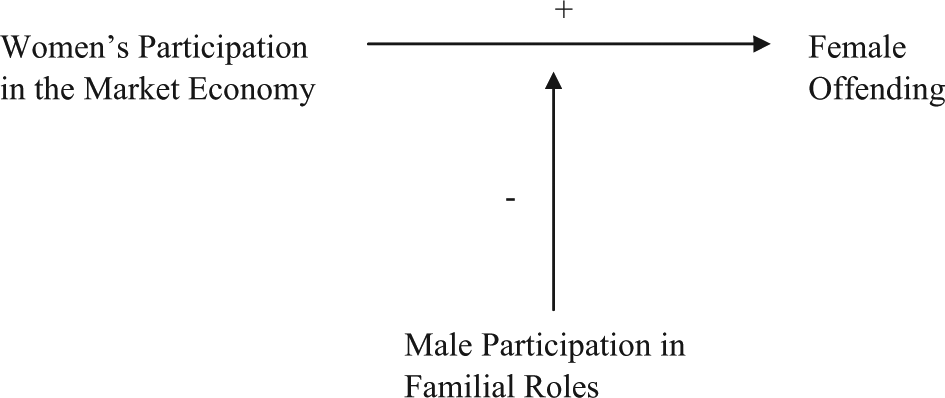
An interactive model of gender differentials in institutional participation and female offending.
We also hypothesize, however, that as women’s involvement in the economy increases, changes in female offending will also be contingent on the degree of men’s involvement in the family. If men increasingly participate in household labor, child care, and nurturing more generally, this shift would have the potential to signify, stimulate, and sustain important cultural changes. The movement of men into nurturing roles should lessen the gender divide into opposites by bringing the prestige of their gender into these roles. The devaluation of care-work should consequently diminish, which should in turn translate into greater value placed on women more generally. Moreover, the enhancement of the cultural valuation of women might very well create the requisite social conditions under which the movement of women into the economy can have an impact on the restructuring of economic roles. With higher valuation, women entering the economic realm would be better positioned to realign the economic institutional roles rather than having to adapt to them, thereby “resetting” the institutional balance of power. These processes are represented by the negative path in the interactive model. The literature inspired by the work on “women’s liberation” and crime has focused primarily on potential increases in female offending associated with changing gender roles and the impact of such increases on the gender gap in crime. Our theoretical perspective implies that male offending is also likely to be affected by changes in gender stratification. Once again, we predict that levels of gender-specific offending—in this case, male offending—will reflect an interaction between women’s participation in the economy and men’s participation in familial roles. Indeed, our interactive model for males is analogous to that for females (see Figure 2).
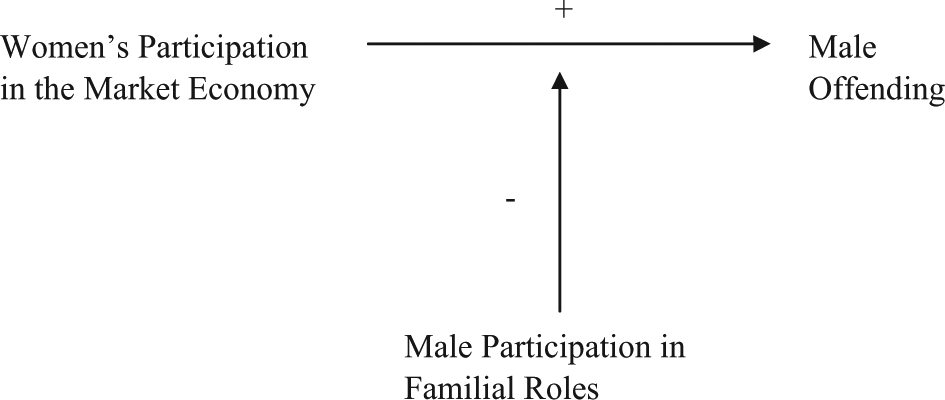
An interactive model of gender differentials in institutional participation and male offending.
The model implies that absent other changes in the institutional order, the movement of women into the economy is expected to promote higher levels of male offending, similar to the effect predicted for female offending. We anticipate that this effect will emerge as a result of weakened social control. As women are forced to balance both financial and familial responsibility, the capacity of the family to fulfill its socialization functions (especially those associated with crime prevention) will decrease. These criminogenic processes should be less likely to emerge, however, to the extent that men have become more heavily involved in familial roles. As men increasingly devote time and energy to the family, the strains associated with a “double shift” should be alleviated. Perhaps even more importantly, the increased participation of men in familial roles will signify enhanced valuation of the institution of the family, which is likely to be accompanied by shifts in the dominant cultural understanding of masculinity and femininity.
Comparative and Historical Predictions
Our interactive models imply several intriguing predictions about the relationships between the gendering of institutional engagement and the overall level of crime and the gender gap in crime, across space and over time. Comparatively, we expect that the overall crime rate will be especially high in nations where women and men are both prominent in the economy, but only women are prominent in the family. These are the conditions under which economic dominance is likely to be intensified for the reasons enumerated above, with criminogenic consequences for both women and men. In contrast, in nations where women are prominent in the family but relatively isolated from direct participation in the market, while men are prominent in the economy, the gender gap in offending should be particularly large. Under these institutional/cultural conditions, men and women are modeled as opposites designed to serve complementary functions (Haas, 2003), and the “buffering effects” of intensive engagement in the family will be especially strong for women. At the same time, although familial roles may be devalued because of their association with women, the overall crime rates may still be tempered by familial socialization and social control if women can devote more of their time to the family rather than being pulled in two directions between the economy and family responsibilities. A remaining possibility is that both women and men are prominent in the economy and in the family. Under these institutional conditions, overall crime rates should be the lowest because the tendencies toward economic dominance should be attenuated. These gender work-family configurations are depicted as ideal types; at this point in history, we would expect to see countries falling more on a continuum of prominence or participation by gender, rather than clear-cut, categorical differences.
In addition to research based on cross-sectional data, our theoretical reasoning implies dynamic relationships that should be amenable to testing, at least in principle. We suggest that changes in female and male involvement in the economy and the family are likely to generate a curvilinear trajectory for crime rates during periods of changing gender roles. A common pattern is likely to be that the entry of women into the labor force on a large scale will not initially be accompanied by a corresponding movement of men into the family realm because of the strong cultural underpinnings of the traditional gendered division of labor. Accordingly, the impact of the greater involvement of women in the labor force should lead at first to rising crime rates as women adapt to the economic institutional roles, internalize market logics, and potentially disinvest to a certain degree in the family as they struggle to balance paid and unpaid labor. Over time, the rise in crime rates is likely to be tempered, stabilized, and eventually reversed as men become more heavily involved in the familial realm and women become valued more on par with men. Research by Messner, Pearson-Nelson, Raffalovich, and Miner (2011) reports that the trends in homicide rates for many nations in the middle to latter years of the 20th century do in fact exhibit this type of curvilinear trajectory. An interesting question for future research is whether the “timing” of the rise and fall of homicide rates in different nations can be linked with changing involvement of women in the economy and men in the family in accordance with our theoretical predictions.
We recognize that there are significant challenges that must be confronted to test these predictions. Whereas indicators of women’s involvement in the market economy can be located in readily available secondary sources and have been used in prior research (e.g., the share of the total labor force that is female; the female labor force participation rate; and the average number of hours per week women spend in employment), measures of gender differentials in participation in familial roles are more difficult to obtain for appreciable samples of nations over extended periods of time. A promising data source that might serve this purpose for future research is the International Social Survey Programme, which has been used in numerous studies to assess gender and household labor in a cross-national context (e.g., Forste & Fox, 2012; Ruppanner, 2008). Individuals across 31 countries were asked to report on their own and their partner’s housework contributions. These data and similar sources might provide a foundation for measuring the degree to which men have assumed household and familial responsibilities in relation to women.
Conclusion
We have argued that a distinctively macro-level criminological theory, IAT, can be enriched substantially by incorporating insights from feminist perspectives on the multifarious ways that gender is built into the basic organization of society. Our arguments have focused specifically on the ways in which gender differentials in institutional engagement in the economy and the family, and concomitant cultural understandings of gender, can either promote or intensify pressures toward economic dominance in the institutional balance of power, or conceivably mitigate these pressures. The core of claims of our elaboration of IAT can be represented in parsimonious models that stipulate interactive effects of women’s participation in the market economy and men’s participation in familial roles.
We acknowledge that the scenarios depicted in these models do not represent the only logical possibilities. For example, changes in notions of male responsibility need not inevitably lead to greater valuation of women. Historically, in the United States, the movement of men into traditionally “feminine” fields has not correspondingly lifted the valuation of women. Rather, the definition of what is normatively “masculine” and “feminine” has been altered in a way that maintains the existing power dynamic (Seidman, 2010). This cultural shift may leave structural inequalities in place, even as stereotypes are modified. Yet the movement of men into the caregiving domain may have a rather unique potential to pave the way for enhanced valuation of women as men gain experience with the utility of “feminine” traits in the performance of familial roles.
Another logical possibility is that increased participation of men in the caregiving role will lead to a transformation in the institution of the family rather than alter notions of gender ideology. Hays (1996) anticipates this possibility when questioning why parenting itself has not become more aligned with the logic of the marketplace. “Given the power of the ideology of the marketplace,” she notes, “a more logical (and cynical) solution [to the demands of mothering] would be an ideological revolution that makes tending home and children a purely commercial, rationalized enterprise, one in which neither mother nor father need be highly involved” (p. 5).
Why do we propose that the orientations associated with familial roles will transform the internalized economic logics tied to men as they become more heavily involved in the family, rather than the other way around? A basic reason is that the very nature of the tasks associated with the effective functioning of the family as an institution are quite distinct from, and in some ways incompatible with, core features of a market mentality. Characteristics such as affective involvement, selflessness, cooperation, altruism, and empathy are essential for caregiving and nurturance but not as much so for traditional market success.
By way of closing, we reiterate that criminologists have long been interested in the potentially criminogenic consequences of greater female involvement in the market economy, and especially their participation in occupational roles that had been previously reserved primarily for men. In contrast, systematic efforts to examine the implications for crime of the general institutionalized patterns of gender stratification described above have yet to be pursued. We suggest that a gender-sensitized variant of IAT provides a promising theoretical springboard for addressing such issues in future criminological research.
Footnotes
Acknowledgements
We are grateful to Richard Rosenfeld, Karyn Loscocco, Nicole Lamarre, and the anonymous referees for their helpful comments on earlier versions of this manuscript.
Declaration of Conflicting Interests
The author(s) declared no potential conflicts of interest with respect to the research, authorship, and/or publication of this article.
Funding
The author(s) received no financial support for the research, authorship, and/or publication of this article.