







Abstract
Research suggests that the representation of women’s lethal violence relies on stock narratives that deny women’s femininity or neutralize their culpability. I test those claims by studying media coverage of female-perpetrated intimate partner homicides in Toronto, Canada, from 1975 to 1999. I find that the vast majority of these homicides received little or no media coverage, which I attribute to the circumstances surrounding “normal” killings and the characteristics of the offenders and victims involved in them. “Normal” homicides do not necessarily disrupt or challenge our understanding of femininity or violence, making them less newsworthy or in need of explanation.
Introduction
Since Lombroso (1895) first described criminal women as physically different from other women, criminologists have developed a deep interest in representations and portrayals of female criminals, which now boast a long history of inquiry. Women who kill are perhaps the most commonly studied group in this area of research, and their crimes have spawned debates that extend beyond offending and into cultural understandings of femininity. Media representations of women who kill tell a larger story than the specific focus on the individual offender or case. They reflect and reinforce cultural notions about femininity that are widespread in a particular society or point in time (Frigon, 2006; Jones, 2003; Seal, 2010). The combination of violence and the feminine challenges particular understandings about acceptable femininity and the portrayals show us some of the ways society struggles to make sense of these apparently conflicting subjects (Farr, 2000; Morrissey, 2003; Sjoberg & Gentry, 2007).
A number of scholars have suggested that women’s violence is so out of place, so traumatic, and so inexplicable that society is unable to “assimilate or understand the event” (Morrissey, 2003, p. 11; Weatherby, Blanche, & Jones, 2008). To explain women’s use of violence, according to this work, the legal system and the media have created stock discourses that provide a simple framework for classifying the killing and the killer so that they can be understood and their power to frighten us can be neutralized. In support of this argument are numerous studies of media and legal discourse on women’s violence that point to two stock narratives: the denial of femininity in the use of violence (i.e., the “bad” woman) and/or the neutralization of women’s responsibility (i.e., the “mad” or “sad” woman).
Much of this research has used a case study methodology and focused on high-profile or spectacular killings (e.g., Ballinger, 1996; Birch, 1993; Jones, 2003; Morrissey, 2003; Nagy, 2014). This work finds that female killers attract a media frenzy in which the perpetrators are subject to myriad levels of scrutiny for their adherence to or deviance from gender norms (Berrington & Honkatukia, 2002; Lloyd, 1995; Skilbrei, 2012) and are portrayed in predictable ways (Morrissey, 2003). Despite the media interest in high-profile cases of women who kill, women’s use of lethal violence is rare, especially as compared with their male counterparts. In fact, the vast majority of women who kill target a family member, most often their intimate partners (Auerhahn, 2007; Kong & AuCoin, 2008; Kruttschnitt, 1994; Mann, 1998). However, research on the representation of women’s lethal violence has tended to focus on exceptional cases and those that receive widespread media attention. The result is that “typical” instances of women’s lethal violence have received little attention from researchers exploring if and how these women’s actions are portrayed in media.
In this study, I test the claims of previous research using all known female-perpetrated intimate partner homicides (IPH) in Toronto from 1975 to 1999. This article does not challenge the existence of these narratives, but instead argues that they apply to only a small proportion of women’s homicides, and it shows that if we look at a more representative sample of women’s homicides, we will see two things: (a) the existence of another type of shorthand narrative explaining women’s violence and (b) evidence that society is not as traumatized or unable to understand women’s violence as some of the literature suggests.
Background
Some scholars have pointed to a limited understanding of femininity in legal and media discourse that frames the portrayal of women’s crimes (Seal, 2010; Sjoberg & Gentry, 2007; Weare, 2013; Worrall, 1981). Such a portrayal assumes a particular view of femininity that idealizes women as “self-sacrificing, passive, and nurturing” (Jones, 2003, p. x), and as a result, women who kill are portrayed as “doubly deviant” because they not only break the law but also violate gender norms (Easteal, Bartels, Nelson, & Holland, 2015; Jewkes, 2009; Naylor, 2001; Wykes, 1998).
To make sense of women’s violence, legal and media discourse make use of stock narratives that typify women’s use of violence as “mad” or “bad.” These standard narratives are adapted from popular myth which provides “a sort of compass” that helps to “make sense of complicated events” (Barnett, 2006, p. 414) by diluting and funneling the information into an “easily digestible scenario” (Jones, 2003, p. 43). In media discourse, a common stock narrative for crime stories is the contest between the forces of good and evil, the righteous and the maleficent, which allows for an easy mapping of the killing onto the narrative structure of the story (Morrissey, 2003).
Research suggests that when women kill their male partners, they may be portrayed in both legal and media discourse only as their partners’ victims (Easteal et al., 2015; R. Taylor, 2009), and not as women who are actively participating in self-preservation (Morrissey, 2003). To explain these crimes, a narrative of victimization is invoked, whereby otherwise “good” women are seen as having been driven “mad” by the abusive husbands they kill (Easteal et al., 2015; Jones, 2003; Naffine, 1995). This portrayal rests on the argument that the woman suffered from a mental imbalance or illness—such as battered woman syndrome (BWS)—brought on by her partner’s abuse: rather than a rational agent acting in self-defense, she acted automatically and without will. As a consequence, some scholars contend that battered women are denied agency, and lose the self-determination they were trying to gain in committing the act, by excusing rather than justifying their violence (Comack & Balfour, 2004; Lazar, 2008; Morrissey, 2003). Importantly, however, some researchers argue that this explanation is conditional on the woman’s adherence to traditional notions of femininity in accordance with their roles as mothers, wives, or otherwise “regular” people (Meloy & Miller, 2009; Meyers, 1997). Women in unconventional relationships, for example, may find their claims as victims or battered women open to challenge (Boyle, 2005; Morrissey, 2003).
Media scholars suggest that the characteristics of crimes interact with other factors to determine their news value, meaning that some types of people and some types of crimes are more likely to be covered in the media (Chermak, 1995; Johnstone, Hawkins, & Michener, 1994). The unusualness or shock value of a crime determines its level of newsworthiness (Carmody, 1998; Chermak, 1995; Peelo, Francis, Soothill, Pearson, & Ackerley, 2004) and, by extension, its placement and coverage in newsprint. Through this logic, crimes that occur in routine contexts have less news value (Sorenson, Manz, & Berk, 1998; Sheley & Ashkins, 1981). Indeed, research has found that media coverage of homicides tends to privilege cases involving individuals of high socioeconomic status who are killed in particularly violent or lurid circumstances (Johnstone et al., 1994; Sorenson et al., 1998), despite the relative rarity of these cases. Cases involving the poor, the non-White, and “disreputable” victims and offenders have been found to attract less attention despite their relative frequency (Johnstone et al., 1994; Sorenson et al., 1998).
Some argue that the rarity of women’s lethal violence—as compared with their male counterparts—makes cases of women’s violence inherently more newsworthy (Berrington & Honkatukia, 2002; Pritchard & Hughes, 1997). Others, however, contend that IPH has less news value than other forms of homicide (McManus & Dorfman, 2005; Sorenson et al., 1998), because it is seen as a private event (C. A. Taylor & Sorenson, 2002). In support of this claim, Wozniak and McCloskey (2010) compared newspaper coverage of male- and female-perpetrated IPH from 2000 to 2003 and found that, regardless of the perpetrator’s sex, coverage was typically routinized and episodic. Yet, they limited their sample of newspaper coverage to the first report of the crime, a curious decision given that media scholars find that initial coverage of crime stories tend to focus on “just the facts” (Bullock & Cubert, 2002; Graber, 1980). In their study of newspaper coverage of homicide in Michigan from 1999 to 2001, Biroscak and Post (2005) found that only 75% of all known IPH cases received coverage. They also found that cases involving Black male victims were less likely to be covered, a finding also noted in research on newsprint coverage of homicide in general (Peelo et al., 2004; Sorenson et al., 1998). Together, this research suggests that the social status of those involved shapes the news value of the crime (Biroscak & Smith, 2005).
Despite these findings, research on the portrayal of women’s IPH continues to point to the stability of stock narratives that position the woman as mad or bad. For example, a study examining coverage of female-perpetrated IPH reported in newspapers from 1978 to 2002 in the United States and Canada found that in over a third of the articles (39%), the woman was depicted as irrational or insane, and that her behavior was explained “as the product of [battered woman’s syndrome] or related psychological pathology” (Noh, Lee, & Feltey, 2010, p. 120). A further 30% of the articles portrayed the women as cold-blooded murderers, and the authors concluded that “the predominant social construction of battered women who kill was one of female deviants; they were either mad or bad” (p. 126). However, this study, similar to many others, looked only at cases reported in newspapers and so was not able to determine whether these cases were similar to or different from cases that received no newspaper coverage. Case study research also supports the prevalence of these narratives. Lin (2012) found that newspaper coverage of Mary Winkler, who shot her husband after enduring years of physical abuse, portrayed her in over 83% of articles as a blameless victim who lacked the mental capacity to make rational decisions. Wozniak and McCloskey’s (2010) work also suggests that newspaper coverage tends to portray women as less accountable for their own violence in IPH compared with men, thereby denying women’s agency in their use of violence.
In sum, studies of the representation of women’s lethal violence consistently point to how women’s normative gender roles frame their culpability. “Good” women can garner sympathy for being doting wives or mothers, “mad” women can be denied agency and hence blame because they are psychologically unbalanced, and “bad” women can attract blame for violating gender expectations. Framing the woman as good or evil and her violence as mad or bad, according to several scholars, works to obscure our understanding of femininity and limit its application to violence (Allen, 1987; Collins, 2014; Morrissey, 2003; Wilczynski, 1997).
While patterns in the portrayal of women’s lethal violence have been clearly established in the literature, this work is largely focused on case studies of sensational or high-profile killings. The main argument in this work is not that killings by women are always high-profile or considered newsworthy, but rather that newsworthy cases highlight the boundaries of acceptable femininity as encapsulated in specific contexts. Other study designs that sample from news sources by necessity analyze only those cases that have received coverage (e.g., Noh et al., 2010; R. Taylor, 2009; Wozniak & McCloskey, 2010). While both types of studies tell us about homicides that are newsworthy and how they are represented, they obscure a larger issue that runs throughout the literature on media depictions of women’s lethal violence. Part of the story that remains untold is whether and how these findings can be applied to a more representative sample of female-perpetrated homicide, beyond select cases or high-profile killings.
Research Questions
My analysis focuses on one of the most common types of homicide by women—the killing of an intimate partner. The sample of cases is drawn from all female-perpetrated IPH known to police from 1975 to 1999 in Toronto, Canada. Beginning with the population of female IPH, rather than with killings reported in the media, allows a determination of whether some types of women’s IPH tend to receive news coverage whereas others do not. If some receive no coverage, it suggests that contrary to claims that violence by women is inherently traumatic for a community or society in general, some types of women’s violence—or some types of violent women—are unexceptional and not worthy of note. To determine whether the stock narratives described in the literature apply to a more representative sample of women’s IPH, 1 I evaluated newspaper coverage of these cases to see if and how the women’s actions were portrayed by the media. The questions my analysis addresses are as follows:
Data
There were two sources of data for this research—official records of women’s IPHs and the newspaper coverage of these homicides.
The official records I used were compiled as part of a larger research project on homicides in four North American cities. 2 For that project, cases were compiled from police and coroners’ records, which included basic demographic information about the victim and accused, as well as a brief description of the circumstances surrounding the killing, the charge filed, and the disposition. The official records also included information on the perpetrator’s history of mental illness, whether there was a history of violence known to police or alleged by the offender, the type of housing the couple lived in, and the legal disposition of the case. In almost all instances, a brief, factual description of the killing and presumed motive was provided.
I collected data on newspaper coverage from The Globe and Mail (henceforth, The Globe), a widely read national newspaper based in Toronto, Ontario. This newspaper was chosen because it is Canada’s largest national circulation newspaper, and despite its national focus, The Globe maintained a city news section devoted to local news in Toronto over the study period. In addition, The Globe has a searchable online database which houses its entire collection in original form (including photographs, etc.).
Sample
Between 1975 and 1999, official records documented 46 IPHs involving a female perpetrator and male victim in Toronto. For this study, I focused on cases where a woman killed her legal spouse or common-law partner, to control for the nature of the relationship. Doing so excluded nine of the 46 cases (eight of the 46 cases occurred between current or former lovers, while one case involved ex-spouses), resulting in a final sample of 37 female-perpetrated IPH. 3
Method
I used content analysis to explore and analyze media coverage of these 37 female-perpetrated IPHs. Content analysis is the typical methodological approach in studies of the portrayal of IPH (Bullock, 2007; Fairbairn & Dawson, 2013; R. Taylor, 2009) and allows the researcher to systematically identify patterns and themes (Altheide, 1996; Matthes & Kohring, 2008). Simple counting of words or phrases is insufficient to establish their meaning, and so, the overall portrayal of the case and tone of the articles were equally important in my analysis (Noh et al., 2010; Wozniak & McCloskey, 2010). In using this approach, my coding was sensitive to what Berg (2008) terms the manifest (countable) content and the latent (underlying) message of the article. 4
Characteristics and Coding of Homicides Based on Official Records
According to official records, the majority of the 37 killings involved White couples (29 cases or 78%) who, on average, were in their early 40s. Most perpetrators and victims worked low-level service jobs or were unemployed at the time of the killing (26 cases or 70%). Alcohol or drug use by one or both parties was noted in the official reports in 21 cases (57%). The charge filed against the perpetrator was most commonly second-degree murder (23 cases or 62%). In six cases (16%), the accused was charged with first-degree murder, while in the eight remaining cases, the woman was charged with manslaughter (five or 14%), or the prosecution did not proceed (three or 8%). Of those cases where prosecution did proceed, 18 (53%) went to trial and 16 (47%) were resolved through guilty pleas to the charge of manslaughter.
Context for the killing
Based on the description of the killing from official records, I coded cases into one of three categories designed to capture the immediate circumstances of the killing: situational violence, domestic violence context, and other.
I coded killings as situational violence if there was no notation or evidence of prior violence or threats of violence in the relationship in the official records. The term “situational violence” has a specific meaning in research on intimate partner violence (Johnson, 2010) that is distinct from other violence between partners, such as systematic abuse (Johnson & Leone, 2005). The use of the term situational violence in this article is used to capture the explanation offered by police for the killing. 5 If the violence developed out of an argument and there was no official history of abuse, it was coded as situational violence. An example is a 1978 killing, where the official record noted only that “an argument developed. She stabbed him, he died later in hospital.” Of the 37 cases, I coded 14 (38%) as situational violence.
I coded cases for which the official record noted a history of violence or threats of violence—whether engaged in by the victim, perpetrator, or both—in the relationship as occurring in the context of ongoing domestic violence. There are, of course, myriad reasons why a person may not report their victimization within an intimate partner relationship to police (Fugate, Landis, Riordan, Naureckas, & Engel, 2005). The goal of this study was not to examine this issue but, instead, was to determine what kinds of cases receive coverage, and if and how that reporting relied on stock narratives to explain the woman’s violence. An example of cases in this category was one where the official records noted that “the victim had a history of assaulting the perpetrator” (1985). I coded 15 of the 37 (40%) cases as occurring in the context of ongoing domestic violence.
The remaining eight cases (22%) involved a range of other circumstances or, in some cases, insufficient description of the context to code them as situational or domestic violence. In a case from 1985, the official record provided no motive for the killing but stated only that the victim was found dead at the back of his house and had last been seen 8 days earlier at a friend’s house. I coded these eight cases as occurring in “other” circumstances.
Coding of Newspaper Coverage
I used the perpetrators’ and victims’ names as keywords to search The Globe’s database. All reports related to the crime were included in the analysis, regardless of when they were printed. I also searched the entire newspaper page by page for the 2 weeks following the homicide to increase the likelihood that all news articles on the killings were located. After the articles were located, I read over the case coverage (if available) for each of the homicides before making any decisions about coding. I then developed a coding sheet based both on themes arising from this reading and on previous literature that points to the importance of analyzing the amount of coverage and the representation of women’s violence in media. These broad themes are discussed below.
Amount of newspaper coverage
The news value of a case was coded based on the number of articles, the nature of the coverage (i.e., what the story was about: initial report, explanation, plea, sentence, etc.), and the length and prominence of the articles (assessed by placement in the paper and accompanying photos; C. A. Taylor & Sorenson, 2002; Wozniak & McCloskey, 2010). I classified coverage of the cases into three main groups: no coverage, limited coverage, and in-depth coverage.
Cases for which no articles could be found in The Globe were coded as “no coverage.” Fourteen of the 37 (38%) cases produced no coverage in The Globe. These cases and their characteristics are discussed in the analysis of findings.
Cases were coded as having limited coverage if the articles about them provided few details about the killing, the victim, and the offender. For almost all the cases in this category, coverage consisted of articles less than five sentences in length that provide basic facts from the police; these articles typically appeared in the city news section of the paper. A typical case in this category would have one or two stories—an initial story to report the killing and a follow-up story upon adjudication of the case. One killing that received limited coverage was first reported under the headline “Woman is charged in stabbing death.” The full article stated that
a 54-year-old Toronto woman was charged yesterday by Toronto Police with the stabbing death of her husband. Police were called to the Danforth Avenue address by a neighbour who reported that a heated argument had taken place at the home. The woman will appear today [in court] to face a charge of second-degree murder.
I coded 21 of 37 cases (57%) as having limited newspaper coverage.
Cases were classified as having in-depth coverage based on the number and placement of the stories. The two cases in this category (5% of 37) were the only ones with articles that included photographs. Coverage of these cases included articles in the first section of the paper and followed the cases throughout the criminal justice process. Often the articles included information not available in official reports. The coverage offered a motive and/or explanation for the homicide and reported or explored the forensic narrative offered in court. For example, a 1975 case initially reported briefly on the killing, but as the case went to trial, coverage increased, offering details of the crime scene that focused on the “bloodstains on [the] crowbar” (January 8, 1976, A5), the pathologist’s testimony about the “blunt force” injuries (January 9, 1976, A5), and the defense explanation of “automatism” (January 13, 1976, A5). As a result, this reporting was at times more subjective in nature and included more dramatic and impressionistic storylines, compared with cases receiving limited coverage.
Representation of women’s violence
Because previous research suggests that female killers are portrayed based on their deviance or adherence to normative femininity, throughout the coding process, I focused on the ways in which notions of gender were used to understand the female perpetrator and/or her actions. I examined articles on each case for the presence of the “bad” or “mad” stock narratives described earlier.
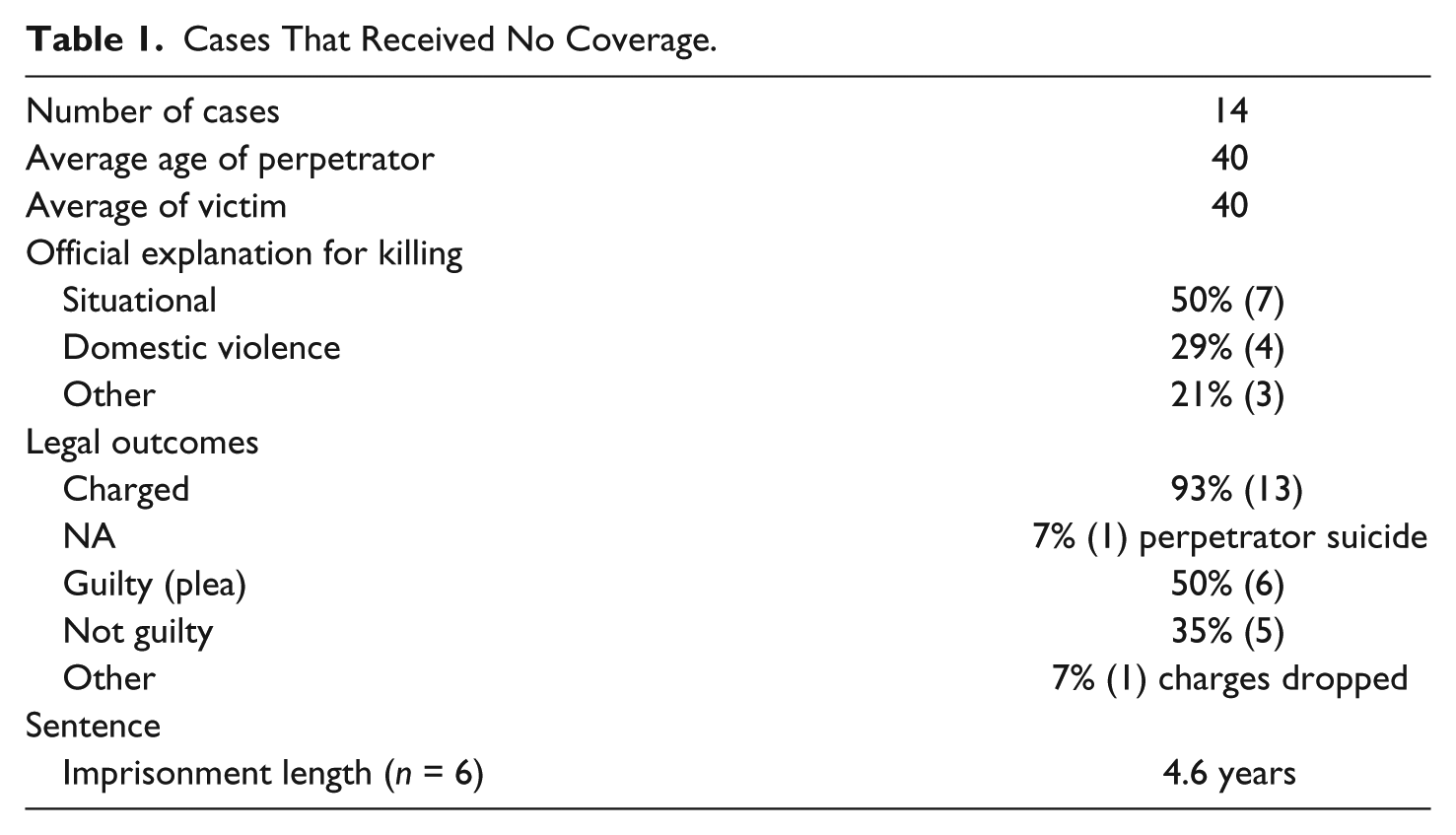
When coverage noted that the woman had a history of psychiatric hospitalization or treatment, I coded this as the “mad” narrative. I also coded portrayals of the woman’s violence as the product of battered woman’s syndrome as using the “mad” woman narrative. An example of a case coded as the “mad” narrative is one in which coverage indicated that the woman was “in a state of automatism” at the time of the killing, according to a psychiatrist (January 13, 1976, A5). Articles were coded for the presence of the “bad” narrative if the representation produced an understanding of the perpetrator as a woman who deviated from normative femininity. One female killer was depicted as a “bad” woman in coverage that emphasized her criminal record, extra-marital affair, and psychiatric problems, including prior attempts to arrange her husband’s murder (June 20, 1986, A12). 6 A total of three women were coded as portrayed by a “mad” narrative and one woman’s case was coded as portrayed by a “bad” narrative. The 33 cases for which the news coverage included neither of these representations were coded as having no stock narrative. Aggregate information about these cases and the news coverage they generated are reported in Tables 1 through 3.
Cases That Received No Coverage.
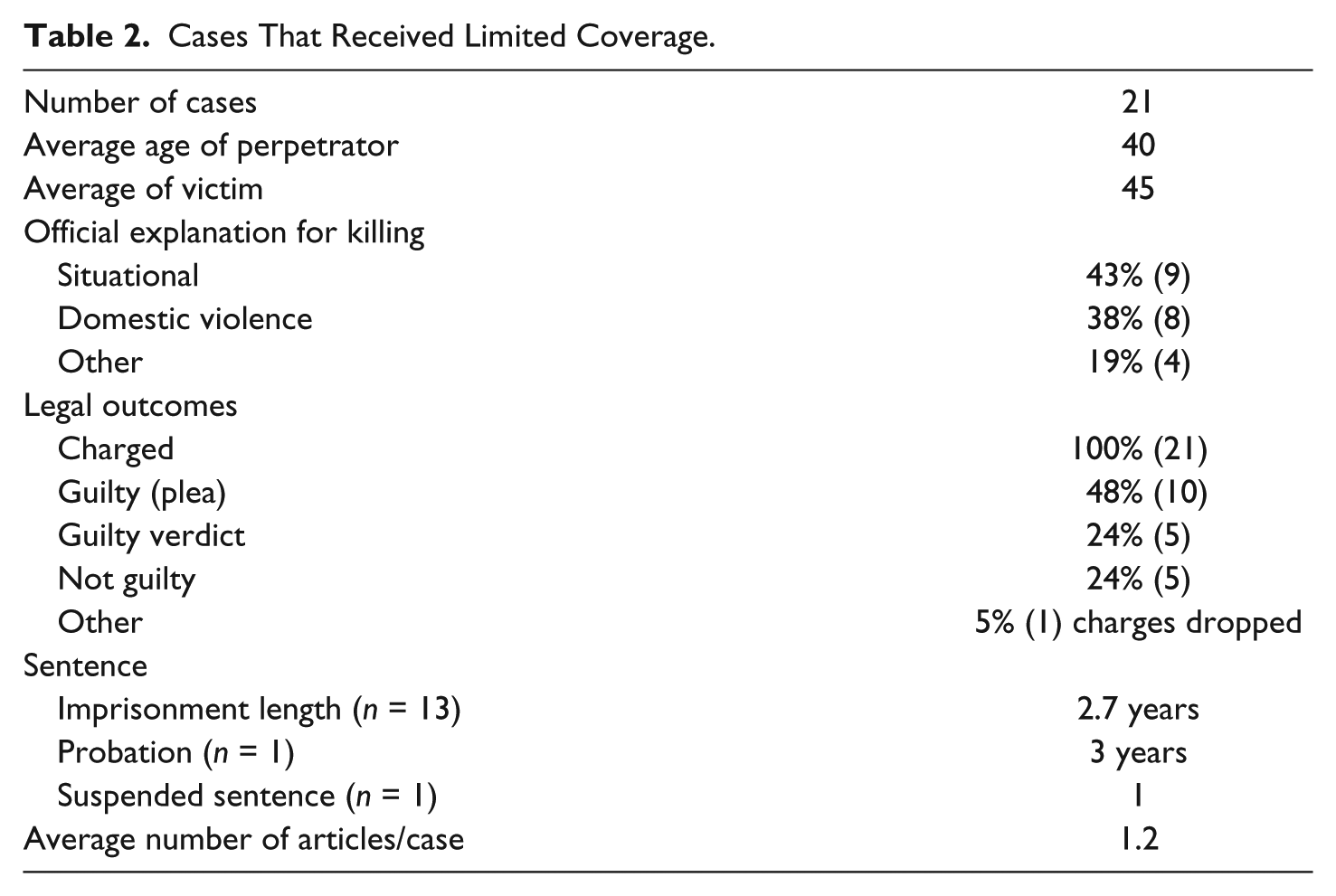
Cases That Received Limited Coverage.
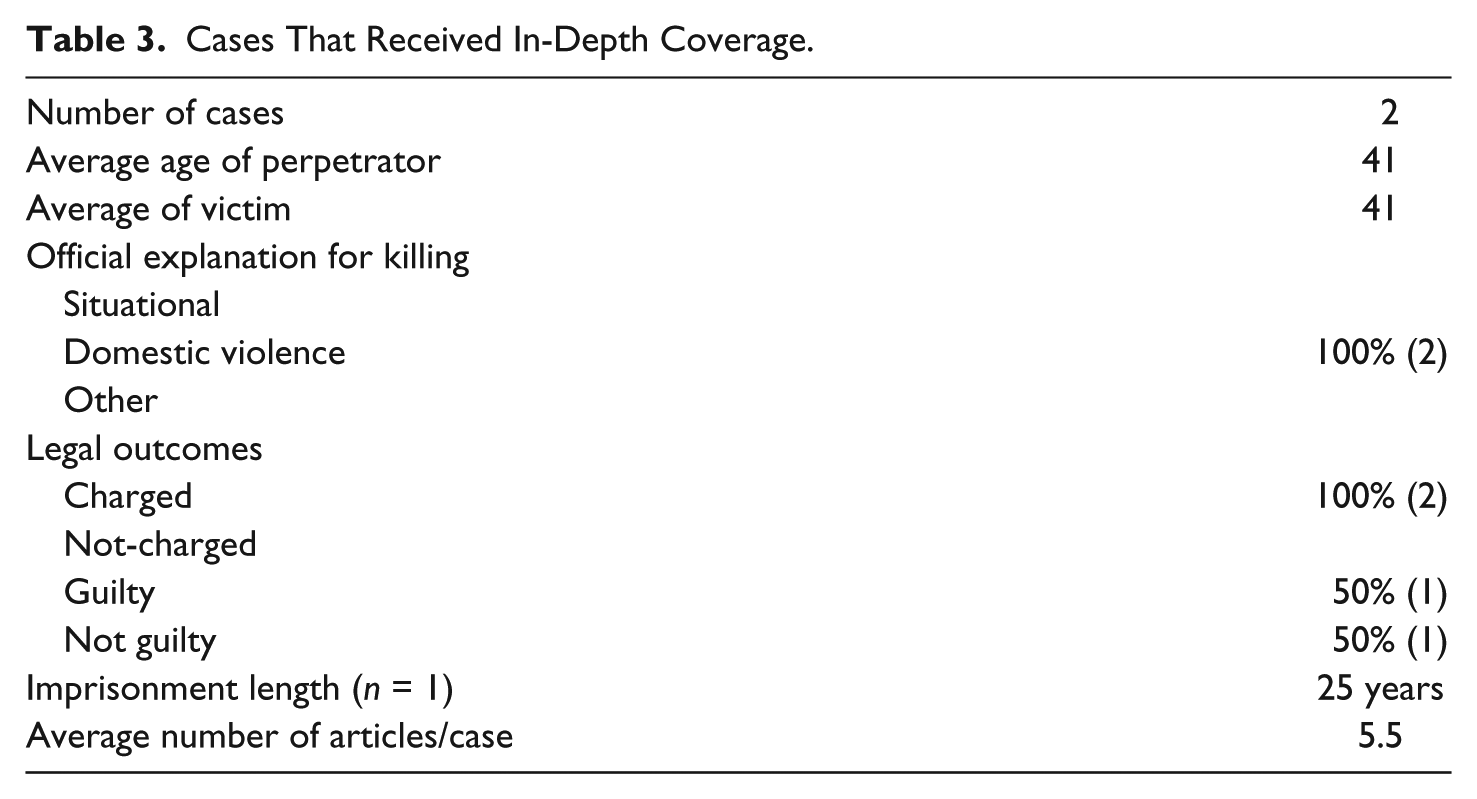
Cases That Received In-Depth Coverage.
Analysis of Newspaper Coverage
Using the official records, I was able to locate news coverage for more than half of the homicides in this study (62% or 23 cases). Nearly all of these cases (21 or 92%) received limited coverage. The two remaining cases featured in-depth coverage. I begin the analysis with the cases that received no media coverage.
Cases With No Coverage
A total of 14 cases (38%) were not covered in The Globe. These killings occurred throughout the study period, with half occurring between 1975 and 1979. 7 Aggregate characteristics of these 14 cases are shown in Table 1.
Based on official records, I categorized six (43%) of these 14 homicides as occurring in the context of ongoing domestic violence; in three of these cases, the official records indicated there had been victim provocation in the form of violence or threats. In a further five of the 14 cases (36%), the official records indicated the homicide appeared to result from situational violence. Three cases (21%) involved other explanations. In eight of the 14 cases (22%) without coverage in The Globe, alcohol was a factor in the killing. The social characteristics of those involved are referenced in the official records of some cases, such as a case from 1976 where a woman killed her common-law partner after an argument over a welfare check, a case from 1979 involving a couple drinking in a rooming house with their roommate, and a case from 1996 in which unemployed partners engaged in a “violent brawl” while both were “highly intoxicated from consumption of several drugs.” In two of these cases (1988, 1996), the official records noted evidence of prior threats of violence by the victim against the perpetrator. In eight (57%) of the cases that received no coverage in The Globe, the accused plead out (6) or was not prosecuted (2).
Cases With Limited Coverage
Based on the official records, the 21 cases that received limited coverage were mostly characterized as situational violence (nine cases or 43%) or related to ongoing domestic violence (eight cases or 38%). In the remaining four cases (19%), the official records indicated that other circumstances led to the killing. The official records indicated that 15 of these 21 cases (71%) involved couples who were unemployed or working in low-level service jobs, and in 13 cases (35%), substance abuse 8 was listed in the official records as a factor in the killing. In 10 of these killings (48%), the accused plead out; in 10 others, the accused went to trial; and in one case, the charges were dropped. Aggregate information from the official reports and from newspaper coverage of the 21 cases with limited reporting is provided in Table 2.
Nature and type of newspaper coverage
The following example characterizes the type of coverage received by the 21 cases in this category. This 1976 case was reported on in a single article, as was true of many cases in this category. The article, titled simply “Woman charged,” stated that a “33-year old Parliament Street woman was charged with murder” after her common-law husband “of the same address” died of multiple stab wounds, but provided no other details (February 14, 1976, C2). The street address provided in the story would be recognized by many readers as being in a poor neighborhood in the city and could serve as a shorthand means of conveying the social characteristics of those involved.
In 13 (62%) of the cases with limited coverage, there were differences between the official record and the media account of the circumstances of the killing and those involved. In 10 (77%) of these cases, The Globe coverage did not provide information on the background for the homicide that was available in the official record. In some cases, this was a minor omission, such as a case from 1976 that did not mention the couple had been drinking heavily in the days leading up to the killing. In two cases, the reasons behind the homicide offered in the official record were absent from the news coverage (1979, 1981). For example, a case from 1979 involved a perpetrator who was drinking at a friend’s house and announced she was going home to practice loading her rifle to kill her husband. Evidence of her premeditation was borne out in the charge of first-degree murder, but the newspaper coverage only reported on the initial killing and offered no explanation. The sole article about the case stated only that the victim had been shot in his home by his common-law wife. The street address of the couple, who also lived in a poor neighborhood, was the only additional detail. This suggests that a homicide involving a poor couple is only of passing interest; even if there are unusual aspects to the case, a simple allusion to the social characteristics of those involved is enough to intuit an explanation of the homicide.
According to official records, a third of these cases (7) occurred in the context of ongoing domestic violence, but newspaper coverage either omitted or misrepresented this information. This is consistent with studies on the representation of IPH or intimate partner violence generally, which finds that media coverage often neglects to raise or discuss the issue of domestic violence (Bullock & Cubert, 2002; Carlyle, Slater, & Chakroff, 2008; Post, Smith, & Meyer, 2009). In this study, this included cases where the perpetrator and/or the victim had a record of previously assaulting the other. Of the three cases where news coverage provided information not available in official documents, the information was reported in a sentencing story that provided additional details about the perpetrator or her use of violence.
Representation of women’s violence
The limited coverage of these cases left little room for descriptions of the perpetrators’ actions, yet some details about this were found in three cases. In one case (1975), a description of the woman was provided by a judge during her sentencing, in which he was quoted as saying he has “considerable compassion for her in the circumstances” (March 6, 1976, B4). This is followed by an excerpt from the woman’s statement to police in which she stated her husband was “pretty high” at the time and they “quarreled over the bad language he had been using and she became hostile and stuck a knife into him”. Because no other explanation is offered for her actions, the reader is left to assume that the judge understood why someone might resort to violence after becoming agitated by a swearing, intoxicated spouse. As her violence is explained in her own words and is not in question or pathologized, no other analysis or explanation appears to have been necessary. The article ends with the judge’s explanation for imposing a lenient sentence (maximum 1 year) because of her long-standing employment and lack of prior record. Although these characteristics depict the woman as a “good” person, they are also legally relevant variables and did not work to deny the woman’s agency through the “mad” or “bad” narrative.
In the two other cases where The Globe provided additional information about the case, the coverage included portrayals that denied the woman’s agency in the violence. In both cases (1979, 1991), a medical explanation of the violence was provided by a psychiatrist testifying on behalf of the defense during sentencing and a narrative of the “mad” woman was used to explain the violence. Coverage of the 1979 case quoted the defense psychiatrist’s account that the woman was “terrified” and “legally insane” at the time of the killing because of years of abuse (November 20, 1980, B4). The psychiatrist went on to note that the victim brought violence into the home through other men who were furious that he had affairs with their wives. The doctor’s testimony portrayed the woman in a positive light as a “devoutly religious” woman who was “disgusted” that her husband forced her to perform “abnormal acts,” as she believed “sex was only for procreation.” The psychiatrist concluded that the perpetrator was “a simple woman who was legally insane and could not appreciate what she was doing at the time”. The testimony provided in the coverage worked to portray the perpetrator as a “good” woman who went “mad” because of an abusive husband, and he alone was ultimately to blame for his death. In this way, the woman was represented as acting without will or agency (Morrissey, 2003).
Coverage of the 1991 case included an initial report of the killing and a second report on the woman’s subsequent guilty plea, with little detail in these two “News in Brief” stories. However, the third and final story covered the woman’s sentencing hearing in a longer report under the headline “Woman tells of abuse at sentencing; Story of 22-year-old who killed fiancé likened to Dickens novel.” In this article, an explanation is offered for the homicide whereby the perpetrator “obviously suffered a lifetime of abuse” according to the testimony of a psychologist. At the trial, the accused described her past in foster care, the murder-suicide of her parents, and her life with repeated abusive partners (November 24, 1991, p. A22). The psychologist testified that this resulted in “low self-esteem and learned helplessness . . . [she became] very submissive and had an overwhelming feeling of despair . . . As a battered woman, she was acting as if there was no other course”. Interestingly, neither self-defense nor the victim’s threats of violence against the woman were cited in explanations for the murder, even though the defense argument relied on psychiatric evidence of learned helplessness and victimization to explain the killing. In this way, the violence the woman used was offset in the courtroom discourse by a focus on her prior victimization, and the murder itself was abrogated.
In summary, most of the cases that received limited coverage reported only basic facts about the killing with few other details. When the killing involved couples who had been drinking and/or a fight that escalated to lethal violence, coverage was brief, sometimes even when some aspects of the killing were atypical. Where news coverage omitted information that was available in the official records, it typically downplayed or did not mention a history of violence in the relationship, consistent with other research in this area (Bullock & Cubert, 2002; Carlyle et al., 2008; Post et al., 2009). However, this occurred in cases where the violence was mutual and in cases where either the woman or the man was the sole perpetrator of the previous violence, so notions about gender and femininity did not appear to make a difference. Two cases involved explanations of the woman’s violence that effectively denied her agency by portraying her as a “mad” woman suffering from some form of illness. Importantly, these explanations were offered in the courtroom narrative by a psychiatrist during testimony for the defense and were therefore relevant in the case.
Cases With In-depth Coverage
Two cases (5%) in the study period received in-depth coverage (1975, 1986), as assessed by the prominence, length of stories, nature of coverage, and accompanying photos. According to the official records, both cases involve exceptional circumstances. Although a history of domestic violence is noted in the official record of the 1975 case, the police were initially called by the perpetrator who reported her husband missing, though he lay dead in their backyard. In the 1986 case, a looming custody battle over the couple’s only child was cited in the official record as the motive for a woman and her lover to plan and carry out the killing of her estranged spouse. In both cases, the newspaper coverage provided additional information about or explanations for the woman’s violence not available in the official records, as described below.
Representation of women’s violence
In both of the cases that received in-depth coverage, the women’s agency was played down through the use of stock narratives that positioned them as either “mad” or “bad.” In the 1975 case, the woman denied any involvement in the killing, telling police she and her husband returned home on New Year’s Day after celebrating the previous evening, but that he went back out and “she didn’t see him again until he was found at the back of their house” (January 8, 1976, B5). The initial report of the killing provided basic facts, but as the case progressed through the system, a courtroom narrative developed to explain the woman’s use of violence. The accused never took the stand or provided any motive; however, the couple’s son testified on her behalf. He stated that his parents “did not have a good marriage” and that although his father was “a good provider,” he was “strict” (January 9, 1976, p. A5). The son also explained that his mother worked nights in a bakery and that “her only interests were her home and her family” adding that “I still don’t believe my mother killed my father”. This worked to produce a normative understanding of the perpetrator as a “good” woman who was not responsible for the killing of her husband. This narrative was bolstered in a follow-up story that covered the testimony of a doctor for the accused. The doctor testified that in his expert opinion, the accused “was probably in a state of automatism at the time,” which he defined as a state “in which an individual is not aware of what is going on, and behaves in a purposeful way while suffering part or complete amnesia” (January 13, 1976, A5). In this way, the courtroom narrative worked to pathologize the woman’s actions and excuse her violence. Because the jury failed to reach a verdict, the judge declared a mistrial, and the second trial was never covered, although it resulted in a finding of not guilty by reason of insanity, according to the official records. The lack of coverage of the second trial suggests that there was no need for further explanation of the killing, because the narrative of a “good” woman driven “mad” by an abusive husband was sufficient to understand it.
In the second case (1986), notions of femininity not only were used to portray the female killer in ways that highlighted her deviance as a “bad” woman but also noted her history of mental illness, suggesting that at times, the narratives of “bad” and “mad” may work together to explain women’s violence. In this case, the estranged couple was in the middle of a custody battle when the accused along with her new lover were charged with first-degree murder in her husband’s death. That she was a Detroit native who had “previous brushes” with the law—including a “deportation order, outstanding charges and a voluntary admission to a psychiatric institution” which “lessened [her] chances of winning the custody battle . . .” (June 8, 1988, p. A19)—was underscored in the coverage. In contrast, the victim was described as an insurance broker and minor league hockey coach, and was depicted through these characterizations and accompanying photos as a reputable man, even though the accused testified that he beat her. Indeed, although this claim was mentioned in reports of her testimony, it was never developed or substantiated. Instead, The Globe reported that her lover had a history of violence and was currently in prison for an armed robbery. Taken together, the killer’s character and record did not accord with notions of appropriate femininity and, instead, depicted the accused as a malevolent woman. Ultimately, she alone was found guilty of first-degree murder.
Discussion and Conclusion
Research has argued that when women kill, their actions are deemed so out of place and incomprehensible that they are represented in legal and media discourse through the use of stock narratives that either deny women’s femininity or neutralize their blame in the violence. However, these findings are based largely on studies that select cases because they are high profile and receive extensive news coverage. Using a sample of 37 cases drawn from all known instances of female-perpetrated IPH between 1975 and 1999 in Toronto, Canada, I investigated whether women who killed their intimate partners were depicted in ways consistent with the findings of other research. My findings both affirm and depart from those of other researchers who have studied representations of women’s lethal violence.
The departures from previous work are perhaps the most significant contributions of this research. By analyzing a more representative sample of lethal violence by women—specifically, all known cases of women killing spouses or common-law partners from one city over 25 years—my analysis shows that much female-perpetrated IPH does not appear to rend the social fabric and challenge popular understandings of gender the way previous research suggests. The fact that most of the cases of women’s IPH received no coverage or attracted limited and routinized coverage indicates that some types of lethal violence by some types of women are not seen as remarkable and exceptional. The characteristics these cases have in common point to the existence of commonsense understandings of women’s violence that require little elaboration.
In total, all but two of 37 cases received limited or no coverage in The Globe. From the official data on these 35 cases, I found common characteristics that could provide an explanation for the narrow or non-existent coverage. According to official records on the cases receiving no or limited coverage, most of the couples worked low-level service jobs or were unemployed at the time of the killing and the victim and/or perpetrator were under the influence of alcohol or drugs at the time of the killing. Recall that research on media coverage of homicide in general finds that the characteristics of those involved and the circumstances of the killing shape the news value of the event (Pritchard & Hughes, 1997). For example, Peelo et al. (2004) found that homicides that arose out of a fight or quarrel, especially when the people involved know each other, were less likely to be reported compared with homicides sparked by other circumstances, such as predatory motives. In my study, killings that resulted from what official records often labeled a “domestic dispute” produced little or no coverage, and any coverage was routinized, matter of fact, and neutral in nature. The social characteristics of those involved in these killings construct a picture of the typical woman who kills as one half of a working-class or unemployed couple involved in an argument that escalated into lethal violence, often after a night of drinking. 9
These findings suggest that the characteristics of these 35 killings—that is, those that received no or limited coverage—make the women’s actions less in need of explanation because a simple reporting of the couple’s employment or living and drinking habits is sufficient to convey and comprehend their meaning. The way these killings are represented is consistent with Sudnow’s (1965) concept of “normal crimes.” In his classic study, Sudnow (1965) argued that public defenders used a classification system to manage their caseloads by employing shorthand knowledge that allowed attorneys to understand and process “normal crimes.” What he terms “normal crimes” are “those occurrences whose typical features, e.g. the way they usually occur and the characteristics of persons who commit them (as well as the typical victims and typical scenes) are known” (p. 260).
In the current study, as the characteristics of these cases mirror the individual and situational characteristics of a large portion of women’s IPH (see Swatt & He, 2006; Goetting, 1989; Roberts, 1996, Riedel & Best, 1998), they are used to convey that the killings are “normal crimes” for which a detailed explanation is not necessary. Rather than a stock story or narrative that develops an explanation for these homicides, a shorthand that cues characteristics such as drinking or social class are the only references needed to explain the women’s violence and render their acts understandable. Indeed, as Jewkes (2009) stated,
For a crime to be reported at all, let alone the subject of the kind of persistent, pervasive coverage which can result in the construction of offenders as folk devils, the prevailing ideological climate must be especially hostile to the offence that has been committed. (p. 108)
As the findings of my study suggest, the ideological climate surrounding many instances of women’s IPH is not particularly hostile but, rather, is comfortable with commonsense notions of the types of people and motivations for these killings. In other words, because these killings do not upset a generally accepted understanding of violence between intimate partners, there is no need for further elaboration in court or in a newspaper article. 10 This explanation complements the work of media scholars reviewed earlier, which argues that when homicides occur in a routine context, they have less news value to the media because less explanation is required (Johnstone et al., 1994; Sorenson et al., 1998). In addition, killings involving low-status individuals that occur in poor neighborhoods have tended to be underreported in favor of homicides that occur in more well-to-do neighborhoods or that involve respected members of the public (Johnstone et al., 1994; Sorenson et al., 1998). In this study, this combination of circumstances and characteristics was the common link among cases that received little or no coverage.
My findings also support the existence of stock narratives to represent the woman or her violence as “mad” or “bad.” However, I suggest that this applies to a much narrower set of cases than previous research suggests. Although there was evidence of these narratives in four cases, in two of these, the stock narrative was invoked only briefly and with no elaboration. Coverage of both of these cases mentioned the women’s agency only in short summaries of sentencing decisions. This supports Morrissey’s (2003) contention that media and legal discourse have a “symbiotic relationship” and points to the importance of being attuned to how claims in the forensic narrative are depicted or absent from the media.
For the other two cases, the newspaper coverage was more extensive and used the “mad” and “bad” stock narratives to frame the women’s crimes. However, these two cases were distinctive in some important ways. Neither case involved alcohol or drugs and both male victims held respectable jobs, a factor that has been linked to the amount of coverage in other media research (Johnstone et al., 1994). In one case, a woman tried to conceal her involvement in the killing by reporting her husband as missing, and in another, the estranged couple was in the midst of a custody battle when the female perpetrator conspired with her new lover to carry out an ambush killing. These cases, similar to those studied in high-profile or case study research, were exceptional in nature because they involved atypical circumstances that attracted more detailed explanations for the killing. The coverage of these cases is consistent with the findings from previous literature on representations of female killers. The legal and media narratives explained the violence by drawing on notions of traditional femininity to portray the female killer as good, but unbalanced, and thus deserving of sympathy, or bad, and thus deserving of condemnation. In one case, what could be considered self-defense was instead constructed as the pathology of “automatism.” As argued in other research (Morrissey, 2003; Weare, 2013), these explanations work to deny the killer’s agency as a woman or indeed as a full human.
This study answers the call by Taylor (2009) and Carlyle et al.(2014) to examine official homicide data and what this can reveal about IPH news coverage. My results differ from those in the larger literature by highlighting a type of female killing that apparently is not traumatizing nor out of our realm of understanding; rather, all that needs to be known to make these killings comprehensible are a few facts. These facts do not defeminize the killer or take away her agency; they simply describe a context that readers will understand as usual or “normal” (Sudnow, 1965).
Had the focus of my study been cases that received the most coverage over the study period, my findings would lend support to previous research on the representation of women’s lethal violence. Instead, because I started my study with all known instances of women’s IPH over 25 years, I was able to determine that some types of killings were not newsworthy. This allowed me to build on the work of others who have found news coverage of women’s IPH is episodic (Sweeney, 2012; Taylor & Sorenson, 2002; Wozniak & McCloskey, 2010) and may depend on the characteristics of those involved (Biroscak & Post, 2005; Pritchard & Hughes, 1997).
My study has limitations that subsequent research may be able to address. Most importantly, I did not have access to official homicide records for the years after 1999, and so could not extend my analysis to more recent years, and I studied news coverage of women’s IPH in only one Canadian city. My findings therefore are of unknown generalizability to women’s IPH in the 21st century and to other cities. Furthermore, the small number of cases of women’s IPH in Toronto during these years, while fortunate, made tracking trends over time an unreliable exercise. However, to the extent that the media remains interested in reporting “newsworthy” events, cases involving women and men with characteristics that fit understandings of “normal” IPHs may have continued to garner little attention. Future research should consider if and how these patterns may have changed over time or how they compare with cases of men’s IPH.
Footnotes
Acknowledgements
I am grateful for the many helpful comments I received on earlier drafts of this paper from Rosemary Gartner and the Feminist Criminology anonymous reviewers. I would also like to thank Rosemary Gartner and Bill McCarthy for permission to use data they collected with the support of the Social Sciences and Humanities Research Council of Canada.
Declaration of Conflicting Interests
The author(s) declared no potential conflicts of interest with respect to the research, authorship, and/or publication of this article.
Funding
The author(s) received no financial support for the research, authorship, and/or publication of this article.