







Abstract
Critical race feminists posit that perceptions of White and minority females differ, which suggests that media representations will vary among female crime victims. To explore this proposition, we examined front-page crime stories from four different U.S. newspapers using Altheide’s approach to qualitative document analysis. We found that stories about White female victims received more repeated coverage and were more likely to contain sympathetic narratives than stories about Latina/Black female victims. In contrast, Latina/Black female victims were more likely to be portrayed as risk-takers and “bad” women, and their victimization was normalized through descriptions of their unsafe environments.
Introduction
Victimization rates for females vary by their race and ethnicity (Bureau of Justice Statistics, 2009). When compared with both Latinas and Black women, White women report the lowest levels of intimate partner violence (Nowotny & Graves, 2013). Black women also experience higher rates of sexual assault (Bureau of Justice Statistics, 2009) and are more likely to be victims of homicide than White women (U.S. Department of Justice, 2011). Despite the higher likelihood of victimization for minority women, media outlets tend to focus on the victimization of White women and girls. In particular, missing or murdered White women and children get considerable attention, a phenomenon known as the “missing white woman [or girl] syndrome” (Moody, Dorries, & Blackwell, 2009, p. 12).
The media’s focus on specific crime victims may influence perceptions about their worth as well as the actions taken by criminal justice officials. For example, research shows police are more inclined to work to solve a case if it has received media coverage (Lee, 2005). And, in another study, offenders who raped White women received sentences 8 years longer, on average, than those who raped Black women (Crenshaw, 1991). Furthermore, researchers find defendants are more likely to receive the death penalty if the victim is White, despite data that show minorities are more likely to be homicide victims (ForsterLee, ForsterLee, Horowitz, & King, 2006; Lee, 1998; Paternoster, 1984). And, defendants convicted of killing White females are more likely to face the death penalty than defendants convicted of killing others (Holcomb, Williams, & Demuth, 2004).
Although it is possible that White and minority female victims of crime may receive differential news coverage, few researchers have empirically examined such a possibility. There are studies about the effects of a victim’s gender or race in media accounts, but very few scholars have specifically examined how a female victim’s race/ethnicity may influence the narrative content in a story about her victimization. The limited existing research focuses on specific types of female victims (e.g., rape victims, missing women, victims of a serial killer, victims of domestic homicide), with empirical questions of interest and employed methodologies varying across studies. A general conclusion that cuts across much of the research is that White female victims tend to have their innocence or lack of culpability highlighted, whereas their minority counterparts are somehow blamed for their victimization (see, for example, Ardovini-Brooker & Caringella-MacDonald, 2002). The thematic content of crime story narratives may differ for White and minority women in other ways, but no researcher has yet empirically explored such a possibility.
Moreover, only two studies to date have explored differences in coverage intensity based on the race/ethnicity of a female victim. In their examinations of stories about missing women, Moody and colleagues (2009) found more follow-up stories about White women than Black women and Gilchrist (2010) found 3.5 times more news coverage about White than Aboriginal women. There may also be differences in the extent to which stories about victims are local or national in scope. Although they did not consider differences in story scope about female victims, Jeanis and Powers (2016) found that missing women received more national coverage than missing men.
The use of photographs in crime stories may also differ by a female victim’s race/ethnicity. To date, however, only Gilchrist (2010) considered such a possibility and found White female victims were more likely to have photographs that accompanied their stories. An analysis of photographs is important because images are used to draw readers into the story (Rossler, Bomhoff, Haschke, Kersten, & Muller, 2011). In addition, researchers find most people remember a story’s photograph long after they forget a story’s content (Graber, 1990).
With the limitations of past research in mind, we examined front-page stories about female crime victims from four different U.S. newspapers from the 2006 calendar year. These papers contained local, national, and international stories, and included stories about victims of many types of crime. We were primarily interested in determining the key themes in story narratives about female crime victims and statistically assessing whether these themes differed by a female victim’s race/ethnicity. However, given their possible salience to differential news coverage, we also explored (a) whether there were more front-page stories for White versus Latina/Black female crime victims, (b) the level of coverage intensity (i.e., repeated coverage and national/international focus) of front-page news stories about White versus Latina/Black female crime victims, and (c) the frequency of news stories with photographs. Critical race feminism provided the overarching theoretical basis for this study, and Altheide’s (1996) approach to qualitative document analysis was used to guide the analyses.
Literature Review
Mass Communications and Social Psychology
Media accounts are important because of their influence on perceptions of phenomena and individuals. The average U.S. citizen considers the media to be his or her primary source of information for most aspects of life, including information about crime (Heath, 1984; Petersen, 2016; Taylor, 2009; Weitzer & Kubrin, 2004). What the media assert about victimization is meaningful because the public processes such messages as important. Simply put, the way the media frame, create, and classify certain issues directly influences viewers’ perceptions (Iyengar & Kinder, 1987; Nelson, Oxley, & Clawson, 1997).
Media framing is a concept found in the mass communications literature and is defined as “the process by which a communication source constructs and defines a social or political issue for its audience” (Nelson et al., 1997, p. 221). Generally, the media use images and the written word in the framing of crime news (Gamson & Modigliani, 1989). The concept of media framing is closely linked to agenda setting. Briefly, agenda-setting theorists argue the media influence what issues people think about and the feelings they have on issues (McCombs & Shaw, 1972). Put another way, a person views an issue as worthy of attention if media outlets portray it as such (Gross & Aday, 2003; Shaw, 1979). Cultivation theory, another theory within the mass communications literature, states consumer consumption of messages affects their perceptions (Weitzer & Kubrin, 2004), and “perceptions about the real world will match what is most frequently depicted in the media” (Weitzer & Kubrin, 2004, p. 499; see also Grabe & Drew, 2007). 1 This is potentially troubling because misleading media messages about crime may result in inaccurate perceptions about offenders and victims.
Social psychology’s causal attribution theory is similar in premise to cultivation theory. The central tenet of this theory is that indirect experiences affect perceptions of the outside world (Kelley, 1973; Tyler, 1980). Most people do not have direct experiences with crime, so they learn about offenders and victims indirectly via the media (Davies, Francis, & Greer, 2008). For example, Black people appear in television news stories as perpetrators of crime 1.5 times more often than they appear as victims, which feeds into negative stereotypes (Chiricos & Eschholz, 2002), including notions that Black men are aggressive (Devine, 1989; Rome, 2006), uneducated (Creighton, Walker, & Anderson, 2014; Devine, 1989), and drug users (Welch, 2007). Researchers also acknowledge that minority women have consistently been stereotyped more negatively than White women (Brennan, 2006; Farr, 2000; Landrine, 1985). For example, Black women are stereotyped as aggressive (Young, 1986), oversexed (Farr, 2000), and “welfare queens” (Hurwitz & Peffley, 1997, p. 393), whereas White women are stereotyped as “competent, dependent, emotional, intelligent, passive . . . and warm” (Landrine, 1985, p. 72). Moreover, White women are often described as good mothers (Wanzo, 2008). Given such stereotypes, it is unsurprising that individuals express stronger negative beliefs about Blacks than Whites when taking race-implicit-association tests 2 (McConnell & Leibold, 2001), and both high- and low-prejudiced people identify the same stereotypical traits for Blacks when asked to do so (Devine & Elliot, 1995).
Critical Race Feminism
Critical race theory, in general, focuses on the ways race and other forms of cultural subordination (such as gender) intersect to influence racial stereotypes (Solorzano, 1997). Central to critical race theory is the belief that “Whiteness” is privileged in American society; the interests and perspectives of White people are dominant (Gillborn, 2015; McIntosh, 1998). Critical race feminism, which is also sometimes referred to as Black feminist thought, stresses the importance of the intersection between race and gender (Belknap, 2014; Collins, 2000; Potter, 2006). Given a privileged status, being a White woman means something quite distinct from being a minority woman because color is a devaluating factor that makes minority women vulnerable to negative treatment (Higginbotham, 1983; McIntosh, 1998).
Black, brown, yellow, and red people have to live within the boundaries defined by others because of their color. Racism is an ideology that justifies the exclusion of people of color from certain areas of economic and social life. It also operates to promote the tolerance of inequities on the part of other members of society. Historically, and to this day, racism is institutionalized in the United States and has a daily impact on the lives of racial and ethnic people. (Higginbotham, 1983, pp. 200-201)
When compared with White women, minority women may never be regarded as equal because they live with additional restrictions and pressures. Therefore, critical race feminism provides a basis for the expectation that White and minority women will be treated differently in news outlets: Due to both sexism and a lack of privileged White status, minority women face more intense forms of marginalized treatment (Belknap, 2014; Chesney-Lind & Morash, 2011; Higginbotham, 1983). In short, the intersection between racism and sexism is unique to minority women and may explain their differential treatment in various arenas, including their media portrayals.
The experiences of minority people are “legitimate, appropriate, and critical to understanding, analyzing, practicing, and teaching” others about racial subordination (Solorzano, 1997, p. 7). As such, it is important for researchers to examine the effects of race/ethnicity and gender in tandem as minority women differ from White women. As suggested by Reid and Comas-Diaz (1990), if one examines a victim’s gender but fails to simultaneously consider her race/ethnicity, then one will provide “an incomplete and, possibly, distorted” view of the outcomes under investigation (p. 400). Therefore, we examine whether and how media accounts may differ for White female victims versus their Black and Latina counterparts.
Prior North American Media Analyses
Few researchers have empirically examined whether White and minority female victims of crime receive differential news coverage. To be clear, although there are studies of victims in the news, very few have examined how a female victim’s race/ethnicity may affect the amount of attention she receives or the narrative elements of her story. Most of the extant literature on media accounts of crime tends to focus on male offenders (see, for example, Creighton et al., 2014; Rome, 2006), differences in coverage of male and female victims (see, for example, Jeanis & Powers, 2016; Min & Feaster, 2010), or on victim newsworthiness (see, for example, Buckler & Travis, 2005; Gruenewald, Chermak, & Pizarro, 2013).
In general, researchers who have studied news coverage of victims find that White victims (regardless of their gender) are overrepresented as crime victims (see, for example, Jeanis & Powers, 2016; Min & Feaster, 2010; Simmons & Woods, 2015) and female victims are overrepresented relative to male victims (see, for example, Johnstone, Hawkins, & Michener, 1994; Sorenson, Manz, & Berk, 1998). Although it has been established that female crime victims get considerable attention in the news, relatively few researchers have looked exclusively at media accounts of female victims (for some exceptions, see Ardovini-Brooker & Caringella-MacDonald, 2002; Gilchrist, 2010; Moody et al., 2009).
To date, only eight studies have focused on media representations of female victims. In these eight studies, researchers zeroed in on coverage of girls and women who experienced very specific forms of victimization, including accounts of missing and/or murdered females (Gilchrist, 2010; Moody et al., 2009; Stillman, 2007; Taylor, 2009), victims of a specific serial killer (Jiwani & Young, 2006; Pitman, 2002), female rape victims of specific rapists (Ardovini-Brooker & Caringella-MacDonald, 2002), and female victims during Freaknik, a spring break ritual in Atlanta, Georgia (Meyers, 2004). Our study differs from the approach taken by past researchers in that we examine all front-page newspaper stories about female victims, regardless of crime type or specific offender.
Moreover, what is generally missing from past studies is an examination of differential coverage for White, Latina, and Black female victims. A few of the existing studies compared the narrative content of stories about White victims versus minority victims (Ardovini-Brooker & Caringella-MacDonald, 2002; Gilchrist, 2010; Moody et al., 2009), but the remaining studies provided little in the way of comparison. Furthermore, none of the previous studies analyzed whether differences noted for White and minority female victims were statistically meaningful.
Meyers (2004) focused solely on media representations of minority women, while Stillman (2007) largely discussed media accounts of Jessica Lunsford (a murdered young, White girl) and other high-profile missing and murdered White women. Taylor (2009) examined media representations of women killed by their romantic partners, but made no attempt to speculate about whether the race of the victim mattered. Jiwani and Young (2006) evaluated newspaper stories about a specific serial killer’s victims. Most of the victims were Aboriginal, which limited the comparisons that could be made between Aboriginal women and White women. In short, sufficient attention has not be given to explorations of media portrayals of White versus minority female victims. As critical race feminists would argue, minority women are marginalized (Higginbotham, 1983) and, therefore, we should expect that coverage of their victimization experiences will differ from the coverage afforded to White female victims. Yet, this theoretical expectation has not been adequately explored in the empirical literature.
An analysis of whether stories about White female victims differ from stories about Latina and Black female victims is warranted, given that many believe White women are the beneficiaries of a “white privilege” (McIntosh, 1998), which many contend garners them sympathetic treatment by the media and general public. Among victims, prior media analyses indicate there is a good girl/bad girl dichotomy that appears in news stories (Gilchrist, 2010; see also Meyers, 1997). To explain, White females are often portrayed or viewed as “ideal” or “worthy” victims (Christie, 1986; Gekoski, Gray, & Adler, 2012), and “words such as ‘perfect,’ ‘ideal,’ ‘angelic,’ ‘golden,’ and ‘fairy tale’” are used to paint a lauded portrait of their lives (Wanzo, 2008, p. 99) and their innate goodness (Pritchard & Hughes, 1997). Importantly, “ideal victims” elicit large amounts of sympathy from media outlets (Jeanis & Powers, 2016).
In contrast, Meyers (1997) acknowledged that women who do not conform to the “ideal victim” stereotype are often shown as being somehow responsible for their victimization—generally because of alcohol/drug use, inattentiveness to their surroundings, association with deviant individuals, and questionable decision making (see also Larcombe, 2002). With regard to differential news coverage, Black female victims are often portrayed as somehow responsible for their own victimization through dangerous behaviors and/or relationships and interactions with dangerous others (Meyers, 1997). Importantly, prosecutors are more likely to prosecute offenders when there are no questions about the victim’s risk-taking behavior at the time of the incident (Spohn, Beichner, & Davis-Frenzel, 2001), and police “responses are frequently influenced by negative judgements regarding the victim’s dress, behavior, and demeanor” (Jordan, 2008, p. 699).
In line with good girl/bad girl and innocent/complicit dichotomies, Bjornstrom, Kaufman, Peterson, and Slater (2010) discussed the devaluation of minorities in media coverage. To clarify, they argued the “victimization of persons of color is devalued (seen as representing less loss or harm to the community) while white victims are privileged” (Bjornstrom et al., 2010, p. 276; see also Wanzo, 2008). Put another way, “‘good’ women are seen as innocent and worth saving or avenging,” whereas bad women are not (Gilchrist, 2010, p. 375). Within the minority devaluation framework, the underrepresentation of minority victims in the news—despite their higher rates of victimization—is unsurprising (Bjornstrom et al., 2010; Weiss & Chermak, 1998) because the privileged status of Whites means the justice system operates in a manner that takes crimes involving White victims more seriously (Bjornstrom et al., 2010; see also Gilchrist, 2010). Simply put, these good girl/bad girl and innocent/complicit dichotomies are important to one’s understanding of crime story narratives. As Gilchrist (2010) stated, “in order for there to be a ‘bad,’ ‘unworthy,’ ‘impure,’ ‘disreputable’ woman/victim—there must simultaneously be a ‘good,’ ‘worthy, ‘pure,’ and ‘respectable’ woman/victim against whom she is judged” (p. 375). These dichotomies align with Greer’s (2007) “hierarchy of victimization,” where ideal and innocent victims are at the top of “the pecking order” in media discourse and “non-deserving” (i.e., bad) victims at the bottom (p. 23).
Visual Analyses of Female Crime Victims
Only one researcher to date examined whether photographs were more prevalent in stories about White female victims; she found White women were more likely to have photographs included with their stories (Gilchrist, 2010). The general lack of attention given to story photographs is daunting when one considers readers “enter the page through the dominant photo” (The Poynter Institute, 1991, p. 25; see also Kress & Van Leeuwen, 2006). In addition, most people do not read a news story in its entirety (The Poynter Institute, 1991). For newsmakers, photographs serve to entice the reader, portray vital information, and hopefully “encourage further reading and information seeking” (Rossler et al., 2011, p. 415). Furthermore, Abraham and Appiah (2006) found readers’ recollection of stories was based primarily on imagery rather than text. As Greer (2007) explained, “visual elements of the news product depict immediately, dramatically, and often in full color what it may take several paragraphs to say” (p. 30). Given the salience of a story’s photograph, we believed this critical element was in need of analysis in our study.
Research Propositions
We analyzed front-page stories from four U.S. newspapers. We expected to find more front-page stories about White female victims than Latina and Black female victims, and we anticipated that White female victims would receive more follow-up coverage. Moreover, we expected to find more national/international stories about White female victims, and we predicted that more of the stories about White women would have photographs. Finally, based upon findings from past research about crime story narratives, we anticipated that stories about White female victims would include more sympathetic themes than stories about Latina and Black female victims. 3
Method
Altheide’s Qualitative Document Analysis
Our study followed Altheide’s (1996) approach to qualitative document analysis. A qualitative analysis of documents “follows a recursive and reflective movement” between concept development, sampling, data collection, data coding, analysis, and interpretation (p. 16). This approach is similar to a quantitative content analysis because it begins with the coding of variables past researchers identified as important. But, unlike quantitative content analysis, qualitative document analysis emphasizes the importance of emergent themes. Such an approach is both analytical and nonrigid; there is an expectation that already established variables will be important, as well as the belief that new, emergent themes will materialize (Altheide, 1996). In line with Altheide’s (1996) method, we read and reread stories multiple times, examined new and established themes, made comparisons across a victim’s race/ethnicity, and wrote minisummaries about our key findings. We provide both basic numeric findings and specific narrative examples in the “Findings” section.
We coded for the race/ethnicity of the female victim, the number of stories in general, the number of stories with repeated coverage, the number of stories with a national/international focus, and whether photographs accompanied a story. Then, consistent with Altheide’s (1996) technique, important variables from prior content analyses of textual narratives were coded. For example, the presence or absence of themes of “good girl,” “bad girl,” “risk-taker,” and “innocent victim” in the stories were coded. Simultaneously, new, emergent themes were added to the coding scheme (data file) over time. 4 Overall, and in line with Altheide’s (1996) approach, narratives were evaluated multiple times throughout the data coding process until no new themes emerged.
Selection of Newspaper Stories
For this study, front-page stories about female victims of all ages from the New York Times, the Los Angeles Times, the Chicago Tribune, and the Houston Chronicle were examined. These four newspapers were purposively selected because they represent four differing regions in the United States and because all four were among the top 10 most circulated newspapers in the country when the study began (BurrellesLuce, 2006). In addition, all four newspapers are considered “serious” or broadsheet journalistic enterprises (as opposed to “tabloid” newspapers). Indeed, the New York Times, the Los Angeles Times, and the Chicago Tribune rank within the top 10 most reputable newspapers in the country based on Washington Post rankings (De Vise, 2011). All the coded stories were unique articles (i.e., not Associated Press wire stories), and all were from the calendar year 2006. 5 Although online news is becoming increasingly popular among news consumers, front-page newspaper stories are still important; in a content analysis of three major newspapers, Greer and Mensing (2004) found that print and online editions had similar lead stories in the first 12 hr of the day. Of course, online news outlets can update (and/or change) their lead stories throughout the day, whereas print newspapers cannot (Greer & Mensing, 2004). The newspapers selected for our analyses feature stories that are both local and national/international in scope and are based in cities with sufficiently large minority populations. All front-page stories that featured an actual or alleged victimization of a woman or female child were coded.
Front-page stories were examined because they attract the greatest number of readers (Buckler & Travis, 2005) and because many (including nonsubscribers) are likely to see a newspaper’s front page while going about their daily activities. Moreover, front-page stories are the most newsworthy stories of the day; newspaper editors and journalists have made the “mental judgement” that these stories deserve prominence (Shoemaker, 2006, p. 105; see also Lundman, 2003). To access a story’s photographs, copies of microfiche were reviewed. The Lexis-Nexis and Proquest mediums were unusable for this study because they seldom include photographs.
A total of 210 crime stories about female victims appeared on the front pages of the four newspapers. In 66 stories, the woman’s race/ethnicity was not discernable, and in 13 stories, the victim’s race or ethnicity was something other than White, Black, or Latina. For this study, only the stories for White, Latina, and Black female victims were analyzed (N = 131) because these are the three largest racial/ethnic groupings in the United States (Kaiser Family Foundation, 2015) and because there were too few stories about women of other ethnicities for analysis. Due to the relatively small number of stories for Black and Latina females (35 stories for Black victims, 21 for Latina victims), a dichotomous White (n = 75) versus Latina/Black (n = 56) independent variable was used. 6 Crime type was coded based on the severity of the primary offense. For example, if a child was murdered by her parents, the crime was coded as murder and not child abuse. While the type of victimization varied across stories, the vast majority of the stories were about females who suffered a violent victimization such as murder, sexual assault, kidnapping, child abuse, or physical assault (n = 113, 86.3% of the total stories). Indeed, of the violent crime stories, 62 were about White female victims (representing 82.7% of the stories about White victims) and 51 stories were about Latina/Black victims (representing 91.1% of the stories about Latina/Black victims). Eighty-two of the 131 stories featured a murder victim (62.6% of the total stories). Of the 82 stories with a female murder victim, 46 were about White females (representing 61.3% of the stories about White female victims) and 36 were about Latina/Black females (representing 64.3% of the stories about Latina/Black female victims). The other four violent crime categories—sexual assault, kidnapping, child abuse, and physical assault—were portrayed in 31 of the 131 stories (23.7%). Of the 31 stories describing violent victimization other than murder, 16 were about White female victims (representing 21.3% of the stories about White female victims) and 15 were about Latina/Black victims (representing 26.8% of the stories about Latina/Black female victims). The high incidence of violent crime stories we found on the front page is unsurprising, given that newsworthy stories often feature violent crimes: “if it bleeds, it leads” (Lundman, 2003, p. 358; see also Chermak, 1995).
Our presentation of the results from our exploratory analysis follows in several steps. First, we present basic numeric findings regarding (a) the number of stories for White and Latina/Black female victims, (b) the number of stories with repeated coverage, (c) the number of stories with national/international coverage, and (d) the number of stories with front-page photographs. We then examine associations between the independent variable (race/ethnicity of the female victim) and the dependent variables with Pearson’s chi-square analyses. Pearson’s chi-square analyses are appropriate because they allow for statistical significance testing between two categorical variables (Faherty, 2008). A phi value is reported because it portrays the strength of the relationship between variables and is used for data with 2 × 2 contingency tables (Faherty, 2008). Finally, we describe differential thematic elements with specific illustrative examples.
Findings
The victim’s race/ethnicity was coded based upon information that appeared within the text of news stories, along with the photographic images that accompanied them. In rare instances, the female victim’s race/ethnicity was coded based upon the race or ethnicity of her pictured family members. Table 1 shows that 75 front-page stories featured a White victim (57.3%) and 56 (42.7%) featured a Latina or Black female victim. This finding is in line with expectations that more stories about White female victims would appear on the front pages of newspapers.
Distribution of the Independent and Dependent Variables (N = 131).
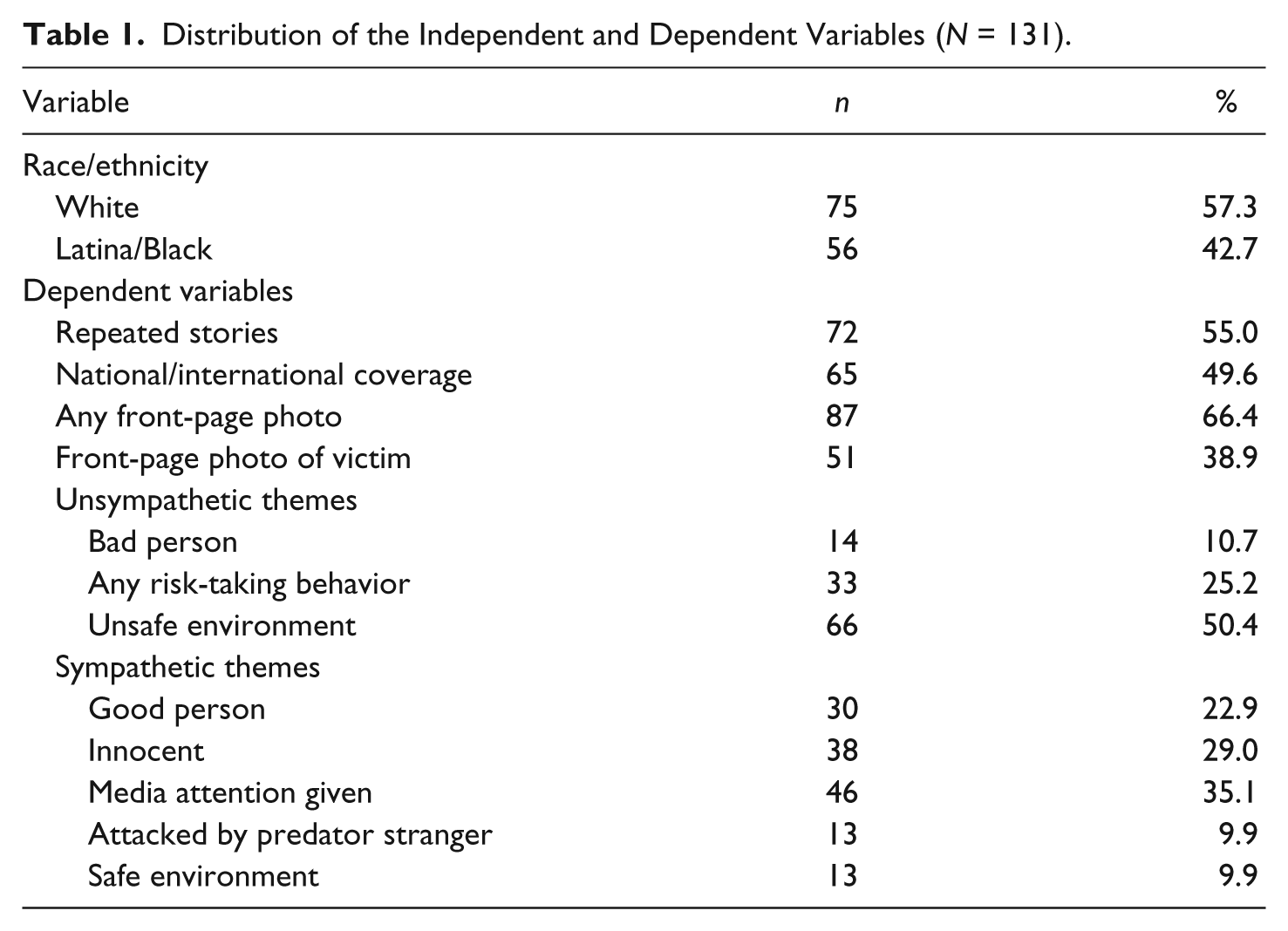
Coverage intensity was examined based on measures of repeated coverage and national/international coverage (i.e., nonlocal coverage). Moody and colleagues (2009) used repeated coverage as a measure of coverage intensity; they tallied how many stories were about the same victim. Table 1 shows that 72 of the 131 stories we found were about the same victim (55%). 7 Our other measure is similar to that used by Jeanis and Powers (2016), who examined whether differences existed in the extent to which stories about victims were national (vs. local) in scope although their study focused specifically on missing persons from Louisiana. In order for a story to have been coded as local in scope in the current study, the story’s events had to take place in the local area (e.g., a murder in Houston featured in the Houston Chronicle). In order for a story to have been coded as national/international in scope, the story’s events had to take place outside the local area (e.g., a kidnapping in California featured in the New York Times). For example, stories about Jill Carroll, JonBenét Ramsey, the Duke Lacrosse accuser, and the Amish girls killed in a mass shooting were all coded as national/international stories because none took place in Los Angeles, New York, Houston, or Chicago. It is logical for one to assume that more notable stories will be disseminated on the national or international level (Jeanis & Powers, 2016; Taylor, Boisvert, Sims, & Garver, 2013). Alternatively, the less notable the story, the more likely the story will only be carried locally. We found that 65 front-page stories were national/international in scope (49.6%).
Table 1 also contains two variables related to story photographs. First, the presence of any photograph on the front page was coded. Eighty-seven of the front-page stories had a front-page photograph (66.4%). Then, we examined whether the photograph portrayed the victim herself. In 51 stories, the victim herself was portrayed on the front page (38.9%).
In line with Altheide’s (1996) approach, the data analysis process included the coding of variables past researchers highlighted as narratively important. Specifically, based on the good girl/bad girl (Gilchrist, 2010; Meyers, 1997) and innocent/risk-taking dichotomies (Ardovini-Brooker & Caringella-MacDonald, 2002), stories were coded as having (or not having) the unsympathetic themes of “bad person” and “risk-taking behavior.” A story was coded as having the “bad person” theme if the victim was described as a bad wife, a bad mother, uncaring, or otherwise deviant (e.g., a sex worker). Fourteen of the 131 stories featured a “bad person” narrative (10.7%). Several stories featured descriptions of risk-taking behavior. In order for a victim to have been coded as a risk-taker, her news story had to portray her as making a reckless decision (e.g., associating with deviants, living with a known criminal, drinking to excess, using drugs). Thirty-three stories described the female victim as a risk-taker (25.2%). Importantly, these categories were not necessarily mutually exclusive; for example, women who engaged in prostitution and who used illegal drugs were coded as both “bad” and “risk-taking.”
Table 1 further shows that the new theme of the “unsafe environment” emerged during the data coding process. The theme of “unsafe environment, unsurprising outcome” was coded if the story featured descriptions of a victim’s dangerous neighborhood or home environment, which we believe serves to diminish the “shock value” (i.e., unexpectedness) and, therefore, sympathy a story may elicit. If crime or deviance frequently occur in certain places or within certain families, then it is not surprising when certain individuals are victimized. Expected victimization does not garner as much sympathy as unexpected victimization, which is important given that the element of surprise is a key factor in assessing a story’s newsworthiness (De Nies et al., 2012; Lundman, 2003). Sixty-six stories featured the “unsafe environment” theme (50.4%).
Based upon the good girl/bad girl and innocent/risk-taking dichotomies, we also coded for the presence or absence of the sympathetic themes of “good person” and “innocent.” Stories were coded as having the “good person” theme if the female was described as a good mother, a good wife, a good student, a good daughter (sister, friend), or as a caring individual. As shown by Table 1, 30 stories described the victim as a “good person” (22.9%). The theme of innocence was coded if the victim was described as naive, wholesome, or harmless, and 38 stories featured this theme (29%).
The new themes of “media attention given,” “dangerous criminal attacks stranger,” and “safe environment” emerged during the data coding process. In general, the “media attention mentioned” theme presented itself if the story included a description of media presence in the aftermath of the crime. Table 1 shows that 46 stories contained this theme (35.1%). The theme of “attacked by predator stranger” also garners sympathy for victims. In stories that had such a theme, the offender was often described as a predator with a lengthy criminal history who attacked a complete stranger, and the victimization was random and shocking. Upon reading a story with such a narrative, a reader is likely to feel sympathy for the victim, given fear of “unpredictable strangers” (Lupton, 1999) and “evil villains” (Wanzo, 2008, p. 110). This theme was present in 13 stories (9.9%). We also uncovered the “safe environment, surprising outcome” theme when reading through the news stories. Such a theme was present if the story featured a description of the safe neighborhood in which the crime occurred. Like the “dangerous criminal attacks stranger” theme, this theme points to the crime’s unexpectedness, which garners sympathy from the reader. Table 1 shows that this theme was present in 13 stories (9.9%).
Coverage Intensity and Use of Photographs by Race/Ethnicity
We then examined whether the race/ethnicity of the female victim was related to the dependent variables of interest. As presented in Table 2, 62.7% of White female victims received repeated coverage, compared with 44.6% of Latina/Black female victims. Chi-square analyses indicated stories about White female victims were significantly more likely to receive repeated coverage than stories about Latina/Black female victims, which is consistent with what Moody and colleagues (2009) found.
Distribution of Coverage Intensity and Use of Photographs by Race/Ethnicity (N = 131).
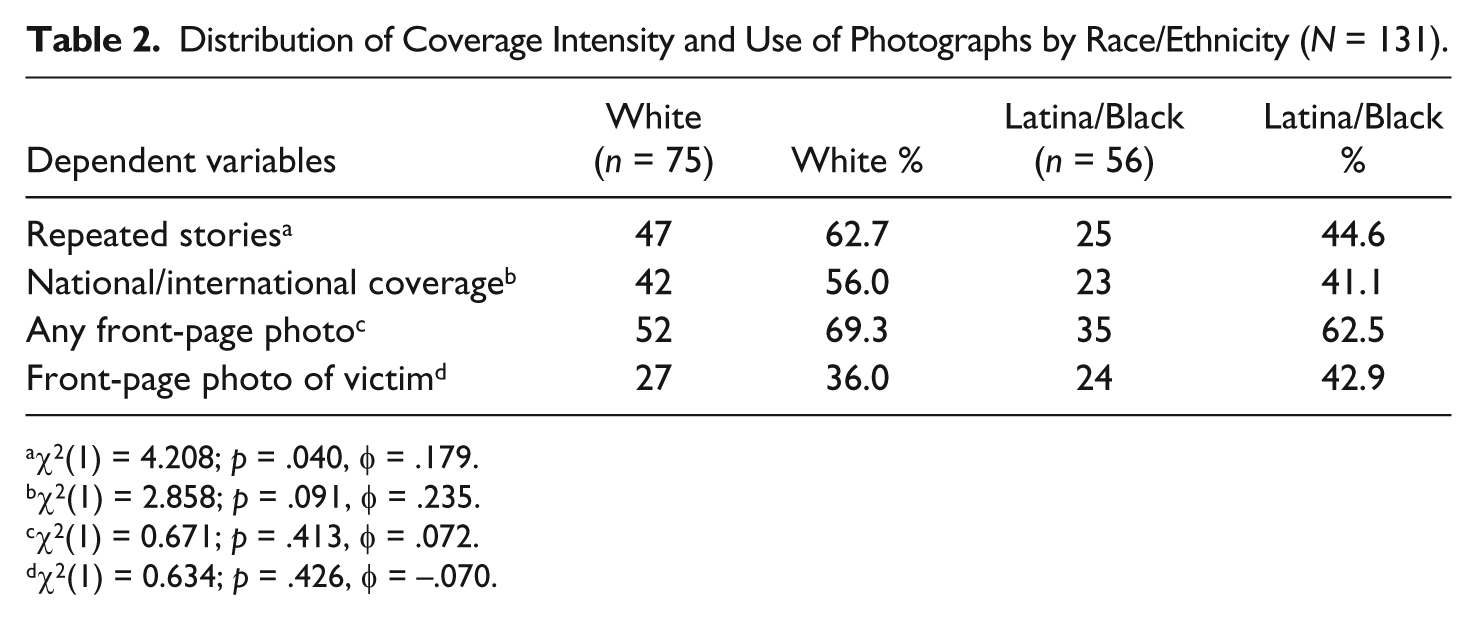
χ2(1) = 4.208; p = .040, φ = .179.
χ2(1) = 2.858; p = .091, φ = .235.
χ2(1) = 0.671; p = .413, φ = .072.
χ2(1) = 0.634; p = .426, φ = –.070.
With regard to differences in the scope of news stories, Table 2 also shows that close to 60% of the stories about White female victims had a national/international scope, compared with about 40% of the stories about Latina/Black female victims. However, this difference was not statistically significant. With regard to the photographic elements of interest, about 69.3% of the stories about White female victims had a front-page photograph, compared with 62.5% of the stories for Latina/Black female victims. Although stories about White female victims were slightly more likely to have a front-page photograph, the difference between the groups was not statistically significant. Front-page photograph content was also examined. In only 36% of the stories about White female victims, the victim herself was portrayed in the front-page photograph, compared with 42.9% of the stories about Latina/Black female victims. However, the difference between the two groups was not statistically meaningful.
Unsympathetic and Sympathetic Themes
We then examined whether the race/ethnicity of the victim was related to the presence of sympathetic or unsympathetic story narratives. Table 3 provides the distribution of the various unsympathetic themes that emerged from the stories we read by the race/ethnicity of the female victim. Latina/Black victims were significantly more likely to be described as a “bad person” than their White counterparts.
Distribution of Unsympathetic Themes by Race/Ethnicity (N = 131).
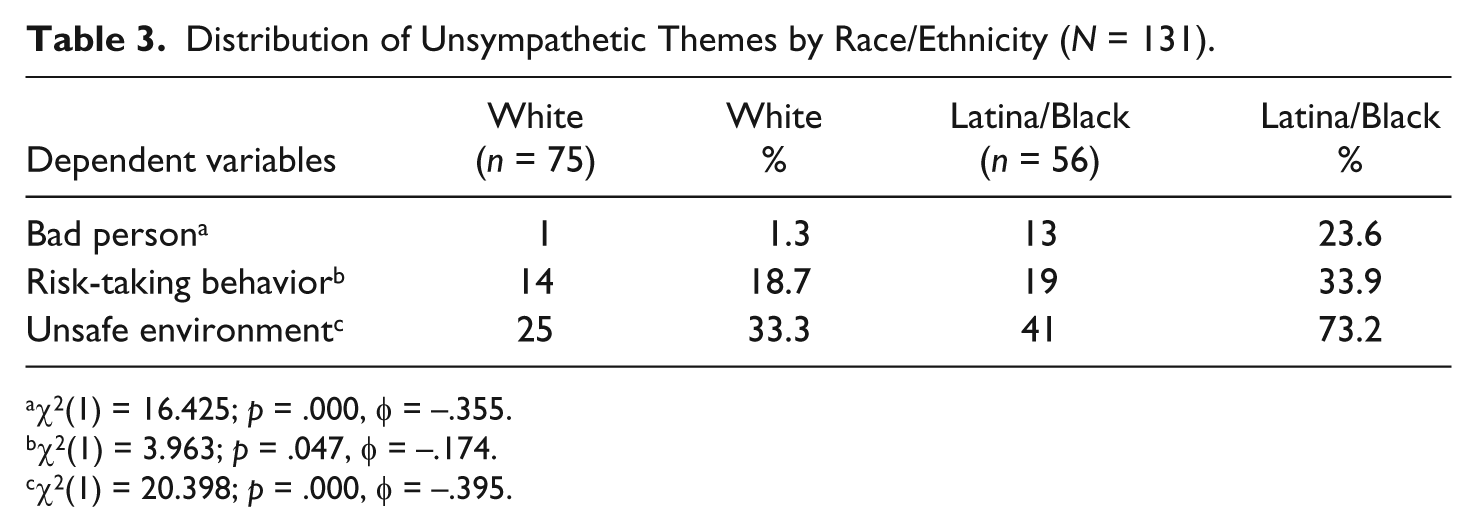
χ2(1) = 16.425; p = .000, φ = –.355.
χ2(1) = 3.963; p = .047, φ = –.174.
χ2(1) = 20.398; p = .000, φ = –.395.
In addition, 33.9% of the stories about Latina/Black females and 18.7% of the stories about White females described the victim as a risk-taker. Indeed, Latina/Black female victims were significantly more likely to be described as taking risks and, therefore, complicit in their victimization. Importantly, the “risk-taking” and “bad person” themes sometimes appeared in tandem in news accounts.
For example, the New York Times published an article about the Duke Lacrosse alleged sexual assault case, and the article painted the 27-year-old Black victim in a negative light. (It is noteworthy that this article was written months before authorities concluded no rape occurred.) The story’s narrative described her as a single mother who worked at “Platinum Pleasures, a strip club, and Angel’s Escorts” (Wilson & Glater, 2006, p. A15). At the time of her alleged assault, she was described as a stripper who went to a party in a “see-through outfit” (Wilson & Glater, 2006, p. A15). After she left the party with a friend, her friend called the police. The responding officer described the victim as “passed out drunk” (Wilson & Glater, 2006, p. A15). These negative details about the victim portrayed her as somehow responsible for her own victimization. As a second example, a Houston Chronicle article about 17-year-old Latina murder victim Nidia Mendoza portrayed her as reckless (Hanson, 2006). She agreed to “exchange money for sex” when she finished her shift as a dancer in a nightclub, and she willingly entered the perpetrator’s van and motel room (Hanson, 2006, p. A10). In both of these examples, the victim is simultaneously portrayed as “bad” and “risk-taking.”
In a Chicago Tribune story, Black murder victim Jimella Tunstall was described as a teenage mother who “once lost custody of her children” (Rozas, 2006, p. A1), which insinuated that she was a “bad” person with diminished worth. In a Houston Chronicle story, a Black domestic violence victim named Carolyn Thomas was described as dating a “known drug dealer released from prison just six weeks before [her] shooting” (Kever, 2006, p. A1). He had threatened to kill her in the past, but she thought “his threats were cute” (Kever, 2006, p. A8). This “risk-taking” behavior served to blame the victim.
Table 3 further shows that the “unsafe environment” theme emerged in 73.2% of the stories about Latina/Black female victims but in only 33.3% of the stories about White female victims. Indeed, Latina/Black female victims were significantly more likely to be described within their unsafe environments than White female victims. Such a theme appeared in a Los Angeles Times story featuring Debra Johnson, a Black woman. Johnson was shot after witnessing a gang homicide in a “public housing project in Watts” (Leovy, 2006, p. A24). The extent of drug use and gang violence in Watts was described multiple times throughout the story, which served to shift focus away from the victim to the extent of crime within her community. Such a narrative not only diminished her victimization, but also served to reinforce the negative stereotype about the pervasiveness of crime in Black neighborhoods. In another story from the Los Angeles Times, the murder of 3-year-old Latina victim Kaitlyn Avila was described. Kaitlyn’s cousin stated her neighborhood is “dangerous . . . too dangerous to live,” and ongoing gang wars were described (Hayasaki, 2006, p. B9).
A Chicago Tribune story featured a 10-year-old Black shooting a victim named Siretha White. The article stated that “the dangers of the neighborhood did nothing to dampen her lively spirit,” while her family described how they had patted people down as they entered Siretha’s birthday party (Huppke, 2006, p. A20). A notable portion of the article documented the prevalence of neighborhood gang violence. Such descriptions of an unsafe physical environment shifted focus away from the victim; readers are left thinking that violent occurrences are common and are a way of life within certain communities.
The theme of “unsafe environment” also presented itself when negative depictions of the victim’s familial environment appeared in a news story. In one story from the Los Angeles Times, a 2-year-old Latina murder victim named Sarah Chavez lived with family members who were known to be dangerous. Sarah was murdered by her aunt and uncle who had previously lost custody of her (Levey, 2006). Indeed, the court ordered Sarah back to them “even though social workers had once suspected them of abusing her” and despite her “injuries” (Levey, 2006, p. A1). An unsafe environment was also portrayed in a Houston Chronicle story about 12-year-old Black murder victim Teketria Buggs. Teketria’s killer, her stepfather Steve Carrington, murdered someone in the past and her family members kept the “grim secret” hidden (Freemantle & Hanson, 2006, p. A1). Moreover, the family home was filled with “arguments and fights, drinking and drugs,” wherein the offender abused the girl’s mother “on occasion” (Freemantle & Hanson, 2006, p. A19). Both of these examples serve to shift focus from the victim to the offender(s). In doing so, the stories highlight the negative traits of Black and Latino offenders, which feeds into unfavorable stereotypes about minorities in general.
Our findings connect to a larger literature about the stereotypes of minorities as poor, criminal, and dangerous (Chiricos & Eschholz, 2002). Put another way, the “unsafe neighborhood” theme closely aligns with racialized views of the urban “ghetto” and the people within it (Wilson, 1996, p. 223). Such racialized views are pervasive in American society and were voiced during a 2016 presidential debate when candidate Donald Trump said, “African-Americans and Hispanics are living in hell. You walk down the streets, you get shot” (Burns & Flegenheimer, 2016). Simply put, when a victimization experience is framed as an unavoidable consequence of negative environmental realities, the theme of an “unsafe environment” serves to normalize and, therefore, diminish the victimization of Latina and Black females. Overall, Latina/Black female victims receive less sympathy because they are viewed as “bad,” “risk-takers,” and as living in “unsafe environments” where victimization is expected.
Sympathetic Themes
With regard to sympathetic themes, Table 4 shows that a little over 30% of the stories about Latina/Black female victims contained the “good person” theme, compared with 17.3% of the stories about White victims. The difference between the two racial groupings, however, was not statistically significant. 8 Likewise, the theme of innocence appeared in about 29% of the stories for both White and Latina/Black female victims, which resulted in no statistically significant difference between the groups.
Distribution of Sympathetic Themes by Race/Ethnicity (N = 131).
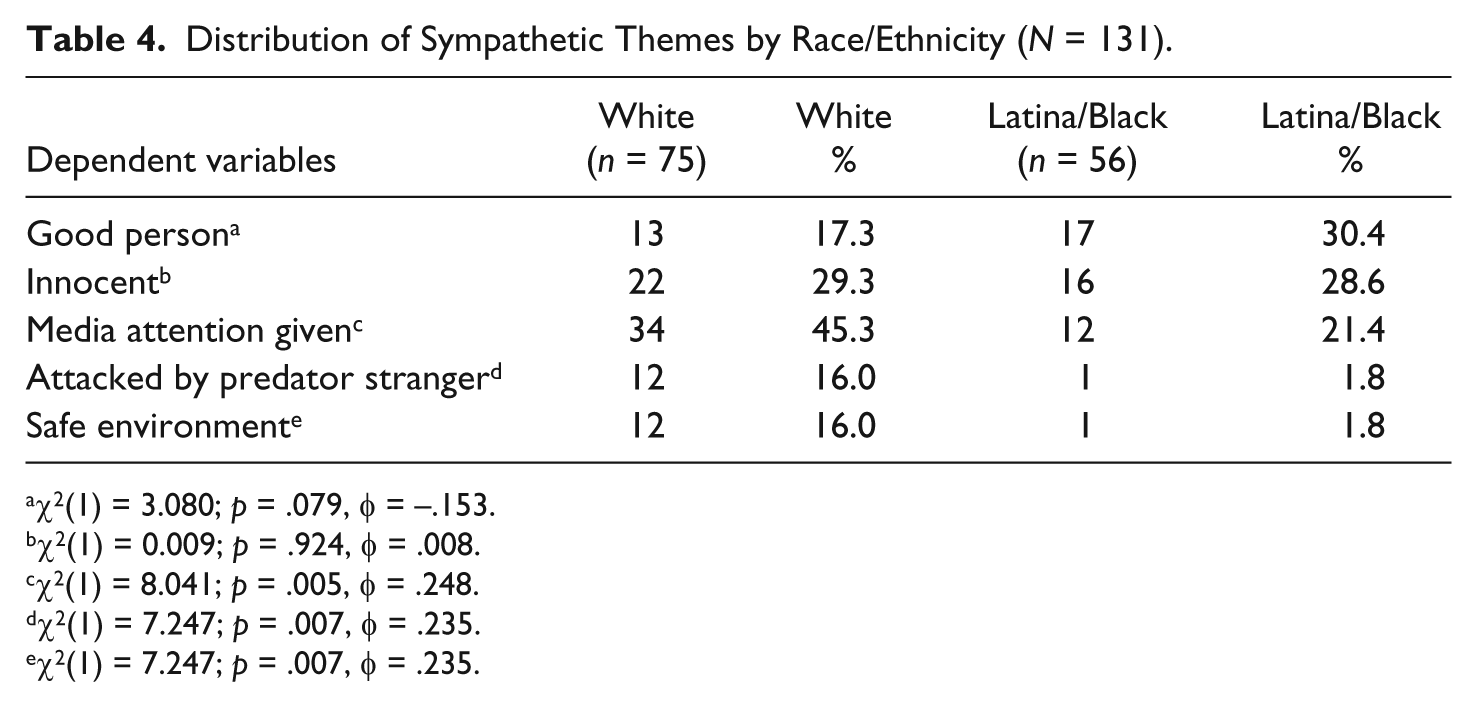
χ2(1) = 3.080; p = .079, φ = –.153.
χ2(1) = 0.009; p = .924, φ = .008.
χ2(1) = 8.041; p = .005, φ = .248.
χ2(1) = 7.247; p = .007, φ = .235.
χ2(1) = 7.247; p = .007, φ = .235.
Table 4 also shows three other sympathetic themes that emerged during the data analysis process. As shown, White female victims were significantly more likely than Latina/Black victims to have media attention mentioned in their stories. Indeed, media attention was described in 45.3% of the stories about White female victims, but in only 21.4% of the stories about Latina/Black female victims. For example, the extent of media attention was mentioned in a Los Angeles Times story about the shooting deaths of four White Amish girls at their schoolhouse. The story described “reporters and photographers . . . throng[ing] the streets” and the fact that the “reclusive community struggle[d] to mourn amid a media onslaught” (Fenton & Scharper, 2006, p. A24). Media attention was also described in a Los Angeles Times story about a kidnapped journalist named Jill Carroll. Carroll was suddenly released from captivity, and she “was shocked by the heavy news coverage of her kidnapping and the publicity surrounding her case” (Daragahi, 2006, p. A22). The theme of “media attention given” places value on the victim; the media cover stories about worthy victims.
In addition, ideal victims are attacked by stranger predators. Table 4 shows that White female victims were significantly more likely to be attacked by an unknown predator than Latina/Black female victims. This theme garners sympathy for the victim due to the tragic and seemingly random nature of the victimization. And, because stories about White females are more likely to contain the theme than stories about Latina/Black females, stereotypes about the vulnerability of White females are fostered.
To illustrate this narrative thematic element, consider a story that appeared in the Houston Chronicle about the murder of a 14-year-old White victim named Jennifer Ertman. Jennifer was brutally murdered by several Black gang members while taking a “shortcut” home for the first time. Most of the story focused upon Derrick O’ Brien, a habitual offender who was ultimately sentenced to death (Ruiz & Turner, 2006). O’Brien’s criminal history was discussed at length. He killed someone in the months prior to Jennifer’s killing, and his “relatives said his behavioral problems began in school” at an early age (Ruiz & Turner, 2006, p. A24). His family did not testify for his defense because they agreed he was a “cruel and intentionally harsh” person. In the story’s text, the assistant district attorney stated, “I’m not a huge fan of the death penalty, but this is the kind of guy I think it’s for” (Ruiz & Turner, 2006, p. A24). Simply stated, O’ Brien was a predator, and Jennifer was his unfortunate, random victim.
This theme also appeared in a Los Angeles Times article about a missing 19-year-old White female named Kristin Smart. Paul Flores, the only suspect in Kristin’s disappearance, was the last person seen with her. A group of women referred to Paul as “Chester the Molester” because he aggressively advanced on women in the past (King, 2006, p. A20). He binge drank by himself, and he often attended parties alone to pursue women (King, 2006). A female student recently called police on him because he climbed onto her balcony without permission (King, 2006). The story narrative portrayed Paul as a predator with a history of aggressively advancing on unsuspecting women.
Such a theme appeared in only one story about a Latina female victim, and in no story about a Black female victim. In a Chicago Tribune story about the murder of a Latina convenience store worker named Wanda Lopez, her murderer’s lengthy rap sheet was described (Mills & Possley, 2006). Carlos Hernandez had been arrested for similar knife attacks in the past, and he was known to have a “short fuse” (Mills & Possley, 2006, p. A10). He had “a particular fondness with a knife with a folding lock blade,” and he “was real quick about stabbing people” (Mills & Possley, 2006, p. A10). Lopez did not know Hernandez, the violent felon with a checkered past who attacked her. In all three of these examples, the victim did not know what was coming, so there is no way that she could have taken steps to protect herself from a dangerous predator. These stories foster stereotypes about victim vulnerability and, therefore, garner sympathy from readers.
Table 4 further shows that White female victims were significantly more likely to be described as living within a safe environment than Black/Latina female victims. In fact, only one story that featured a Black or Latina female victim contained this theme. In a Los Angeles Times story about a missing White female named Kristin Smart, her father stated, “we thought it was a safe community, you know. And it is. It just didn’t work out that way for our family” (King, 2006, p. A1). A Houston Chronicle article about the shooting deaths of four White Amish girls described the Amish community as a place where “violent crime is virtually nonexistent” (Scolforo, 2006, p. A1). Furthermore, a Houston Chronicle story about the shooting death of a White female named Rachel Pendray, a woman who knew the victim stated “nothing like this usually happens at Huntsville” (Rice, 2006, p. A4). These descriptions of the safe environments in which the victims lived and the unexpected events that transpired added “shock value” to their stories, which garnered sympathy from the reader.
Discussion
Black and Latina women are more likely to experience violent victimization than White women (Lauritsen & Heimer, 2009; Rennison, 2001). Despite these realities, media outlets tend to focus on the victimization of White women and children (Moody et al., 2009), which influences perceptions about the worth of certain types of crime victims and the actions taken by criminal justice officials. Research shows police are more inclined to work to solve a case if it has received media coverage (Lee, 2005), offenders who rape White women receive longer sentences than offenders who rape Black women (Crenshaw, 1991), and defendants convicted of killing White females are more likely to face the death penalty than defendants who kill others (Holcomb et al., 2004).
Ideas about victim worth materialize, in part, from media coverage of crime. Within mass communications literature, scholars argue the media use images and the written word in the framing of crime news (Gamson & Modigliani, 1989), and consequently influence what issues people think about and the feelings they have on issues (McCombs & Shaw, 1972). According to cultivation theory, consumer consumption of messages affects perceptions (Weitzer & Kubrin, 2004), and “perceptions about the real world will match what is most frequently depicted in the media” (Weitzer & Kubrin, 2004, p. 499; see also Grabe & Drew, 2007). In addition, causal attribution theorists maintain that indirect experiences affect perceptions (Kelley, 1973; Tyler, 1980), which is important within the context of the current study given that most people do not have direct experiences with crime (Davies et al., 2008). Instead, individuals generally learn about offenders and victims indirectly via the media (Davies et al., 2008). Such notions indicate that stories about crime victims matter. However, crime story content will differ depending on the characteristics of the victim.
With regard to differential news coverage of crime victims, critical race feminists highlight the need for examinations of the effects of race/ethnicity and gender in tandem because racism results in distinct perceptions and experiences for White females versus minority females (Collins, 2000; Higginbotham, 1983; Potter, 2006). Therefore, we examined whether and how media accounts differed for White versus Latina/Black female crime victims.
Our study differed from other relevant studies in several important ways. First, unlike past research, our study was not limited to an examination of specific types of victimization, specific victims, or specific offenders. Instead, we examined all front-page newspaper stories about female victims, regardless of crime type or specific offender, to gain a better understanding of reports of crime victims in general. Second, we analyzed whether the observed differences found for White versus Latina/Black female victims were statistically meaningful. No other researcher has yet performed bivariate statistical analyses of differences in the narratives themes found in stories about White versus Latina/Black female victims. In addition, we provided specific narrative examples of the differences we found to provide context to our findings, whereas most other researchers did not (for the few exceptions, see Ardovini-Brooker & Caringella-MacDonald, 2002; Gilchrist, 2010; Moody et al., 2009).
In our examination, we found that a larger number of stories were about White female victims. In general, front-page stories tended to feature a violent victimization such as murder, sexual assault, kidnapping, child abuse, or physical assault (n = 113, 86.3% of all stories). Roughly 83% of stories about White female victims were about their violent victimization, compared with 91% of stories about Latina/Black female victims. Although this difference was not statistically meaningful, it is worth remembering that researchers find Latina and Black women have higher rates of violent victimization than White women (Lauritsen & Heimer, 2009; Rennison, 2001). So, our finding that stories featuring Latina/Black victims were more likely to portray violent victimization than stories about White females was not surprising. However, the higher total number of violent victimization stories about White females—despite their lower rate of violent victimization—may be an artifact of the unexpected nature of their crimes. Indeed, normalized events have less affectual impact than abnormal (or unexpected) events (De Nies et al., 2012; Lundman, 2003). Although we found no statistically significant differences in national/international coverage or front-page photographic representations for stories about White versus Latina/Black women, the stories about White female victims did receive significantly more repeated coverage. Such a finding coincides with notions that stories about White female victims are more noteworthy than stories about minority victims (Christie, 1986; Jeanis & Powers, 2016), which is consistent with notions of minority devaluation and White privilege wherein crimes involving Whites are taken more seriously (Bjornstrom et al., 2010).
Story narratives also varied; stories about Latina/Black female victims were significantly more likely to contain unsympathetic themes than stories about White female victims. This overall finding is consistent with the Black feminist perspective, which maintains that perceptions of White women are distinct from those of minority women. Indeed, Latina/Black females were significantly more likely to be described as “bad” and “risk-taking,” which meant that they were more often blamed for their victimization based on their immoral behavior and/or the “bad” people with whom they willingly associated (for a similar conclusion, see Meyers, 1997).
Furthermore, Latina/Black female victims were significantly more likely to be described in news stories as residing in unsafe environments, which served to normalize their victimization and foster negative stereotypes about Latino and Black families and neighborhoods. These stories featured accounts of widespread gang violence and abuse within the family. While it is true that minorities are far more likely to live in urban centers (California Newsreel, 2003) and that “females who reside in urban areas have the highest rates of victimization” (Lauritsen & Heimer, 2009, p. 38), this does not mean that their victimization should be perceived as something that was bound to happen. Nonetheless, in crime stories that highlight negative environmental conditions, readers tend to believe that crime cannot be avoided, which diminishes a story’s shock value. Such a finding is in line with the concept of minority devaluation, which explains that the “victimization of persons of color is . . . seen as representing less loss or harm to the community” than the victimization of White people (Bjornstrom et al., 2010, p. 276; see also Wanzo, 2008).
Statistically significant differences also materialized in the presence of specific sympathetic themes in news stories for White versus Latina/Black female victims. For example, the themes of the “safe environment” and “attacked by a predator stranger” were significantly more likely to appear in stories about White female victims. Both themes added to the “shock” value of stories about them; their victimization was unexpected and, therefore, tragic. It is interesting to note that, in reality, minority female victims are more likely to be violently victimized by a stranger than White women (Lauritsen & Heimer, 2009), but crime story narratives tended not to reflect that reality. Discussions of a White female’s victimization at the hands of a stranger are noteworthy when one considers that others have found that unpredictable and unique events are more likely to receive media coverage (De Nies et al., 2012; Lundman, 2003).
In addition, the theme of “media attention given” was significantly more likely to appear in story narratives featuring White female victims. Descriptions of “media attention,” which included reports of numerous news reporters and widespread coverage, serve as a cue for the reader—This victim is important. This finding is consistent with notions of White privilege and with agenda-setting theory—The media tell readers what (and who) to care about (Gross & Aday, 2003). Accounts of female victims are meaningful given that causal attribution theorists find media representations are especially opinion-forming for readers who do not have direct experience with crime (Davies et al., 2008).
While the results of this study are in line with predictions derived from critical race feminism, including expectations about minority devaluation and White privilege, there are some notable limitations to the study that must be mentioned. First, there were 56 total stories for Latina and Black female victims, which precluded our ability to examine whether news coverage differed between the stories about the two groups of minority women. Our inability to separately examine stories for Latina and Black female victims may have obscured important differences between them. Future researchers are encouraged to aim to analyze a larger number of stories to allow for possible examinations of differential portrayals among minority women.
Furthermore, we encourage others to continue with our line of inquiry through examinations of more recent news stories. With that said, we believe the extent of both implicit and explicit racial bias has not changed greatly over the past decade, although racism has become a more evident concern in American culture (as evidenced by discussion of the topic during the 2016 Presidential Debates and via the Black Lives Matter Movement). Moreover, while our qualitative document analysis supports the premise that sympathetic narratives are less common in news stories about the victimization of minority women, which may lead to ideas about victim worth, we did not test whether actual readers were influenced by newspaper accounts. Future researchers may wish to use an experimental design to test whether actual or vicarious readers (i.e., those who briefly glimpse the front page) have differential perceptions of minority versus White female victims after exposure to front-page news. 9
Another potential limitation of this study is the lack of a control for “type” of victimization. It may be possible that news coverage would differ based on victimization type (e.g., homicide stories vs. sexual assault stories vs. child abuse stories), which may be an avenue for future research. In addition, the effect of a victim’s age on thematic content should be explored, if possible. 10 It may be that differences in story narratives are more likely to emerge in stories about adult female victims than in stories about very young children because child victims are not likely to be viewed as complicit in their victimization. Within a “hierarchy of victimization,” young children are considered “ideal victims” because they are vulnerable, defenseless, and innocent (Greer, 2007). Future research should also more thoroughly examine stories about victims who receive repeated news coverage. Such a pursuit would be worthwhile because it could shed light on the types of stories that newspaper editors and journalists consider especially important. Researchers are also encouraged to explore media representations of female offenders. This study focused on the print media’s portrayal of female victims, but studies about media portrayals of offenders are also important. In that regard, it would be interesting for others to determine whether stories about minority female offenders also tend to highlight their past or current deviance, negative character traits, and criminogenic environments.
Moreover, feminist scholars may wish to consider how other personal identities beyond race and gender—such as class or sexual orientation—may influence a female victim’s news coverage. However, news stories rarely provide explicit information on the victim’s class and almost never mention a victim’s sexual orientation. Of the stories we reviewed, about 20% in total included any reference (and often a vague reference) to the victim’s socioeconomic standing, and no story mentioned the victim’s sexual orientation. Therefore, it was not possible for us to include such measures in our study.
Media portrayals of victims are important because what appears in the news influences perceptions of “worthy” and “sympathetic” victims among the general public and among criminal justice actors. We found differences in crime story coverage of White versus Latina/Black female victims; there were fewer stories about Latina/Black female victims, fewer repeated stories about the victimization of Latina/Black females, and the narrative content tended to be unsympathetic (e.g., bad person, risk-taker/complicit, bad environment) in the stories about Latina/Black female victims. Our findings add to a growing body of Black feminist literature, by showing that “women’s experiences in relation to crime and deviance are far from monolithic” (Henne & Shah, 2016, p. 4). Our findings also shed light on the argument that the “media are one means through which racism pervades, albeit sometimes in unconscious, subtle, indirect, and covert ways” (Yosso, 2002, p. 53).
Footnotes
Acknowledgements
We would like to express our gratitude to Dr. Emily Wright and Dr. Candice Batton for their assistance with earlier versions of this article. We would also like to thank the Editor of Feminist Criminology and three anonymous reviewers for their valuable comments and suggestions.
Authors’ Note
Points of view or opinions stated in this article are those of the authors and do not represent the official positions or policies of the University of Nebraska Omaha or others. An earlier version of this article was presented at the 2017 Annual Meeting of the Academy of Criminal Justice Sciences in Kansas City, Missouri.
Declaration of Conflicting Interests
The author(s) declared no potential conflicts of interest with respect to the research, authorship, and/or publication of this article.
Funding
The author(s) disclosed receipt of the following financial support for the research, authorship, and/or publication of this article: This research was supported by two grants provided by the University of Nebraska Omaha—a grant from the University Committee on Research and Creative Activity (UCRCA) and a grant for Graduate Research and Creative Activity (GRACA).