







Abstract
The vast majority of research on the impact of familial incarceration focuses on its effect on children, even though one in eight adults in the United States has had a child in prison. While some studies have examined the lived experiences of mothers with an incarcerated adult son, no research has explored the effect of an adult daughter’s incarceration on their mother. Using in-depth interviews with four mothers who have adult daughters in prison, this study finds that these mothers were significantly affected by their daughter’s incarceration. They experience painful emotions, face significant barriers and challenges, and highlight the pressing need for mental health services. Along with other prior works, our findings can be used to inform policy and clinical recommendations for those working with and advocating for incarcerated populations and their impacted loved ones.
Introduction
Since the 1970s, the sharp rise in incarceration rates in the United States (U.S.) has fractured families, often leaving loved ones without providers and protectors (Wildeman et al., 2019). To illustrate how common it is to have a justice-involved family member, particularly a parent, in 2013 Sesame Street introduced Alex, the first character with an incarcerated father (Poehlmann-Tynan & Turney, 2021). In a national study by Elderbroom and colleagues (2018), they found that one in two adults in the U.S. has experienced familial incarceration. Much of the research, though, on the impact of familial incarceration focuses on parental incarceration, despite the fact that those who are incarcerated are not just parents, they are also sons and daughters with one in eight adults in the U.S. having had a child incarcerated (Elderbroom et al., 2018).
Additionally, a lack of research exists exploring the relationship between mothers and incarcerated daughters. While there is limited research on the impact of a son’s incarceration for mothers (Benisty et al., 2021; Tadros et al., 2023c), there are no studies that address the lived experiences of mothers with an incarcerated daughter. The consequences of imprisonment for mother-daughter relationships are of personal and cultural significance for developing an understanding of women’s psychological or behavioral health. As such, the purpose of this study is to provide a more detailed look at mothers’ experiences with an incarcerated adult daughter.
Impacts of Parental Incarceration on Children
Between 1.7 million and 2.7 million children are impacted by parental incarceration during their childhood and adolescence (Wildeman et al., 2019) with about half of those in prison being parents to minor children (Maruschak et al., 2021). According to data from the Bureau of Justice Statistics (Maruschak et al., 2021; Wang, 2022), about 52% of incarcerated women with minor children reported living with them at the time of their arrest, compared to 40% of incarcerated fathers. As a result of a parent’s incarceration, children are often cared for by the other parent or stepparent (71%), a grandmother (13%) and/or a grandfather (4%), or other relatives (5%) (Wang, 2022). Furthermore, 10% of minor children enter the foster care system following maternal incarceration, as compared to just two percent of children entering the foster care system following paternal incarceration (Davis & Shlafer, 2017; DeHart et al., 2018; Myers et al., 1999).
A child with an incarcerated parent is considered high-risk and more likely to experience behavioral, mental health, and delinquency issues as compared to a child with non-incarcerated parents (Burgess-Proctor, 2006; Dworsky et al., 2020; Myers et al., 1999; Reho et at., 2021; Tadros & Durante, 2022; Wright et al., 2012). This adversity is also more likely to lead to the dissolution of marriage or relationships between parents, with increased potential of residential instability and homelessness, ultimately impacting familial relationships (Poehlmann-Tynan & Turney, 2021; Reho et at., 2021) and the psychological well-being of children in the household, even as they enter adulthood.
The challenges and stigma associated with parental incarceration are more pervasive, though, amongst families with an imprisoned female family member, particularly mothers. In a survey of 6146 incarcerated individuals in state and federal correctional facilities, results indicated a child is six times more likely to experience incarceration in their lifetime when a parent has been incarcerated, with mothers being 2.5 times more likely to report that their adult children were incarcerated compared to fathers (Dallaire, 2007). In a longitudinal study of 5873 youth, Chavira and colleagues (2017) found that adult children with an incarcerated mother are also 75% more likely to be convicted of a crime and serve probation as compared to their counterparts without a convicted mother. In addition, maternal absence due to incarceration results in an increased likelihood of substance use and domestic violence for impacted children (Chavira et al., 2018). Approximately 75% of children with an incarcerated mother exhibit symptoms of traumatic stress, contributing to poor social emotional development and mental health (DeHart et al., 2018). The children of incarcerated mothers also demonstrate poor academic performance and are more likely to engage in behavioral incidents at school and drop out (Chesney-Lind, 1989; Myers et al., 1999). Moreover, the likelihood of offspring rearrest is most impacted by maternal incarceration, not paternal incarceration (Tasca et al., 2011).
Recent research has also found same-sex gendered pathways into the criminal justice system such that daughters are at an increased risk of criminal justice involvement if they have had an incarcerated mother compared to sons and imprisoned fathers (Burgess-Proctor et al., 2016; Tadros et al., 2023c). When an individual is incarcerated, it does not just affect the one in prison; the experience impacts loved ones as well (Elderbroom et al., 2018). Ultimately, the disruption of the maternal-child relationship negatively affects childhood development and makes children more socially and emotionally vulnerable, and more likely to experience personal involvement in the criminal justice system during their adult years (Belknap & Holsinger, 2006; Bloom et al., 2003; Dallaire, 2007; Myers et al., 1999).
Impact of Child Incarceration on Parents
The vast majority of the research on the familial effects of incarceration is focused on incarcerated male family members (e.g., sons and fathers) as well as parental incarceration rather than justice-involved children, despite the fact that almost 13% of U.S. parents have a child in the system (Elderbroom et al., 2018). Additionally, the gendered influence of mother-daughter dyads remains poorly studied and understood (Burgess-Proctor et al., 2016) and most of the research speaks to the parent-child relationship when the child is under eighteen-years-old. Despite this, when a child is incarcerated, mothers are more likely to experience increased levels of psychological distress punctuated by increased states of depression and anxiety (Wildeman et al., 2019). In addition, mothers of incarcerated children may experience additional economic stressors related to caring for an incarcerated adult child who has children and for whom the mother is providing primary care (Wildeman et al., 2019). As a result, increased states of depression, anxiety, and financial burden contribute to strained relationships between mothers and incarcerated children (Bruns, 2020; Montes et al., 2021).
Despite the lack of research on the impact of an adult daughter’s incarceration on their mothers, recent research has explored how mothers cope with an incarcerated adult son (Tadros et al., 2023c). This research found that mothers with an incarcerated adult son face a slew of barriers, challenges, and concerns like a lack of resources for the family, inconsistent rules within and between the facilities in which their child is incarcerated, a lack of support from others, stigma faced by the mothers as well as their sons, financial burdens, health concerns, and a lack of appropriate treatment (Tadros et al., 2023c). The mothers also discussed the emotional toll of having a son in prison. They often felt sad and expressed a constant worry for their son’s safety while incarcerated and their future once released.
It is possible that mothers with an incarcerated adult daughter will have similar experiences. However, there are distinct differences between incarcerated women and men, which could alter the lived experiences of mothers with an incarcerated daughter. For example, as mentioned earlier, incarcerated women were significantly more likely to be the primary caretakers of their minor children prior to prison (Maruschak et al., 2021; Wang, 2022). In a report by the Prison Policy Initiative, incarcerated women report higher rates of disabilities as well as physical and mental health issues than incarcerated men with over half of women in prison meeting the criteria for substance use disorder (Kajstura & Sawyer, 2023). Women in prison also report significant childhood disadvantages like being unhoused before the age of 18 (12%), being in foster care at some point (19%), living in a family that received welfare or other public assistance (43%), and almost half had been arrested by the age of 18 (45%) (Kajstura & Sawyer, 2023).
Research conducted by Horstman (2019) on 60 mother-daughter dyad communication found that specific communication behaviors positively correlate with daughters’ increased resilience over time. In a study by Paikoff et al. (1993) using 161 mother-daughter dyads, disruptions of the mother-daughter dyad results in a lack of communication, divergent perceptions, and deleterious adult behaviors, resulting in a decline of women’s psychological and behavioral well-being. The relational-cultural connectedness of the mother-daughter dyad is of societal importance, as a disruption of the mother-daughter dyad negatively impacts women’s psychological and behavioral health at both the personal and cultural levels, mother-daughter feminist socialization, and women’s well-being in terms of identity, self-esteem, and aspiration (Colaner & Rittenour, 2015). Ultimately, incarcerated women tend to be worse off than their male counterparts with distinct root causes of criminal behavior. As such, their mothers’ experiences of their incarceration may also be distinct from the experiences of mothers with an incarcerated adult son (Tadros et al., 2023c).
Current Study
The current study utilizes a feminist, phenomenological lens which challenges the traditional phenomenological approach of describing lived experiences by questioning assumptions and biases. More commonly known phenomenological ideologies, Merleau-Ponty and Husserl assume neutrality in experiences, but often are represented by white, male subjects (Carman, 1999). Feminist phenomenologists analyze gender-related social and political issues, including aspects like sexuality, racialization, class, ethnicity, and disability (Kaku, 2024).
Despite the rise in incarceration over the past several decades, non-incarcerated family members, including parents, still face increased social stigma which affects family dynamics, and elicits little empathy from society, contributing to decreased social supports (Arditti, 2005; DeHart et al., 2018; Wildeman et al., 2019). As such, the purpose of this study is to better understand the impact of incarceration on parents with system-involved adult children, particularly the needs and challenges experienced by mothers with incarcerated adult daughters by giving voice to this under-researched population and sharing their unique experience. This study’s guiding research question is: What is the lived experience of mothers with an incarcerated adult daughter?
Method
Participants and Procedures
The following study obtained institutional review board approval from Syracuse University. Thus, researchers followed all ethical procedures as required by the IRB. Researchers recruited participants for this study from an online Facebook support group called “Incarcerated Loved Ones,” which consists of over 16.6k members. Members of this group varied, but all had a loved one who was or is incarcerated. The group’s main purpose is to provide encouragement, advocate for reform within the criminal justice system, and provide information for members related to the process of incarceration. To provide justification for our recruitment, we looked to previous works to obtain our sample and various studies have utilized this Facebook group to gain a deeper understanding of incarcerated individuals and their loved ones (Tadros et al., 2022, 2023a, 2023b, 2023c). Because this is a closed Facebook group, researchers first had to obtain approval to join the group from the group’s administrator. Once they had joined the group, they also needed permission to post in the group’s feed. All members of this group, including the researchers, agreed to group rules ensuring the privacy of all members. The group comprises thousands of participants and, thus, each post receives high activity when members share their personal situations regarding issues such as criminal justice procedures or thoughts on sentencing.
Researchers shared the requirements to participate in the study in an initial inquiry post to recruit those who qualified. The inquiry called for mothers of incarcerated daughters (18 years of age and older) to share their lived experience. After verifying that the individuals met criteria, the researchers acquired contact information (phone and email) through the privacy of Facebook messenger. The participants for this study consisted of four mothers who all have an adult daughter that is currently incarcerated. Although many members expressed interest in participating, many were romantic partners or mothers of incarcerated sons, thus did not meet criteria for inclusion. All participants were white female mothers, two of whom had experience going to therapy while the other two did not. Interviews took place from February 2023 to June 2023. Researchers completed one in-depth interview with each participant.
Once identified as an interested participant, individuals received informed consent forms as well as a request for availability for audio-recorded interviewing. This study was conducted on a voluntary basis and researchers informed participants that they could withdraw at any time and that they could not answer certain questions if they did not feel comfortable. All participants were informed that interviews would be audio-recorded for transcription purposes. Researchers assured participants that while interviews were being recorded, all identifying information would be de-identified when transcribed. Once participants consented to the study guidelines and procedures, researchers commenced the interview process.
The interviews focused on several semi-structured questions, though researchers asked follow-up questions when necessary. Researchers developed questions to collect information regarding participants’ lived experience of being a mother to an incarcerated daughter. Participants shared their unique experience as mothers as well as their thoughts, feelings, and attitudes towards the matter. With such gravity regarding these questions and the intricate feelings of individuals with incarcerated loved ones, researchers were careful to not cause harm to participants of the study. Researchers adhered to all ethical research protocols during the entire study in order to respect participants’ contributions, deliver their shared experiences as accurately as possible, and to lessen any potential harm. Once interviews concluded, researchers debriefed each participant and encouraged them to seek mental health services if any distress resulted or if they had any request for such referrals. More specifically, researchers referred participants back to the informed consent form which included information for resources such as the National Alliance on Mental Illness website and various numbers for The National Suicide Prevention Lifeline, National Sexual Assault Hotline, National Domestic Violence Hotline, and a Crisis Text Line. Participants were not compensated.
Upon completion of audio-recorded interviews, researchers transcribed and reviewed all conversations. To ensure participant confidentiality, researchers de-identified all identifying information included in the interviews. One researcher coded the interviews, utilizing thematic analysis. To generate meaning researchers noticed patterns (Miles, 2014), which was then discussed between two researchers in order to identify important statements. This study utilized open coding consisting of one coder and one auditor. Discussion of findings and analysis of codes helped researchers reach agreement on themes and codes. Researchers created themes when they identified various similarities across codes. This allowed multiple codes to fall under an umbrella theme, therefore allowing commonalities across lived experiences of mothers with incarcerated daughters to be discussed. Researchers collected statements that reflect the lived experience of mothers with incarcerated daughters when reviewing the transcribed interviews. Once researchers reviewed and synthesized relevant data and collected impactful quotes, all transcribed interviews were then permanently deleted to further ensure confidentiality of information and protection of participants.
Semi-structured interviews all ranged from a minimum of 15 minutes to 45 minutes; this was contingent on how long the mothers wanted to expand on each question asked. Interviews consisted of seven questions and interviews asked follow-up questions if needed. Interview questions are included in an appendix.
Analytic Strategy: Phenomenology
This study employed a feminist phenomenological approach to address the overarching research question. The application of this phenomenological construct provided opportunities to develop understanding with respect to the lived experiences of incarcerated mothers and daughters, as well as a framework for understanding emergent themes (Creswell & Poth, 2018). Furthermore, identifying emergent themes provided insight regarding the experiential phenomena of research participants and their individual and collective perspectives.
Utilizing a qualitative, phenomenological design also provided objective and subjective perspective with respect to the impact of shared experiences on familial relationships (Creswell & Poth, 2018). The intersection and interconnectedness of lived, shared experiences provided an understanding of the essence of the phenomenon being studied (Prosek & Gibson, 2021). Collectively, utilizing a qualitative, phenomenological approach provided a framework for interpreting emergent themes, analyzing data, and making meaning of the lived experiences of incarcerated mothers and daughters. Thus, this analytic method is appropriate for exploring shared relationship experiences and significance/meaning.
Results
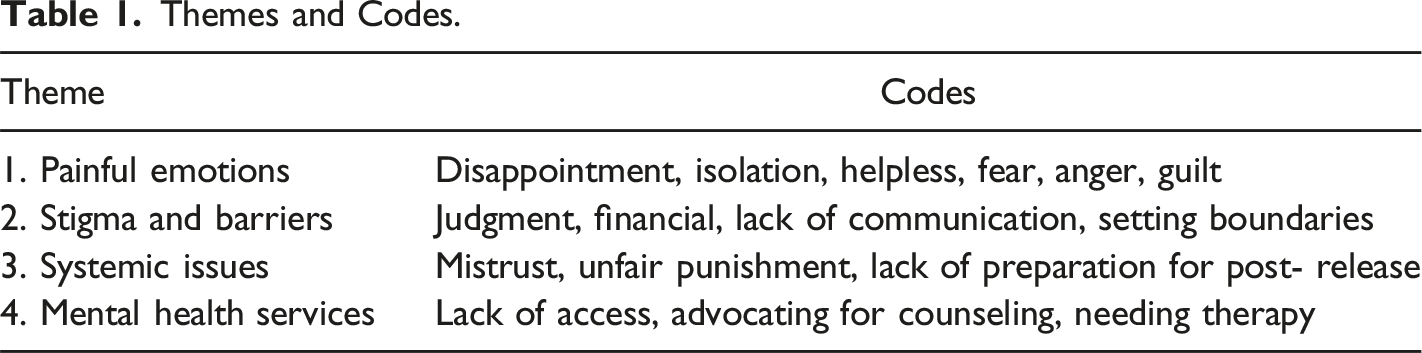
Themes and Codes.
Painful Emotions
The first theme identified was painful emotions experienced by mothers with incarcerated daughters. The mothers interviewed shared various emotions that were overwhelmingly identified as painful. These emotions regarded their daughters’ incarceration as well as the mother’s own experience coping with their realities. We will discuss the codes disappointment and helplessness below due to their frequent occurrence across all interviews of mothers with incarcerated adult daughters.
Disappointment
Disappointment was a common discussion point in three of the four interviews. Mothers similarly shared their disappointment in the reality of their situations and the loss of idealized versions of their daughter’s lives. Participant 4 shared her disappointment in her daughter’s incarceration due to a case that occurred in the daughter’s young adulthood, “her life has completely changed from her 20s.” This mother shared the feeling of disappointment in the loss of her daughter’s life today due to her poor decisions as a young adult, further lamenting how her present daughter shares no similarity to her previous self. Despite being incarcerated, her daughter has grown into an improved version of herself unrecognizable to her past. Now with a daughter and family of her own, this life has been put on hold. Participant 4 went on to share that the daughter she knows today is a completely different person than the one convicted of the crime in her past. The life-altering reality of their situation is one this mother continues to grieve in the present day. Similarly, Participant 3 shared: 15 years is a long time and I need to be prepared that she could be there that long. It is a constant emotional warfare. Dealing with the disappointment of this is nothing I could have ever imagined for my child or my family.
This mother’s experience follows suit to Participant 4’s disappointment at the years lost and the life that must wait until her daughter’s sentence is served. Participant 1 echoed this disappointment, sharing, “For me it’s not getting to see her grow up.” This mother’s disappointment mirrors the other participants in the disappointment of crucial years with their daughters. The mothers’ mentions of disappointment were not towards their daughters’ actions but rather the reality of their situations. Participant 3 mentioned a, “self imposed isolation” that due to the unique experience of her daughter’s incarceration, she feels alienated from others who have not experienced this. Although the mental health status of each participant was not stated, the mothers’ anecdotes describing lost years with their daughters could likely have produced symptoms of depression and anxiety.
Helplessness
Two participants mentioned feelings of helplessness as an overwhelming attitude toward their situations. Participant 3 described their experience, “sometimes you just wanna crumble.” Participant 2 shared similar sentiments when lamenting, “I mean it breaks my heart.” Such emotions can be expected when a loved one is incarcerated due to the inability to change sentences or situations. This emotion can be especially amplified for the parent of an incarcerated child, due to the nature of such a relationship. Participant 4 shared their helplessness when consulting with professionals, “lawyer is telling me - nothing I can do at this point.” This mother was distraught knowing in her daughter’s situation, all she could do was quietly sit and wait. The mothers’ acknowledgement of their daughter’s situations surrounded a strong feeling of helplessness. They realized due to their daughter’s adulthood, all they can really do is wait for the day their daughters are no longer incarcerated.
Stigma and Barriers
The second theme identified was stigma and barriers. The participant shared distress when discussing the perception of incarceration and the copious barriers that come along with incarceration itself. Codes that will be further discussed in this theme were judgment, financial, and setting boundaries.
Judgment
Judgment was mentioned by two participants when discussing their perception of their daughter’s circumstance as well as how others may look at their daughter’s situation. Each participant’s perception of judgment surrounding incarceration informs how they interact with others when discussing their daughter’s situations. Participant 3 explained, “we don’t have this stuff in my family,” highlighting that her daughter’s incarceration was a first in her line of relatives. This participant went on to share: The other day I was thinking I could never have imagined this, my dad passed away from COVID in um March of 21 and she was sentenced in June of 21 and I have often thought - I don't even know if I would have been able to tell him.
This acknowledgement of one’s own inner judgment regarding incarceration can be jarring when it directly affects your own family. Coming to terms with their own feelings towards incarceration would have proven to be difficult if faced with telling older generations of their family. Participant 1 shared their own struggle outside of the family commenting that they avoid certain individuals because of their rhetoric when speaking of incarceration. They shared, “there’s certain people I just don’t talk to anymore about it or I avoid because they try to say things that I don’t appreciate, so I just avoid them.” This participant went so far to remove themself from certain people’s company because they do not appreciate the rhetoric in which incarceration is discussed in such settings. Participant 3 said, “And to add to that the stigma with this because of what she did we are all paying the price and paying the time - I do feel like we all got sentenced.”
Financial
Financial struggles were mentioned by all of the participants. Whether it was finances in their own home or regarding their daughter’s incarceration, monetary barriers were common across interviews. Participant 2 shared their struggles of finances noting: I got bills out here I have to pay and I gotta live out here and then I call them bills because if you have to send money for the commissary, money for the phone, money for - it’s living two lives.
Providing for one’s child is an inherent quality of a parent and takes on new meaning when such distance like incarceration is in play. Participant 4 lamented struggles with maintaining home finances as well as the burden of financially supporting her incarcerated daughter, and described it as, “… living two lives.” Additionally, having to navigate financial barriers associated with taking care of the children of an incarcerated daughter was described as a monetary struggle. The experience was consistent with having to sustain two lives and was described as, “it’s just hard, financially, having to maintain both” when speaking of the financial burden of having to raise her granddaughter.
Setting Boundaries
Two participants made mention of the importance of setting boundaries and their struggle, at times, of doing so. Participant 2 shared her struggle with her daughter at times saying, “I tell her I am pulling my mom-card out and you are going to listen.” This participant’s struggle with treating her daughter as an adult while still acknowledging her motherly role is one she continues to balance. Offering her daughter a sense of autonomy and still playing a motherly role in her daughter’s life is something this participant shared as a necessary struggle to endure. Participant 3 also wrestled with setting boundaries, saying, “there are times where I feel like I don’t set good enough boundaries because she asks all the time for stuff.” Providing for a child is a duty many parents feel compelled to do; however, when their child is incarcerated, it can be hard to create and maintain effective boundaries. This specific boundary revolves around not always sending “books and money” to her incarcerated daughter. This struggle comes from a place of motherly concern where she deeply wants to provide for her child but realizes that she needs to be more firm in communicating what she can offer to her daughter and not always saying “yes” to her daughter’s constant requests. Creating realistic expectations and boundaries with an incarcerated loved one can be a difficult but necessary step in creating a healthy relationship for the involved individuals.
Systemic Issues
Systemic issues was a theme that emerged due to the participants general attitude towards the criminal justice system. The mothers shared various concerns regarding incarceration and the system’s failure in different areas. The codes identified within this theme include mistrust, unfair punishment, and a lack of preparation for release. Mistrust and the lack of preparation for release were common concerns and will be expanded on for the theme of systemic issues.
Mistrust
Two participants shared their distaste for the criminal justice system. Participant 3 shared, “I feel like the system sets them up to fail and that is why so many of them end up back in.” This observation of the system is informed by this mother’s feeling towards incarceration and while she mentioned not having incarceration within her family tree, she openly had a strong distaste for the criminal justice system. Participant 2 shared a similar sentiment referring to the criminal justice system as “criminal injustice.” This mother’s perception of the system was informed by her partner’s experience incarcerated. She noted her loved one’s experience of “drill sergeants” for guards and sharing, “prison does something to people.” These negative assessments of the criminal justice system reflect the mother’s distrust towards the system in place that were informed by previous experiences with incarceration even before their daughter’s incarceration.
Lack of Preparation for Release
Two mothers shared a unique perspective of the lack of preparation for release for the family. Participant 2 highlighted, “they don’t do any preparation or really anything that they claim that they do.” This participant’s opinion was formed from her significant other’s release from prison and the lack of resources he was provided for his reentry to society. This mother’s perception came from a fear that her daughter will experience the same ill-preparation her partner did. Participant 3 expanded on this idea, bringing to light the lack of resources for families to prepare for their child to come home sharing, “I don’t think there is anything out there that prepares the families for what they are going to experience.” Participant 3’s perspective stems from a mother whose life has been changed due to her daughter’s incarceration and the lack of preparation she feels with her daughter’s upcoming release. Specifically noting that she feels that there are no resources to prepare families for the release of their child and the new person they have become. She wonders how the whole family will cope with another lifestyle change both financially and mentally.
Mental Health Services
Participants shared their insistence on mental health services for not only their incarcerated daughter, but the families as well. Highlighting the need for mental health services outside of incarceration and for loved ones is a subject necessary for discussion. Codes for the theme mental health services included lack of access, advocating for counseling, and needing therapy. Due to the consensus among our interviewees for the code needing therapy, it will be discussed below.
Needing Therapy
Three mothers shared their support of therapy not only for their incarcerated daughter but for themselves and families as well. Participant 2 expressed the need for therapy sharing: Yes, services would be beneficial to me and to everybody else. I think it's more so the people that have been incarcerated because it is their outlet, their mindset on things gets really screwed up because of things that happen.
This participant brings to the conversation an important reality that incarceration itself can yield negative thoughts and therefore should be addressed with therapy. By offering incarcerated individuals an outlet for sharing their emotions, this participant believes her loved ones and others would greatly benefit from such services. Participant 3 expressed that therapy would be beneficial to her granddaughter as her mother’s incarceration could leave difficult feelings for the child to work through. Discussing these emotions early on could better prepare the child for acknowledging their mother’s situation down the road. This participant further suggested access to therapy while incarcerated mentioning, “I wish they had more programs in the facilities.” Within the study, previous experience with therapy was split between the mothers with two having engaged in therapy and two not. It is unclear whether the participants’ time in therapy was directly related to their daughters’ incarceration.
Discussion
This study was conducted to better understand the lived experiences of mothers with an incarcerated adult daughter. Incarceration not only impacts the individual incarcerated, but it also impacts the lives of loved ones as well. Consequently, it is important to amplify the voices of those impacted by incarceration by sharing their unique experience.
Painful Emotions
A preeminent theme that emerged was the painful emotions experienced by mothers when handling and navigating their daughters’ incarceration. The emotions experienced by mothers were overwhelmingly negative with respect to their daughters’ incarceration. Incarceration, by its very nature, creates separation barriers, which has a negative effect on relationships (De Claire et al., 2020). Additionally, mothers reported negative, painful experiences with respect to maternal experiences in coping with their own realities. Painful emotions are expected when working with incarcerated loved ones, however, some studies have cited mixed feelings (De Claire et al., 2020; Garofalo, 2020; Tadros & Presley, 2024), whereas the results of this study highlighted all negative emotions. This is not to assert positive feelings cannot be experienced, however, the mothers who participated in this study reported no positive feelings. Instead, they discussed feeling overwhelming disappointment and helplessness with their situation.
The mothers’ shared feelings of disappointment were not about their daughters’ incarceration itself, but instead resided in the reality of both their own situations as well as the loss of their idealized versions of, or expectations for, their daughters’ lives. Similar to other studies (Arditti et al., 2005; Benisty et al., 2021; Braman, 2004; Hannon et al., 1984; Parke & Clarke-Stewart, 2003), participants in this study also shared an overwhelming sense of hopelessness and powerlessness. These feelings were situated around an awareness in terms of an immense sense that there was nothing that could be done to change circumstances.
Despite these overwhelming negative feelings, it was clear from our interviewees that the mother-daughter relationship remained strong in the face of life-altering circumstances like a prison sentence. They remained steadfast in their support, being there for them emotionally and financially as well as often stepping in to take care of their daughter’s children. They also discussed how, while they were disappointed in the circumstances that led to their daughter’s incarceration, they did acknowledge that their daughters had changed for the better. In fact, one mother shared that her present daughter shares no similarity to her previous self. This mother acknowledges that, despite being incarcerated, her daughter has grown into an improved version of herself unrecognizable from her past.
Stigmas and Barriers
The second theme that emerged was stigmas and barriers for families, including issues mothers and loved ones had to navigate as a result of an adult daughter’s incarceration. Studies have shown that justice-involved individuals are among the most stigmatized individuals in society (Skinner-Osei & Mercedes, 2023), often resulting from the public’s perceptions of incarceration, the individual’s possession of a criminal record, and the considerable barriers associated with incarceration (McLeod & Tirmazi, 2017).
All participants in this study discussed feeling judged by others and even themselves regarding their daughters’ incarceration. Because of these judgements, they described feeling misunderstood and unsupported, resulting in circumventing relationships and avoiding communications to abstain from difficult conversations. Benisty and colleagues (2021) highlight that these feelings of judgment often cause family members of incarcerated individuals to develop a counter-rejection to relieve their own distress. This often results in family members pulling away from social circles and potential support systems as a way to “[protect] themselves from negative feelings, or from damage to their social status caused by existing or potential stigma” (Benisty et al., 2021, p. 259).
All mothers in this study discussed significant financial barriers, particularly in regards to supporting an incarcerated daughter as well as taking care of their own finances at home, often including their daughter’s children. Financial barriers are major concerns that impact households and family members with incarcerated loved ones (Cochran et al., 2016, p. 2018; Duwe & McNeeley, 2021). While all participants in this study were white, it is important to note that financial barriers associated with incarceration disproportionately impact communities of color (Cochran et al., 2016). Because of the additional stigma placed on justice-impacted people of color and the fact that Black justice-involved individuals experience greater difficulties post-incarceration (Frazier, 2014; Williams et al., 2019), it may be likely that the issues discussed by the mothers in this study vastly downplay the stigma and barriers experienced by mothers with incarcerated adult children, particularly daughters.
These challenges suggest that it is not just the incarcerated individual that experiences the stigma or the label of being justice-involved. The incarcerated individuals’ families also experience vicarious or courtesy stigma (Braman, 2004; Condry, 2007; Goffman, 1963; Green et al., 2006; Kotova, 2020; May, 2000; Nesmith & Ruhland, 2008; Phillips & Gates, 2011). As such, it is imperative for all impacted individuals - mothers, children, etc. - to have appropriate access to therapy and programming to assist with the challenges they face while their family member is incarcerated and upon their return.
Systemic Issues
Each mother discussed various systemic issues that affected their experiences with having an incarcerated adult daughter. These issues included their own feelings of mistrust with respect to how they and their daughters were being treated and the unjust nature of the system. These issues related to navigating the criminal justice system and concerns related to the treatment of incarcerated individuals across the U.S. and the failings of the criminal justice system align with several recent studies (McCarthy & Adams, 2019; McLeod & Tirmazi, 2017).
Oftentimes, the criminal justice system is viewed as unjust as a result of families and the incarcerated experiencing what is perceived to be a failing system. Both mothers and daughters described feelings of mistrust and anger and viewed the system as unjust and responsible for causing their incarceration. These perceptions included sentiments that the criminal justice system sets up justice-involved individuals to fail and why our criminal justice system has become a revolving door. This finding of eroding trust and undermining confidence in the system aligns with the concept of legal cynicism, or the notion that people perceive the law to be irrelevant in their lives (Kirk, 2016; Sampson, 2012; Sampson & Bartusch, 1998).
The mothers in this study also discussed the lack of preparation for release both for their daughters as well as themselves. In prior studies that interviewed mothers, siblings, romantic partners, coparents, etc. and their experiences with an incarcerated loved one, participants did not speak to this issue (Tadros et al., 2020, 2023b, 2023c; Tadros & Presley, 2024). However, the mothers here raised concerns regarding their daughters’ preparation for release. Preparation for re-entry and reintegration with families and society must begin with the onset of incarceration (Skinner-Osei & Mercedes, 2023). Regular visitations, including remote, video visitations as well as the continuation of positive relationships while incarcerated positively influence families and incarcerated individuals post-release (De Claire et al., 2020; Duwe & McNeeley, 2021; Fahmy & Wallace, 2019). Despite research showing that certain activities undertaken while an individual is incarcerated (e.g., visitation, education, etc.) improve outcomes upon release, the criminal justice system often does little to prepare the incarcerated for reintegration into society (Comfort et al., 2018; McLeod & Tirmazi, 2017). And most individuals leave prison and return to resource-deprived communities unprepared for their return (Fogel et al., 2021). This is even more likely the case for justice-involved people of color (Clear, 2007; Frazier, 2014; Reisig et al., 2007). In addition, families are often also unprepared for the return of a family member after a prison sentence. Incarceration does not just impact the individual who is incarcerated. As such, preparation for release needs to encompass all impacted individuals.
Mental Health Services
Research has shown that there is a need for families and individuals experiencing incarceration to be provided mental health services due to depression, dissatisfaction with life, and the stresses experienced by families and those incarcerated (Wildeman & Turney, 2012). Social support and connections are major influences in providing positive mental and physical health services (Fahmy & Wallace, 2019). The strain of caring for an incarcerated family member creates unique stresses for parents, which places emotional burdens on parents, families, and incarcerated children. Recent research has found that having a child in prison is associated with declines in maternal health, especially for those who were grandmothers (Goldman, 2019). As a result, mothers, families, and incarcerated daughters are in need of appropriate healthcare, including mental health therapy. One mother spoke to services being beneficial to her as well as the family and incarcerated daughter. Another mother expressed that therapy was needed for her granddaughter, as incarceration may lead to emotional damage and therapy was needed to help the child process perceptions and feelings.
Limitations
This study utilized the Facebook Group - Incarcerated Loved Ones. Though this is a great source of recruiting participants, the sample size is limited. Requirements of membership within this Facebook include an active Facebook account, understanding of joining groups, and reliable access to the internet. These requirements omit individuals who do not have Facebook accounts and those who lack access to the internet. Individuals with lower SES and the elderly may fall under one or both of these limitations. This Facebook group operates solely in English therefore excluding individuals that speak other languages. This study opted for convenience sampling which presents as the least demanding method given that the researcher has to select the most reachable subjects. This method demands less in terms of cost, time, and effort however yields the risk of poor quality data which can result in insufficient findings (Oppong, 2013).
Participants in this study identified both as a female and as a mother which limited our sample, thus, we do not have the perspective of fathers or males. With such requirements to participate, this study did not include 1) younger incarcerated children and 2) fathers and sons. Additionally, no participants identified as African American, Asian, or Asian American, American Indian or Alaska Native, Native Hawaiian, Pacific Islander or another race. The sample collected represents only white women’s lived experiences ultimately limiting the representation of other races and their experience with a loved one’s incarceration. Additionally, this study only consisted of four mothers with incarcerated adult daughters. Unfortunately, the recommended sample is six to eight (Creswell, 2018). However, previous phenomenological studies that have explored the lived experience of an individual with an incarcerated loved one have had similar sample sizes (Tadros et al., 2020).
Another limitation of this study included a single interview allotted for each participant and technical issues inherent to the virtual interviewing format. Further, non-verbal forms of communication are unable to be identified when conducting interviews over the phone. Therefore, these communications are unable to be coded when processing interviews. There is no way to know if in person interviews would have provided more information. Due to the fact that this support group brings together members who are actively seeking connection, these individuals who share the lived experience of a loved one’s incarceration are susceptible to listen to the experiences of others and in some cases, offer advice or support. This assists in furthering the point that they are seeking a better relationship with their loved one, as compared to a mother with an incarcerated daughter not in such a group (Tadros & Presley, 2024). Though individuals may have met requirements to participate in this study, the Facebook group receives countless posts per day resulting in individuals possibly missing the invitation to participate which ultimately limits the overall number of participants.
Future Directions
When a loved one is involved in the criminal justice system, many families feel helpless and powerless (Tadros et al., 2022, 2023b). Though one individual receives a sentence, oftentimes entire families feel affected in the aftermath of incarceration (Lee et al., 2014; Martin, 2017; McLeod et al., 2017, 2019). Resources for families of the incarcerated can help individuals better adjust to a life with an incarcerated loved one. Such services can address unique emotions during and after incarceration. Both situations present new challenges and demand adjustments in all areas of life. Furthermore, increasing access to relational therapy for families dealing with one parent’s incarceration and developing culturally relevant treatment approaches that meet the unique issues of incarcerated coparenting are both important goals (Tadros & Durante, 2022). Through timeline follow-back methods, daily diaries, observational assessments, and ecological momentary assessment methods, studies should examine relationships between mental health and coparenting specific behaviors (e.g., communication frequency, negotiating) (Tadros, Fanning, et al., 2021). Further, future research should investigate children’s results in relation to incarcerated parent–caregiver coparenting interactions, such as the repercussions for children’s mental health, social competence, happiness, and educational outcomes (Tadros, Fanning, et al., 2021). Further, this study only explored the lived experience of mothers with incarcerated adult daughters, therefore we believe they have very different experiences if their daughters were under 18 and considered minors. We recommend that future studies examine the incarcerated mother-daughter relationship with younger daughters.
Footnotes
Declaration of Conflicting Interests
The author(s) declared no potential conflicts of interest with respect to the research, authorship, and/or publication of this article.
Funding
The author(s) received no financial support for the research, authorship, and/or publication of this article.

Appendix
Author Biographies