







Abstract
This paper examines the unprecedented legislative changes currently sweeping the abortion landscape in the United States, and how such changes do not simply criminalize abortion but also uphold patriarchal social norms that extend beyond the issue of reproductive rights. Through a qualitative analysis of total and hyper-restrictive abortion bans from 2018 to 2022, we find that these bans typically involve seemingly “compassionate” exceptions and that they avoid criminalizing abortion seekers. While such elements are often framed as rooted in a concern for the well-being of pregnant persons, our analysis reveals the ways that this language ultimately reinforces patriarchal gender roles.
On June 24, 2022, the Supreme Court of the United States revoked the constitutional right to abortion and returned the power to regulate the procedure to each individual state. While many states were already restricting abortion access in the years leading up to this decision (Johnson, 2014), the Dobbs v. Jackson Women’s Health Organization (Dobbs) case (Dobbs v. Jackson Women’s Health Organization, 2022) enabled a host of previously unconstitutional abortion bans to take effect. As a result, the abortion landscape in the United States has changed rapidly and dramatically in the two years since the Supreme Court released this decision. The state-level abortion bans as a result of Dobbs typically put substantial restrictions on abortion access, with many restricting access to the procedure prior to gestational viability (referred to throughout this paper as total and hyper-restrictive abortion bans). As of September 2024, 22 states ban or restrict abortion earlier in pregnancy than the gestational viability precedent established by Roe v. Wade (Roe) almost 50 years prior, while two other states have bans or restrictions that have been blocked by state courts (The New York Times, 2024).
Previous literature has examined links between abortion and the maintenance of patriarchal gender roles, as well as the history and significance of exceptions to abortion restrictions (Brown et al., 2024; Chesney-Lind & Hadi, 2017; Davis, Nielsen, & Stappenbeck, 2024; Doan & Schwarz, 2020; Evans et al., 2023; Goodwin, 2024; Kennedy, 2001; Spitzer, 2021; Telford & Solberg, 2023; Watson, 2023; Ziegler, 2021); however, there is little research that contextualizes these topics within the current abortion landscape by analyzing the language used in abortion bans. As a result, the present study aims to address this gap in the literature by examining how language utilized in total and hyper-restrictive abortion bans created in the United States between 2018 and 2022 contributes to and exemplifies patriarchal gender roles and social control. This study also adds to a growing body of research post-Dobbs that examines the potential effects of this decision.
Through a qualitative textual analysis of 18 total and hyper-restrictive abortion bans from 18 different states from 2018 to 2022, our study offers insights into the ways these laws not only restrict access to abortion, but also strengthen patriarchal mechanisms of domination that extend beyond the issue of reproductive rights. Specifically, we find that, while total and hyper-restrictive abortion laws may appear to simply restrict or criminalize abortion and people who seek to end their pregnancies in an effort to protect the fetus, the language utilized in these bans often revolves around gendered social roles that reify women’s subordinate position in society as dependent victims and mothers. This is accomplished through seemingly humanitarian efforts to either provide “compassionate” exceptions to the abortion bans or through language that avoids criminalizing the abortion seekers themselves. Our analysis reveals that these supposedly benevolent framings are not actually rooted in a concern with the pregnant person or even the fetus’s wellbeing, but instead are rooted in a desire to further force women under the control of patriarchal institutions, namely the police and the medical establishment. We conclude that while access to abortion is the primary concern of this most recent wave of anti-abortion legislation, it is essential for both scholars and activists to also account for how these laws further subordinate women in a variety of ways that extend beyond the singular issue of abortion.
Literature Review
Patriarchy, Social Control and Abortion
Previous research has established that abortion restrictions can act as a form of social control to reinforce patriarchal gender roles. Patriarchy is a structural system of oppression that assumes the inherent dominance and superiority of men and the natural weakness and subordinance of women and other marginalized groups (hooks, 2004). Patriarchy also pushes women into roles of caretaking and service of others, particularly motherhood, where it is often believed that being a mother is the “instinctive vocation” of women (hooks, 2004; Roberts, 1993, p. 4). The role of women as mothers is important to the maintenance of their status as the subordinate sex, and a hallmark of patriarchy is controlling the sexuality and reproduction of women (Chesney-Lind & Hadi, 2017). Women’s control over their reproduction is important in determining their status and welfare, and therefore the state has a vested interest in restricting their autonomy, through an emphasis on fetal life, in order to reinforce the role of women as mothers (Brown et al., 2024). Controlling reproduction also perpetuates the supposed role of women in service to men, especially through being a good wife, “a conduit to male reproduction,” and the caretaker of a man’s children (Goodwin, 2022, p. 13). Restricting abortion plays an important role in this control, as it forces women into these predetermined gender roles (Kennedy, 2001). Beyond forcing women into predetermined gender roles, restricting the right to reproductive autonomy also restricts the citizenship of women by denying their fundamental rights to privacy and equality, resulting in a state of gendered citizenship wherein women’s citizenship is “conditioned by gender” (Nossiff, 2007, p. 75).
The control of women through abortion restrictions dates back to the 19th century, where many anti-abortion physicians believed that “women’s ‘holiest duty [was] to bring forth living children’” (Brown et al., 2024, p. 28). While Roe served as a slight departure from this rhetoric (Nossiff, 2007), many significant Supreme Court decisions since 1973 have reinforced traditional conceptions of womanhood. For example, the case Planned Parenthood of Southeastern Pennsylvania v. Casey (Casey) portrayed women as beings in need of protection and essentially asserted that the rights of women were of lesser value than the state’s interest to regulate abortion (Nossiff, 2007). Casey set the stage for the Gonzales v. Carhart decision in 2007, particularly with respect to the language used to describe women, as the decision in this case linked women with their role as mothers in part by stating that “respect for human life finds an ultimate expression in the bond of love the mother has for her child” (Gonzales v. Carhart, 2007, p. 159). These linguistic choices are seen in Dobbs, as well, as the decision is framed through the supposed need to protect the fetus, as opposed to the potential effects abortion bans have on women (Brown et al., 2024). Essentially, as stated by Darcy (2023), the Dobbs decision enshrined the patriarchal conception of a selfless, ideal mother into law.
It is also important to note that, with the idea that women are inherently maternal, female deviance has traditionally been framed through a lens of women going against patriarchal norms, specifically with respect to their reproductive autonomy, with women often being labeled deviant or not respectable when they aim to control their own sexuality and reproduction (Chesney-Lind & Hadi, 2017). With that, people of color and individuals with low socioeconomic status, along with other historically marginalized groups, typically bear the brunt of these methods of social control, as the realities of their lived experiences represent different threats to the established social order (Darcy, 2023; Doan & Schwarz, 2020; Flavin, 2009). The criminal justice system has been used to regulate the behaviors of women, particularly marginalized women, to “return women and fetuses to their normative place in the social order” (Doan & Schwarz, 2020, p. 11). This is further exemplified through Doan and Schwarz’s (2020) research wherein they found that the majority of the anti-abortion laws they analyzed incorporated surveillance and social control in the legislation, as well as the idea that being a mother is the inherent role of women. Their analysis suggests that anti-abortion legislation “position[s] the state to carefully manage women’s reproductive experiences through surveillance and social control” (p. 27).
Exceptions to Abortion Restrictions
Previous research has examined both the origins and potential consequences of exceptions to abortion restrictions, particularly health exceptions and exceptions for rape and incest. Generally, exceptions that are written into law codify situations in which abortions are acceptable or permittable. Health exceptions were introduced into legal doctrine by Roe, and abortion jurisprudence, including Doe v. Bolton, Casey, and Stenberg v. Carhart, has historically recognized the importance of this exception (Spitzer, 2021). However, other decisions, such as Gonzales v. Carhart, appeared to erode the protections offered by health exceptions (Spitzer, 2021).
Furthermore, what constitutes a health exception has always been notoriously vague. For example, the issue of whether mental health constitutes a legitimate health-based exception has long been a point of contention. While case law in Doe v. Bolton and Casey seemingly accepted the inclusion of mental health in these exceptions, some scholars argue against such inclusion, stating that it would essentially nullify any abortion restriction (Tierney, 2004). Tierney (2004) exemplifies this argument by asserting that mental health, barring suicidality, does not pose the same threat to the woman’s life as physical health issues, and therefore does not warrant the same type of exception. Other scholars, however, argue that the inclusion of this exception is imperative, as it not only recognizes the mental health risks of pregnancy and birth, but it also allows the rights of the pregnant person to take precedence over the hypothetical rights of the fetus (Spitzer, 2021). Currently, Alabama is the only state that explicitly includes a mental health exception in their abortion law (Telford & Solberg, 2023). According to scholars such as Telford and Solberg (2023), this lack of mental health exceptions has the potential to cause significant harm, as it limits options for pregnant people with mental illnesses, both with respect to their health and that of the fetus.
Exceptions for rape and incest came about as early as the 1880s, but language permitting these exceptions first appeared in model abortion laws in the 1950s (Evans et al., 2023; Ziegler, 2021). These exceptions have historically been justified in part through a supposed hierarchy of innocence, wherein fetuses are the most innocent, but women who are pregnant as a result of nonconsensual sexual activity are also presumed to be innocent, thereby deeming them worthy of obtaining this medical procedure (Ziegler, 2021). However, controversy remains, as many anti-abortion activists have argued that the innate innocence of the fetus trumps that of the woman in all circumstances (Ziegler, 2021). Nonetheless, it is important to note that the inclusion of rape and incest exceptions essentially indicates that there are warranted and unwarranted reasons for obtaining an abortion, which can allow the state to justify the criminalization of other, supposedly unwarranted reasons for seeking out the procedure (Cohen, 2015; Ziegler, 2021).
Rape and incest exceptions have the potential to result in a host of other consequences, as well. It is widely documented that most rape exceptions now require a police report or a report to a medical provider in order to be considered legitimate (Davis, Nielsen & Stappenbeck, 2024; Evans et al., 2023). This requirement has largely been framed through a lack of trust in pregnant people and the supposed need to have a third party evaluate the truth of their claims (Evans et al., 2023). This idea reflects a “deep societal misogyny” and the devaluation of survivors, as it subjects them to a “benevolent patriarchy” which gatekeeps access to care and may or may not grant it (Evans et al., 2023, p. 9). It can also be extremely difficult and potentially traumatizing for victims of sexual assault to navigate the criminal justice system in order to access care (Davis, Nielsen & Stappenbeck, 2024; Evans et al., 2023). This may be particularly pronounced in cases where alcohol played a role in the rape or assault, which accounts for approximately 50% of sexual assaults (Davis, Nielsen, & Stappenbeck, 2024). As found by Davis, Nielsen, and Stappenbeck (2024), victims who were drinking are less likely to define their experience as rape, and third parties are also less likely to validate an alcohol-involved rape, as intoxicated victims are often seen as more blameworthy for what happened to them, thus potentially deterring them from seeking out these exceptions.
Our study builds upon this literature to understand how these themes of forced motherhood, (lack of) criminalization, and mental health and rape/incest exceptions collectively factor into the most recent wave of anti-abortion legislation. There have been two large waves of abortion bans in recent history: one between 2005 and 2007, and one between 2019 and 2022 (Bustillo, 2022). The political climate surrounding abortion changed between 2007 and 2019, with abortion politics after 2016 characterized in part by the conservative, pro-life justices that were appointed to the Supreme Court and circuit courts during this time (Singh et al., 2019). With the belief that judges would uphold restrictions to reproductive rights, there was a subsequent wave of trigger bans and other restrictive abortion laws that were unconstitutional according to the precedent set by Roe (Singh et al., 2019). Our study analyzes the aforementioned themes within these laws in order to offer a timely analysis of how the effects of this legislation extend beyond the issue of abortion. As our analysis reveals, these new total and hyper-restrictive bans are not only a threat to women’s bodily autonomy, but they also contribute to a broader apparatus of women’s subordination and disempowerment.
Methods
Data Collection
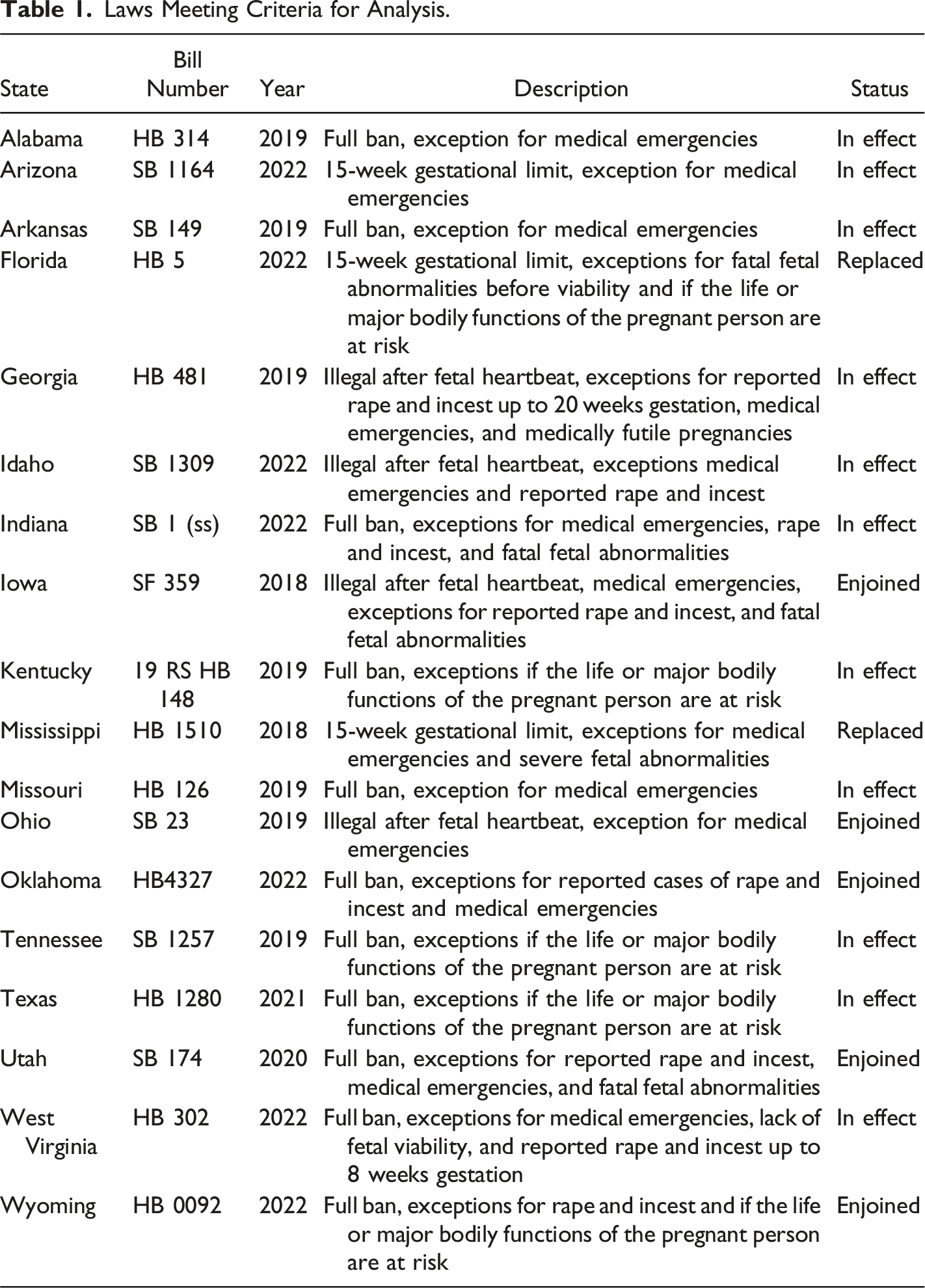
To analyze the latent, gendered consequences of this most recent wave of abortion laws, we conducted a textual analysis of total and hyper-restrictive abortion bans in the United States from 2018 to 2023. To be included in the dataset for this study, abortion laws were required to meet two inclusion criteria: they must have been signed into law between 2018 and 2022 1 and they must have had the characteristics of a total or hyper-restrictive abortion ban, which, as stated previously, were defined to include state-level laws that ban abortion or restrict the legality of the procedure to a gestational age prior to fetal viability (as legal abortion until viability was the precedent set by Roe and overturned by Dobbs) (Dobbs v. Jackson Women’s Health Organization, 2022; Roe v. Wade, 1973).
Laws Meeting Criteria for Analysis.
Data Analysis
These total and hyper-restrictive abortion bans were analyzed using a qualitative textual analysis, wherein the language in each ban was examined in an effort to “assess meanings, values, and messages” conveyed by the text (Smith, 2017, p.1). A qualitative approach was implemented to allow for a reflexive research process that took contextual factors, latent meanings, and other non-operationalizable variables into account. The process for coding and analyzing the data followed that of Glaser and Strauss’ (1967) approach to grounded theory in that the researchers allowed themes to emerge organically from the data rather than analyzing data based on specific questions or categories in the existing literature (Charmaz, 2006). Data analysis began with open coding in which inductive and in vivo codes were developed through reading the laws line-by-line in order to identify overarching concepts and themes. The laws were coded extensively and pervasively, and significant words or phrases were assigned to as many categories as seemed appropriate. This step yielded a variety of patterns, including, but not limited to, pregnant people as victims and mothers, humanization of the fetus, punishments for violating abortion bans, exceptions for physical and mental health, exceptions for rape and incest, and moral appeals. All codes were created using Atlas.ti version 23.
Using the codes generated from this initial coding process, secondary, axial coding was performed in order to identify patterns among the initial codes (Tracy, 2013). During this process, we refined the initial codes created in Atlas.ti, keeping in mind which codes appeared with the greatest frequency, as well as which codes were most relevant to the present study. Patterns that emerged during this process included depictions of pregnant people versus the fetus and exceptions, which were then further refined to create the overarching themes of avoidance of criminalization as gendered victimhood, exceptions for physical versus mental health, and exceptions for rape and incest. Following this process, subthemes focusing on language of criminalization, performed abortion and motherhood were created in order to clarify the overarching themes. It is also important to note that this coding process was reflexive, meaning that there was a constant interplay between the texts, the codes, and the analysis (Smith, 2017; Tracy, 2013).
Results and Analysis
Avoidance of Criminalization as Gendered Victimhood
Findings as Represented in Each State Law.
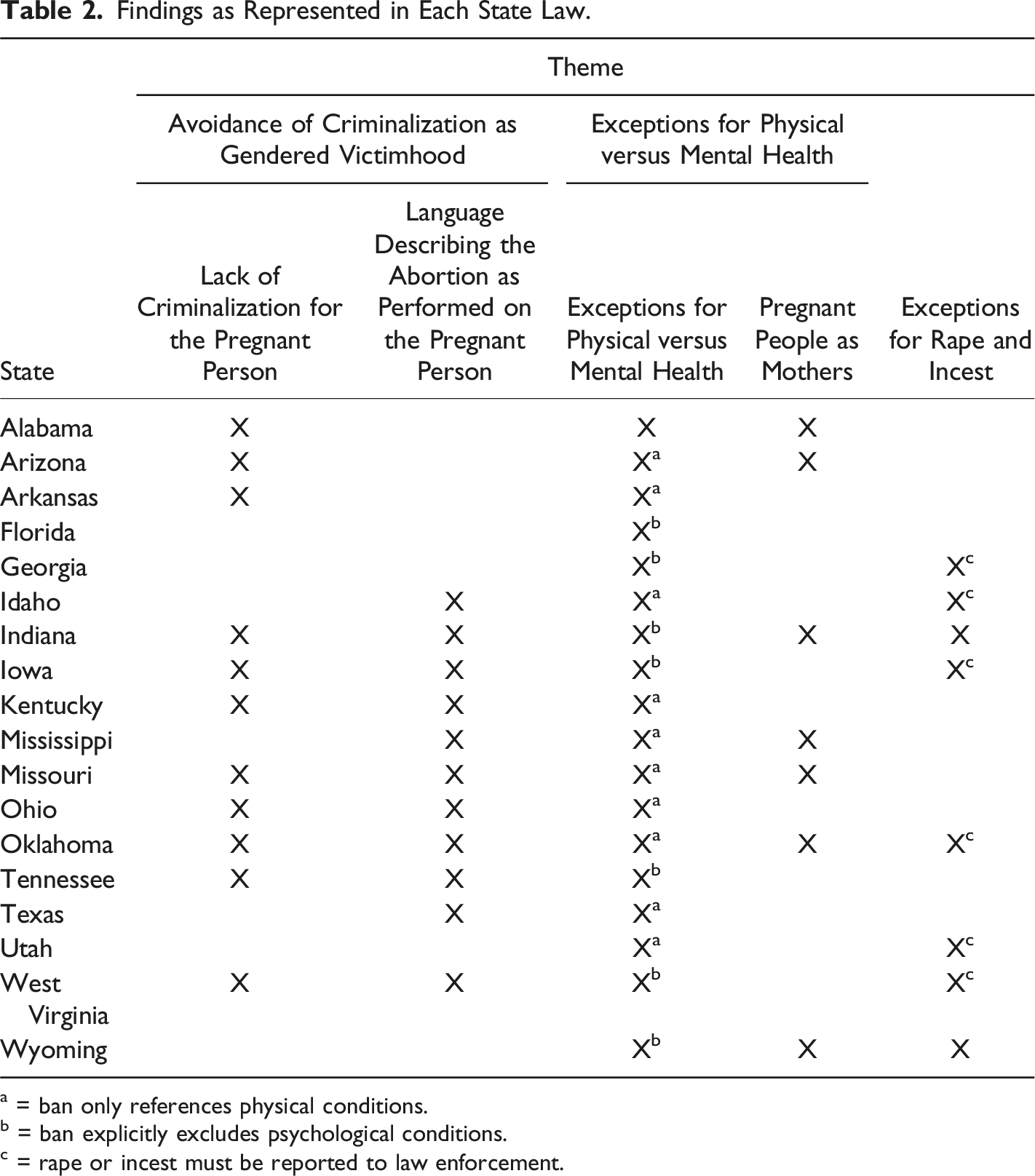
a = ban only references physical conditions.
b = ban explicitly excludes psychological conditions.
c = rape or incest must be reported to law enforcement.
Similarly, 11 of the bans depict the pregnant person as having an abortion performed on them, as opposed to electing to undergo the procedure (see Table 2). This is seen poignantly through Missouri’s HB 126 (2019), where the pregnant person is described as the “woman upon whom an abortion is performed or induced” (p. 26). This law also justifies the supposed need for the abortion ban in question by using the word victim directly, stating that information must be provided to the pregnant person confidentially so as to ensure that they are not “a victim of coerced abortion” (Missouri HB 126, 2019, p. 18). Indiana’s SB 1(ss) (2022) also provides a significant example of this theme, referring to the pregnant person as “the woman submitting to the abortion” (p. 13).
Through these two framings, these total and hyper-restrictive bans paint a picture of helpless, maybe even ignorant women, who have abortions performed on them by “criminal” medical staff. In addition, they reinforce problematic perceptions of abortion seekers as coerced women who lack agency and sound reasoning in their medical decisions. As such, while at first glance the decision to not criminalize abortion seekers themselves may appear to protect reproductive rights, it is important to address the ways these laws perpetuate a gendered sense of feminized innocence that maintain women’s subordinate position in society. Furthermore, these laws contribute to the apparent egregiousness of abortions by presenting such procedures as beyond the scope of a reasonable personal decision. Instead of framing abortions as a procedure elected by a rational adult, they are instead framed as categorically undesirable procedures that are often forced upon helpless women. As such, even though the language of these laws ostensibly lessens the likelihood of severe punishments for abortion seekers, it simultaneously weakens perceptions of women’s agency by confining them to a category of perpetual victimhood.
Exceptions for Physical versus Mental Health
Another way that these laws maintain gendered stereotypes of women as victims is through their language around exceptions. Of the 18 total and hyper-restrictive abortion bans analyzed, each one contains an exception to save the life of the pregnant person in a medical emergency (see Table 2). However, it is important to note that, in nearly every one of these bans, this exception is only for physical conditions, not psychological ones. The bans approach this distinction primarily by only referencing physical ailments, with no mention of psychological conditions whatsoever, or by explicitly stating that mental health conditions do not fall under the exception. Ten laws depict medical emergencies as only physical ailments, with no reference to psychological conditions. This is exemplified by Arkansas’s SB 149 (2019), where a medical emergency is defined as: a condition in which an abortion is necessary to preserve the life of a pregnant woman whose life is endangered by a physical disorder, physical illness, or physical injury, including a life-endangering physical condition caused by or arising from the pregnancy itself. (p. 4).
In another example, Arizona’s SB 1164 (2022) considers a medical emergency to be: a condition that so complicates the medical condition of a pregnant woman as to necessitate the immediate abortion of her pregnancy to avert her death or for which a delay will create serious risk of substantial and irreversible impairment of a major bodily function. (p. 1).
In this context, a major bodily function also excludes psychological conditions by omission, as it is defined to include “functions of the immune system, normal cell growth, and digestive, bowel, bladder, neurological, brain, respiratory, circulatory, endocrine, and reproductive functions” (Arizona SB 1164, 2022, p.1).
Seven other laws explicitly state that mental health conditions are not included under the exception to the ban by asserting that psychological conditions are not a valid medical emergency. For example, HB 481 from Georgia (2019) states that: no such greater risk shall be deemed to exist if it is based on a diagnosis or claim of a mental or emotional condition of the pregnant woman or that the pregnant woman will purposefully engage in conduct which she intends to result in her death or in substantial and irreversible physical impairment of a major bodily function. (p. 4).
The language used in Alabama’s HB 314 (2019) reflects a similarly severe sentiment that psychological conditions do not constitute a medical emergency, but it does state that a valid psychological exception can exist if: a second physician who is licensed in Alabama as a psychiatrist, with a minimum of three years of clinical experience, examines the woman and documents that the woman has a diagnosed serious mental illness and because of it, there is reasonable medical judgment that she will engage in conduct that could result in her death or the death of her unborn child. (p. 7).
However, this stipulation still excludes exceptions for psychological conditions that do not lead to death or bodily harm as it ultimately ties the severity of mental illness to the physical death of the patient and/or the fetus.
As the examples above illustrate, these exceptions clearly prioritize physical conditions over mental health concerns. Like the linguistic framings of abortion seekers as victims rather than criminals, such language portrays the pregnant person through a gendered lens that emphasizes their status as a maternal, physical vessel rather than an individual whose rights and quality of life matter in their own right. By suggesting that mental health considerations are not legitimate reasons to end a pregnancy, the language in this most recent wave of total and hyper-restrictive anti-abortion laws maintains that psychological well-being is only of concern when it may impact the abortion-seeker’s physical ability to carry the fetus. Such framings thus reduce the pregnant person to a primarily physical body whose sole purpose is to birth the fetus regardless of either the fetus or pregnant person’s future quality of life.
Through such gendered framings, these exceptions around health also function to uphold the image of pregnant people as mothers. Across the total and hyper-restrictive state abortion bans analyzed in this study, pregnant people are frequently portrayed as being inherently maternal, as seven of the laws used language to directly conflate pregnant people with mothers (see Table 2). This is seen in laws from Alabama, Missouri, and Oklahoma, where the pregnant person is consistently described as the “unborn child’s mother” (Alabama HB 314, 2019, p. 1; Missouri HB 126, 2019, p. 7; Oklahoma HB 4327, 2022, p. 6). This sentiment is echoed in the laws from Arizona and Mississippi, where the pregnant person is frequently referred to as the “maternal patient” (Arizona SB 1164, 2022, p. 1; Mississippi HB 1510, 2018, p. 3). Similarly, the laws from Indiana and Wyoming simply refer to the pregnant person as the “mother” (Indiana SB 1(ss), 2022, p. 6; Wyoming HB 0092, 2022, p. 2). In sum, whether through direct language or more indirect clauses that treat pregnant people as primarily physical bodies rather than individuals with complex psychological experiences, the language of these laws follows a long tradition of reducing pregnant people to gendered social roles and functions.
Exceptions for Rape and Incest
In addition to health-based exceptions, eight of the 18 total and hyper-restrictive abortion bans analyzed also contain an exception for cases of rape and incest (see Table 2). In six of the laws that include this exception, the instance of rape or incest must be reported to law enforcement or a medical provider in order to be considered valid. For instance, in HB 481 from Georgia (2019), it is asserted that an abortion may be performed if “the pregnancy is the result of rape or incest in which an official police report has been filed alleging the offense of rape or incest” (p. 4). Iowa’s SF 359 (2018) takes this restriction even further by requiring that the incident of rape or incest be reported to law enforcement within a certain amount of time, stating that an exception may be granted if a pregnancy is the “result of a rape which is reported within forty-five days of the incident to a law enforcement agency or to a public or private health agency which may include a family physician” (p. 3).
In West Virginia, the exceptions for rape and incest are only available upon reporting the incident to law enforcement when the fetus is a certain gestational age. HB 302 (2022) states that the restriction on abortion imposed by the law: shall not apply to an adult within the first 8 weeks of pregnancy if the pregnancy is the result of sexual assault, as defined in §61-8B-1 of this code, or incest, as defined in §61-8-12 of this code, and at least 48 hours prior to the abortion the patient has reported the sexual assault or incest to a law enforcement agency having jurisdiction to investigate the complaint and provided the report to the licensed medical professional performing the abortion. (p. 14).
As with mental health exceptions, the language used to explain exceptions around rape and incest similarly undermine perceptions of pregnant people’s agency by questioning their trustworthiness and moral capacity to understand their own experience. Rather than treat pregnant people as competent decision makers who may wish to terminate their pregnancy for a variety of reasons, only instances of explicit victimhood, and, in some cases, victimhood that has involved law enforcement within a certain time frame, are rendered reasonable justifications for a person to seek an abortion. Such parameters around reporting the sexual violence to law enforcement thus further objectify and bring women under the control and domination of the patriarchal criminal justice system. Much in the same ways that these exceptions around health foster a sense of distrust and dependency among pregnant people through only allowing trained professionals in the male-dominated medical industry to determine the necessity of an abortion, exceptions around rape and incest similarly promote distrust and reductive assumptions of pregnant people and further extend their submission to patriarchal systems of domination. In sum, by only making exceptions for particularly egregious, formally verified forms of forced pregnancy, these laws again strip pregnant individuals of their agency to assess the violence and undesirability of their pregnancy, and instead locate the validity of such assessments within the power of patriarchal institutions, namely the police and the medical establishment.
Discussion
Our analysis reveals that more than simply restricting access to abortions, recent total and hyper-restrictive abortion legislation accomplishes a variety of gendered functions that reinscribe patriarchal norms surrounding pregnant people’s agency. Specially, we found that many of these laws, including the explicit exceptions to the laws, are written in ways that portray abortion seekers as victims rather than criminals, despite the fact that these laws center around the criminalization of abortion. As such, we argue that the most recent wave of anti-abortion laws are written to maintain a gendered sense of women’s innocence, which functions to undermine perceptions of their agency in their decision to get an abortion. Through this tendency to avoid criminalizing abortion seekers themselves, alongside various legal exceptions that dictate situations where seeking an abortion is determined to be acceptable, these laws do not simply prevent abortions. Instead, they criminalize activity around abortions in ways that preserve pregnant people’s gendered roles as victims and mothers, rather than as potential agentic “criminals.” The language in these laws therefore suggests that the most recent wave of total and hyper-restrictive anti-abortion legislation primarily functions to preserve women’s subordinate position in society rather than to protect unborn fetuses. As such, the language in these laws upholds gendered perceptions of pregnant people’s agency that confines them to a status of perpetual vulnerable victims in need of “benevolent” patriarchal rule. Our analysis thus motivates a critical examination of the ways that supposed consideration and compassion for pregnant people and fetuses in abortion legislation can actually mask and propagate women’s oppression by placing them in a perpetual state of dependency.
To not criminalize the people who get abortions, while still making the act of obtaining an abortion illegal, is not only contradictory, but it further assumes that people who get abortions are not agentic decision makers; rather, they are helpless victims. This framing is compounded by the historical tendency to associate criminality with masculinity, and victimhood with femininity. As scholars such as Irwin and Chesney-Lind (2017) and Morash and Chesney-Lind (2006) discuss, women’s and girls’ experiences, whether that be with criminality or victimization, are laden with patriarchal influences that center on the control and confinement of women to prescribed gender norms and retributive responses when those norms are violated. Specifically, victimhood is associated with inherent vulnerability often linked to weakness and dependency which further removes women’s bodily autonomy and agency (Cunniff Gilson, 2016). Similarly, the current total and hyper-restrictive abortion bans function to reinforce pregnant people’s role in society as victims - people who should not make decisions about their own bodies, and who should not have the right to exercise power over the conditions that define their lives. Furthermore, this language enables bans to appear humanitarian while upholding oppressive gender norms. Thus, this finding further demonstrates that these total and hyper-restrictive bans do not simply prevent abortions; rather, they primarily protect patriarchal social relations.
Through the use of language such as “upon whom” or “submitting,” these abortion bans characterize pregnant people as passive actors who are victimized by abortion providers, as well as the procedure itself. In particular, the word submitting gives important insights into the connotation of this phrasing. For women, being submissive has traditionally been seen as a “normal, moral, and natural behavior” that reflects their supposed inherent lack of agency and freedom (Garcia, 2021, p. 3). Further, Garcia (2021) asserts that women who embody their stereotypically submissive nature may in turn be seen as “passive victims” (p. 4). As a result, we argue that this connotation can be applied here, given the direct use of the word submission, as well as the language that describes women as having an abortion performed “upon” them. It is also important to note that, within this idea of victimization, it is also implied that pregnant people are not capable of making important decisions for their bodies and livelihoods; instead of making an active, agentic choice to obtain an abortion, they are merely submitting themselves to the wishes of abortion providers, as well as the procedure itself. With that, the language that depicts women to be passive victims further reinforces the patriarchal ideology perpetuated by these bans, as female submission to dominant males is paramount to this structure (Goodwin, 2022; hooks, 2004). Thus, by describing pregnant people as individuals who are unable to exercise agency to make their own decisions, this language reifies the patriarchal assumption that women are vulnerable, irrational individuals.
Exceptions to abortion restrictions in these total and hyper-restrictive bans are also indicative of the ways in which these laws maintain and promote specific gender roles. While these exceptions are presented under the guise of concern for the pregnant person’s well-being, they promote the idea that abortions are only acceptable if carrying the pregnancy to term would disrupt their role as a mother. Language that portrays pregnant people as mothers relegates the pregnant person to a single role: a physical vessel to birth the fetus. We argue that this depiction reinforces the patriarchal idea that there is nothing more important to a pregnant person’s identity than being a mother; once they have children, or, in the case of these bans, once they are pregnant, their status as a mother overpowers any other statuses or characteristics that they may possess. Essentially, being a mother is their master status (Hughes, 1945; Waggoner, 2017). As mentioned above, central to patriarchal ideology is the idea that women are naturally designed to be mothers (Roberts, 1993). Additionally, within patriarchal constructions of gender, the role of women as mothers is of the utmost importance, as, beyond maintaining male superiority, it relegates women to unpaid and undervalued roles that are only deemed valuable if they ascribe to normative constructions of motherhood (Roberts, 1993). Thus, the conflation of pregnant people with mothers in total and hyper-restrictive state abortion bans has the potential to indirectly reinforce the patriarchal subordination of women, as it puts their value in motherhood and only sees them as a vessel for the fetus they are carrying.
Additionally, as seen through exceptions for physical health that simultaneously ignore and devalue mental health, it is implied that pregnant people cannot be trusted to understand their own experiences of illness; rather, they must be validated by a health professional. Similarly, exceptions for rape and incest often require verification via criminal justice apparatuses, again casting pregnant people as largely incapable of understanding a violation of bodily autonomy. This finding is important especially when examined through the lens of how women are treated by predominantly patriarchal institutions such as the healthcare and criminal justice systems.
Within the healthcare industry, women often experience inequitable treatment compared to male counterparts such as dismissal of pain and symptoms, misdiagnosis, or inadequate medical treatment when presenting with symptoms that do not match with those of a typical man (Cho, 2019; Criado Perez, 2019). In fact, there is a long history of women who present unusual or unexplainable symptoms being diagnosed as hysterical, as opposed to actually investigating the source of symptoms (Thompson & Blake, 2020). Similar to the inequities in healthcare, requiring pregnant people to have their experience of rape or incest validated by law enforcement forces them to work within a criminal justice system that is designed for and controlled by men. Instead of having bodily autonomy in the aftermath of a traumatic event, pregnant people must subscribe to certain dictated conditions in order to be freed from their maternal duties. Forcing pregnant people to engage with the criminal justice system to validate their need for an abortion not only severely restricts their agency, but it also puts them at the whim of actors who are part of the patriarchal social structure.
In these situations, pregnant people are forced to make decisions through a patriarchal lens. Either they give up their agency and have their reproductive choices made for them by an outside entity, or they avoid interaction with this organization and assume the maternal role that patriarchy dictates. Requiring external entities to assist with or validate the need for an abortion suggests that pregnant people cannot be trusted to accurately perceive their own experiences, as instead of being given the right to make the decision to obtain an abortion independently, they are forced to rely on the conceptions of others for access to this care. This functions to perpetuate patriarchal social control, where bodily autonomy is removed from the individual. They are driven into systems that value and are built upon male experiences, which in turn devalues the experiences of pregnant people and once again pushes them into roles required to maintain a patriarchal social structure, particularly motherhood.
This experience is particularly pronounced for women of color and other marginalized groups across the healthcare and criminal-legal systems. For example, Black women experience extreme levels of bias in the healthcare system, as research demonstrates that they are more likely to be dismissed by clinicians, denied pain medication, and misdiagnosed with severe psychiatric conditions (Baker et al., 2010; Cho, 2019). Additionally, pregnant people who do not fit into traditional narratives of ideal victims, which is narrowly defined as individuals who violate standards of traditional femininity, such as LGBTQIA + women, women who use illicit substances, women of color, and women who are of low socioeconomic status, often experience disparate treatment by law enforcement when reporting sexual violence (Carbone-Lopez et al., 2016; Randall, 2011; Shaw & Lee, 2019). This is on top of the fact that racialized communities tend to be overpoliced, and that residents of these neighborhoods often report lower levels of confidence in the police compared to their white counterparts, which in turn makes it less likely that they will seek police assistance even if they are victims of a crime (Desmond et al., 2016; Lanni, 2022).
As Darcy (2023) argues, restricted access to safe abortions has a disproportionate impact on marginalized communities that already encounter discrimination and systemic racism throughout the many patriarchal systems that govern access to care. Pregnant people are compelled by the state into either “forced motherhood” and “forced child surrender” upon the birth of the child (p. 4), which produces a compounded effect for marginalized women who are already facing oppressive conditions. Additionally, Thakkilapati (2019) suggests that marginalized women’s decisions to obtain an abortion are influenced heavily by normative constructions of motherhood – motherhood based on the experiences of white, middle-class, heterosexual women (Ross & Solinger, 2017) - which constrains their reproductive choices and outcomes. The total and hyper-restrictive abortion bans rely on normative constructions of motherhood, thereby contributing to the disempowerment of marginalized communities. Thus, regardless of whether or not the marginalized pregnant person seeks an abortion under an exception, which, as detailed above, is steeped in patriarchal and discriminatory value systems, they are forced to make their reproductive decisions within the constraints of patriarchy and systemic racism. In turn, for all pregnant people, this works as a method of social control, as they are further locked into the oppressive roles undergirded by racism, capitalism, and sexism.
Conclusion
While the language of these total and hyper-restrictive abortion laws attempts to convey a primary concern with the life of the fetus, a careful analysis of their language instead reveals a greater preoccupation with the maintenance of gendered social roles and the continued power of patriarchal institutions of control (i.e. the medical establishment and the police). Through presenting pregnant people as mothers who are mistreated and coerced by abortion providers, these laws perpetuate ideological frameworks in which women are seen primarily as victims, whereas abortion providers are criminalized. Although criminalizing abortion seekers would generate a host of other oppressive and violent possibilities for pregnant individuals, none of which we are suggesting, it is critical to note that this lack of criminalization similarly maintains a deeply sexist status quo. Rather than see pregnant people as competent decision-makers, this victimizing language legitimizes the repressive measures built into these laws, because from the onset, women are seen as powerless dependents whose lives and bodies must be managed by the state. In this way, draconian attacks on women’s freedom and bodily autonomy become framed through a humanitarian lens that operates under a “benevolent” patriarchy, which ultimately adds validity to such oppressive logics.
In this same vein, exceptions written into these abortion bans similarly uphold women’s oppression under the guise of concern for their safety and wellbeing. Again, rather than being based in a true concern for the pregnant person, or even the fetus’s health, such exceptions uphold a patriarchal approach to reproduction that denies women’s agency and transfers their decision-making capacity to the auspices of male-dominated institutions. In this way, it becomes clear that, as previous scholars have noted, people seeking abortions are not treated as full complex humans, but instead as physical vessels that maintain gendered social roles rooted in capitalism and the nuclear family. Furthermore, the linguistic choices in these laws bolster stereotypes of women as irrational, helpless, and submissive beings, which further justifies their domination. Together, these elements coalesce to ensure women’s subordinate position in society, thereby upholding the power of patriarchal institutions and their corresponding ideologies in U.S. society.
Our data thus echoes the previous scholarship on anti-abortion laws, in that our analysis reveals that this most recent wave of total and hyper-restrictive abortion legislation is largely a continuation of patriarchal efforts to force women into a subordinate role where they perform unpaid labor within the nuclear family. While at first glance these laws seem to revolve around a concern with fetal life, their specific language around exceptions and criminalization paint pregnant people as primarily victimized mothers, which reveals a primary fixation on subordinating women rather than preventing abortions. As such, we implore both scholars and activists to stay attuned to the ways in which this most recent wave of anti-abortion legislation not only curtails women’s reproductive rights, but also reinscribes regressive gender norms that extend beyond the singular issue of abortion.
Footnotes
Acknowledgements
The authors thank Dr. Alex Alvarez for his continued support and guidance of the research.
Declaration of Conflicting Interests
The author(s) declared no potential conflicts of interest with respect to the research, authorship, and/or publication of this article.
Funding
The author(s) received no financial support for the research, authorship, and/or publication of this article.
