







Abstract
Phosphorus (P) and fluoride (F) contamination in natural and industrial waters poses a serious environmental challenge. Mixed iron (Fe) and manganese (Mn) oxide composites have emerged as highly effective adsorbents for the removal of these pollutants from water. However, studies on real water system applications and the design of multicharged polymer-supported systems remain limited. In this work, FeMn-mixed oxides functionalized with polyacrylic acid (as a negative charge donor) and chitosan (as a positive charge donor) were engineered and applied as efficient adsorbents for the selective removal of P and F ions from both laboratory-prepared and real water samples. The as-prepared material was comprehensively characterized before and after adsorption using advanced analytical techniques. X-ray photoelectron spectroscopy and Fourier transform infrared spectroscopy analyses confirmed that carbon, nitrogen, and oxygen functional groups, together with the active participation of Fe and Mn ions, played central roles in the adsorption process. Real water samples collected from the Peshawar District (Khyber Pakhtunkhwa, Pakistan) were tested, and batch adsorption experiments validated the high removal efficiency of the composites. The composite exhibited a specific surface area ranging from 27.4 m2 g−1 before adsorption to 20.4 m2 g−1 after dye adsorption. Batch adsorption experiments demonstrated maximum removal efficiencies of 95–99% for both dyes under optimal conditions (pH 2–10, 298 K). Overall, this study presents a robust composite-engineering strategy and highlights the practical potential of the developed material for real-world water purification, particularly in industrial applications.
Keywords
Introduction
The pervasive contamination of water with phosphorus (P) and fluoride (F) poses a serious threat to ecosystems and human health (Luo et al., 2025; Yang et al., 2024, 2025). In China, rapid industrialization and agricultural intensification have heightened the release of P- and F-rich effluents, contributing to eutrophication and groundwater fluoride issues in regions like central China’s Jiaokou Irrigation District (Shaji et al., 2024). Likewise, in Pakistan especially in Punjab and Khyber Pakhtunkhwa and along irrigation zones, F and P contamination in drinking water has raised health alarms, with endemic fluorosis and eutrophication reported in vulnerable communities (Earnest et al., 2021; Tolkou et al., 2021). As per the World Health Organization guideline, the permissible value for F in water is 1.5 mg L−1, while for P, it is 0.05 mg L−1 (Peng et al., 2025). Against this backdrop, adsorption-based water treatment emerges as a flexible, cost-effective approach, capable of addressing such multi-ion contamination in diverse contexts (Civan Çavuşoğlu et al., 2024; Liu et al., 2024; Neves et al., 2024; Wang et al., 2026; Zhang et al., 2023).
Mixed iron–manganese (FeMn) oxide adsorbents have attracted growing interest due to their redox versatility, high surface area, and strong affinity for anionic species (Neves et al., 2024). Globally, oxide-based composites, including Fe-based materials and activated carbons modified with metal species, have demonstrated effectiveness in simultaneously removing P and F, achieving removal efficiencies of around 85–90% in advanced methods such as iron-loaded capacitive deionization (Dai et al., 2023; Neves et al., 2024). However, a significant gap remains in the development of polymer-supported, multicharged FeMn adsorbents, particularly for applications in real water systems (Azeez et al., 2024; Bhattacharya et al., 2024b; Khan et al., 2022b; Yang et al., 2025).
Integrating multicharged polymers, namely, polyacrylic acid (PAA) and chitosan with FeMn oxide matrices, leverages both electrostatic interactions and functional group chemistry to enhance adsorption. PAA contributes negatively charged carboxylate moieties, while chitosan provides positively charged amine groups, creating a synergistic effect that enables selective and robust binding of anionic contaminants (Akaniro et al., 2025; Azeez et al., 2024; Bhattacharya et al., 2021, 2023, 2024a). While composite strategies have advanced F and P removal individually, reports combining multiple-charged polymer systems with FeMn oxides, particularly applied to actual water samples, are scarce, especially in the context of China and Pakistan’s water challenges. Materials such as red clay (Li et al., 2025), lanthanum-coated sludge biochar (Lu et al., 2025), Mg-MOF-74 (Zhou et al., 2025), and La-MOF composite (Ma et al., 2025) have been widely reported for treating contaminants in aqueous solutions and other industrial wastewater. Many existing adsorbents have limited effectiveness due to weak interactions with P and F, resulting in insufficient uptake capacity (Yang et al., 2025). However, real samples from effected area in Pakistan and the role of metal ions and organic linkers during adsorption processes by advanced spectroscopic techniques such as X-ray photoelectron spectroscopy (XPS), atomic force microscopy (AFM), thermogravimetric analysis (TGA), scanning electron microscopy (SEM), Fourier transform infrared spectroscopy (FTIR), and Raman spectroscopy before and after adsorption process are limited (Khan et al., 2022a). The present work introduces a FeMn–PAA/Chitosan composite that not only prevents particle agglomeration but also imparts additional functional groups, enabling simultaneous and more efficient removal of P and F compared with previously reported FeMn–chitosan systems. Developing multifunctional adsorbents that can efficiently treat complex, real-world water matrices is crucial for sustainable environmental engineering (Peters, 2025).
To bridge these gaps, our study develops FeMn-mixed oxide composite functionalized with both PAA and chitosan, targeting selective removal of P and F from laboratory-prepared and real water samples sourced from the Peshawar district, Khyber Pakhtunkhwa, Pakistan. We applied comprehensive characterization XPS and FTIR among others to elucidate the role of surface functional groups and Fe/Mn centers in adsorption. Under optimized conditions, the material achieved nearly complete removal of P and F ions from real samples, demonstrating its strategic promise for water treatment in industrial and agricultural regions of Pakistan and potentially in regions of China facing similar contamination scenarios.
Method
Chemicals and materials
The following high-purity, research-grade chemicals were procured and used without further purification: KH2PO4 (≥99%), NaF (≥99%), PAA, chitosan (degree of deacetylation ∼80–85%, serving as the positively charged polymeric component), KMnO4, FeSO4·7H2O and FeCl3·6H2O, NaOH (pellets, ≥98%), HCl (37%), and NaNO3 (≥99%). Analytical-grade solvents, deionized (DI) water, were used for all preparations. The pH of working solutions was adjusted using NaOH (0.01–0.1 M) and HCl (0.01–0.1 M) standard solutions. A calibrated digital pH meter (±0.01 accuracy) was employed for all measurements. Adsorbate stock solutions of P and F were prepared by dissolving accurately weighed amounts of KH2PO4 and NaF in DI water. From these stock solutions, working concentrations ranging between 5 and 200 mg L−1 were obtained through serial dilution. All adsorption experiments, including kinetic and isotherm studies, were conducted in triplicate, and the mean values are reported. The standard deviations were below 3%, indicating high reproducibility of the results.
The synthesis of the adsorbent materials
The adsorbent composites were prepared by a coprecipitation method with polymer modification, adapted from Qi et al. (2015). First, 12.5 g of FeCl3·6H2O and 12.2 g of FeSO4·7H2O were dissolved in 200 mL of distilled water in a 500 mL beaker. The solution was stirred at 500 rpm for 30 min at room temperature to ensure complete dissolution and homogenization of the Fe³+ and Fe2+ salts. Under vigorous mechanical stirring, 2.38 g of KMnO4 was slowly introduced into the iron salt solution, along with the controlled addition of 0.2 M NaOH. The NaOH solution was added dropwise to maintain the pH between 7 and 8. This intermediate solution was denoted as Solution A. In parallel, the polymer supports were prepared. Chitosan powder (10 g) was dispersed in 300 mL of 0.1 M HCl and stirred for 4 h at room temperature, producing a clear, homogeneous viscous solution (designated Solution B). This acidic medium ensured protonation of amino groups on chitosan, enhancing its solubility and positive charge density. Separately, 1 g of PAA was dissolved in 100 mL of distilled water under continuous stirring until a uniform solution (designated Solution C) was obtained, contributing negatively charged carboxyl groups. Solutions B and C were then added dropwise to Solution A under continuous stirring to allow uniform dispersion of the polymers within the FeMn oxide matrix. The final mixture was stirred for an extended period of 5 h, promoting thorough interaction between the inorganic and polymeric components and facilitating the formation of a stable multiple-charged FeMn oxide–polymer composite. After synthesis, the resulting suspension was filtered, and the solid precipitate was washed repeatedly with distilled water until the filtrate reached near-neutral pH, ensuring removal of unreacted ions and residual salts. The washed precipitate was then dried in a vacuum oven at 55°C for 36 h, yielding the final adsorbent powder. The dried material was carefully ground and stored in airtight containers for subsequent characterization and adsorption experiments.
Adsorption study
Batch adsorption studies were performed to evaluate the removal efficiency of P and F ions by FeMn–PAA/Chitosan composite. For each experiment, 0.1 g of dried adsorbent powder was accurately weighed and transferred into 100 mL polyethylene bottles, containing 40 mL of adsorbate solution of predetermined concentration. The initial concentrations of P and F were varied systematically in the range of 5–200 mg L−1, prepared by diluting stock solutions of KH2PO4 and NaF, respectively. The suspensions were agitated on an orbital shaker set at 150 rpm for contact times ranging from 1 to 420 min to study the adsorption kinetics. The solution pH was adjusted between 3 and 11 by dropwise addition of 0.01–0.1 M NaOH or 0.01–0.1 M HCl, depending on the experimental requirement. Temperature-controlled adsorption experiments were performed at 298, 308, 318, and 328 K using a thermostatic water bath to assess the thermodynamic behavior of the process. After completion of each adsorption run, the suspensions were filtered and the residual P concentration in the filtrate was determined spectrophotometrically (Hitachi UV–Visible spectrophotometer) by the ascorbic acid–molybdate blue method (Yang et al., 2014). The residual F concentration was measured using a fluoride ion-selective electrode coupled with an Orion 4-star pH/ISE meter, following calibration with standard F solutions. The percentage removal and adsorption capacity (qe, mg g−1) were subsequently calculated to establish adsorption isotherms, kinetics, and thermodynamic parameters.
Real sample collection, analysis, and adsorption
Peshawar, the capital of Khyber Pakhtunkhwa province in Pakistan, is situated in a broad valley near the eastern terminus of the historic Khyber Pass, close to the Afghanistan border. Geographically, it lies between 34°15′–34°44’ N latitude and 71°22’–71°42’ E longitude, covering an area of approximately 1,257 km2 and supporting a population of around 2 million. Previous studies have reported elevated concentrations of P and F in groundwater from various parts of the Peshawar district, posing significant environmental and public health concerns (Ahmad et al., 2020). For this study, six distinct water samples were collected from locations selected primarily based on industrial activity and potential contamination sources. The sampling sites included: (A) Hayatabad Industrial Zone, (B) Hayatabad Combined Drainage System, (C) Warsak Road Marble Factory Zone, (D) Tehkal Area, (E) Nouthia Jadeed Area, and (F) Ring Road Pushtakera Area. Each sample was collected in 100 mL high-density plastic bottles. The P content in the collected water samples was determined using the ascorbic acid–molybdate blue method with a UV/Visible spectrophotometer, following standard protocols. F concentrations were measured using a fluoride ion-selective electrode coupled with a digital meter. The removal of P and F from these real water samples was subsequently evaluated using the synthesized FeMn–PAA/Chitosan composite through batch adsorption experiments, as described in the experimental section.
Characterization of adsorbent materials
The synthesized FeMn–PAA/Chitosan composites were comprehensively characterized before and after adsorption to evaluate their structural, morphological, and chemical properties. FTIR (Thermo Fisher Scientific IS20, USA) was employed to identify functional groups present on the composite surface and to monitor changes in chemical bonding resulting from P and F adsorption. Raman spectroscopy (Horiba LabRAM HR Evolution, Japan) provided complementary information on the vibrational modes of the metal-oxide lattice and polymeric components, revealing interactions between Fe, Mn, and the dual-charged polymers. The surface morphology and microstructure were examined using SEM (Hitachi S-3400N, Tokyo, Japan), enabling visualization of particle size, aggregation, and surface roughness. AFM (Bruker Dimension Icon, Germany) was further used to quantify nanoscale surface topography, roughness parameters, and polymer distribution on the adsorbent surface. XPS (Nexsa G2X, Thermo Scientific, USA) was employed to analyze the elemental composition and oxidation states of Fe and Mn ions, as well as the presence of carbon, nitrogen, and oxygen functional groups, providing insights into adsorption mechanisms at the atomic level. In addition, TGA (Shimadzu DTG-60H, Japan) was performed to assess the thermal stability of the composites and to quantify the polymer content before and after adsorption. By combining these advanced analytical techniques, the study elucidated both the physical and chemical transformations occurring during adsorption and confirmed the active roles of polymer functional groups and metal ions in the removal of P and F from aqueous solutions.
Regeneration study
The reusability of the synthesized adsorbent was assessed through repeated adsorption–desorption cycles using 0.1 M HCl as the regenerating agent and P as the model contaminant. In each run, 0.1 g of the adsorbent was contacted with 40 mL of a 200 mg L−1 P solution and stirred at 298 K for 3 h to reach equilibrium. The P-loaded adsorbent was then separated by centrifugation, and adsorption capacity was calculated from the residual P concentration. Afterward, the material was rinsed thoroughly with distilled water to remove weakly bound species and dried overnight at 80°C to restore its structure. For regeneration, the dried adsorbent was immersed in 0.1 M HCl and stirred for 3 h to desorb the retained P. In this procedure, adsorption followed by desorption was repeated for six consecutive cycles to evaluate the composite’s stability, efficiency, and reusability. Adsorption capacity was recorded after each cycle to track potential performance losses and gauge the material’s durability under repeated use.
Results and Discussion
Characterization
The surface area of the composite decreased from 27.4 to 20.4 m2 g−1 after P adsorption. This could indicate changes in the adsorbent structure or pore formation during the adsorption process. The Brunauer–Emmett–Teller (BET) surface area of the FeMn–PAA/Chitosan composite decreased after P adsorption, which can be attributed to the occupation and blockage of surface pores and active sites by P ions. As these ions bind to the functional groups and fill the micro- and mesopores of the adsorbent, the accessible surface area available for nitrogen adsorption during BET analysis is reduced (Papes et al., 2025). This decrease in surface area provides further evidence of effective P adsorption onto the composite material. Similar behavior was reported by Yang et al. (2018) during P adsorption by Fe-mixed oxides.
FTIR spectroscopy was employed to identify the surface functional groups on FeMn–PAA/Chitosan composite and to elucidate their potential interactions with the adsorbed P molecules. Figure 1a shows the FTIR spectra of the pristine composite and the P-loaded composite. In both spectra, a broad absorption band centered at 3435 cm−1 is observed, corresponding to the stretching vibrations of hydroxyl (–OH) groups, which are present on both the inorganic oxide surface and the polymer matrix (Min et al., 2024). The band appearing at 1,624 cm−1 is attributed to N–H bending (deformation) vibrations of chitosan, indicating the presence of amino groups capable of interacting with anionic species. A distinct peak at 1,108 cm−1 is associated with C–O stretching vibrations from the PAA and chitosan backbone (Alqarni et al., 2024). Notably, the intensity of the C–O stretching band decreases after P adsorption, suggesting the involvement of hydroxyl and carboxyl groups in hydrogen bonding with the adsorbed P ions. These spectral changes, together with the presence of positively charged amino groups on chitosan, indicate that P adsorption occurs through a combination of electrostatic interactions between negatively charged P ions and positively charged sites on the composite, as well as hydrogen bonding with surface hydroxyl and carboxyl groups. Overall, the FTIR analysis confirms that both the polymeric functional groups and the metal oxide surface sites actively participate in binding P ions, providing mechanistic insight into the adsorption process and the high efficiency of the composite material.
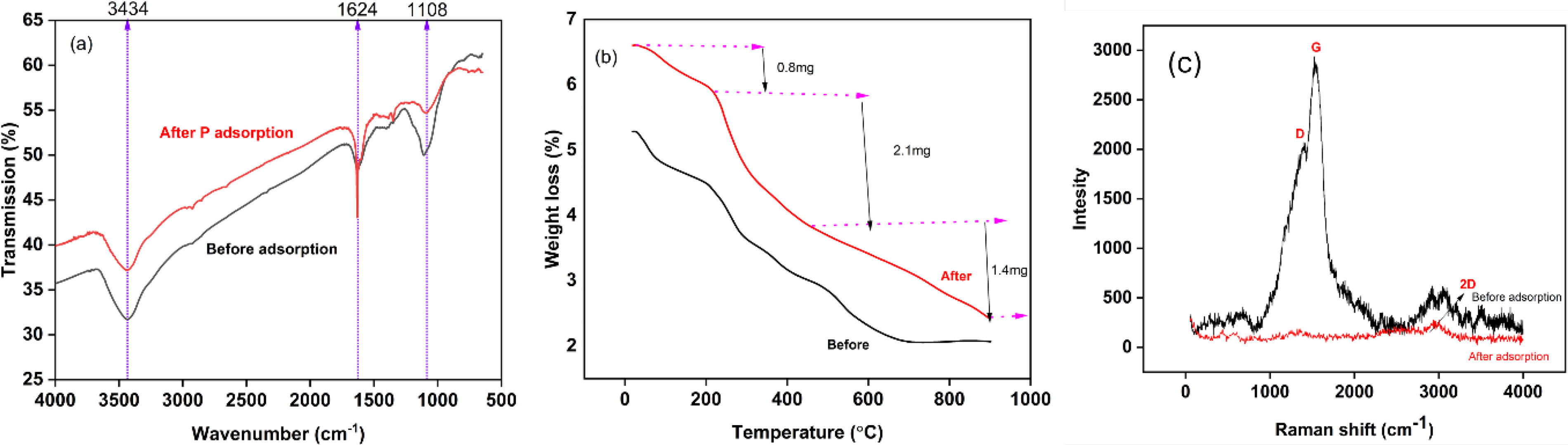
TGA was employed to assess the thermal stability and durability of FeMn–PAA/Chitosan composite before and after adsorption. TGA measures the change in weight of a material as a function of temperature, providing insight into moisture content, polymer decomposition, and the stability of inorganic components. In this study, the analysis was conducted over a temperature range of 30 to 1,000°C under controlled conditions. The thermogram of the composite (Fig. 1b) revealed a three-stage weight loss pattern. Initially, a small weight loss of approximately 0.8 mg occurred below 250°C, which is attributed to the desorption of physically adsorbed water molecules from both the metal oxide surface and the polymer matrix. Between 250°C and 500°C, the composite experienced a further weight loss of about 2.1 mg, corresponding primarily to the thermal degradation of amino groups from chitosan and partial decomposition of the PAA chains. At higher temperatures, from 500°C to 1,000°C, an additional weight reduction of approximately 1.4 mg was observed, associated with the decomposition of oxygen-containing functional groups and the oxidation of residual carbon. The total weight loss up to 1,000°C was around 4.3 mg, indicating that the composite possesses excellent thermal stability (Shen et al., 2014). This high thermal resistance can be attributed to the strong chemical interactions between the Fe/Mn oxide components and the polymeric functional groups, which reinforce the structural integrity of the material and make it suitable for repeated use under harsh environmental or industrial conditions. Similar results were reported by Alaqarbeh et al. (2022) during characterization of chitosan–FeMn composite for heavy metal adsorption.
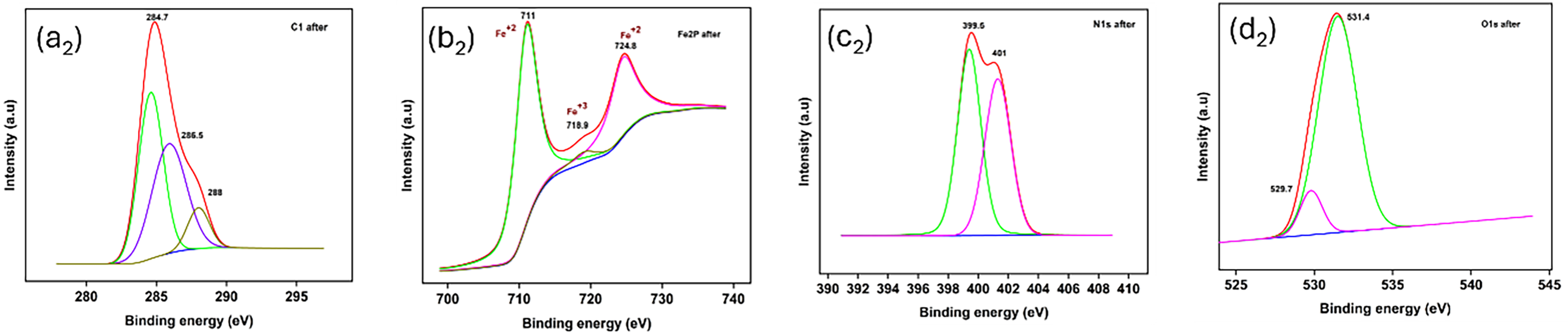
XPS was employed to investigate the surface chemical states and elucidate the interaction mechanisms between P ions and FeMn–PAA/Chitosan composite. After P adsorption (Fig. 2a2), the binding energy of α-carbon shifted to a lower value, accompanied by a decrease in peak intensity, indicating that α-carbon atoms actively participated in the adsorption process through electronic interactions with P ions. Analysis of the Fe 2p spectra revealed that the binding energy of Fe³+ increased following P adsorption, while its peak intensity decreased (Fig. 2b1 and 2b2). This observation suggests that Fe³+ ions form coordination complexes with P species on the composite surface. In contrast, Fe2+ exhibited minimal changes in binding energy and intensity, indicating that Fe³+ is the dominant active site responsible for P binding. The N 1s spectra (Fig. 2c1 and c2) showed a decrease in peak intensity after adsorption, highlighting the participation of nitrogen-containing functional groups (primarily from chitosan) in the sorption process (Eltaweil et al., 2021). The O 1s spectrum (Fig. 2d1 and d2) exhibited a slight shift in binding energy from 529.4 to 529.7 eV, suggesting an increase in electron density around oxygen atoms due to interactions with P ions. Similarly, the Mn 2p spectrum showed an increase in binding energy from 653.6 to 654.0 eV, supporting the active involvement of manganese in the adsorption process. Collectively, these observations confirm that P ions interact with the composite surface through both oxygen- and nitrogen-containing functional groups, forming a combination of electrostatic interactions, hydrogen bonding, and possibly π–π or hydrophobic interactions. Notably, the comparatively small change in N 1s binding energy relative to O 1s suggests that nitrogen-containing groups contribute more significantly to the irreversible adsorption of P. This indicates a stronger chemical affinity between P ions and nitrogen sites than with oxygen sites, emphasizing the key role of polymeric amine groups in stabilizing adsorbed species and enhancing the overall adsorption capacity of the composite material. Similar results were reported by Eltaweil et al. (2021) during characterization of magnetic chitosan composite for heavy metal adsorption.
XPS spectra of composite after P adsorption (
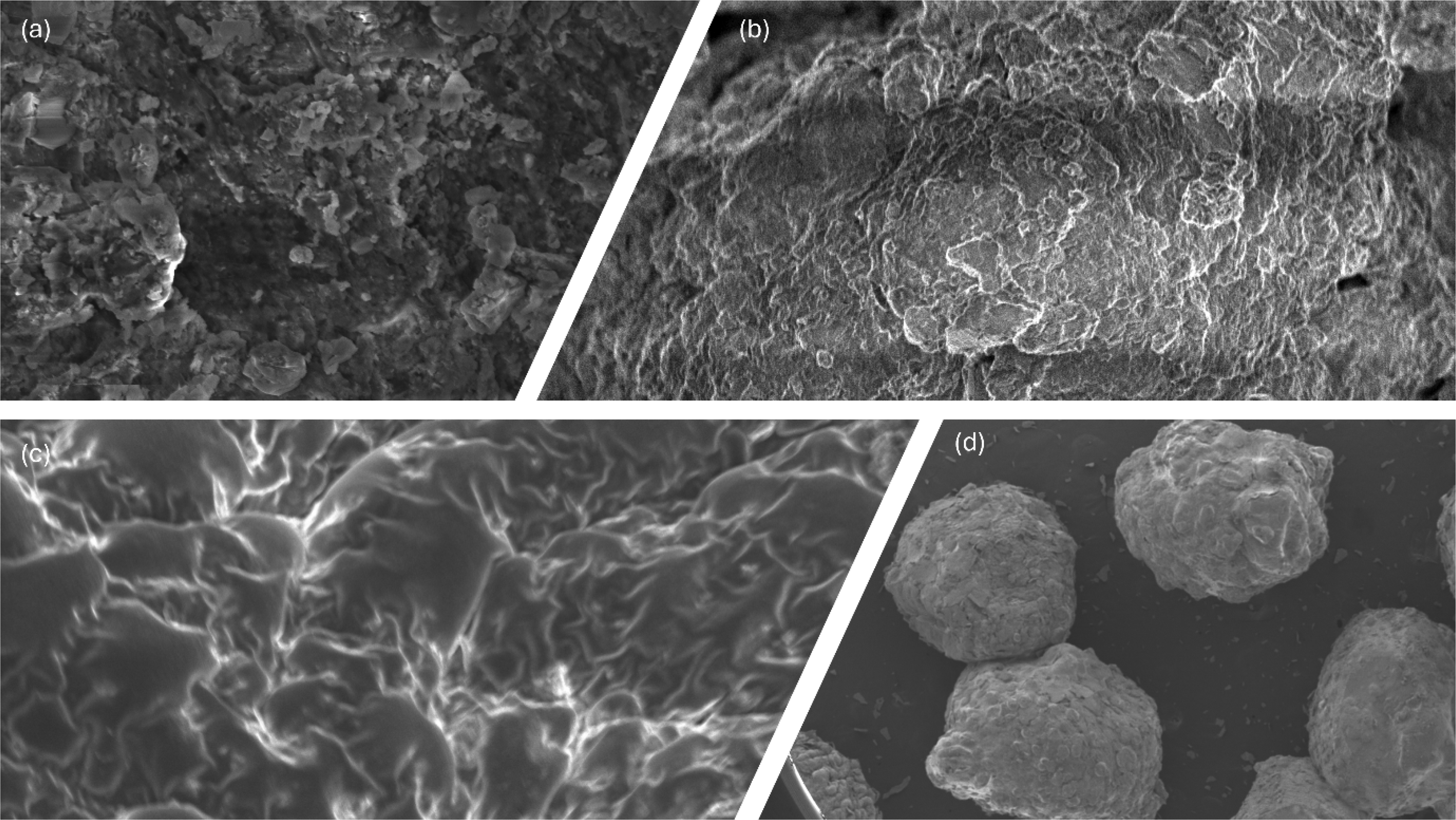
SEM was employed to examine the surface morphology and structural changes of FeMn–PAA/Chitosan composite before and after adsorption of P and F ions, as shown in Figure 3a–d. Prior to adsorption, the surface of the composite (Fig. 3a) exhibited a fibrous and highly porous texture, characterized by the deposition of polymeric particles on the metal oxide surface. The initial structure showed irregularity and localized agglomeration, reflecting the heterogeneous distribution of the polymer and oxide phases, which provides abundant active sites for subsequent ion binding. Following adsorption, significant morphological changes were observed (Fig. 3b). AFM and SEM analyses showed that the surface roughness and porosity of the composite increased after P adsorption, while BET measurements revealed a decrease in surface area from 27.4 to 20.4 m2 g−1. These results indicate that interaction with P ions not only occupied surface sites and pores but also induced measurable structural rearrangements, making the surface less uniform and more textured. The reduction in sharp edges and the appearance of smooth folds indicate complexation and strong binding between ions and the functional groups of the composite. These morphological alterations imply the coexistence of multiple adsorption mechanisms, including electrostatic attraction, hydrogen bonding, and coordination interactions, consistent with the XPS and FTIR analyses. In addition to the powdered composite, SEM imaging of the composite beads (Fig. 3c and d) revealed near-spherical morphology with diameters ranging from 1 to 2 mm. Unlike the powdered composites, the beads displayed greater surface irregularities due to the bead formation process. The cross-sectional view (Fig. 3c) highlighted a hollow, microsized internal framework, which likely contributes to enhanced diffusion and accessibility of adsorbate ions. The overall shape of the beads was observed to be slightly imperfect rather than perfectly spherical (Fig. 3d), indicating minor deformation during synthesis. These SEM observations collectively demonstrate that adsorption induces noticeable changes in surface texture and morphology, confirming the active participation of polymeric and oxide components in binding ions. The combination of porosity, folding, and surface irregularities in both powdered and bead forms of the composite is indicative of a highly accessible and interactive surface, which supports the high adsorption capacity observed in batch experiments. The SEM images revealed significant changes in surface morphology after adsorption, where the initially porous and rough surface of the adsorbent became smoother and partially covered, indicating the deposition of adsorbed species. This morphological transformation is consistent with the XPS analysis, which confirmed the presence of new peaks and binding energy shifts corresponding to adsorbate–adsorbent interactions. The correlation between SEM and XPS results thus highlights that the adsorption process not only alters the chemical environment of surface functional groups, as evidenced by XPS, but also modifies the physical surface features, as shown by SEM. Together, these findings confirm that adsorption involves both chemical interactions at active sites and observable morphological changes on the material surface.
SEM images of
Raman spectroscopy was employed to investigate the structural and electronic properties of FeMn–PAA/Chitosan composite before and after adsorption, as shown in Figure 1c. The Raman spectrum of the pristine composite exhibited three characteristic peaks. The D band at 1,395 cm−1 is attributed to disordered carbon structures and the presence of oxygen-containing functional groups such as –OH and –COOH. The G band at 1,542 cm−1 corresponds to graphitic structures, representing sp2-hybridized C–C bonds, while the 2D band at 2,588 cm−1 is associated with surface interactions and the possible presence of layered graphitic features within the polymeric matrix. In addition, overtone peaks were observed between 2,500 and 3,000 cm−1, which are characteristic of carbonaceous materials and confirm the structural complexity of the composite (Selen and Güler, 2021). Following adsorption of ions, significant changes were observed in the Raman spectra. The intensity of the D band decreased, indicating that adsorbate molecules primarily interacted with disordered carbon sites, likely through binding to oxygen-containing functional groups. In contrast, the 2D band exhibited an increase in intensity, suggesting modifications in the surface electronic structure and possible reorganization of layered graphitic-like regions due to adsorbate interaction. The D-to-G intensity ratio (D/G), which is commonly used to assess the degree of structural disorder in carbon-based materials, was higher in the pristine composite, reflecting a more disordered structure. After adsorption, a noticeable decrease in the D/G ratio was observed, implying that the interaction between adsorbate and the composite, likely through van der Waals forces and π–π stacking, led to partial ordering or structural reorganization of the surface. Overall, the Raman analysis indicates that adsorption not only involves chemical interactions with functional groups but also induces modifications in the electronic and structural properties of the composite. These observations complement FTIR and XPS results, highlighting the multifaceted nature of adsorbate–adsorbent interactions and the crucial role of both disordered and graphitic carbon domains in enhancing the adsorption performance of the material (Sharma et al., 2024).
AFM was employed to investigate the surface morphology, grain size, uniformity, and pore distribution of FeMn–PAA/Chitosan composite, providing critical insights into the topographical features that influence adsorption performance. AFM offers high-resolution three-dimensional imaging, enabling precise visualization of surface roughness, grain distribution, and structural modifications before and after adsorption. Understanding these surface characteristics is essential, as the adsorption process is strongly affected by the availability and accessibility of active sites. For AFM sample preparation, adsorbate molecules were allowed to interact with the composite in aqueous solution, and the resulting adsorbate–adsorbent complexes were deposited onto a silicon wafer substrate for imaging. The 3D topographical images of the composite before and after adsorption are presented in Figure 4. Prior to adsorption (Fig. 4a1–a4), the surface exhibited randomly distributed grains of varying sizes, with moderate roughness and heterogeneous pore distribution, reflecting the composite’s inherent structural irregularity. Following adsorption (Fig. 4b1–b4), the surface topography underwent notable changes. The grains showed enhanced agglomeration, leading to increased surface roughness, while certain areas appeared smoother and flatter, indicating rearrangement of the surface layers due to interactions with adsorbate molecules. The images also revealed the formation of nanoaggregates, where adsorbate ions occupied and attached to the surface and pore sites of the composite. Height profile analysis confirmed a reduction in flake thickness to approximately 62 nm after adsorption, suggesting partial filling of pores and increased surface coverage by adsorbate ions. These structural modifications provide direct evidence that adsorption occurs not only at discrete active sites but also involves surface restructuring and pore occupation, highlighting the dynamic interaction between the adsorbate and composite surface Overall, AFM analysis demonstrates that FeMn–PAA/Chitosan composite possesses a highly accessible and responsive surface, capable of accommodating adsorbate ions while undergoing nanoscale morphological changes that enhance adsorption efficiency (Zhang et al., 2019).
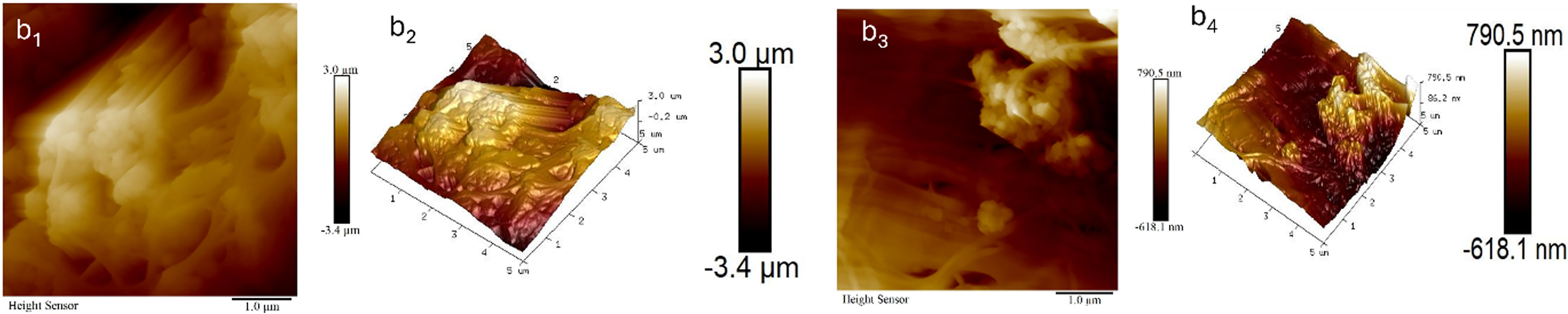
AFM spectra of P composite after P adsorption (b1–b4).
Kinetic Study of Adsorption
The adsorption kinetics of P and F ions were systematically investigated to elucidate the rate-controlling steps and underlying mechanisms governing the interaction between the ions and FeMn–PAA/Chitosan composite (Jana and Bhunia, 2025). Understanding these kinetics is particularly critical for practical applications such as wastewater treatment, where rapid and efficient removal of contaminants is essential (Jana and Bhunia, 2025; Khan et al., 2020). Kinetic experiments were performed at pH 5 using an initial adsorbate concentration of 50 mg·L−1, with adsorption monitored over a 24-h period at different temperatures ranging from 298 to 328 K (Fig. 5a and b). The adsorption process exhibited a rapid initial uptake phase, during which a large fraction of the ions was adsorbed within a short time, reflecting the availability of abundant active sites on the composite surface. This was followed by a slower approach to equilibrium, where the adsorption rate gradually decreased as the number of available active sites became limited. Once equilibrium was reached, no further uptake of ions was observed, indicating that the composite surface had reached saturation. Minor desorption events were also noted over extended contact times, likely due to the gradual release of weakly bound ions from saturated sites, explaining why prolonging contact time beyond equilibrium did not enhance overall removal efficiency. Equilibrium was achieved more rapidly for F, within approximately 20 min (Fig. 5b), whereas P required around 50 min to reach equilibrium (Fig. 5a). The initial adsorption rates were high for both ions, reflecting strong affinity of the composite toward anionic species, but plateaued once the active sites were occupied. Notably, P exhibited higher overall adsorption capacity than F, likely due to its more complex structure containing multiple oxygen atoms capable of forming stronger electrostatic and hydrogen-bonding interactions with the composite surface. Similar kinetic results are reported by Khan et al. (2024) while studying dye adsorption on PVP composite highlighting that adsorbates with larger, more complex structures often exhibit stronger and more sustained interactions with polymer-supported adsorbents. The rapid initial uptake followed by slower approach to equilibrium suggests that the adsorption process is controlled by both surface interactions and diffusion into internal pores, which has important implications for designing treatment systems with optimized contact times for efficient contaminant removal.
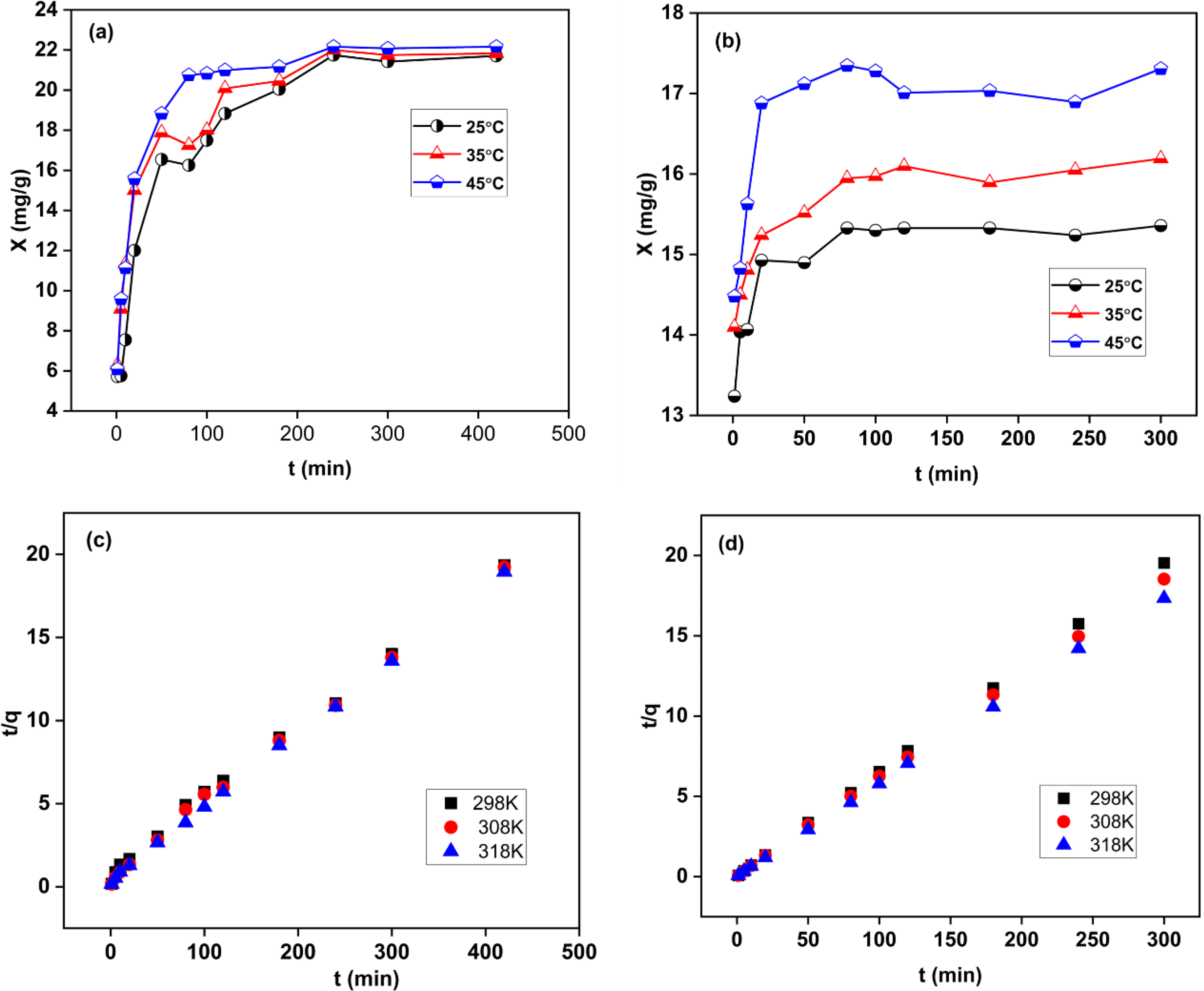
Kinetics of P
Kinetic modeling of P and F adsorption
The pseudo-first order and pseudo-second-order kinetic models are commonly used to study the adsorption mechanisms of adsorbate onto adsorbent materials.
The pseudo-first-order expression is typically represented as:

The pseudo-second-order equation is typically written as:

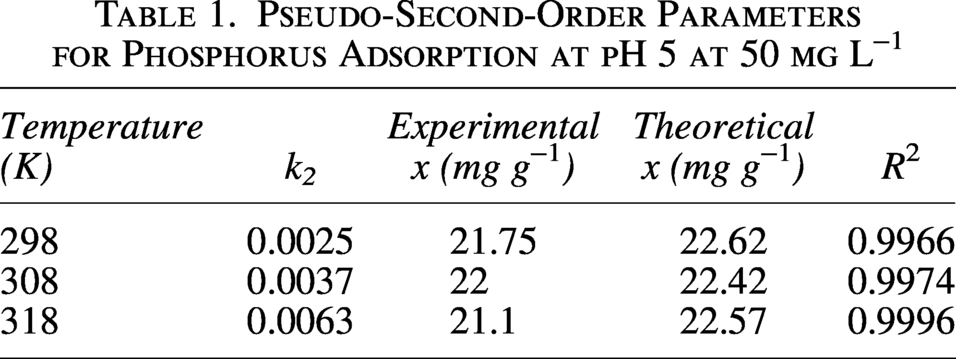
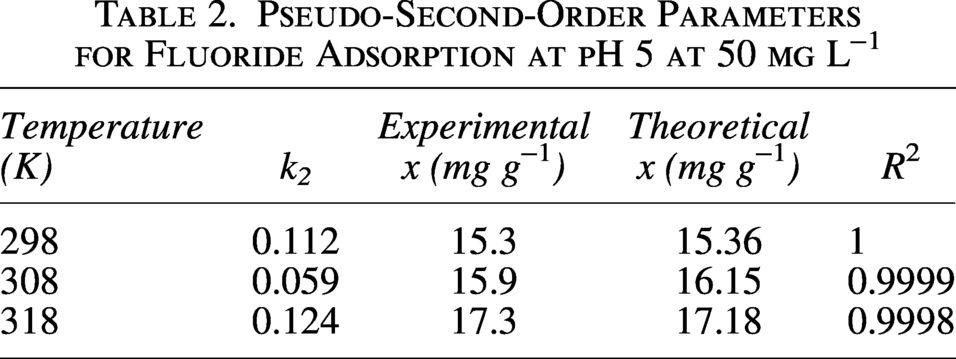
In this study, qt (mg g−1) represents the adsorption capacity at time t, while qe (mg g−1) denotes the equilibrium adsorption capacity. The parameter k2 is the rate constant for the pseudo-second-order kinetic model. The linear relationship observed in the plots of t/qt versus t (Fig. 5c and d), along with the strong correlation between experimental and calculated qe values and high R2 values close to unity (Tables 1 and 2), confirms that the pseudo-second-order model accurately describes the adsorption kinetics of the process which implies that chemisorption is the dominant rate-limiting mechanism for both adsorbate. Chemisorption involves the formation of strong chemical bonds between P and F molecules and the adsorbent surface, typically resulting in higher adsorption capacities and more irreversible adsorption. Similar data were presented by Pazoki and Anbia (2025) during study of chromium adsorption by chitosan composite. Specifically, the pseudo-first-order model assumes that adsorption occurs primarily through a physisorption mechanism with diffusion-controlled processes. However, in our case, the calculated equilibrium adsorption capacities from this model showed a large deviation from the experimental values, and the correlation coefficients (R2) were considerably lower. This mismatch suggests that the pseudo-first-order model fails to capture the rate-limiting step of the adsorption process. By contrast, the pseudo-second-order model provided both excellent correlation coefficients and a close agreement between calculated and experimental adsorption capacities. This indicates that the adsorption is dominated by chemisorption involving valence forces through electron sharing or exchange between the adsorbent functional groups (–OH, –COOH) and the target ions (P and F). Thus, we conclude that chemisorption is the primary mechanism governing the kinetics of our system.
Pseudo-Second-Order Parameters for Phosphorus Adsorption at pH 5 at 50 mg L−1
Pseudo-Second-Order Parameters for Fluoride Adsorption at pH 5 at 50 mg L−1
The intraparticle diffusion model
The intraparticle diffusion model was used to investigate the adsorption mechanism.
The linear form is typically represented as:

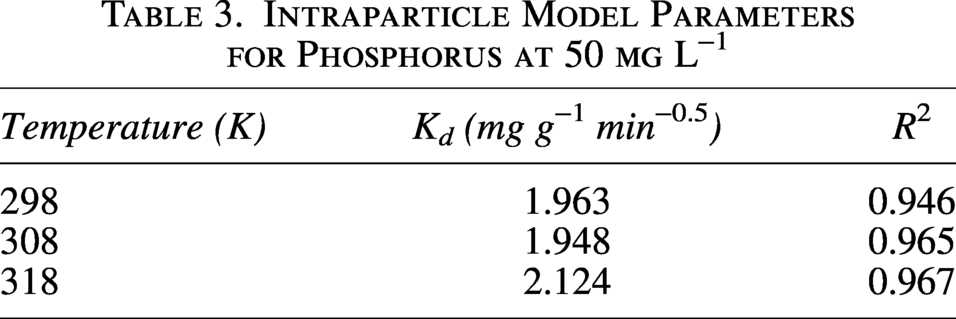
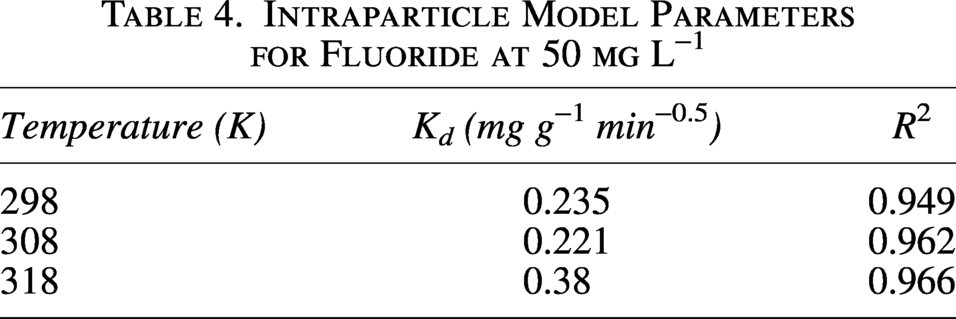
In this context, qt represents the amount of ions adsorbed at time t, Kd is the intraparticle diffusion rate constant, and C is the intercept related to the boundary layer thickness. Similar multilinear plots were reported by Özacar et al. (Özacar and Şengil, 2005) for the adsorption of complex yellow onto pine sawdust at 298 K. These patterns indicate a two-stage adsorption mechanism: an initial phase dominated by external surface diffusion, followed by a slower intraparticle diffusion stage, with the latter serving as the rate-limiting step. A linear qt versus t1/2 plot that passes through the origin implies that intraparticle diffusion solely controls the adsorption process. However, the deviation from the origin observed in Figure 6a and b suggests that intraparticle diffusion is not the only rate-controlling mechanism. This deviation is attributed to variations in mass transfer rates between the initial and later stages of adsorption. The R2 values in Tables 3 and 4 support the applicability of the intraparticle diffusion model for both P and F. Nevertheless, the presence of intercept C and the fact that the lines do not pass through the origin indicate the influence of a boundary layer, confirming that intraparticle diffusion is not the sole rate-limiting step.
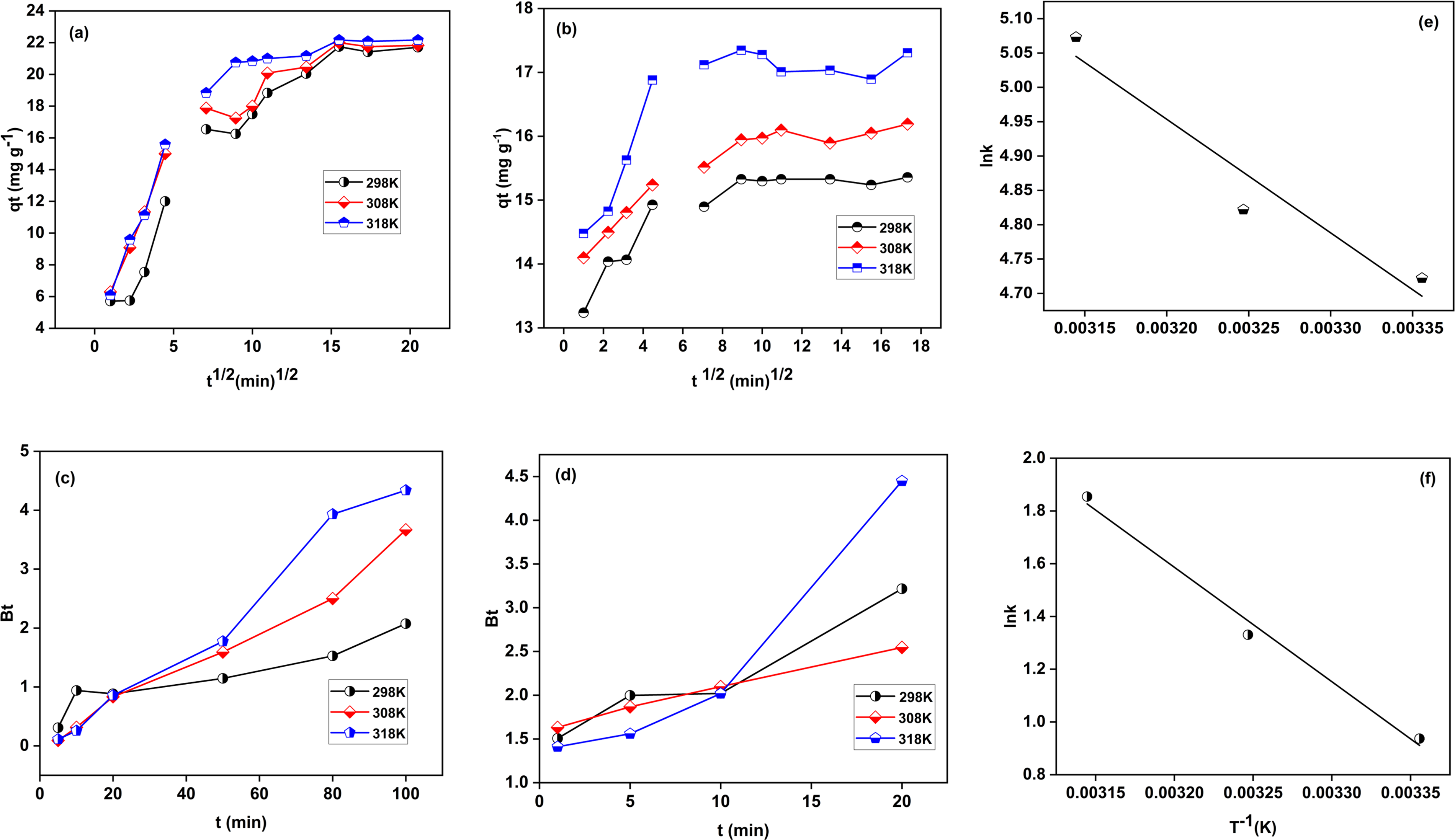
Intraparticle diffusion plots for P adsorption
Intraparticle Model Parameters for Phosphorus at 50 mg L−1
Intraparticle Model Parameters for Fluoride at 50 mg L−1
The Boyd model was applied to the kinetic data to identify the actual rate-determining step. The Boyd model equation is typically represented as:


Equation (5) can be written in the following form:


Here, qe represents the adsorption capacity at equilibrium, qt denotes the adsorption at time t, F is the fraction of solute adsorbed at time t, and Bt is a mathematical function of F. As shown in Figure 6c and d, the plots do not pass through the origin, indicating that the adsorption process is predominantly governed by external (film) diffusion.
The Boyd model helps distinguish whether the rate-limiting step is film diffusion (external mass transfer) or intraparticle diffusion (internal mass transfer). In our analysis, the Boyd plots were nonlinear at the early stage and did not pass through the origin, implying that film diffusion significantly contributes to the initial adsorption rate. This supports the conclusion from the intra particle model that intraparticle diffusion is not solely controlling the adsorption kinetics. As the process proceeds, the contribution of internal diffusion becomes more prominent, but the overall rate remains dominated by surface-controlled chemisorption. Together, the intraparticle diffusion and Boyd analyses demonstrate that adsorption occurs via a multistep mechanism: rapid initial surface adsorption governed by film diffusion, followed by slower intraparticle diffusion into pores. The pseudo-second-order kinetic model remains appropriate because the rate-limiting step is chemically controlled adsorption on the surface, rather than purely diffusion-controlled.
Arrhenius equation
The temperature dependence of the adsorption rate constant can be analyzed using models such as the Arrhenius equation, which provides insight into the activation energy and the underlying adsorption mechanism. The equation is expressed as:

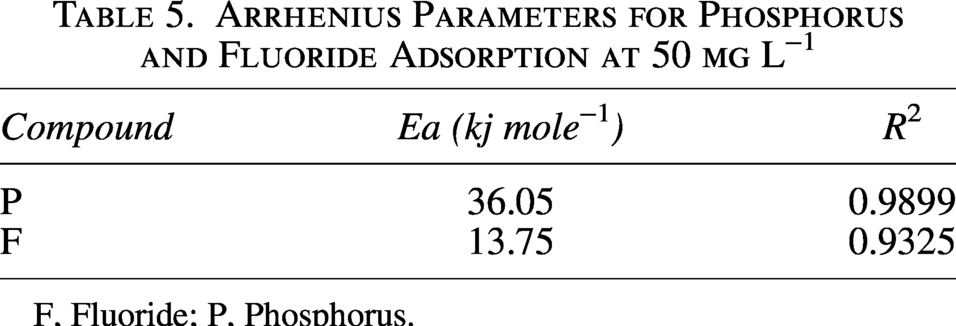
Here, k is the rate constant, A the pre-exponential factor, Ea the activation energy, R the gas constant, and T the temperature in Kelvin. By plotting lnk versus 1/T, the activation energy (Ea) can be determined from the slope (-Ea/R) and the pre-exponential factor (A) from the intercept (Fig. 6e and f). The linear plots of lnk against 1/T enabled the calculation of activation energies for the adsorption of P and F onto polyacrylic acid-stabilized chitosan-based FeMn composites, which were 36.05 and 13.75 kJ/mol, respectively (Table 5). Activation energy offers valuable insight into the adsorption mechanism, helping distinguish between physical and chemical adsorption. Typically, low activation energies (0–80 kJ/mol) indicate physisorption, whereas higher values (80–400 kJ/mol) suggest chemisorption.
Arrhenius Parameters for Phosphorus and Fluoride Adsorption at 50 mg L−1
F, Fluoride; P, Phosphorus.
Effect of Various Parameters
Effect of initial concentration
The initial concentration of adsorbate is a critical factor influencing the adsorption process, as it directly affects the availability and utilization of active sites on the adsorbent surface. The relationship between initial concentration and percentage removal often varies with the system; at low concentrations, most adsorbate molecules can easily occupy available active sites, resulting in high percentage removal, whereas at higher concentrations, the adsorption sites may become saturated, which can reduce overall percentage removal efficiency. In the present study, the effect of varying initial concentrations of P and F ions, ranging from 5 to 200 mg L−1, on their adsorption onto FeMn composites was investigated using a fixed adsorbent dose of 0.1 g. As illustrated in Figure 7a and c, the composite demonstrated higher percentage removal at increasing initial concentrations, indicating that the adsorbent possessed sufficient active sites to accommodate the additional ions at these concentration ranges. The adsorption capacity of the material increased progressively with increasing ion concentration, eventually approaching a plateau once equilibrium was reached. At lower concentrations, the adsorption capacity was limited because the driving force for mass transfer was relatively weak, and the number of ions in solution was smaller relative to the abundance of available adsorption sites. As the ion concentration increased, the concentration gradient between the solution and the adsorbent surface became stronger, enhancing the migration of ions toward the adsorbent and promoting higher uptake. This increase in driving force facilitates the occupation of more active sites, leading to improved adsorption capacity until saturation occurs. Yang et al. (2025) reported similar results by studying P and F adsorption by magnetic adsorbents, where higher initial concentrations resulted in increased adsorption capacities due to enhanced ion–adsorbent interactions. The results underscore the importance of optimizing initial ion concentration to maximize adsorption efficiency while considering the practical limits imposed by active site availability.
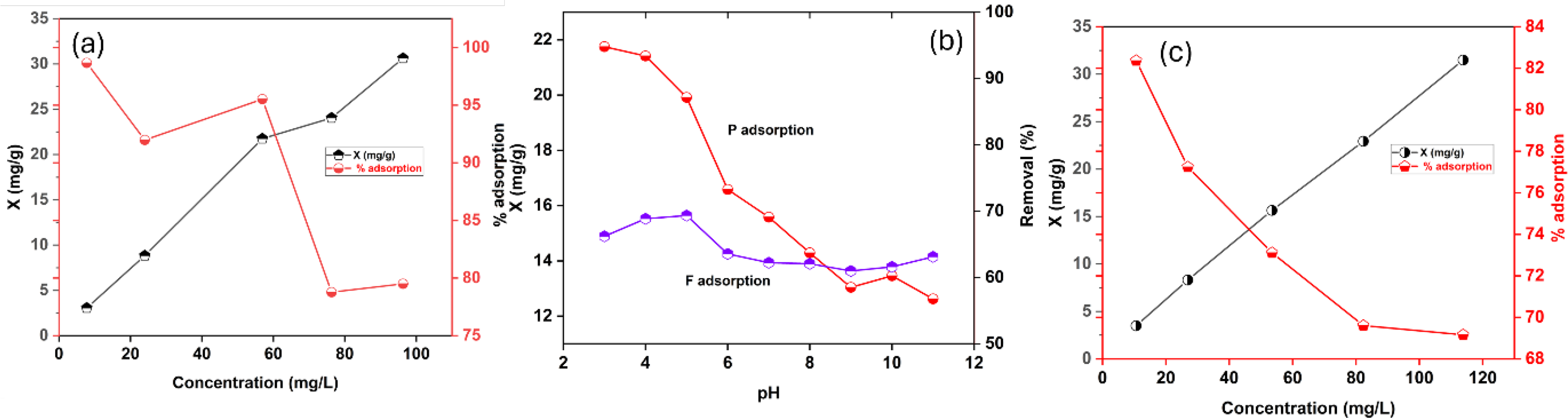
Effect of initial concentration of P adsorption
Effect of pH
The pH of the solution significantly influences adsorption efficiency by affecting both the surface charge of the adsorbent and the degree of ionization or protonation of the ions (Villars et al., 2020). The adsorption of P and F ions onto the polyacrylic acid-stabilized chitosan-based FeMn composites was investigated over a pH range of 3–11 at 298 K, using 0.1 g of adsorbent and an initial ion concentration of 50 mg L−1. F adsorption is lower in acidic conditions, possibly because it forms hydrofluoric acid (HF), which does not ionize well, reducing the amount of free F available for adsorption. In alkaline conditions, adsorption is also lower, likely due to hydroxide ions (OH−) competing with F ions for adsorption sites, as they have similar charges and sizes. At low pH, hydrogen ions (H+) bond with F to form weakly charged HF, reducing F adsorption. When pH exceeds 3.16 (the pKa of HF), F ions dominate, and adsorption increases. As pH rises further, F removal peaks, then declines above pH 6 due to competition from hydroxide ions (OH−) for binding sites on the adsorbent and deprotonation of adsorption sites (Fig. 7a) (Aigbe et al., 2019). As pH increases from 3 to 11, P adsorption decreases. The pH influences the type of P species (H2PO4 and HPO42-) and the charge on the adsorbent surface. At low pH, the surface is highly protonated, enhancing electrostatic attraction with P anions. As pH rises, the surface becomes less positive and more negatively charged P species dominate, reducing attraction and adsorption (Fig. 7a). Above a certain pH, the surface becomes negatively charged, causing repulsion and further decreasing adsorption (Milovanović et al., 2023). The FeMn-mixed oxide core exposes amphoteric surface hydroxyls (M–OH; M = Fe, Mn) that protonate/deprotonate with pH:
Acidic: M–OH + H+ ⇌ M–OH2+
Basic: M–OH ⇌ M–O− + H+
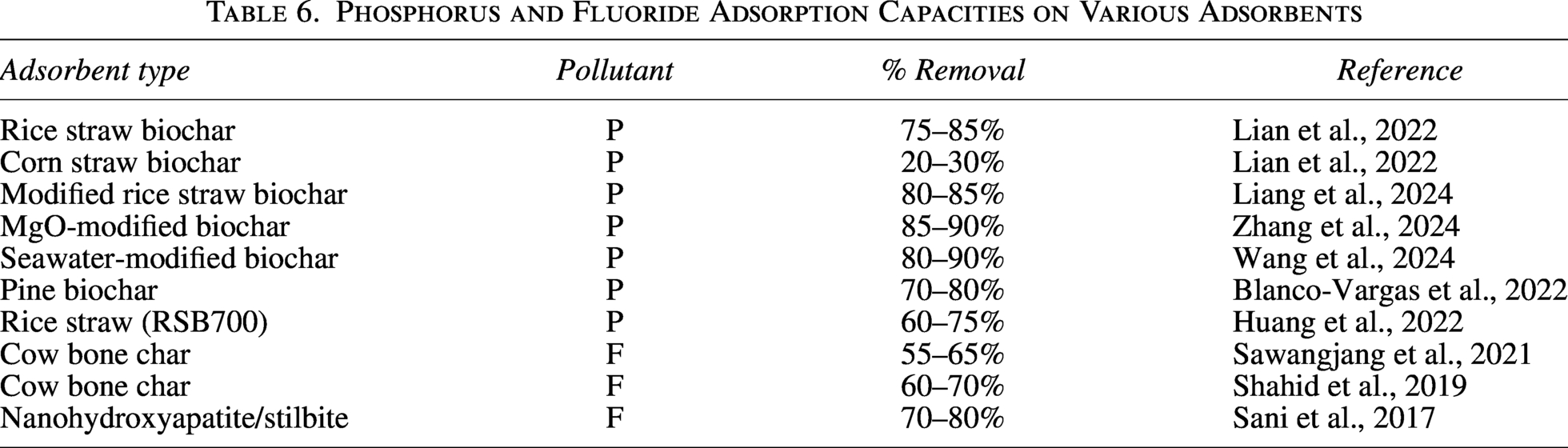
The grafted polymer shell contributes amine (–NH2/–NH3+) and carboxyl (–COOH/–COO−) groups. Both positive (–NH3+, M–OH2+) and negative (–COO−, M–O−) sites coexist yielding a multicharged interface that presents complementary binding domains without pore collapse. Table 6 shows various adsorbents for P and F removal.
Phosphorus and Fluoride Adsorption Capacities on Various Adsorbents
Real Water Samples Analysis and Removal
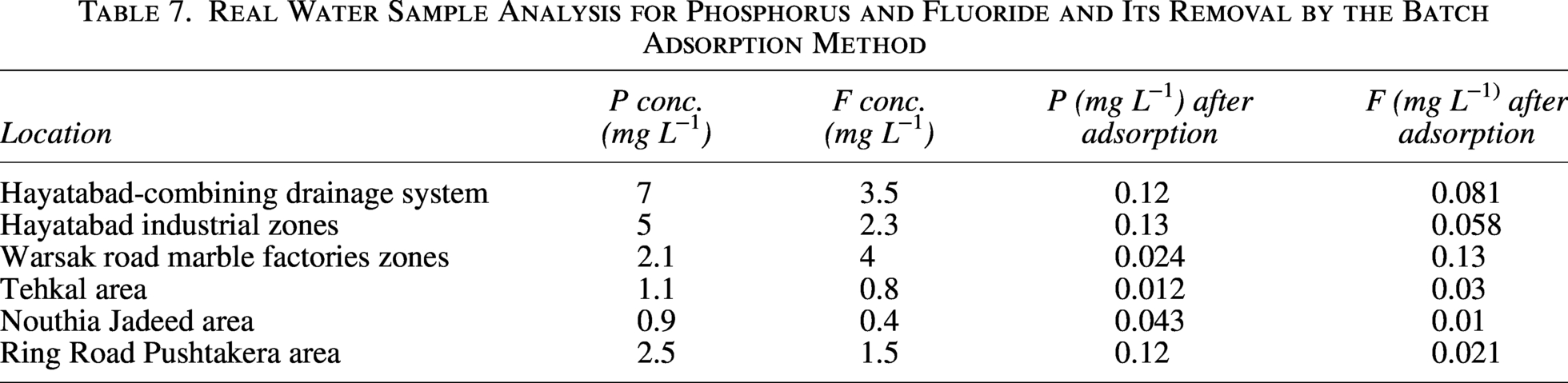
Water samples were collected from six different locations across district Peshawar, Khyber Pakhtunkhwa, Pakistan, to evaluate the levels of P and F contamination. The sampling locations included areas with varying degrees of industrial and residential activity to provide a representative overview of water quality in the region. The measured concentrations of P and F in these samples are summarized in Table 7. Among the six sites, the Hayatabad combined drainage system and the Hayatabad industrial zone exhibited the highest concentrations of P and F. These elevated levels can be attributed to extensive industrial activity in these areas, including fertilizer production, paint manufacturing, cement factories, cosmetics, and Teflon industries, which release P and F containing effluents into surrounding water bodies. F in groundwater originates from both natural and anthropogenic sources. Naturally, it is released through the dissolution of F containing minerals present in soil and rock formations, while anthropogenic sources include industrial discharge and agricultural runoff. Similarly, P is naturally present in water systems, often in the form of dissolved P compounds, but its concentration is significantly influenced by human activities such as industrial effluents and the use of P-based fertilizers. In contrast, the other water resources sampled in the district exhibited relatively low concentrations of P and F, indicating minimal contamination from industrial or anthropogenic sources. These findings highlight the impact of localized industrial activity on water quality and underscore the necessity of targeted treatment strategies, particularly in highly industrialized zones, to ensure safe and sustainable water supply for the surrounding communities. The composite maintained high removal efficiency in real water, demonstrating robustness suitable for practical environmental applications.
Real Water Sample Analysis for Phosphorus and Fluoride and Its Removal by the Batch Adsorption Method
Regeneration Study
The practical utility of an adsorbent largely depends on its ability to be regenerated and reused without major loss of efficiency. To evaluate this, regeneration of the composite was systematically examined using 0.1 M HCl as the desorbing agent for P. Adsorption–desorption experiments were performed over six consecutive cycles. The initial adsorption capacity for P was 97%, gradually declining to 70% after the sixth cycle. These results indicate that the composite retains a substantial fraction of its uptake capacity, demonstrating good structural stability and the robustness of its amine and carboxyl functional groups. The progressive decline in performance is attributed to incomplete ion desorption, partial deactivation of active sites, and cumulative thermal and chemical stress during drying and acid treatment. The observed regeneration pattern is consistent with the thermodynamics of the system: adsorption is exothermic, so higher temperatures reduce uptake, while acidic conditions favor desorption at elevated hydrogen concentrations. The composite’s regeneration capacity and stability suggest its potential integration into continuous water treatment systems (Huang et al., 2025).
Conclusion
The multiple sites FeMn composites were successfully synthesized and demonstrated high efficiency in removing P and F ions from water. The mechanisms of ion attachment to the composite surface were systematically investigated using a suite of advanced spectroscopic and microscopic techniques, providing insights into the nature of adsorbate–adsorbent interactions. Real water samples were collected from various locations in district Peshawar, Khyber Pakhtunkhwa, Pakistan, and analyzed for P and F concentrations. Batch adsorption experiments were then performed to evaluate the composite’s practical performance under realistic conditions. Comprehensive characterization using FTIR, TGA, XPS, AFM, SEM, and Raman spectroscopy revealed detailed information about the surface functional groups, structural stability, topography, porosity, and electronic environment of the composite before and after adsorption. The adsorption kinetics were best described by a pseudo-second-order model, indicating that chemisorption processes predominantly controlled the uptake of ions. XPS analysis suggested that multiple interactions including hydrogen bonding, π–π stacking, and electrostatic attraction contributed to the adsorption of P and F onto the composite surface. The structural and chemical insights obtained from these characterization techniques confirm that the composite provides highly accessible active sites and maintains structural integrity even after repeated adsorption cycles, making it suitable for practical applications. The study highlights that the combination of dual-charged polymer functionalization and mixed metal oxides significantly enhances ion removal efficiency, particularly for contaminants present in real water systems affected by industrial activity. Overall, the results demonstrate that FeMn–PAA/Chitosan composite is a robust and promising adsorbent for the treatment of P- and F-contaminated water, with potential for application in industrial and municipal wastewater treatment systems. The composite exhibited a specific surface area of 27.4 to 20.4 m2 g−1 before and after dye adsorption. Batch adsorption experiments demonstrated maximum capacities of 95–99% for both dyes under optimal conditions (pH 2–10, 298 K). This work provides an environmentally relevant route for treating contaminated waters, bridging material science with practical environmental engineering solutions.
Authors’ Contributions
A.K.: Conceptualization, methodology, data curation, formal analysis, and writing original draft. R.H.: Validation, data curation, interpretation, drafting, revision, and editing. S.C.: Investigation, analysis, validation, data curation, and review. T.L.: Date analysis, validation, review, and editing. R.Y.: Investigation, analysis, validation, revision, and editing. D.X.: Project administration, resources, supervision, investigation, analysis, data curation, review, and editing.
Footnotes
Acknowledgment
The authors acknowledge the School of Chemical and Environmental Engineering, Anhui Polytechnic University, Wuhu, China, and Zhang Yi and Weihua Chen for the technical assistance.
Author Disclosure Statement
The authors declare that they have no known competing financial interests or personal relationships that could have appeared to influence the work reported in this article.
Funding Information
The authors gratefully acknowledge the funding by the Major Program of Natural Science Foundation for Higher Education Institutions of Anhui Province (2024AH040021) and the National College Student Innovation and Entrepreneurship Training Program (202310363071).