







Abstract
Almost a year since my inaugaral editorial: Managing Movement, Leading Change (Freshwater, 2012) where I highlighted the importance of challenging philosophical and epistemological stances; we are taking the opportunity to do just that in relation to the elusive concept of “paradigm” through the highly versatile and dialogic form of the editorial.
Conceptualizing the concept of paradigms as “elusive” is an important metaphor and one to which we will allude througout this editorial. In our editorial: Why Write (Freshwater & Cahill, 2012), we put into tension some competing definitions of paradigm in order to open up the debate on what constitutes a paradigm and to outline why we felt it is important for this debate to be held in the mixed methods community. Since that editorial, we have had a very interesting response from the coeditor, Donna Mertens: What Comes First? The Paradigm or the Approach? (Mertens, 2012).
Mertens argued against the school of thought that paradigms can be methdological in their foundation (Freshwater & Cahill, 2012) and offered the use of “paradigms as philosophical frameworks that delinieate assumptions about ethics, reality, knowledge, and systematic enquiry” as a way of “[clarifying] the basis of disagreements” (Mertens, 2012, p. 256) with regard to the use of paradigms in mixed methods research. At this juncture we would like to take a step back, into the nexus of the disagreements themselves: We believe that “disagreement” offers a more interesting space in which to hold a debate and refine a discourse rather than the seemingly solid ground of a solution. And one that potentially continues to delineate paradigms as philsophical frameworks that lead to choices in methods. We contend that engaging with disagreements and their constructions and deconstructions can underpin some of the most progressive and innovative of debates. Rather like this one, we hope! As an exemplar, we draw on some of the argument presented by Mertens (2012) in the October editorial.
Mertens (2012) cites Greene and Hall who caution against using qualitative, quantitative, and mixed methods as labels for paradigms—arguing that this is to “reify and essentailize them and thereby disregard their constructed nature . . .” (p. 255). The association of a paradigm with a reified and essential entity is interesting in this context. We would argue that understanding the constructed nature of paradigms is key, and in this context we would question the association of paradigms with something that is “reified” or “essential.” As noted in our editorial Why Write (Freshwater & Cahill, 2012), discourse development (including the discourses that underpin paradigms) is inherently relational, iterative, and responsive—and subject to its own deconstruction. That is why it would be misleading to associate paradigms and the paradigmatic structures therein, as “reified” or “essential.” And we would go as far as to suggest that, in this sense the concept of paradigms must remain “elusive,” which is not the same as “reified.”
Therefore, in considering definitions of paradigm, we would like to make clear that we are not arguing for three paradigms (quantitative, qualitative, and mixed methods) versus three phiosophical frameworks (dialectical, postpositivist paradigm, and pragmatic paradigm). Rather, what we are arguing for is some degree of plurality in considerations of what consitutes a paradigm. A sticking point appears to be the semantic boundaries of the terms qualitative/quantitative/mixed methods. We note Biesta’s (2010) assertion that the terms quantitative and qualitative denote kinds of data rather than the epistemologies, designs, and ontological assumptions that are associated with different research frameworks. However these terms do not only apply to methods of data collection and choice of methods—they have become more widely accepted as signifiers of methodological approach that are epistemological standpoints. We have only to consider the title of a well-known qualitative journal (Qualitative Inquiry) to surmise that the label qualitative is not restricted to data collection. What we suggest, and it is merely a suggestion, which we hope will stimulate debate, is that the label “mixed methods” has been used somewhat imprecisely within the mixed methods community in that it has not always distinguished between its dual meaning of (a) a set of procedures and (b) a methodoogical approach. This has led to some conceptual confusion and misunderstanding concerning whether mixed methods could or should indeed be viewed as a paradigm.
There are voices in the mixed methods community that contend that mixed methods does indeed constitute a paradigm. Johnson, Onwuegbuzie, and Turner (2007), in arguing for defining mixed methods as one of three major paradigms, coined the terms research paradigm and methodological paradigm to denote
a set of beliefs, values, and assumptions that a community of researchers has in common regarding the nature and conduct of research. The beliefs include, but are not limited to, ontological beliefs, epistemological beliefs, axiological beliefs, aesthetic beliefs, and methodological beliefs. (pp. 129-130).
So we return to the concept of paradigm as “elusive.” On one hand, we acknowledge that the term paradigm has suffered from a series of slippery definitions and this factor added to the conceptual mayem regarding the use of the term mixed methods, puts us at risk of being caught in a mire of epistemological, ontological, and axiological relativity. On the other hand, we would caution against setting the concept in semantic concrete, being mindful that as highlighted in our earlier editorial, when creating texts through the medium of editorial practice we need to value the way that space, movement, and change sculpt discourse and academic debate, ensuring that dissenting voices are given expression. As a tentative response to curbing the elusivity of the beleaguered concept of paradigm, we are suggesting the concept of paradigamtic frame (Figure 1). This concept of paradigmatic frame (Morgan, 2007) has been used by Madill and Gough (2008) to consider diverse approaches to the positioning of qualitative research in psychological science. Although this model might run the risk of generating yet more semantic straitjackets (!), we present the notion of paradigmatic frame here to open up the concept of paradigm, to show how it can be understood as a continuum of increasing generalization. Moving from a model of dichotomy (paradigm or not) to a continuum (increasing generalization) may allow us to consider these points of both semantic and epistemological tension with regard to the concepts of paradigm and mixed methods research in a more equitable way in future debates.
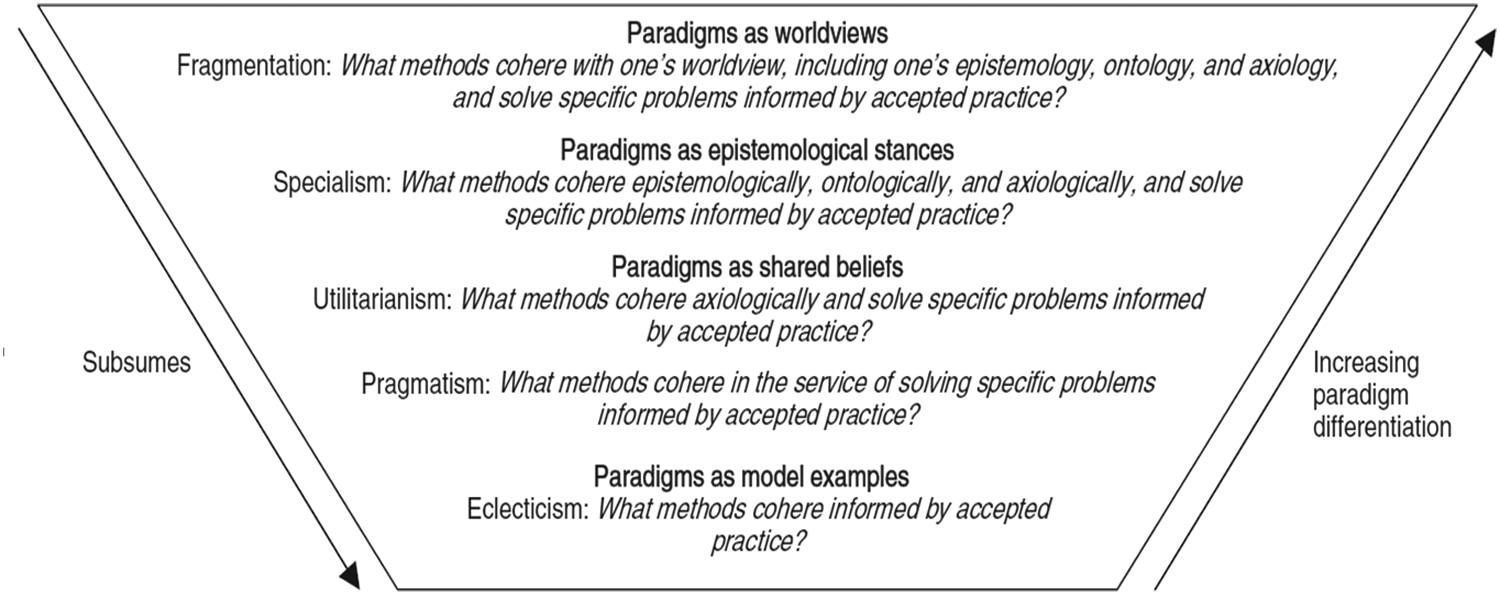
Criteria for judging intermethod coherence associated with increasingly generalized versions of “paradigm”