







Abstract
The Southeastern United States is home to one of the most culturally resistant arenas for undocumented immigrant students to pursue postsecondary education. Using a transformative mixed methods approach, we explore the multidimensional dynamics of contention that are present as campus administrators navigate the process of serving a group of students who are marginalized due to their unresolved immigration status. Our article contributes to the methodological literature by exemplifying how transformative mixed methods are powerful tools for understanding how the oppression of vulnerable populations is institutionalized in organizational settings.
Immigration in the United States is imbued with philosophical, humanitarian, economic, and practical dimensions. Procedurally, immigration is a geopolitical phenomenon; people are categorically excluded from (or included in) a geographically bounded nation-state that possesses the political power to confer some measure of “status” to members. Although U.S. federal immigration policy may offer some level of procedural specificity for local, state, and municipal authorities, immigration policies are enacted through the prevailing sociocultural and historical meanings that characterize a particular location. The purpose of this study is to critically assess the local conditions and cultural norms that have shaped postsecondary access and opportunity for undocumented immigrant college students in one of the nation’s most restrictive environments: the Southeastern United States. We use a transformative mixed methods assessment to interrogate the ways in which college campuses navigated the unique cultural context of their region while implementing administrative actions that affected educational opportunity for undocumented students.
Transformative mixed methods are useful for understanding: (a) how it is that higher education leaders accept a reality that can be oppressive for undocumented students and (b) how campuses (and the corresponding administrators who work there) can adjust their practices to be willfully more inclusive. By focusing on campus administrative processes related to the relative inclusion/exclusion of undocumented students, we expand the repertoire of how transformative mixed methods designs can be applied to organizational processes. Our unique focus on collective and organizational processes helps illuminate the multiple and competing ways in which institutional power and organizational power (or lack thereof) manifest when enacted by campus administrators and leaders operating in a particular localized cultural context. We layer complementary forms of data to highlight normative administrative practices in the Southeastern United States (where immigration policies tend to be most restrictive) and, perhaps more important, to construct insights about the ways in which collective meanings or interpretations constrain or encourage campuses to pursue the twin educational goals of inclusion and student achievement for undocumented students. Our study adds to the mixed methods methodological literature by applying a process-based analysis (Bidart, Longo, & Mendez, 2013) to a transformative methodology to assess how the categorical exclusion/inclusion of a particular group is a function of organization-level actions and collective framing processes.
Transformative Designs for Contextualizing Organizational Problems and Processes
As a class of research, mixed methods research (MMR) combines quantitative and qualitative techniques to capitalize on the strengths of each to offer insights that are multidimensional in nature (Johnson & Onwuegbuzie, 2004). MMR is ontologically pluralistic by design, thus providing a radical space (Onwuegbuzie, 2012) to synthesize and identify objective normative phenomenon in social life that are complicated by subjectivity, context, epistemological meaning-making, and emotions and values. Within this broader tradition of mixed methods, transformative designs are distinctively attentive to identifying power imbalances to work toward transforming pervasive inequalities in a variety of spaces and situations (Mertens, 2010). Transformative designs involve working directly with affected community members’ to help accrue insights into matters of inequity (Mertens, 2007; Mertens, Bledsoe, Sullivan, & Wilson, 2010). Furthermore, transformative research is distinctively action oriented, with the community-researcher collaboration yielding understandings and steps to disrupt oppression (Mertens, 1999, 2012).
Transformative research approaches activate and amplify the voices and experiences of marginalized identity groups to advance social justice (Mertens et al., 2010). Often, they employ critical, feminist, queer, and disability theory (Mertens et al., 2010) to consider the intersections of individual identity with social constructions of difference, institutionalized power structures, and social contexts to name oppressive and discriminatory realities that are in need of transformation. While a critical focus on marginalized identities has been, and should be, a central part of transformative designs, few studies apply transformative research to contemplate organizational functioning as a source for overcoming oppressed realities. This gap is problematic given the discrete objective that transformative research must produce knowledge linked to specific action that undermines oppression and reveals systemic and institutionalized inequities. In many respects the task of remedying social inequities or broadening inclusion, in ways that categorically remove barriers, is mediated through organizational actions and work routines that are structured to better serve the needs of particular classes of marginalized groups (Arthur, 2011; Bensimon & Malcolm, 2012). Our study directly addresses this gap in the transformative literature by applying a transformative MMR design to organizational-level processes, guided by a social movement conceptualization of contention and oppression in institutional settings.
Our intention to respond to the gap in the transformative MMR literature is inspired by merging the commentaries of Romm (2015) and Mertens et al. (2010). Romm (2015) argues that transformative research might realize its aim of contributing to socially just change by adopting a critical systemic approach. Such an approach attends to the interconnectedness of people, processes, and formal organizations where injustices occur; embedded in these connections are collective processes of knowing and becoming that need to be examined (Romm, 2015). Although not labeled as part of a critical systemic approach, Mertens et al. (2010) similarly highlight the extent to which the aims, values, and actions of transformative research intersect with the interests and ethical standpoints of professional organizations, advocacy groups, and disciplinary or academic organizations. Implicit in both perspectives is the tacit suggestion that transformative research must achieve more than simply disrupting individual meaning-making to inform subsequent action. Rather, transformation also emerges from disrupting structural and institutionalized oppression that can be addressed by understanding complex cultural realities and organizational responses to them. Romm (2015) further advises that transformative researchers therefore shift their research “towards recognizing the impact of ways of knowing (and framing of issues/problems) on the unfolding of systems” (p. 418). In so doing, transformative research is further compatible with participants’ strong desire to understand their problems as being connected to the structures, practices, people/power, contexts, and processes that they must routinely navigate.
Our article therefore contributes to the transformative research literature by proving an illustrative example for assessing systemic organizational processes that function to maintain or disrupt privilege and exclusion. Our process-based analysis (Bidart et al., 2013) focuses on organizational actors (campuses), which possess the agency and capacity to respond to their environments in ways that advance or diminish the inclusion of a marginalized class of people, here undocumented college students. We operate from a logic that social transformation is possible when the research process allows the organizational actors (campus practitioners) to make sense of the forces that exert pressure on their actions and exposes them to processes that cultivate collective frames of meaning, so that they are better equipped to advance social justice and human rights (Mertens, 2010). Romm (1995) describes research about knowing as being constitutive of an intervention into a social problem because it opens new possibilities for action among social actors; this is indeed our value position and aim. Moreover, our assessment offers integration of a transformative process that begins with problem identification, conceptualization, data collection, analysis, and community collaboration throughout (Figure 1).
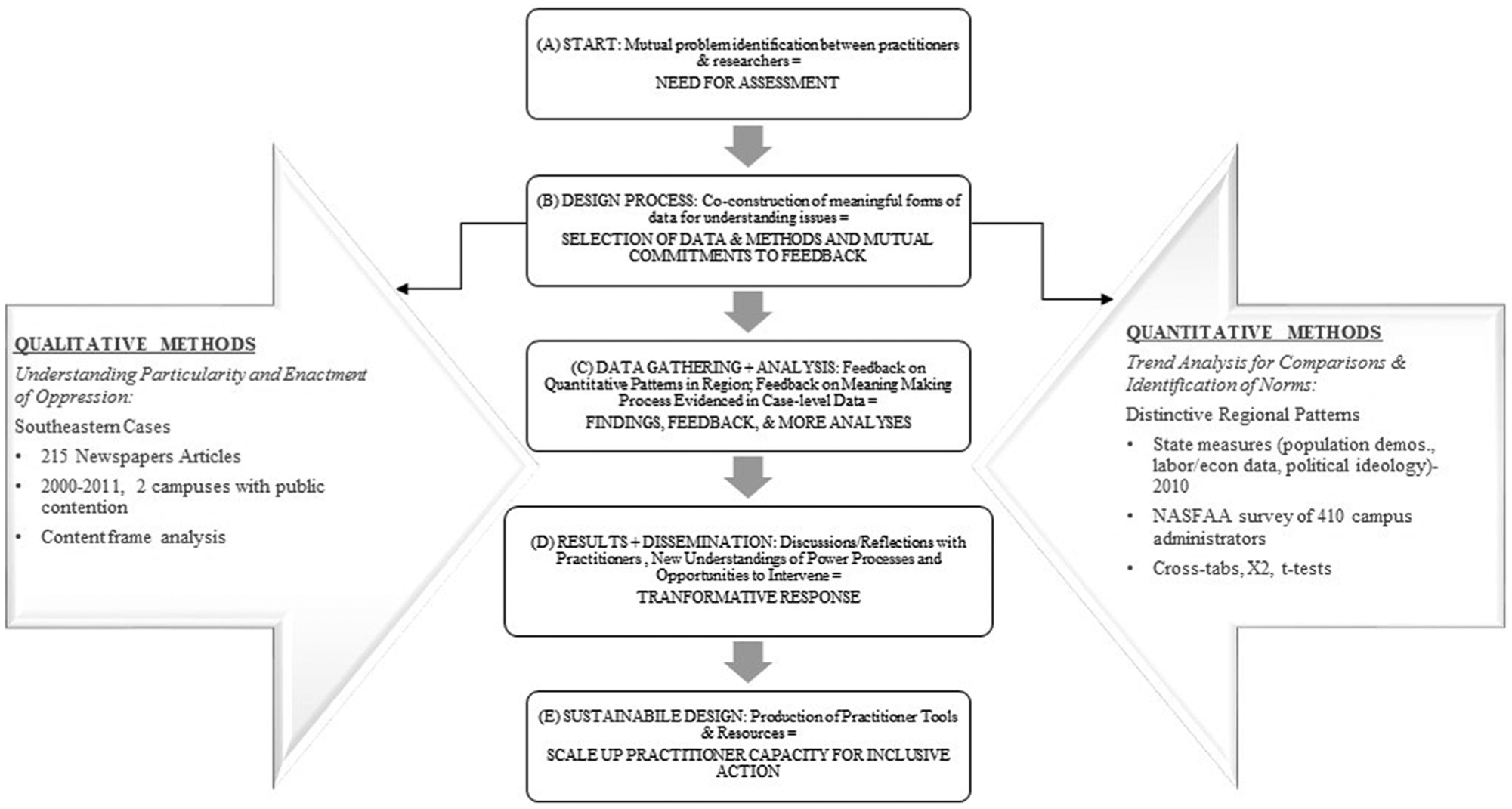
Transformative organizational assessment processes focused on resisting oppression of undocumented students in the Southeastern United States by understanding collective norms, needs, and meaning-making.
The Project: A Need for Transformation
In 2011, we began a collaborative multifaceted project, funded by the Ford Foundation, to assist campuses in becoming equipped to assure college access and opportunity for undocumented students. The project’s aim was to improve campus and higher education professional association leaders’ abilities to implement an organizational response that could be efficacious in light of the regressive and restrictive contexts relating to immigration in which campuses were operating. As our team partnered with campus professionals working in the Southeastern United States, they insisted that understanding and navigating the unique pressures of their local environments (cultural, political, structural, economic) was central to determining a realistic strategy for responding to the needs of undocumented college-bound students in ways that aligned with their campus and professional values. We therefore integrated these practitioner criteria toward designing a study that narrows in on “dynamic systems including changing contexts, sets of actions and events, driving forces and turning points” (Bidart et al., 2013, p. 745) necessary for evoking change. These aims led us to a transformative MMR design of organizational processes (Figure 1).
It is well established that the axiological dispositions of researchers and community-member partners motivate and direct transformative research designs (Mertens, 2007, 2012; Romm, 2015). In fact, a social problem only becomes worthy of a transformative design because those involved with the research process render a clear judgment about the injustice of the status quo, and acknowledge this as reality (Mertens, 2007). Our study comports to these axiological and ontological presuppositions inherent to transformative designs; we come to the topic from the standpoint of organizational insiders. As researcher-practitioners, our experiences have afforded us direct involvement with our topic. Our team includes a lifelong activist in the undocumented student movement, campus administrators that have worked within the system and lived its constraints, and educational researchers who seek to improve opportunities for underrepresented students. These experiences have greatly sensitized us (Charmaz, 2003) to the complex processes to which colleges and universities must attend when responding to undocumented students. Our backgrounds have also afforded us legitimacy with the community of practice featured in this assessment (campus administrators) as we set out to engage them in the transformative research process.
Background Context: Challenges for College-Bound Undocumented Youth
Many undocumented college students arrive in the United States as children, accompanied by parents seeking better lives for their families (Gonzales, 2009). They experience the bulk (if not all) of their primary and secondary education in American schools, and unsurprisingly, “their dominant language is English, they proclaim an American identity and they live an American life style” (Perez, 2009, p. 8; see also Wong et al., 2012). While conventionally American, most undocumented youth are operationally restricted from access to basic resources and institutions that are necessary for survival and success in U.S. society. These affordances include the ability to obtain drivers’ licenses, legal employment, financial aid, or even eligibility for admission to college (Perez, 2009; Wong et al., 2012). Even more concerning, undocumented youth tend to “live in the shadows,” encumbered by a constant fear of deportation of their families, or of themselves to a nation for which they have little to no familiarity (Perez, 2009; Wong et al., 2012). These fears complicate their access to essential resources such as police/public safety, health care, social services, or anything regulated by a local or federal government agency. Concerns about immigration status take precedence over the value of receiving the substantive help that the agency/authority might provide. The barriers undocumented students confront both marginalize and expose them (and their families) to a future aligned with poverty and hardship (Barnhardt, Ramos, & Reyes, 2013; Wong et al., 2012), rather than the promise of a creating a better life.
The current situation for undocumented immigrant students is also characterized by a history of contentious legislation and public policy. Since 2001, a handful of U.S. states have adopted in-state tuition residency statutes that allow undocumented students to pay the same tuition and fees as other residents of the state. Although these state policies have been constantly challenged in court by anti-immigrant groups, many have passed judicial review without violating the federal provisions outlined by Plyler v. Doe in 1982 (Flores, 2010). These statutes are largely in response to (a) the delay of the federal Development, Relief, and Education for Alien Minors (DREAM) Act—federal legislation that has been introduced repeatedly without passage for more than a decade, and aims to provide a path to citizenship for undocumented youth; and (b) the ambiguous language of the Illegal Immigration Reform and Immigrant Responsibility Act (IIRIRA §505, passed in 1996), which has led to states’ differential interpretations of the terms “residence” and “postsecondary educational benefit” (Bruno, 2010; Russell, 2011).
Both the Department of Homeland Security’s 2012 Deferred Action for Childhood Arrivals and President Obama’s 2014 Executive Action offer temporary reprieve from deportation to undocumented youth who meet certain requirements—one of which is being enrolled in high school (U.S. Department of Homeland Security, 2015; The White House Office of the Press Secretary, 2014). These requirements, however, do not override any campus or state practices related to college admissions or costs for undocumented youth. Therefore, in states where restrictions prohibit enrollment or in-state tuition pricing, undocumented youth may be preemptively ineligible to meet federal criteria (Olivas, 2012).
The Restrictive Southeastern United States
Within the larger immigration context in the United States, the Southeastern region of the United States, consisting of Alabama, Arkansas, Florida, Georgia, Kentucky, Louisiana, Mississippi, North Carolina, South Carolina, Tennessee, Virginia, and West Virginia (as identified in the National Center for Education Statistics), imposes the most restrictive context for college-bound immigrant youth. While the majority of U.S. states have not enacted provisions to restrict undocumented students’ admission, enrollment, or financial aid eligibility, several state policies in the Southeastern United States (a) ban undocumented college students from accessing some or all of the public colleges and universities in the state (as is the case in Alabama, Georgia, and South Carolina), or (b) place procedural restrictions on undocumented students’ tuition pricing, financial aid, and admissions eligibility (as is the case in North Carolina) due to state higher education oversight boards’ directives (National Conference of State Legislatures, 2014; Olivas, 2012). Furthermore, eight Southeastern states have contemplated state legislation aimed at enacting restrictions on college access for undocumented immigrants.
The discriminatory environments for undocumented immigrant students in the Southeast may be shaped through the attitudes that are held by nonimmigrants situated in this geographic location. Public attitudes toward immigration in the United States have been linked to patterns of political ideology, popular discourse communicated through the journalistic media, and regional contexts (Chandler & Tsai, 2001; Dunway, Branton, & Abrajano, 2010; Fryberg et al., 2011). Geographically, Haubert and Fussell (2006) observed a relationship between negative attitudes toward immigration and one’s residence in the Southern United States. Espenshade and Calhoun (1993) found that economic conditions, population statistics, and public opinion bounded by geography shape individuals’ views on immigration. Indeed, population statistics in the Southeast have reflected striking demographic shifts. All but one of the top 10 states with the fastest-growing Hispanic populations from 2000 to 2011 were located in the Southeastern United States (Brown & Lopez, 2013). This growth may have altered patterns of individual contact, perceptions of labor market competition, and emotional responses to cultural threat in the region, all of which have been shown to predict anti-immigration attitudes (Hainmueller & Hiscox, 2010; Newman, Hartman, & Taber, 2012; Scheve & Slaughter, 2001). UC-Davis law school dean Kevin R. Johnson (2012) further ties these patterns to the region by arguing that the contemporary anti-immigration fervor in Alabama reflects that locality’s long-standing nativist cultural tendencies, generalized antipathy toward the federal government (exacerbated by the Civil War), and a historical tradition of upholding a state-sanctioned racial caste system in the labor market there. In other studies examining contentious social issues in higher education, the university’s geographic location operates as resource (and/or barrier) to resolving matters (Van Dyke, 1998; Van Dyke, Dixon, & Carlon, 2007). Organizational theory also suggests that when facing contested issues, college and university leaders desire to act in ways that align with field-level legitimacy ascribed by other campuses, higher education professional organizations as well as with locally salient meanings and sentiments that align with the university’s mission and values (Lounsbury, 2001; Lounsbury & Pollack, 2001).
Viewed through prior research and theory, Southeastern U.S. universities, such as the ones selected in this assessment, are likely to face a range of pressures deeply laden with unique localized meanings as they seek to address the contested issue of access and opportunity for undocumented students. Our transformative mixed methods assessment asks: What are the prevailing campus administrative views and practices (as they relate to postsecondary educational opportunity for undocumented students) in the Southeastern United States? How do localized cultural frames of meaning in the public discourse characterize the topic of postsecondary access and opportunity for undocumented immigrant students? From a critical and integrative perspective, what (if anything) can we learn about how campuses hold or relinquish their power to support student achievement and inclusive educational practice?
A Conceptual Framework for Pursuing Transformative Processes in Organizations
Our transformative design prioritizes the organization as the unit-of-analysis, making it necessary to further decipher how a publicly contested issue like access and opportunity for undocumented college students intersects with organizational functioning. In any analysis it impossible to assess or depict all aspects of a story in its entirety, which leads Bidart et al. (2013) to caution analysts to select only what is relevant to the systemic process. Because campuses confront inherent complexities as they navigate distinctive and multilayered organizational and institutional challenges related to undocumented college students, we draw from the literature emphasizing organizational-level phenomenon in contested contexts (Davis, McAdam, Scott, & Zald, 2005; Fligstein, 1996; McAdam & Scott, 2005; Schneiberg & Soule, 2005) to contemplate critical process mechanisms.
How Organizations Respond to Contested Issues
As a category of research, organizational analyses evaluate observable phenomena within and across organizations, including their structures, functions, and resources, and the unique features of organizational life (McAdam & Scott, 2005), which makes these frameworks constructive for understanding systemic processes. Neoinstitutional theorists (DiMaggio & Powell, 1983; Meyer & Rowan, 1977) extended the structural perspective of legitimate organizational action to infuse it with a view that organizations are subjected to powerful isomorphic influences (coercive, mimetic, and normative) from the environment or field in which they are situated. These theorists emphasize the importance of the cultural meanings present in an organization’s environment as having a dominant role in specifying how organizations understand and enact social responsibility (Bieri & Boli, 2011; Marquis, Glynn, & Davis, 2007), or their version of what is “right” in response to a contested matter. Making evident how an organization takes a stand on an issue is part of ascribing an axiological position necessary in a transformative design.
Schneiberg and Soule (2005) focus on organizational processes that occur during conditions of contention and controversy. The environmental conflict they describe is supported by a classic view of social change processes where groups amplify common sentiments in order “to achieve change in the social structure and the allocation of value” (Zald & Useem, 1987, p. 249). That is, collective frames of meaning operate to affirm the power inherent to existing status structures, or alter said structures so the distribution of power changes. As organizational actors (e.g., leaders, administrators) seek to transform the reality around a contested issue, they must generate new norms of action and knowing, while simultaneously invoking the preexisting taken-for-granted norms that grant the organization legitimacy to act. Therefore, Schneiberg and Soule (2005) assert that as organizations seek to transform and resolve a contentious issue the process will involve (a) cultural expression; (b) diffusion, mimesis, and emergent community order; and (c) shock, succession, and politically reconstructed order. Cultural expression connotes the existing system-wide rationalized meanings and approaches to problem solving that are deemed legitimate thus “rendering only certain problems or solutions thinkable” (p. 125). Diffusion, mimesis, and emergent community order describe organizations’ tendencies to pursue localized solutions or to import those actions of other organizational actors who are similarly positioned as a means for ensuring the legitimacy of their response and communicability to stakeholders (Schneiberg & Soule, 2005). The terms shock, succession, and politically reconstructed order acknowledge that generally exogenous shocks (e.g., new laws, critical events) spark “cultural processes—sense—and claims-making activities, searches for new solutions, and a succession of players, forms, and logics as groups mobilize to gain power in organizations and fields by framing situations” (p. 127). Schneiberg and Soule’s research demonstrates that multiple models of order are advocated—with proposed solutions emerging from organizations monitoring peer organizations, looking to associations of professionals for endorsements, or self-borrowing from the organization’s own internal responses to prior contentious circumstances. These are the processes that our campus collaborators seek to know.
Procedures
Our application of a transformative design to organizational-level phenomenon engages the three features that Schneiberg and Soule (2005) delineate in their analysis of contention in institutionalized fields to identify the particular processes to which campuses must attend when formulating a response to serving undocumented college students. Our goal is to understand the phenomenon of local contention with regard to undocumented students in the Southeastern United States as a process, carried out within complex higher education organizations which are themselves embedded in historical contexts and cultural frames of meaning. As Romm (2015) notes, when this type of knowing emerges from transformative research, it becomes an intervention, integrating research and practice leads to new sorts of meaning-making about social processes and options for responding to them. Drawing on Bidart et al.’s (2013) description of processual analysis, complex social phenomenon are processes that happen over time, during which multiple and interdependent contexts, events, and social interactions represent a story of organizational change “that cannot be reduced to the mere sum of the factors that produced it” (p. 744). In order to adequately honor the complexity in the restrictive Southeastern United States, the research design integrates data regarding not only why, but how higher education organizations confronted the issue of undocumented students in their local context, focusing on the contextual “ingredients,” temporal sequences, driving forces, and turning points (Bidart et al., 2013).
The quantitative and qualitative components were selected and integrated purposefully (Creswell & Garrett, 2008; Creswell & Plano Clark, 2011; Mertens, 2007) for the purpose of revealing embedded meanings in the particular localized context of the Southeastern United States. While both forms of data are equally important, the qualitative data received interpretive priority by virtue of its capacity to showcase collective meaning, contextual complexity, and temporal depth (Bidart et al., 2013). Our parallel convergent design (Creswell & Plano Clark, 2011) best diagramed as: ((quan + quan) + QUAL)) (Morse & Niehaus, 2009) featured in Figure 1, involved two forms of quantitative descriptive data providing the cross-case legitimacy that the community of practice (i.e., campus administrators) sought, while the inclusion of two in-depth qualitative cases reinforced the locally salient contexts that manifest when colleges navigate undocumented students’ issues. State-level measures described the sociopolitical climate and the emergent community order (Schneiberg & Soule, 2005) pertaining to the relative receptivity to undocumented immigrant college students’ postsecondary access and opportunity. Campus-level data specified how routine, normative administrative practices in higher education functioned to constrain or enhance campuses’ abilities to act. Extensive use of case-level newspaper data captured the nature of the public discourse and framing applied by campuses and other stakeholders to illuminate the driving forces for oppression (or change), or “the various levels of contexts, organizations, and individuals that give impulse to the process” (Bidart et al., 2013, p. 746) of how campuses navigated postsecondary access and opportunity for undocumented students.
Qualitative Data
Case-level data involved two public, 4-year campuses located in different states in the Southeastern United States. We selected information-rich, public campuses, because state policies apply uniformly to publics (whereas private campuses are unconstrained by many state higher education policies). Selected cases were purposively alike in accordance with our conceptual framework’s suggestion that similar organizations are subjected to parallel field pressures. The campuses enrolled roughly 24,000 students, with more than two-thirds of the students attending full-time, and where the tuition pricing ($5,500 in-state and $15,000 out-of-state) and the percentages of students receiving aid were similar (approximately 63%). Middle State University (MSU) is a highly competitive land-grant and state flagship institution, which enrolls 60% in-state. MSU students are predominantly White, only one-fifth are students of color. Cumberland University (Cumberland) is a somewhat selective, comprehensive institution; more than 90% of Cumberland students reside in-state, and one-third are students of color.
Case data were gathered from local, regional, and national news articles on matters involving undocumented college students at these two campuses between 2001 and 2011. 1 Coinciding with organizational studies related to public contention, newspapers have been used to study contentious social movement activity and are considered an appropriate source of data (Earl, Martin, McCarthy, & Soule, 2004; Oliver & Maney, 2000; Oliver & Myers, 1999). Newspaper reporting conveys the collective or social representation of events and offers access to processes and local actors’ impressions of the substantive matter and the community’s various responses to it (Barnhardt, 2012; Einwhoner & Spencer, 2005). Actors represented in newspaper data ranged from the president or senior campus administrators, to alumni, internal campus stakeholders (such as students or faculty), the direct aggrieved parties (undocumented students themselves), as well as external constituent groups that claimed to have a stake in the matter (policy makers, ideological or political groups, etc.). This eclectic accounting of perspectives amounts to a type of “community forum” (Einwhoner & Spencer, 2005), which is what we sought to access and analyze as we work to understand the localized meanings and frames, and how these amplify or constrain campuses’ abilities to act in a more inclusive manner.
In total, 215 newspaper articles were collected and analyzed; 42 focused on MSU and 173 referenced Cumberland. The data were evaluated within-case (Onwuegbuzie & Combs, 2010) through a content frame analysis of the public newspaper discourse. Frame analysis, in the study of contentious activity and social movements, gives analytical attention to the common interpretation that movement actors and stakeholders assign to a situation (Benford, 1997; Benford & Snow, 2000; Snow, 2004), and sorts out “common knowledge,” or “what people think and how they structure their ideas, feelings, and beliefs about political issues” (Neuman, Just, & Crigler, 1992, p. 3). Analysis involved a full-text review of each article in the case. Our coding and categorization was prefaced in a conventional approach to research (Stage & Manning, 2003) involving the use of a priori codes to evaluate the manner in which the issue was: (a) defined (diagnostic framing), (b) proposed to be resolved (prognostic framing), and (c) justified as being an important issue to address (motivational framing; Benford & Snow, 2000). Axial codes were identified through an inductive modified grounded theory approach (Strauss & Corbin, 1998) involving repeated readings of the text, identifying themes, and further refining themes into selective categories. Summative profiles and timelines were constructed for each case, thus generating a cohesive narrative (Weiss, 1994) regarding the locally understood meanings.
Quantitative Data
State- and campus-level data consisted of 2010 measures depicting the current Southeastern U.S. context in which our campus collaborators were working. State measures included the share of the state population demographics, labor and economic statistics, and political and ideology statistics. These data were gathered from U.S. Census sources, the Pew Hispanic Center (Passel & Cohn, 2011). Analyses involved bivariate comparisons of Southeastern trends against national norms. Campus measures were obtained from a 2010 survey of more than 410 campus financial aid office representatives. Respondents included 15% of the 2,700 National Association of Student Financial Aid Administrators public and private U.S. campus members. The 38-item survey assessed the norms of administrative work in campus financial aid offices relating to serving undocumented students, asking about: the level of administrator knowledge regarding state policies on this issue, how financial aid staff resolved administrative questions related to undocumented students, and how financial aid staff approached their professional development. Likert-type response options were used. Probability weights were applied to adjust the sample to reflect the population of National Association of Student Financial Aid Administrators campuses according to institutional type and geographic location, which amounted to 49.5% public and 50.5% private institutions, with 22% of the campuses located in the Southeastern United States. Analyses involved cross-tabulations with chi-square tests, and t tests to evaluate regional differences.
The presentation of our findings parallels the integration process applied throughout the assessment (Figure 1). We begin with brief case summaries and a quantitative overview for context, and then results are presented in a comingled fashion with the qualitative stories driving the presentation to better showcase dynamic processes (Bidart et al., 2013) that campuses experienced in navigating their organizational response. Featuring the qualitative data mirrored the way we integrated data into conversations with campus collaborators, for they had a strong desire to understand the context and dynamics through stories that felt familiar. The numbers revealed administrative norms and sociopolitical realities of the Southeastern U.S. localized context. The integration of quantitative “objective” information with relevant stories from the cases operated as a sense-making tool for the mid-level campus administrators, and ultimately a strategic organizational asset in advocating for changing administrative routines to the campus leaders that wielded influence in the organization and within the state. Our conceptual framework required integrating our forms of data since it denotes that widespread normative meanings and behaviors are both an antecedent and product of the battle over conferring collective meaning in the characterization of a problem, and the relative legitimacy of the array of possible (transformative) solutions within a particular culture and context. Moreover, our prioritization of the qualitative work avoided privileging the dominant or modal organizational practices reflected in the quantitative data, thus better aligning our assessment with a transformative design philosophy.
Findings: Organizations Steeped in Contention
Middle State University
In recent years, MSU pursued a university-wide effort to generate awareness of diversity issues, including immigrants’ and human rights. Between 2007 and 2008, campus organizations dedicated to advancing college access for undocumented immigrant students had become increasingly engaged and vocal—locally and nationally. At the Governor’s behest, the state’s higher education administrative office instructed the state’s public universities to conduct an audit of their administrative practices to ensure that undocumented students were not receiving in-state tuition pricing. Soon thereafter, a state representative introduced legislation that would provide some undocumented students with eligibility for in-state tuition pricing at public institutions. Coinciding with the introduction of this legislation, MSU’s new President immediately voiced his public support for the bill. Other public university presidents in the state also supported the proposed legislation, aligning with MSU’s President’s position. Over the ensuing months, elected officials, including the Governor, expressed opposition for the bill, as did other organizations, community groups, and a few university leaders. Even in the face of public opposition, supporters of the bill and immigrants’ rights advocates continued to organize. Groups on opposing sides of the issue encouraged the community to contact their elected representatives, participated in various discussion forums, and issued editorials to local papers. Students advocating for undocumented students and passage of the state bill organized a visit to the state capital and put together a youth lobbying day. Following roughly 6 months of public debate, the legislation failed and the state campuses were required to verify the tuition pricing of enrolled undocumented students. No state legislation was or has been adopted that specifically outlines postsecondary policies related to undocumented college students.
Cumberland University
Cumberland was thrust into a public conversation about undocumented immigration when one of its students was arrested for a minor traffic violation and put into deportation processes. In an effort to assist the student, Cumberland’s president and other top administrators intervened, advocating to government officials that the student be allowed to stay in the United States, thus suspending her deportation. The student’s friends organized to build awareness of the incident—directing attention to the student’s plight while also cultivating public support for undocumented college students broadly. These events fostered sustained discussions on campus and spurred a state-wide discussion regarding the legitimacy of undocumented immigrants and their access and participation in higher education. As students and administrators were publicly advocating for the arrested student and for undocumented students generally, state policy makers enacted legislative restrictions on access to higher education for undocumented students. Ultimately, the student was allowed to stay in the United States because of her student status at Cumberland. Restrictive state laws pertaining to the admission and tuition pricing for undocumented students were adopted within a year of the student avoiding deportation.
The Southeast in Comparison: Tools for Campus Collaborators
The 2010 immigration population demographics in the Southeastern United States are/were not markedly different from the rest of the United States (Table 1), with 2.34% of the Southeastern population estimated to be undocumented immigrants. This is an overall lower percentage than the national average, but not significantly different. Other measures in Table 1 indicate that distinctive cultural norms prevail. The Southeastern United States is/was notably more conservative ideologically; in 2010, 43.13% of the populace classified themselves as conservative (compared with 37.85% elsewhere in the U.S., p≤ .01). Correspondingly, liberal views were less common (only 16.96% of the populace compared with 20.18% nationally, p≤ .001) in the Southeast. In terms of political activity related to immigration, U.S. Senators in the Southeast were also far less supportive of the federal DREAM Act legislation in 2010, where approximately just 1 out of every 10 of the Southeastern U.S. Senators voted in favor of it (11.1% and 10.7%, p≤ .05), compared with a national average of roughly one out of every two Senators voting in favor of this bill (Table 1).
State-Level Descriptive Statistics for 2010.
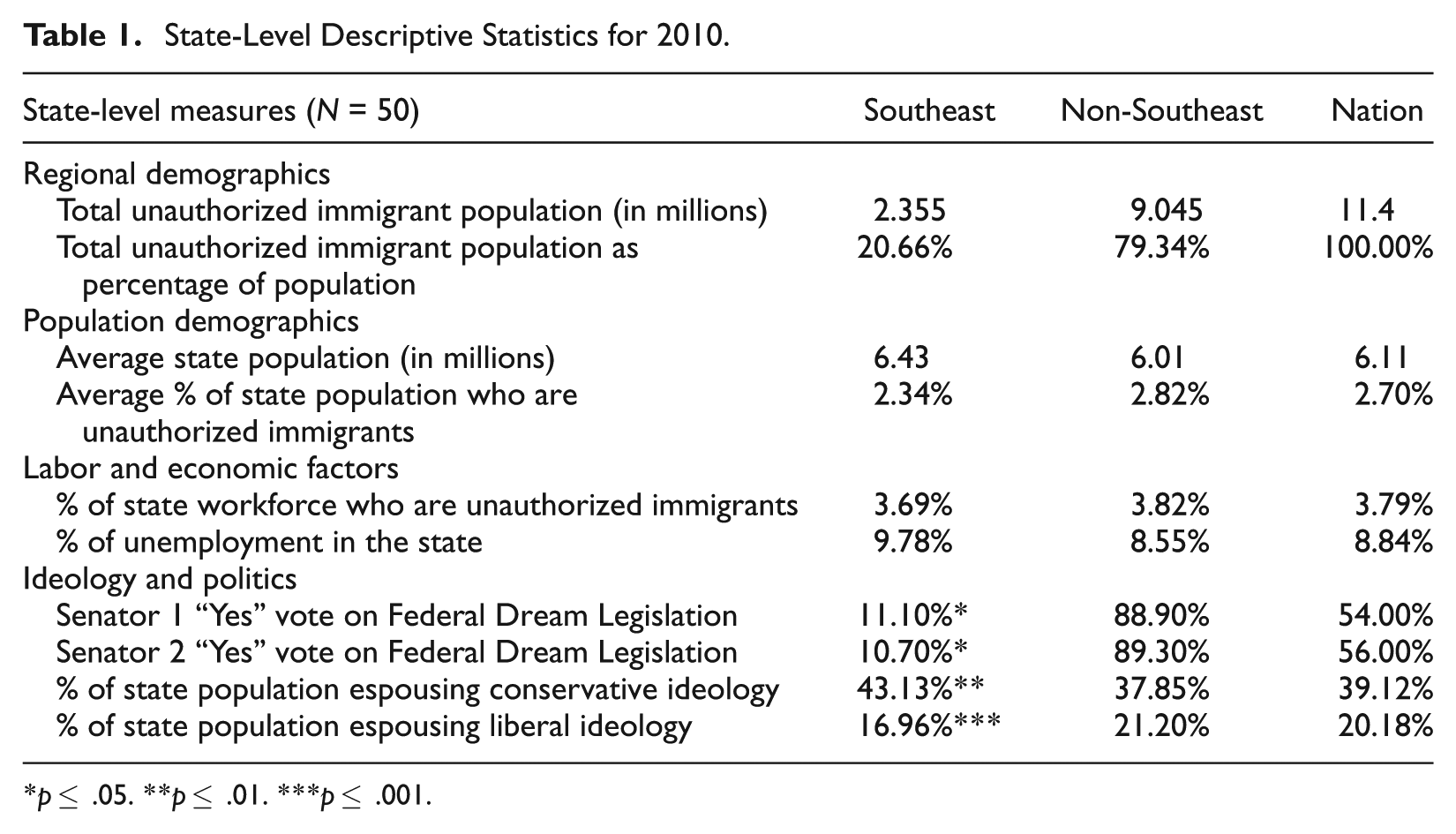
p≤ .05. **p≤ .01. ***p≤ .001.
With these trends, our campus collaborators were eager to presume that resistance to undocumented students was a function of journalistic bias. Consequently, we integrated their impressions into the analysis to interrogate their assumption; this consisted of examining case data to attempt to recover some of the power they were ascribing to the press. What we found was that for MSU, nearly 83.3% of the 42 articles reported in ways that elevated and focused on a frame of inclusion (Figure 2). For Cumberland, slightly more than one-fourth of the 173 articles asserted an inclusive frame of the events, and the vast majority of Cumberland articles were framed to depict neutrality offering binary portrayals of the issue contrasting inclusive and restrictive perspectives (Figure 2). These general data patterns helped campus collaborators move past and transform their thinking about the problems, which allowed them to be more receptive to collective dynamics of meaning making to which their campuses were subjected.
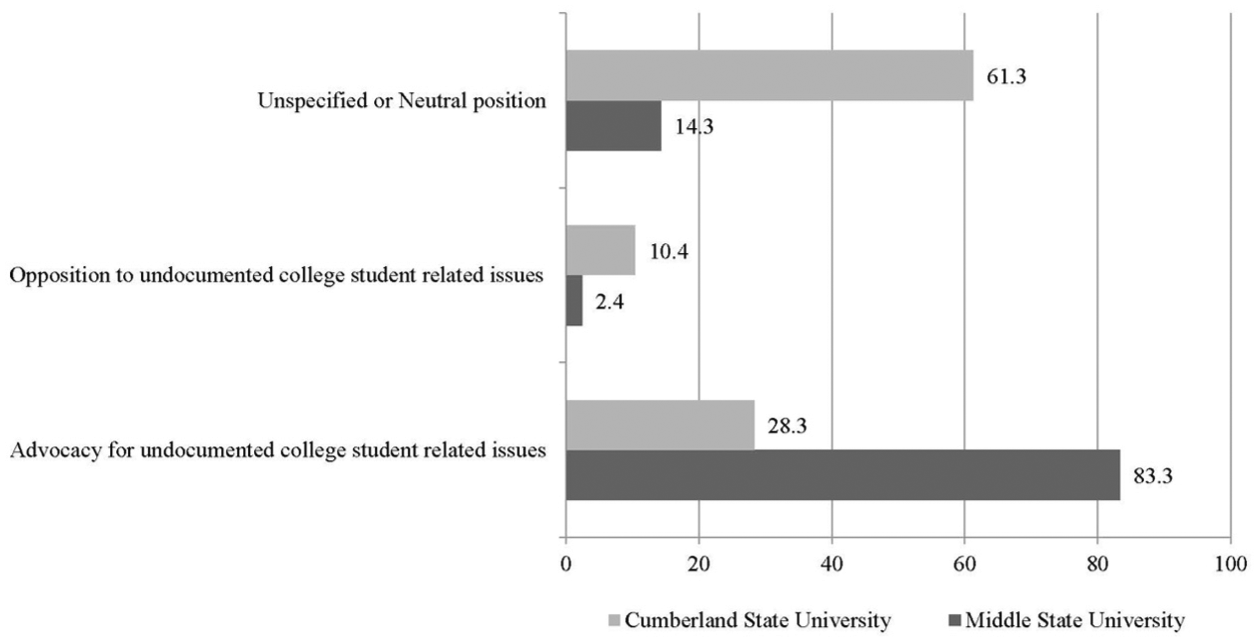
Patterns of media coverage in Southeast cases.
Findings: Privileged Meanings in Collective Processes
The cases demonstrate how issues facing undocumented college students emerged as matters of public conversation and contention. MSU became the centerpiece of an extensive discussion following the introduction of a piece of inclusive state legislation and MSU’s President’s subsequent advocacy for its passage; and the Cumberland discussion was prompted on account of an undocumented student’s arrest and impending deportation. Despite these different impetuses for activating public discourse, consistent patterns pointed to three collective frames that offer deeper insight to the localized cultural norms and to the availability of problem-solving strategies emphasizing: a definition of the matter through the lens of exposing professional administrative practices (diagnostic framing); a remedy to the issue that assumes greater state authority in the inner workings of higher education institutions (prognostic framing); and a justification for taking action that was prefaced on a rationale of meeting the local needs of the state (motivational framing).
Administrative Practices
The public narrative around the Cumberland student’s traffic arrest was immediately linked to her tuition price, “After her arrest it was discovered she was paying in-state tuition at [Cumberland] even though she’s an illegal immigrant” (Metro News, July 15, 2010). Cumberland’s administrative response to the public exposure of their tuition pricing focused on altering their practice of charging in-state tuition. This administrative action was pursued without any attempt at justification, suggesting the campus’s action was conditioned on the legitimacy associated with the normative view of in-state tuition pricing for undocumented students as being problematic.
Cumberland’s lack of resistant discourse was consistent with the administrative practices of college campuses in the Southeastern United States (SE); only 6.7% of campuses explicitly allow for in-state residency tuition pricing for undocumented students, whereas on average, 25% nationally do (Table 2). Likewise, the percentage of Southeastern U.S. campuses that explicitly deny in-state residency tuition pricing to undocumented students is double that of campuses nationally (45.3%, p≤ .001 SE, vs. 22.5% nationally). One in every five Southeastern U.S. campuses label undocumented students as “out-of-state” residents, which is twice that of campuses located elsewhere in the United States (21.6% SE vs. 11.0% outside of the SE; Table 2). Furthermore, less than one fourth of campuses in the Southeastern United States offer institutional financial aid to undocumented students (24.0%, p≤ .01) compared with 45.1% of campuses located elsewhere (Table 2). These data portray the financial aid and residency classification administrative norms surrounding undocumented immigrant students as particular to the localized context in which the case campuses were operating.
Percentage of Campuses With the Corresponding Admissions and Financial Aid Practices by Location.
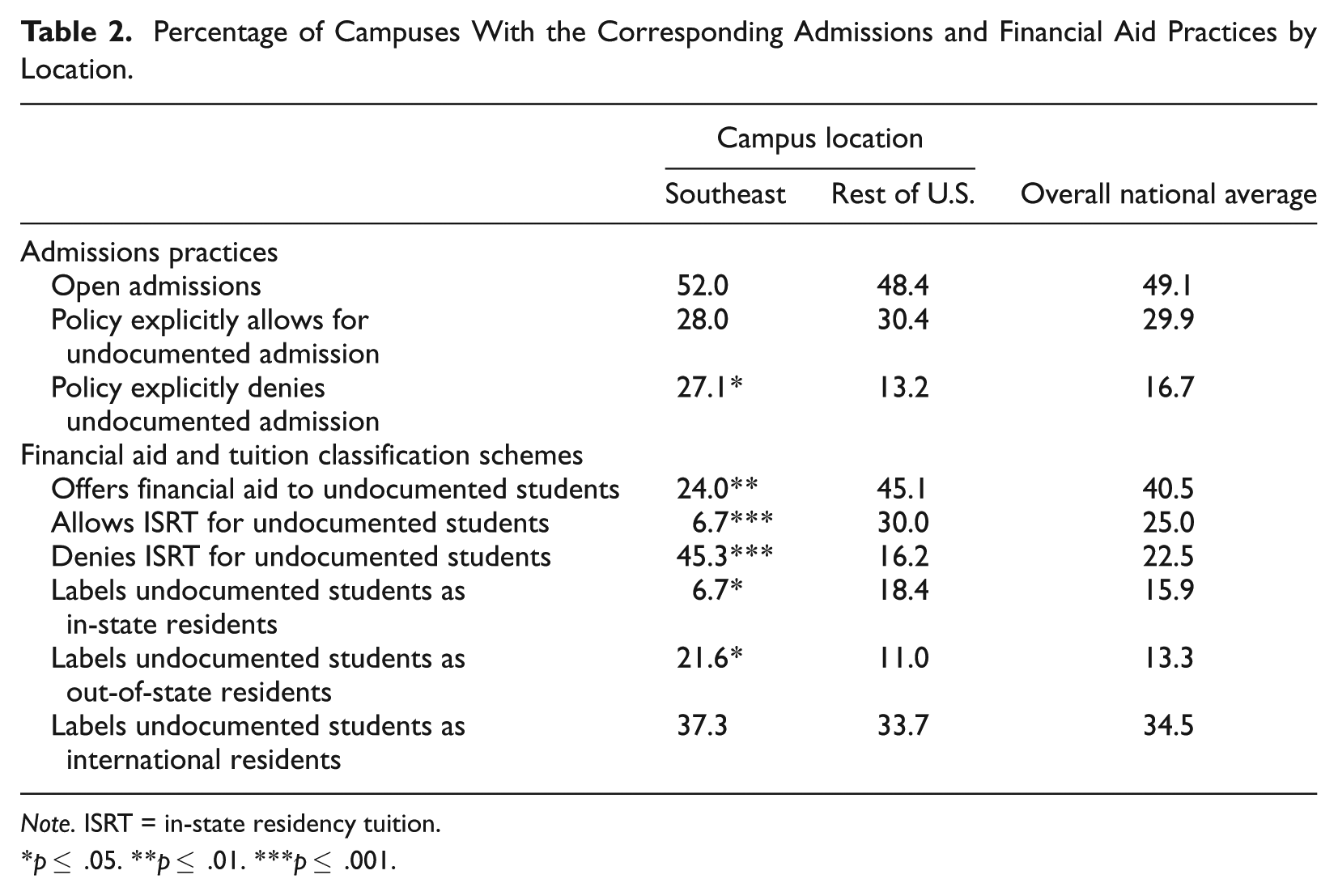
Note. ISRT = in-state residency tuition.
p≤ .05. **p≤ .01. ***p≤ .001.
Similar public accounts of the events at Cumberland framed the problem as one
complicated by administrative procedural details, where a reporter summarized: We suspect few [Cumberland county] residents had any idea that it was so
easy for those in this country illegally to enroll in our state’s
colleges . . . [Cumberland] requires college applicants to specify on
the application form whether they are U. S. citizens or not, a negative
answer to that question is not grounds for rejection. Rather, if they
meet other criteria and are enrolled, it merely means they must pay
out-of-state tuition costs, rather than the much cheaper in-state rate.
(City News, May 13, 2010)
This synopsis emphasizes the taken-for-grantedness of the localized idea that enrolling in college is “easy” for undocumented students on account of campuses providing limited scrutiny, and the idea that being a non-citizen is sufficient grounds for rejection from college admission. Diagnosing the problem as one produced by administrative error was directed to top campus administrators, presidents specifically. Shortly after the Cumberland student’s arrest, during a related student-sponsored lecture, a panelist remarked: “You know, [President of Cumberland] is a disgrace to the university system . . . for having admitted illegal immigrants, and of course it was a disgrace to have in-state tuition at [Cumberland]” (City News, October 18, 2010). As campus administrative practices became more familiar to the public, elected officials reified the same diagnosis of the issue; they viewed in-state tuition pricing as altogether inappropriate for undocumented students. One politician opined: “I think to anyone with even a slight bit of common sense it’s crystal clear how illegal immigrants are so easily gaming the system” (Metro News, May 22, 2010).
The public discourse regarding MSU was also closely tied to a narrow framing of the issues to administrative practices regarding admission of and tuition pricing for undocumented students. An investigative news article referenced that “illegal immigrants” can obtain “the cheaper in-state rate [and] out-of-state tuition is almost three times the in-state rate” (City Paper, April 10, 2005), by choosing to leave items blank, and having an in-state address. Article details revealed that MSU administrators did not verify applicant data, including citizenship. When asked, the admissions director stated: “How do you prove you’re a citizen? We don’t require a Social Security number. There’s really no way to track that” (City Paper). The admissions director’s public commentary further highlighted general administrative processes, stating “students omit putting their Social Security number on their applications because of worries over identity theft,” and “We don’t profile based on their last name” (City Paper). The manner in which MSU’s administrative practices were showcased in the newspaper included an implicit assumption that in-state tuition is accomplished by gaming the system, as was similarly suggested in the Cumberland data where a student would “leave blank” critical pieces of information with the suspect intention of obtaining cheaper tuition. Alternatively, however, the admissions director was communicating that the institution had been careful not to proscribe “illegal” or “undocumented” status to a student, or to act in a manner that fostered labeling. The discourse reveals a juxtaposition of the admissions director’s explanation of administrative practices that could foster greater inclusion for undocumented students, alongside a narrative that questioned the legitimacy of such efforts by drawing on the localized norms surrounding tuition pricing for undocumented students in the Southeastern United States.
As the situation evolved, MSU’s president publicly supported a bill granting
in-state tuition pricing to undocumented students who met specific state
residency requirements. However, the normative framing in the public discourse
characterized the matter as originating from MSU administrators not having
provided sufficient constraints. This interpretation is compatible with the
public discourse that included other local college officials in MSU’s state
emphasizing the legitimacy of their own practices, based in their ability to
prohibit the practices that were happening at MSU. For example, another
university’s president summarized: Some mistakenly believe [my university] offers scholarships and in-state
tuition to the children of illegal immigrants, but in fact there are
checks in the system to bar people who are in the country illegally from
receiving aid. “We do not give scholarships to illegal aliens.”
(Metro Paper, December 8, 2007)
The patterning of administrative action in the Southeastern United States, where undocumented students are/were systematically labeled as “out-of-state” residents at twice the percentage of campuses located elsewhere in the United States (Table 2), may reveal the infusion of administrative structure with a locally resonant cultural meaning. This finding parallels Perez’s (2009) and Wong et al.’s (2012) assertions that a student’s immigration status places categorical constraints on the individual’s ability to access structural and institutional resources. For example, even when immigrant students have resided in-state for their secondary education, Southeastern U.S. schools are categorically inclined to label such students as out-of-state residents; whereas, a nonimmigrant student with the same pattern of residency would likely be listed as an in-state student. Seemingly, the public discourse of each case suggests that the uncertainty around immigration takes precedence over other types of residency distinctions that are salient in administering public higher education and serving students.
Local Resonance
In both cases, public discourse was sustained by a motivational framing to connect immigration issues and college access with localized ambitions of benefitting the state. For MSU, campus leaders and some community members argued that the inclusion of undocumented students was an essential element for improving state economics. MSU’s president highlighted the importance of assisting undocumented students because of the state’s low ranking in the overall number of residents who possessed college degrees, and that “helping a student, any student, get a four-year degree is going to help the economy, it’s going to help the state” (National Paper, October 24, 2008). He also acknowledged the specific role of immigrants, noting that parts of the state “wouldn’t have been built without them” (Metro Paper, March 24, 2009), thus offering further motivations to act on behalf of families with a legacy of local contribution. The president also invoked local cultural references as motivation to generate some public support for classifying undocumented students as in-state residents, with remarks like, “These students . . . speak superb English with a [state] accent” (City Paper, March 23, 2009). Other presidents from the satellite campuses in the state followed MSU’s President’s lead by elaborating the relationship between local educational access and student achievement as a motivating rationale for being supportive of undocumented students’ educational aspirations. One noted: “We are wasting a valuable resource if we automatically turn away people that are really residents here and are contributing to the economy and paying taxes and we don’t treat them like we do other students” (City Paper, October 7, 2008; Metro Paper, October 10, 2008).
In both cases, community members’ affirmed the local salience of the issue, advocating that their community should be motivated to act to improve the educational and economic conditions: “For our community and our state to secure economic success, we must make the opportunity to pursue education as widely available as possible. We must develop a workforce capable of excelling in the knowledge-based economy” (Metro Paper, April 6, 2009). The MSU students’ youth lobbyists advocated that subsequent policy action would be justified because “education is the base for having better communities” (Campus Paper, January 1, 2009). Despite campus and community members emphasizing the local economic salience of the undocumented student issue, the 2010 data demonstrate that labor and economic factors related to immigration were not distinctive in the Southeastern United States (Table 1). This might contribute to the relative resonance of other prominent localized cultural meanings that drove the public discourse on the topic.
The motivational frame to support engagement and action on the issue became local
and self-referential to the conditions of the state and the South generally; a
president from one of MSU’s satellite campuses elaborated by comparing: The current plight of undocumented Hispanics to the plight of black
students in the South before integration. “How are you going to increase
the percentage of baccalaureate degrees if you’ve got a group of
citizens who’ve been denied an education?” [a college President] said.
“You realize that’s the reason that most of the Southern states are at
the bottom of the education spectrum anyway, right? Because they didn’t
educate African Americans through the years.” (City
Paper, October 7, 2008, and reprinted in Metro
Paper, October 10, 2008)
A state senator also deliberately invoked location as a rationale for motivating action for undocumented students by invoking the South’s segregation of schools up until the 1950s, acknowledging: “We know what happens in this state when we choose not to educate a group of folks. We’re living it,” [Senator] said. “We know how this movie ends” (City Paper, March 24, 2009).
At Cumberland, similar local rationales provided a motivational framework for inclusive campus action. The director of admissions at Cumberland offered locally salient population statistics in stating, “Hispanics now make up more than five percent of the state’s population” (Metro News, June 11, 2002). Press accounts covered outreach efforts by several state colleges, including Cumberland, “to raise awareness of higher education opportunities for Hispanics, even those who are undocumented” (Metro News). However, public discourse most prominently framed postsecondary opportunity for undocumented students as requiring local policy action to compensate for a lack of useful or appropriate federal policy (e.g., the shortcomings of federal systems to verify the immigration status of students), suggesting: “Washington is going to continue to ignore the need for more rigorous immigration enforcement” (Metro News, May 22, 2010).
Solution Seeking
The public discourse in the cases emphasized that a proper resolution would be
found through greater involvement on the part of the state-level higher
education authority. In the wake of events at Cumberland, several public calls
prompted the Board of the public university system to take remedial action and
assert its authority over university administrators. One news piece summarized: The ire that has been directed at [Cumberland] officials should be sent
to their bosses at the [Board]. If the higher authority (in this case,
the [Board]) is not going to make a big deal about adhering to
immigration laws, why should the lesser authorities (in this case, the
admissions office at [Cumberland] and other colleges)? (Metro
News, May 13, 2010, and reprinted Regional
News, May 14, 2010)
These calls were shaped and reinforced by actions of political and community groups vying for a chance to construct and resolve the issue politically through the tactic of filing legal complaints, suggesting that the state university system, and its authority, the Board, were in violation of the law by allowing an undocumented student to receive in-state tuition pricing. These impressions were supported in opinion pieces, where the Board was depicted as willfully violating its fundamental duty to resolve these matters. The sustained tone of this rhetoric eventually reinforced the Board’s decision to disallow the public institutions under its authority from admitting undocumented immigrant students.
At MSU, the willful intervention of the state’s top higher education administrator coincided with a renewed focus on undocumented students’ opportunities for postsecondary education in the anticipation of proposed legislation that would designate a clear path for in-state tuition pricing for students who resided in the state for a required amount of time before applying to the state’s public institutions. Specifically, “the head of the state’s [higher education office] issued an order requiring schools to ensure students receiving in-state tuition were legal residents” (National Paper, October 24, 2008). This mandate was enacted in the absence of any statute specifying how tuition pricing would proceed for undocumented students. The state’s Governor and his surrogates went on record affirming their view that in-state tuition pricing was “a legal issue far more than a philosophical issue” (National Paper), thus invoking the state’s fiduciary authority to reign in campuses that exceeded locally “acceptable” parameters of action. The state’s higher education office’s edict forced MSU and the other public campuses in the state to reclassify current students’ rates of tuition. Moreover, what was technically an ambiguous state policy environment as it related to undocumented students (no statues restricting or denying certain privileges) was in practice a restrictive environment that categorically eliminated in-state pricing for students who would otherwise meet the existing residency requirements.
In the two cases, public discourse revealed that solution seeking was constrained internally by the local state dynamics and formal channels of authority. Nowhere in the public discourse was the question raised about the appropriateness of the state applying its authority over campuses to enact categorical restrictions. Enlivening this point further, at MSU, a procedural work-around was fashioned rather than challenging the legitimacy of the local state dynamics. When MSU students had their tuition bills changed midstream as a consequence of the state board asserting oversight without a statutory prohibition, MSU’s president solicited private donations to cover the switch to out-of-state pricing.
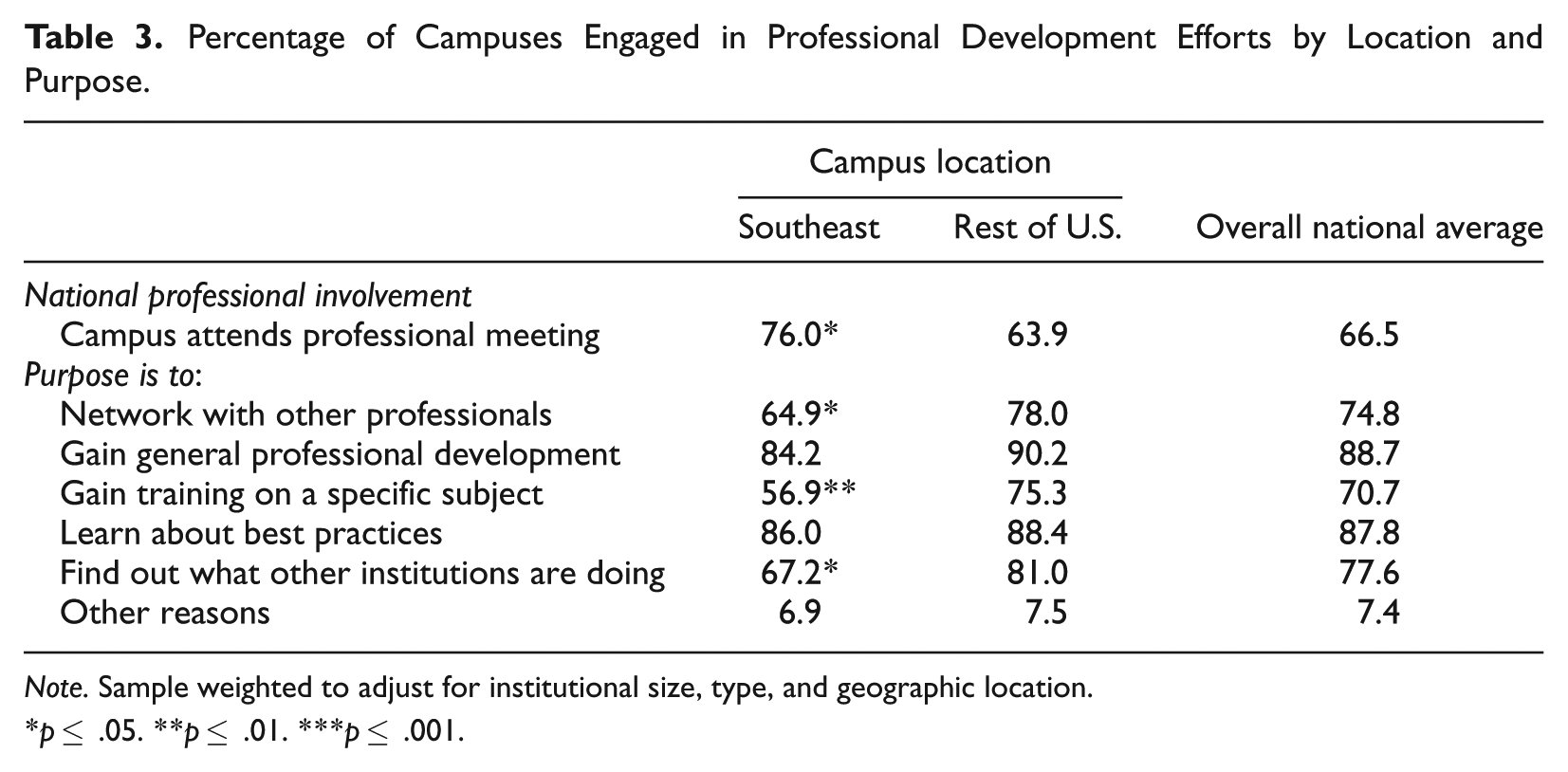
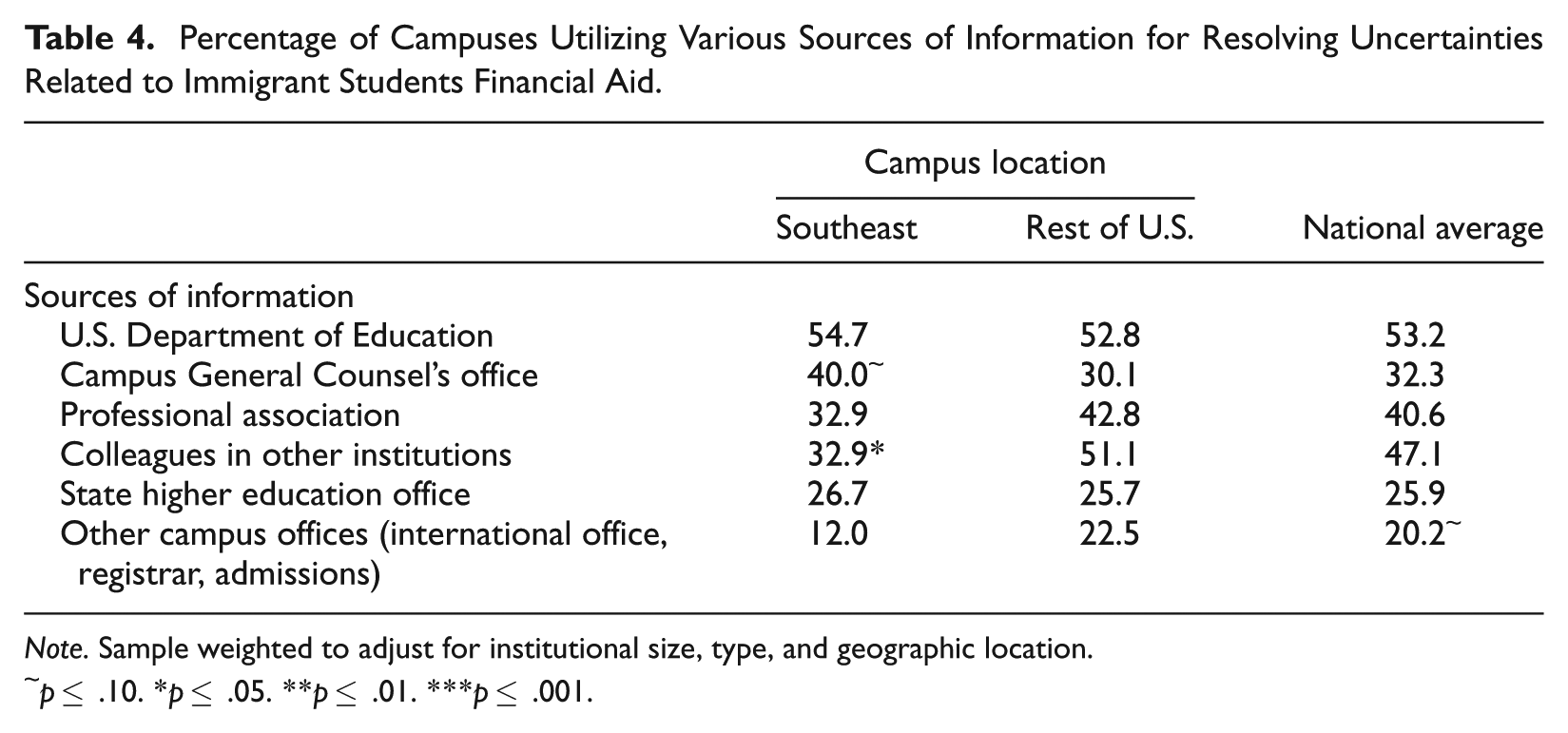
The fact that administrators were disinclined to reference external (non-Southeastern United States) examples or ideas in the public discourse comports with the self-reported data from campus administrators in the region, and how they approach their work. Southeastern U.S. staff fall 10 percentage points below the national average of 77.6%, with 67.2% of Southeastern U.S. campuses indicating they attend professional meetings as a way of finding out what other institutions are doing in terms of responding to administrative issues that they face (Table 3). Also, far fewer campuses (32.9% SE vs. 51.1% elsewhere, p≤ .05, Table 4) seek the assistance of colleagues at other colleges when looking for sources of support to determine how to resolve matters that emerge on account of students’ undocumented immigration status. It seems that Southeastern U.S. educational administrators may operate in contexts where the localized norm is to be disinclined to seek advice or input from other campuses or colleagues when attempting to find solutions for immigrant students’ financial aid.
Percentage of Campuses Engaged in Professional Development Efforts by Location and Purpose.
Note. Sample weighted to adjust for institutional size, type, and geographic location.
p≤ .05. **p≤ .01. ***p≤ .001.
Percentage of Campuses Utilizing Various Sources of Information for Resolving Uncertainties Related to Immigrant Students Financial Aid.
Note. Sample weighted to adjust for institutional size, type, and geographic location.
p≤ .10. *p≤ .05. **p≤ .01. ***p≤ .001.
With the salience of a locally derived solution seeking approach elaborated in the public discourse, and the general trend data about campus administrators in the Southeastern United States, our findings suggest that (a) there is a great deal of cultural clarity about how to proceed administratively thus rendering advice unnecessary (a case of normative community order having already taken hold); or (b) that guidance derived from nonculturally relevant sources (external campuses) does not meet the local legitimacy requirements (Schneiberg & Soule, 2005) necessary for subsequently resolving the contention/uncertainty with the recommendations that flow from the advice.
Discussion
Describing and naming the driving forces (Bidart et al., 2013) in the problem of access and opportunity for undocumented students in the Southeast was a major task in partnering with our campus collaborators. At the outset they did not feel that they could rightfully explain the problems in concrete ways that would help them cultivate commitment within the campus leadership structure. Our assessment aided them in providing tangible patterns to draw on, and nuanced details about how the community privileges certain meanings that maintain oppressive realities. It was the integration of direct feedback from campus practitioners at all stages, from initiation of the research problem, to data collection, to analysis, and reanalysis that allowed us to shape the research process and the understanding of the issues that helped practitioners find a voice toward transformation.
Our assessment revealed that the community order in the Southeast favors restriction as a legitimate path for structuring an institutional response to matters related to undocumented students. Markedly, fewer Southeastern U.S. campuses provide financial aid to undocumented students or offer in-state tuition pricing, and they are more inclined to deny in-state tuition pricing, to label undocumented students as out-of-state residents, and to exclude undocumented students from financial aid. Furthermore, the assessment granted access to a community discourse driven by a perception that framed allowing undocumented students to receive in-state tuition pricing, scholarships, or even admission eligibility as a contradiction, an even an injustice of sorts, fueled by administrative mismanagement. These findings are congruent with extant literature investigating the experiences of undocumented immigrant college students indicating that undocumented students are both perceived negatively in the South (Haubert & Fussell, 2006), and categorically restricted from accessing institutions or services because their immigration status dictates the conditions of their interactions with the authority body (Gonzales, 2009; Perez, 2009; Wong et al., 2012).
Bringing findings to our collaborators helped them understand their own complicit involvement in cultivating oppression. Our analysis showcased that educational leaders engaged in a sort of systematic self-censoring, whereby they were less inclined to publicly discuss alternative problem-solving strategies. Campus leaders’ choices not to deviate from the dominant cultural norms of their local context contributed to maintaining the status quo and potentially undermining any rhetoric that could support alternative viewpoints. When administrators in the cases did address the uncertainty created by undocumented students’ immigration status, they approached it as primarily a problem of the exploitation of the public benefit (blaming the undocumented student), or one of unwieldy/irresponsible university administrators (blaming the leadership and authority of the institution). These frames limited the solutions to only those that invited greater control and inspection of administrative processes for regulating compliance around admissions or in-state tuition pricing protocols. The exclusion of external ideas was so prevalent, that a less prestigious university’s president publicly disparaged MSU for its efforts to facilitate undocumented students’ success. The challenge of determining a campus response sparked a cycle of public discourse that revealed the same overriding assessment of “flawed” administrative practices, and prompted calls for the state’s higher education authority body to assert its power over organizational action. The patterns affirm that actionable responses are culturally proscribed and a possible manifestation of a larger and more systemic pattern of organizational administration in the Southeastern United States.
Contemplating Transformation
If administrators are going to resist the localized (and largely restrictive) local cultural pressures (Schneiberg & Soule, 2005), Southeastern U.S. campuses might be wise to actively diagnosis the problems by framing the injustices more pointedly in the public discourse. We observed administrators offering motivational frames for acting in a supportive manner toward undocumented students but they stopped short of engaging in an outright discussion of how undocumented students were being excluded by the system as it currently existed. These findings reflect the utility of a critical systemic perspective that Romm (2015) argues for, where knowing is an intervention that prompts more transformation. This was indeed the case with this assessment, our campus collaborators became able to observe their environment differently, thus overcoming a context that they were so steeped in that they found it difficult to describe, in precise ways, anything that could lead them to actionable ideas.
We connected our assessment process through direct outreach and continued communication with our campus collaborators, which is central to a transformational design. Practitioners and educational administrator colleagues were clear that they needed evidence that was particular to power dynamics unique to their location, in order to advocate in ways that resonated with superiors and within professional networks. While the process focused locally, it also opened practitioners to listening to ideas from colleagues working elsewhere; this was a transformation in and of itself. Particularly constraining for our campus collaborators was the finding that revealed the normative perspective (and oppressiveness) that undocumented students’ residency status should be classified outside the proverbial walls of the institution—either being proscribed by the state’s higher education authority or by state statute. In some ways, mid-level leaders’ awareness of the magnitude of the resistance they faced helped them to begin thinking about ways to serve in allied roles to their central leadership. Ultimately our collaboration with practitioners spurred the development of an online repository of resources for campus leaders in higher education who advocate for immigrant and undocumented student success (http://uleadnet.org). This assessment, and other similar research projects, have been translated into practical guides consisting of policy briefs, trend reports, quick reference sheets, webinars, workshops, and pro forma syllabi tailored to diverse institutional practitioners to help them critically examine their current policies and the complexity of these phenomena when searching for avenues to support undocumented students.
Conclusion
Broadly speaking, transformation manifests at the intersections, where the community of practice drives the questions and methods, where actions and discourses portray the overlap of controversy, meaning, and local culture, and where results meet those in positions to take action or to be advocates for student success. These intersections are illuminated by integrating qualitative and quantitative approaches from beginning to end of the project. Our assessment frames how organizational issues can be featured in MMR specifically, and how the focus on power that is paramount in transformative research designs prompts discovery about meaning-making processes that structure oppression and motivate social change. Situating the organization as the unit of analysis sets up conditions for community members and researchers alike to understand institutionalized processes where likeminded allies can work to exercise greater agency. Admittedly, while the organizational focus of the study was essential for understanding meaning systems that continue to produce oppression, the study did not engage the direct effects of mobilization coming from the undocumented students themselves. Future work in MMR and transformative methods should pursue multilevel processual analyses to devise additional strategies for capturing a broader range organizational-level phenomenon that speak to additional social change dynamics within contested institutional domains.
Footnotes
Declaration of Conflicting Interests
The author(s) declared no potential conflicts of interest with respect to the research, authorship, and/or publication of this article.
Funding
The author(s) disclosed receipt of the following financial support for the research, authorship, and/or publication of this article: This study was supported by a grant from the Ford Foundation to the National Forum on Higher Education for the Public Good at the University of Michigan.