







Abstract

In this editorial, we briefly review a series of worldviews that have been articulated to support mixed methods inquiry that emerged partially in response to the paradigm wars in mixed methods. While emphasizing their value, we also note the articulated philosophies largely reflect North American and European thought. Worldviews from other regions of the world remain noticeably absent from discussions about the philosophical underpinnings of mixed methods. After a sabbatical teaching and conducting research in China, one of us (MDF) experienced firsthand the potential and relevance for yinyang philosophy to render mixed methods understandable and to feel more accessible to an Asian audience. Here, we introduce how yinyang philosophy adds a novel perspective for unifying qualitative and quantitative research as a value-added “mixed methods whole.” Finally, we make a call for scholars around the world to consider their own unique cultural traditions and thinking, and introduce these worldviews to the global mixed methods community.
North American and European Worldviews Supporting Mixed Methods Research
The flurry of the Journal of Mixed Methods Research editorials about paradigms in the first decade of publication in the field of mixed methods (Molina-Azorin & Fetters, 2017) alludes to the critical role and value of the identification of philosophical underpinnings to ground the field and the dialogue continues (Shannon-Baker, 2016). Early on, pragmatism emerged as a worldview to unify the use of qualitative and quantitative work (Biesta, 2010; Feilzer, 2010; Morgan, 2007). In fact, in the 2003 Handbook on Mixed Methods in the Behavioral and Social Sciences, Tashakkori and Teddlie indicated that 13 major scholars in the field had embraced pragmatism as the foundational philosophy behind mixed methods research. Mertens (2007) led in the articulation of a transformative/emancipatory paradigm. Maxwell and Mittapalli (2010) provided critical realism as another option for unifying mixed methods. Hesse-Biber and Kelly (2010) illustrate application and fit of mixed methods and postmodernism. A dialectic stance introduced by Greene and Hall (2010) and further expounded as dialectical pluralism as a metaparadigm (Johnson, 2017) provided a position for utilizing different philosophical perspectives together. To this list, Schoonenboom (2017) has now added the performative paradigm, and Creswell and Plano Clark (2018) advance the use of different paradigms depending on the type of mixed methods design being employed by the researcher.
Despite the growing list and acceptance, there remains a shortfall. These philosophical stances are North American and European in origin, and other global philosophical articulations are noticeably missing. We believe for the field to advance as an international methodology, mixed methods needs a broader geography of thought.
Yinyang Philosophy
Yinyang philosophy provides an Asian framework that melds qualitative and quantitative approaches as mixed methods research. Yinyang thought emerged in the third century B.C.E. Wang (2012) explains how yinyang is not a substance, thing, or fixed essence, but a way of unfolding and coordinating multidimensional relationships that are complex and changing. Yinyang has its origins in nature. The moon is associated with yin  and the sun associated with yang
  . The interconnectedness of yinyang is dynamic and expressed conceptually through yinyang imagery. People around the world widely recognize the taijitu symbol (Figure 1). The symbol is comprised of two large tear-drop shapes, with the black representing yin and the white representing yang. Within the symbol, a small circle of yang (white) occupies the fullest area of the yin (black), and a small circle of yin (black) occupies the fullest area of yang. This symbolizes that within yin there is yang, and within yang there is yin. These two components might be seen as two fish chasing each other. The dynamism of yinyang symbolism illustrates change and complementarity and illustrates that everything participates in a universal ebb and flow. Importantly, the two components when brought together create a “whole” with different properties than the individual parts.
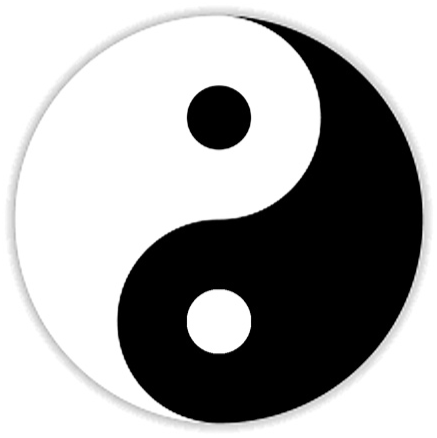
The taijitu symbol.
Yin associations include the moon, female, moist, subjective, soft, sensitive, and passive (Wang, 2012). These features would allude to important aspects of qualitative research such as being subjective, compassionate (soft), and sensitive (advocacy), that correspond with yin. These features are not emphasized in quantitative research. Yang associations include the sun, male, dry, objective, hard, harsh, and active (Wang, 2012). These features allude to characteristics of quantitative research, an emphasis on the objective, hard data, and harsh, and correspond quantitative research with yang. These features are not emphasized in yin.
As with other North American and European philosophies, yinyang’s relevance to mixed methods research can be considered from the dimensions of ontology, epistemology, axiology, methodology, and rhetoric (Creswell & Plano Clark, 2018). Philosophical dimensions can be thought of as the perspective the researcher brings to a study. Thus, a researcher embracing the yinyang philosophy from an ontological perspective would bring to the research investigation the importance of the duality of reality – both the subjective and objective. From an ontological perspective, yinyang philosophy accepts both a duality of reality as yin and yang as well as a singular reality. This thinking suggests that the qualitative and the quantitative are interconnected and indivisible. Yinyang thinking assumes that having both together is natural. Moreover, yinyang philosophy holds the two contrary approaches to be complementary. From an epistemological perspective, a researcher with a yinyang perspective would hold that both forms of knowledge are necessary for understanding the whole or oneness of a phenomenon. Epistemology asks the question: How do we really know something? In yinyang philosophy, we know something when we can understand the whole or oneness of a phenomenon. From an axiological perspective, a researcher accepting yinyang philosophy would value incorporating both the yin-qualitative and the yang-quantitative parts to understand a mutual interconnected whole. Yinyang is synthetic and emphasizes values such as balance, harmony, and wholeness. Within the yin-qualitative also exists the yang-quantitative, and within the yang-quantitative exists the yin-qualitative. From a methodological perspective, a researcher driven by yinyang philosophy would accept that one form may be more prominent depending on the application. But both forms of the yin-qualitative and yang-quantitative procedures can best be used to understand the whole. For mixed methods analysis, the dynamism and change, speak to (1) relevance of sequential and convergent designs or cyclical designs; (2) activities of transforming, data consolidation, and (3) identifying the qualitative within the quantitative, and the quantitative within the qualitative. From a rhetorical perspective, a researcher influenced by yinyang philosophy would support flexibility in presentation with component parts being balanced while also accepting that one component may be more emphasized than the other. Yinyang philosophy endorses illustrating both the qualitative yin and quantitative yang together for providing an integrated understanding of the whole, and seeking balance through cooperation. This thinking appeals to the writer to find the whole that is greater than the sum of the individual parts, a key characteristic of mixed methods integration. The features of yinyang philosophy as an Asian worldview support the embrace of mixed methods research. In writing, the resulting ‘whole’ often occurs in the discussion section when an interpretation is made, the writer’s metainferences.
A Call for Additional Philosophies for the Field of Mixed Methods Research
At multiple levels, yinyang philosophy resonates with and supports many aspects of mixed methods research. The taijitu symbol has already become associated in many venues taking place when mixed methods research discussions occur in China. After one of us (Fetters, 2018) presented “Yin and Yang: An Eastern Philosophy for Mixed Methods Made in Heaven” as an oral presentation in the Vienna Mixed Methods International Research Association meeting in 2018, he was approached by a Japanese attendee who exclaimed that mixed methods made much more sense to him based on the concept of ionmyō We maintain that—like all professionals, or perhaps even like all forms of work or even all forms of intentional human activity—social inquirers conduct their craft from within a particular understanding of the nature, texture, and role of social inquiry in society. It is simply not possible to conduct social inquiry without some self-understanding of what it means to be an inquirer, what the purpose and role of such activity is in society, and what a competent study looks like. For many inquirers this self-understanding may be implicit, but it is present nonetheless. (p. 121) (the pronunciation of yinyang in Japanese). This background about yinyang origins and philosophy, as well as fit with mixed methods from the perspectives of ontology, epistemology, axiology, methodology, and rhetoric provides an illustration for how other worldviews can be considered vis-à-vis mixed methods. We agree with Greene and Hall (2010), who state,
We anticipate there are additional worldviews and indigenous philosophies from Africa, India, and other parts of Asia, the Middle East, Central and South America. Some might relate to religiophilosophical dimensions of Buddhism, Hinduism, Islamism, Shintoism, or others. With articulation of these additional worldviews, these social inquirers will view and help the mixed methods community see mixed methods in a new light, and give legitimacy as a methodology to other cultures. The example of yinyang serves as a clarion call to mixed methods thinkers around the globe to explore the relevance of mixed methods to other philosophical stances beyond those of North American and European thought. We invite scholars around the globe to articulate additional philosophies and worldviews to further inform a diverse and integrated mixed methods enterprise. Additional worldviews of mixed methods will expand access of mixed methods to communities around the globe much more broadly and across different sociopolitical contexts. By providing additional visions for the integrated use of mixed methods research, we hope this call will help promote the scholarship that will further facilitate resonation and application of mixed methods in research and evaluation studies around the globe.
Footnotes
Acknowledgements
The authors express their appreciation to Robin Wang, R. Burke Johnson and John W. Creswell for scholarly discussions that have influenced our thinking about this topic.