







Abstract

Introduction
Recently, we have seen a notable increase in the publication of methodological reviews, now becoming established as a distinct type within the field of systematic reviews. These reviews, called methodological studies by Mbuagbaw et al. (2020), have been defined as a type of review “that describes or analyzes methods (design, conduct, analysis or reporting) in published (or unpublished) literature” (p. 2). They make it possible for researchers to examine methodological practice in a particular field or discipline, identify “questionable research practices” (Aguinis et al., 2023, p. 47), propose guidelines to improve these practices, minimize research waste, and develop and refine methods (Aguinis et al., 2023; Khalil & Munn, 2023; Martin et al., 2020; Mbuagbaw et al., 2020). Several recent publications have proposed guidelines for methodological reviews, including checklists for improving their use, clarity, and thoroughness (Aguinis et al., 2023); recommendations for their design and implementation (Martin et al., 2020); and a guide that highlights their key characteristics: what they are and how, when and why they are conducted (Mbuagbaw et al., 2020).
Howell Smith and Shanahan Bazis (2021) introduced the term mixed methods research systematic methodological reviews (MMR-SMR) to denote a type of review in which researchers “summarize trends in how MMR [mixed methods research] is used within a field or across fields using a pool of studies identified in a systematic way” (p. 547). Since the early-2010s, MMR-SMRs have been published in a broad range of disciplines and fields, including information science (Granikov et al., 2020), management (Molina-Azorin, 2011), nursing (Younas et al., 2019), population health research (Brown et al., 2015), and health services research (Lee et al., 2022). MMR-SMRs can contribute to these disciplines in a number of ways (Howell Smith & Shanahan Bazis, 2021; Kosiol et al., 2023; Molina-Azorin & Fetters, 2016). First, by describing current practice, reporting the prevalence of mixed methods studies in these disciplines, and highlighting new research trends, MMR-SMRs can encourage researchers to adopt a mixed methods approach in order to expand their methodological repertoire. Second, by providing evidence of problematic practices, such as failure to provide an explicit rationale for using mixed methods or to integrate quantitative and qualitative components, MMR-SMRs can provide researchers with methodological guidance in order to improve the quality of published studies. Finally, by demonstrating new applications for mixed methods research, MMR-SMRs can encourage adoption of innovative practices that will help research in a particular discipline to advance. These innovative practices may include new ideas such as hybrid forms of data collection and novel approaches to integrating quantitative and qualitative data and findings.
The two authors of this editorial have conducted MMR-SMRs, sometimes working jointly and sometimes with other colleagues, examining the uses of this approach in accounting (Lamprecht & Guetterman, 2019), palliative care (Fàbregues et al., 2020), and work–family research (Jaga & Guetterman, 2023). We have also conducted MMR-SMRs focused on the use of specific design types and tools such as mixed methods case study designs (Guetterman & Fetters, 2018), visual joint displays (Guetterman et al., 2021), mixed methods intervention designs (Fàbregues et al., 2022, 2023), and secondary analysis (Fàbregues et al., 2024). In conducting these reviews, we have encountered significant challenges, usually related to the unique characteristics of mixed methods research. In this editorial, we will summarize these challenges, even though the ones we describe are drawn from our personal experience and may not encompass all of the potential challenges researchers might face. However, as a result of discussions with colleagues, we believe that the challenges we report are relatively common. We also offer a series of recommendations on ways to address these challenges. From a practical and experiential standpoint, our recommendations complement the broader guidelines for conducting MMR-SMRs proposed by Molina-Azorin and Fetters (2016), and by Howell Smith and Shanahan Bazis (2021). We hope this editorial will raise general awareness of the pitfalls entailed in designing and conducting MMR-SMRs to help researchers identify solutions to overcome these challenges and conduct these types of reviews with greater efficiency and rigor.
Challenges in Designing and Conducting Mixed Methods Research Systematic Methodological Reviews and Ways to Address Them
Challenges in Conducting MMR-SMRs and Ways to Address Them.
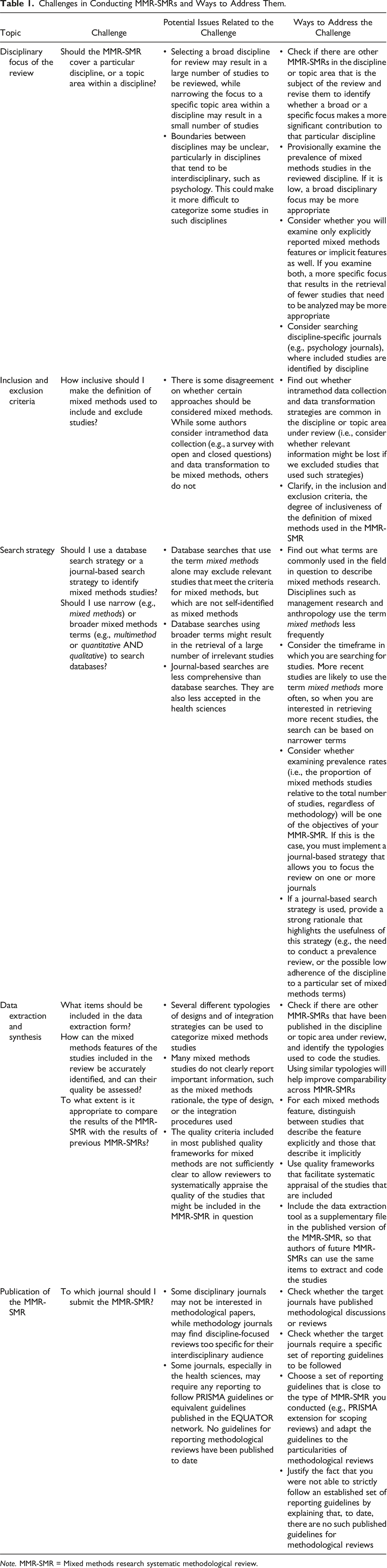
Note. MMR-SMR = Mixed methods research systematic methodological review.
Disciplinary Focus of the Review
MMR-SMRs are frequently disciplinary in scope, focusing on the prevalence and practice of mixed methods research within a particular discipline or on a topic area within a discipline. One important challenge for researchers conducting these reviews is to be able to determine how comprehensive the scope should be; whether to focus on a broad discipline or on a particular topic area. This decision is critical since, if the approach is a broad one, we will need to review more studies, and this in turn might limit our ability to examine them in depth. To address the challenge of comprehensiveness, authors can take several actions, such as considering the contribution that a broader or narrower disciplinary focus can make to the discipline under review, provisionally examining the prevalence of mixed methods studies in this discipline and determining the level of detail of the analysis that will be made of the included studies. Another related issue is the interdisciplinary nature of many disciplines in which topic areas and sub-disciplines are not easily categorized under a single discipline. For example, educational psychology includes elements of both education and psychology, so studies in this field often cannot be grouped easily under a single discipline. One solution to this issue would be to use a journal-based search strategy to identify the mixed methods studies to be reviewed. This strategy will involve searching a set of selected journals specific to the discipline or topic area that is the focus of the review. By assuming that the studies published in these journals belong to that particular discipline, we can avoid the challenging task of classifying studies by discipline and deciding on their inclusion and exclusion.
Inclusion and Exclusion Criteria
When we are defining inclusion criteria, a key decision will always be how inclusive the definition of mixed methods should be. There is a consensus in the literature on considering mixed methods as a type of research in which “elements of qualitative and quantitative research approaches” (Johnson et al., 2007, p. 123) are combined in order to enhance our understanding of a particular phenomenon. In this definition, the expression “qualitative and quantitative research approaches” is often interpreted as meaning that both the qualitative and quantitative data are collected separately and analyzed using qualitative and quantitative forms of analysis. However, some researchers prefer to adopt a more inclusive interpretation, and, in this case, the expression above could also refer to other ways of operationalizing mixed methods such as data transformation (i.e., analyzing qualitative data using quantitative methods and vice versa) or intramethod data collection (i.e., implementing a questionnaire with closed and open-ended questions or an interview with a nested instrument). Adopting a broader definition of mixed methods entails certain controversial issues, since not all members of the mixed methods community necessarily accept that data transformation and intramethod data collection should be considered mixed methods approaches. However, these approaches might have currency in the discipline or topic area we are reviewing, and, in that case, excluding them would be inappropriate.
Search Strategy
Researchers conducting MMR-SMRs face the challenge of choosing between two main strategies to search for the studies that are to be included in the review: the database strategy, which is common to most systematic reviews; and the journal-based strategy previously described. Both strategies entail issues that researchers must consider. When using a database strategy, we must ensure that relevant studies are not overlooked when we are conducting the search using the term mixed methods alone. This issue of the possibility of omitting relevant articles is more likely to crop up in disciplines like management or anthropology, where authors use alternative terms—such as quantitative and qualitative or multimethod—to describe their mixed methods studies. Similarly, this problem can arise in reviews where the time frame of the search includes studies that were published a few years ago, in which case, they are less likely to have been self-identified as mixed methods. Therefore, when we are determining which terms to include in a search query for an MMR-SMR, we must consider the prevalent approach to mixed methods in the discipline under review and the temporal scope of the search. Journal-based search strategies also present several limitations, the most significant being their lack of acceptance in fields such as the health sciences, where they are perceived as biased and lacking in rigor. However, a journal-based search strategy may be the most appropriate approach if our objective is to conduct a prevalence study, a rationale that will need to be convincingly explained in the MMR-SMR. This strategy can be implemented either by identifying mixed methods studies through a term-based search in the selected journals, or by reviewing all articles published in those journals in order to identify those that used a mixed methods approach (Molina-Azorin & Fetters, 2016).
Data Extraction and Synthesis
Several challenges may arise when extracting and synthesizing data from the included studies. One important challenge is developing the data extraction tool. In this step, we need to determine which of the several typologies available we will choose in order to identify and code the mixed methods features that we will analyze in each included study (i.e., rationale, design types, and integration procedures). In order to facilitate better comparison of the results of our MMR-SMR with those of previous MMR-SMRs, it is usually a good idea to use typologies that have already been used in those previous MMR-SMRs. Another challenge is that many mixed methods studies still do not provide a detailed and adequate reporting of the procedures that were used, making it difficult for reviewers to accurately characterize these procedures and, therefore, forcing them to infer such information. In these instances, when reporting the results of our MMR-SMR, we should distinguish between the explicit and implicit characteristics of the included studies. This distinction will provide readers with information regarding the status of clarity and transparency in the reporting of mixed methods studies in the discipline. Also, it may allow them to delineate which results of the MMR-SMR are derived from the information explicitly provided by the authors of the included studies and which are derived from the interpretation of the authors of the review. Another problematic circumstance is that we have not yet tested the reliability of most quality appraisal tools for mixed methods research. This limitation may be an issue if one of the objectives of the MMR-SMR is to appraise the methodological or reporting quality of the included studies. Authors may differently interpret the quality criteria included in the mixed methods quality appraisal tools, particularly when the wording of the criteria, or the instructions for their use, are not sufficiently clear. For example, while a common quality criterion is that there should be some form of quantitative and qualitative integration, most tools fail to provide sufficient information on how to assess such integration or how to distinguish between high and low degrees of integration quality. Therefore, authors should use quality appraisal tools that facilitate the systematic appraisal of the included studies. This more systematic appraisal will contribute to improving the transparency of the quality appraisal process and the comparability of the results of the appraisal across SMRs.
Publication of the Mixed Methods Research Systematic Methodological Review
Authors of MMR-SMRs face the challenge of deciding which journal to target to publish their review. One difficulty is that, in disciplines where methodological articles are less prevalent, publishing a review of this type might be difficult. Conversely, methodological journals may not be inclined to publish MMR-SMRs if they are too discipline-specific and may not appeal to a broader audience. Therefore, authors of MMR-SMRs must consider whether reviews of this type will be of interest to the journals in their discipline and they must ascertain whether similar methodological reviews have been published in the target journals. A second challenge related to publishing MMR-SMRs is that reporting criteria have not yet been sufficiently developed, either for methodological systematic reviews in general, or for specific types, such as MMR-SMRs. This can pose a difficulty when attempting to publish MMR-SMRs in disciplines in the health sciences, where authors are often required to adhere to consolidated reporting guidelines, such as the PRISMA guidelines. One potential solution to this issue is to select, from among the consolidated guidelines available, the one that most closely aligns with the type of review we have conducted and to choose only the criteria from these guidelines that are relevant to our MMR-SMR.
Advances in Mixed Methods that Address the Challenges of Conducting Mixed Methods Research Systematic Methodological Reviews
In this editorial, we have identified many of the challenges we have faced as authors when designing and conducting MMR-SMRs. Some of these—such as defining the scope of the review and establishing inclusion and exclusion criteria—are universal to most types of reviews, while others are unique to mixed methods research; for example, the determination of the search strategies used to identify mixed methods studies, or the characterization of the mixed methods procedures employed in the included studies. Current and future advances in the field will help to address some of the challenges unique to mixed methods.
For example, the increasing use of the term mixed methods to self-identify study design and methods is a naturally occurring advance seen in recent literature which reduces the risk that MMR-SMR authors might overlook some relevant studies when using this term alone in a search. However, this trend is manifest in only some fields, such as the health sciences, while in others, like anthropology and linguistics, authors continue to use different terms as a result of their disinterest in using “terminological labels for what they did [the authors]” (Maxwell, 2016, p. 21). Another natural advance is the continual improvement in the reporting quality of mixed methods studies, as evidenced by the results of several recent MMR-SMRs. This improvement in quality may be a result of the increasing availability of reporting guidelines, such as the Good Reporting of A Mixed Methods Study (GRAMMS) guidelines (O'Cathain et al., 2008), and of the greater attention to the topic of reporting currently seen in mixed methods textbooks and other literature. This is an advance that clearly benefits authors of MMR-SMRs because better reporting allows these authors to derive results and conclusions from explicit information instead of having to make inferences from implicit information, thus entailing a much lower risk of reaching inaccurate conclusions. Another positive natural advance is a greater consensus on typologies used to classify the information extracted and synthesized in the MMR-SMRs. The typologies of Creswell and Plano Clark (2018) and of Tashakkori et al. (2021) are often used to categorize mixed methods designs, while those of Fetters et al. (2013) and Pluye et al. (2018) are commonly used to categorize integration strategies. The prevalence of these typologies entails a risk of excluding less-used typologies, but the advantage of their widespread use is that it facilitates comparison of results across MMR-SMRs.
Other advances that will help address current challenges in conducting MMR-SMRs will require a more active involvement of the members of the mixed methods community. As we argued in a previous editorial (Guetterman et al., 2023), there is a need to improve the format of existing frameworks for mixed methods reporting. For example, although the GRAMMS guidelines developed by O’Cathain et al. (2008)—the reporting quality framework that is currently most widely used in MMR-SMRs—have many advantages in terms of their ease of use, they also have several limitations. One of these limitations is the lack of a clear definition of the meaning of the three categories—“yes,” “yes, but,” and “no”—used to assess the way the studies comply with each of the six criteria included in GRAMMS. This lack of clarity in definitions may lead authors to assign different meanings to these categories in different MMR-SMRs, and this ambiguity undermines the reliability of these guidelines, and the comparability of their results across MMR-SMRs. Fàbregues et al. (2022) have made a recent effort to address this issue by developing a rubric that operationalizes the meaning of the categories for each of the six GRAMMS reporting criteria. Other recent frameworks, such as the Rigorous Mixed Methods Framework, developed by Harrison et al. (2020) and recently expanded by Parey and Kutscher (2024), have also attempted to make the process of appraising reporting quality more systematic. However, neither of these frameworks has been formally validated and they were not generated through a consensus process among members of the mixed methods community, a much-needed step in the coming years (Guetterman et al., 2023).
Another issue that will need to be actively addressed in the future is the development of guidelines for reporting MMR-SMRs. Such guidelines would not only help authors of reviews of this type to adapt their reports to journal submission requirements but would also help to improve the comparability of results across MMR-SMRs. This latter initiative could be coordinated with other current initiatives to develop reporting guidelines for the more general area of methodological reviews, such as the MethodologIcal STudy reportIng Checklist (MISTIC) (Lawson et al., 2020), which has been in development since 2019, but has not yet been published in its final form.
Requirements for Mixed Methods Research Systematic Methodological Reviews Submitted to the Journal of Mixed Methods Research
JMMR has published several MMR-SMRs in its 18-year history, including Hart et al. (2009), Alise and Teddlie (2010), Molina-Azorin (2011), Boeije et al. (2013), van der Roest et al. (2015), McManamny et al. (2015), and Snodgrass et al. (2024). In addition, the journal published an editorial by Molina-Azorin and Fetters (2016) and an umbrella review by Howell Smith and Shanahan Bazis (2021), both of which focused on MMR-SMRs. Molina-Azorin and Fetters (2016) provided an overview of prevalence reviews published up to 2016 and described components that should be included in such reviews when submitted to JMMR. Howell Smith and Shanahan Bazis (2021) summarized current practices in conducting MMR-SMRs by identifying and analyzing 80 reviews published from 1989 to 2019. Those authors found a significant increase in the number of MMR-SMRs from 2010 onwards, which testifies to their current relevance. JMMR welcomes manuscripts reporting on MMR-SMRs, as long as they meet two main criteria.
First, MMR-SMRs submitted to JMMR must meet the high standards of methodological and reporting rigor that are specific to these types of reviews, some of which have been summarized by Molina-Azorin and Fetters (2016) and Howell Smith and Shanahan Bazis (2021). These standards include the need to define a clear methodological question, conduct a systematic and comprehensive search of mixed methods studies, provide a thorough interpretation of the review findings, and propose recommendations for improving mixed methods practice and reporting in the discipline or topic area under review. Second, given the interdisciplinary nature of the JMMR readership, the MMR-SMRs should make a contribution that goes beyond discipline-specific considerations. For example, SMRs may focus on a particular discipline, but at the same time be contextualized in a particular country or continent. The fact that no reviews have been carried out examining the use of mixed methods in a particular area would be of interest to JMMR, and the same applies to the opportunity to reflect on the relationship between the predominant culture and the practice of mixed methods in the particular area under examination. Similarly, examining the use in a particular discipline of a specific type of mixed methods design or procedure (e.g., intervention designs or joint displays) for which no reviews have been published to date in any discipline would be of great interest to the journal.
Authors planning to submit MMR-SMRs to JMMR must consult the Checklist of Mixed Methods Elements in a Submission to Advance the Methodology of Mixed Methods Research by Fetters and Molina-Azorin (2019) in order to ensure that their manuscripts meet the journal’s requirements for publication. Meeting those requirements will not only improve the methodological relevance of the MMR-SMR, but it will also guarantee that the review will make a significant contribution to the field of mixed methods.