







Abstract
The purpose of this investigation was to determine the relationship between university club and intramural sports participation and student grades via the American College Health Association National College Health Assessment (NCHA) survey, while controlling for confounding variables. Data were obtained from the NCHA for the fall 2008, spring 2009, fall 2009, and fall 2010 time periods. The original sample included 178,091 respondents. After inclusion and exclusion criteria, the final analytic sample included 85,316 respondents. Multinomial logistic regression was used to evaluate the role of participation in club and/or intramural sports on self-reported grade averages. Analyses were adjusted for significant covariates that have been identified as potentially impacting academic success. In general, sport participants were more likely to report higher grade averages than nonparticipants. The strongest relationships were found for participants of club sports. Future research should investigate relationships between club and intramural sports and other indicators of academic success.
Keywords
Physical activity (PA) has been found to have numerous benefits for both physical and mental health. Being physically active can decrease the risk of many chronic diseases such as cardiovascular disease, type 2 diabetes, stroke, various cancers, and even reduce the risk of premature death (Blair & Morris, 2009; Haskell, Blair, & Hill, 2009; Reiner, Niermann, Jekauc, & Woll, 2013). PA has also been found to improve mental health indicators. For instance, PA has been shown to reduce anxiety and stress, improve mood and self-esteem, and increase cognitive functioning (DiLorenzo et al., 1999; Etnier et al., 1997; Harvey, Hotopf, Overland, & Mykletun, 2010). Unfortunately, research has also shown that as age increases, PA levels decline (Sallis, 2000). These declines occur most rapidly when individuals transition from late adolescence to early adulthood, which, for many, encompasses the college years (Douglas et al., 1997; Kwan, Cairney, Faulkner, & Pullenayegum, 2012; Zick, Smith, Brown, Fan, & Kowaleski-Jones, 2007). However, for some, early adulthood can be used to establish PA patterns that will lead to health benefits later in life (U.S. Department of Health and Human Services, 2000). Moreover, research has shown that PA levels during college can have an impact on PA levels later in life (Forrester, Ross, Hall, & Geary, 2007; Sparling & Snow, 2002). With the college time period being an important transition from late adolescence to adulthood, support for the promotion of PA on college and university campuses has grown (Leslie, Sparling, & Owen, 2001).
There are various avenues for PA on college campuses, but one avenue that is easily accessible for most students is through services and facilities provided by recreational sports departments (Cooper & Theriault, 2008). Recreational sports departments provide a variety of options for PA including intramural and club sports, group fitness classes, fitness facility access, and open recreation areas (e.g., basketball courts, volleyball courts, swimming pools). Although campus administrators view health and PA as important, they may see it as secondary to student academic success; therefore, recreational sports departments are under pressure to justify the need for their services and obtain funding to support opportunities to benefit students (Haines, 2001).
Student academic success is commonly defined by grade point average (GPA), persistence, and retention (Seidman, 2005). Although academic success is oftentimes defined by these variables, Astin’s (1999) theory of involvement found it also depends on the connection and involvement that a student makes with his or her university. This theory centers on five basic postulates: (1) involvement in the investment of physical and psychological energy in objects, (2) involvement occurs along a continuum, (3) involvement is both quantitative and qualitative, (4) student learning and professional development is directly proportional to involvement quantity and quality, and (5) effectiveness of educational policy and practice is directly related to the capacity for student involvement (Astin, 1999). Recreational sports participation is one example of an extracurricular activity that students have access to on college campuses. Furthermore, recreational sports fits into this theory as it aligns with most of the postulates that Astin presents: Recreational sports participation is both a physical and psychological investment of energy (Postulate 1); participation can occur at different levels on a continuous scale, and it can be measured for level of involvement in most cases (Postulate 2); and we can quantify participation as well as ask students to provide qualitative insight into the benefits of participation (Postulate 3). Many university recreation departments have missions focused on health-related benefits, improvements in quality of life, and personal development for students (Ellis, Compton, Tyson, & Bohlig, 2002). Current investigations have focused on the contributions of recreational sports services to students’ learning experiences.
Various investigators have studied the relationship between academic success and campus wide recreational sports participation, including fitness center use, and club and intramural sports participation as a whole. Results have shown a small but positive relationship between recreational sports participation and several student success indicators including retention (Belch, Gebel, & Maas, 2001; Danbert, Pivarnik, McNeil, & Washington, 2014; Forrester, 2015; Henchy, 2011; Huesman, Brown, Lee, Kellogg, & Radcliffe, 2009; Kampf & Teske, 2013; McElveen & Rossow, 2014; Windschitl, 2008), GPA (Belch et al., 2001; Danbert et al., 2014; Huesman et al., 2009; Kampf & Teske, 2013; McElveen & Rossow, 2014; Windschitl, 2008), credits completed (Belch et al., 2001; Danbert et al., 2014; Windschitl, 2008), class standing (Danbert et al., 2014), graduation rates (Huesman et al., 2009), and various social factors such as sense of belonging (Henchy, 2011; Miller, 2011). Although results are positive, many studies focus on recreational sports participation in general, and more specific avenues of recreational sports participation have yet to be thoroughly investigated.
In particular, there is a gap in the literature concerning the relationship between club and intramural sports participation and college student academic success. Kampf and Teske (2013) investigated club sport participation and retention and found that even after controlling for other variables that can impact retention, such as high school GPA, students who participated in club sports were more than twice as likely to enroll at the university the following year than nonparticipants. McElveen and Rossow (2014) examined the relationship of intramural sports participation and academic indicators in first-year students. The investigators found no significant differences in GPAs between students participating in intramural sports at frequencies of either moderate- or high-level participation, compared to nonparticipants. However, they did find an almost 6% higher retention rate in students who played intramural sports compared to those who did not (McElveen & Rossow, 2014). While these studies found some positive relationships among club and intramural sports participation and academic success, only one group controlled for confounding variables (Kampf & Teske, 2013), and both assessed only one institution. With few studies addressing the relationship between club and intramural sports participation and academic indicators, more research is needed on larger, nationally representative samples with more control of potential confounding variables. In a time of scrutiny when it comes to budgets (Kampf & Teske, 2013), limited generalizability of current literature can generate difficulties for recreational sports departments when providing justification for expenses of facilities and services.
The purpose of this investigation was to determine the relationship between university club and intramural sports participation and student grades via the American College Health Association (ACHA) National College Health Assessment (NCHA) survey, while controlling for confounding variables. We hypothesized that students reporting participation in club and/or intramural sports would report higher grades than students who do not participate in either.
Method
Survey
Data used for this study were collected through the ACHA/NCHA during the fall 2008, fall 2009, spring 2009, and fall 2010 semesters. Spring 2010 data were not available to us. This survey began as the NCHA-I in the spring 2000 and was updated to the NCHA-II in fall 2008. There are six primary components to this survey, which include (1) health, health education, and safety; (2) alcohol, tobacco, and other drug use; (3) sexual health; (4) mental and physical health; (5) impediments to academic performance; and (6) demographic characteristics (ACHA, 2017). In total, 219 different institutions that ranged from community colleges to research institutions with student bodies from 2,500 to more than 20,000 students participated during this time frame.
Study Participants
Study participants were anonymous responders (N = 178,091) to the NCHA during the semesters specified above. Approval from the institutional review board was not necessary since the data were de-identified and thus not considered to be human subjects’ research. Exclusion criteria included students reporting: (1) collegiate varsity level sport participation; (2) an age outside of the normal college age range of 18–24 years old (Institute of Education Sciences, National Center for Education Statistics, 2016); (3) self-report of a disease or disorder that could impact academics or ability to participate in sport or PA such as ADHD (DuPaul, Weyandt, O’Dell, & Varejao, 2009), chronic illness (e.g., cancer, diabetes, autoimmune disorders; Davis, 2012), deaf/hard of hearing (National Council on Disability [NCD], 2003), learning disability (Cortiella & Horowitz, 2014), mobility/dexterity disability (NCD, 2003), partially sighted/blind (Scott, 2009), or speech or language disorder (NCD, 2003); or (4) missing data for variables of interest. Inclusion criteria included being a full-time, undergraduate student with a body mass index (BMI) greater than or equal to 12 kg/m2. The final analytic sample after exclusion and inclusion criteria included 85,316 respondents.
Exposure Variable
The exposure variable was sport participation, which was assessed via the following question, “Within the last 12 months, have you participated in organized college athletics at any of the following levels? Varsity, club sports, intramurals.” Participants responded with a “yes” or “no” answer to each level of sport. Two variables of interest were developed from this question: (1) sport participation in general (participant or nonparticipant in club or intramural sports) and (2) sport participation stratified by sport type (club sports, intramural sports, or both sports). These variables were compared to the reference group of nonparticipants.
Outcome Variable
The outcome variable of academic success was self-reported grade average assessed via the following question, “What is your approximate cumulative grade average? A, B, C, D/F, or N/A.” Because they represented a very small percentage of respondents, those reporting “D/F” (0.6%) or “N/A” (3.2%) were removed for statistical purposes.
Covariates
Several covariates were also assessed due to their impact on academic success variables: semester the survey was completed, race (DesJardins, Ahlburg, & McCall, 2002; Reason, 2009; Zheng, Saunders, Shelley, Mack, & Whalen, 2002), gender (DesJardins et al., 2002; Reason, 2009; Zheng et al., 2002), year in school (Reason, 2009), current residence (Nowack & Hanson, 1985), work hours per week for pay (Dundes & Marx, 2006), stress level (Pritchard & Wilson, 2003), diagnosed depression (Boynton Health Service, 2007), cigarette use (Boynton Health Service, 2007), and substance use (alcohol and/or marijuana; Pritchard & Wilson, 2003; Wolaver, 2002), campus size (Lower, Turner, & Petersen, 2015), and university type (public/private; Lower et al, 2015).
The majority of covariates were recategorized by combining response categories of the questions for statistical purposes. Race was analyzed as “White” and “non-White.” Gender included “male” or “female”; there was a small response rate (0.1%) of “transgendered” who were not analyzed. Current residence was dichotomized into “campus residence hall” or “other.” Work hours per week for pay was analyzed as “<20 hr” or “≥20 hr.” Stress level was categorized as “none/less than average,” “average,” and “more than average/tremendous.” Diagnosed depression, cigarette use, and substance use variables were restructured and evaluated as “yes” or “no” variables.
Statistical Analyses
Statistical analyses included the calculation of percentages for all variables of interest. Multinomial logistic regression was used to evaluate the role of participation in club or intramural sports on the likelihood that a student would report an “A” versus “C” grade average or a “B” versus “C” grade average. Those reporting a “C” grade average were used as the referent group. Those reporting no participation in any sport category (nonparticipants) were also used as a referent group as comparisons were made between participants and nonparticipants. Sport participation variables were evaluated in both unadjusted and adjusted models, first as a dichotomous variable of participant versus nonparticipant and then as a variable stratified by category of sport participation (club sports, intramural sports, both sports) versus nonparticipants. Chi-square analysis was used to identify significant variables for adjusted models. All analyses were conducted in SPSS Version 23.0 statistical software. An alpha level of p < .05 was used to indicate statistical significance. Statistical assumptions for all analyses were met.
Results
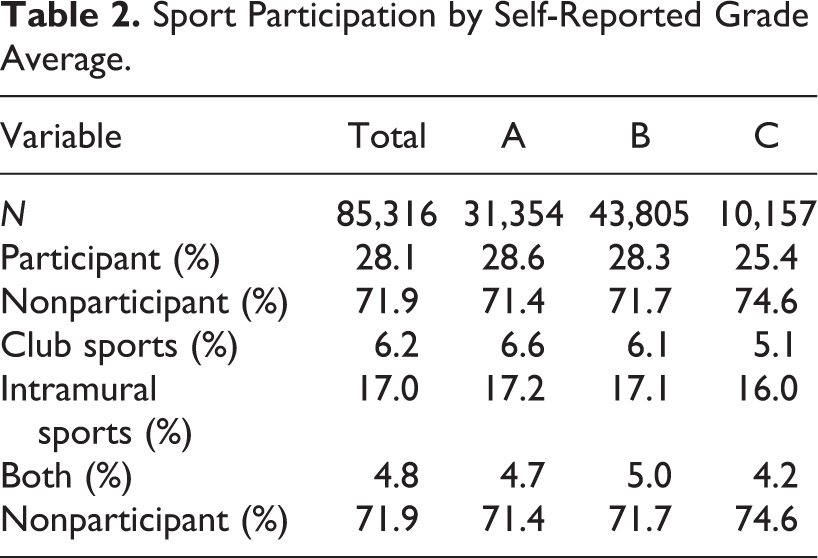
The analytic sample (N = 85,316) had an average age of 19.9 ± 1.5 years, BMI of 23.7 ± 4.7 kg/m2, and was primarily White (74.5%) and female (67.7%). In total, 28.1% of respondents reported participating in either club or intramural sports. When sport participation was further analyzed, the majority of these respondents participated in intramural sports (17%), followed by club sports (6.2%), and both sports categories (4.8%). All covariates assessed were significantly related to self-reported grade average (p < .05). Respondents participating in the survey in fall 2008 reported higher grade averages than respondents participating in fall 2009, fall 2010, and spring 2009, χ2(6, N = 85,316) = 147.57, p < .001, V = .03. Furthermore, the following characteristics were associated with reporting higher grade averages: being female, χ2(2, N = 85,316) = 208.11, p < .001, V = .05; non-Hispanic White, χ2(2, N = 85,316) = 1,807.72, p < .001, V = .15; living on campus, χ2(2, N = 85,316) = 618.197 p < .001, V = .09; no prior cigarette use, χ2(2, N = 85,316) = 921.12, p < .001, V = .10; no prior substance use, χ2(2, N = 85,316) = 451.46, p < .001, V = .07; never having been diagnosed with depression, χ2(2, N = 85,316) = 30.77, p < .001, V = .02; reporting no/less than average stress, χ2(4, N = 85,316) = 127.68, p < .001, V = .03; being an upperclassman, χ2(6, N = 85,316) = 97.27, p < .001, V = .02; working less than 20 hr per week, χ2(2, N = 85,316) = 596.49, p < .001, V = .08; attending a private campus/university, χ2(2, N = 85,316) = 1,779.39, p < .001, V = .14; and attending a smaller university/campus, χ2(8, N = 85,316) = 399.99, p < .001, V = .05. Tables 1 and 2 depict covariate variables and sport participation by self-reported grade average. Table 3 depicts covariate variables by sport participation.
Demographic Variables by Self-Reported Grade Average.
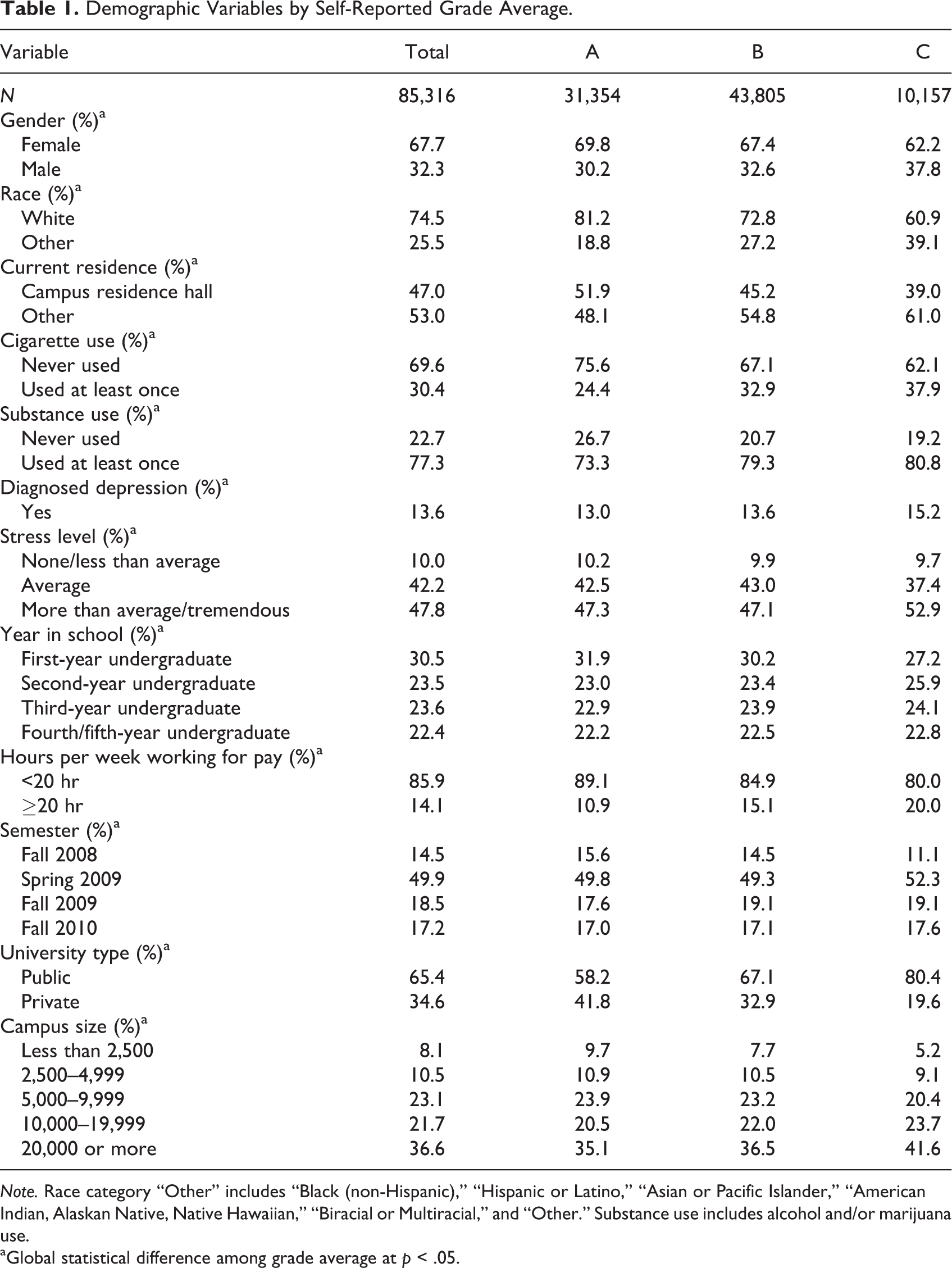
Note. Race category “Other” includes “Black (non-Hispanic),” “Hispanic or Latino,” “Asian or Pacific Islander,” “American Indian, Alaskan Native, Native Hawaiian,” “Biracial or Multiracial,” and “Other.” Substance use includes alcohol and/or marijuana use.
aGlobal statistical difference among grade average at p < .05.
Sport Participation by Self-Reported Grade Average.
Demographic Variables by Sport Participation.
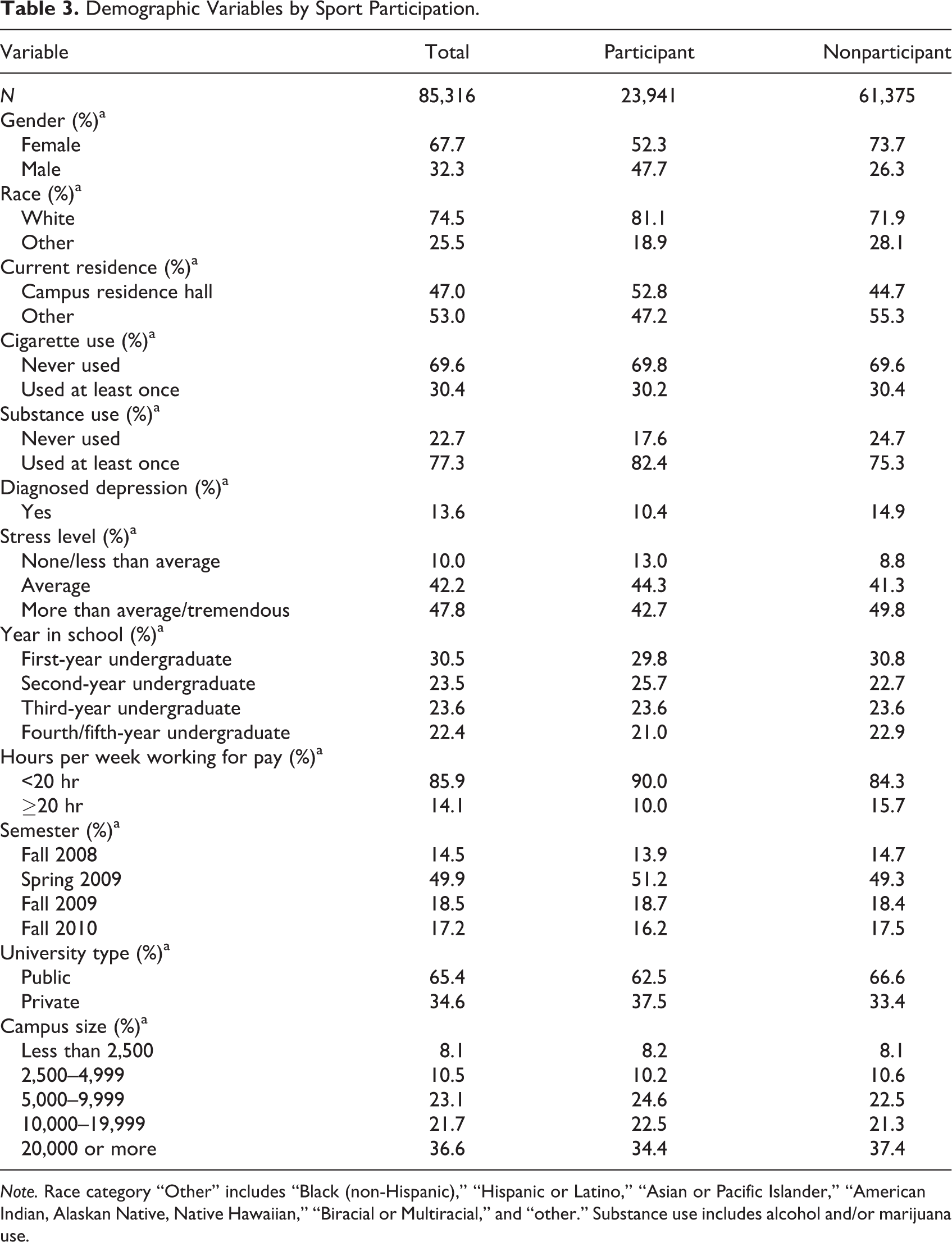
Note. Race category “Other” includes “Black (non-Hispanic),” “Hispanic or Latino,” “Asian or Pacific Islander,” “American Indian, Alaskan Native, Native Hawaiian,” “Biracial or Multiracial,” and “other.” Substance use includes alcohol and/or marijuana use.
As seen in Table 4, respondents who reported any sport participation (either club and/or intramural sports) were 18% more likely to report an A versus C average, odds ratio (OR) = 1.18, 95% CI [1.12, 1.24], and 16% more likely to report a B versus C average than nonparticipants, OR = 1.16, 95% CI [1.11, 1.22]. After adjusting for significant covariates (race, gender, year in school, current residence, work hours per week for pay, stress level, diagnosed depression, cigarette use, substance use, university type [public/private], and campus size), participants of club or intramural sports were 8% more likely to report a B versus C average than nonparticipants, adjusted odds ratio (aOR) = 1.08, 95% CI [1.03, 1.14]. ORs were no longer significant for A versus C average comparisons as the 95% confidence intervals (CIs) included 1.0.
Odds Ratios for Self-Reported Grade Average by Sport Participation.
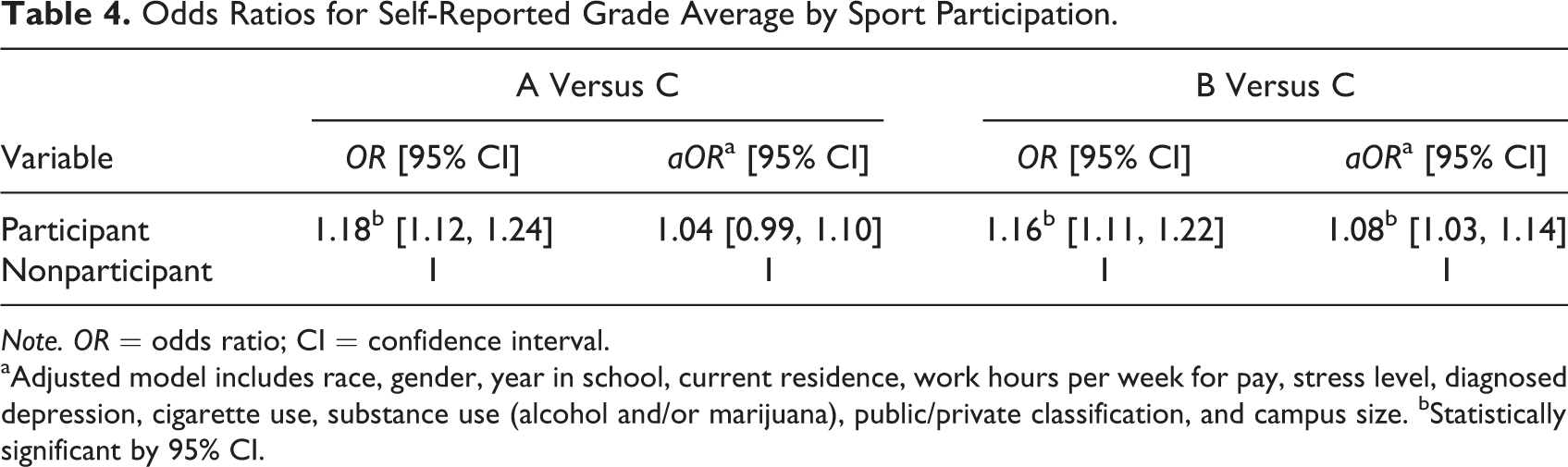
Note. OR = odds ratio; CI = confidence interval.
aAdjusted model includes race, gender, year in school, current residence, work hours per week for pay, stress level, diagnosed depression, cigarette use, substance use (alcohol and/or marijuana), public/private classification, and campus size. bStatistically significant by 95% CI.
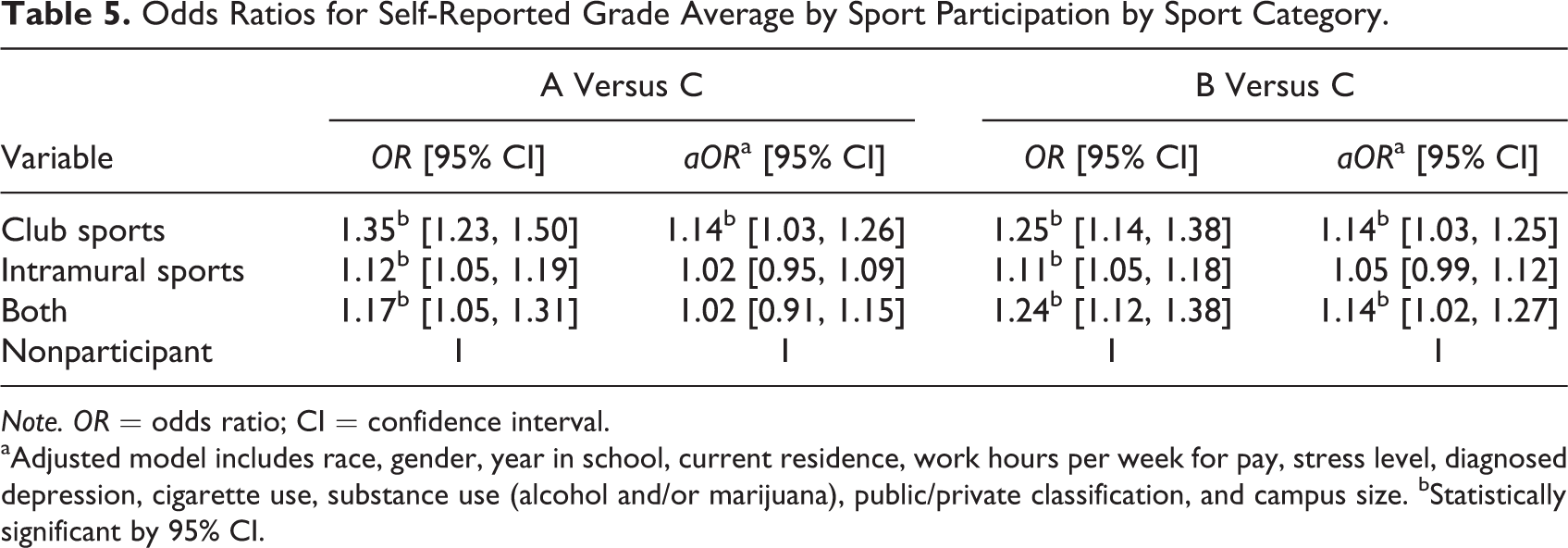
Results for sport participation by sport category can be found in Table 5. When stratifying participants by category of sport participation (club sports, intramural sports, both sports), club sports participants were 35% more likely to report an A versus C average, OR = 1.35, 95% CI [1.23, 1.50], and 25% more likely to report a B versus C average than nonparticipants, OR = 1.25, 95% CI [1.14, 1.38].
Odds Ratios for Self-Reported Grade Average by Sport Participation by Sport Category.
Note. OR = odds ratio; CI = confidence interval.
aAdjusted model includes race, gender, year in school, current residence, work hours per week for pay, stress level, diagnosed depression, cigarette use, substance use (alcohol and/or marijuana), public/private classification, and campus size. bStatistically significant by 95% CI.
Intramural sports participants were 12% more likely to report an A versus C average, OR = 1.12, 95% CI [1.05, 1.19], and 11% more likely to report a B versus C average than nonparticipants, OR = 1.11, 95% CI [1.05, 1.18]. Participants of both club and intramural sports were 17% more likely to report an A versus C average, OR = 1.17, 95% CI [1.05, 1.31], and 24% more likely to report a B versus C average than nonparticipants, OR = 1.24, 95% CI [1.12, 1.38].
After adjusting for all covariates, club sports participants were 14% more likely to report an A versus C average, aOR = 1.14, 95% CI [1.03, 1.26], and 14% more likely to report a B versus C average than nonparticipants, aOR = 1.14, 95% CI [1.03, 1.25]. Participants of both sports were 14% more likely to report a B versus C average than nonparticipants, aOR = 1.14, 95% CI [1.02, 1.27]. ORs were no longer significant for intramural sports participants for either A or B average versus C average comparisons and participants of both sports for A versus C comparisons as the 95% CIs included 1.0.
Discussion
The purpose of this study was to determine the relationship between university club and intramural sports participation and student grades via the ACHA/NCHA survey, while controlling for confounding variables. Overall, the results of this study support the proposed hypothesis that students reporting participation in club and/or intramural sports report higher grade averages than students who do not.
When considering sport participation in general, results were mostly positive. Participants of either club or intramurals sports were more likely to report an A versus C grade average and more likely to report a B versus C average than nonparticipants. After adjusting for significant covariates, participants of either club or intramural sports were more likely to report a B versus C average than nonparticipants, but significance was lost in the A versus C average comparison. Upon investigating participants of each sport type separately (i.e., club sports participants, intramural sports participants, participants of both), mixed results were found after adjusting for significant covariates. Club sports participants were more likely to report higher grade averages in both unadjusted and adjusted models, but intramural sports participants and participants of both sports did lose significance in either one or both grade average models when adjusting for covariates. With the current gap in the literature concerning the relationships between academic success and club and intramural sports participation, it is difficult to make comparisons to other studies. Kampf and Teske (2013) investigated club sports participation and found positive relationships for retention but did not assess grade averages. McElveen and Rossow (2014) investigated intramural sports participation and similarly found no relationship between participation and GPA but did not account for covariates. Neither study used a sample that included students from more than one university. Therefore, results from the present investigation are needed to evaluate this relationship that include different variables of academic success, consider covariates, and include a more nationally representative sample.
The strongest relationships were found in participants of club sports, followed by those individuals reporting participation in both club and intramurals sports. Previous research suggests some reasons as to why this might occur including the following: being on a more consistent and cohesive team, the added responsibility and leadership skills needed, required minimum GPAs, need for greater time management skills, a higher level of competition, move vigorous PA, and the role of coaches in club sports (Lower, Turner, & Petersen, 2013). Another consideration would be the role of socioeconomic status as a variable that can impact both club sport participation and student academic success. Club sport participation has the potential to be significantly higher cost to participants than other avenues of recreational sport depending on the characteristics of the team (i.e., if a coach is hired, travel costs, etc.). Students who can afford this higher cost may have higher socioeconomic status, which has been associated with more favorable academic outcomes (Tinto, 2006). Each of these variables, or the combination of all, could be driving factors behind the stronger relationships between club sports participation and self-reported grade averages in this study. Future research should investigate differences in the variables discussed by Lower, Turner, and Petersen (2013) between club sports participants and participants of other avenues of recreational sports.
As with all research investigations, there are strengths and limitations to the present study. Sample size and the use of a national dataset to investigate the research questions are a strength of this study. Few studies have evaluated national datasets in general or have comparable sample sizes, and this provides more generalizability of the results. An additional strength of this study is the adjustment of analyses for various covariates that could also impact academic success. Student academic success is an intricate web with many different impactors. By adjusting for variables that have been shown to impact academic success, the researchers were able to provide a stronger argument for the positive relationships between club and intramural sports participation and self-reported grade average.
Although this study addressed some of the limitations of previous research, there are still others, including the cross-sectional nature of the study. The data in this study span multiple years, but individual responses were not tracked to assess the longitudinal impact of club and intramural sports participation on self-reported grade average. In addition, all data were self-reported and can be subject to recall bias, and researchers were limited by the wording of the survey questions. With GPA responses being limited to letter grades without including + or − levels, misclassification bias could have also occurred with some individuals. While we were unable to analyze the very low (D/F) and unavailable (N/A) grades, their removal did not likely influence the overall study findings because there were so few of them. Other limitations were also present statistically with differences in group sizes between participants and nonparticipants. Variables such as frequency and/or longevity of participation in club and intramural sports were not evaluated due to the dichotomous nature of the questions. Future research should work to address these limitations through longitudinal studies that also evaluate differences in frequency of participation.
College is a time of great importance for the development of positive future health behaviors in young adults. Previous research has shown that these positive health behaviors, such as participation in PA through avenues such as recreational sports, can also have an impact on academic success. Results of this study support the findings of previous research and demonstrate a positive relationship between participation and self-reported grade averages, in particular for club sports participants. Future research should continue to investigate national-level data sets for these relationships and adjust for covariates that could also impact academic success. With almost 30% of students reporting participation in either club and/or intramural sports, recreational sports professionals can utilize information from this study to support the need for club and intramural sports opportunities when addressing higher administration. Professionals should also consider the variety of variables that can impact student academic success and design programming and services evaluations to include these variables if possible.
Footnotes
Declaration of Conflicting Interests
The author(s) declared no potential conflicts of interest with respect to the research, authorship, and/or publication of this article.
Funding
The author(s) disclosed receipt of the following financial support for the research, authorship, and/or publication of this article: The authors received funding from the NIRSA Foundation to complete this research.