







Abstract
Smart wearable technologies present a paradox for student wellness, promising data-driven enhancement while often diminishing the intrinsic rewards of physical activity. This study explores this tension, framing student runners’ abandonment of wearables not as a failure of motivation, but as a proactive psychological strategy. Drawing on Self-Determination Theory, we analyze semi-structured interviews to identify how this abandonment serves to restore thwarted psychological needs. Three key mechanisms are identified: (1) The reclamation of autonomy in response to a “dual performance” pressure, where runners resist data surveillance that mirrors academic quantification in order to restore embodied awareness and playful leisure. (2) The reassertion of competence, where technical inaccuracies and relentless social comparison erode self-efficacy, triggering a shift away from external validation toward intrinsic motivation and the simple joy of running. (3) The reconstruction of relatedness, which reframes abandonment as a pro-social act, where the alienation of superficial virtual communities prompts runners to seek authentic, real-world emotional connections. Ultimately, the study reveals that for students, abandoning wearable technology is a rational act of psychological self-preservation. Findings offer critical insights for university wellness programs and technology designers on how to better support student well-being by prioritizing intrinsic motivation over pervasive quantification.
Keywords
Running has gained widespread popularity on university campuses due to its accessibility and low cost (Liang & Wu, 2024; Liu & Liu, 2021; Novytskyi et al., 2024). For many students, its appeal lies not just in physical benefits, but in its capacity to offer a simple source of pleasure, freedom, and mental clarity, often serving as a crucial outlet for academic stress (Curtin et al., 2025). With the rise of digital health trends, smart wearable devices are becoming integral to the campus fitness landscape, promising to enrich the running experience. These devices provide real-time monitoring of physiological and performance data (Mason et al., 2023; Van Hooren et al., 2024), offering immediate feedback and guidance to runners. Industry data reflects the integration of wearable devices into running, with massive market growth projections (Bhaltadak et al., 2024), underscoring the increasing integration of technology into the very fabric of student recreational life.
However, despite significant technological advancements in wearable devices, the phenomenon of student runners abandoning these devices has become increasingly prominent, drawing considerable academic attention (Lazar et al., 2015; Mertala & Palsa, 2023). Issues such as tactile notifications disrupting athletic focus and cluttered interface designs (e.g., advertisement push notifications) have been identified as critical factors contributing to device abandonment (Lechelt et al., 2024). The risk of abandonment significantly increases when devices fail to accurately understand user intentions (e.g., misalignment in setting fitness goals) or when users feel a lack of control over the device's behavior (Garg, 2019). Despite the prevalence of device abandonment, a theoretical framework explaining this phenomenon remains lacking. This gap is particularly significant among university students, a key demographic for wearable technology. While the global market for wearables continues to grow, a significant challenge remains: research indicates that approximately 30% to 70% of users discontinue tracking after only a few months of use (Attig & Franke, 2023; Kamal Basha et al., 2022). Recent surveys also indicate that only six out of ten users are willing to continue using the devices after the trial period (Van Hooren et al., 2024).
These findings highlight a central paradox: despite high rates of initial technological adoption, long-term user engagement with wearable devices remains remarkably low. This challenge suggests that while wearable devices may achieve initial “technological adoption,” sustaining long-term user engagement remains a critical challenge, often hindered by issues such as diminishing user motivation and the lack of sustained engagement strategies (Portz et al., 2024). Particularly, the phenomenon of individuals choosing to “disconnect,” either temporarily or permanently, is not merely a rejection of technology but often a rational response to perceived costs outweighing benefits. For instance, users may abandon devices due to “motivation loss,” perceived data inaccuracy, or simply finding the device “troublesome” to maintain (Attig & Franke, 2023; Lin, 2023). Furthermore, discontinuation can manifest as “episodic use” or “lapses,” serving as a coping mechanism for tracker-related stress, or even as “happy abandonment” when users have successfully internalized healthy habits and no longer require external monitoring (Attig & Franke, 2023). Consequently, post-adoption abandonment is increasingly understood not as a failure, but as a user's active strategy to manage the tension between technological dependence and personal well-being.
Existing research on technology adoption, often employing frameworks like the Technology Acceptance Model (TAM), tends to focus on the “acceptance-use” phase (Andres et al., 2024; Mwangi et al., 2024). Such models, however, often overlook the unique, non-utilitarian motivations inherent in leisure and play. For instance, scholars have examined how technical elements influence health behaviors (Hajj-Boutros et al., 2023), or how devices reconstruct bodily perceptions to promote exercise (Moye et al., 2022; Toner et al., 2023), but focus less on how they might detract from the intrinsic satisfaction of the activity itself. Furthermore, the common binary classification of “using” versus “not using” a device has been criticized (Gallistl et al., 2021) as it fails to capture the nuanced act of intentional abandonment as a strategy to preserve the quality of one's leisure experience.
Concurrently, while research on user abandonment behavior has identified technical triggers such as hardware flaws (e.g., poor battery life, sensor malfunctions), functional mismatches (e.g., misaligned feedback and needs), and experiential disruptions (e.g., discomfort in wearing, cumbersome operation) (Mason et al., 2023; Van Hooren et al., 2024), it has not adequately explained why some users choose to actively discontinue use even when faced with technological improvements. This phenomenon, particularly the abandonment of electronic devices in the sports domain, has garnered attention from researchers (Mertala & Palsa, 2023; Patel & O'Kane, 2015). This suggests that beyond technical functionality, the psychological ‘cost’ of using the device within a student's recreational context is a critical, yet underexplored, factor that influences long-term engagement.
This study specifically focuses on student runners within the campus recreation context for two compelling reasons related to the population and two related to the activity. First, university students are in a critical developmental period characterized by identity formation and heightened sensitivity to peer feedback and social comparison (Cedrún & Civila, 2024; Hatano et al., 2023), making them an ideal population for observing the psychological impact of this technology. Second, they navigate a unique tension between the highly quantified, performance-driven world of academics and the pursuit of leisure as a restorative escape (Mouratidou et al., 2024; Teuber et al., 2024). For the activity, running is not only one of the most ubiquitous and accessible forms of recreation on campuses, but it is also an activity that has become deeply integrated with the ‘quantified-self’ culture. Its emphasis on metrics like pace, distance, and heart rate makes running an ideal ‘laboratory’ for observing the conflict between the “datafied body” and the “embodied experience” (Biruk, 2024; Liu, 2023).
This study employs Self-Determination Theory (SDT) to investigate the psychological mechanisms underlying why student runners choose to disconnect from smart wearables. Given that self-determined motivation is a primary predictor of sustained campus recreation engagement (Newsome & Garcia, 2025), understanding how technology might inadvertently disrupt this motivation is crucial. SDT posits that human motivation relies on the satisfaction of three core psychological needs: autonomy, competence, and relatedness (Deci & Ryan, 2008). This theory is particularly well-suited for this inquiry because these needs provide a precise framework for analyzing the specific conflicts created by data-driven technologies in a recreational context. We posit that abandonment is not merely a technical issue, but a response to a fundamental tension between the logic of data-driven optimization and the core psychological needs that define a fulfilling and restorative recreational experience: autonomy, competence, and relatedness.
Therefore, this study employs the SDT framework to analyze how specific wearable features, including data monitoring, algorithmic feedback, and virtual communities, impact fundamental needs to drive the decision to abandon the devices.This theoretical approach addresses a critical gap by shifting the focus from adoption to abandonment, providing empirical evidence to inform a student-centered paradigm that prioritizes psychological well-being and intrinsic enjoyment over pure performance metrics, thereby fostering a balance between academic pressure and holistic health. This study highlights that when technology shifts from being an “empowering tool” to a “motivational burden,” turning play into labor and adding another layer of performance pressure to student life, users may protect their leisure experience through abandonment.
Method
Data Collection
This study investigates the behavioral patterns and psychological motivations of collegiate recreational runners who discontinued using wearable devices. The research was conducted on university campuses, focusing on students who previously relied on smartwatches or fitness trackers for athletic monitoring but ultimately abandoned such technology. To acquire participants, we recruited through the university's campus recreation center, student-led running clubs, and campus-wide digital forums. We also employed a referral strategy to ensure the inclusion of students who train independently and may not engage in formal group activities. Potential participants were contacted via university email or social media to discuss their involvement, and upon securing their consent, further arrangements were made for the interviews.
To reach the target population, the researchers employed snowball sampling, a non-probability sampling strategy. Specifically, the process began by identifying a few eligible student runners as initial points of contact and then leveraging their campus social networks to gradually expand the sample size. Although this method may introduce selection bias, it is well-suited for an in-depth analysis of a relatively small but representative sample within a complex university ecosystem (Isaac & Eid, 2018), This approach proved effective in reaching a diverse range of students across different academic disciplines and years of study, thereby revealing the underlying reasons for their abandonment of wearable devices.
From November 2024 to May 2025, the research team conducted a total of 20 semi-structured, in-depth interviews with self-identified student recreational runners. Participants were offered a choice between an in-person interview (conducted in a private room at the campus library or recreation center) or an online interview, with the final decision based on their preference for convenience and privacy. All online interviews were conducted via Tencent Meeting, a professional video conferencing platform comparable to Zoom. Each interview lasted 30 to 90 min.
Participants were selected based on: (a) being a currently enrolled undergraduate student; (b) prior regular use of smart wearable devices during running (≥1 months); (c) voluntary discontinuation of use for a minimum of 1 month at the time of interview; (d) running primarily for leisure, fitness, or as a way to manage academic stress, rather than for varsity-level competitive purposes; and (e) no restrictions on device brands to capture diverse experiences. The final sample comprised 20 undergraduate students (11 female, 9 male) from various academic disciplines, distributed across different stages of their university studies: 5 first-year, 6 s-year, 6 third-year, and 3 final-year students. The types of wearable devices previously used by the participants were varied, primarily consisting of mainstream smartwatches and fitness trackers. The most commonly reported brands included Apple Watch, Xiaomi, Garmin Forerunner series, Huawei, as well as devices from and other manufacturers.
The interviews focused on participants’ experiences with wearables, their decision to abandon usage, and perceived changes in running autonomy, competence, and social connections post-discontinuation. Data saturation was reached after 17 interviews, with subsequent interviews providing diminishing marginal returns.
In addition to the primary interview data, two forms of supplementary data were collected. First, researchers maintained field notes, documenting contextual observations and initial reflections immediately following each interview. Second, publicly available online commentary—including relevant posts on social media platforms, articles from WeChat Official Accounts, and post-purchase product reviews—was gathered during the research period to provide a broader public perspective on the topic.
Data Analysis
The analysis process began with the verbatim transcription of all 20 semi-structured, in-depth interviews. This was accomplished using the professional transcription software iFlyrec, which was selected for its high accuracy with Mandarin Chinese. Each transcript was subsequently reviewed for accuracy by a member of the research team. To gain a deeper understanding of why these runners chose to discontinue using wearable devices, we employed thematic analysis, a systematic method for identifying, extracting, and interpreting themes within qualitative data (Braun & Clarke, 2006; Clarke & Braun, 2017). This method was used to analyze data collected from interviews, observations, documents, and online resources. The data analysis process comprised six stages: familiarization with the data, generating initial codes, searching for themes, reviewing themes, defining and naming themes, and interpreting themes.
The interview transcripts served as the primary dataset. This primary data was cross-referenced with secondary sources: publicly available online commentary (including relevant posts on social media platforms, articles from WeChat Official Accounts, and post-purchase product reviews) and the researchers’ own field notes. The online commentary was used for triangulation and supplementary explanation; its purpose was to check whether themes emerging from our interviews resonated within the broader student runner community, thereby enhancing the robustness of our findings. It was not separately quantified or weighted.
The data analysis process comprised six stages: familiarization with the data, generating initial codes, searching for themes, reviewing themes, defining and naming themes, and interpreting themes (Braun & Clarke, 2006; Clarke & Braun, 2017). Throughout this process, researchers identified and categorized major themes based on the various.
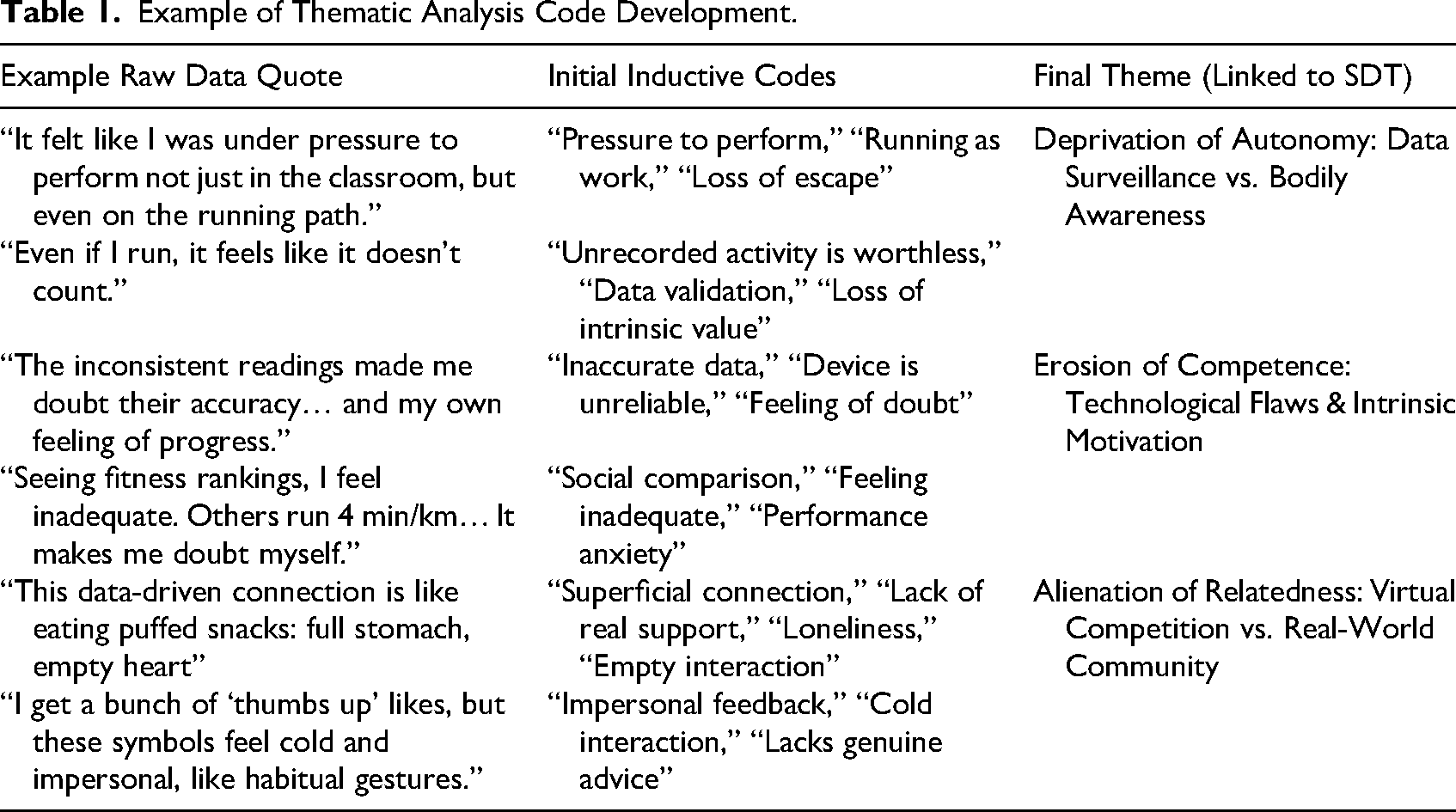
Our coding process employed a phased, hybrid approach to ensure findings were both grounded in the data and theoretically informed (Fereday & Muir-Cochrane, 2006). To address the transition to this revised methodological framework, the research team conducted a systematic re-evaluation of the initial coding structure to ensure a rigorous alignment between the data and the theoretical lens. Initially, the process was inductive (data-driven). Consistent with the early stages of hybrid analysis, three researchers independently conducted open, line-by-line coding to capture the raw nuances of participants’ experiences. At this stage, we “bracketed” the SDT framework to allow codes to emerge directly from the participants’ language without theoretical imposition. Following the inductive phase, we executed a second analytical cycle where the emergent themes were deductively scrutinized using the SDT framework. Subsequently, as patterns crystallized, we observed that the emergent themes strongly resonated with the core psychological needs described in SDT. Therefore, in the final stage of theme development—aligned with what Fereday and Muir-Cochrane (2006) describe as “corroborating and legitimating coded themes” —we applied the SDT framework deductively. This iterative step involved mapping the inductive codes back onto the theoretical tenets of SDT to verify their conceptual fit and ensure that the theoretical framework accurately represented the participants’ lived experiences. In this phase, SDT functioned not as a rigid initial template, but as a theoretical lens to refine, define, and name the themes that had already emerged. For instance, scattered codes related to resisting external pressures were consolidated under the theoretical construct of “Deprivation of Autonomy” (Table 1). By re-analyzing the data through this hybrid lens, we ensured that our findings retained their empirical groundedness while gaining the necessary interpretative depth provided by the revised methodology.
Example of Thematic Analysis Code Development.
We acknowledge that our personal backgrounds and experiences necessarily shape the research process. The research team brings specific perspectives to this study: our academic backgrounds in leisure sports inform our sensitivity to the interplay between technology and intrinsic motivation in recreational activities. Furthermore, one researcher is a recreational runner who has personally experienced and reflected upon the decision to abandon wearable device usage. While these perspectives helped us establish initial rapport with participants and provided valuable context, we were mindful of their potential to bias our analysis. To mitigate this, we engaged in ongoing reflexivity through maintained analytical memos and regular team discussions, where we consciously challenged emerging interpretations. This ensured that our findings remained firmly grounded in the participants’ narratives rather than being disproportionately influenced by our personal or theoretical predispositions.
This study was conducted in strict accordance with the ethical principles of the Declaration of Helsinki. A rigorous ethical protocol was followed throughout the study. All participants were provided with a comprehensive information sheet and gave their written informed consent prior to the interviews. The principles of voluntary participation, the right to withdraw, and data confidentiality were strictly upheld. All data were anonymized to protect participant privacy.
Results
The analysis reveals three core psychological mechanisms underlying student runners’ decisions to abandon wearable devices. These are organized into three themes: (1) the deprivation of autonomy due to data surveillance and the subsequent reawakening of bodily awareness; (2) the erosion of competence due to technological flaws and social comparison;(3) the alienation of relatedness in virtual competition and the reconstruction of real-world emotional communities.
Deprivation of Autonomy Due to Data Surveillance: the Reawakening of Runners’ Bodily Awareness
The analysis reveals that data surveillance imposes a form of “dual performance pressure” on student runners, severely compromising their psychological need for autonomy. Participants widely felt that the data-driven nature of wearables uncomfortably mirrored the quantitatively evaluated academic environment they sought to escape. Rather than functioning as a leisure tool, the device extended the logic of academic evaluation into the domain of play. One participant vividly illustrated this systemic intrusion, comparing the metrics on his watch to the academic scores that dominate his campus life: “As a student, my life is already full of numbers—GPA, exam scores, deadlines… Running was supposed to be my escape from all that… but then I found myself trapped in another cycle of metrics on my sports watch—pace, distance, calories. It felt like even my free time now had a grading system. I felt like I was under pressure to perform not just in the classroom, but even on the running path.” (Male, 21 years old)
Such psychological pressure was compounded by a shift in the locus of control, where the device's external commands began to colonize the runner's internal somatic intuition. The conflict between “what the body feels” and “what the data says” often resulted in the runner surrendering to algorithmic authority. For instance, a 19-year-old female runner described forcing herself to run through fatigue simply to “satisfy the algorithm” when her watch criticized her pace. She profoundly characterized this surrender as “outsourcing [her] own feelings to a machine,” a process that alienated her from her physical self and rendered the experience inauthentic. Consequently, an “ontological hollowing” of the running experience emerged, where the data record became more real than the activity itself. As one participant (Male, 22) admitted, if his watch ran out of battery, he felt his entire run was “ruined” and “didn’t count,” indicating that his autonomy had been entirely supplanted by data dependency.
However, faced with this profound deprivation of autonomy, the findings show that runners are not merely passive subjects. Many engage in “active resistance”—deliberately abandoning the device to reclaim agency. By silencing the digital feedback loop, they force themselves to relearn how to listen to internal physiological signals. This abandonment thus functions not as a cessation of activity, but as a “reawakening of bodily awareness.” One participant described this restorative immersion after turning off her device: “Once, I stumbled upon a scenic trail and turned off my devices. Immersed in the moment, I felt my breath, footsteps, and connection with nature. I became one with my surroundings.” (Female, 18 years old)
Erosion of Competence Due to Technological Flaws: Reigniting Runners’ Intrinsic Motivation
This study found that runners’ sense of athletic competence was eroded through two primary pathways: the epistemological failure of the technology itself and the social anxiety induced by gamified comparison.
First, technical failures extended beyond mere hardware malfunctions; they created a cognitive dissonance that directly undermined runners’ confidence in their physical capabilities. When devices provided inaccurate data, participants initially questioned their own bodies rather than the machine, leading to unnecessary frustration. For instance, one runner (Male, 20) reported confusion when his tracker displayed “unrealistically high heart rates (180 bpm)” during easy jogs, forcing him to wear multiple devices just to validate his own somatic experience. Beyond inaccuracy, the “contextual blindness” of algorithmic feedback proved even more damaging. Algorithms often delivered generic praise or criticism that failed to account for the runner's actual training load or recovery needs, leading to a sense of being “misunderstood” by the device. A participant described the alienation caused by this decontextualized feedback: “My watch congratulates me for hitting 10,000 steps on a day I did a grueling hill workout, but it tells me my fitness is declining on a rest day. It has no real understanding of training context, which makes its feedback feel arbitrary and sometimes even insulting.” (Male, 22 years old)
The current analysis suggests that when wearable technology operates as a rigid, external judge without context, it thwarts the user's sense of competence, transforming a support tool into a source of invalidation. However, interestingly, technological discrepancies within the devices sometimes acted as a paradoxical catalyst for positive change. The rupture in data continuity forced some users to confront their dependency on external metrics. One participant shared a pivotal moment of realization triggered by a conversation with her mother, which highlights the shift from external regulation back to intrinsic motivation: “I ditched my faulty fitness tracker after the heart rate monitor failed, even with a replacement core. Thinking of upgrading to a sports watch, I mentioned it to my mom. “If the monitor's wrong, does that mean you can’t run?” she asked. “You ran fine without it.” She was right. I love running for itself, not the data. Some friends have every gadget but never run. The joy is in the run, not the tracker.” (Female, 20 years old)
The narrative of reclamation illustrates a reclamation of autonomy. Once liberated from the “obsession with running” metrics, participants reported a broader engagement with physical activity. For example, a 21-year-old female participant noted that she “let go of the obsession” with closing activity rings and began exploring yoga and swimming, redefining exercise as a source of fun rather than a source of stress. Second, beyond technical flaws, the study found that the social features of wearables—specifically leaderboards and sharing functions—fostered a competitive atmosphere that severely threatened runners’ perceived competence. The visibility of peer performance created a localized “upward social comparison” that often resulted in feelings of inadequacy. One participant (Male, 20) articulated this self-doubt, noting that seeing others’ superior metrics (e.g., “4 min/km pace”) made him feel he would “never measure up,” effectively devaluing his own achievements. Critically, this pressure to perform for a virtual audience had tangible, harmful consequences. The pursuit of external validation frequently overrode the body's safety signals, pushing runners to prioritize digital status over physical health: “Seeing others share fitness posts made me feel pressured. Chasing likes, I pushed too hard, ignored fatigue, and got injured—strains, joint pain.” (Female, 19 years old)
This finding underscores that when competence is defined by relative ranking rather than personal progress, the technology shifts from being a motivational tool to a mechanism of physical and psychological harm.
Alienation of Relatedness Due to Virtual Competition: Reconstructing Runners’ Real-World Emotional Communities
The analysis indicates that the virtual social networks created by wearables, with their emphasis on quantification and competition, often foster superficial connections that fail to satisfy runners’ deeper needs for belonging (Relatedness). Instead of fostering genuine community, these platforms frequently generate “quantified interactions”—performative exchanges that leave users feeling emotionally isolated. Participants commonly described interactions within these virtual communities as “hollow.” For instance, a 23-year-old male runner noted that while he received habitual likes, the symbols felt “cold and impersonal,” devoid of specific advice or care. This superficiality creates a paradox where users are constantly connected but deeply lonely. A 17-year-old female runner used a powerful metaphor to capture this specific form of digital alienation: “I slowly lost interest in checking fitness rankings… This data-driven connection is like eating puffed snacks: full stomach, empty heart. When I sprained my ankle and stopped for two weeks, the system just docked points, but no one noticed my absence.” (Female, 17 years old)
The inherent potential for digital isolation suggests that wearable communities often function as transactional systems rather than emotional ones, prioritizing data continuity over human well-being. Furthermore, the data-centric nature of these platforms was found to breed envy and negative competition, actively eroding real-world friendships. One participant (Female, 21) described how sharing data transformed a supportive running partnership into a silent rivalry, where she felt “jealous of (her friend's) pace” and “pressured by distance.” The transparency of data replaced their actual conversations with “silent online competition,” ultimately ruining both the fun of the activity and the friendship itself.
In more severe cases, this forced transparency of location and performance data escalated from psychological alienation to direct physical threats, completely shattering the foundation of trust required for a sense of belonging: “Last year, while training for a marathon, my real-time heart rate, pace, and running route were synced to the group chat. A male runner used this information to estimate my address and waited along my night running route to chat me up.” (Female, 20 years old)
In response to the vacuity and peril of these virtual spaces, the findings show a distinct pivot where runners actively returned to the real world to reconstruct warm, embodied emotional communities. The resulting social shift represents a move from “visual” validation (screens/rankings) to “tactile” and “practical” support. For example, a 19-year-old male participant described uninstalling his apps to join a physical running group, noting that the “real-time guidance on breathing” and “back pats” from peers felt “much more real than staring at screens.” He emphasized that when injured, the community offered tangible rehabilitation help rather than mere data points. Similarly, another runner (Male, 20) recovering from injury reported a fundamental shift in values: by joining a slow-running group that explicitly rejected devices, he was able to transition from being “obsessed with virtual race rankings” to focusing on “health and relaxation,” thereby satisfying his need for relatedness through shared physical presence rather than digital comparison.
Discussion
This study investigated why student recreational runners abandon smart wearable devices, framing the phenomenon not merely as a technological issue but as a psychological response to unmet needs within the unique context of university life. Our findings, interpreted through the lens of SDT, reveal three core mechanisms that drive abandonment: (1) a loss of autonomy under data surveillance; (2) an erosion of competence from technical flaws and social comparison; (3) an alienation of relatedness in virtual communities. The findings collectively demonstrate that when technology transforms a restorative leisure activity into a stressful, performance-oriented task, students proactively disengage to preserve the intrinsic value of running.
Data-Driven Discipline and the Need for Autonomy
Our primary finding reveals a profound conflict between the data-driven discipline imposed by wearables and students’ need for autonomy. The results show that for students already saturated with quantitative evaluations, the constant tracking of running metrics turned a liberating escape into a form of “graded” labor. While recent research by Taylor et al. (2025) demonstrates that recording physical activity and goal setting are direct positive predictors of activity levels among the general student body, our qualitative insights suggest that this relationship is mediated by the perceived nature of the tracking itself. The observed autonomy loss strongly aligns with the core tenet of SDT that excessive external controls undermine intrinsic motivation by thwarting the fundamental need for autonomy (Ryan et al., 2022; Ryan & Deci, 2020). Furthermore, such erosion of autonomy provides a critical psychological layer to the “intention-behavior gap” documented among active leisure participants (Xie et al., 2025). While previous research has identified the general tension between device metrics and bodily sensations (Niering et al., 2023), our study contributes a novel insight by framing this as a “dual performance” pressure specific to students; that is, the perceived obligation to meet quantifiable standards both in their academic lives (e.g., grades, scores) and now in their recreational activities (e.g., pace, distance). By highlighting these tensions, the analysis illustrates how technology can replicate the oppressive logic of an academic environment within a leisure context, imposing new psychological burdens rather than providing the emotional support users seek (Baldassarri et al., 2023), thereby defeating the activity's original purpose.
Furthermore, our participants’ decision to consciously “unplug” is more than just device abandonment; it is an act of resistance against the instrumentalization of exercise (Esmonde, 2020; Mertala & Palsa, 2023). By returning to a sensory-focused approach, they re-engage with an embodied form of knowledge that many experienced runners find superior to standardized device feedback (Giraldo-Pedroza et al., 2020). Prioritizing internal cues over digital metrics enables runners to plan and execute their workouts with greater precision (Yfantidou et al., 2024), achieving a deeper “flow” state that is often disrupted by the device's “predatory consumption of attentional resources” (Patel & O'Kane, 2015). Thus, abandonment is not a failure of motivation but a strategic choice to protect and restore autonomy in a critical domain of student life.
Technological Fallibility and the Fragility of Competence
Beyond the erosion of autonomy, a second critical pathway to abandonment emerged from the systematic undermining of runners’ sense of competence. SDT posits that feeling effective and capable is crucial for sustained engagement (Howard et al., 2021). Initially, runners trust and rely on key metrics to assess training effectiveness (Huang & Ren, 2020). However, our results confirm that technical inaccuracies—such as GPS signal loss, heart rate errors, and data synchronization failures (Pobiruchin et al., 2017; Van Hooren et al., 2024) —are a primary reason for abandonment (Nuss & Li, 2021). Our contribution lies in demonstrating the psychological consequence: these flaws transform a tool intended to build confidence into a source of doubt. For a student constantly being assessed, a faulty device that provides untrustworthy feedback disrupts the personal sense of accomplishment they seek in recreation.
The erosion of competence is significantly amplified by the devices’ social features. Our findings reveal a critical nuance: even runners who can tolerate technical shortcomings often find the social functionalities problematic (Palsa & Mertala, 2024). While some research notes that casual runners prioritize social sharing (Clermont et al., 2020), our data shows the dark side of this engagement. In contrast to recent evidence showing that peer-led physical activity programs can effectively enhance students’ sense of social competence and psychological wellbeing (Kirby et al., 2025), the technology-mediated “socializing” in our study often produced the opposite effect. The resulting pressure from constant quantitative comparison on leaderboards and the pressure to perform for “likes” (Zhang & Mao, 2022) foster feelings of inadequacy and anxiety, as also suggested by Bowell et al. (2024). When these accumulated negative emotions lead individuals to anticipate further negative outcomes, they ultimately abandon the technology altogether (Patel & O'Kane, 2015). The epiphany of one of our participants— “The joy is in the run, not the tracker”—captures the essence of this process. Abandonment becomes a necessary step to disengage from this toxic evaluation system and reconnect with the intrinsic pleasure and personal mastery of the activity itself.
Virtual Alienation and the Search for Authentic Relatedness
Finally, our findings reveal a third pathway to abandonment: an alienation of relatedness, where virtual social features failed to provide genuine emotional connection. SDT emphasizes that a sense of belonging is a fundamental human need (Ryan & Deci, 2000), yet our study shows that the “data-driven relatedness” fostered by wearables—characterized by superficial “likes” and competitive rankings—is a poor substitute. The qualitative exploration gives qualitative depth to the “online authenticity paradox,” where the constant “front stage” performance required on social media (Singh, 2025) makes authentic, vulnerable sharing nearly impossible (Haimson et al., 2021). The resulting virtual connections, governed by a “positivity bias” and instrumental logic (Bowell et al., 2024; Haimson et al., 2021), lack the empathetic support crucial for well-being, leaving participants feeling “alone together” (Singh, 2025). The participant's metaphor of this connection being like “puffed snacks: full stomach, empty heart” poignantly captures this deficit.
Notably, the most significant contribution of this theme is its illustration of abandonment as a profoundly pro-social act. The decision to disconnect is not an anti-social withdrawal but a rational rejection of a system that can be unfulfilling, unsupportive (Huh-Yoo et al., 2023), and even unsafe, as the disturbing instance of a privacy violation in our data shows. In response, students actively sought out embodied communities where bodily co-presence and mutual support fostered genuine trust. Such a transition aligns with evidence that campus recreation program utilization enhances social connectedness among university students (Sim et al., 2026). It can be seen as a search for “sincerity”—a focus on empathy and mutual understanding—over the performative authenticity that characterizes many professional and online interactions (Park et al., 2024). Even platforms designed for authenticity, like BeReal, can fail if the sharing feels coerced rather than intentional (Kim et al., 2024). Therefore, by abandoning their devices in favor of real-world running clubs, participants were strategically pursuing a higher quality of human connection, satisfying their need for relatedness in a more meaningful way.
The Role of Cultural Context in Wearable Abandonment
The socio-cultural landscape of Chinese higher education provides a critical backdrop for understanding the psychological costs of wearable technology. In Chinese culture, the concept of “mianzi” (face) and the emphasis on collective social standing mean that digital metrics on platforms like WeChat Sports are often perceived as more than personal health data; they function as a form of public social capital (Marginson & Yang, 2022; Sundararajan, 2020). This cultural sensitivity to peer evaluation significantly amplifies the “dual performance pressure” identified in our findings, as students feel an implicit obligation to maintain a “successful” athletic persona that aligns with their academic achievements (Zhang & Zhou, 2024). When the digital record of a run becomes a visible marker of self-discipline within a tight-knit campus social network, the activity shifts from an autonomous pursuit of well-being to a performative display of competence. Consequently, the act of “disconnecting” represents a cultural negotiation (Lin & Miller, 2003)—a deliberate move to withdraw from a hyper-visible evaluation system to protect the private, intrinsic joy of the activity.
Furthermore, the pervasive phenomenon of “involution” (neijuan) in Chinese universities further deforms the original purpose of wearable monitoring. Commonly understood in the Chinese context as a state of hyper-competition where individuals exhaust themselves in an endless struggle for limited resources without achieving meaningful progress (Zhang et al., 2024), neijuan has created an environment where students are habituated to constant quantitative benchmarking. In such a framework, where every aspect of life—from GPA to standardized test scores (Wang et al., 2024)—is subjected to intense comparison, wearable devices risk becoming another instrument of “graded labor.” Within this highly competitive atmosphere, participants in our study frequently used academic metaphors to describe their fitness tracking, suggesting that the logic of academic evaluation has deeply permeated their leisure spaces. In this context, the algorithmic feedback of a smartwatch does not function as a supportive coach, but rather as an extension of the rigid, performance-oriented logic that characterizes their academic lives. Therefore, for Chinese student runners, abandoning wearables is not merely a rejection of a technical device, but a rational coping strategy to resist the encroachment of “evaluative obsession” into their last remaining domain of restorative leisure (Taut & Brauns, 2003).
Application to Practice
The findings of this study provide clear and actionable insights for collegiate recreation professionals—including campus recreation directors, student club advisors, and intramural coaches—who aim to foster sustained student participation and enhance well-being. While smart technology is often perceived as a tool for engagement, our research indicates that it can inadvertently drive students away if it undermines the core pleasures of the activity. To counteract this, practitioners should prioritize the autonomy and intuitive experiences of student runners. For example, this could take the form of organizing “unplugged” group runs as part of a campus-wide “Digital Detox Week,” or creating “mindfulness running” workshops that teach students to pay attention to their breathing and environment without technological aids. Positioning technology as a “compass, not a commander” for students—a tool to be consulted when needed, rather than obeyed—can help preserve intrinsic motivation and the joy of movement, offering a necessary counterbalance to the structured demands of academic life.
Another key strategy involves redefining success to build true competence among student participants. The study reveals that rigid, data-driven goals often lead to frustration, particularly for students already navigating a high-pressure environment of grades and evaluations. Campus recreation programs should, therefore, shift focus from narrow performance metrics toward broader, more personal definitions of achievement. This can be achieved through programs modeled after the popular “Couch to 5K” philosophy, where the primary goal is completion and personal consistency, not time. Practitioners could also create challenges tied to student life, such as a “Midterm Miles Challenge” that rewards maintaining a consistent running schedule during a stressful period, regardless of pace. Celebrating milestones such as completing a first campus 5 K, maintaining a consistent running schedule during a stressful midterm period, or supporting fellow participants reinforces a sense of competence grounded in personal effort and growth, rather than algorithmic evaluation. This approach nurtures student resilience and long-term engagement by validating diverse forms of progress and contributing to their holistic development.
Finally, practitioners must recognize that virtual leaderboards are poor substitutes for meaningful human connection, which is a cornerstone of the collegiate experience. The most powerful driver of retention in campus recreation is a strong, supportive community rooted in authentic relationships. Technology should be leveraged not to replace face-to-face interaction but to facilitate it. Drawing inspiration from the community-focused ethos of global movements like Parkrun, which emphasizes participation and volunteering over competition, campus programs could use a running app's group function to organize post-run meetups at the student union or create collaborative team challenges focused on collective goals (e.g., “our residence hall's total mileage”) rather than individual rankings. By intentionally creating inclusive environments where emotional support and shared experiences are prioritized, collegiate recreation professionals can ensure that technology enhances, rather than detracts from, the fundamental social and emotional rewards that make campus sports a vital component of student life.
Limitations, and Future Directions
This study has limitations. Our sample consisted of university students in a specific cultural context, and their experiences with the “dual performance” pressure may not be generalizable to other populations. Future research could explore how older adults or non-student recreational athletes navigate their relationship with wearable technology. Additionally, a longitudinal study tracking runners from adoption to abandonment could provide even deeper insights into the evolving psychological dynamics over time. Despite these limitations, this study provides a rich, theoretically grounded understanding of why motivated individuals abandon technologies designed to support them, reframing abandonment as a rational and often necessary act of psychological self-preservation.
Footnotes

Funding
The authors disclosed receipt of the following financial support for the research, authorship, and/or publication of this article: This research was supported by the National Social Science Fund of China (Grant No. 22CTY017).
Declaration of Conflicting Interests
The authors declared no potential conflicts of interest with respect to the research, authorship, and/or publication of this article.