







Abstract
Surging consumer demand for personalization is straining conventional mass customization paradigms, which have reached a functional bottleneck. Constrained by predefined modularity, conventional mass customization approaches can neither achieve the real-time, data-driven responsiveness of hyper-personalization nor deliver the creative openness inherent in co-design experiences. To address these limitations at a systemic level, we propose and validate a novel AI-driven Mass Personalized Customization (AMPC) paradigm that integrates generative intelligence and manufacturing adaptability within a unified, closed-loop framework. The AMPC paradigm features a four-layer architecture with a central Data & Technology Hub connecting the Semantic Intent, Design Generation, Physical Realization, and Closed-Loop Service subsystems. To validate this paradigm, we present a systematic case study in the apparel industry, detailing the complete workflow from user intent recognition, through AI-driven creative generation and virtual try-on, to smart manufacturing and feedback analysis. The analysis shows that the AMPC framework overcomes traditional limitations by enabling greater user design freedom and establishing a data-driven feedback loop for ongoing optimization, thereby offering a new model for the digital transformation of the apparel value chain.
Keywords
1. Introduction
In the era of Industry 4.0, Mass Customization (MC) has emerged as a critical strategic paradigm in the fashion industry, responding to evolving consumer expectations for personalized products while maintaining cost structures comparable to mass production.1–3 However, despite decades of theoretical development and practical implementation, traditional MC approaches in fashion retail face a fundamental challenge. They deliver what we term surface-level customization rather than comprehensive customization experiences. 4 Contemporary MC systems predominantly operate through combinatorial selection within predetermined design frameworks, constraining consumer creative expression to predefined modules, color palettes, and material options.5–7 This approach, however, often falls short of addressing consumers’ increasing demand for individualized uniqueness and creative autonomy. Furthermore, the rigid modularity limits the depth of user involvement, thereby hindering effective value co-creation and sustainable competitive differentiation. The resulting disconnect between consumer expectations for creative freedom and the reality of limited customization options represents what we identify as the Generative Bottleneck, a fundamental constraint that prevents fashion brands from achieving true market differentiation through personalization while maintaining operational efficiency and scalability.
In response to these challenges, academia and industry have integrated intelligent technologies such as 3D visualization and flexible manufacturing into specific process nodes.8,9 However, these technologies remain fragmented improvements within the traditional linear workflow, failing to bridge the systemic gap between creative design and physical manufacturing. Consequently, information asymmetries persist, preventing the seamless translation of user intent into production. Against this backdrop, generative AI (GAI), particularly multimodal models like diffusion models, offers a capability to map unstructured inputs directly to high-quality visual designs.10–12 Current research in this domain predominantly focuses on algorithmic advancements for generation quality 13 or interface optimization for user interaction. 14 However, a critical limitation remains: existing studies largely treat GAI as a standalone creative tool rather than an integrated component of the manufacturing system.15,16 Specifically, there is a lack of systematic methodology for effectively converting generated designs into manufacturable parameters. This disconnection impedes the ability of GAI to function as a driver for industrial transformation, leaving a significant gap in achieving a fully closed-loop customization process.
To address this limitation, we propose a novel paradigm for AI-driven Mass Personalized Customization (AMPC). In conceptualizing this framework, we explicitly distinguish three critical dimensions often conflated in existing literature: the industrial foundation, the interaction process, and the customization depth. We posit that Mass Personalized Customization (MPC) serves as the overarching industrial paradigm, providing the infrastructure for scalable flexible production. Within this ecosystem, the framework introduces AI-driven co-design experiences as the core interactive mechanism, enabling consumers to transcend passive selection and actively collaborate with generative agents. This synergistic process facilitates the transition from standard customization to hyper-personalization, a superior outcome where the system interprets implicit, affective user intent to deliver products that resonate on a deeply individual level. Building on these distinctions, a core feature of the AMPC paradigm is its end-to-end integration of AI throughout the customization value chain, from requirement comprehension through design generation and manufacturing implementation to service feedback. This integration constructs a comprehensive intelligent system initiated by user interaction in natural language and propelled by a dynamic closed-loop feedback mechanism. Through implicit semantic alignment and manufacturability constraints, the paradigm directly translates the user’s creative intent into executable production directives, thus enabling a transformative leap from combinatorial customization to generative customization.
To summarize, the main contributions of this study are threefold: (1) Theoretical Framework: We propose the AMPC paradigm to address the Generative Bottleneck in traditional mass customization, integrating MPC principles with AI-driven design into a closed-loop generative framework. (2) Methodological Innovation: We develop a unified methodology for translating semantic design intent into manufacturable outputs by combining intent parsing, diffusion-based image generation, and parametric design algorithms. (3) Empirical Validation: We validate the paradigm through a comprehensive case study and quantitative evaluation, demonstrating its effectiveness in improving pre-production efficiency and user satisfaction while supporting scalable digital transformation.
2. Related work
2.1. Development of the MC paradigm
The concept of MC originated as a strategy to transcend the standardization inherent in traditional mass production, aiming to offer variability through modular product architectures. 17 While early frameworks successfully introduced scale-based variety, the proliferation of digital technologies and evolving consumer roles has driven the paradigm toward higher levels of personalization. 18 However, practical implementation faces significant systemic challenges. As identified in empirical studies,19,20 critical barriers include rigid modularity, insufficient technological flexibility, and operational inefficiencies in information processing. To address these impediments, scholars have proposed a variety of solutions from multiple perspectives. From a managerial standpoint, Harper et al. 21 investigated the paradoxes of small batch customization in the European apparel industry. They argued that traditional trade-off logic is inadequate for high-cost environments and instead proposed a paradoxical approach, enabling firms to build dynamic resilience through a three-stage framework: tension identification, response mechanisms, and dynamic adjustment. Focusing on consumer engagement, Blank et al. 22 empirically demonstrated that earlier participation in the design process enhances consumers’ product attachment, thereby extending product lifespan and increasing perceived value. From a methodological perspective, Yang et al. 23 applied the theory of inventive problem solving (TRIZ) to resolve the core conflict between variety and fit in apparel MC. They categorized customization types and constructed a two-dimensional matrix of modularity versus variety, providing a theoretical basis for differentiated MC strategies. Technologically, Longo et al. 1 developed an evolutionary decision-support model that integrates genetic algorithms with anthropometric data to satisfy dual demands for personalized fit and comfort without compromising production efficiency.
Theoretical evolution and comparative analysis of customization paradigms.

2.2. Generative AI technologies and applications
The advent of Generative AI, particularly multimodal models based on large pre-trained architectures, offers a theoretical framework to overcome the Generative Bottleneck in customization.
26
GAI distinguishes itself by its capacity to interpret unstructured inputs and synthesize diverse design outputs.27,28 As illustrated by the text-to-image framework in Figure 1, by mapping semantic vectors into a latent space and subsequently decoding them into images, GAI possesses the potential to directly translate a user’s abstract intent into a visual design proposal, a capability widely regarded as a transformative force for the design industry.
29
Architecture of the text-to-image large model.
Within the fashion industry ecosystem, GAI applications have demonstrated substantial technological advancement and commercial potential. A systematic review by Shi et al.
15
synthesizes developments across critical domains including multimodal consumer preference understanding,30–34 automated design generation and 3D visualization,35,36 virtual try-on,37,38 and intelligent garment production workflows encompassing 3D display and pattern automation.39,40 These innovations address specific technical challenges in visualization and pattern automation. However, critical examination of these applications reveals a systematic limitation: existing research predominantly treats GAI as discrete technological tools rather than an integrated manufacturing paradigm. This fragmentation results in three fundamental disjunctions that impede effective system-level integration: (1) The Design-Manufacturing Gap: Contemporary GAI systems often generate visually compelling imagery that lacks engineering constraints.
41
A substantial semantic and technical discontinuity persists between these visualization-centric outputs and the structured manufacturing specifications required for physical production. (2) The Interaction-Feedback Gap: Most applications function as single-iteration generators, lacking iterative feedback mechanisms for refinement. This limitation restricts the system’s ability to align generated results with precise user intent through continuous adjustment, hindering the achievement of high-fidelity personalization and deep user involvement. (3) The System Integration Gap: Current technologies are applied in isolation within existing workflows, failing to form a closed-loop data architecture. This piecemeal integration prevents the synchronization of demand, design, production, and service modules, limiting the overall adaptability and responsiveness of the manufacturing system.
In summary, while the MC paradigm remains constrained by combinatorial logic, GAI applications continue to operate in a fragmented manner. The proposed AMPC paradigm is designed to bridge these gaps by transforming GAI from an isolated design utility into a central orchestrating intelligence, thereby enabling a unified workflow that integrates creative generation with precise manufacturing execution.
3. AMPC paradigm
3.1. Paradigm definition
The AMPC paradigm is formally defined as a comprehensive manufacturing and marketing paradigm that fundamentally reconceptualizes personalized production by systematically integrating generative AI capabilities with human expertise to transform individual consumer preferences into unique, manufacturable value propositions through adaptive, closed-loop collaborative workflows characterized by continuous learning, real-time optimization, and dynamic system evolution. Fundamentally, AMPC introduces a paradigmatic shift from sequential design-then-manufacture processes to integrated co-generative workflows, where design creativity and manufacturing feasibility inform each other simultaneously throughout the entire value creation process. Structurally, this paradigm replaces traditional linear value chains with dynamic, collaborative value networks that enable real-time integration among consumers, designers, and manufacturers. Operationally, unlike traditional mass customization approaches that limit consumers to predefined combinations, AMPC employs generative AI capabilities to dynamically create, evaluate, and optimize personalized solutions within manufacturing constraints.
Based on systems theory and collaborative design theory, the AMPC paradigm necessitates a fundamental architectural innovation that transcends traditional linear manufacturing models. Conventional manufacturing systems employ unidirectional information flows and sequential decision-making processes, whereas the complexity inherent in mass personalized customization demands the establishment of dynamic system architectures characterized by adaptive capabilities and bidirectional feedback mechanisms. As illustrated in Figure 2, the framework identifies four core functional components essential for operationalizing generative customization and defines their structural relationships and interaction protocols. The integrated architecture is organized around a Data & Technology Hub that orchestrates four primary functional domains, collectively enabling the paradigm’s vision of seamless customer-to-product value creation. A layered architecture of the AMPC paradigm.
3.1.1. Semantic intent subsystem
This subsystem serves as the primary customer engagement interface. Its core function is to systematically capture and structure diverse customer preferences into actionable design requirements. To address the Interaction-Feedback Gap identified in existing literature, this subsystem moves beyond single-shot inputs. Operationally, this subsystem facilitates preference discovery and requirement specification. It captures explicit customer inputs, such as style descriptions and reference images, while simultaneously analyzing implicit preferences derived from browsing patterns and historical choices. The resulting structured requirement model drives the subsequent design phase, ensuring a high degree of fidelity between the design objective and the customer’s intent. GAI technologies are leveraged here to enable users to interact directly with the system via natural language and other intuitive modalities, thereby initiating the co-design process.
3.1.2. Design generation subsystem
This subsystem serves as the creative core of personalized design development. Governed by the semantic vector and control parameters from the intent subsystem, it generates personalized design artifacts and specifications. Specifically, this subsystem enables iterative design exploration through concurrent concept development and specification refinement. Crucially, to bridge the Design-Manufacturing Gap, this subsystem does not operate in isolation; it integrates manufacturability constraints directly into the generation process. This ensures that while satisfying personalization and creative diversity, the design’s geometric forms, functional attributes, and material specifications are precisely defined and translated into structured data directly executable by the downstream manufacturing system.
3.1.3. Physical realization subsystem
This subsystem orchestrates the transformation of personalized fashion designs from digital concepts into tangible products. Unlike traditional linear models where manufacturing is a passive recipient, this subsystem acts as an active participant to further resolve the Design-Manufacturing Gap. It continuously feeds back its constraints and state data into the design space through the Data & Technology Hub. It represents the critical stage where personalized fashion concepts materialize into unique customer products, leveraging advanced manufacturing capabilities to ensure precise translation of individual design requirements into high-quality items.
3.1.4. Closed-loop service subsystem
This subsystem provides the dynamic optimization and evolution mechanisms, ensuring the framework operates as a self-learning, customer responsive ecosystem. It directly tackles the Interaction-Feedback Gap by establishing a continuous improvement cycle that spans the entire customer journey. During the design phase, it captures iterative customer feedback and preferences to continuously enhance design accuracy and customer satisfaction levels. In the production stage, it monitors production efficiency and quality, providing critical insights that enhance both manufacturing excellence and design optimization for future iterations. Post-delivery, it leverages channels such as customer communities and rating systems to acquire long-term customer experience data. This information ultimately drives the fine-grained, continuous optimization of products, processes, and the overall service workflow, enabling the entire system to achieve adaptive learning and collaborative evolution.
3.1.5. Data & technology hub
Serving as the central hub and operational backbone of the AMPC architecture, this subsystem fulfills critical roles in data aggregation and intelligent decision support. It is the fundamental solution to the System Integration Gap, breaking down the silos typical of fragmented GAI applications. It seamlessly integrates and analyzes diverse customer, design, and operational data from across the entire personalization journey while serving as a coordination platform. By mediating inter-subsystem communication, it ensures seamless coordination and provides structured access to essential knowledge assets, driving data-driven coordination across all subsystems.
3.2. Workflow innovation
The development of the AMPC paradigm represents a fundamental reengineering of traditional manufacturing operations rather than incremental technological enhancement. This transformation manifests through two critical operational innovations that fundamentally alter the manufacturing value creation process, as illustrated in Figure 3. (1) Integration of Requirements Engineering and Design Specification. The traditional product-push model is replaced by interactive requirements engineering process. Within the AMPC framework, the consumers’ interaction sequence, from initial preference articulation through the iterative design parameter refinement to final solution convergence, serves as real-time production order commitment. Consequently, marketing transforms from a downstream, post-production function into an integral component of the initial requirements elicitation and specification phase, enabling direct customer-production alignment. This structural change improves the fidelity of the final product to user requirements and reduces the lead time between demand articulation and order fulfillment, thereby mitigating supply-demand mismatch. (2) Parallelization of Design and Production Planning. The linear, sequential dependency of the design-develop-manufacture workflow is eliminated. Through the integration of GAI and unified information systems, persistent data connectivity is maintained across all functional stages. AI-generated design specifications are algorithmically translated into manufacturable parameters and machine-executable instructions. This mechanism allows production planning activities (e.g., material procurement, resource scheduling) to initiate in parallel with design finalization, effectively decoupling these stages from traditional temporal constraints. This architecture removes information silos and establishes a coordinated production system capable of multi-stage concurrent operations. Comparison of the traditional linear workflow and the AMPC workflow.

4. System architecture and implementation
This section presents the technical architecture and implementation methodologies for the core subsystems within the AMPC framework. We detail the operational mechanisms and integration strategies that enable the transformation from user requirements to manufactured products.
4.1 Semantic intent subsystem
The Semantic Intent Subsystem addresses the fundamental challenge of translating ambiguous, multimodal customer inputs into structured, machine-executable design specifications. Traditional customization approaches suffer from interpretation inconsistencies and limited requirement capture capabilities, thereby constraining both personalization depth and manufacturing efficiency. This section elaborates on how the subsystem addresses these challenges through multimodal semantic integration and iterative requirement refinement to achieve precise capture and formal representation of user intent.
4.1.1. Addressing requirement ambiguity via multimodal semantic fusion
The ambiguity of customer requirements stems from their intrinsically unstructured and multi-dimensional features. To address this challenge, the subsystem employs a multimodal fusion mechanism to integrate dispersed consumer signals into a unified, high-dimensional semantic representation. 42 This mechanism operates on two levels: explicit information capture and implicit preference mining. Explicit information capture allows users to input their needs through various modalities, including natural language (text/speech) and images (photographs/sketches), thereby breaking the constraints of traditional menu-based selections and significantly increasing the dimensionality and freedom of user expression. Implicit preference mining is conducted by intelligent agents that automatically collect and analyze a user’s historical behavioral data, social media content, 43 and online product reviews. 44 By leveraging Natural Language Processing (NLP), Computer Vision (CV), and sentiment analysis techniques, the system not only recognizes direct commands but also infers latent stylistic preferences and aesthetic inclinations to construct a dynamic, multi-dimensional user profile. 45 Through the fusion of explicit and implicit information, this mechanism transforms a user’s vague initial intent into a more deterministic initial semantic vector, which contains multi-dimensional information such as style, emotion, and function, providing a high-quality input for the subsequent generation stage.
4.1.2. Addressing requirement uncertainty via dialogue-based collaborative analysis
The uncertainty of consumer requirements is primarily manifested in their dynamic evolution throughout the interaction process, reflecting the highly subjective and contextual nature of fashion preferences. The AMPC framework repositions consumers as co-creators rather than passive recipients, aligning with relationship marketing principles in fashion retail. Through dialogue-based collaborative analysis, it transforms one-time requirement definition into a continuous, collaborative value-discovery process. Effective interaction is a core driver of creative collaboration, as evidenced by successful cases in fashion customization. 46 Here, GAI technology assumes the role of an intelligent fashion consultant, mimicking the advisory function of personal stylists and fashion experts. Based on its understanding of the current conversational context, it can proactively pose guiding questions or offer style-informed suggestions to stimulate consumers’ further reflection and clearer articulation of their aesthetic and functional preferences 47 . This multi-turn intelligent interaction converts the unidirectional transmission of requirements into a bidirectional, co-exploratory discovery process, ensuring that the final design solution reflects both individual style identity and market-informed aesthetic choices.
Figure 4 illustrates the complex collaborative analysis mechanisms of this subsystem. The efficacy of these mechanisms is highly dependent on the design of the interaction interface, which must strike a delicate balance between expressive freedom and system constraints to optimize customer experience and conversion rates.48–50 The fashion customization context requires specialized interface paradigms that accommodate the visual and emotional nature of fashion consumption. Common user interface (UI) paradigms include the Language User Interface (LUI) and the Graphical User Interface (GUI). The LUI, centered on natural language, aligns with human expressive habits and supports highly personalized creative input. The GUI, based on parameterized visual elements, offers intuitive operation and controllable outcomes, clearly defining the system’s customizable boundaries. The AMPC framework integrates both paradigms to maximize fashion customer engagement while maintaining production efficiency and cost-effectiveness. When customer expressions exceed fashion production feasibility or price points, the system provides real-time feedback and style-aligned alternative suggestions, ensuring generated designs remain both physically producible and market-competitive. The dialogue-based collaborative analysis mechanism.
4.2. Design generation subsystem
The Design Generation Subsystem serves as the core generative engine within the AMPC framework, driving rapid fashion-product ideation at scale. Its primary objective is to convert the formalized semantic vector from the Semantic Intent Subsystem into fashion design solutions that balance aesthetic novelty with production-ready feasibility. In the context of mass customization, this objective translates into a complex, multi-constraint optimization problem characterized by high concurrency. 29 Although existing generative design workflows define stages such as objective definition, generation, and selection, they universally confront a core challenge: how to bridge the semantic gap between the aesthetic representation of generated content and the constraint parameters of engineering implementation.
To mitigate this limitation, we propose a Constraint-Guided Parametric Generation Model (CPGM). The model is designed to produce, in a single inference cycle, both a visual rendering and a structured manufacturing file containing pattern pieces, grading rules, and seam allowances. Figure 5 outlines the end-to-end training pipeline of CPGM. The CPGM utilizes a pre-trained large model as its foundation, which is then fine-tuned using both a general industrial domain dataset and a specialized private dataset.
51
Training of the constraint-guided parametric generation model.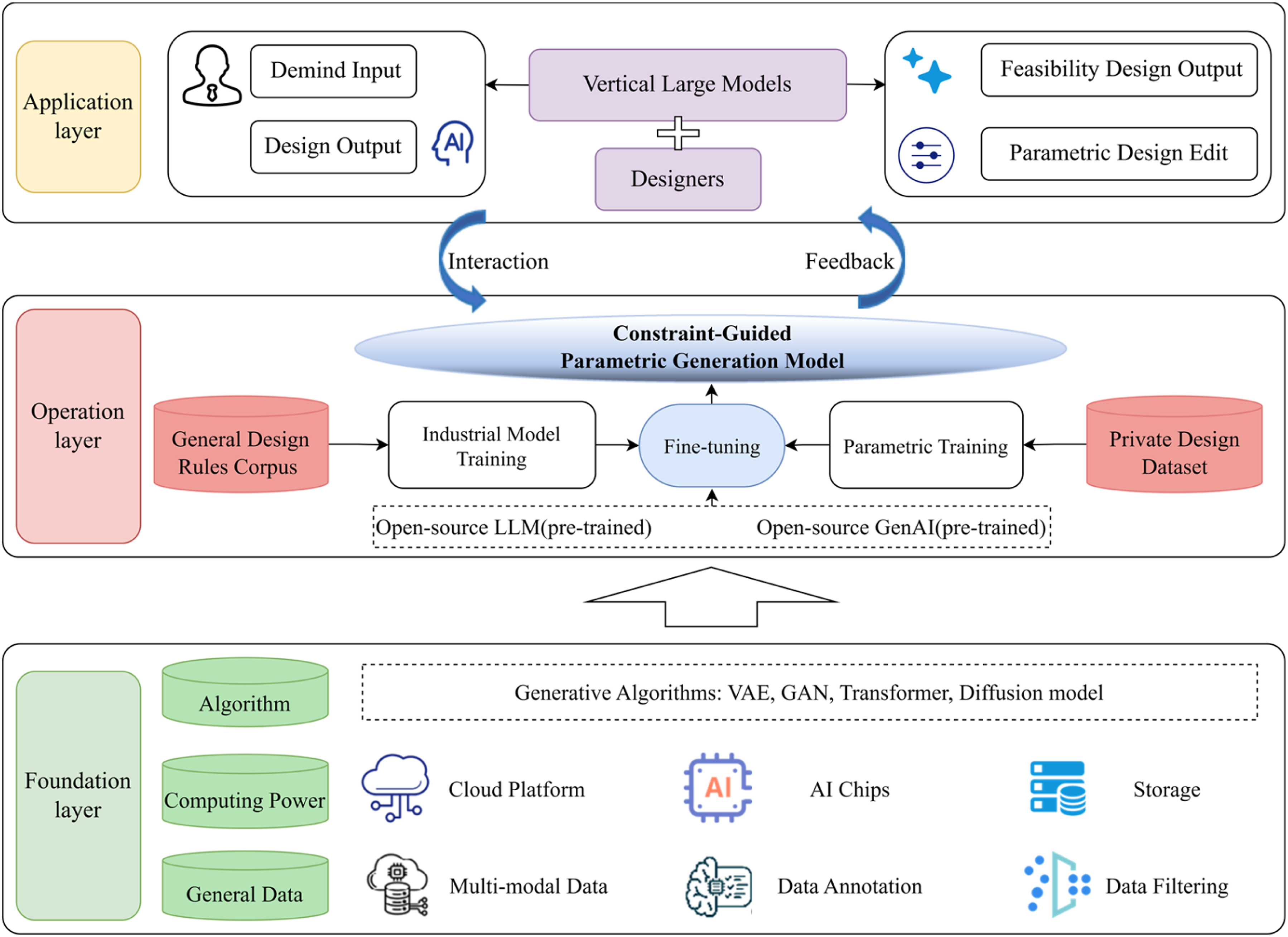
The general industrial dataset, referred to as the General Design Rules Corpus, is used for the initial industrialization training of the pre-trained model. This stage aims to instill the model with an understanding of common industrial design rules, engineering terminology, and material characteristics, thereby achieving a preliminary alignment between the model’s latent space and the semantic space of the design domain. This provides a cognitive foundation for the subsequent, more specialized parametric learning. 52 The Private Design Dataset is a proprietary collection, constructed for a specific design domain, containing a large number of structured design-parameter pairs. In this dataset, each design image is annotated with its complete set of structured manufacturing parameters. The training is guided by a multi-objective loss function, which integrates visual fidelity, semantic alignment, and physical feasibility into a unified mathematical framework. 53 By adjusting the weights of the different loss terms, we can guide the model to proactively avoid infeasible design pathways while learning to generate creative content, thereby striking a controllable balance between design freedom and engineering practicality.
The CPGM constitutes the core of the Vertical Large Model in the application layer. In practice, the CPGM collaborates with human designers, who provide expert evaluation of its output from both aesthetic and manufacturability perspectives. 54 Their feedback is then used to refine the design through recommendations for parametric edits. This dynamic loop of continuous expert feedback not only enables a precise response to personalized requirements but also provides a valuable data stream for the continuous optimization and online learning of the CPGM.
4.3. Physical realization subsystem
The Physical Realization Subsystem is the critical link in the AMPC framework for instantiating digital designs into physical products. Its core challenge lies in efficiently and cost-effectively translating the highly personalized and dynamic design solutions from the front-end into executable instructions for the back-end flexible manufacturing system. Conventional methods are characterized by a pronounced data and process discontinuity between the design and manufacturing phases, which necessitates extensive manual intervention to interpret design specifications and formulate process plans. Within the AMPC framework, we address this challenge through a smart manufacturing system centered on the DataHub, with its overall collaborative workflow depicted in Figure 6. This system is capable of directly parsing the structured parameter set from the CPGM and automatically translating it into a series of executable production orders that span the entire value chain, from the supply chain to the shop floor. The operational mechanism of this system can be deconstructed into three core layers: (1) Automated Task Decomposition and Planning. Upon receiving the parameter set from the CPGM, the DataHub first performs automated task decomposition and planning. For instance, a parameter object containing specifications for a particular color, size, and process is automatically decomposed into a series of independent sub-tasks and dispatched to the corresponding operational modules. A bill of materials is generated and sent to the Procurement module to trigger the supplier management process. Stocking and material tracking orders are issued to the Warehouse module. Concurrently, instruction sets containing pattern data, process commands, and key quality control parameters are distributed to the Manufacturing and Quality modules. (2) Dynamic Resource Scheduling and Supply Chain Coordination. The decomposed sub-tasks are fed into the decision and prediction engine of the DataHub, which utilizes advanced scheduling algorithms to solve the production batching problems for high-variety, small-batch orders. As shown in Figure 6, this approach optimizes internal resources for logistics and production.
55
More importantly, it leverages Internet of Things (IoT) technologies and open APIs to enable real-time data sharing and resource coordination with upstream suppliers.
56
For example, based on the materials specified in the parameter set, it can automatically trigger a purchase request to the optimal supplier, enabling just-in-time material provision. (3) Digital Twin-based Visualization and Traceability. Throughout the manufacturing process, the DataHub constructs a dynamic digital twin for each custom order based on real-time data collected from all operational links via IoT sensors. This approach not only enables automated tracking and visualization of all stages, including warehousing, logistics, manufacturing, quality inspection, and packaging, but also feeds real-time status data back to the user through the order management module. This data is also synchronized with the Closed-Loop Service Subsystem, to be discussed in Section 4.4, providing the user with a fully transparent view of the entire production process. The DataHub workflow of the physical realization subsystem.
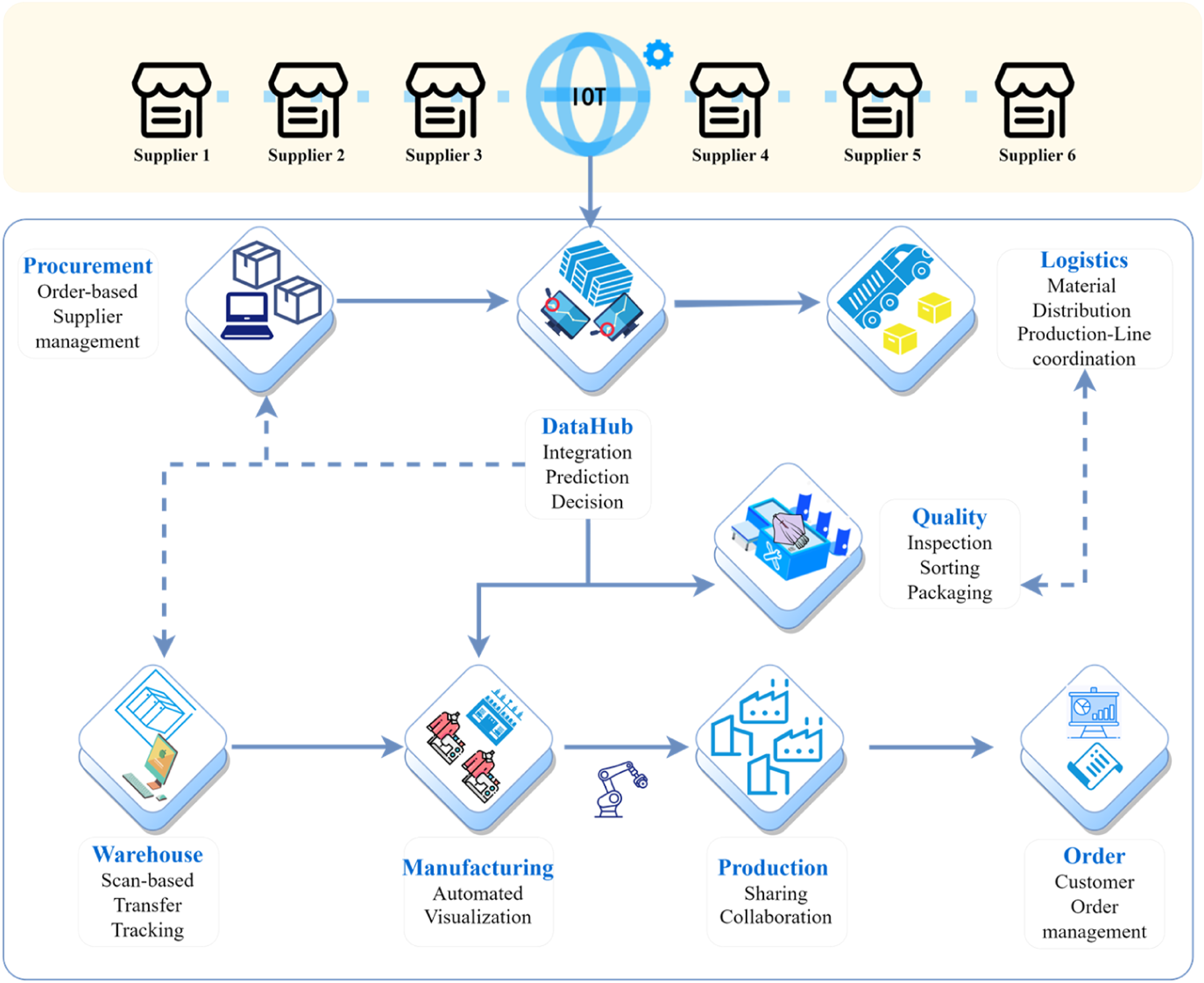
Consequently, within the AMPC framework, the Physical Realization Subsystem emerges as an intelligent adaptive system. Empowered by the DataHub architecture, it autonomously interprets AI design intent, plans production pathways, and provides real-time feedback on its operational status.
4.4. Closed-loop service subsystem
The Closed-Loop Service Subsystem serves as the customer experience optimization and system evolution engine of the AMPC framework, designed to ensure a positive consumer experience and drive the continuous evolution of the system’s capabilities by providing intelligent services. The subsystem operates through two complementary service components: the customer-focused experience interaction service and the system intelligence feedback optimization service. The experience interaction service is dedicated to providing users with a highly personalized customization experience. It achieves this by integrating deep learning-based recommendation algorithms to instantaneously analyze real-time user interaction streams and historical preference data, thereby dynamically generating personalized guidance for customization to effectively reduce the user’s decision-making complexity. Furthermore, the service incorporates an AI assistant agent with specialized domain knowledge to function as a virtual customization consultant, providing users with expert guidance throughout their personalization journey.
The feedback optimization service focuses on enabling the long-term evolution and continuous improvement of the entire customization ecosystem. By leveraging data collection mechanisms in front-end applications and IoT terminals, the service systematically gathers user interaction data, after-sales service requests, and post-purchase product usage feedback to understand customer experiences comprehensively. This data is then analyzed to identify the strengths and weaknesses of product designs and to pinpoint bottlenecks within the production process. For instance, upon detecting a product anomaly or receiving user feedback, the service can automatically create a service ticket, initiate the corresponding workflow, and trigger the re-training and optimization of the relevant system modules.
5. Case study
To elucidate the operational mechanism and practical utility of the AMPC framework, this section introduces an illustrative case study. We have selected T-shirt customization, a quintessential scenario within the apparel industry, as the context for our analysis. Currently, the primary challenge in the T-shirt customization market stems from the pronounced discrepancy between the growing consumer demand for sophisticated and diverse forms of creative expression, and the prevailing customization models that are template-based, offer limited creative freedom, and rely on inefficient design-to-production pipelines. This case study aims to provide a detailed exposition of how the AMPC framework functions as a cohesive whole to systematically address these industry challenges.
5.1. Challenges and opportunities
As a highly standardized apparel medium, T-shirt customization services have already established a considerable market foundation. Nevertheless, existing systems are universally constrained by two principal bottlenecks: (1) Front-end Requirement Distortion: A primary challenge lies in the formalization of user intent. Users’ high-level creative concepts are difficult to translate into formal design specifications. This persistent semantic gap between consumer intent and design language results in significant communication overhead and high rates of iterative revision, thereby hindering the accurate translation of initial concepts into viable design artifacts. (2) Back-end Flexibility Deficit: A critical bottleneck exists in the design-to-production pipeline. There is often a fundamental misalignment between design artifacts and manufacturing constraints, as the design process is largely decoupled from downstream manufacturability considerations. Consequently, scheduling high-mix, low-volume production runs becomes computationally intractable, escalating operational costs and rendering scalable mass customization economically infeasible.
The AMPC framework is designed to provide a novel systemic solution to these challenges by integrating AI-driven front-end understanding and generation with seamless back-end smart manufacturing connectivity.
5.2. AMPC-driven customization workflow
This section details the synergistic operation of the AMPC framework in driving a closed-loop T-shirt customization process, as depicted in Figure 7. An illustrative workflow of the AMPC-driven T-shirt customization process.
5.2.1. Requirement articulation and comprehension
The process initiates with a robust multi-dimensional data foundation that integrates unstructured user inputs (e.g., social media trends, natural language descriptions) with a structured domain-specific knowledge graph (Figure 8). This graph systematically categorizes apparel design elements, including fit classifications and fabric semantics. Upon receiving a user’s natural language prompt (e.g., “retro sci-fi aesthetic”), the Semantic Intent Layer leverages a multimodal Large Language Model (LLM) to parse abstract concepts into core semantic entities. An AI-driven conversational engine then engages the user through clarification queries and visual cues, progressively refining vague affective expressions into a structured design constraint vector ready for generation. Hierarchical labels for fashion data.
5.2.2. Design generation and interactive adjustment
The design generation module employs a Conditional Diffusion Model with a dual-decoder architecture to ensure both aesthetic quality and manufacturability. 57 This mechanism produces two synchronized outputs: (1) visual proposals: High-fidelity renderings displaying pattern configuration and color schemes for user preview; and (2) manufacturing specifications: A parameterized data structure defining fabric types, color codes, and precise pattern coordinates. To facilitate co-design, the interface allows users to adjust parameters via interactive controls. The system updates both the visual preview and the manufacturing bill in near real-time, maintaining a persistent high-fidelity correspondence between the digital representation and industrial parameters.
5.2.3. Virtual try-on and pattern engineering
This stage bridges the gap between digital design and physical realization through two key processes. First, the 3D virtual try-on module reconstructs a personalized digital avatar. To ensure standardized operation, the input protocol requires a single front-view full-body photograph captured under neutral lighting conditions. The reconstruction is based on Skinned Multi-Person Linear (SMPL) parameter regression from a monocular RGB image, where 2D keypoints are detected to constrain the estimation of the 3D body pose and shape parameters. The recovered SMPL parameters are then converted into a 3D body mesh representation. Based on this mesh avatar, the virtual try-on system drapes the designed garment to simulate clothing deformation and visualize fitting through stress-distribution maps. 58 Second, Adaptive Pattern Generation translates the confirmed design into production-ready assets. Leveraging models such as Sewformer 40 and DressCode, 59 the system maps anthropometric features to pattern adjustment rules. Upon order confirmation, this module automatically reverse-engineers the 3D garment model into a set of 2D CAD patterns compliant with industrial standards, concurrently performing layout optimization to minimize fabric waste. The pattern-making readiness of the generated outputs was checked according to pattern-piece completeness, boundary continuity, key-dimension consistency, seam-allowance availability, and CAD importability.
5.2.4. Intelligent production and delivery
The Intelligent Manufacturing Execution System (IMES) orchestrates production by ingesting the digital instruction package (design files, BOM, and CAD patterns). The workflow is managed through three integrated layers: (1) Digital Tracking: Fabric components are bonded to smart hangers equipped with RFID chips, which store the complete process specifications for each unique order. (2) Dynamic Routing: Once introduced into the smart overhead conveyor system, an AI scheduling engine determines the hanger’s trajectory in real-time. (3) Optimization Logic: The engine dynamically dispatches complex orders to specialized workstations while assigning standard tasks to default stations, optimizing total lead time and equipment utilization. Simultaneously, the client interface provides real-time production visibility to enhance user engagement.
5.2.5. Feedback and evolutionary optimization
The framework implements a dual-level feedback loop to drive continuous evolution. At the individual level, post-delivery feedback is captured via a structured virtual try-on interface, where users quantify tactile impressions by annotating specific fit areas on a virtual model. This data refines the user’s specific digital avatar for future orders. At the aggregate level, the service module mines accumulated feedback to detect recurrent fit issues and preference trends. These insights drive the iterative optimization of the design generation model, pattern-template library, and production workflows, closing the loop for adaptive system learning.
5.3. Performance evaluation and comparative analysis
To rigorously validate the effectiveness of the AMPC-driven T-shirt customization, we conducted a comprehensive evaluation using 50 diverse customization prompts and their corresponding generated outputs, focusing on process efficiency, pattern-making readiness, and design capability.
5.3.1. Efficiency analysis
We compared the pre-production lifecycle of the AMPC-driven customization framework against the traditional bespoke customization workflow. To ensure the validity of the baseline data, the time consumption metrics for the traditional workflow were derived from semi-structured interviews with five senior merchandisers and pattern makers from leading garment customization enterprises. These experts possess an average of 10+ years of experience in apparel customization. The baseline data represents the standard operational time required for a single customized order under typical industrial conditions, excluding logistical delays.
Comparative analysis of time consumption between traditional customization and the AMPC framework.
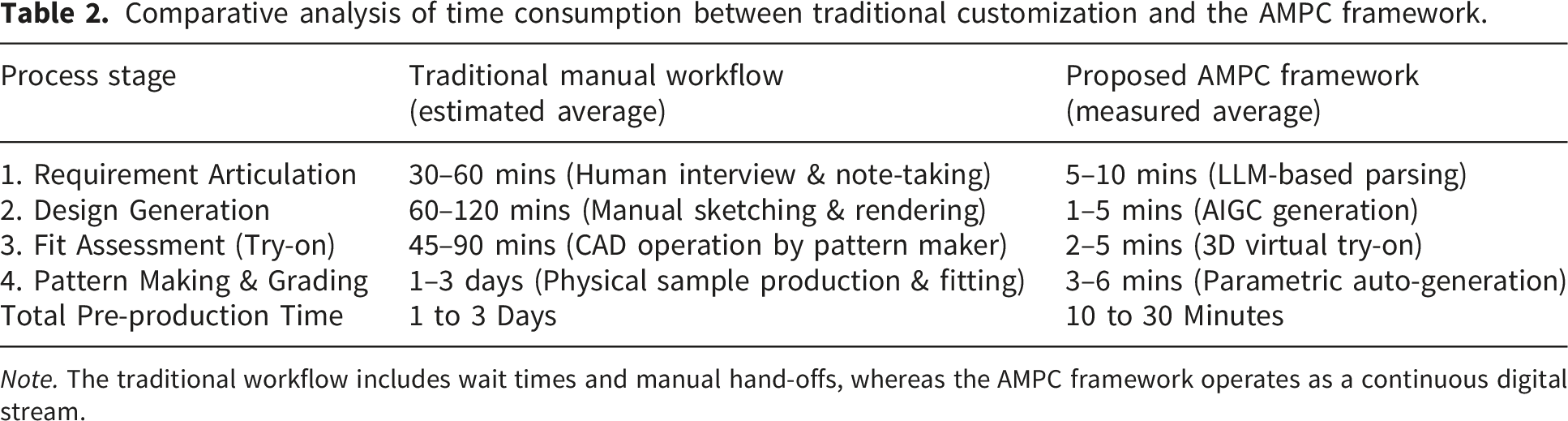
Note. The traditional workflow includes wait times and manual hand-offs, whereas the AMPC framework operates as a continuous digital stream.
Beyond time efficiency, we further checked the pattern-making readiness of the 50 generated outputs. Among these outputs, 35 cases (70%) could be directly used for pattern making without manual modification, 12 cases (24%) required only minor correction, mainly involving seam-allowance adjustment, boundary smoothing, labeling, or local alignment correction, and 3 cases (6%) required substantial correction because of incomplete pattern geometry or fit-related inconsistency. This result provides more direct support for the production-oriented capability of the AMPC workflow, while also indicating that expert review remains necessary for technically complex or irregular outputs.
5.3.2. Design quality and semantic alignment
Beyond efficiency, the quality of the generated designs is paramount. We evaluated the system’s ability to accurately translate user text prompts into visual designs using both objective and subjective metrics. To objectively quantify the alignment between user prompts and the generated designs, we employed the CLIP Score metric,
60
which measures the cosine similarity between the text and image embeddings in the CLIP feature space (using the ViT-B/32 backbone). Using the same 50-prompt test set, which covered diverse customization requirements ranging from “minimalist geometric patterns” to “complex vintage illustrations”, the AMPC design module achieved a CLIP Score of 0.32 ± 0.06 (mean ± standard deviation). Given the highly specialized nature of customized apparel design, we position this metric primarily as a rough quantitative proxy for semantic alignment between user text prompts and generated visual attributes. This score indicates a reliable degree of semantic fidelity in translating domain-specific clothing descriptions into practical designs. We also conducted a user study with 20 participants to evaluate the practical utility of the system. Participants were asked to input their desired T-shirt styles and rate the outputs on a 5-point Likert scale (1 = Very Poor, 5 = Excellent). The evaluation criteria and results are summarized in Figure 9, where the error bars represent the standard deviation of the user ratings. The performance of the proposed AMPC framework was evaluated using four dimensions commonly adopted in intelligent fashion design and virtual try-on research.1,61,62 (1) Perceptual Aesthetic Quality (PAQ), assessing the overall visual apparel and design harmony of the generated output; (2) Faithfulness to Input Constraints (FIC), measuring the alignment between generated garments and user-specified attributes; (3) Perceived Visual Realism (PVR), evaluating the realism and naturalness of virtual try-on visualizations; and (4) Overall User Satisfaction (OUS), reflecting participants’ holistic experience and subjective preference toward the system outputs. User satisfaction evaluation results across four key dimensions.

The high satisfaction scores indicate that the AMPC framework not only accelerates the process but also maintains a high standard of aesthetic quality and personalization accuracy, effectively bridging the gap between vague user intent and precise manufacturing specifications.
5.4. Discussion
The deductive application of the AMPC framework to the T-shirt customization case study elucidates its potential as a transformative paradigm for mass personalized customization. In contrast to prevailing models, the AMPC framework demonstrates distinct advantages across four dimensions. First, it achieves deep semantic alignment through AI-driven interaction, effectively bridging the gap between ambiguous user requirements and precise production directives. Second, the framework ensures design-manufacturing synchronization by concurrently generating visual designs and their corresponding manufacturing parameters, thereby guaranteeing intrinsic manufacturability. Third, it offers scalable flexibility; leveraging data-driven intelligent scheduling enables the fulfillment of high-variety, small-batch orders at an efficiency level approaching that of mass production. Finally, the closed-loop service architecture empowers the entire system with autonomous evolutionary capabilities, allowing it to continuously learn and self-optimize based on accumulated user feedback and production data.
However, translating this theoretical framework into industrial reality entails significant challenges. First, resource and deployment constraints pose a primary hurdle. Implementing high-level automation requires substantial infrastructure investment, while training large multimodal models demands significant computational resources. Second, integration complexity presents a formidable technical barrier. Retrofitting legacy manufacturing systems to interface with the proposed AI-driven DataHub is difficult, particularly given the lack of standardized data protocols in the fragmented fashion industry. Finally, the reliability of generative outputs remains a concern. Although the dual-decoder mechanism mitigates non-manufacturable designs, generative models may still exhibit hallucinations or produce aesthetically suboptimal results. Consequently, robust human-in-the-loop validation mechanisms are essential during the transition phase.
6. Conclusion and future work
This paper has proposed a novel paradigm, termed AMPC, which delineates a four-layer system architecture and elaborates on the business processes and collaborative optimization procedures predicated upon it. By emphasizing deep user participation from the initial design stage, the paradigm supports an in-depth exploration of the theoretical frameworks for user semantic intent subsystem, design generation subsystem, physical realization subsystem, and closed-loop service subsystem. Furthermore, this work has detailed the data interactions among these hierarchical layers and their specific implementation pathways. The effectiveness of the AMPC paradigm was substantiated through a case study in the apparel industry, demonstrating that by optimizing business processes, the framework can maximize technological advantages to improve customization efficiency and reduce costs, thereby providing foundational support for the accelerated adoption of mass personalized customization.
Nevertheless, this study is subject to certain limitations which outline the roadmap for future research. First, the implementation costs of high-level automation and large model training may deter small and medium-sized enterprises. Second, while deep user participation is central to the AMPC paradigm, the willingness of users to engage varies considerably. Third, although GAI exhibits immense potential, its maturity in generating industrial-grade parameters for complex garment categories remains to be validated. Consequently, future work will focus on three strategic directions: (1) Mechanisms for Enhancing User Participation: Future work should investigate personalized interaction designs and effective incentive mechanisms tailored to different user archetypes. This aims to address the inherent variability in users’ willingness to engage deeply in the co-design process. (2) Advancing GAI Capabilities and Reliability: A critical direction involves developing methodologies to accurately translate creative designs into manufacturable parameters for complex apparel categories beyond T-shirts, such as structured outerwear. Additionally, research should focus on lightweight model adaptation techniques to reduce training costs and lower the entry barrier for industrial adoption. (3) Operational Validation: Future studies should aim to develop a physical operational prototype to quantitatively evaluate the framework’s long-term efficiency in real-world environments, providing more robust empirical evidence for industrial scalability.
Footnotes

Funding
The authors disclosed receipt of the following financial support for the research, authorship, and/or publication of this article: This study was partly supported by the Research and application of unmanned water plant operation management and control system based on artificial intelligence, Beijing Educational Science Planning 2025 Priority Focus Project: CEAA25008 and Beijing Institute of Fashion Technology High-level Talent Program#1 under Grant (BIFTGCC202301).
Declaration of conflicting interests
The authors declared no potential conflicts of interest with respect to the research, authorship, and/or publication of this article.