







Abstract
Particulate contamination deteriorates the appearance and hygienic performance of textile products. Although anti-soiling treatments are commonly applied during textile manufacturing, simple post-treatment approaches for controlling particulate adhesion after manufacturing remain insufficiently understood. This study investigated the effects of representative textile post-treatment agents—fabric softeners, antistatic agents, and water repellents—on the anti-soiling performance of cotton fabrics against particulate soil. Changes in friction characteristics, water repellency, and electrostatic behavior were evaluated using the Kawabata Evaluation System, spray tests, and electrostatic half-life measurements. Anti-soiling performance was assessed using the weight of soil adhesion (WS) and the removal rate of powder (RR). The results showed that treatment conditions significantly affected WS but not RR. Water-repellent treatment tended to reduce soil adhesion, whereas fabric softener treatment, despite reducing surface friction, tended to increase soil adhesion. Combination treatments generally preserved the individual effects of each agent but did not produce synergistic anti-soiling effects. These findings suggest that the adhesion and removal processes of particulate soil are governed by different mechanisms and that improvements in individual surface properties do not necessarily correspond to enhanced anti-soiling performance. The results provide basic guidelines for evaluating particulate anti-soiling performance from the perspective of textile surface properties and demonstrate the potential of simple post-treatment approaches for influencing particulate soil behavior.
Keywords
1. Introduction
Textile products are commonly affected by stains originating from two major sources: those derived from the human body, such as perspiration and sebum, and those originating from the surrounding environment, including food, soil, and dust. These stains are generally classified into three categories according to their physicochemical properties: water-soluble stains, oil-soluble stains, and particulate soil. 1 The adhesion of stains to fibers not only alters the appearance of textiles due to the intrinsic color of the contaminants, thereby reducing aesthetic value, but also degrades hygienic performance. When contaminants adsorb onto the fiber surface or penetrate into the fabric structure, they may impair functions such as breathability and water absorbency, which can ultimately lead to deterioration of skin hygiene.2,3
Common stain removal methods include home laundering and dry cleaning; however, repeated washing can cause morphological and physical deterioration of textile products, such as stretching, shrinking, and texture changes. 4 To mitigate these issues, various anti-soiling treatments have been developed to suppress stain adhesion and prevent changes in appearance and functional performance.5–10 Existing anti-soiling treatments are generally classified into three types: SG (Soil Guard) treatments, which inhibit stain adhesion; SR (Soil Release) treatments, which facilitate the removal of adhered stains during washing; and SH (Soil Hide) treatments, which reduce the visibility of stains. In other words, SG treatments enhance resistance to soil adhesion, while SR treatments improve the ease with which adhered soil can be removed during laundering. However, these treatments are typically applied during the manufacturing process, making it difficult to modify or enhance anti-soiling properties after production.
In contrast, there is increasing demand for simple post-treatment approaches that can modify surface properties after manufacturing. Fabric softeners, antistatic agents, and water repellents are representative textile post-treatment agents that can be conveniently applied in practical use conditions. These agents are known to modify various surface properties of textiles, including friction characteristics, surface texture, electrostatic behavior, and surface free energy.
Fabric softeners function by adsorbing cationic surfactants onto fiber surfaces, forming a coating layer that reduces inter-fiber friction and suppresses the generation of static electricity.11,12 Changes in frictional properties and surface smoothness induced by such treatments have been quantitatively evaluated using the Kawabata Evaluation System (KES) for fabric surface properties. 13 Antistatic agents operate by forming a hydrophilic film on the fiber surface that retains moisture from the surrounding air, thereby facilitating charge dissipation along the fiber surface and suppressing static buildup.14,15 As a result, the decay behavior of static electricity in textile materials has been reported to change, with a reduced half-life commonly used as an evaluation metric. 16 Water repellents, on the other hand, reduce the surface free energy of fibers through fluorine-based or silicone-based resins, thereby inhibiting wetting by water and dirt. Numerous studies have examined the wetting behavior and surface energy control of textile materials treated with water-repellent finishes.17–19
Thus, textile post-treatment agents can be regarded as effective means of controlling various physical properties of fiber surfaces, including friction characteristics, surface morphology, electrostatic properties, and surface free energy. However, the effects of these agents are often evaluated only in terms of individual physical property changes, such as friction or electrostatic behavior. Systematic studies examining how multiple surface property changes induced by such post-treatments influence the adhesion and removal behavior of stains remain limited.
From the perspective of stain classification, the adhesion and removal behavior of water-soluble stains is primarily governed by fiber hydrophilicity, whereas that of oil-soluble stains is largely determined by the hydrophobicity of the fibers and their chemical affinity with oily substances. 20 In these cases, chemical interactions play a dominant role, making it difficult to isolate the influence of physical surface properties. In contrast, the adhesion and removal behavior of particulate soil differs fundamentally from dissolution or wetting phenomena associated with water- or oil-based stains. Instead, it is primarily governed by physical interactions, including mechanical entrapment caused by fiber surface irregularities, electrostatic attraction due to static charge, and particle–fiber interactions related to surface free energy.21,22 Consequently, particulate soil is highly sensitive to changes in the physical properties of fiber surfaces and is therefore suitable for evaluating the effects of surface property modifications.
Therefore, this study focuses on particulate soil to elucidate how changes in fabric surface properties induced by textile post-treatments influence the adhesion and removal behavior of particulate soil. Fabric samples treated with fabric softeners, water repellents, and antistatic agents were prepared, and their surface characteristics, water repellency, and electrostatic properties were evaluated before and after treatment. In addition, the soil adhesion amount and powder removal rate were quantitatively measured as indicators of the anti-soiling performance of fabrics.
Unlike conventional anti-soiling studies focused on industrial textile finishing, the present study examines particulate anti-soiling behavior under simple household-level post-treatments from the perspective of interacting surface properties, including frictional characteristics, electrostatic behavior, and surface free energy. By systematically examining the relationship between surface property control and particulate anti-soiling performance, this study aims to provide new insight into how post-manufacturing household treatments influence particulate adhesion behavior and to establish fundamental guidelines for controlling particulate anti-soiling performance through practical textile care processes.
2. Materials and methods
2.1. Sample preparation
2.1.1. Test specimen and pre-treatment
Specifications of the cotton fabric used as the test specimen, including fiber properties and structural parameters.
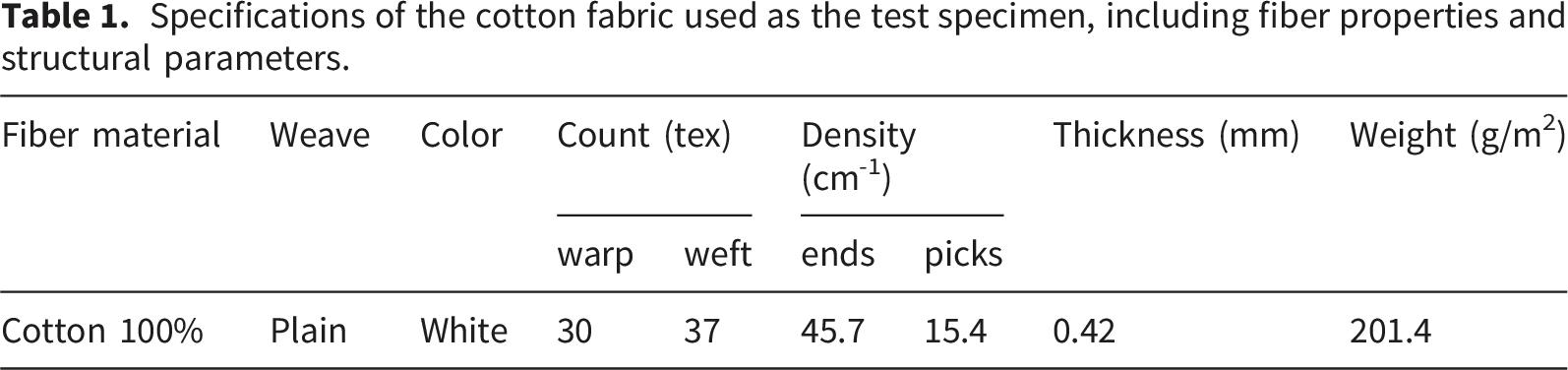
This cotton fabric has been reported in previous studies 23 to exhibit clear particulate soil adhesion behavior and was therefore selected as a standard fabric in which differences in anti-soiling treatment performance can be easily detected.
To standardize the initial surface condition of the fabric, a pretreatment simulating practical laundering conditions was conducted. A household washing machine (NA-FS70H5, Panasonic, Japan) was used. The washing process consisted of washing for 9 min, rinsing for 3 min, rinsing for 3 min, and dehydration for 7 min, with a bath ratio of 1:23 (water volume: 35 L). After washing, the fabric was air-dried indoors and then ironed at 180–200 °C. A synthetic laundry detergent (Emal, Kao Corporation, Japan) was used at a dosage of 40 mL with room-temperature water.
2.1.2. Sample preparation conditions
In this study, representative textile post-treatment agents were selected: a fabric softener (Humming Flair FF&H Hon, Kao Corporation, Japan), a water repellent (SLB-N300C, 3M), and an antistatic agent (Elegard, Lion Corporation, Japan).
Six treatment conditions were prepared: a) untreated (pretreatment only), b) softener treatment, c) water-repellent treatment, d) antistatic-agent treatment, e) softener + water-repellent treatment, f) softener + antistatic-agent treatment. For the softener treatment, 10 mL of the softener was added during the second rinse cycle of the pretreatment washing process.
For the water-repellent treatment, as shown in Figure 1, the spray can was fixed to a stand so that the distance between the nozzle and the fabric surface was maintained at 200 mm. The agent was sprayed for 2 s over a 50 × 50 mm area, and the fabric was repositioned sequentially to treat the entire surface of a 200 × 200 mm sample. After spraying, the samples were air-dried for at least 20 min. The spray can was shaken five times before each application. Spraying was continued until the surface was uniformly moistened without dripping, following the manufacturer’s instructions. To improve treatment reproducibility, the spraying distance, spraying time, and sample positioning were standardized for all samples. Schematic illustration of the spray treatment setup for water-repellent and antistatic agents, showing the fixed nozzle position and the distance between the spray nozzle and fabric surface (200 mm).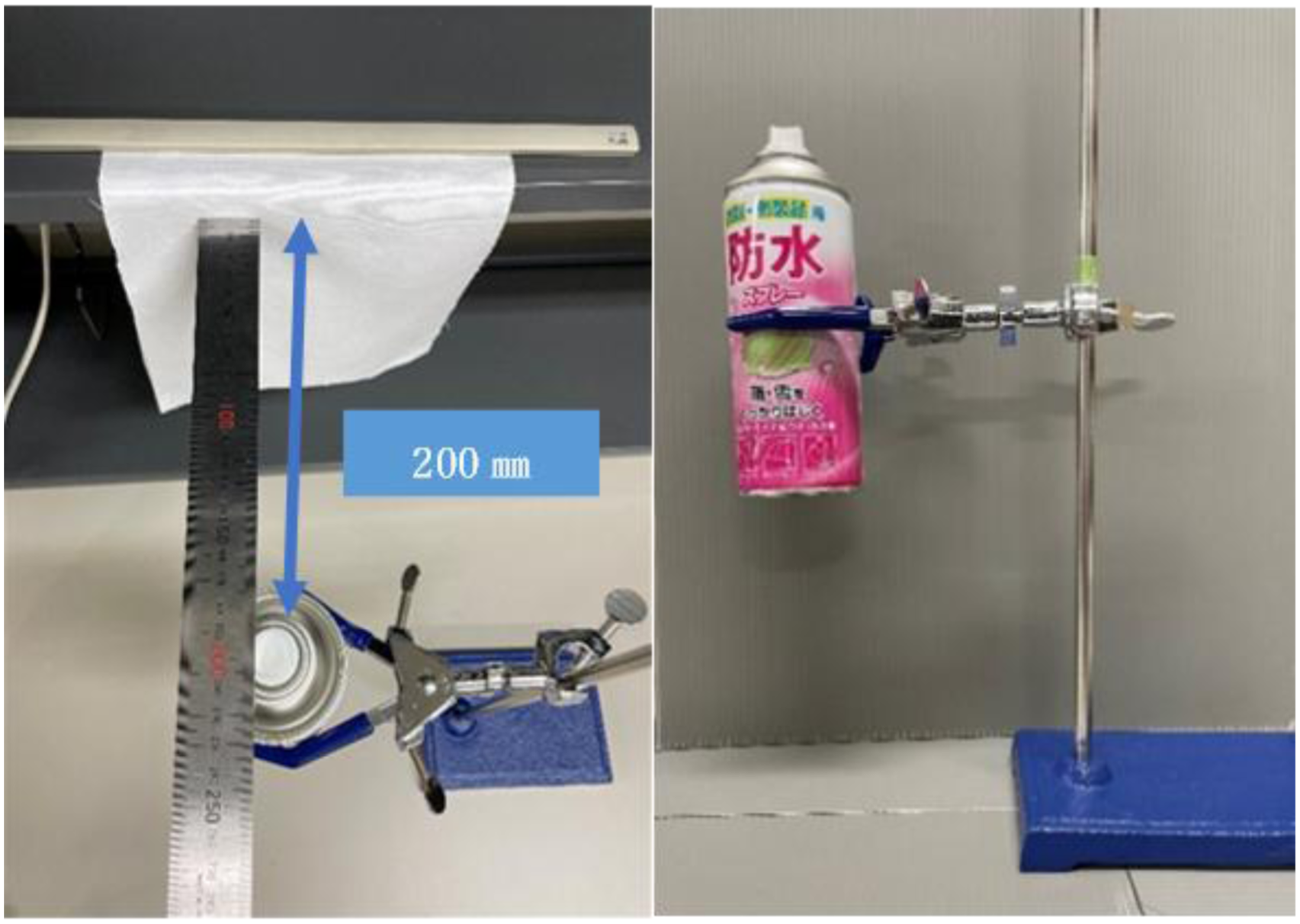
The antistatic treatment was performed using the same spraying procedure as the water-repellent treatment.
For the combined treatments, the softener treatment was first applied during laundering, followed by the spray treatment (water repellent or antistatic agent), reflecting practical application sequences.
2.2. Evaluation of fabric properties
To evaluate changes in fabric surface properties caused by the post-treatment agents, surface characteristics, water repellency, and electrostatic properties were measured.
2.2.1. Surface test
Surface properties were evaluated using a Kawabata Evaluation System surface tester (KES-FB4, Kato Tech Co., Ltd., Japan). Measurements were conducted three times in both the warp and weft directions under standard measurement conditions. The following parameters were obtained: mean coefficient of friction (MIU), mean deviation of the coefficient of friction (MMD), arithmetic mean surface roughness (SMD). The average values and standard deviations were calculated for each parameter. Prior to testing, the specimens were conditioned for 24 h at 20 °C and 65 % relative humidity, and the measurements were performed under the same environmental conditions.
2.2.2. Water repellency test
Water repellency was evaluated using the spray test in accordance with JIS L 1092:2017. 24 In this test, the specimen was mounted on the spray tester at an angle of 45° relative to the direction of falling water. Subsequently, 250 mL of water at 20 ± 2 °C was poured into the funnel and sprayed onto the specimen for 30 s. After spraying, the specimen was inverted and gently tapped against a hard surface to remove residual water droplets. The wetting condition of the specimen surface was then visually compared with standard photographs corresponding to five grades: Grade 5: no wetting and no water droplets, Grade 4: no wetting, small droplets adhered, Grade 3: partial droplet-like wetting, Grade 2: approximately half the surface wetted, Grade 1: entire surface wetted. The grade was determined by agreement between two experimenters. Each sample was tested three times, and the mean value and standard deviation were calculated. Before testing, the specimens were ironed at 180–200 °C to remove residual moisture.
2.2.3. Electrostatic test
Electrostatic properties were evaluated according to JIS L 1094:2014 (half-life method). 16 Each specimen was first neutralized using a blower-type static eliminator (BF-XMB, Shishido Electrostatic, Japan). The specimen was then placed on the specimen table of a static honest meter (H0110-S4B, Shishido Electrostatic, Japan) with the fabric surface facing upward. The distance between the voltage application unit and the specimen table was set to 23 mm, and the distance between the charge-receiving unit and the specimen table was set to 18 mm. Following a 30-s voltage application during rotation of the turntable, the electrostatic voltage when the initial charge voltage decayed to half of its original value was measured as the half voltage (HV). The time required to reach this point was defined as the half-life (HT). Each measurement was repeated three times for each specimen. Before measurement, the specimens were conditioned for 24 h at 20 °C and 40 % relative humidity, and the measurements were performed under the same environmental conditions.
2.3. Soil adhesion and removal test
The stain resistance test was conducted in accordance with JIS L 1919 Method A-1.
25
An artificial contaminant was prepared with the following composition: peat moss (40.00%), Portland cement (17.00%), kaolin (17.00%), diatomaceous earth (17.00%), mineral oil (8.75%), carbon black (0.10%), and ferrite iron (III) oxide (0.15%). The contamination and removal procedures were conducted as follows: ① Three specimens (100 × 100 mm) were cut from each sample and pre-dried to constant weight using an infrared moisture analyzer (FD-720, Kett Electric Laboratory Co., Ltd., Japan) at 50 °C. The specimens were then conditioned for 24 h under standard conditions (20 ± 2 °C, 65 ± 4 % RH). ② The specimens were wrapped along the warp direction around rubber tubes and fixed with vinyl adhesive tape. ③ One gram of the artificial contaminant and the three mounted specimens were placed in a sealed cylindrical container and mounted in an ICI-type pilling tester. The container was rotated parallel to the rotation axis at 60 ± 2 rpm for 20 min. ④ After rotation, the specimens were removed from the rubber tubes. ⑤ To remove loosely adhered contaminant, the reverse side of each specimen was flicked with two fingers. After each flick, the specimen was rotated by 90°, and a total of five flicks were applied. The amount of contaminant adhered and removed during the process was evaluated based on the weight measurement method reported in previous studies.
26
The following weights were measured using an analytical balance (ML204T/00, Mettler Toledo). The weight of soil adhesion (WS) and the removal rate of powder (RR) were calculated using equations (1) and (2), respectively.

Each condition was measured three times, and the mean values and standard deviations were calculated.
3. Results



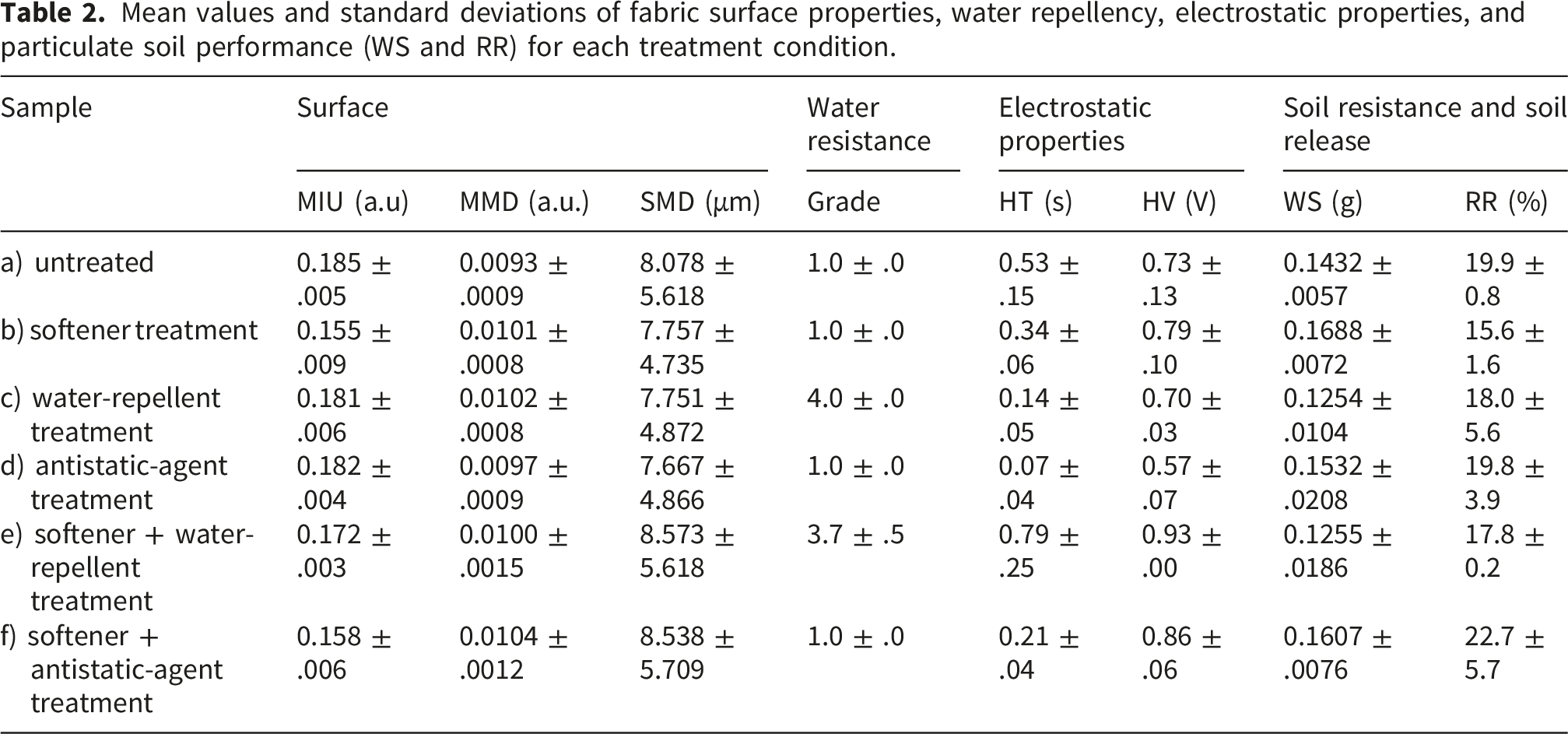
Mean values and standard deviations of fabric surface properties, water repellency, electrostatic properties, and particulate soil performance (WS and RR) for each treatment condition.
Results of one-way ANOVA and Dunnett’s multiple comparison test for evaluating the effects of treatment conditions on fabric properties and anti-soiling performance.
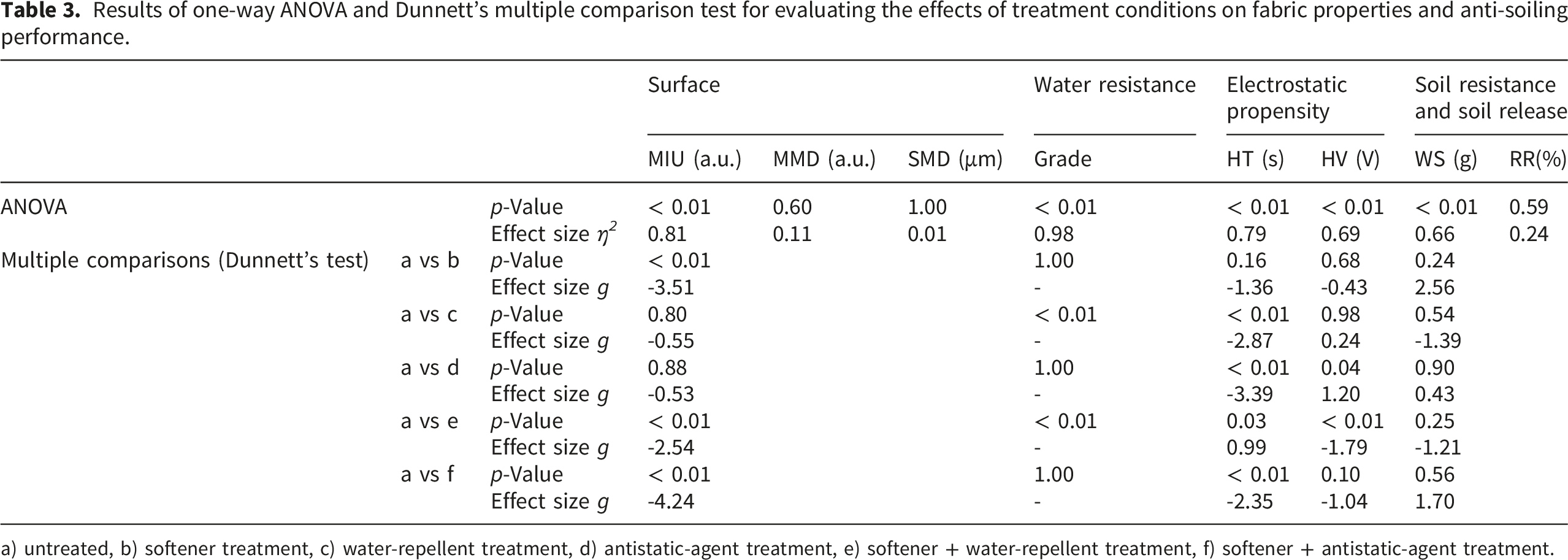
a) untreated, b) softener treatment, c) water-repellent treatment, d) antistatic-agent treatment, e) softener + water-repellent treatment, f) softener + antistatic-agent treatment.
3.1. Physical properties tests
The results of the physical property tests are summarized below. The ANOVA results shown in Table 3 indicate that the sample preparation conditions had significant effects on the mean coefficient of friction (MIU), water repellency grade, and electrostatic properties, namely half-life (HT) and half voltage (HV) (p < 0.01). In contrast, no significant main effects were observed for the mean deviation of the friction coefficient (MMD) or the arithmetic mean surface roughness (SMD). According to the results of Dunnett’s test (Tables 2 and 3), MIU was significantly lower in Samples b, e, and f (fabric softener treatments) than in Sample a (untreated) (p < 0.01). This result indicates that fabric softener treatment reduced the surface friction of the fabric.
For electrostatic properties, significant main effects of the treatment conditions were observed for both HT and HV (p < 0.01). Regarding HT, Samples d and f (antistatic-agent treatments) exhibited significantly shorter HT values than Sample a (untreated) (p < 0.01), indicating faster charge dissipation. In addition, Sample c (water-repellent treatment) also showed a significantly shorter HT compared with Sample a (untreated) (p < 0.01). In contrast, Sample b (softener treatment) showed a tendency toward shorter HT, but the difference was not statistically significant (p = 0.16).
For the half voltage (HV), Sample d (antistatic-agent treatment) showed a significantly lower HV than Sample a (untreated) (p < 0.01). In contrast, no significant differences in HV were observed for Samples b (softener treatment) or Sample c (water-repellent treatment).
For water repellency, Samples c and e (water-repellent treatments) exhibited significantly higher water repellency grades than Sample a (untreated) (p < 0.01).
Overall, these results confirm that each post-treatment agent produced its characteristic effect on the fabric properties under the experimental conditions of this study. In addition, Samples e and f (combination treatments) generally exhibited the primary effects observed in the corresponding single treatments.
3.2. Soil adhesion and removal test
Representative photographs of the samples after the soil adhesion and removal test are shown in Figure 2. Visual observation suggested differences in particulate soil adhesion behavior depending on the treatment condition. In particular, samples treated with water repellent tended to exhibit less visible particulate contamination, whereas samples treated with fabric softener tended to retain more particulate matter on the fabric surface. Representative photographs of particulate contamination behavior after the stain resistance test under each treatment condition: a) untreated, b) softener treatment, (c) water-repellent treatment, d) antistatic-agent treatment, e) softener + water-repellent treatment, and f) softener + antistatic-agent treatment.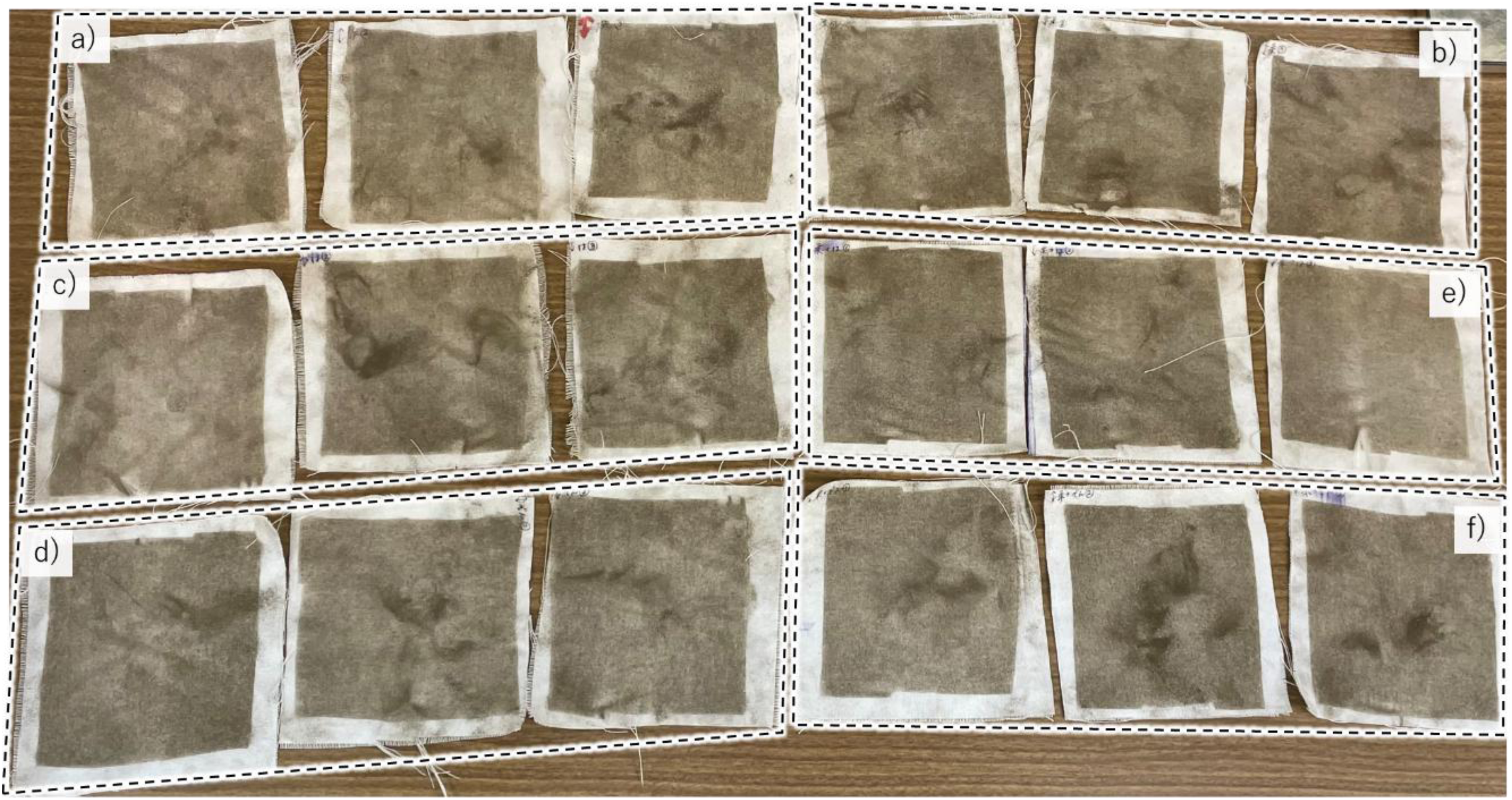
The results of the particulate soil test are summarized in Table 2. For the weight of soil adhesion (WS), the ANOVA results indicated a significant main effect of the treatment conditions (p < 0.01), as shown in Table 3. In contrast, no significant main effect was observed for the removal rate of powder (RR). Because a significant main effect was detected for WS, Dunnett’s test was conducted using Sample a (untreated) as the control. However, no treatment condition showed a statistically significant reduction in WS compared with Sample a (untreated). Although no statistically significant reduction in WS was observed compared with the untreated sample, Samples c and e (water-repellent treatments) showed a tendency toward lower WS values. In contrast, Samples b and f (fabric softener treatments) tended to show higher WS values.
These results suggest that the type of post-treatment agent may influence particulate soil adhesion behavior, although no statistically significant reduction in WS was observed under the present experimental conditions.
4. Discussion
4.1. Relationship between particulate soil adhesion/removal behavior and textile surface properties
In this study, the anti-soiling performance against particulate soil was evaluated using two indicators: the weight of soil adhesion (WS) and the removal rate of powder (RR). The results showed a significant main effect of treatment conditions on WS, whereas no significant main effect was observed for RR. These results indicate that different factors may govern the adhesion and removal processes of particulate soil.
The variation in WS among treatment conditions suggests that surface properties of the fiber, such as frictional characteristics, electrostatic behavior, and surface free energy, influence the adhesion of particulate soil. When particles come into contact with the fiber surface, the physical state of the fiber surface appears to play an important role in determining the ease of adhesion.
In contrast, RR did not differ significantly among treatment conditions. This result suggests that, under the present experimental conditions, particle removal may be influenced more strongly by structural factors than by surface property modifications induced by the post-treatments. Under the removal conditions employed here, differences in surface properties were therefore not clearly reflected in RR.
These findings indicate that anti-soiling performance against particulate soil should not be evaluated using a single index. Instead, the characteristics related to soil adhesion suppression (soil resistance) and those related to post-adhesion removal (soil release) should be considered separately.
4.2. Effect of fabric surface properties on particulate adhesion behavior
As described above, the influence of post-treatments on particulate anti-soiling performance was mainly observed during the adhesion stage. The following discussion examines the relationship between changes in fabric surface properties induced by these treatments and the weight of soil adhesion (WS).
First, considering frictional properties, samples treated with fabric softener exhibited a significant decrease in the mean coefficient of friction (MIU). However, although no statistically significant increase was observed, WS tended to increase relative to the untreated sample. Previous studies have reported that fabric softeners reduce inter-fiber friction by forming surfactant layers on fiber surfaces.11,12 The present reduction in MIU is consistent with these reports. These results suggest that reduced inter-fiber friction does not necessarily suppress particulate adhesion. One possible explanation is that increased fiber mobility caused by softener treatment may facilitate particle penetration into fiber fuzz and inter-fiber spaces in cotton fabrics.
One possible explanation is that the reduction in inter-fiber friction caused by softener treatment may increase fiber mobility, thereby facilitating the penetration of particles into fiber fuzz and inter-fiber spaces. In addition, the hydrophobic film formed by the surfactant component of the softener may stabilize particle adhesion. Thus, the modification of frictional properties may alter the adhesion mechanism rather than simply reducing particle adhesion.
Next, regarding electrostatic properties, previous studies have shown that antistatic treatments suppress charge accumulation and accelerate charge dissipation on textile surfaces.14–16 The reductions in electrostatic half-life (HT) and half voltage (HV) observed in the present study are consistent with these reports. These changes would generally be expected to weaken electrostatic attraction between particles and the fiber surface.21,22 However, the amount of adhered particles (WS) did not decrease compared with the untreated sample. This suggests that although electrostatic interaction contributes to particle adhesion, other factors such as mechanical entrapment associated with fiber surface structure may also have contributed to particle adhesion under the present experimental conditions.
Finally, previous studies have reported that fluorine- or silicone-based water repellents reduce surface free energy and alter wetting behavior on textile surfaces.17–19 The increase in water repellency grade observed in the present study is consistent with these previous findings. Although the decrease in WS was not statistically significant, water-repellent-treated samples showed a tendency toward lower WS values. This trend suggests that reductions in surface free energy may weaken particle–fiber interactions and reduce the stability of particulate adhesion.
Overall, these results indicate that improvements in individual surface properties do not necessarily correspond directly to reduced particulate adhesion. Depending on the treatment, particle adhesion may even increase. Therefore, evaluating anti-soiling performance solely based on improvements in individual physical properties, such as friction reduction or electrostatic control, is insufficient. A comprehensive evaluation considering multiple factors governing particulate adhesion is required. It should also be noted that the present study focused on a cotton fabric with a relatively rough surface structure and fiber fuzz, which may mechanically entrap particulate soil. In contrast, synthetic fibers such as polyester and nylon generally have smoother fiber surfaces and different surface morphologies. Therefore, the adhesion and removal behavior of particulate soil, as well as the effects of post-treatments observed in this study, may differ depending on fiber type and fabric structure. Further studies using a wider range of textile materials are required to clarify the generality of the present findings.
4.3. Possibilities and limitations of anti-soiling control using simple post-treatments
The results of this study demonstrate that post-treatments can modify surface properties such as friction, electrostatic behavior, and surface free energy, thereby influencing particulate adhesion behavior to some extent. This suggests that, even outside the textile manufacturing process, a certain degree of anti-soiling control may be achievable through post-treatment approaches.
However, no statistically significant reduction in WS was observed for any treatment condition, and the observed changes appeared primarily as tendencies rather than clear improvements. One possible reason is that such treatments do not precisely control the amount or distribution of the treatment agents on the fabric surface, leading to variability in treatment effects.
Regarding combination treatments, Samples e (softener + water repellent) and f (softener + antistatic agent) generally retained the primary effects observed in the corresponding single treatments. In other words, the effects of individual treatments were not completely negated when agents were combined. This suggests that multiple surface properties can be modified simultaneously through post-treatment processes.
However, no synergistic anti-soiling effect exceeding that of the individual treatments was observed. This indicates that although multiple surface properties can be modified simultaneously, these effects do not necessarily act in the same direction. In some cases, competitive interactions between treatments may occur.
For example, in Sample f (softener + antistatic agent), a compensatory behavior was observed for the half voltage (HV), suggesting that combined treatments may sometimes suppress improvements in certain surface properties. These findings indicate that while post-treatments can modify surface properties, their effects may interact in complex ways.
Overall, although simple post-treatments show potential for influencing particulate adhesion behavior, their ability to control anti-soiling performance remains limited and dependent on the treatment conditions and combinations used.
4.4. Practical implications and future challenges
The results of this study suggest that even simple post-treatments can influence the adhesion behavior of particulate soil. This indicates the potential to adjust anti-soiling performance according to the intended use and environmental exposure of textile products.
For example, textile products such as outdoor apparel, sportswear, and workwear are frequently exposed to particulate contaminants. In such cases, simple post-treatment approaches may complement anti-soiling treatments applied during manufacturing.
From a practical perspective, the results suggest that antistatic agents and water repellents may reduce particulate adhesion tendencies, whereas fabric softener treatment, despite improving surface smoothness, may increase particulate adhesion. Therefore, when balancing anti-soiling performance with comfort or handle properties, the type and combination of treatment agents should be carefully considered.
While the current findings illustrate the potential of simple post-treatments for influencing particulate adhesion behavior, several limitations remain. First, the mechanistic interpretations proposed in this study are based on the relationships between changes in surface properties and particulate adhesion behavior. Direct observations of fiber morphology, particle penetration behavior, and interfacial interactions were not performed. Therefore, the proposed mechanisms should be interpreted as possible explanations rather than direct evidence. Further investigation using microscopic observation and quantitative analysis of particle–fiber interactions is needed to clarify the underlying mechanisms.
In addition, in simple post-treatments using household textile care agents, particularly for spray-applied treatments such as the water repellent and antistatic agent used in this study, it is difficult to precisely control the amount and uniformity of treatment agents on the fabric surface. Because the treatment add-on amount and surface coverage were not quantitatively evaluated, variability in treatment distribution may have affected the reproducibility and interpretation of anti-soiling performance. Quantitative evaluation of treatment coverage and dosage represents an important next step for better understanding their relationships with changes in surface properties.
Furthermore, this study focused on a single cotton fabric and a particulate contaminant defined by JIS L 1919, which may limit the generality of the findings. Therefore, the present results may not directly apply to synthetic fibers, blended fabrics, or other textile structures with different surface characteristics. Future research should systematically investigate the effects of fiber type, blend composition, fabric structure, particle size, and electrostatic properties on particulate adhesion behavior.
5. Conclusion
This study investigated the effects of simple post-treatments using textile treatment agents—fabric softeners, antistatic agents, and water repellents—on fabric surface properties and the adhesion and removal behavior of particulate soil. The results demonstrated that the factors influencing particulate soil contamination differ between the adhesion and removal stages. The post-treatments mainly affected the weight of soil adhesion (WS), whereas no significant influence was observed on the removal rate of powder (RR).
Regarding surface properties, water-repellent treatment showed a tendency toward reduced soil adhesion (WS), although no statistically significant reduction was observed under the present experimental conditions. In contrast, fabric softener treatment, despite decreasing surface friction, tended to increase soil adhesion. In addition, although antistatic treatment improved electrostatic properties, this improvement did not necessarily correspond to reduced soil adhesion. These findings indicate that improvements in individual surface properties do not always directly suppress particulate soil adhesion.
For combination treatments, the primary surface property changes observed in single treatments were generally maintained. However, no synergistic anti-soiling effect exceeding that of the individual treatments was observed, and in some cases compensatory effects appeared in certain physical property indices.
These results suggest that when attempting to control particulate soil adhesion through post-treatment approaches, it is important to select appropriate treatment agents and combinations based on the mechanisms of particulate adhesion and the desired surface properties, rather than applying treatments indiscriminately.
Overall, the findings demonstrate the potential of simple post-treatment approaches to influence particulate anti-soiling performance and provide fundamental guidelines for evaluating soil resistance and soil release behavior from the perspective of textile surface properties.
Footnotes

Author contributions
H.M. conceived and designed the study and supervised the project. T.Y. and Y.S. conducted the experiments and collected the data. T.Y. and H.M. wrote the manuscript. All authors read and approved the final manuscript.
Funding
The authors received no financial support for the research, authorship, and/or publication of this article.
Declaration of conflicting interests
The authors declared no potential conflicts of interest with respect to the research, authorship, and/or publication of this article.
Data Availability Statement
The datasets generated during and/or analyzed during the current study are available from the corresponding author on request.