






Abstract
“Understanding the relationship between falls and subsequent nursing home placement can help in developing interventions aimed at promoting aging without injury.”
Introduction
Unintentional falls are a leading cause of injury-related morbidity and mortality among adults aged 65 and older (older adults).1,2 In the United States, each day there are over 100 deaths and over 10 000 injuries due to older adults falls.1,2 Among older adults treated in an emergency department for a fall injury, about 20–30% sustained moderate to severe injuries including fractures, head injuries, and lacerations. 3 The majority of hip and pelvic injuries and internal injuries required hospitalization or transfer for additional care. 3 Non-fatal falls often lead to a cascade of adverse events including increased healthcare utilization and loss of independence.4-6 Falls have been identified as a major predictor of subsequent nursing facility admission, with previous reports finding that individuals who experienced falls were more likely to be admitted to these facilities due to complications or diminished functional capacity.6,7 One of the most often cited studies was conducted over 20 years ago on a sample of older adults in one jurisdiction. 8 Given decreases in percentages of older adults living in nursing homes, updated, nationally representative estimates of the relationship of falls with nursing home entry are warranted. 9
There is limited research on different nursing facility types within the same study. Nursing homes and skilled nursing facilities (SNFs) both serve as settings for long-term care but may differ in the types of care they provide. Nursing homes primarily assist with activities of daily living (ADLs), or activities related to personal care. Nursing home coverage is typically paid for by Medicaid or long-term care insurance benefits. SNFs offer more intensive medical care, including rehabilitation therapies, post-acute medical care, and specialty medication administration. SNF care is typically covered by Medicare for a limited number of days per year.10,11
This study aims to use the nationally representative, longitudinal Medicare Current Beneficiary Survey (MCBS) to examine the relationship between unintentional falls in older adults and subsequent placement in nursing facilities (nursing homes or SNFs) while characterizing older adults by age, sex, race, health status, and functional limitations. Understanding the characteristics of older adults admitted to nursing facilities after a fall can help improve care models and interventions aimed at preventing falls.
Methods
Data Source
Data from the MCBS were examined for this study. MCBS is a longitudinal continuous phone and in-person survey that collects information on Medicare beneficiaries, such as medical risk factors, healthcare usage, and health outcomes directly from the beneficiaries themselves.12,13 Interviews are conducted three times a year for 4 years for each participant. The data were obtained through the Centers for Medicare and Medicaid Services (CMS). MCBS data used were a Limited Data Set (LDS), which are files that contain beneficiary-level health information but do not include direct identifiers. 14
Data from 2016–2021 MCBS were analyzed to measure older adult (65+) falls for five cohorts in the baseline years (2016, 2017, 2018, 2019, and 2020) and estimate the risk of nursing facility (nursing home or SNF) placement in the subsequent years (2017, 2018, 2019, 2020, and 2021). To ensure proper temporal ordering, we measure falls in the baseline year and nursing home admission in the subsequent year. Each 2-year survey period was combined to maximize sample size and increase analytical power. Older adults who were community-dwelling and alive at baseline, and were surveyed between 2016 and 2021, were included in the analysis. The analytical sample for the study includes 31 517 beneficiaries and represents over 200 000 000 older adult Medicare beneficiaries across the five cohorts based on the continuously enrolled 2-year longitudinal weights provided in the MCBS sampling files. Among all beneficiaries, response rates of the MCBS for continuously enrolled beneficiaries were stable of around 52%–54% from 2016 to 2019. In 2020 and 2021, response rates decreased to 40.3% and 36.6%, respectively, but outreach and data collection procedures were changed due to COVID-19 pandemic. 14 An overview of the study design and beneficiary flow is provided in a flowchart in Supplemental Figure 1.
Study Measures
Independent Variables
The main independent variable in this analysis was a binary variable that shows if an older adult experienced at least one fall or no falls in the baseline year. The covariates included in the analysis have an association with nursing facility admissions based on previous studies and were collected at baseline.15,16 They include age, sex, race, marital status, dual eligibility of Medicare and Medicaid, general health, chronic conditions, Activities of Daily Living Limitations (ADLLs), and Instrumental Activities of Daily Living Limitations (IADLLs). Age was categorized into three categories: 65–74 years, 75–84 years, and 85+ years. Race was recategorized into a binary variable, white and all other races, due to sample size. Marital status was coded into a binary variable where a beneficiary is either married at baseline or not. The not married category includes those who were widowed, divorced, separated, or never married. Dual eligibility indicated whether a beneficiary is dual eligible for full eligibility of Medicare and Medicaid. General health was coded as poor/fair, good, and very good/excellent.
The chronic conditions included were depression, dementia, Alzheimer’s, diabetes/high blood sugar, Parkinson’s disease, stroke, arthritis, osteoporosis, mental disorder, hypertension/high blood pressure, myocardial infarction/heart attack, other heart condition, osteoarthritis, hardening of arteries, congestive heart failure, and other cancer. The chronic condition variable was categorized into three groups: 0 conditions, 1 or 2 conditions, and 3 or more conditions. The ADLLs included were difficulty in walking, bathing, dressing, eating, getting in/out of a bed/chair, and using the toilet. The IADLLs included were difficulty using the telephone, preparing meals, doing light housework, managing money, and shopping. Both the ADLL and IADLL variables were recoded into binary variables as 0 or 1 or more ADLLs or IADLLs.
Outcome Variables
The outcome being assessed was admission into a nursing facility. This was also broken down into nursing homes and SNFs. To determine admission into a nursing facility in the following year after a fall, the older adult first must not have been admitted in the base year. In addition, some recipients were placed into multiple facilities in a given year; however, we only considered the first admission as their main facility placement. To determine the first admission, we used the earliest date of admission within the year regardless of the placement being in a nursing home or SNF.
Statistical Methods
Descriptive statistics were calculated displaying the count, weighted percentage, and 95% confidence interval (CI) for older adults who fell at baseline and separately for older adults who were admitted in the following year by age, sex, race, marital status, dual eligibility of Medicare and Medicaid, general health, chronic conditions, ADLLs, and IADLLs. We used Chi-square significance testing to assess the difference between demographic characteristics among older adults who reported a fall in the baseline year and those who were admitted into a nursing facility, with statistical significance defined as P < .05. Crude risk ratios and adjusted risk ratios (aRRs) adjusting for the nursing facility risk factors mentioned above with their respective 95% CIs were calculated for any nursing facility admission, nursing home admission, and SNF admission following a fall at baseline year. Statistical analysis was performed in SAS 9.4 and SAS-Callable SUDAAN 11.
Results
Descriptive Statistics for Community-Dwelling Older Adults Who Fell at Baseline (n = 7575), Medicare Current Beneficiary Survey, 2016–2021
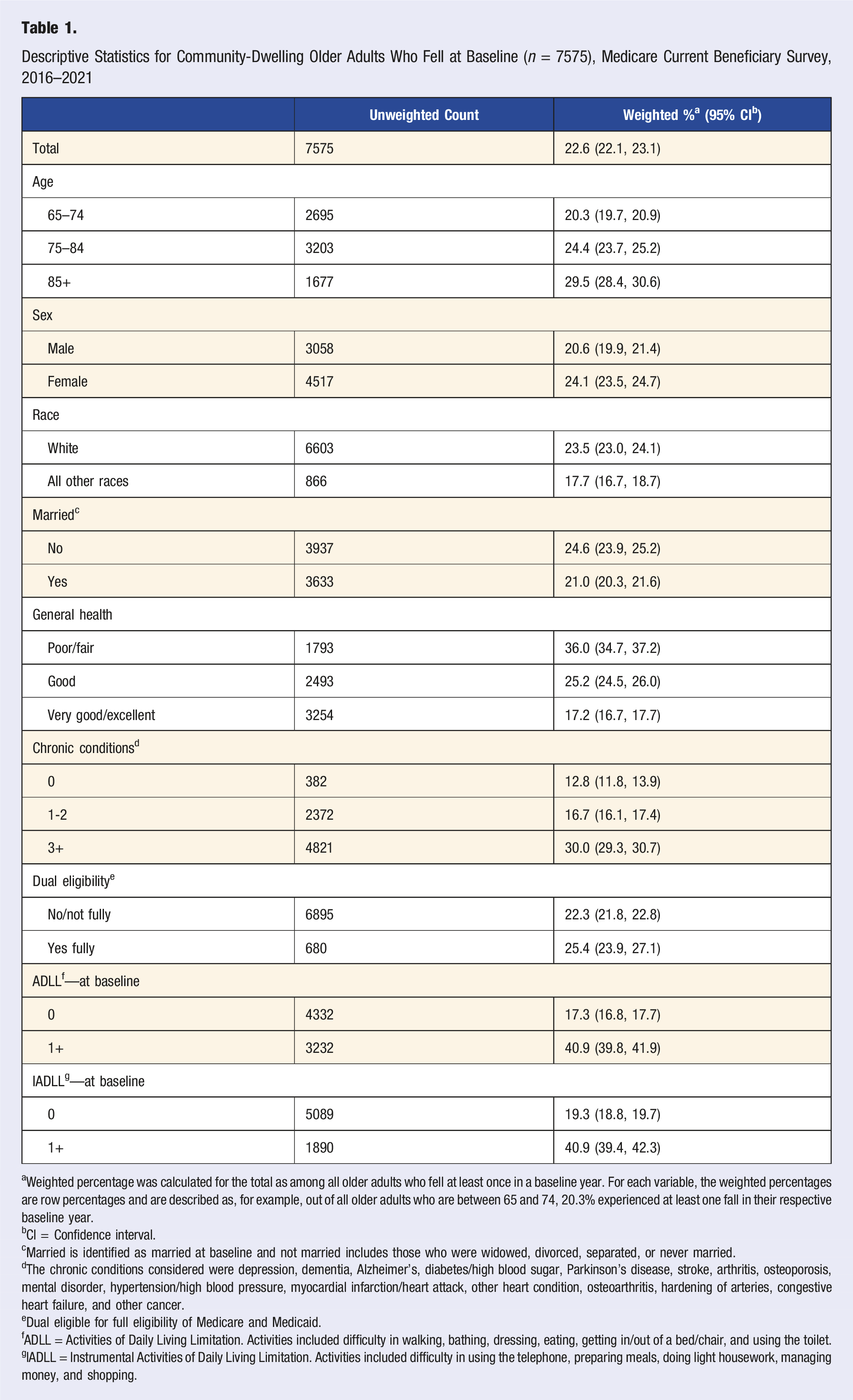
aWeighted percentage was calculated for the total as among all older adults who fell at least once in a baseline year. For each variable, the weighted percentages are row percentages and are described as, for example, out of all older adults who are between 65 and 74, 20.3% experienced at least one fall in their respective baseline year.
bCI = Confidence interval.
cMarried is identified as married at baseline and not married includes those who were widowed, divorced, separated, or never married.
dThe chronic conditions considered were depression, dementia, Alzheimer’s, diabetes/high blood sugar, Parkinson’s disease, stroke, arthritis, osteoporosis, mental disorder, hypertension/high blood pressure, myocardial infarction/heart attack, other heart condition, osteoarthritis, hardening of arteries, congestive heart failure, and other cancer.
eDual eligible for full eligibility of Medicare and Medicaid.
fADLL = Activities of Daily Living Limitation. Activities included difficulty in walking, bathing, dressing, eating, getting in/out of a bed/chair, and using the toilet.
gIADLL = Instrumental Activities of Daily Living Limitation. Activities included difficulty in using the telephone, preparing meals, doing light housework, managing money, and shopping.
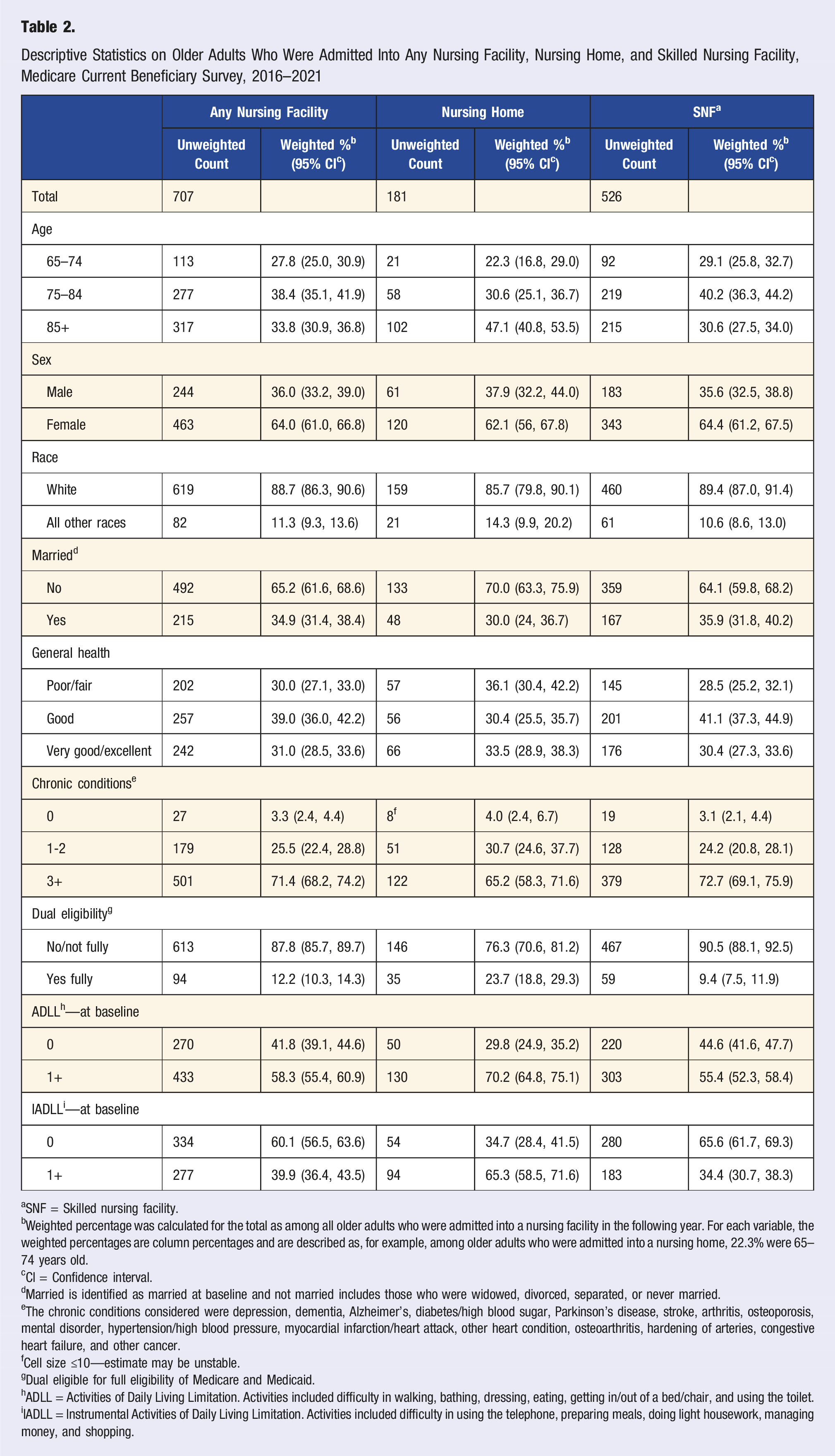
Descriptive Statistics on Older Adults Who Were Admitted Into Any Nursing Facility, Nursing Home, and Skilled Nursing Facility, Medicare Current Beneficiary Survey, 2016–2021
aSNF = Skilled nursing facility.
bWeighted percentage was calculated for the total as among all older adults who were admitted into a nursing facility in the following year. For each variable, the weighted percentages are column percentages and are described as, for example, among older adults who were admitted into a nursing home, 22.3% were 65–74 years old.
cCI = Confidence interval.
dMarried is identified as married at baseline and not married includes those who were widowed, divorced, separated, or never married.
eThe chronic conditions considered were depression, dementia, Alzheimer’s, diabetes/high blood sugar, Parkinson’s disease, stroke, arthritis, osteoporosis, mental disorder, hypertension/high blood pressure, myocardial infarction/heart attack, other heart condition, osteoarthritis, hardening of arteries, congestive heart failure, and other cancer.
fCell size ≤10—estimate may be unstable.
gDual eligible for full eligibility of Medicare and Medicaid.
hADLL = Activities of Daily Living Limitation. Activities included difficulty in walking, bathing, dressing, eating, getting in/out of a bed/chair, and using the toilet.
iIADLL = Instrumental Activities of Daily Living Limitation. Activities included difficulty in using the telephone, preparing meals, doing light housework, managing money, and shopping.
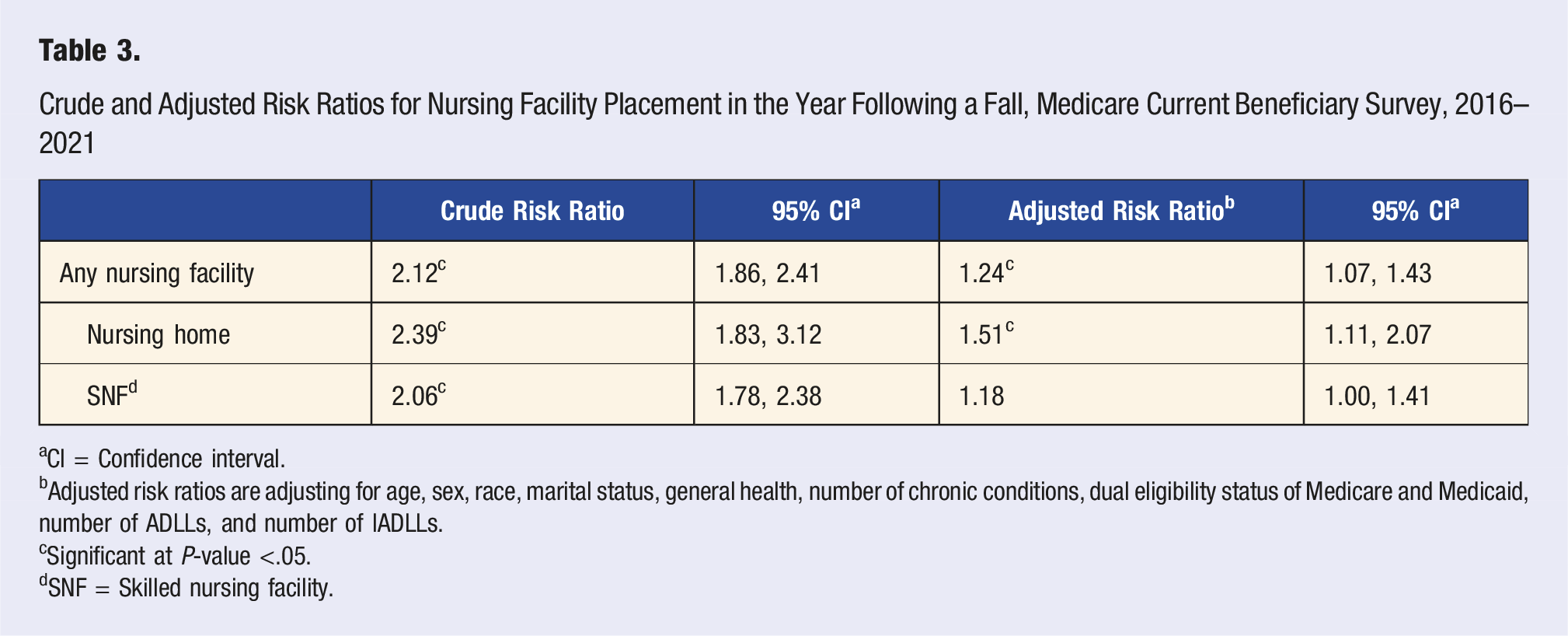
Crude and Adjusted Risk Ratios for Nursing Facility Placement in the Year Following a Fall, Medicare Current Beneficiary Survey, 2016–2021
aCI = Confidence interval.
bAdjusted risk ratios are adjusting for age, sex, race, marital status, general health, number of chronic conditions, dual eligibility status of Medicare and Medicaid, number of ADLLs, and number of IADLLs.
cSignificant at P-value <.05.
dSNF = Skilled nursing facility.
Discussion
Our study highlights the significant association between falls and an increased risk of nursing facility placement among older adult Medicare beneficiaries. The association persisted even after adjusting for demographic and health characteristics. Our study is unique in that we were able to compare two different types of nursing facilities in the same study and show that the risk of nursing home admission was higher compared to SNF placement. These findings contribute to a growing body of evidence that identifies falls not only as a cause of injury but also an event in the transition from community living to institutional care.6,7 Falls among older adults often initiate a cascade of events that undermine an older adult’s ability to live independently. Beyond physical injury, falls often result in psychological consequences such as fear of falling again, which can limit mobility and reduce independence, and contribute to further functional decline.17,18 In many cases, the consequences of a fall combined with limited in-home caregiver support and inadequate home environments may result in nursing home placement, even if the physical injury from the fall is not severe.4,19,20
In our cohort, we identified several demographic and health characteristics associated with higher fall rates at baseline, including age (85+ years), female sex, poor self-reported health status, multiple chronic conditions, and existing functional limitations. These factors increased fall risk and likely exacerbated the severity and consequence of falls, contributing to a greater need for institutional care in the subsequent year. Our findings are consistent with prior literature that identified these populations at higher risk of falls and nursing home placement.21-23 Not only do these characteristics increase fall risk, we also identified functional limitations and the presence of three or more chronic conditions to be significantly associated with the risk of nursing home placement after a fall. These factors are indicative of greater frailty and a higher need for assistance with daily activities, making it more challenging for individuals to recover from falls independently. Two-thirds of those who were admitted to nursing homes after a fall had three or more pre-existing health conditions, suggesting that intervening earlier in these populations to prevent or reduce these conditions could prevent falls and help delay or prevent institutionalization.
Falls are multifactorial with both intrinsic and extrinsic factors contributing to increased fall risk. Intrinsic factors such as gait, strength and balance disturbances, muscle weakness, cognitive deficits, and visual disturbances are well-documented risk factors for falls.24-27 Extrinsic factors including the use of medications and environmental hazards (e.g., slippery floor or poor lighting) can further increase the likelihood of falls and subsequent injury.25,27 Reducing these risk factors can in turn reduce the risk of a fall. 28 While older adults can take some preventive actions on their own such as doing strength and balance exercises, other risk factors including chronic conditions and medications need to be addressed by a healthcare professional. The Centers for Disease Control and Prevention’s Stopping Elderly Accidents, Deaths, and Injuries (STEADI) initiative offers healthcare professionals practical tools to screen for fall risk, assess for modifiable factors, and intervene effectively to reduce the likelihood of future falls. 29 Implementing STEADI-based strategies in primary care settings has been shown to reduce fall-related hospitalizations and may lower associated healthcare expenditures. 30 STEADI also provides prevention information for older adults and caregivers. Approximately 2.5% of US adults aged 65 and over lived in a nursing facility/SNF, but for those 85 years and older, over 10% reside in these facilities. 31 Fall prevention efforts can help reduce injury, loss of independence, 30 and potentially admission into these nursing facilities. Successful implementation of fall prevention programs like STEADI requires substantial system-level support, including adequate reimbursement for time-intensive assessments and interventions. Public health initiatives that promote home safety assessments, community-based exercise programs, and caregiver education can reduce fall-related injuries and delay the need for long-term care.
Limitations
While our study offers valuable insights into the relationship between falls and subsequent nursing home placement, several limitations should be noted. First, the MCBS relies on self-reported data, which may introduce recall bias, particularly regarding fall events or the accuracy of chronic condition reporting. This could lead to underreporting or misclassification of falls and other health conditions. Second, our study is observational, and causality cannot be inferred from the results. Third, due to the structure of MCBS, we did not include older adults who fell and were admitted in the same year. We cannot precisely identify the date of a fall occurring and therefore cannot determine whether a fall occurred before or after a nursing facility admission. We also were unable to assess falls occurring prior to MCBS enrollment, which underestimates lifetime fall burden and its relationship to nursing facility placement. Fourth, for our study, we focused on using the binary variable for falls and did not include the number of falls and if a fall resulted in an injury. Fifth, while we adjusted for a variety of demographic and health characteristics, the data may still be subject to unmeasured confounding variables, such as environmental hazards, living situation, and social support networks, which may influence prevalence of fall and nursing home placement. Additionally, since the MCBS sample does not include all Medicare beneficiaries, the findings may not be generalizable to the broader population.
Conclusion
Understanding the relationship between falls and subsequent nursing home placement can help in developing interventions aimed at promoting aging without injury. By identifying and addressing key risk factors for falls, healthcare providers can implement preventive measures such as physical therapy, home modification, and medication adjustments to help older adults maintain their independence for as long as possible.
Supplemental Material
Supplemental Material - Older Adult Falls as a Predictor of Nursing Facility Placement
Supplemental Material for Older Adult Falls as a Predictor of Nursing Facility Placement by Dawson S. Dobash, Yara Haddad, Ketra Rice, and Gwen Bergen in American Journal of Lifestyle Medicine
Footnotes
Author Contributions
Study concept and design: All. Analysis of data/statistical analysis: DD and KR. Interpretation of data: All. Drafting of the manuscript: DD and YH. Critical revision of the manuscript for important intellectual content: All. Final review and approval of manuscript: All.
Declaration of Conflicting Interests
The authors declared no potential conflicts of interest with respect to the research, authorship, and/or publication of this article.
Funding
The authors received no financial support for the research, authorship, and/or publication of this article.
Disclaimer
The findings and conclusions in this report are those of the authors and do not necessarily represent the official position of the Centers for Disease Control and Prevention.
Ethical Consideration
Ethical approval was not required for this study.

Supplemental Material
Supplemental material for this article is available online.