







Abstract
This study focuses on the development and evaluation of a tailored culinary nutrition education pilot program targeting the diet quality and cooking self-efficacy of university students. This program, titled the College Cooking Connection (CCC), was informed by community-based participatory research (CBPR), social cognitive theory (SCT), and evidence-based curricula. Moreover, the CCC curriculum was preemptively evaluated by experts for perceived feasibility and acceptability in a college student population. Success of learner objectives and perceived change in skills and knowledge were assessed using post-lesson evaluations and surveys. Clarity and feasibility of lesson objectives and content were supported by expert reviewers, and most undergraduate participants accurately completed lesson evaluations. Furthermore, a majority of undergraduates reported a perceived improvement in culinary/nutrition skills and knowledge following completion of CCC. The greatest perceived increase in knowledge following completion of CCC was in the category of nutrition and mental health, while undergraduates found lesson topics related to cooking skills and budgeting to be the most valuable. The CCC contributes novel curriculum development methodology to the existing body of research targeting undergraduates’ dietary behaviors, while highlighting the feasibility and efficacy of a community-tailored approach to undergraduate health programming.
“The overall success of CCC program outcomes may be related to increased participant engagement with lesson content considered relevant to undergraduates.”
Introduction
The transition from adolescence to young adulthood is accompanied by drastic lifestyle changes, often involving the adoption of new health behaviors.1,2 For many young adults this transition occurs within the college environment, which is marked by demanding academic schedules, widely accessible convenience foods, and excessive alcohol consumption. These factors contribute to unhealthy dietary choices commonly reported by university students, including inadequate fruit and vegetable intake and excessive intake of processed foods.3,4 According to a national survey conducted by the American College Health Association in 2025, less than one third of undergraduates eat three or more servings of vegetables daily and only 18.5% meet the dietary guidelines for fruit intake. 5 The suboptimal dietary patterns of college students are likely connected to infrequent at-home meal preparation, which may be impacted by the low cooking self-efficacy of this population.6-8 Disrupting current trends in undergraduates’ dietary habits is of significant importance due to the increased risk of unhealthy weight gain among this cohort. First year college students report gaining an average of 3-7 pounds, with weight gain often persisting throughout degree progression.9-11 Unhealthy weight outcomes in young adulthood exacerbate the risk for obesity and related comorbidities later in adulthood,12,13 highlighting the need for nutrition and culinary interventions to improve the dietary behaviors of undergraduates. Existing culinary and nutrition programs targeting the cooking self-efficacy of college students have been shown to increase at-home meal preparation and improve overall diet quality.14-16 The success of former undergraduate nutrition programs is likely related to the use of behavioral theories in program curricula.17,18 Nutrition interventions have been widely centered around the Social Cognitive Theory (SCT),14-16 which focuses on intrinsic and extrinsic factors that influence human behavior, with an emphasis on increasing self-efficacy through experience and skill mastery.18,19
While the SCT has proven to be a powerful tool in eliciting dietary behavior change,18,19 the complex nature of college students’ health warrants a more tailored approach. Undergraduate specific programs often focus on general nutrition information, basic cooking skills, and grocery shopping.14-16 Although considered important topics, subjects like mental health and budgeting are commonly overlooked in existing programs despite being key influencers of college students’ dietary choices.3,4 The absence of these topics in program curricula could be related to the lack of community-based participatory research (CBPR) in culinary and nutrition interventions designed for undergraduates. The use of CBPR increases feasibility and efficacy of health interventions by involving members of the target population as interest-holders in program development.20-22 This approach not only empowers community members, but also provides the research team with an in-depth understanding of specific community needs. Excluding community input during program development may result in missing essential topic areas that undergraduates find to be particularly helpful and motivational for eliciting behavior change. To our knowledge, few undergraduate nutrition programs utilize CBPR to tailor program content.23,24 Therefore, this study aims to address current gaps in undergraduate nutrition program development and highlight the feasibility and efficacy of a community-tailored approach to undergraduate nutrition education. This program, titled the College Cooking Connection (CCC), was evaluated for feasibility and acceptability by experts and undergraduates alike.
Program Overview
CBPR and Curriculum Development
The college-tailored health program originated as a product of a CBPR course offered to undergraduates at the University of Maine and University of Kentucky and received expedited Institutional Review Board approval from both universities. During the CBPR course, undergraduate research partners (full-time students aged 18-24) collaborated with faculty research partners to conduct campus-wide situational assessments and interviews with community interest-holders. Utilizing themes identified from situational assessments and interviews, undergraduate research partners developed proposals for potential college health interventions. During a 3-day workshop at the end of the CBPR course, undergraduate research partners presented their ideas to classmates and faculty research partners and selected an intervention using nominal group technique. The resultant program framework was a culinary and nutrition intervention. Undergraduates were recruited for participation in CCC through a campus-wide email containing a survey which provided the option to enroll in the program. Written consent was obtained from participants at the time of enrollment.
College Cooking Connection 4-week Program Overview.
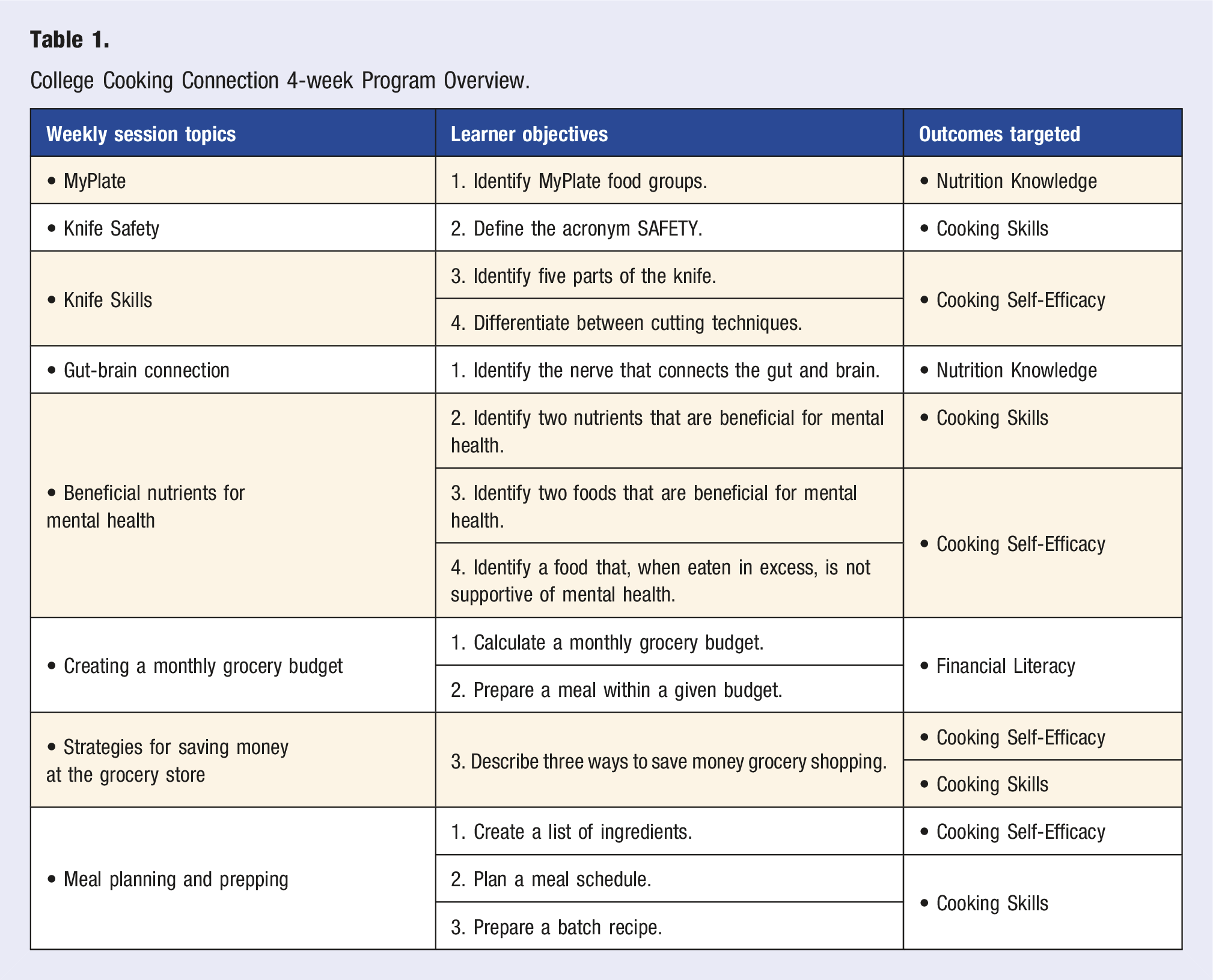
Lesson one of CCC focused on general nutrition knowledge and culinary skills, with an emphasis on MyPlate 26 and knife skills. Undergraduates applied their knowledge during the corresponding cooking activity through identification of MyPlate food groups and the application of various cutting techniques (i.e., chop, dice, and mince). Lesson two introduced students to the connection between nutrition and mental health. During this lesson, students learned which foods contain beneficial nutrients for mental health and prepared a recipe containing these ingredients. Lesson three of CCC focused on budgeting, including how to create a grocery budget and strategies for saving money at the grocery store. During the corresponding culinary activity, students created their own recipe within a given budget of $10 using ingredients from a mock grocery store assembled by instructors. The final lesson of CCC built upon skills and knowledge from previous classes and focused on meal planning and prepping. To reiterate topics covered in the final lesson, students prepared a batch recipe. While CCC was specifically tailored to meet the needs of undergraduates, lesson topics and activities can be adapted for other populations using a CBPR approach.
Evaluation and Results
Evaluation of CCC was conducted in two parts: the first being through expert review of the curriculum and the second being through assessment of participant outcomes. All data were analyzed using descriptive statistics.
Expert Review
All CCC materials were preemptively evaluated by experts to assess program feasibility and acceptability. An expert review survey was developed in Qualtrics and distributed to a non-randomized sample of experts (N = 20) specializing in nutrition, college student health, curriculum development, and education. Perceived program feasibility and efficacy were measured using an interval scale, where experts were asked to numerically rank the CCC curriculum based on perceived teachability, feasibility, and ability to improve undergraduates’ nutrition-related health behaviors. Scores ranged from 0-10, with higher scores indicating greater perceived feasibility and greater potential to facilitate healthful behavior change. The expert review also included an open-ended portion intended to give expert reviewers the opportunity to provide unstructured curriculum feedback regarding likes, dislikes, missing topics, and potential areas of confusion.
Of the 20 experts contacted, seven completed the expert review. Those who completed the expert review survey specialized in nutrition and college student health, and three of them were registered dietitians. On average, expert reviewers had 4.3 (±11.32) years in their respective fields, ranging from 0 (current graduate student) to over 25 years of experience. Clarity of program objectives and adequacy of lesson content were unanimously supported by expert reviewers (n = 7). Expert reviewers felt confident in their ability to teach the CCC curriculum (8.5 ± 1.57) and supported the feasibility of offering CCC on their respective campuses (8.96 ± 0.87). Expert reviewers also reported that the program could improve the diet quality (8.37 ± 2.08), cooking skills (9.34 ± 0.73), self-efficacy (9.48 ± 0.85), and cooking self-efficacy (8.43 ± 1.52) of undergraduates.
To summarize findings of open-ended survey questions, inductive thematic analysis was performed by two graduate student coders. Overall, expert reviewers found the curriculum valuable, organized, and clear, but noted the need for additional resources and improved accessibility for instructors. Expert reviewers suggested including PowerPoint presentations with corresponding lessons to increase convenience and consistency for instructors, as well as additional information related to kitchen set-up. All expert reviewers gave similar feedback across both quantitative and qualitative questions. Constructive feedback from expert reviewers was used to make curriculum revisions prior to the start of CCC classes. These changes included rephrasing lesson objectives from “should be able” to “will be able,” the addition of a vegetarian option for all recipes, and the inclusion of a detailed list of kitchen equipment and utensils needed for recipe preparation.
Participant Evaluation
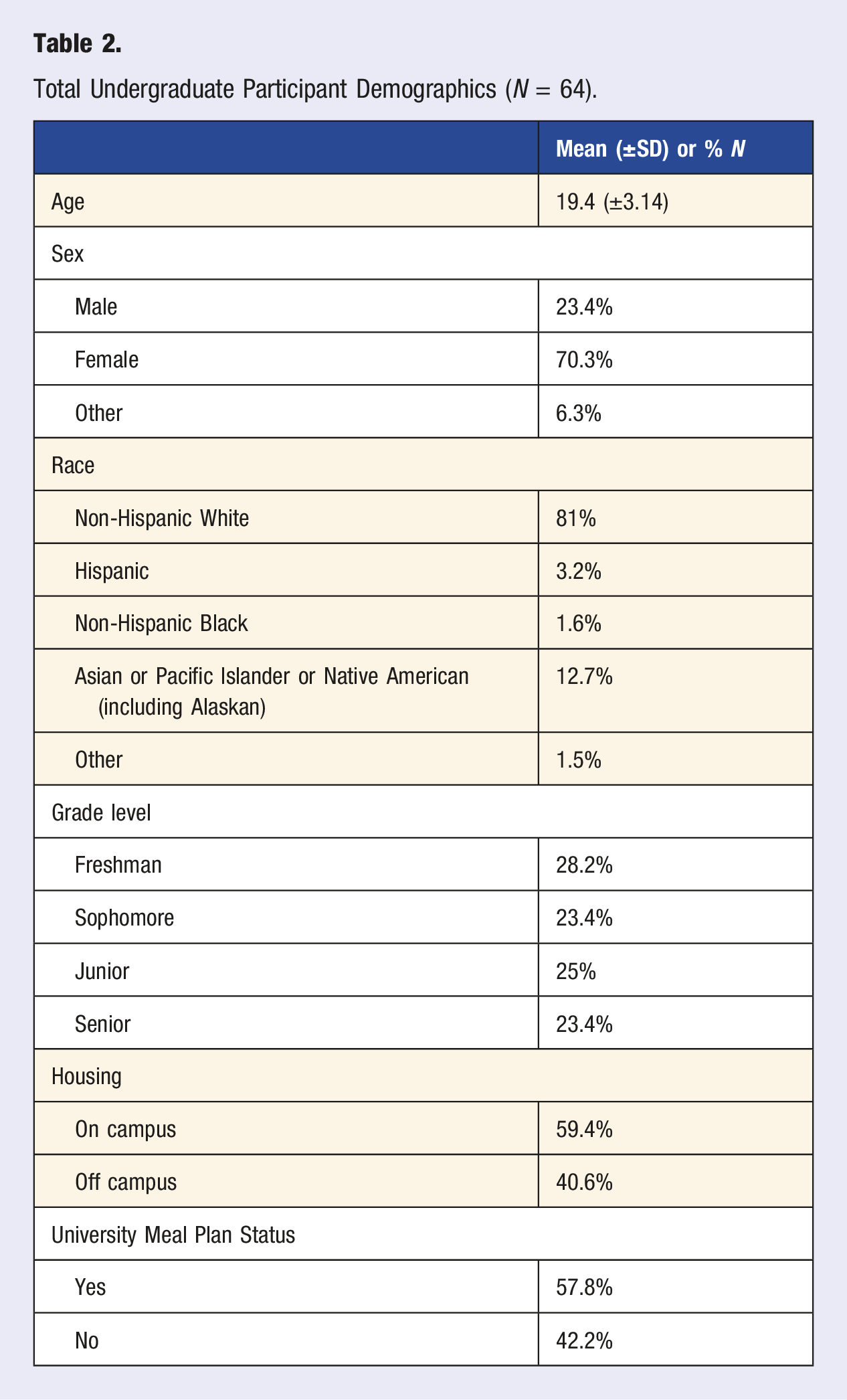
Total Undergraduate Participant Demographics (N = 64).
Mean % (n) College Cooking Connection Lesson Objectives Met by Subsample of Undergraduate Participants (N = 44).
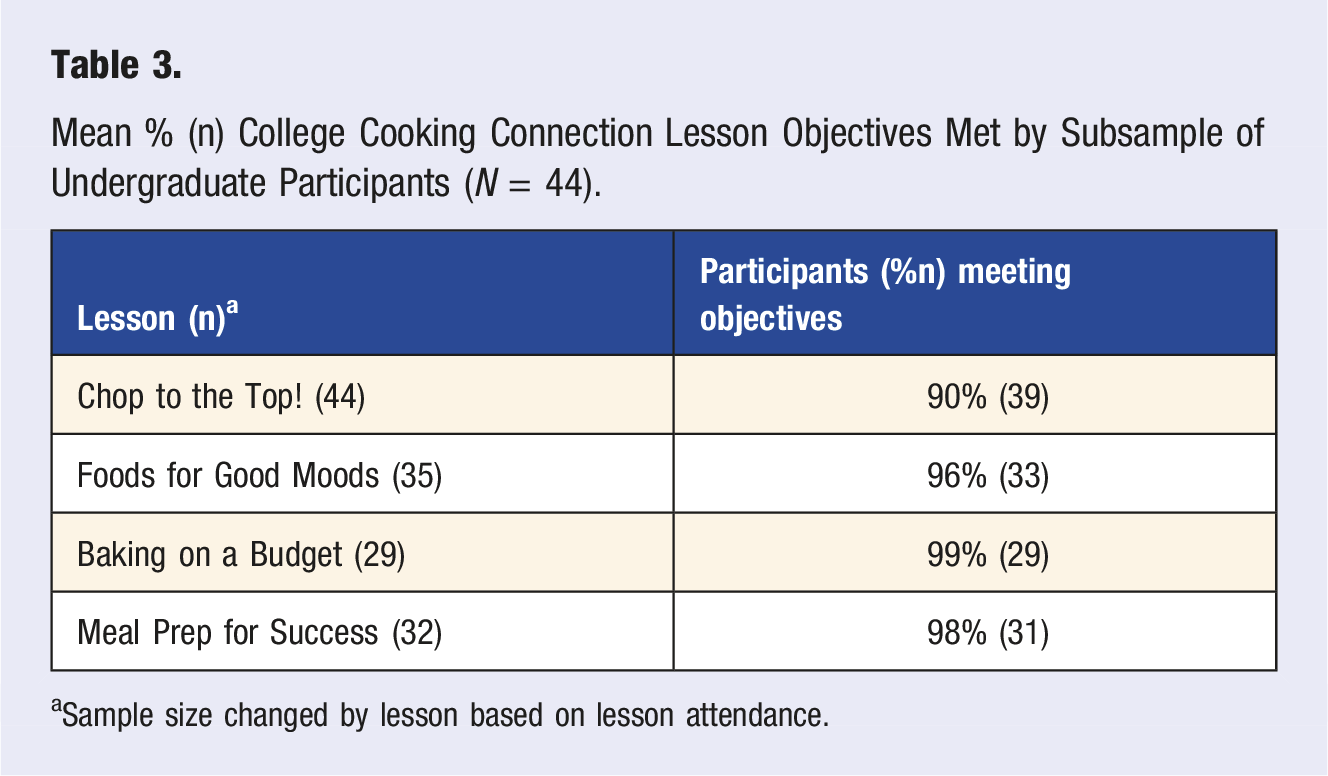
aSample size changed by lesson based on lesson attendance.
Undergraduates also provided feedback on lesson value and perceived change in skills and knowledge in a post-intervention Qualtrics survey. Questions related to these outcomes were developed by graduate and faculty research partners. Undergraduates were asked to rank lessons in order of value, with a score of “1” indicating maximum perceived value and a score of “4” indicating minimum perceived value. Of the four lessons, students found lesson one: Chop to the Top and lesson three: Baking on a Budget to be the most valuable.
Percent of Participants Reporting Perceived Improvements in Skills and Knowledge (N = 64) a .
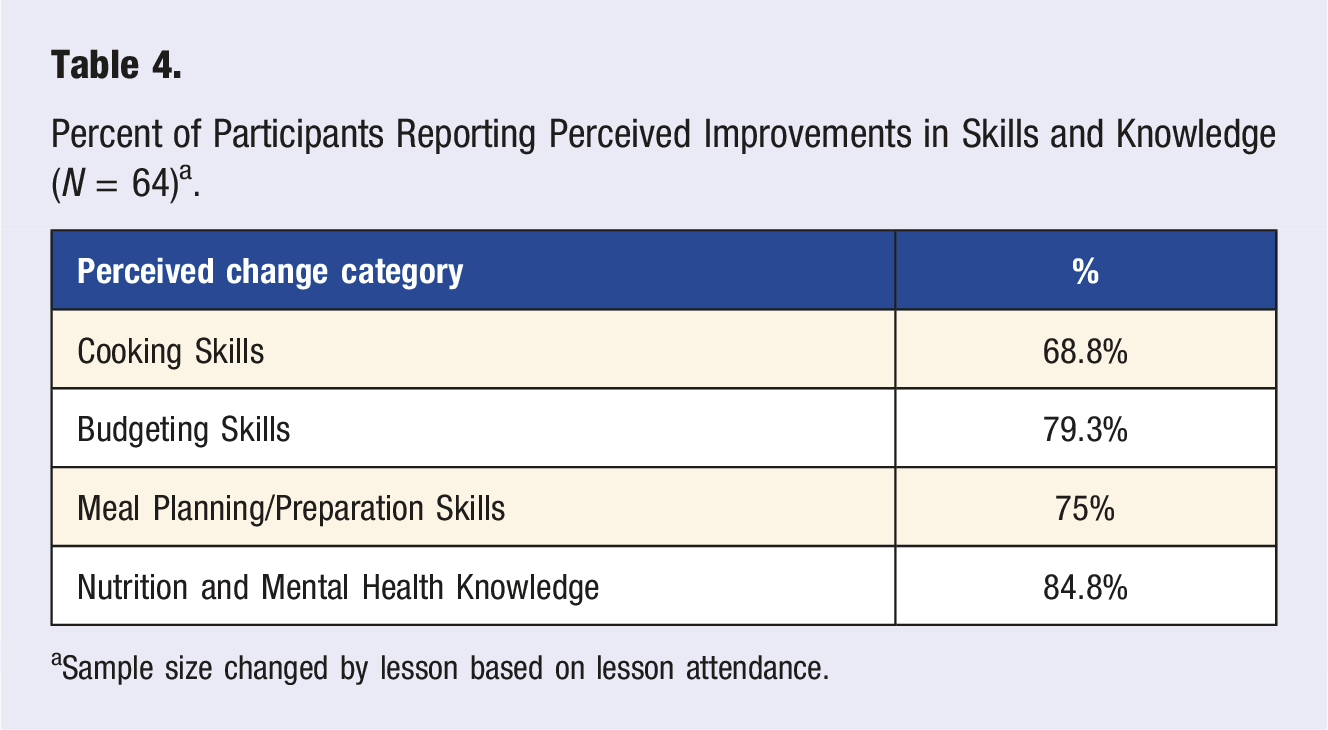
aSample size changed by lesson based on lesson attendance.
Discussion and Implications
Perceived program feasibility and clarity were unanimously supported by expert reviewers. Further, program feasibility and clarity were supported by over 90% of participants meeting learner objectives, with most participants also reporting a perceived increase in culinary and nutrition skills and knowledge. The perceived clarity of the program and success of learner objectives are likely related to CCC’s rigorous curriculum development process, which utilized CBPR, SCT, and evidence-based curricula to tailor relevant lesson content for undergraduates. To our knowledge, few undergraduate nutrition interventions involve a CBPR process to tailor curriculum content.23,24
Our program curated lesson content based on relevant topics identified by undergraduates, which included mental health, budgeting, and meal planning. Of CCC’s four lessons, undergraduates found lesson one, which focused on general nutrition knowledge and cooking skills, to be the most valuable. This finding aligns with current literature highlighting the poor diet quality and low cooking self-efficacy of undergraduates,6-8 while reiterating the importance of foundational culinary and nutrition concepts in undergraduate nutrition programming. Lesson three, which focused on budgeting, was also highly ranked by undergraduates. The high perceived value of this lesson illustrates the role of financial status in guiding undergraduates’ dietary behaviors, while emphasizing the need for budget-friendly health promotion strategies in this population. While most existing undergraduate health programs focus on nutrition knowledge, cooking skills, and grocery shopping, budgeting is often overlooked despite its influence on undergraduates’ dietary health.14-16 The lack of emphasis on budgeting in existing program curricula may be related to the absence of undergraduate input during lesson development. Although lesson two, which focused on the connection between nutrition and mental health, was not ranked as the most valuable, undergraduates reported the greatest perceived increase in knowledge in this area. This finding highlights an existing gap in the nutrition knowledge of undergraduates and illustrates the importance of connecting dietary habits with non-physical outcomes such as mental health.
The overall success of CCC program outcomes may be related to increased participant engagement with lesson content considered relevant to undergraduates. Success of learner objectives and improvements in skills and knowledge may also be related to CCC’s expert review process. 27 Preemptive expert review of the curriculum may have increased perceived clarity of lesson content among undergraduates, thus resulting in greater understanding of nutrition and culinary concepts. Most college health interventions do not include an expert review process and many fail to assess perceived skill change of participants, despite being a useful parameter of program efficacy.14-16 These outcomes, as well as understanding specific content undergraduates find valuable, are critical for informing the development of future college health interventions.
Despite the novelty and success of CCC, this study was not without limitations. While 20 experts were contacted for curriculum review, only seven completed the survey. Ideally this sample of expert reviewers would have been larger to optimize curriculum feedback; however, the sample size of expert reviewers in our study mirrors existing programs utilizing an expert review process.28,29 While the intervention was effective among undergraduates who attended, retention of participants was a challenge during CCC. The largest number of undergraduates attended lesson one (N = 44), but these numbers declined in subsequent lessons (Table 3), suggesting potential barriers to engagement that may limit overall impact. Information related to why participants did not return would have been beneficial for informing future CCC programming. These data highlight the need to enroll a larger number of undergraduate participants, with particular emphasis on recruitment of male participants, who represented less than 30% of CCC’s subject pool.
An additional limitation of CCC was the use of a post-test design to assess undergraduates’ perceived change in skills and knowledge. A post-test design was used to reduce potential testing effects, as pre-intervention measures could bias participants to focus on targeted outcomes. However, utilization of a pre-post-test design to assess participant outcomes may have provided more robust insights to overall program efficacy. Despite these limitations, the combination of CBPR, SCT, and evidence-based curricula led to the creation of an undergraduate nutrition program deemed feasible, acceptable, and effective by experts and undergraduates alike. This study addresses critical gaps in undergraduate nutrition education by evaluating a tailored culinary and nutrition intervention developed using expert feedback, evidence-based curricula, SCT, and CBPR. While existing college health programs have incorporated these methods independently,14-16 to our knowledge CCC is the first to integrate these approaches to deliver targeted nutrition education to college students. Improvements in perceived skills, knowledge, and success of learner objectives among undergraduates who attended CCC support the combination of community partnership and theory-driven skill building as a critical mechanism of dietary behavior change in collegiate young adults.
While our program focused on curriculum feasibility, acceptability, and clarity of lesson content and objectives, future CCC programming may want to consider additional variables such as perceived stress, and biological measures indicative of diet quality (i.e., blood glucose, polyphenols, and lipids), depending on the objectives and budget of the program. Inclusion of these outcomes may increase awareness and strengthen perceptions of overall program impact.
Footnotes

Author Contributions
Curriculum development: CW, JM, MB; Course Instruction: CW, JM, MB, KP; Data analysis: CW, JM KP; Manuscript Writing: CW. Manuscript review and editing: all authors.
Funding
The authors disclosed receipt of the following financial support for the research, authorship, and/or publication of this article: This work was supported by National Institute of Food and Agriculture; Grant No: 2020-0336.
Declaration of Conflicting Interests
The authors declared no potential conflicts of interest with respect to the research, authorship, and/or publication of this article.