







Abstract
Digital transformation in local government represents an institutional rather than a purely technical process. It unfolds under conditions of resource scarcity, vendor dependency, and competing accountability demands, conditions particularly pronounced in municipalities operating at the margins of administrative capacity. This study examines how local government actors in a German regional context interpret and enact digital transformation within these constraints. Drawing on six focus groups with thirty officials from twenty-five municipalities, it combines the Technology–Organization–Environment framework with Suchman's legitimacy typology into an integrated TOE–L analytical model. The analysis identifies two interrelated mechanisms of legitimacy work: legitimacy–capacity decoupling and guerrilla legitimation. Both illustrate how administrations sustain credibility when reform ambitions exceed capacity. Together, these dynamics constitute reflexive legitimacy work, that is, the conscious management of symbolic and practical tensions in digital reform. Conceptually, the study reframes legitimacy as an operational capability of governance. It advances institutional and public management theory by showing how local administrations govern through legitimacy under constraint.
Key Points for Practitioners
When political ambitions outpace what municipalities can actually deliver, honest and early communication with elected officials and citizens alike reduces pressure on staff and protects institutional credibility.
When formal IT governance slows implementation, managers should support controlled local experimentation to keep services functioning and identify practical solutions that can be scaled more widely.
Vendor dependency and fragmented responsibilities frequently restrict municipal action; managers can mitigate this by coordinating early with providers, documenting constraints, and communicating them to higher-level authorities.
Encouraging cross-departmental learning—particularly from improvised solutions that work in practice—helps turn isolated successes into organization-wide capabilities for future digital initiatives.
Introduction
Digital transformation has become a central priority for public administrations, yet its realization is fundamentally shaped by the institutional conditions under which governments operate. More than the technical conversion of analog processes into digital formats, transformation in this sense denotes a deep reconfiguration of organizational structures, routines, and value creation (Vial, 2019), one that, in local government, is inseparable from questions of legitimacy. Where administrative capacity is fragmented, resources are constrained, and accountability demands compete, digital change cannot be understood as a technical process alone (Mergel et al., 2019; Patalon, 2026a). It becomes, above all, a problem of justification: of demonstrating to higher authorities, elected officials, and citizens alike that reform is necessary, feasible, and appropriate (Haug et al., 2024; Kuhlmann & Heuberger, 2023). Following Suchman (1995), this justification work operates across three dimensions: pragmatic legitimacy, grounded in functional benefits; moral legitimacy, rooted in ethical appropriateness; and cognitive legitimacy, reflecting taken-for-granted assumptions about what modern administration requires. Operating under conditions of vendor dependency, infrastructural gaps, and fragmented authority (Levesque et al., 2024; Voorwinden, 2021), these administrations engage in continuous legitimacy work—justifying, narrating, and negotiating digital reform within institutional constraints that exceed their control (Cordella & Paletti, 2019; Cordella & Tempini, 2015).
Recent research highlights that place shapes how digital transformation unfolds, influencing both the pace and the meaning of change (Cunha et al., 2020; Liao et al., 2025). Local administrations must demonstrate modernization to higher authorities while remaining accountable to citizens who expect personal service, expectations that often conflict with digital-first imperatives (Djatmiko et al., 2025; Su et al., 2025). These tensions produce paradoxes: municipalities signal progress through digital portals while maintaining analogue access for vulnerable groups, or adopt cloud solutions while facing vendor-imposed restrictions that constrain use. Such contradictions reveal digital transformation as a process of institutional negotiation rather than linear modernization (Janssen & van der Voort, 2016; Meyer & Rowan, 1977).
This study examines these dynamics through an empirical lens focused on municipalities in the region of South Westphalia in Germany, specifically a set of local administrations operating under pronounced conditions of resource scarcity, vendor dependency, and multi-level accountability. The analytical interest lies not in the contextual category itself but in the visibility it affords to legitimacy mechanisms under constraint (Buffat, 2015; Weber et al., 2021). Municipalities in this region rely on regional IT service centers that both enable and restrict innovation, await federal coordination while compensating for delivery failures, and depend on short-term funding that rewards visibility over sustainable capacity (Kuhlmann & Heuberger, 2023). Under these conditions, digital transformation advances through pragmatic bricolage rather than linear planning. Administrations assemble partial solutions and manage appearances of progress, aware that credibility often depends more on symbolic compliance than on substantive completion (Brunsson, 2019).
Despite growing research on digital government, municipalities operating under institutional constraint remain understudied (Levesque et al., 2024; Liao et al., 2025). Existing work emphasizes infrastructure and service provision but rarely examines how administrations interpret and legitimate digital change within the institutional conditions that shape their action (David et al., 2023; Kiviaho & Einolander, 2023). These interpretive processes determine whether transformation appears credible and appropriate within local governance systems. For administrations operating at the margins of capacity, legitimacy becomes the decisive condition under which digital reform can move from symbolic commitment to operational practice (Dubois & Sielker, 2022). Without it, digital transformation remains rhetorically present but operationally limited.
This study addresses these gaps by examining how local government actors interpret digital transformation across technological, organizational, and environmental dimensions, and how legitimacy shapes these processes. It builds on six focus groups with thirty participants, including digital officers, administrative leaders, IT executives, and regional project staff from twenty-five municipalities. The analysis combines the Technology–Organization–Environment (TOE) framework by Tornatzky and Fleischer (1990) with Suchman’s (1995) legitimacy typology, resulting in the TOE–L framework, which conceptualizes digital transformation as institutional justification work through which technologies, structures, and dependencies gain pragmatic, moral, and cognitive legitimacy.
The findings reveal recurring legitimacy tensions across all three TOE domains. Technologically, municipalities face efficiency paradoxes where digitalization creates additional workload and forces improvisation to bypass vendor constraints. Organizationally, cognitive and generational divides outweigh material barriers, requiring pedagogical leadership and temporal patience. Environmentally, vendor monopolies and coordination gaps produce authority vacuums that compel administrators to balance multiple accountability regimes. Together, these patterns illustrate reflexive legitimacy work—actors’ conscious management of the gap between symbolic compliance and substantive transformation, turning legitimacy maintenance into a core mode of governance (Brunsson, 2019).
Accordingly, the study addresses two research questions:
The article contributes theoretically by embedding legitimacy as a constitutive element of digital transformation, reinterpreting the TOE framework through an institutional lens. Empirically, it illuminates how resource-constrained administrations make sense of contradictory modernization demands. Practically, it offers insights for policymakers and practitioners, suggesting that sustainable digitalization depends less on technical design than on institutional arrangements that allow local actors to justify change credibly within their administrative and moral contexts.
The remainder of the article is structured as follows. Section 2 develops the theoretical framework, introducing the TOE–L model and situating it within neo-institutional and digital government theory. Section 3 describes the methodological approach, including data collection and analysis procedures. Section 4 presents the empirical findings organized along the three TOE domains. Section 5 discusses the two core mechanisms—legitimacy–capacity decoupling and guerrilla legitimation—and their theoretical and practical implications. Section 6 concludes with reflections on the study's contributions and directions for future research.
Theoretical Framework
Digital transformation in public administration is increasingly understood as an institutional rather than a purely technical process. Beyond efficiency and automation, it reflects evolving norms, values, and legitimacy claims that shape how governments modernize and justify change (Mergel et al., 2019). This section conceptualizes digital transformation in local governance as an institutional practice of justification and extends the classical TOE framework by integrating a legitimacy perspective.
Digital Transformation as Institutional Practice in Local Governance
Digital transformation in government is often described as a modernization project aimed at digitizing services, automating processes, and improving efficiency. Yet such accounts overlook the institutional and interpretive dimensions that determine how digitalization is understood and enacted within public organizations (Patalon, 2026b). Transformation involves a reconfiguration of administrative culture, structures, and routines that reshapes governance itself (Mergel et al., 2019). Fountain (2001) describes this as the social enactment of technology, where digital tools acquire institutional meaning and become embedded in everyday practice.
From a neo-institutional perspective, digital transformation represents a continuous negotiation of meaning (Lindgren et al., 2019; Meijer & Bekkers, 2015). Technologies achieve legitimacy only when they align with administrative logics, moral expectations, and public values (Cordella & Paletti, 2019). This shifts attention from technology as a neutral instrument to the social practices through which it is justified and stabilized (Scott, 2008). What counts as digital progress therefore depends on context and on how institutional actors interpret change within local value systems.
At the municipal level, digital transformation reshapes the moral and professional fabric of administration through new roles, routines, and symbols. It unfolds as a socio-technical process driven by leadership, culture, and infrastructure (Scholta et al., 2019; Tangi et al., 2021). Local governments frequently operate through collaborative arrangements that compensate for structural deficits but also create new dependencies. Digitalization thus becomes as much a matter of legitimacy management as of innovation (Dubois & Sielker, 2022; Gil-Garcia et al., 2018).
The institutional dynamics of digital transformation are shaped significantly by administrative context. Municipalities operating under conditions of resource scarcity, vendor dependency, and fragmented accountability face particular legitimacy challenges that intensify the need for ongoing legitimacy work (Levesque et al., 2024; Kuhlmann & Heuberger, 2023). In many local government settings, officials operate in close proximity with citizens whose expectations for personal service can conflict with digital logics of standardization (Meijer & Bekkers, 2015). These contextual conditions do not define a distinct theoretical category but rather intensify and render visible the institutional mechanisms through which legitimacy is produced and maintained. Introducing digital technologies therefore involves moral as well as technical negotiations about what constitutes good administration and whose needs define modernization (Salemink et al., 2017). Administrative context thus functions as a moderating condition that shapes how legitimacy work unfolds in practice, making it analytically productive for examining institutional mechanisms that operate across local government settings more broadly.
This understanding reflects a broader shift in digital government research from functionalist to institutional perspectives (Lindgren et al., 2019). Organizations adopt innovations not only for efficiency but to maintain legitimacy (DiMaggio & Powell, 1983; Meyer & Rowan, 1977). Digital transformation in local government therefore constitutes a continuous practice of institutional justification that balances technological possibilities, organizational constraints, and environmental pressures to sustain credibility across multiple audiences. Studying this process in contexts where institutional constraints are particularly pronounced allows the generative mechanisms of legitimacy work to be theorized beyond the empirical case. While this study draws on municipalities operating under constrained administrative capacity, the theoretical interest lies in the legitimacy mechanisms that such contexts render observable rather than in the contextual category itself.
From Structural Determinants to Institutional Justification: The TOE Framework
Tornatzky and Fleischer’s (1990) TOE framework offers analytical clarity by structuring innovation conditions into three domains: technological, organizational, and environmental (Baker, 2012; Oliveira & Martins, 2011). Applied to public administration, and particularly to local governance, this structural lens remains useful but incomplete. Classical TOE explanations privilege adoption drivers and understate the interpretive work through which digital change gains institutional meaning (Mignerat & Rivard, 2009).
A neo-institutional perspective repositions the TOE domains as arenas of legitimacy work rather than static determinants. In the technological arena, digital artifacts act as both tools and symbols. Technologies signal modernization and transparency, and their legitimacy often develops asynchronously: symbolic adoption can precede operational impact, creating temporal gaps between appearance and practice (Lindgren & van Veenstra, 2018; Suddaby et al., 2017). Technological choices are further mediated by intermediaries such as regional IT providers and vendors that shape, and sometimes restrict, what municipalities can credibly implement (Buffat, 2015; Fountain, 2001).
The organizational arena concerns the moral and cognitive foundations of administrative action. Leadership, professional ethos, and culture determine whether digitalization is experienced as innovation or disruption (Denhardt & Denhardt, 2000; Moynihan, 2005). Readiness is interpretive rather than structural because meaning is constructed and shared in everyday routines (Weick, 1995). Public organizations frequently face accountability for outcomes they cannot fully control, generating tensions between formal responsibility and practical authority that require adaptive legitimation toward staff and stakeholders (Lawrence & Suddaby, 2006; Wajcman, 2010).
The environmental arena situates municipalities within layered interdependencies. National legislation exerts coercive pressure, inter-municipal networks diffuse normative standards, and citizen expectations create mimetic pressures (DiMaggio & Powell, 1983; Patalon & Wyczisk, 2024). In local settings, asymmetric power relations amplify these dynamics when intermediary institutions limit autonomy, coordination lags, and funding schemes favor visibility over capacity building (Buffat, 2015; Fountain, 2001; Hodgson et al., 2019).
Under such conditions, formal compliance can serve symbolic as well as substantive purposes. Municipalities are not passive recipients but strategic actors negotiating competing expectations within limited authority and time (Brunsson, 2019; Lawrence & Suddaby, 2006; Meyer & Rowan, 1977). Reinterpreting the TOE framework in this way shifts attention from deterministic adoption to institutional justification. Digital transformation becomes an ongoing negotiation among technical, bureaucratic, political, and civic rationalities that requires continuous explanation of why change matters and how it aligns with public values.
Legitimacy as Institutional Currency in Local Public Management
In the context of neo-institutionalism, organizations pursue legitimacy alongside efficiency (DiMaggio & Powell, 1983; Meyer & Rowan, 1977). Legitimacy denotes the socially constructed perception that organizational actions are appropriate within prevailing norms and expectations (Suchman, 1995). In public administration, it functions both as a resource and as a compass defining what can be credibly justified as good governance (Deephouse & Suchman, 2008). It is a continuous accomplishment produced through practices and narratives that render administrative work meaningful to diverse audiences.
In local governance, legitimacy becomes particularly salient due to proximity and visibility. Decisions about digitalization are moral and reputational acts as much as technical ones, signaling what counts as modernization (Sørensen, 2020). Local governments operate under dual legitimacy regimes: upward accountability to state agendas and downward responsiveness to citizens whose expectations often diverge from digital-first imperatives. To reconcile these demands, municipalities frequently perform symbolic alignment with national narratives while preserving local credibility (Meyer & Rowan, 1977).
Suchman’s (1995) typology clarifies these dynamics. Pragmatic legitimacy rests on perceived benefits or efficiency gains yet remains fragile when digital tools increase administrative burdens (Janssen & van der Voort, 2016). Moral legitimacy depends on whether actions are perceived as fair, inclusive, and socially desirable (Salemink et al., 2017). Cognitive legitimacy emerges when digital practices become taken for granted as part of normal administration (Scott, 2008). In practice, these forms intersect and overlap, requiring administrators to balance functional credibility, moral justification, and cultural familiarity.
Legitimacy work can become reflexive when actors consciously manage their own legitimation efforts (Greenwood et al., 2011; Lawrence & Suddaby, 2006). This reframes classic decoupling: organizations may intentionally maintain a gap between formal compliance and operational practice to preserve credibility under constraint (Brunsson, 2019; Meyer & Rowan, 1977). In resource-limited settings, such reflexivity represents adaptive competence rather than institutional weakness.
Legitimacy is also temporal. Different forms stabilize at varying speeds, and narrative work is required to bridge these gaps (Suddaby et al., 2017; Weick, 1995). When formal mechanisms fail, municipalities may engage in adaptive legitimation—improvised strategies that maintain accountability and service continuity even outside official procedures (Lipsky, 2010; Scott, 2008). Such practices illustrate that legitimacy is sustained through creativity and negotiation as much as through compliance.
This understanding positions legitimacy as the institutional currency of local public management. It underpins how administrators justify reform, balance competing expectations, and sustain accountability amid uncertainty.
Extending TOE through Legitimacy: The TOE-L Framework
To capture this complexity, the study extends the classical TOE framework by integrating legitimacy as a cross-cutting analytical dimension. The resulting TOE–L model reframes digital transformation not as linear diffusion but as a situated practice of institutional justification. Technology, organization, and environment are conceptualized as interdependent arenas where legitimacy is continuously negotiated and where actors render digital change both rational and right (Suchman, 1995).
Rather than treating legitimacy as an external condition, the TOE–L framework defines it as an interpretive infrastructure that permeates all three domains (Deephouse & Suchman, 2008). Municipal digitalization thus becomes a process of sensemaking through which administrators translate modernization pressures into culturally credible narratives (Weick, 1995). Technologies function not only as operational tools but also as moral and cognitive symbols rendered meaningful within administrative discourse (Fountain, 2001). Drawing on sensemaking theory (Weick, 1995), we conceptualize interpretation as the articulation of legitimacy claims through which actors render digital transformation meaningful within their institutional context. Enactment, in turn, refers to the practical strategies through which these claims are operationalized under conditions of institutional constraint (Lawrence & Suddaby, 2006).
Building on Suchman’s (1995) typology, the framework differentiates three interrelated forms of legitimacy—pragmatic, moral, and cognitive—that operate across the TOE domains. In local contexts, these dimensions often overlap. Digital initiatives are justified simultaneously as practical necessities, ethical commitments, and signs of modernity, creating hybrid configurations of legitimacy that are adaptive yet fragile (Bitektine & Haack, 2015). The resulting nine-cell analytical matrix is shown in Figure 1.
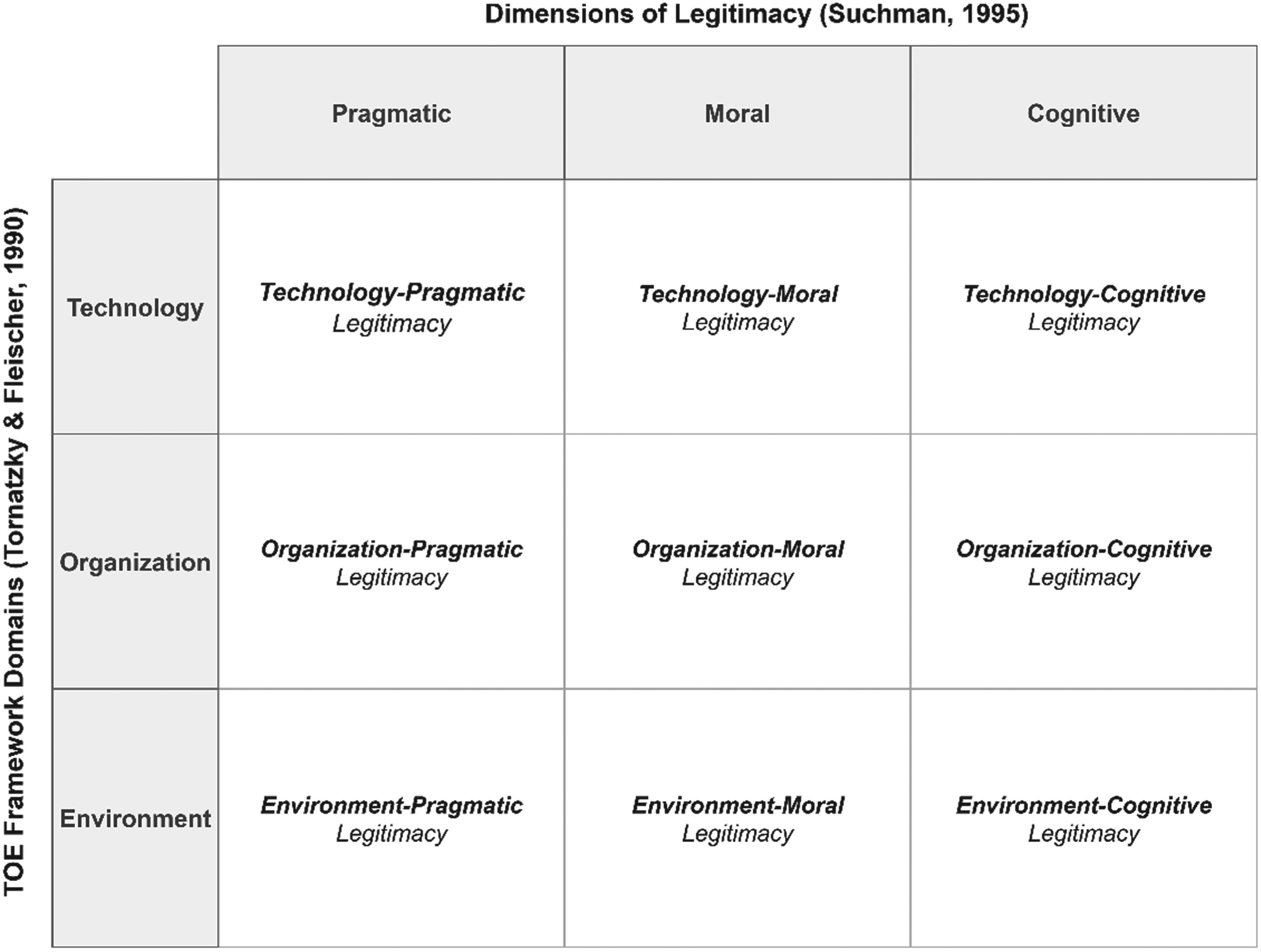
The TOE–L framework: integrating technology–organization–environment domains with legitimacy dimensions.
Within the technological domain, legitimacy develops around digital infrastructures and artifacts. Technologies may signal modernization and efficiency (pragmatic), promote fairness and accessibility (moral), or embody bureaucratic rationality as taken-for-granted norms (cognitive).
In the organizational domain, legitimacy concerns structures, routines, and professional practices. Arrangements may gain credibility through coordination and performance (pragmatic), through participatory and fair processes (moral), or through normalization as accepted routines (cognitive).
At the environmental domain, legitimacy is negotiated across interorganizational dependencies. Municipalities may align with policy mandates and funding rules (pragmatic), appeal to solidarity and shared responsibility (moral), or internalize external pressures as self-evident obligations (cognitive).
This cross-domain configuration positions legitimacy as the connective tissue between structure and meaning. It explains how technological, organizational, and environmental logics intertwine through justification work that stabilizes transformation in practice (Scott, 2008). The TOE–L framework thus bridges functionalist and institutionalist traditions, maintaining the structural clarity of TOE while embedding analysis in the symbolic and moral realities of governance (Mignerat & Rivard, 2009). This integrative perspective provides the conceptual foundation for the empirical analysis that follows.
This study employs an interpretive qualitative design (Klein & Myers, 1999) to examine how legitimacy is constructed and negotiated in municipal digital transformation (see Appendix A). It applies qualitative content analysis (QCA) following Kuckartz and Rädiker (2024), which combines systematic transparency with openness to emergent meaning structures. QCA is well suited to complex, socially embedded phenomena such as digital transformation, where meaning must be reconstructed from practitioners’ lived experiences rather than abstract theorization (Mergel et al., 2019; Morgan, 1996). Focus groups served as the primary data collection method because they capture how meaning is co-constructed through interaction (Kitzinger, 1995; Krueger & Casey, 2015). This collective format reflects the interdependent and contextual nature of local governance, where legitimacy is jointly produced and maintained (Barbour, 2018).
Data Collection
Six focus groups were conducted in the region of South Westphalia, Germany between March and April 2025. Thematic saturation was achieved after five sessions; a sixth was added to validate emerging themes. Each session lasted around 120 min and was held in an accessible, neutral venue. Data collection followed a stimulus-based discussion design. Each session opened with a short video clip (approximately 40 s) in which a digital transformation expert reflected on the challenges facing local government digital transformation, identifying a lack of time, personnel, and capacity as central constraints. Following a brief pause, the moderator invited open reflection with a single non-directive opening question: “What do you think of the expert's statement?” This question was intended to activate participants’ own interpretive frameworks rather than channel responses toward predefined categories, thereby providing empirical material relevant to RQ1. The following 15-min open reflection per focus group encouraged participants to link these ideas to their own municipal contexts, yielding approximately 60 min of focused discussion in total on opportunities, barriers, and legitimacy dynamics. The moderator supported this discussion through selective probing questions aimed at deepening responses and surfacing enacted strategies under constraint, particularly those relevant to RQ2. The video stimulus description and illustrative moderator probes are provided in Appendix B. Although the broader sessions covered additional topics, following Barbour’s (2018) recommendation to organize focus groups into distinct thematic sections, this paper analyzes only this stimulus-based discussion. All sessions were moderated by a trained facilitator, supported by a researcher who took field notes. With written and verbal informed consent, discussions were audio- and video-recorded, transcribed verbatim, and anonymized in accordance with best practice in qualitative research (Creswell & Poth, 2025) and European data protection law. All data were collected and analyzed in German; English translations of selected quotations were reviewed to preserve contextual meaning (see Appendix C).
Participant Selection and Demographics
Participants were recruited through purposive and convenience sampling (Etikan, 2016). Purposive sampling ensured inclusion of key actors directly involved in municipal digital transformation—digital officers, IT managers, administrative leaders, and regional project staff (Patton, 2015). Convenience sampling addressed scheduling and geographic constraints across participating municipalities.
In total, 30 participants from 25 municipalities took part. Thirteen identified as female and seventeen as male; most were between 35 and 59 years old (n = 22). Participants represented municipal and district administrations, regional authorities, municipal subsidiaries, and one external advisory organization.
Professional roles reflected the diversity of digital transformation work: ten held strategic or leadership functions, eight managed projects, five worked in IT or technical positions, four had advisory or academic backgrounds, and three worked in administrative specializations. Most (n = 27) were directly engaged in digital transformation, especially in e-government, digital citizen services, IT infrastructure, and open data. Municipalities ranged from small towns (<5,000 inhabitants) to large cities (>100,000), with the majority representing medium-sized administrations. This composition ensured both strategic and operational perspectives and enhanced the interpretive richness and transferability of the findings.
Data Analysis
All transcripts were analyzed using MAXQDA 2024, following the seven-step QCA procedure of Kuckartz and Rädiker (2024). This approach combines rule-based transparency with openness to emergent meaning structures—appropriate for exploring complex constructs like municipal digital transformation.
Analysis began with repeated readings of all transcripts to develop an overall understanding. Reflexive memos captured early impressions and evolving analytical insights. Based on this immersion, a deductive coding frame was developed using the TOE–L framework as the analytical lens. The framework produced a nine-cell matrix representing intersections between the three structural domains (Technology, Organization, Environment) and the three legitimacy forms (Pragmatic, Moral, Cognitive) (Suchman, 1995). A supplementary code captured general reflections on legitimacy (see Appendix D).
Subsequent line-by-line coding refined this structure through constant comparison within and across groups. All transcripts were then re-coded for consistency. Co-occurrence analysis identified intersections between technological, organizational, and environmental narratives and their legitimacy forms. Because the TOE–L model conceptualizes legitimacy as transversal, double coding was both permissible and analytically meaningful. For example, a statement could be coded as Technology–Pragmatic Legitimacy or Environment–Moral Legitimacy. These overlaps illuminated how functional reasoning and legitimacy work co-evolved—consistent with recommendations for multiple coding when conceptually justified (Kuckartz & Rädiker, 2024).
Each TOE domain was operationalized as follows: Technology: statements on digital infrastructures, interoperability, and perceived usefulness; Organization: internal capacities, leadership, and culture, including IT as both innovation driver and bottleneck; Environment: external dependencies such as regulation, inter-municipal collaboration, and benchmarking against peers. Pragmatic legitimacy: tangible benefits for citizens or efficiency gains (“faster service delivery”); Moral legitimacy: ethical appropriateness and inclusivity (“ensuring access for elderly users”); Cognitive legitimacy: taken-for-granted necessity (“we must digitalize because everyone else does”).
Within each domain, legitimacy was coded according to Suchman's typology:
All coding decisions were documented in an audit trail to ensure transparency and traceability (Lincoln et al., 1985). Analytical credibility was strengthened through iterative reflection, memo writing, and comparison across focus groups (Saldaña, 2021). Emphasis was placed on reflexive rigor rather than formal intercoder reliability, consistent with interpretive standards of QCA (O’Connor & Joffe, 2020).
The resulting TOE–L coding framework balanced methodological transparency with interpretive sensitivity to the institutional realities of municipalities. In line with Klein and Myers’ (1999) principles, the analysis remained reflexive and contextually grounded, treating interpretation as a continuous dialogue between empirical meaning, theoretical abstraction, and the researchers’ evolving understanding.
Results
This section presents findings from six focus groups (FG1–FG6) representing diverse municipal contexts in South Westphalia. Using the TOE–L framework, the analysis explores how participants (P) interpreted digital transformation across technological, organizational and environmental domains through pragmatic, cognitive and moral dimensions of legitimacy.
Technological Domain
Across all focus groups, participants described digital technologies in ambivalent terms. While policy narratives framed digitalization as a pathway to efficiency, participants consistently portrayed it as slow, complex and demanding of additional effort. Technologies often required long familiarization periods before yielding measurable benefits. Moral reasoning appeared uneven, ranging from complete absence to explicit reflection on accessibility and inclusion.
Pragmatic Legitimacy: Efficiency Deficits and Experiential Validation
Participants repeatedly challenged the assumption that digitalization automatically enhances efficiency. FG1-P4 summarized this as “double work”: “I often have the impression that when we digitalize, we have to do everything twice. We have to do it the way it's always been done and then also digitally.” This perception was echoed across multiple groups, indicating that digital adoption initially adds procedural layers rather than streamlining existing processes. FG1-P3 emphasized the resulting strain on resources, noting that new software consumed “time and all available capacity.” FG2 participants described how pragmatic goals were undermined by external gatekeeping from regional IT service centers. FG2-P4 recounted a case where a municipality invested
Cognitive Legitimacy: Foundational Hierarchies
Cognitive legitimacy centered on perceived hierarchies of technological importance. Several participants described Document Management Systems (DMS) as the essential foundation of any digital transformation. FG2-P5 stated: “The start is a DMS. If I don't have an E-Akte, I don't need digital either.” FG2-P1 reinforced this view: “It starts with having the binders digitally.” FG4-P1 generalized the principle: “You simply have to create the foundations before you move forward.” These statements show that municipalities construct sequential hierarchies of legitimacy where foundational technologies must be established before advanced tools are considered. While basic systems enjoyed cognitive acceptance, innovative applications such as artificial intelligence were seen as aspirational rather than actionable. FG2-P5 admitted: “I didn't say anything because I didn't have time to deal with AI yet.” FG6-P4 added that training and change management extended for months after deployment, creating “dry spells” before benefits became visible. Cognitive legitimacy thus reflects a layered progression: municipalities rationalize incremental change as responsible modernization while indefinitely postponing more disruptive innovation.
Moral Legitimacy: From Silence to Inclusion Ethics
Moral legitimacy varied considerably across focus groups. FG1 participants focused solely on operational matters and showed no explicit ethical framing. In contrast, FG2 and FG4 connected digitalization to moral responsibility through data security. FG2-P3 referred to a local cyberattack, emphasizing that traffic authority data “requires special protection.” FG3 and FG5 went further, invoking explicit inclusion ethics. FG3-P2 argued: “We must also enable the citizen to participate digitally at all.” FG5-P1 described outreach initiatives to prevent exclusion: “We don't want to forget the older population in all this digitalization. We drive out to them.” FG6 expanded this moral reflection to sustainability concerns. FG6-P3 criticized short-term funding that led to wasteful procurement, while FG6-P4 warned: “When the funding is gone, we'll have a huge problem because so many platforms can't be properly operated.” These findings show that moral legitimacy emerges situationally rather than systematically. It is most visible where administrative proximity to citizens is highest and where the risk of exclusion becomes ethically salient.
Organizational Domain
Participants described organizational conditions through markedly different frames. Interpretations of capacity ranged from acute scarcity to relative sufficiency accompanied by knowledge deficits. Cultural readiness often appeared more restrictive than material resources, as entrenched routines and mindsets shaped the pace and depth of change. Ethical reflections emerged around the responsibility to support employees during these transitions.
Pragmatic Legitimacy: The Resource Debate
Participants differed sharply in how they framed the resource problem. FG1 established a scarcity baseline: “What's missing is that municipalities have no time, they have no people, have no solution.” FG1-P1 added: “The people are sometimes really at maximum capacity.” In contrast, FG2 and FG3 rejected this deficit narrative. FG2-P4 asserted: “We have resources. We have other problems that slow us down.” FG2-P3 elaborated: “Personnel is definitely there. Resources are there. It often lacks in know-how and know-how transfer.” FG3-P5 described proactive adaptation: “We founded an extra department, Future Department, with these topics.” However, FG4 and FG5 returned to the scarcity narrative. FG4-P5 described dual-role strain: “I have a dual function, treasury and digitalization. And then treasury work is naturally prioritized. Then my resources are repeatedly shifted.” FG5-P1 identified acceptance as the greater challenge: “I believe that alongside personnel resources, it's an even bigger problem to win acceptance for the new and ultimately take all employees along.” These accounts show that capacity constraints are not purely material but interpretive. Some municipalities construct scarcity as a lack of staff or time, while others see it as a question of competence or motivation. Pragmatic legitimacy thus depends on how organizations frame and communicate their own constraints. The ability to present resource limitations as rational and credible becomes a strategy of maintaining legitimacy under pressure.
Cognitive Legitimacy: Entrenched Routines and Identity Work
Across all groups, participants identified deeply rooted routines as a major barrier to change. FG1-P1 referred to the “mindset of the people” as fundamental, while FG1-P4 summarized resistance through the familiar phrase: “We’ve always done it this way.” Such expressions serve as cognitive anchors that legitimize continuity and discourage experimentation. FG6 offered particularly nuanced insight. FG6-P2 described two colleagues in identical roles who displayed opposite attitudes—one enthusiastic, one resistant—demonstrating how personal dispositions shape organizational readiness. FG6-P5 recounted a colleague who deferred engagement entirely: “Come back when I’m retired,” adding “in ten years.” This temporal exemption illustrates how employees symbolically position themselves outside the transformation horizon, constructing cognitive legitimacy for inaction based on career stage. These findings indicate that organizational digitalization is as much a cultural as a structural process. Cognitive legitimacy is not simply acceptance of new tools but a form of identity work through which employees reconcile personal meaning, professional ethos and institutional expectations.
Moral Legitimacy: Care Responsibilities and Accountability Gaps
Moral legitimacy surfaced through reflections on leadership responsibility and ethical care. FG6-P1 used a vivid metaphor to describe approaches to staff guidance: “Or do I take them by the hand like a child crossing the street for the first time. Can I push them and say: ‘That's how it is now. If the car comes, tough luck.’ Or do I take them by the hand a third and fourth time, third, fourth training in DMS.” This framing positions patient repetition as a moral duty of care toward employees navigating unfamiliar technologies. Yet participants also highlighted accountability gaps. FG2-P3 described structural delegation without authority: “We can say ‘Digital Transformation—you’re responsible.’ But when I hear ‘as long as SIT (regional IT service center) doesn’t agree, nothing runs here anyway,’ then that's actually just a straw man.” This quote captures the moral tension between formal responsibility and actual control. In contrast, FG6-P3 reported positive experiences when central coordination units provided strategic alignment and support, enabling more coherent implementation. These findings reveal ethical ambivalence in organizational transformation. Leaders must balance obligations to support staff, comply with institutional hierarchies and deliver results under dependency. Moral legitimacy thus emerges not from the resolution of these tensions but from their ongoing negotiation through care, patience and reflexive accountability.
Environmental Domain
Participants described the environmental context of municipal digital transformation as characterized by systemic constraints rather than enabling frameworks. Two barriers dominated discussions: vendor monopolies that restricted local autonomy and federal coordination mechanisms that delayed implementation. Simultaneously, funding instruments functioned as cognitive triggers, motivating previously dormant initiatives while generating ethical debates about fairness, sustainability and inter-municipal equity.
Pragmatic Legitimacy: Intermediary Obstruction and Adaptive Workarounds
Across all focus groups, participants criticized the regional IT service center as a central bottleneck. FG5-P2 summarized this dependency: “We’re still dependent on the data center, our data center. And that also significantly inhibits.” Laughter frequently accompanied such comments, prompting the FG4 moderator to observe: “And I find it charming that whenever the term SIT comes up, everyone starts laughing and smiling.” This collective reaction revealed a shared understanding of constraint and frustration with the intermediary's gatekeeping power. FG5-P1 illustrated the practical implications through a mobile citizen office project. When the SIT quoted
Cognitive Legitimacy: Funding as a Priority Mechanism
Funding emerged as a decisive cognitive mechanism shaping what municipalities consider legitimate priorities. FG6-P3 described how financial incentives transformed passive acceptance into active engagement: “With our foreign office, for example, there are online applications and so on, I communicated everything, advantages, took everyone along.—‘Yes, we’ll do it.’ They were never against it, but they didn’t do it. Now funding was thrown on the market by the state. […] Now they find the time to implement it.” Identical proposals received different treatment before and after funding became available, suggesting that financial incentives act as cognitive framing devices rather than responses to objective needs. Scale further influenced how participants understood technological dependency. FG4-P4 explained: “I think no municipality here in South Westphalia is large enough to start developing its own solutions or developing software. We’ll be dependent on service providers.” This pragmatic acceptance of structural dependency coexisted uneasily with the improvisational autonomy described earlier. Municipalities internalized dependency as a normal condition of governance while simultaneously engaging in subversive adaptation to overcome it. Cognitive legitimacy thus emerges from reconciling contradictory rationalities—dependency as necessity and autonomy as aspiration.
Moral Legitimacy: Funding Philosophy and Equity Concerns
Moral legitimacy appeared most clearly in discussions about funding fairness and sustainability. FG6-P2 praised trust-based funding models: “They transferred an amount to the municipalities and said: ‘You have so much time to use it sensibly. You just have to say afterwards what you did with it.’ […] That naturally makes it lucrative.” FG6-P2 contrasted this approach with traditional bureaucratic schemes where “resources are burned in all directions for nothing.” Others expressed ethical and sustainability concerns. FG6-P4 warned: “When the funding is gone, we’ll have a huge problem because so many platforms can’t be properly operated. Total risk.” FG5-P4 raised distributive justice issues: “Some municipalities that have the financial means have launched their own municipal program […] But that's very municipality-specific. Then you can’t help people in the neighboring town.” These reflections highlight the moral ambiguity of external funding regimes. While trust-based instruments promote innovation and local discretion, they risk deepening inequality between municipalities. Conversely, rigid bureaucratic schemes prevent waste but stifle initiative. Moral legitimacy in this context is not a stable condition but a balance between autonomy, fairness and responsibility. In the end, participants portrayed the environmental domain as both enabler and limiter of municipal digital transformation. It provides essential resources while simultaneously reinforcing structural dependency, compelling municipalities to negotiate legitimacy through adaptive, often ambivalent, responses.
Cross-Domain Patterns
Several cross-domain patterns emerged across the six focus groups. Participants consistently identified contradictions between policy narratives of efficiency and the operational realities of municipal work. Rather than simplifying processes, digitalization often introduced additional layers of complexity and administrative effort. DMS were widely regarded as essential foundations, while advanced technologies such as artificial intelligence remained aspirational. Moral considerations displayed striking variability: some municipalities focused exclusively on procedural tasks, while others articulated explicit inclusion ethics and sustainability concerns.
Across technological, organizational, and environmental domains, participants oscillated between dependence and autonomy. Some described themselves as waiting for external solutions provided by federal coordination programs or regional IT service centers, whereas others engaged in improvised experimentation to circumvent delays and restrictions. FG5-P1's account of assembling a low-cost mobile office despite potential sanctions contrasted with FG3-P1's depiction of passive expectation, illustrating how local actors navigate competing institutional logics of compliance and initiative.
Taken together, these findings reveal a fragmented governance landscape in which no single actor consistently coordinates municipal digital transformation. Federal and state institutions issue mandates without providing enabling infrastructure, vendors control technical design without assuming service responsibility, and municipal leaders bear civic accountability without corresponding implementation authority. Under such conditions, participants described “ticking boxes” as a strategy of symbolic compliance, pursuing digital projects primarily to demonstrate formal progress rather than achieve substantive transformation.
This pattern reflects a growing reflexive awareness of legitimacy work within constrained systems. Participants consciously maintained appearances of modernization to satisfy external expectations, even when substantive outcomes were limited. Digital transformation thus appears less as a linear process of modernization and more as an ongoing institutional negotiation shaped by dependency, legitimacy pressures, and adaptive improvisation.
Across the three domains, two recurrent patterns of legitimation emerged in response to institutional obstruction. The first involved the conscious maintenance of symbolic compliance: municipalities sustained the appearance of progress through reports, milestones, and procedural alignment while managing the gap between reform ambition and operational capacity. The second involved adaptive circumvention: where formal channels delayed or restricted innovation, local actors improvised informal solutions—developing workarounds, navigating vendor constraints, and assembling partial arrangements outside official procedures—to preserve service continuity and public credibility. In the following discussion, these empirically grounded patterns are conceptualized as legitimacy–capacity decoupling and guerrilla legitimation, respectively.
Discussion
This study examined how pragmatic, cognitive, and moral legitimacy shape digital transformation in municipalities and how actors sustain credibility when formal institutional channels fail. By extending the TOE framework by Tornatzky and Fleischer (1990) with Suchman’s (1995) legitimacy typology, the analysis conceptualizes digital transformation as an institutional process of justification rather than technical modernization. The findings highlight two interconnected dynamics: legitimacy–capacity decoupling and guerrilla legitimation. Together, these mechanisms show how local administrations reconcile reform imperatives with structural limitations and preserve functional legitimacy under constraint.
Legitimacy–Capacity Decoupling
Participants described persistent contradictions between the rhetoric of digital reform and the routines of municipal work. Promises of efficiency often resulted in “double work,” as digital and analog processes coexisted. Administrations frequently lacked the staff and technical autonomy to realize expected benefits but continued to present progress through reports and procedural milestones. These accounts reveal a deliberate management of the gap between ambition and capacity.
This pattern can be understood as legitimacy–capacity decoupling, understood as a reflexive form of decoupling in which actors consciously sustain external credibility while recognizing internal limitations. Unlike the passive inconsistency described by Meyer and Rowan (1977), reflexive decoupling entails strategic awareness. Municipalities maintain the appearance of modernization because symbolic performance secures funding and political trust. The finding aligns with Oliver’s (1991) concept of strategic acquiescence and extends Swidler’s (1986) idea of a “cultural toolkit,” showing how administrative actors draw on symbolic repertoires to stabilize legitimacy under pressure.
Legitimacy–capacity decoupling reframes symbolic compliance as adaptive governance rather than failure. It allows administrations to preserve credibility and service continuity when transformation exceeds available resources. For public management, this suggests that performance indicators and funding mechanisms should recognize reflexive forms of adaptation as legitimate contributions to reform, not as mere resistance.
Guerrilla Legitimation
Where formal governance channels delayed or restricted innovation, municipalities turned to improvised, collective solutions. Some developed local software when regional IT providers withheld approval; others created temporary systems to bridge federal coordination gaps. Leaders often described guiding hesitant colleagues “by the hand,” emphasizing persuasion and empathy. These actions maintained functionality and public trust despite limited formal authority.
Such practices constitute guerrilla legitimation—collective efforts to preserve credibility by circumventing procedural and structural barriers. Building on O’Leary’s (2006) notion of “guerrilla governance” and Lipsky’s (2010) “street-level bureaucracy,” this concept shifts the focus from individual discretion to organizational improvisation. Guerrilla legitimation transforms institutional blockage into a site of creativity: by negotiating informal authority, local actors enact legitimacy through results rather than rules.
Recognizing guerrilla legitimation highlights that informal agency is not deviance but a pragmatic response to fragmented authority. For policymakers, this underscores the need to design governance frameworks that reward functional outcomes and shared learning, not only procedural conformity. Supporting experimentation can convert localized improvisation into systemic capacity building within multi-level digital governance.
Reflexive Legitimacy Work
Across the cases, legitimacy–capacity decoupling and guerrilla legitimation frequently appeared together. Administrations balanced symbolic assurances with practical improvisations, combining awareness of external expectations with adaptive action. Participants described learning across departments and reinterpreting compliance norms to maintain coherence between mandates and feasibility.
These intertwined mechanisms form a broader process of reflexive legitimacy work, that is, the continuous sense-making through which actors justify symbolic and pragmatic choices. Within the extended TOE–L framework, legitimacy operates across technological, organizational, and environmental dimensions: digital tools become symbols of progress, professional relations sustain trust, and external dependencies both constrain and enable local discretion. This perspective reconceptualizes legitimacy as a dynamic competence rather than a static resource.
Reflexive legitimacy work reveals how municipalities govern through legitimacy when they lack full control over infrastructure, regulation, or reform timing. For public management, the implication is clear: sustaining reform under uncertainty requires cultivating institutional reflexivity, specifically the capacity to interpret, justify, and adapt within constraint. Strengthening this reflexive capability can enhance accountability and resilience in future digital-governance reforms.
Figure 2 synthesizes these dynamics. Institutional conditions of constraint—fragmented administrative capacity, vendor dependency, resource scarcity, and multi-level accountability—act as structural drivers of two interrelated legitimation strategies: legitimacy–capacity decoupling, through which municipalities maintain symbolic compliance while managing expectation gaps, and guerrilla legitimation, through which actors circumvent formal barriers through improvised and informal solutions. Together, these strategies constitute reflexive legitimacy work as an overarching governance mode, defined as the conscious balancing of conformity and autonomy under constraint. Importantly, this process is recursive rather than terminal: reflexive legitimacy work feeds back into institutional conditions, either reproducing or gradually transforming the constraints that prompted it.
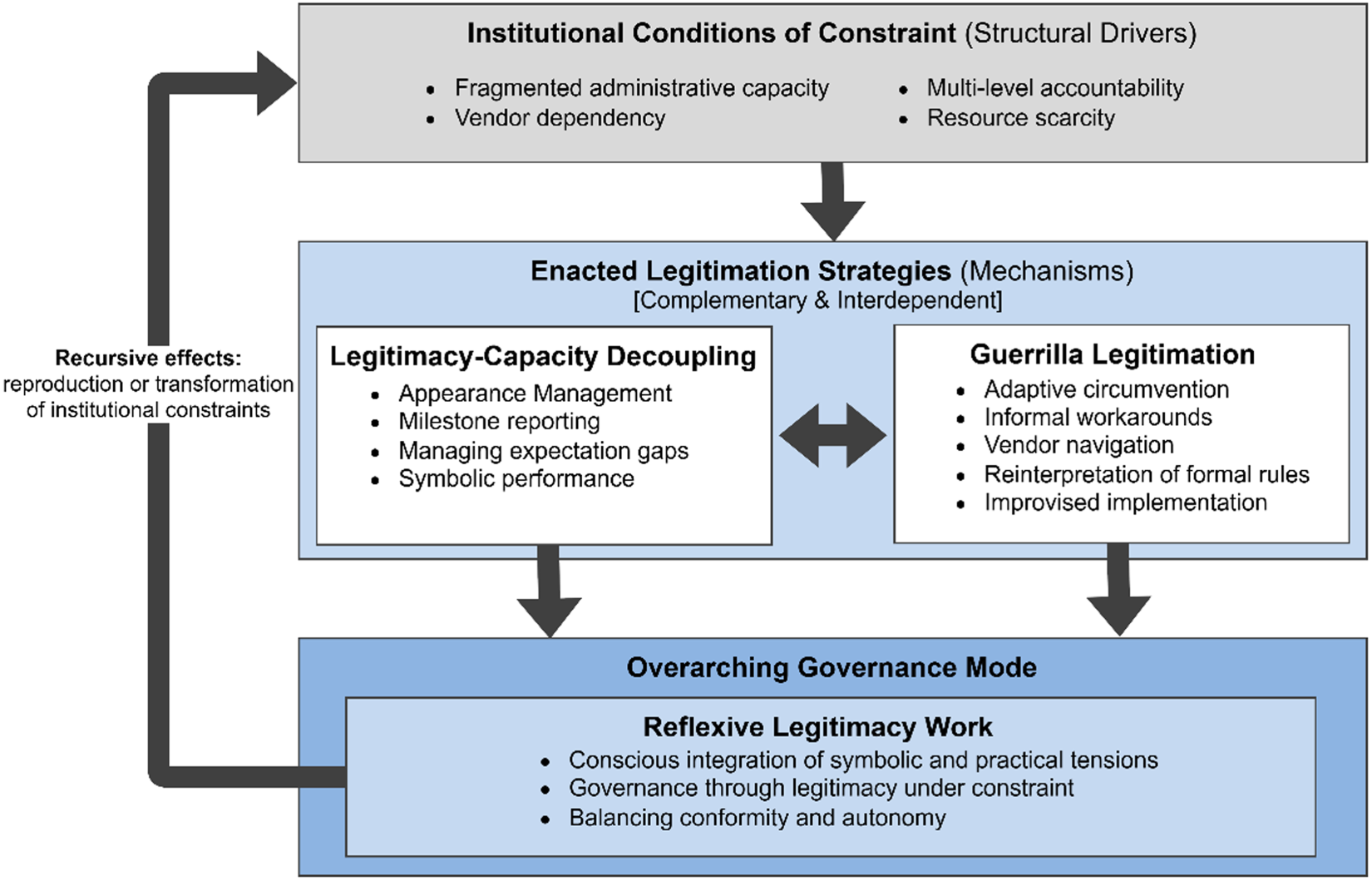
Reflexive Legitimacy Work in Local Government Digital Transformation: Institutional Conditions as Structural Drivers, Enacted Legitimation Strategies, and Recursive Governance Dynamics.
Recognizing legitimacy as an operational capability carries important implications for public management at multiple levels.
At the local level, acknowledging decoupling as a structural condition enables more transparent communication about progress and constraints. Institutionalizing cross-departmental learning from successful improvisations can transform individual workaround experience into collective adaptive capacity. Strengthening moral legitimacy requires participatory processes that align efficiency goals with inclusiveness and fairness, thereby reframing digital transformation as an ethical as well as technical endeavor.
At the policy level, the findings highlight the need to match formal mandates with sustainable capacity support. Multi-year funding and interoperable standards can mitigate dependency on intermediaries and foster substantive, long-term reform over short-term symbolic compliance. Governance frameworks should reward institutional learning, experimentation, and reflexivity rather than procedural conformity, thus promoting substantive transformation over performative alignment.
At the technological level, legitimacy deficits often arise when digital solutions remain detached from administrative practice. Co-design approaches and iterative feedback loops can enhance usability and experiential credibility. Modular systems that allow incremental adoption are particularly suitable for local contexts where transformation unfolds gradually and resources remain limited.
Across all levels, credible digital transformation depends less on technical implementation than on institutional arrangements that enable actors to justify change as both rational and right. Public management reform should therefore be understood as a continuous process of legitimacy work, linking technological capacity with democratic accountability.
Limitations and Future Research
This study has several limitations that suggest avenues for further inquiry. The focus group format may have introduced social desirability bias, particularly in sessions that combined hierarchical levels. The regional focus limits the generalizability of findings to other administrative traditions and resource environments. Sampling may also have favored municipalities already engaged in digital initiatives, while the absence of citizen perspectives constrains insight into external legitimacy. Future research should therefore include civic and political actors to examine how administrative legitimacy resonates beyond organizational boundaries.
Longitudinal and comparative research could clarify whether reflexive legitimacy represents a temporary adaptation or a stable mode of governance. Comparative studies across national and regional contexts may reveal distinct legitimacy regimes shaped by administrative culture and institutional history. As algorithmic systems and data infrastructure increasingly mediate administrative decision-making, future work should trace how legitimacy dynamics evolve under conditions of growing opacity and automated accountability; and whether the mechanisms of reflexive legitimacy work identified here persist, transform, or dissolve in more highly automated governance environments. Ethnographic and longitudinal approaches could further illuminate how legitimacy is enacted, negotiated, and sustained in everyday digital governance.
Conclusion
This study examined how municipalities interpret and enact digital transformation, showing that legitimacy operates as a constitutive mechanism of governance rather than a contextual by-product. Using the TOE–L framework, the analysis conceptualized digital transformation as institutional justification work through which public actors align technological initiatives with organizational norms and environmental expectations.
Empirically, two dynamics explain how administrations sustain reform under constraint. Legitimacy–capacity decoupling captures how municipalities manage gaps between ambition and feasibility, maintaining credibility through the symbolic appearance of progress. Guerrilla legitimation describes adaptive practices that restore functionality when formal systems fail. Together, these mechanisms reveal that public organizations govern not only through structures and resources but also through continuous legitimacy production across pragmatic, moral, and cognitive dimensions.
Theoretically, the study advances institutional perspectives on digital government by reframing legitimacy as an operational capability. Symbolic compliance is not interpreted as failure but as adaptive governance—a rational response to fragmented authority and reform pressure. Reflexive legitimacy work emerges as a central competence that allows administrations to balance conformity with autonomy while maintaining accountability in complex governance environments.
For public management, these insights highlight that effective digital transformation depends less on technological adoption than on institutional reflexivity, understood as the capacity to interpret, justify, and adapt under constraint. Policies that emphasize learning, co-design, and sustained capacity building can strengthen this reflexive capability.
In sum, legitimacy constitutes the connective tissue of contemporary governance. It translates institutional expectations into credible action and sustains public trust when reform ambition exceeds administrative means. As digital infrastructures grow more complex and interdependent, maintaining legitimacy through justification, accountability, and inclusion will remain the defining challenge for twenty-first-century public management. The analytical tools developed here—legitimacy–capacity decoupling, guerrilla legitimation, and reflexive legitimacy work—offer a conceptual vocabulary for understanding how public organizations navigate this challenge across diverse institutional settings.
Footnotes
Acknowledgements
The author thanks the municipal representatives and digital officers from South Westphalia for their time and the valuable insights provided during the focus groups. Additional thanks are due to Markus Hertwig, Peter Weber, Anja Wyczisk, and Luis-Aaron Wulfert for their support during the research. The author also extends heartfelt thanks to the peer reviewers for their meticulous and genuinely constructive feedback.
Ethical Approval
The study was conducted in accordance with the ethical guidelines of the German Research Foundation (DFG) and the ethical standards for sociological research. According to the policies of South Westphalia University of Applied Sciences, no formal approval by an ethics committee was required for this type of study.
Consent to Participate
Written and verbal informed consent was obtained from all participants prior to the focus group discussions, in accordance with institutional and data protection guidelines.
Consent for Publication
Not applicable.
Author Contribution
The author confirms sole responsibility for all aspects of the study, including conceptualization, methodology, data collection, analysis, and writing of the manuscript.
Funding
The publication of this Article is funded by the Open Access Publication Fund of South Westphalia University of Applied Sciences.
Declaration of Conflicting Interests
The author declared no potential conflicts of interest with respect to the research, authorship, and/or publication of this article.
Data Availability Statement
The author confirms that the data supporting the findings of this study are available within the article and its supplementary materials. Additional data, including a summary of the application of  principles in this study, the complete set of quotations illustrating pragmatic, cognitive, and moral legitimacy claims across TOE-L domains, and a coding framework excerpt illustrating legitimacy dimensions across the TOE-L domains, are available in the online supplementary materials associated with this article. The raw data are not publicly available as they contain information that could compromise the privacy of research participants.
Author Biography
Appendix A.
The study was guided by the seven principles of interpretive field research proposed by Klein and Myers (1999). These principles informed data collection, analysis, and reflexivity throughout the research process. Table A1 summarizes how each principle was operationalized in this study.
Appendix B. Focus Group Stimulus and Illustrative Moderator Probes
Appendix C. Coding Framework Excerpt
Table C1 compiles all quotations used in the article, presented in their original German form and English translation. Each entry indicates the citation type (direct quote, paraphrased with partial quote, paraphrased summary, or synthesized reference) and the corresponding section reference in the Results. Direct quotes are verbatim translations of the German original. Paraphrased with partial quote entries retain selected phrases in quotation marks while rephrasing surrounding text for clarity. Paraphrased summaries convey participants’ statements in the authors’ own words while maintaining empirical accuracy. Synthesized references merge multiple similar statements into a single pattern description to illustrate recurring themes. All translations prioritize conceptual fidelity over literal correspondence; colloquial and regionally specific expressions were rendered into English to preserve their pragmatic meaning and rhetorical tone.
Appendix D. Coding Framework Excerpt
Table D1 presents a representative excerpt from the final codebook, including code definitions, sample quotations, and Sparaanalytical notes illustrating how abstract categories were linked to empirical data.