






Abstract
Various scholars have pointed to a need for responsible algorithmization to minimize risks and harm and maintain citizen trust in government use of algorithms. They highlight the importance of an organizational focus to the responsible implementation of algorithmic systems in the public sector. Empirical knowledge about practices of responsible implementation in government is scarce. To develop a practice-based understanding of responsible algorithmization, this empirical study examines such practices within the Netherlands Police. I employ a qualitative interpretive analysis of scavenged material to understand the relationship between organization and responsible algorithmization practices. The findings show that the traditional ‘bureaucratic response’ to new challenges, which typically involves creating rules, procedures and positions can both facilitate and impair responsible algorithmization. The research highlights the necessity of balancing bureaucratic practices with innovative approaches to achieve responsible algorithmization. Therefore, I propose that, in addition to the bureaucratic response, organizations should simultaneously invest in pragmatic short-term solutions and more durable long-term structural changes.
Key Points for Practitioners
Government organizations are increasingly pushed to realize a responsible implementation of algorithms to avoid undesirable outcomes.
Conventional actions to achieve this, such as creation of rules and guidelines, positions, awareness etc. do not automatically translate to more responsible practices.
Organizations should invest in pragmatic solutions that enable responsible algorithmization in the short-term, for example for specific projects or situations.
On a longer term, structural changes may be necessary. However, waiting for those is not a viable approach as innovation continues.
Introduction: Responsible Algorithmization and Bureaucracy
‘Responsible algorithmization at the police ‘predicts’ who will use violence in the future’.
The newspaper article forwarded by my supervisor explains ethnicity influences the prediction. “I don’t understand why they keep making such mistakes,” my supervisor texts. I am equally puzzled, knowing the police as dedicated to responsible algorithmization.
Although this algorithm was discontinued a few days later, similar headlines critical of governmental algorithm use regularly grace news outlets in the Netherlands. To prevent such news and maintain citizen trust, some authors point to the need for responsible algorithmization (RA) in governments (Grimmelikhuijsen & Meijer, 2020; Kool et al., 2018; Meijer & Grimmelikhuijsen, 2021; Meijer & Thaens, 2021; van de Poel & Sand, 2021). RA is regarded as crucial for minimizing risks and harm (Kool et al., 2018; Meijer, 2009; Meijer & Grimmelikhuijsen, 2021; van de Poel & Sand, 2021). To date, however, little is known about what exactly such responsible algorithmization looks like in archetypical bureaucratic organizations like the police (Lorenz, 2019; Lorenz et al., 2021; Meijer et al., 2021).
When facing new challenges, bureaucratic organizations rely on a conventional bureaucratic response, based on the logics of rationality, specialization, hierarchy and formalization. This response typically involves introduction of new rules, procedures and positions (Bolman & Deal, 2017; Monteiro & Adler, 2022; Weber, 1947; Wilson, 1989). I use the lens of the bureaucratic response as a starting point for understanding RA practices in the Netherlands Police. This approach helps address the main research puzzle of this article: why well-intentioned bureaucratic organizations like the Netherlands Police end up with problematic algorithms despite a commitment to responsible algorithmization, and how this might be overcome.
RA distinguishes itself from related concepts such as (data & AI) ethics, governance, Responsible AI (RAI) and Responsible Research and Innovation (RRI) in two ways.
First, the concept of responsible algorithmization invites us to take a practice-based approach. Algorithmization denotes transformations resulting from the introduction of algorithms, thereby implying dynamic and ongoing processes (Meijer & Grimmelikhuijsen, 2021). This relates to Bovens’ (1998) understanding of ‘active’ responsibility, or responsibility-as-a-virtue. Active responsibility refers to moral obligation and duty, where an individual assumes responsibility and behaves accordingly (Bovens, 1998; Meijer, 2009; Meijer & Grimmelikhuijsen, 2021; van de Poel & Sand, 2021; Wieringa, 2020). Active responsibility can thus be understood as a practice. Combined, responsible algorithmization implies dynamic and ongoing practices corresponding to the overarching aim of implementing algorithms in a responsible manner.
Second, the concept foregrounds the importance of the organization by regarding algorithms as sociotechnical systems, highlighting the importance of actors, artefacts and organizational context alike (Gillespie, 2016; Lorenz et al., 2022; Meijer & Grimmelikhuijsen, 2021; Meijer et al., 2021; Seaver, 2017; Wieringa, 2020). Responsible algorithmization thus refers to transformations through efforts to implement these sociotechnical systems responsibly. Beyond regarding the algorithms as innovation, RA practices are innovations themselves aimed at organizational transformation. Responsible algorithmization as practice is deeply influenced by the logics guiding an organization.
Responsible algorithmization thus entails the study of practices in relation to their organizational context. From this processual perspective (van Hulst et al., 2016), RA should thus be regarded as purposeful organizational transformation or innovation by itself, established through practices. To date, little empirical work has focused on RA practices within bureaucratic organizational contexts.
This article provides an empirical, practice-based understanding of the relationship between organization and responsible algorithmization in the public sector context of policing, thus informing future research in this area. Although this research focuses explicitly on my experiences at the Netherlands Police, the findings may apply to similar bureaucratic organizations and be relevant to researchers and practitioners working on responsible algorithmization throughout the public sector.
The remainder of the article is structured as follows: first, section 2 builds on existing literature about related concepts such as (data & AI) ethics, governance, responsible AI and responsible research and innovation to build towards a practice perspective for the study of responsible algorithmization. Section 3 elaborates on how I conducted the study of responsible algorithmization practices in the Netherlands Police. In section 4, I present and analyze empirical narrative encounters to gain an understanding of the relationship between organization and responsible algorithmization practices in the Netherlands Police, structured along the logics underlying the bureaucratic response. Finally, section 5 aims to draw lessons from this analysis, proposing a threefold strategy for organizing for responsible algorithmization.
A Practice Perspective for Responsible Algorithmization
Academic work on responsible algorithmization practices in the public sector is scarce. However, much has been written about related concepts such as (data & AI) ethics, governance, responsible AI and responsible research and innovation. Literature often uses these concepts interchangeably, with relationships remaining implicit or varying across sources.
To overcome these conceptual confusions, I briefly establish the related concepts of responsibility, ethics and governance and their use for algorithms. Next, I introduce ‘responsible algorithmization’ as the central concept in this article and a way to bridge the disciplinary divides and add a new perspective to the existing body of literature. Finally, I introduce bureaucracy as a practice perspective for studying responsible algorithmization in the police context.
Responsibility for Algorithms
Responsibility is a well-researched concept, particularly prominent in the public administration literature. Bovens (1998), distinguishes passive and active responsibility. Passive responsibility, or ‘accountability’ denotes responsibility allocated to one actor by another actor, resulting in the (potential) performative act of being called to account for an action or event after it has occurred. Accountable actors have a duty to justify actions and the consequences thereof (Bovens, 1998; Helberger et al., 2018; Leonelli, 2016; Meijer, 2009; Stahl, 2023).
In contrast, active responsibility, or responsibility-as-a-virtue refers to an individual sense of moral obligation and duty, where an individual voluntarily assumes responsibility and behaves accordingly (Bovens, 1998; Leonelli, 2016; Meijer, 2009; Meijer & Grimmelikhuijsen, 2021; van de Poel & Sand, 2021; Wieringa, 2020). Such responsibility embraces what Vetterlein refers to as ‘positive duties’, such as preventative actions and a commitment to ‘doing good’ rather than ‘preventing harm’ (Vetterlein, 2018). Active responsibility, then, can be understood as a practice.
Responsibility and accountability do not necessarily overlap. An actor may assume responsibility without being held accountable. Likewise, actors that are held accountable may distance themselves from their responsibility. When it comes to implementing algorithms in public sector contexts, both passive and active responsibility are needed (Morrison et al., 2024; van de Poel & Sand, 2021).
Within the algorithmic domain, we can further distinguish between literature on Responsible Research and Innovation (RRI) and Responsible AI (RAI). The concept of Responsible Research and Innovation (RRI) was introduced to bridge the gap between theory and practice in light of increasing societal awareness and concerns about technological impact (Boenink & Kudina, 2020; Herrmann, 2023; Meijer, 2009; Stahl & Wright, 2018; van de Poel & Sand, 2021). RRI is built on the sentiment that innovation should take ethical principles and societal values into account, ensuring that processes and outcomes of innovation are acceptable, desirable, and sustainable both in the present and in the future (Doezema et al., 2019; Meijer & Grimmelikhuijsen, 2021; Stahl & Wright, 2018; Stilgoe et al., 2013; van de Poel & Sand, 2021; Yigitcanlar et al., 2021). Von Schomberg proposes the following (often cited) working definition: “Responsible (…) innovation is a transparent, interactive process by which societal actors and innovators become mutually responsive to each other with a view on the (ethical) acceptability, sustainability and societal desirability of the innovation process and its marketable products (in order to allow a proper embedding of scientific and technological advances in our society).” (von Schomberg, 2012, p. 50)
In dealing with values, RAI and RRI are closely related to literature on ethics as well as governance. Ethics is often introduced as the study of ‘what one ought to do’ or ‘how one ought to act’. It builds a strong theoretical base that helps us answer these questions, distinguishing ‘right’ from ‘wrong’ in ethical decision-making (Ananny, 2016; Keymolen & Taylor, 2023; Loyens & Maesschalck, 2010; Sigfrids et al., 2022; Stahl, 2023; van Maanen, 2022). Applied to the domain of algorithms, work on ‘AI ethics’, ‘data ethics’ and ‘algorithm ethics’ can be discussed as one body of literature. Floridi and Taddeo (2016) provide the following definition of data ethics as: ‘a new branch of ethics that studies and evaluates moral problems related to data (including generation, recording, curation, processing, dissemination, sharing and use), algorithms (including artificial intelligence, artificial agents, machine learning and robots) and corresponding practices (including responsible innovation, programming, hacking and professional codes), in order to formulate and support morally good solutions (e.g., right conducts or right values).” (Floridi & Taddeo, 2016, p. 1)
A similar approach is commonly found in literature on algorithmic governance. The concept of ‘governance’ is highly pluralistic. At its core, governance implies as a focus on practices and processes of decision-making through collaboration between a variety of actors (Introna, 2016; Sigfrids et al., 2022; Van Kersbergen & Van Waarden, 2004). Applied to algorithms, the terms AI, data or algorithmic ‘governance’ are connected to the aim of mitigating risks (e.g., through accountability) and implementing technologies so that they benefit society (Abraham et al., 2019; Janssen et al., 2020; Sigfrids et al., 2022; Wirtz et al., 2022).
This aim may be reached through ‘ethical’ or ‘good’ governance of algorithms. Mišić and colleagues’ (2025) literature review indicates that good governance is mostly focused on ‘good order’, e.g., foregrounding the importance of a functional democracy and the rule of law, whereas ‘ethical governance’ is focused on ‘good society’, including social justice and wellbeing. They find the concepts to be complementary (Mišić et al., 2025). Despite this slight difference in focus, both seem to rely heavily on the creation of public and ethical values and principles to help guide desired behavior in practice (de Graaf & Meijer, 2019; Jørgensen & Sørensen, 2012; Meijer & Ruijer, 2021; Mišić et al., 2025; Sigfrids et al., 2022).
Boundaries between these three concepts remain thin. They are often used interchangeably, and the relationships between them are established in diverging ways, if defined at all. For example, there seems to be a lack of consensus about the concept of RAI. Sadek et al. (2025) seem to equate this concept to AI ethics (Sadek et al., 2025), whilst Rakova and colleagues (2021) mention that RAI work can help surface new AI ethics issues, implying that they are different concepts (Rakova et al., 2021)
Similarly, some literature regards governance as the ‘top’ layer above concepts like (AI) ethics, RRI and literature in the field of public administration (Mišić et al., 2025; Sigfrids et al., 2022). For example, Sigfrids et al. (2022) refer to AI ethics as a governance solution for AI (Sigfrids et al., 2022). Later, however, they propose that “[t]o move toward the ethical development and use of AI, the principles for good governance, human rights, and ethics, and the procedures of RRI should be integrated in the governance approach (…)” (Sigfrids et al., 2022, p. 14). This statement seems to contradict the previously established relationship of AI ethics as a governance solution in favor of AI ethics as the overarching goal, in line with literature that places ‘ethics’ above ‘responsibility’ and ‘RRI’ (Stahl, 2023; van Maanen, 2022). In contrast, the study conducted by Herrmann (2023) discusses both ethics and governance under the twin umbrellas of RRI and RAI literature. For the body of RRI literature, he further finds that the concept of governance has been absorbed by the concept of ethics over time (Herrmann, 2023).
Responsible Algorithmization
Due to these conceptual confusions and the high level of overlap, separating these concepts from one another in any meaningful way lies beyond the scope of this research. Despite the differences, some overarching patterns seem to emerge from this rich body of literature; a lack of impact and a lack of attention to organization. The current paper introduces the concept of ‘responsible algorithmization’ to bridge these gaps, with a specific focus on public sector contexts.
Lack of Impact
First, some authors point out a neglect of theory (Herrmann, 2023; Morrison et al., 2024; Stahl et al., 2021; van Maanen, 2022), as most work is focused on the creation and implementation of ‘principles’ to ensure responsible and ethical implementation of algorithms (Herrmann, 2023; Leonelli, 2016; Mittelstadt, 2019; Munn, 2023; Stahl & Wright, 2018). There is much critique associated with this principled approach, and there is increasing academic consensus that these high-level principles and guidelines do not automatically translate to practices (Fest et al., 2022; Jobin et al., 2019; Leonelli, 2016; Mišić et al., 2025; Mittelstadt, 2019; Rakova et al., 2021), Munn (2023) even going so far as to discard ethics altogether in favor of alternative approaches to AI justice, calling ethics ‘useless’ (Munn, 2023).
Although frameworks encompass some of the values held by an organization, values often remain vague and abstract, offering little practical guidance (de Graaf & Meijer, 2019; Fest et al., 2022; Jobin et al., 2019; Madan & Ashok, 2023; Mišić et al., 2025; Sadek et al., 2025; Sigfrids et al., 2022). Lack of impact of this approach is further exacerbated by a lack of consequences. Frameworks and guidelines are often voluntary and free of any obligations or regulatory mechanisms (Keymolen & Taylor, 2023; Mišić et al., 2025; Munn, 2023; Sigfrids et al., 2022). Some authors even point to the risk of principled approaches being mis-used by actors for ‘ethics washing’ as a means to feign ethical engagement whilst dodging regulation (Keymolen & Taylor, 2023; Leonelli, 2016; Morrison et al., 2024; Munn, 2023; Sigfrids et al., 2022; van Maanen, 2022).
This gap, often termed the ‘principles-practice’ gap is accompanied by an overall lack of empirical work in the field (Morrison et al., 2024; Sigfrids et al., 2022; van Maanen, 2022).
Organizational Lacuna
Second, it is widely known and accepted that the responsible implementation of technologies should take into account the wider sociotechnical context in which technologies are developed and deployed (Ananny, 2016; Christin, 2017; Kitchin, 2017; Kitchin & Lauriault, 2018; Leonardi, 2011). Authors in the body of literature discussed here point to a lack of attention to this wider context (Keymolen & Taylor, 2023; Leonelli, 2016; Morrison et al., 2024; Munn, 2023; Sadek et al., 2025; Sigfrids et al., 2022; Stahl, 2023).
The organizational context is understood to be particularly impactful for responsible implementation of algorithms (Herrmann, 2023; Mittelstadt, 2019; Morrison et al., 2024; Munn, 2023; Rakova et al., 2021; Sadek et al., 2025; Sigfrids et al., 2022; Stahl, 2023). However, organizational factors are often neglected in favor of a focus on individual actors (Loyens & Maesschalck, 2010; Mingers & Walsham, 2010; Mittelstadt, 2019; Morrison et al., 2024; Rakova et al., 2021; Sadek et al., 2025; Stahl, 2023; van de Poel & Sand, 2021) or a technocentric approach (Mingers & Walsham, 2010; Morrison et al., 2024; Munn, 2023; Sadek et al., 2025).
Although there are some exceptions where organizational context and structure are explicitly considered with due attention to practice, such as the work of Rakova et al. (2021) these are rare and typically focuses on private rather than public-sector organizations (Rakova et al., 2021).
Responsible Algorithmization
The concept of ‘responsible algorithmization’ allows us to bridge these gaps, as it places the ‘organization’ front and center, as well as implying a focus on processes and practices. In contrast to earlier work regarding algorithms as artefacts, algorithmization regards them as sociotechnical systems, highlighting the importance of actors, artefacts and organizational context (Gillespie, 2016; Lorenz et al., 2022; Meijer & Grimmelikhuijsen, 2021; Meijer et al., 2021; Seaver, 2017; Wieringa, 2020). Algorithmization denotes organizational transformations that occur as a result of the introduction of these sociotechnical algorithmic systems (Meijer & Grimmelikhuijsen, 2021).
As such, responsible algorithmization entails looking at the wider sociotechnical system when studying algorithms. Within this sociotechnical system, responsible algorithmization foregrounds the organization and the wider organizational transformations which occur alongside algorithmization. This may overlap with the individual level, as organizational change can often be understood as the result of cumulative efforts by a wide variety of individual organizational actors. Understood as such, responsible algorithmization requires action and effort, in line with notion of ‘active responsibility’ developed earlier. In this article, I view RA from a processual perspective (van Hulst et al., 2016), as purposeful organizational transformation or innovation by itself.
The turn towards a practical and organizational focus is thus key to this understanding of responsible algorithmization. In this work I apply use responsible algorithmization to gain a new understanding of the public sector context of policing.
A Practice Perspective for Responsible Algorithmization
Police organizations are commonly regarded as archetypical bureaucratic organizations (Lorenz, 2019; Lorenz et al., 2021; Meijer et al., 2021). As such, an organizational perspective for responsible algorithmization in this sector must be regarded through an understanding of its bureaucratic context. Several researchers have explored the impacts of algorithmic technologies on bureaucracy. As early as 2002, Bovens & Zouridis signaled the shift from traditional street-level bureaucracies to ‘screen-‘ and ‘system-level bureaucracies’ in which direct contact with citizens is greatly reduced and increasingly mediated through algorithmic technology (Bovens & Zouridis, 2002; Bullock, 2019; de Boer & Raaphorst, 2021). At system-level, some of the decision-making discretion moves away from the front-line bureaucrat towards data professionals or even machine agents (Bullock et al., 2022; Kool et al., 2017; van Eck et al., 2018; Zouridis et al., 2020).
This literature can help to understand the effects algorithms have on their bureaucratic context, but it does not consider the effects that the bureaucratic context may have on responsible algorithmization. To explore the relationship between responsible algorithmization and organization, a more foundational understanding of bureaucracy is necessary. Although many different conceptions of ‘bureaucracy’ exist, most are grounded in Weber's understanding of bureaucracy as an ideal-typical organizational structure to maximize efficiency and effectiveness in large organizations (Bolman & Deal, 2017; Bullock et al., 2022; Monteiro & Adler, 2022; Weber, 1947). This understanding challenges stereotypes of bureaucracies as slow or overly complex. In a bureaucracy, the characteristic set of logics is composed of rationality, specialization, hierarchy and formalization of rules (Bolman & Deal, 2017; Bullock et al., 2022; Meijer et al., 2021; Monteiro & Adler, 2022; Weber, 1947; Wilson, 1989).
The bureaucratic organization relies on a rational logic of decision-making based on thorough analysis and conducted top-down by high levels in the hierarchy (Feitsma, 2020; Lindblom, 1959; Weber, 1947; Wilson, 1989). Specialization refers to the division of work within the organization, tasks are divided amongst positions and roles with well-defined responsibilities (Bolman & Deal, 2017; Monteiro & Adler, 2022; Weber, 1947; Wilson, 1989). Bureaucracies are highly structured, following a hierarchy of offices with a clear chain of command. Simply put, each level is subordinate to the level above it and supervises the level below it. Decisions originating from higher levels carry more weight (Bolman & Deal, 2017; Monteiro & Adler, 2022; Weber, 1947; Wilson, 1989). Institutionalized and documented rule and regulation govern work and practices within the bureaucratic organization (Bolman & Deal, 2017; Weber, 1947).
When faced with new challenges, these organizations rely on a conventional bureaucratic response, based on the logics of rationality, specialization, hierarchy and formalization. This response typically translates to the introduction of new rules, procedures and positions (Bolman & Deal, 2017; Monteiro & Adler, 2022; Weber, 1947; Wilson, 1989). This article uses the lens of this bureaucratic response as a starting point to investigate responsible algorithmization practices in the Netherlands Police and gain an understanding of the relationship between organization and responsible algorithmization practices.
Studying Responsible Algorithmization Practices
To address the main research puzzle of this article of why well-intentioned bureaucratic organizations like the Netherlands Police end up with problematic algorithms despite a commitment to responsible algorithmization, and how this might be overcome, this section first introduces the empirical context of the Netherlands Police, followed by a discussion of the method.
Empirical Focus: The Netherlands Police
In contrast to many other police organizations globally, the Netherlands Police has a centralized force, established in 2013 through the merger of 25 regional and one national police corps which had previously functioned autonomously (Terpstra & Fyfe, 2015; Terpstra et al., 2019). As per 2024, this centralized organization is divided in ten regional units, two national units and a supportive unit (Dutch: ‘Politiedienstencentrum’), with many further specializations and divisions. At the National level the police commissioner and his support team form the corps leadership. Domain-specific specialized responsibility is spread amongst ‘portfolio holders’ and ministerial accountability lies at the Minister of Security and Justice. Tasks are separated between management (at different layers of the organization), support staff (e.g., HR, IT, data professionals, lawyers, teachers, press office etc.) and operation (e.g., police officers, detectives, forensic researchers, intake and service, intelligence etc.).
These high levels of centralization, hierarchization and specialization add weight to the understanding of the Netherlands Police as a bureaucracy (Terpstra et al., 2019). This understanding is echoed both within the organization and its environment. In reporting failures of responsible algorithmization, media outlets refer to “The Police”, implying a single, homogenous organizational unit that can be collectively held responsible for such failure. A similar tendency is found in recurring political and societal debates concerning the role, mandate and structure of the Netherlands Police (Cachet & Marks, 2009; Terpstra, 2024). Internally, studies show the Netherlands Police creates a strong sense of shared identity, mission and culture amongst employees, often referred to as ‘blue’ in reference to the organization's color scheme (Fest et al., 2023; Landman et al., 2020; Terpstra, 2024).
This understanding of the Netherlands Police as a bureaucratic organization warrants critical consideration. Despite centralization increasing influence at the highest level of the organization, much local autonomy and discretion remains, particularly for local operational employees (Cachet & Marks, 2009; Terpstra & Fyfe, 2015). A comparative study between German and Dutch police found that the impact of hierarchy in the Netherlands police is much lower than in Germany (Meijer et al., 2021). Research also highlights a growing distance amongst specialized employees, and the emergence of new policing logics driven by increasing use of digital technologies (Fest et al., 2023; Terpstra, 2024; Terpstra et al., 2019; Waardenburg et al., 2018). Finally, police leadership was found to have an inhibiting effect on innovation efforts (Ernst et al., 2021).
Data and Methods
Responsible algorithmization efforts are dispersed across various departments and teams within the Netherlands Police, emerging at different times and often without formal coordination. While some RA-initiatives are intentional and planned, many arise from individual efforts, remaining unannounced and undocumented. There is no clear, delineated space for data collection for this research. Due to this lack of oversight (see also 3.1), neither the researcher nor the police can make a definitive judgment on the overall success of RA. Rather this article aims to deepen our understanding of RA practices in relation to the organization. To navigate these challenges and achieve this goal, I rely on a qualitative interpretive analysis of “scavenged” material (Fest et al., 2022; Seaver, 2017; Wieringa, 2023).
Scavenging is a pragmatic approach to ethnographic research which enables researchers to investigate systems or processes that are typically considered hidden or opaque. The concept was coined by Seaver (2017) specifically for the study of algorithms, which are often considered black boxes. He argues ethnographers have always taken a pragmatic approach to research, finding ways to scavenge materials e.g., when research sites were difficult to access (Gusterson, 1996, 1997) or when practices were scattered across multiple locations (Hannerz, 2003; Marcus, 1995). By gathering data from diverse “entry points” or unconventional locations of knowledge, scavenging broadens the scope of what is traditionally considered ethnographic data, providing access to insights that are not easily captured through more traditional methods (Fest et al., 2022; Seaver, 2017; Wieringa, 2023).
My scavenged data can be divided into four categories, separated based on the physicality and the intentionality with which it was gathered (see Table 1). Using the variety of data types can strengthen triangulation. I often asked participants during presentations whether my findings were recognizable to them, and I was able to match informal conversations to what I had read in documents (Bryman, 2012; Schwartz-Shea & Yanow, 2012).
A Typology of Scavenged Data Sources.

A Typology of Scavenged Data Sources.
The first category concerns intentionally collected data, reified in documents. This includes e.g., verbatim transcripts of semi-structured interviews, policy documents, (external) evaluation reports, extensive narrative fieldnotes of observations or minutes of a workshop with policy-level police employees organized to present and discuss research findings. This data is quantifiable, the article is partially grounded in 28 interviews with diverse actors at the Netherlands Police and 369 pages of fieldnotes based on ∼ 350 h of observation, 40 documents and 1 workshop with 10 participants.
The second category comprises unintentional physical data. This data was not collected intentionally by me as research data, but does contribute to my argument and exists in some physical form, e.g., notes from informal communications and presentations, e-mail conversations or newspaper snippets. These texts have not been saved or stored as research data, making it difficult to trace them back, but they do inform my analysis. This has resulted in at least 10 documents as well as written notes scattered between to-do lists and work-related ruminations across 3 A5-sized notebooks.
Finally, I rely on non-physical research data, such as oral or mental information not written down and therefore difficult to quantify. Non-physical data could be collected either with the intention of using it as data (category three) but more often, it was unintentional (category four). This includes presentations, informal conversations I have had with police employees taking the role of informant, helpful colleague or friend. Much information can be gathered from thought experiments over a coffee or beer as well as frustrations or excitement with the way things are going. Personal reflections and researcher memory also form a non-physical data source.
Non-physical data becomes accessible through immersion and cannot be gathered when attempting to keep research subjects at a distance. Immersion allows for close engagement with participants at the research site and offers valuable perspectives essential to ethnographic research (Jong et al., 2013; Orel, 2024; Schwartz-Shea & Yanow, 2012; van Hulst et al., 2016; van Maanen, 2011).
Spending almost four years conducting ethnographic research into responsible algorithmization at the Netherlands Police (September 2020 – May 2024), I became increasingly immersed in the organization. During this period, I was continuously ‘connected’ to the organization, but not always ‘in the field’. As such, my immersion was ‘textured’, switching between periods of closeness and distance (Dumont, 2023; Flemming & Rhodes, 2023; Gusterson, 1997; Rouncefield, 2011; Seaver, 2017). This approach allowed me to transverse a common risk of ‘immersion’, where the researcher increasingly adopts participants’ views and culture, referred to in the Netherlands Police as being ‘painted blue.’ Although I did experience moments where I heard myself repeating narratives I picked up in the field, the moments spent ‘out’ of the field allowed me to retain academic distance and reflect on these experiences. Through the balance between immersion and distance, I have managed to stay critical for the duration of my fieldwork, limiting undue influence on my data collection and analysis.
Meanwhile, my immersion caused direct changes towards more responsibility, e.g., sharing findings with high-level police actors, making me an actor in responsible algorithmization efforts in the Netherlands police as much as I investigated them. In the current article, I therefore regard my lived experiences and reflections as a researcher as data, reminiscent to autoethnographic practices (Kitchin, 2021; McGregor, 2023; Orel, 2024).
This article aims to combine information from these data types to provide a holistic image of RA practices at the Netherlands Police. To this end, I introduce narrative ‘encounters’ as empirical material. These encounters are grounded in the variety of data sources established in this section and capture my experiences as a researcher of responsible algorithmization within the Netherlands Police. Whilst they cannot always be traced back to specific data sources, I consider them illustrative of how RA is practiced within the Netherlands Police. Presenting and analyzing these narrative encounters alongside the bureaucratic logics of rationality, specialization, hierarchy and formalization results in a deeper understanding of the relationship between organization and responsible algorithmization practices at the Netherlands Police.
In this section, narrative encounters are introduced to investigate the relationship between organization and responsible algorithmization practices in the Netherlands Police. Encounters are analyzed alongside literature for each of the bureaucratic logics of rationality, specialization, hierarchy and formalization.
Rationality
Rational decision-making is central to the ideal-typical bureaucracy. This refers to a systematic approach to decision-making and organizational design, based on thorough and impartial analysis of data. The following encounter illustrates how rational analysis and organizational reality may clash, impacting responsible algorithmization practices:
Encounter: Mapping Endeavor
When I started my research in 2020, I did not know much about the Netherlands Police, or their use of algorithmic systems. Mapping the landscape around algorithms and AI in the organization seemed a logical first step. During one of my first interviews the interviewee laughed at my efforts. He told me jokingly about how impossible it was to get even a basic understanding of the Netherlands Police, let alone about algorithms or AI.
I did not take him too seriously. The questions I was asking were simple. For example: ‘how many data scientists work here?’. To my surprise, however, nobody seemed to know. After receiving answers ranging from five to two-hundred-and-forty-six from various contacts, I was now staring at an e-mail with the definitive answer: zero.
Curious, as I knew multiple teams and specializations worked with data science, including robotics, digital crime cases, intelligence, high tech crime, drones, a team focused on street-level innovation (TROI), local innovation teams called ‘q-teams’, and a team focused on ICT-infrastructure. Plus, I regularly saw job postings on LinkedIn asking specifically for data scientists. There was a Police Lab AI, and even a Data Science Community – yet no data scientists. In this message, the HR department informed me of the regrettable news that there was no such thing as a data scientist. 1 Not on paper, at least.
I now understand that it may not have been a joke at all. It may have been a warning.
Questions such as those asked in the encounter are essential to a rational analysis for RA purposes. While these questions seem simple, the encounter shows they are impossible to answer in practice. Rationality requires actors’ ability to make informed analytical decisions and critically assess algorithmic systems. Whilst this may be possible for some actors, particularly about projects they are personally and directly involved with, it will be difficult for more distant actors. This is also visible in the encounter, as information about the state of algorithmization that was collected through informal networks was unavailable through centralized means.
Whilst rationality is useful for routine tasks, innovation typically relies on circumventing strict organizational structures and rules to create space for experimentation, learning and risk-taking (Bekkers et al., 2011; Caniëls & Romijn, 2008; Meijer & Thaens, 2021; Wilson, 1989). Innovation and bureaucratic ideals of rational decision-making thus seem incompatible by nature. Lindblom argued that this type of ideal rational logic is not achievable in practice, as no organizational actor can oversee all potential outcomes or solutions to a problem. According to this view, the type of analysis that necessarily underlies rationality cannot be achieved in complex organizational realities. Instead, such complex organizations may transform through incremental and ongoing changes based on partial analyses. This requires bottom-up decision-making at different levels and divisions of the organization (Feitsma, 2020; Greenwood, 2016; Lindblom, 1959).
Organizational complexity can be caused by e.g., size, number of employees, structure, technology, complexity of the environment and formal status (Bovens, 1998; Dooley, 2002). To allow for this variety, I follow Dooley's definition of complexity as “(…) the amount of differentiation that exists within different elements constituting the organization.” (Dooley, 2002, p. 4). The encounter above clearly shows such layers of differentiation present within the Netherlands Police. As a bureaucratic organization, the Netherlands Police contains many teams and subdivisions, organized e.g., around certain domains (e.g., teams working on ‘drones’ or ‘high tech crime’), but they may also be organized spatially (e.g., local police teams) or by innovation goals (e.g., the ‘q-teams’, TROI and the Police Lab AI). Discretion is divided between these various teams and actors, particularly when it comes to regional police employees in the operational domain (cf. Terpstra & Fyfe, 2015).
My findings thus show that the bureaucratic logic of rationality does not seem suitable for responsible algorithmization. The encounter indicates there is no overview of algorithmic systems active within the organization. 2 There is also no clear overview of employees (data professionals) designing them, whose expertise may be crucial for forming autonomous judgments about algorithmic systems and their risks. The complexity of organizational reality appears to inhibit the bureaucratic principle of rationality when it comes to responsible algorithmization.
Specialization
The second bureaucratic logic I analyze here is specialization, the division of work within the organization. The following encounter illustrates the interaction between specialization and RA practices:
Encounter: Not-so-Low Hanging Fruits
Due to the ethnographic nature of my research, I often stumbled upon “low-hanging fruits”. Tangible issues that might be easily resolved by the Police. One fruit came up when I observed police officers writing police reports. Officers faced a straightforward problem: there were too many specific code options in the registration system, causing inaccuracy and frustration ( Donatz-Fest, 2024 ). I knew that resources were made available for redesign of this system, and I shared my findings with the manager responsible. The findings were reiterated and recognizable, but the manager simply stated it “couldn’t be helped.”
His team had no jurisdiction over the codes; they were managed by another organizational unit. The other unit had previously been reluctant to make any changes, claiming that yet other teams (e.g., intelligence) were dependent on the codes. I was surprised by this explanation; the sheer number of options paradoxically often reduced specificity, as officers would choose ‘other’ to avoid navigating the labyrinth of codes. The manager was reluctant to tackle the issue; “I’m not going to do that by myself,” he told me. It seemed the fruit was not quite low-hanging, and plucking it would require a collective organizational effort he felt ill-equipped to orchestrate.
In bureaucratic organizations, low-hanging fruits should be easy to implement through policy or rule. The encounter shows this is not the case, and a seemingly simple change proves difficult to implement. Various actors in the organization acknowledge the issue I identify but none feel empowered to take responsibility and address it. The team in charge of redesigning the system seems to lack the mandate to enact this change. Responsibility for codes is shared between different teams in the organization. This phenomenon is sometimes referred to as the problem of many hands, where so many actors are involved that gaps emerge in the distribution of responsibilities (Bovens, 1998; Doorn, 2012; Helberger et al., 2018).
Implementing RA practices proves challenging throughout the organization due to the problem of many hands paired with limited mandate. I have heard similar stories from other actors, including data professionals and people in advisory or sub-managerial roles as well as in other contexts or situations within the Netherlands Police. People appointed to fulfil certain tasks often lack the necessary mandate or resources to achieve these tasks. The findings show that the high degree of specialization is not necessarily substantiated in practice. This may in part be attributed to the innovativeness of RA efforts. Within the Netherlands Police much of the innovation is reliant on personal relationships and actors’ proficiency in ‘lobbying’ within the organization (Ernst et al., 2021).
My findings indicate that the bureaucratic logic of specialization does not necessarily result in responsible algorithmization. Whilst tasks and responsibilities are clearly divided between organizational units, the encounter shows that they are mutually dependent on one another. Responsibility is ultimately shared between a multitude of individual actors, and a single actor may not feel empowered or mandated to realize changes that, on paper, fit their specialization (Doorn, 2012; Helberger et al., 2018; March & Olsen, 2011; Rakova et al., 2021)
Hierarchy
As noted, a bureaucratic organization is highly structured, following a hierarchy of offices with a clear chain of command. Although the Netherlands police do fit this description, it should be noted here that the impact of hierarchy may be lower than in other countries (Meijer et al., 2021). The following encounter illustrates the impact of hierarchy on RA practices:
Encounter – Space for Impact
On a Friday afternoon, just as I was about to lay down work for the weekend, I received an e-mail; a calendar invitation titled ‘Values, Camera, Action!’. The same title I had given to my recent research paper, which reported concerns about an algorithmic system used by the police. The e-mail scared me. There was no explanation, just the title, and some high-level managers listed as invitees. I had presented my findings before but had been told no more FTE were available for improvements. Other priorities took precedence. Needless to say, the weekend was much less relaxing than intended.
A few days later, during the meeting, I was told of concerns that news media might read the paper and portray the Police negatively. More negative than I intended, as my aim was to aid responsible implementation of algorithms, not to discourage implementation. To my surprise, a new window for change opened up during that meeting. The media-concerns opened up a road to actual improvement of the system, where that had previously been impossible. The Police opted to implement improvements based on my research in the months following the meeting. It took a while to get over my initial scare and negative feelings about this encounter, but I have since come to see it as a successful story of responsible algorithmization.
In this encounter, an external source of pressure – the threat of news media – acted as a catalyst in aligning the values and responsibilities of actors at different levels of the organizational hierarchy. Implementing improvements was prioritized in practice, despite previous indications this would not be possible. This effect seems to relate to accountability, rather than responsibility. News media are known to play an important role during various phases of accountability (e.g., Jacobs & Schillemans, 2016). In this case, however, no actual accountability has taken place; actors may or may not be held accountable in the (near) future. In the encounter, they base their actions on the anticipation that news media will pick up on this story, and actors will be held to account. As explained by Bovens: “the realization that one will or might be held to account, the passive side of responsibility, stimulates people to behave responsibly, the active side. (…)” (Bovens, 1998, p. 39). This phenomenon is referred to in literature as ‘felt’ or ‘anticipated’ accountability (Hall et al., 2017; Overman & Schillemans, 2022).
Anticipated accountability, in the encounter, is a reactionary event. It remains unclear why it took effect at precisely this moment in time. Anticipated accountability may influence government officials’ actions and decisions more strongly if an issue is politically sensitive. In the Netherlands, these topics are relatively sensitive, as a result of some high-level public scandals and scrutiny at the Police, and more broadly the Dutch government (Algemene Rekenkamer, 2022; Amnesty International, 2020; Wieringa, 2023). This could explain the added power of anticipated accountability in the encounter. During a workshop session, participants mentioned that they are similarly concerned about public backlash or critical reports from government research institutions.
From this encounter we can conclude that the bureaucratic logic of hierarchization has the potential to strengthen RA. The anticipated accountability in the encounter reached actors at a higher level of the organizational hierarchy than had been approached previously. The concerns about the research article helped to gather these actors around the topic and align their interests. The involvement and alignment of management-level actors in the encounter was crucial, creating the necessary space for responsible algorithmization in practice.
Formalization of Rules
Formalization of rules refers to the extent to which work and practices are governed by institutionalized and documented rules (Bolman & Deal, 2017; Weber, 1947). Numerous legal frameworks aim to govern everyday data science practices. Relevant to this study are e.g., the EU's General Data Protection Regulation (GDPR), the EU Artificial Intelligence Act, the European Convention of Human Rights (ECHR) and the EU Charter of Fundamental Rights as well as National and domain-specific rules e.g., the Dutch Constitution, General Principles of Good Governance (ABBB), the Police Law 2012 and the Police Data Act.
Legal frameworks are supplemented by “soft law,” including ethical guidelines and codes of conduct, which are prescriptive and persuasive, but not legally binding (Jobin et al., 2019; Keymolen & Taylor, 2023). International bodies like the Council of Europe, the EU, OECD, UNESCO, and industry groups like IEEE and ACM have issued such guidelines (European Commission, 2019; Wagner et al., 2018; Yeung, 2020). Principles may also be reified in codes, for example the code for good digital public governance (Meijer & Ruijer, 2021), or the Professional Code of the Netherlands Police. One step further are practice-oriented tools, e.g., the Impact Fundamental Rights and Algorithms Impact Assessment (FRAIA) (Gerards et al., 2021), the Data Ethics Decision Aid (DEDA) (Franzke et al., 2021) or ethics based auditing (EBA) (Mökander & Floridi, 2023). While a distinction has been made here between legal and soft-law frameworks, it should be noted that the principles relevant to responsible algorithmization in these documents overlap greatly. For example, both refer to principles such as transparency, non-discrimination and privacy (Fest et al., 2022; Jobin et al., 2019). However, formalization of rules does not necessarily translate to RA practices, as the following encounter illustrates:
Encounter: Paper vs. Practice
The camera shifts to a pile of documents on the desk. On top, I see the guideline for governmental algorithm use published by the Ministry of Justice and Security. Underneath, supposedly, are other guidelines. The data professional laughs. I am taken aback. This may well be the first time a data professional at the Netherlands Police responds positively to my question of whether they use frameworks. More commonly, I hear complaints about how difficult these frameworks and guidelines are to work with. Principles are lofty and vague, with no practical direction. There are simply too many frameworks, and the relationship between laws and softer frameworks is not always clear. Guidelines are perceived as added administrative load, standing in the way of experimentation and innovation.
My surprise is short-lived as the data professional explains that this is a recent development – until recently frameworks were not on the radar. Rather than informing a data science project, the frameworks are the project. This data professional is trying to translate the lofty principles to a more practice-oriented tool. That seems to be the sole reason there is a pile of frameworks on the desk.
The implementation of such formalized rules like frameworks and guidelines in public organizations can be considered a huge step for the organizational embedding of responsible algorithmization. It takes much work to agree on a set of guiding principles, gain the necessary support to turn these principles into policy and ground them in requirements and procedures. As management layers in organizations are tasked with implementing such rules, and designing policy for their organization, awareness throughout the organization of RA is likely to grow (Fest et al., 2023; Mittelstadt, 2019; Whittaker et al., 2018).
However, as noted in the theory section, there is increasing academic consensus that these high-level principles and guidelines do not automatically translate to practices (Fest et al., 2022; Jobin et al., 2019; Leonelli, 2016; Mittelstadt, 2019; Rakova et al., 2021). Such governance mechanisms stay mostly in the management or ‘paper’ domain. Whilst frameworks may encompass some of the values held by the organization, these concepts are quite vague and offer little guidance for practical applications (de Graaf & Meijer, 2019; de Graaf et al., 2016; Fest et al., 2022; Jobin et al., 2019; Madan & Ashok, 2023). In contrast, tools such as DEDA, EBA, FRAIA and perhaps the tool the data professional is working on in the encounter, do provide practice-oriented steps. However, their application is often relatively labor intensive, which limits the scope of their implementation in daily practice.
The bureaucratic logic of formalization of rules, then, may strengthen awareness of responsible algorithmization rather than enabling RA in practice. The encounter shows that rules may lack specificity or practical application. As Mittelstadt notes: “High-level consensus is encouraging but it has little bearing on the justification of norms and practical requirements proposed within specific contexts of use” (Mittelstadt, 2019, p. 504).
Responsible Algorithmization: A Tale of Pipes and Ducts
Using the lens of the bureaucratic response, based on the logics of rationality, specialization, hierarchy and formalization, this article set out to gain a deeper empirical understanding of responsible algorithmization practices in the context of the Netherlands Police. This work provides a more nuanced understanding of the relationship between bureaucratic organizations and responsible algorithmization. In this section I rely on the metaphor of the organization as pipework in a building to reflect on the findings discussed in section 3. Metaphors are powerful instruments, that may help to understand and interpret complex contexts such as organizations (Morgan, 1986; Stone, 2022). They are a way of making sense of complex organizational contexts (ontologically) as much as they shape the way we interpret organizations (epistemologically). By viewing organizations through metaphors, different aspects of organizations are highlighted (Morgan, 1986, 2011). The chosen metaphor, that of the organization as pipework, enables a processual and dynamic focus suitable for the interpretation of responsible algorithmization practices within the organization (van Hulst et al., 2016). Through this metaphor I arrive at a threefold strategy for organizing responsible algorithmization (see Table 2).
Threefold Strategy for Organizing for Responsible Algorithmization.
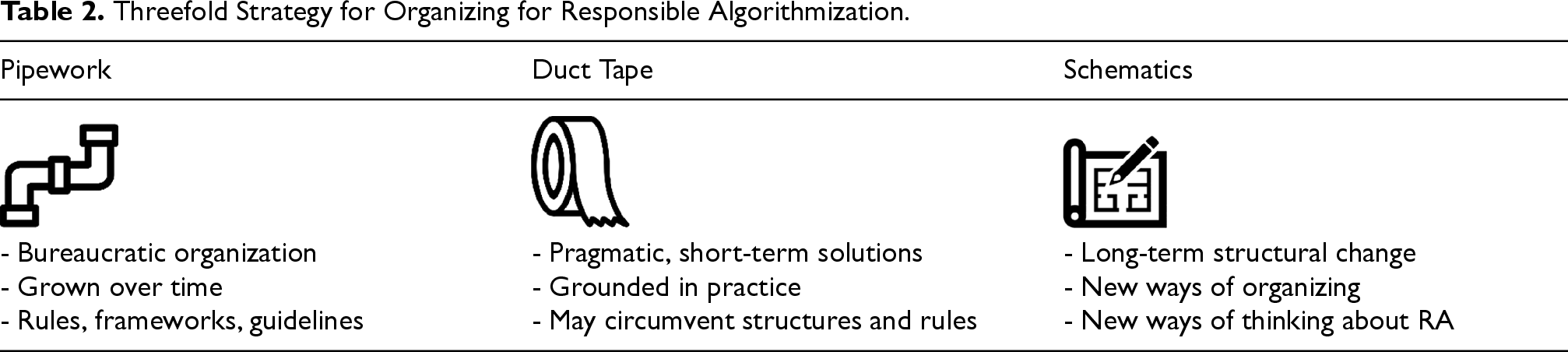
Threefold Strategy for Organizing for Responsible Algorithmization.
The bureaucratic organization of the Netherlands Police may be understood as pipework. When functioning expectedly, pipework resembles many of the bureaucratic logics; there is a clear top-down flow, with clear divisions of tasks between different pipes and conforming to a schematic. A plumber would rely on rational logic in solving a problem; they would try to pinpoint an issue and fix it in the most efficient and effective way possible. Based on these bureaucratic logics of rationality, specialization, hierarchy and formalization, organizations are quick to rely on rules, procedures and positions (Bolman & Deal, 2017; Monteiro & Adler, 2022; Weber, 1947; Wilson, 1989).
My analysis of RA practices at the Netherlands police indicates that there is some potential in the bureaucratic response for achieving responsible algorithmization. The discussion of hierarchy showed that there is potential for strengthening RA if high-level actors are involved and their goals aligned. Formalization of rules might help increase awareness throughout the organization and could potentially play a role in alignment.
The analysis also shows that the bureaucratic response falls short in realizing responsible algorithmization in practice in other situations. That, however, is no reason to discard it altogether. Hierarchy, formalization and specialization could be strengthened through e.g., hierarchical commitment, clear policy, and internal pressure mechanisms or the installation of positions such as ethicists, ethics boards or roles specifically dedicated to responsible algorithmization (Keymolen & Taylor, 2023; Rakova et al., 2021; Sigfrids et al., 2022; Stahl et al., 2021). The analysis shows that for such measures to be effective; these positions would need to be firmly embedded within the bureaucratic structure with individuals empowered and mandated to make decisions.
However, it is unlikely the bureaucratic response by itself will be sufficient for achieving responsible algorithmization. As noted before, innovation typically relies on circumventing strict organizational structures and rules. This is further strengthened by rapid developments both in algorithmic technologies and in how we approach matters of responsible algorithmization (Bekkers et al., 2011; Caniëls & Romijn, 2008; Makridakis, 2017; Meijer & Grimmelikhuijsen, 2021; Meijer & Thaens, 2021; Rakova et al., 2021; Yeung, 2020). Some authors also posit that actions in line with the bureaucratic response may be harmful, inviting disengagement or even adverse effects like ethics washing while taking up valuable resources allocated to RA (Leonelli, 2016; Munn, 2023; van Maanen, 2022).
One could argue that in these cases, the pipework is not functioning as expected. Leaks emerge where responsible algorithmization floods out, resulting in unchanged practices.
The Duct Tape: Actionable Responsibility
Leaks are immediate issues that call for short-term solutions. To enable responsible algorithmization in such cases, I call for an additional logic in bureaucratic organizations, next to the existing logics of rationality, hierarchy, specialization and formalization, which I term ‘duct tape’. Duct tape denotes pragmatic, short-term solutions that allow actors to navigate RA within the current organizational reality. Although some authors feel such pragmatic or ad-hoc approaches are undesirable and should be prevented (Sigfrids et al., 2022), I regard them more positively.
Duct tape certainly does not offer the most perfect solution and might be discarded in favor of more durable repairs over time. However, it can help to prevent risks and scandals thereby retaining citizen trust in the meantime, overcoming inertia. This is particularly important when more extensive solutions seem unattainable and outside an actor's sphere of influence, which is often the case in organizational contexts – as my analysis also shows. Similarly, a duct tape approach can help when technologies and related ethical concerns develop more quickly than what bureaucratic responses can keep up with. The scope of my research is too limited to provide an overview of different types of duct tape, this is an important avenue for future research. Nonetheless, some potential forms of duct tape may be identified.
First, individuals can function as such. This article sketched RA as a purposeful organizational process of transformation and innovation by its own right, rather than regarding it as part of algorithmization. Literature on successful innovation could thus provide insights into how efforts towards responsible algorithmization might function in practice. This includes a need for thoughtful experimentation and continuous improvements. Simply put; an actor may simply “try” something and evaluate on it whilst it is implemented in practice.
This places much of the RA work in organizations on the shoulders of individuals. Literature suggests that skilled and strongly motivated individuals who manage to navigate existing organizational structures, rules and procedures while fulfilling different roles are often present in organizations, even if unnoticed (Rakova et al., 2021; Wilson, 1989). Similarly, ethics literature speaks of ‘moral exemplars’, individuals who have a well-developed sense of morality and are skilled in virtuous behavior (Keymolen & Taylor, 2023; van Maanen, 2022). It should be noted however, that there is also a risk that the discretion of individuals decreases over time, as organizations shift towards the ‘system-level’ (Bullock, 2019; Busch & Henriksen, 2018). As such, individual approaches are unlikely to be sustainable for prolonged periods of time.
An organization might invest in identifying and enabling such individuals within the organization, removing barriers raised by the bureaucratic structure and allowing individuals to focus their energy on the RA work itself rather than navigating organizational structures. Examples of measures include creating a formalized innovation space and giving such individuals mandate to enact changes, rewarding responsible behavior and experimentation and training virtuous behavior and practitioner responsibility (Keymolen & Taylor, 2023; Rakova et al., 2021; Sadek et al., 2025). There is some clear interplay with the bureaucratic pipework here, as for instance frameworks and guidelines may help determine what exactly constitutes virtuous behavior and hierarchical relationships can help in establishing mandate for individuals.
Second, the analysis also points to ‘anticipated accountability’ (Hall et al., 2017; Overman & Schillemans, 2022), which could be leveraged strategically by organizations. Anticipated accountability can be deployed, for example, through thought experiments: imagining potential news headlines or consequences for specific projects. This may take multiple forms, e.g., thinking about potential backlash from the public, decreases in public trust, being prohibited from further development of specific technologies etc. Rakova and colleagues also report on some practitioners using reputational risk as a leverage to increase RA investments (Rakova et al., 2021).
Finally, the organization can look at ways to enhance existing processes e.g., revisiting processes of procurement and licensing to include requirements for responsible algorithmization (Mittelstadt, 2019), or investing in some of the operationalizable tools that are increasingly being developed (Fest et al., 2022; Herrmann, 2023; Sigfrids et al., 2022).
Although duct tape is useful and can help circumvent inertia, it is important to see such solutions in the context of their limitations. They are short-term and imperfect solutions that often lack durability and as such warrant periodical revaluation and replacement by more structural solutions over time. Without this understanding, organizations run the risk of creating new ‘legacy’ systems comprised of duct tape (Sadek et al., 2025).
The Schematics: System-Level Change
Although my ethnographic work indicates the need for strategic use of the bureaucratic pipework alongside a renewed respect for the logic of duct tape, these efforts are unlikely to suffice long-term. The analysis highlights difficulties particularly related to the bureaucratic logics of specialization and rationality. I posit that this may be attributed to the system-level character of algorithmic technologies. Algorithms are commonly anticipated to have immense fundamental impact on society (Makridakis, 2017; Wetenschappelijke Raad voor het Regeringsbeleid, 2021). Algorithms will change society as we know it, although it is difficult to predict exactly how. System-level technologies cannot be confined to single domains. Whilst a specialized division or department may be able to tackle domain-specific challenges, algorithmization transcends specialization. Organizational units are mutually dependent when it comes to algorithmization, and a single department or team is ill-equipped to take actions towards responsible algorithmization.
Previous system-level technologies inspired system-level transformations. In response to the invention of combustion engines, for example, entire physical infrastructures were changed to accommodate cars. Eventually, successful RA might require similar system-level change, which I term re-drawing the ‘schematics’. Rather than fixing problems within, the entire pipework might require redesign.
Redrawing the schematics might be focused on the organization itself. The discussion in this article highlights a potential need for (re)arranging hierarchical relationships, responsibilities and mandates – complete with ‘carrots’ and ‘sticks’, rethinking the practical application of rules when it comes to innovations and finding ways of decision-making not reliant on rationality. In addition, further aligning values, goals and collaboration throughout and between organizational domains might help achieve responsible algorithmization in practice and reduce the burden of RA on individuals (Mittelstadt, 2019; Rakova et al., 2021; Sigfrids et al., 2022). Some authors also point to the need for a shift in organizational culture away from a compliance mindset, thus advocating for ‘active responsibility’ (Morrison et al., 2024; Rakova et al., 2021; Sadek et al., 2025). As we saw, this level of active responsibility will be difficult, if not impossible, to achieve within the current bureaucratic structure.
Next to the internal organization, system-level changes also entail a focus on the external context and wider infrastructure. Some authors call for practical measures such as external mechanisms for accountability and responsibility that can exert pressure (Keymolen & Taylor, 2023; Rakova et al., 2021; Sigfrids et al., 2022), or incorporating a wider variety of stakeholder and citizen perspectives through participation mechanisms, particularly consulting minority voices (e.g., various ages, ethnicities, sexualities) that are often neglected (Herrmann, 2023; Mittelstadt, 2019; Munn, 2023; Sadek et al., 2025; Sigfrids et al., 2022). Other literature poses more fundamental questions about the relationships between technocentric capitalist systems based on competition vs. cooperative and problem-based systems (Keymolen & Taylor, 2023; Mittelstadt, 2019; Munn, 2023; Sigfrids et al., 2022; van Dijck, 2020) as well as questioning the western and Eurocentric nature of much of the RA literature and initiatives (Herrmann, 2023; Munn, 2023).
During my fieldwork, a debate about system-level changes slowly began emerging in the Netherlands Police. This debate includes, for examples, ideas about the extent to which teams working on or with algorithms should professionalize and receive mandate to use such systems autonomously, and what requirements should be met both in terms of technical knowledge as well as knowledge on wider matters of algorithmization and responsible algorithmization. This could entail a structural shift away from the hierarchical organization towards more autonomous communities and teams. In contrast, there was little attention for the wider environment.
Conclusion
None of these approaches of pipework, duct tape and redrawing the schematics can be successful at achieving responsible algorithmization in isolation. The analysis shows that the conventional ‘bureaucratic response’ (the pipework) is insufficient for achieving responsible algorithmization in practice. Algorithmic technologies can be understood as domain- and discipline- transcendent system-level technologies. This work highlights the limitations of organizing for responsible implementation of such technologies through traditional bureaucratic logics of specialization, hierarchy, formalization of rules and rationality.
As such, I proposed two additional ways of organizing for responsible algorithmization: system-level organizational change (re-drawing the schematics) and pragmatic short-term solutions (duct tape). Whereas duct tape is designed for short-term use and inherently entails periodical revaluation and replacement by more structural system-level changes over time. Even with such system-level changes, however, organizations will stay complex and some of the issues discussed in this article will likely never be fully resolved.
Instead, I argue that this organizational complexity must be acknowledged and accommodated in conversations about RA. The organizational reality, now often neglected, is essential for successful responsible algorithmization. As such, all three levels of the threefold strategy proposed here warrant attention. The findings highlight the necessity of balancing bureaucratic practices with these innovative approaches to achieve responsible algorithmization in practice. I propose that organizations like the Netherlands Police should simultaneously invest in utilizing existing bureaucratic organizations, preparing for system-level changes and finding ways to make responsible algorithmization more actionable in the meantime. The three forms of organizing for responsible algorithmization are inherently different, but each should be recognized on its own merits.
Next to the introduction of the threefold strategy, this paper provides three main contributions to literature:
First, it provides a practice-based understanding of the relationship between organization and responsible algorithmization. Although the concept of algorithmization inherently entails an organizational focus (Grimmelikhuijsen & Meijer, 2020; Meijer & Grimmelikhuijsen, 2021; Meijer et al., 2021) empirical knowledge taking such a perspective to focus specifically on responsible implementation in government is scarce. This research has shown that organization may enhance or hamper responsible algorithmization practices. Please note that the ambition of this article is not to identify and present a complete overview of all the ways in which organization and responsible algorithmization interact, but rather to gain insight into responsible algorithmization practices through an organizational focus.
Second, although academic work focusing on responsible algorithmization practices in the public sector is limited, much has been written about related concepts such as (data & AI) ethics, governance, responsible AI and responsible research and innovation. However, these concepts are fuzzy and often used interchangeably. Taken together this body of literature shows two main gaps, being a failure to achieve actual impact for responsible implementation of algorithms and a disproportionate focus on individuals in these processes, with a lack of attention for the organizational context. The concept of ‘responsible algorithmization’ as a practice allows us to bridge disciplinary divides and overcome these two central gaps in the literature.
Finally, although this research focuses explicitly on my experiences at the Netherlands Police, the findings I discuss may apply to similar bureaucratic organizations. As bureaucratic logics are inherent to the way in which organizations like the Netherlands Police function, the challenges identified here will likely never be fully resolved. Instead, bureaucratic organizations need to find ways to successfully achieve responsible algorithmization within this organizational reality. More empirical and theoretical research is needed to deepen our understanding of the two additional responses proposed here and solidify the threefold strategy of simultaneous investment in pipework, duct tape and schematics. As of now, the strategy comprises tentative suggestions for responsible algorithmization in public sector practice. These insights may thus be helpful to researchers and practitioners working on responsible algorithmization throughout the public sector. The threefold strategy proposed here invites practitioners in these organizations to take a more active approach towards organizing for responsible algorithmization.
Footnotes

Funding
The author received financial support for the research, authorship, and/or publication of this article. The work was supported by funding from the Nederlandse Organisatie voor Wetenschappelijk Onderzoek for the project ‘ALGOPOL. Value-Sensitive and Transparent Algoritmization: Key to Building Citizen Trust?’ (algopol.sites.uu.nl) [406. Q1 DI.19.011].
Declaration of Conflicting Interests
The author declared no potential conflicts of interest with respect to the research, authorship, and/or publication of this article.