Abstract
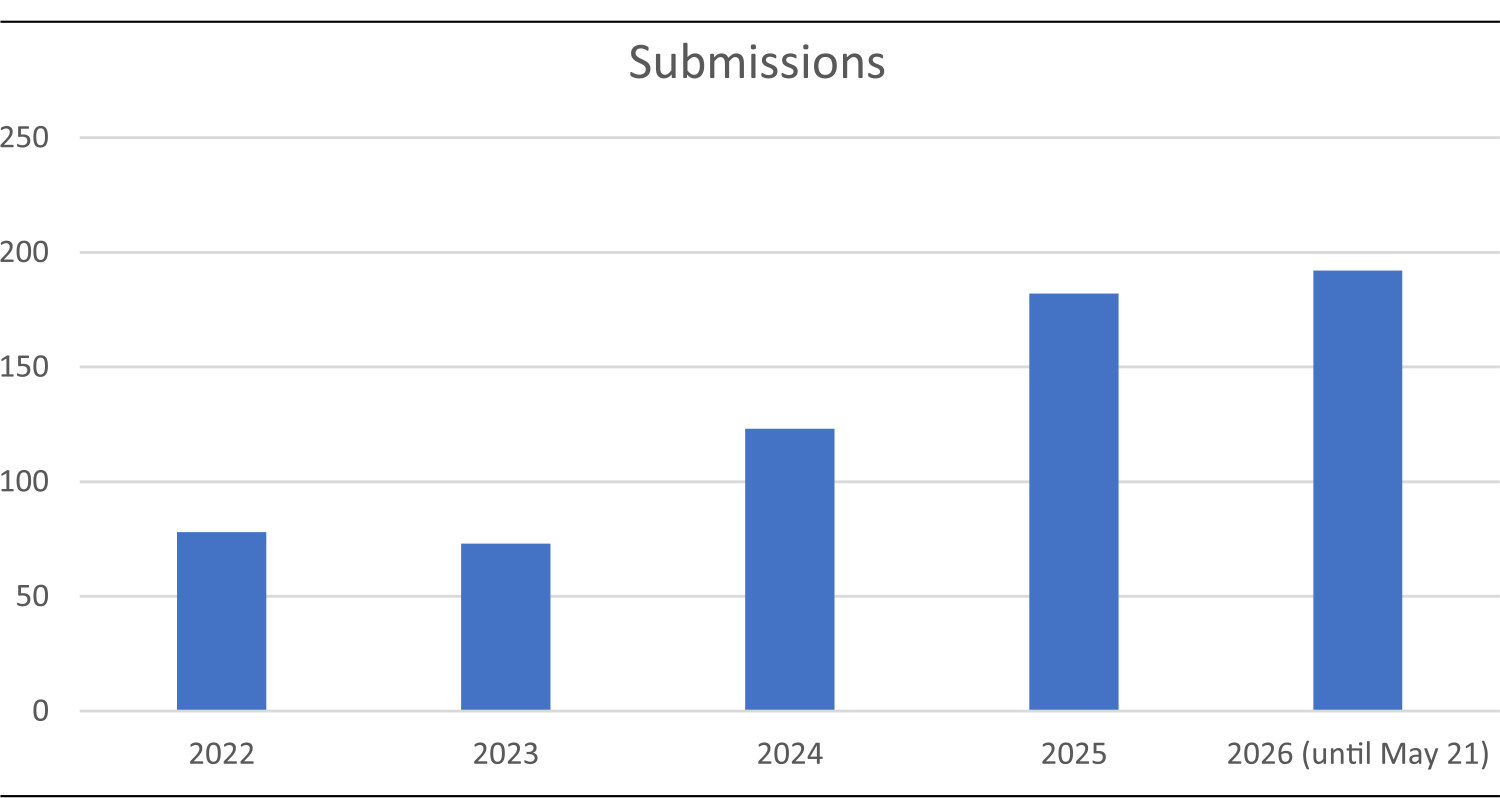
Since 2023, Information Polity has seen an explosion in the number of submitted manuscripts, an increase of over 100% (see Table 1). While we first saw this increase as a sign of the growing attractiveness of our journal, this is now becoming worrisome, as it places duress on our traditional editorial and peer review systems. This is not unique to our journal, across the sector, in all academic disciplines, there has been a rapid rise in the production and submission of academic manuscripts. In turn, this has meant an increased demand for reviews and reviewers, making it harder to maintain quality standards. The growth we have witness is part of a broader change in the academia.
Why is this number rising so steeply? The honest answer is that we don’t know since we have not undertaken a thorough analysis. A part of the explanation is the growing recognition of Information Polity as a core journal in the field. In 2023, Clarivate started attributing Impact Factors to journals indexed in the Emerging Sources Citation Index (ESCI), where Information Polity is currently indexed. This will certainly have had a positive effect on the number of submissions, but it seems highly unlikely that this alone explains the rapid increase in submissions.
We suspect a technological culprit: Artificial Intelligence (AI). An interesting analysis of the impact of AI-assisted authoring of academic papers was published by Gartenberg et al. (2026) in Organization Science. Based on their analysis of papers submitted to this journal, they argue: ‘Submission volume has risen 42% since the late 2022 release of ChatGPT, while writing quality [during the same period] has declined.’ They conclude that that the current use of AI tools, amplified by existing publish-or-perish incentives, tilts the overall academic production towards a larger number of lower quality papers, and not better research. AI is not only used for authoring papers but also increasingly for writing reviews. And, again, the evidence suggests that this undermines the quality of reviews. While AI is not yet used to the same extent for reviewing, Gartenberg et al. (2026) found that over 30% of reviews in Organization Science used some degree of AI. They argue that this does not contribute to quality work, and whilst they did not conduct an in-depth analysis, they did find that the quality of writing in these reviews’ declines.
So how should we respond? Gartenberg et al. (2026) identify three future scenarios. Scenario 1 suggests that journals will get better at identifying AI-papers via AI detection tools. This would mean that Information Polity should use tools, like Pangram, to filter out the poor-quality AI-authored papers which currently pollute our pipeline. The problem would be solved. Scenario 2 is more threatening, it suggests that detection will prove to be difficult and ‘AI-slush’ will drive out quality. This would mean that Information Polity would be overburdened with AI-generated papers and we would no longer be able to maintain our high standards for reviewing and editorial control. Scenario 3 is more hopeful. In this scenario, institutional and technological controls will result in high quality usage of AI for strengthening research and the quality of written work. This would then help to produce better rather than more papers, and at the same time, Information Polity could use AI for editorial and reviewing work in a responsible manner.
So how do we work towards a hopeful future for AI in research? This is a complex but urgent question, especially in view of the operational difficulties we are facing in processing the high number of manuscripts that are being submitted to our journal. Direct changes such as using tools to identify whether papers have been written by AI are urgently needed, but we are not convinced that this is enough. We also need to discuss how we can streamline our processes and use AI in a responsible manner to edit and review manuscripts, and identify what kinds of AI usages are acceptable for authors - for an interesting perspective on the responsible use of AI tools in academic publication see Boldwin and Borchert (2026). This also means that we need tools which do not enhance our dependence on big tech companies but ensure the digital autonomy of academic work. Finally, we may need to find new ways for quality control of publications that are not based on the funnel model of publishing in academic journals. We need to rethink the nature of academic publications in an AI era, and this may result in dramatic changes. We live in turbulent times.
Manuscripts Submitted to Information Polity.