







Abstract
A smart city approach places citizens at the center of decision-making. However, only a small proportion of citizens actually engage in participatory initiatives. Although citizen participation has been extensively studied, limited empirical evidence exists on how citizens’ awareness of participatory initiatives relates to both their participation and their perception of municipal efforts to promote participation. This paper analyses these relationships using a Propensity Score Matching (PSM) approach based on survey data from a medium-sized city in Argentina. Since the factors associated with participation and perceptions of municipal promotion may also shape citizens’ awareness of government programs, PSM is used to improve comparability between aware and non-aware citizens and to examine the association between awareness of participatory initiatives and participation outcomes. The results show statistically significant differences in both participation propensity and perceptions of municipal promotion between citizens who are aware of these initiatives and those who are not. Awareness is positively associated with prior civic engagement, visiting the municipal website and age, and negatively associated with being a woman. Policy implications highlight the importance of disseminating successful participatory experiences and strengthening communication strategies to encourage broader citizen engagement.
Key Points for Practitioners
Local governments should actively promote and disseminate information about participatory initiatives.
Local governments could implement “small wins” strategies through short-term community initiatives that provide tangible engagement outcomes.
Citizen participation resources should prioritize information diffusion, successful experiences, and participatory opportunities, particularly in smart cities and contexts with smaller digital divides.
Increasing transparency and sharing successful participation experiences through digital and in-person channels can reduce informational inequalities and encourage civic engagement.
Introduction
In recent years, the tendency to complement representative democracy with participatory and deliberative approaches has gained increasing prominence across democratic nations, particularly in Europe (García et al., 2023). Involving citizens in decision-making contributes to more efficient and legitimate governance outcomes. Policymakers and civil society advocates view these approaches as a means to strengthen public trust in democratic institutions and improve the legitimacy and effectiveness of policy outcomes. Moreover, participatory processes offer public administrators an opportunity to explain and justify political decisions that may otherwise be unpopular among citizens (Irvin & Stansbury, 2004).
At the same time, the production and delivery of public services have attracted renewed academic and political attention (Meijer, 2011; Pestoff, 2006; Sarantidis, 2023). A key feature of this process is the central role citizens play as co-producers of public services (De Witte & Geys, 2013). Aware citizens are individuals who have knowledge or awareness of key issues, such as public policies or digital technologies (Guo & Neshkova, 2013; Soto-Acosta & Cegarra-Navarro, 2016), and whose engagement is essential for the success of smart city initiatives. In Smart City initiatives, citizens’ awareness of participation policies plays a key role, as it enables greater engagement in urban governance processes and may also shape citizens’ perceptions of how actively local governments promote participation. In this context, policymakers must balance the democratic principle of citizen engagement with the need to ensure efficient and effective decision-making (Hong, 2015).
Information and communication technologies (ICT) play a key role in expanding citizen participation across different decision-making processes. Web 2.0 platforms and the widespread use of smart devices have enabled broader engagement in areas such as urban planning, traditionally limited to small groups of citizens. ICT-based tools have become essential in local, regional, and national governance (Cardullo & Kitchin, 2019; Monzon, 2015), contributing to the sustainability of cities through digital participation (Bouzguenda et al., 2019). Within this framework, concepts such as smart cities and e-participation have emerged, although empirical studies on ICT's concrete impact on citizen participation remain limited (Morato et al., 2020).
However, some authors argue that ICT is not the origin of these new participatory demands, but rather a facilitator of change driven by a more educated and sophisticated citizenry in a context of growing disaffection toward political institutions (Brugué & Gallego, 2003; Kaase & Newton, 1995). These developments reflect a shift from hierarchical, top-down decision-making toward new forms of shared governance and redistribution of power (Meijer, 2016). Technology alone is not enough to ensure engagement, it requires participatory designs that motivate citizens to take part in all stages of decision-making (Bryer, 2013). In this sense, e-participation initiatives within smart cities aim to co-create sustainable urban solutions (Caragliu & Del Bo, 2019; Rodríguez-Bolívar, 2021), a goal reinforced after the COVID-19 pandemic, which accelerated digitalization and highlighted the need to reduce the digital divide, particularly in Latin America (Annunziata et al., 2021; Espinoza, 2022).
Some studies have analysed the factors influencing citizen participation (Panopoulou et al., 2014; Sánchez-Nielsen et al. 2014; Simonofski et al., 2021). However, there is still scarce empirical evidence on the relationship between citizens’ awareness of public initiatives and their participation. In particular, this paper aims to examine whether awareness of municipal participatory initiatives encourages citizens to engage in governance processes and influences their perceptions of municipal efforts to promote citizen participation. Specifically, this study addresses the following research questions: Is awareness a critical factor in explaining citizen participation? Does it also influence how citizens perceive municipal efforts to promote participation? To account for potential endogeneity between these variables, a Propensity Score Matching (PSM) analysis is employed. The study uses data from Bahía Blanca, an Argentinean port city located in the southwest of Buenos Aires province.
This paper contributes to the literature by providing a quantitative empirical analysis of the relationship between citizens’ awareness of participation initiatives, their participation decisions and their perceptions of municipal efforts to promote participation. While previous studies have often focused on conceptual or descriptive analyses of participation in smart cities, this study applies a quantitative approach to examine these relationships empirically. This approach complements the predominantly qualitative literature by providing empirical evidence on the determinants of participation. Using Propensity Score Matching (PSM), the study identifies how awareness of participatory initiatives influences engagement while addressing potential endogeneity. Furthermore, by examining the case of Bahía Blanca—an intermediate city that has become a national leader in open government—this study extends the empirical scope of research typically centered on major metropolitan areas. Overall, the findings contribute new evidence to the debate on whether digital transparency effectively fosters active citizen participation and shapes citizens’ perceptions of participatory governance in emerging economies.
The structure of this article is as follows. Section 2 presents the theoretical framework underpinning the study. Section 3 describes the methodology, data, and variables used. Section 4 presents the empirical results, which are then discussed in relation to previous studies. Finally, Section 5 concludes the paper with key findings and policy implications.
Theoretical Framework
Citizen participation plays a central role in policymaking, as well as in deliberation and decision-making processes. In recent years, its development has been increasingly shaped by the diffusion of ICT, which enable new forms of digital participation and interaction between citizens and governments. In this context, access to information and knowledge becomes a key factor enabling citizens to engage with participatory initiatives.
From this perspective, the notion of knowledge cities provides a useful analytical framework for understanding the role of information in civic engagement. Knowledge cities rely on the production, diffusion, and renewal of knowledge, where citizens and their relational networks constitute the main knowledge pool (Goldberg et al., 2006; Van Wezemael, 2012). Recent literature increasingly links knowledge city and smart city approaches, highlighting knowledge as a driver of development and participation (Putra et al., 2025). While knowledge cities provide a broader framework focused on knowledge, innovation, and human capital, smart cities emphasize the use of digital technologies to improve urban services and governance often promoting citizen participation as a central component of these processes and placing citizens at the core (Esposito et al., 2024; Monzon, 2015; Simonofski et al., 2021; van der Hoogen et al., 2024).
In this context, knowledge can be understood as citizens’ awareness of participatory opportunities. Access to information about civic initiatives increases citizens’ understanding of participation and its potential benefits, while also fostering future collaboration between citizens and local governments (Khatibi et al., 2021; Kiss et al., 2022; Owojori et al., 2022). Greater awareness may also shape how citizens perceive the efforts made by local governments to promote participation. Without such awareness, opportunities for engagement remain limited (Chitsa et al., 2022), preventing participatory and smart cities initiatives from fully achieving their objectives. In fact, the concept of engagement is closely tied to trust-building and the integration of diverse perspectives in decision-making (Cortés Cediel & Gil, 2018). However, a persistent gap remains between citizens’ expectations and the policies implemented by governments, which can generate dissatisfaction and weaken trust in public institutions (Grazian & Nahr, 2020).
A substantial body of research has examined the determinants of citizen participation. Previous studies show that citizens with higher education and prior community experience are more likely to participate (Irvin & Slansbury, 2004; Simonofski et al., 2021). In addition, ICT use can encourage digital participation by reducing information and transaction costs (Haaskjold et al., 2020; Shahab & Allam, 2020). However, the digital divide still limits inclusion in Latin America (Alderete, 2022; Peacock, 2020). In Argentina, many participatory experiences continue to take place offline, such as participatory budgeting. Evidence from face-to-face participatory budgeting shows that citizen-proposed and defended projects are usually highly specific and localized—often focused on particular neighborhoods or blocks—which makes it difficult to drive broader citywide transformation (Annunziata et al., 2026). At the same time, Lim and Oh (2016) argue that online participatory budgeting tends to be less representative and deliberative compared to in-person formats. Hence. technology is necessary but not sufficient for building participatory smart cities as awareness of participatory opportunities is a key condition for citizen engagement.
Furthermore, the socio-demographic factors also shape participation: age and gender are usually negatively associated, while education and public sector employment tend to foster participation (Al-Jamal & Abu-Shanab, 2016; Naranjo-Zolotov et al., 2019; Sharma, 2015). In this vein, evidence indicates that gender shapes patterns of citizen participation in nuanced ways (Desposato, & Norrander, 2009; Jima-González et al., 2025; Picarella, 2024). Women often face barriers to formal political participation like voting or seeking elected office, driven by time constraints, gender norms, and structural discrimination. When women participate, policy processes may become more attuned to gendered needs and constraints, supporting more inclusive and responsive governance.
Urban modes of governance and local context factors are also critical to explain the citizen participation (Przeybilovicz et al., 2022). These authors compare modes of governance across three smart city cases. In the context of smart city initiatives, citizen engagement constitutes a dynamic process that evolves over time, as individuals may negotiate, adapt, or transform their roles and forms of participation. In addition, the design of participatory institutions influences who becomes aware of and engages with participatory opportunities (Fung, 2006). Yet, the specific link between awareness and participation remains underexplored from a quantitative perspective, which is the main contribution of this study.
Beyond influencing participation, awareness may also shape how citizens perceive local governments’ commitment to participatory governance (Bozkus Kahyaoğlu et al., 2025). In participatory governance frameworks, the visibility of participatory opportunities and the communication strategies adopted by public institutions play an important role in shaping citizens’ perceptions of institutional openness and responsiveness (Holum, 2023). As noted by Fung (2006), participatory processes depend not only on institutional design but also on citizens’ ability to access information about opportunities for engagement. In this sense, awareness of participatory initiatives may affect not only citizens’ likelihood of participating but also their perceptions regarding whether local governments actively promote citizen participation. Consequently, awareness can influence both behavioural outcomes, such as participation, and attitudinal outcomes, including citizens’ perceptions of municipal efforts to foster engagement.
Building on the literature discussed above, this study conceptualizes awareness as an informational precondition that may facilitate citizen engagement in participatory governance. In the context of smart and knowledge cities, participatory opportunities are not automatically accessible to all citizens, since individuals differ in their access to information, civic interest, digital skills, and exposure to governmental communication channels. Awareness may therefore operate as an enabling mechanism that reduces informational barriers and increases citizens’ understanding of available opportunities for engagement.
From this perspective, citizens who are aware of participatory initiatives may be more likely to participate because they possess greater knowledge about how, where, and why participation can occur. Awareness may also influence perceptions of municipal commitment to participation, since citizens who are informed about participatory programs are more exposed to governmental efforts aimed at encouraging civic engagement. In contrast, citizens who lack awareness may perceive fewer opportunities for involvement and lower institutional responsiveness.
However, this relationship is not assumed to be deterministic or unidirectional. Awareness may itself be associated with prior civic engagement, institutional trust, media exposure, or digital access. Therefore, the study does not interpret awareness as an isolated causal driver, but rather as a relevant informational condition associated with participatory behaviour and perceptions within the broader context of participatory governance and smart city development. (Figure 1)
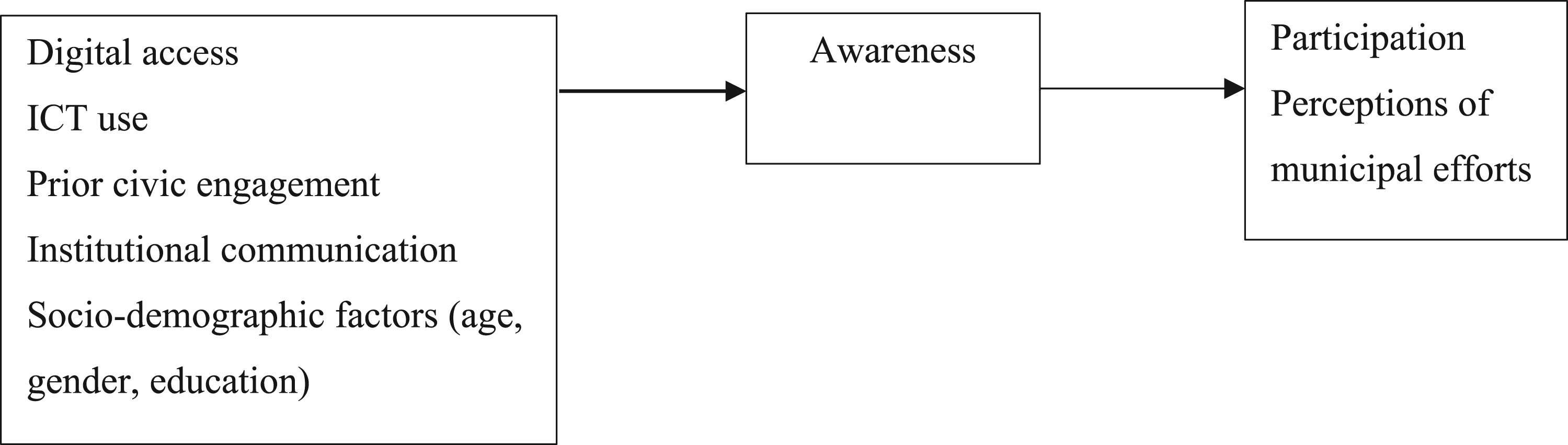
Conceptual model of relationships. Source: The author.
Case Study Description
The city of Bahía Blanca, located in the southwest of Buenos Aires Province, Argentina, has a population of 336,574 inhabitants (INDEC, 2023). Bahía Blanca is a mid-sized city in Argentina characterized by a slight female majority (around 52%), similar to the national pattern. The population has a relatively high educational profile compared to national averages, with a significant share having attained or being enrolled in tertiary or university education 1 . Access to digital infrastructure is widespread, with roughly four out of five households reporting internet connectivity, indicating a favorable context for the diffusion of digital initiatives. The average age of the population is around 35 years, reflecting a predominantly young-adult demographic structure. In terms of employment, the public sector represents a relevant share of the local labor market, consistent with the presence of public administration, education, and health institutions in the city.
According to the Open Data Index 2023, the city ranks among the top municipalities in the country, alongside the Autonomous City of Buenos Aires (CABA), and has consistently occupied leading positions in the 2021 and 2022 rankings. Since 2001, the municipality has implemented a series of initiatives leveraging ICT to enhance citizen engagement. It has been a regional pioneer in e-government and the use of social media for disseminating information and communicating with citizens (Díaz & Gutiérrez, 2021). To promote administrative modernization, citizen participation, entrepreneurship, and local development, the municipal government established the Science and Technology Agency (2011), the Innovation and Open Government Agency (2012), and subsequent secretariats. These initiatives underscore the strategic importance of open and participatory governance within the municipality.
Bahía Blanca has applied ICT across a range of public services, from online tax payments and public information requests to a digital platform for smart parking (Alderete, 2021; Alderete & Díaz, 2021). The municipality maintains an Open Government Portal, providing access to information on municipal purchases, employee salaries, official declarations, waste management statistics, and an interactive city map with data on schools, transportation, and health units. In response to the COVID-19 pandemic, the municipality strengthened citizen engagement by creating a dedicated portal for pandemic-related information (Díaz & Gutiérrez, 2021).
Despite being recognized for data transparency; the municipal portal offers limited statistics on citizen participation. Virtual voting initiatives have decreased in recent years, leaving mostly in-person participation opportunities. The most common forms of citizen engagement are neighborhood boards (50.4%) and discussion forums (47.5%), with nearly half of respondents participating in these activities. In contrast, deliberative councils and hackathons are the least utilized forms of engagement. By the time the survey was conducted, e-participation initiatives prevail at the local government level. Although this paper focuses on e-participation, it also includes off-line participation.
Data Sources
Between August and October 2022, we conducted an online survey on citizen participation among residents of Bahía Blanca. A total of 249 valid responses were collected, although the survey inherently excluded individuals without Internet access. The survey link was distributed through the research institute's social media channels and promoted via interviews on local radio stations and newspapers. However, this type of sampling is commonly used in studies examining civic engagement and digital participation, where respondents’ familiarity with digital tools is directly related to the phenomenon under study.
The questionnaire was designed based on prior public online surveys on citizen participation conducted in Medellín, Colombia; Nuevo León, Mexico; Navarra, Spain; and other locations. It also drew on the literature on citizen participation and smart cities, as outlined in the theoretical framework. The survey collected information on participation rates, forms of engagement, time devoted to participation initiatives, citizen demographics, and related metrics. Most questions were closed-ended and employed Likert scales.
The sample size of 249 respondents is considered sufficient for a finite population (≤100,000) (Vázquez Casielles & Trespalacios Gutiérrez, 2002). The required sample size was calculated using the following formula:

Z represents the critical value corresponding to the chosen significance level, assuming a normal population distribution. For a 95% significance level, Z = 1.96; for a 90% significance level, Z = 1.645.
N is the population size of the city, which was 335,000 in Bahía Blanca in August 2022.
K is the margin of error, or the maximum acceptable difference between the population proportion and the sample proportion, based on the significance level. For a 95% confidence level, K = 0.05; for a 90% confidence level, K = 0.10 (this study used K = 0.10).
P indicates the proportion of the population interested in citizen participation or related topics. We assumed that 20% of the population is interested in smart cities, although a conservative estimate of 50% is typically recommended.
It is important to interpret the empirical findings with caution, as the sample represents citizens who use the Internet and have an interest in the topic, rather than the entire population.
Internet penetration in Bahía Blanca reaches 92.5% of households, slightly above the national average of 89.7%. Regarding digital devices, 91.1% of individuals’ report owning a smartphone, while 64.1% have access to a computer at home. At the national level, these figures are 90.5% and 62.7%, respectively (INDEC, 2023). Therefore, the proportion of the population without access to the online survey is estimated to be below 7.5%. Given the relatively small digital gap in terms of internet penetration and device ownership, the potential sampling bias derived from conducting an online survey is expected to be minimal.
Variables Description
Dependent variables:
Treatment Variable:
Although awareness is inherently multidimensional, survey-based studies frequently rely on single-item indicators when questionnaire design or secondary data availability limits broader operationalization (Diamantopoulos et al., 2012; Sarstedt et al., 2016). Therefore, the variable used in this study should be interpreted as a proxy for self-reported awareness rather than as a comprehensive measurement of the construct.
Independent variables:
Education (univ_educ): 1 if the citizen's highest education level is university or higher, 0 otherwise. Gender (female): 1 if the citizen is a woman, 0 otherwise. Age (age): Citizen's age in years. Engagement (previous experience): 1 if the citizen has prior participation experience in municipal initiatives, 0 otherwise. Digital access (digital_access): 1 if the citizen has access to computer and internet, and 0 otherwise. Visit_website (visit_web): If the citizen has visited the municipality's website during the last year, and 0 otherwise. Public sector employment (public_sector): 1 if the citizen works in the public sector (administration, health, or education) during 2022–2023, 0 otherwise.
Digital access is captured through a relatively simple indicator, which may not fully reflect other relevant dimensions such as the quality of connectivity, frequency of use, or digital skills. Hence, visiting the municipality's website is included as an indicator of ICT use or appropriation, specifically in relation to e-government.
Methodology
To examine the relationship between awareness and citizen participation and perceptions of municipal efforts to promote participation, this study employs a quasi-experimental matching strategy based on the Propensity Score Matching (PSM). Rather than assuming a direct causal relationship, the analysis compares participation and perception outcomes between citizens who report being aware of these initiatives and observationally similar individuals who are not aware. This approach seeks to improve comparability between groups by accounting for observable differences associated with awareness, since citizens who are aware of participatory projects may systematically differ from those who are not. Such differences may also be related to participation and perceptions, generating potential endogeneity concerns. Therefore, the matching procedure is used as a statistical adjustment strategy to reduce selection bias in observable characteristics, and the results should be interpreted as conditional associations rather than definitive causal effect.
The PSM method, originally developed by Rosenbaum and Rubin (1983), was employed to improve comparability between citizens who reported awareness of participatory initiatives and those who did not, based on observable characteristics. The procedure involves four steps. First, a probabilistic (Probit or Logit) model is estimated to calculate the likelihood of a citizen being aware of participation initiatives. Second, the corresponding propensity score (PS) is obtained. Third, the sample is divided into two groups, aware and non-aware respondents, and the region of common support is identified. Finally, non-parametric matching is conducted by pairing individuals with similar PS values to construct comparable groups. The matching procedure aims to reduce observable differences between respondents that could influence participation and perception outcomes. In this sense, PSM is used as a statistical adjustment strategy rather than as a definitive causal identification approach. For individuals in the non-aware group, comparable cases from the aware group are used to estimate differences in participation and perception outcomes conditional on observed covariates (Guo & Fraser, 2015; Rosenbaum & Rubin, 1983).
After verifying the underlying assumptions, estimations were conducted using multiple matching algorithms, Nearest Neighbour, Kernel, and Radius matching, to assess the robustness of the estimated associations (Bernal & Peña, 2017). These methods compute the average differences in participation and perception outcomes between matched respondents with similar observable characteristics. Statistical significance tests were applied to evaluate whether these differences were distinguishable from zero.PSM help address potential selection bias associated with observable characteristics (Heckman et al., 1999) by conditioning comparisons on covariates through a probabilistic model, (Chen & Kaplan, 2015). However, because the analysis relies on cross-sectional observational data, unobservable factors and reverse causality cannot be completely ruled out. Therefore, findings should be interpreted as conditional associations rather than definitive causal effects. The estimations were performed using Stata 14 with the psmatch2 command. For each respondent, a propensity score was estimated as the probability of being aware of citizen participation initiatives, conditional on observable individual characteristics. Control variables included age, gender, education level, and employment type.
In this study, PSM is not used to establish definitive causal effect, but rather to reduce observable differences between aware and non-aware individuals and provide more balanced comparison across groups.
Results
Table 1 shows the descriptive statistics of the variables: the treatment (awareness), the results (Participation; Perception), and the independent variables. On average, most citizens have a computer with internet access (89%), hold a university degree (62%) and are women (58%).
Descriptive Statistics of the Variables.
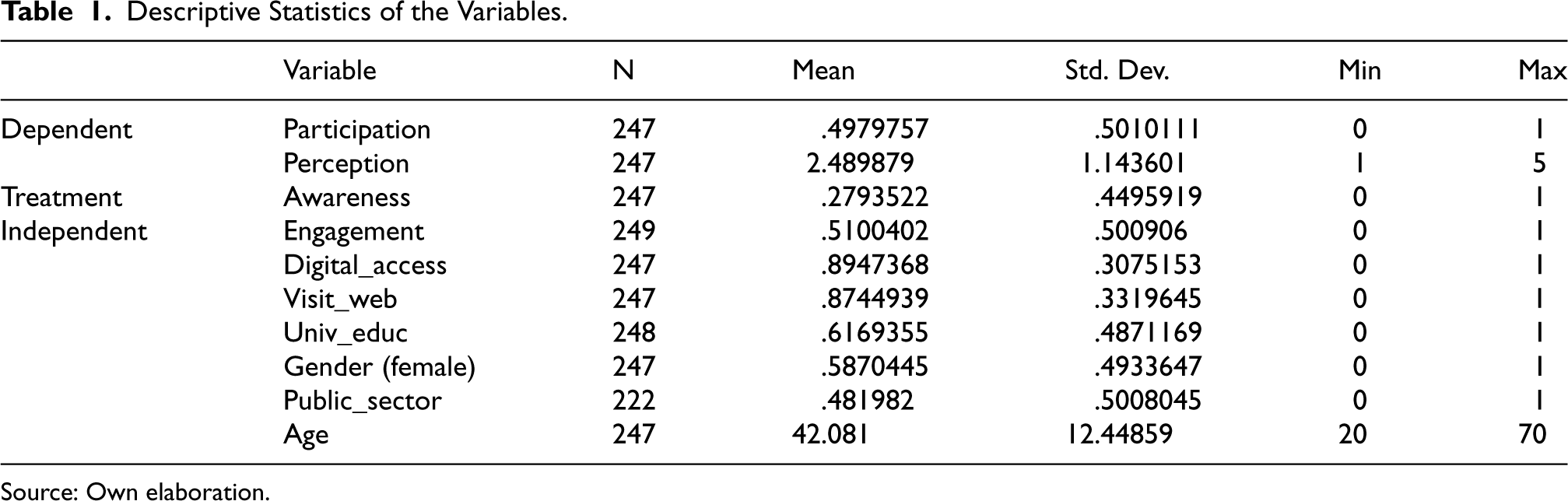
Descriptive Statistics of the Variables.
Source: Own elaboration.
Citizens can select the type of participation such as voting, participatory budget, neighbourhood meetings, talks/debates, hackatons, deliberative council, discussions and others. Besides, types of citizen participation are not restricted to online or virtual ones; 67% of citizens expresses that their participation was in-person while 33% was virtual/ online or mix (online and in-person initiatives). As a result, digital technologies were necessary as a mean to participate, at least in one third of the cases.
After describing the variables, the results of the probabilistic model (PROBIT) are presented. This model was estimated to determine the probability that a citizen is aware of municipal participation initiatives. In other words, the Propensity Score Matching (PSM) analysis is based on these estimates. Table 2 reports the results. The variables experience, gender (female), age and visit the web are statistically significant. The results indicate that greater prior experience in participatory activities, used as a proxy for engagement, is associated with a higher likelihood of citizen awareness. In contrast, being a woman is associated with a lower probability of awareness. Finally, citizens who have visited the municipality's website—used here as a proxy for ICT use—show a higher likelihood of awareness. The non-significant effect of university education suggests that awareness of participatory initiatives is not primarily driven by formal educational attainment but rather by other forms of civic engagement or interaction with local government information channels. Besides, the non-significant effect of digital access may also reflect measurement limitations, as the indicator used captures only basic access and does not account for other dimensions such as connectivity quality, frequency of internet use, or digital skills. To address potential measurement limitations, the variable visit_web was added to the model to capture actual internet use, complementing the digital access indicator and improving the estimation of individuals’ exposure to online environments. Finally, the variable public sector was not significant to explain the likelihood of awareness 3 .
Probit Model Determinants of the Probability of Awareness.
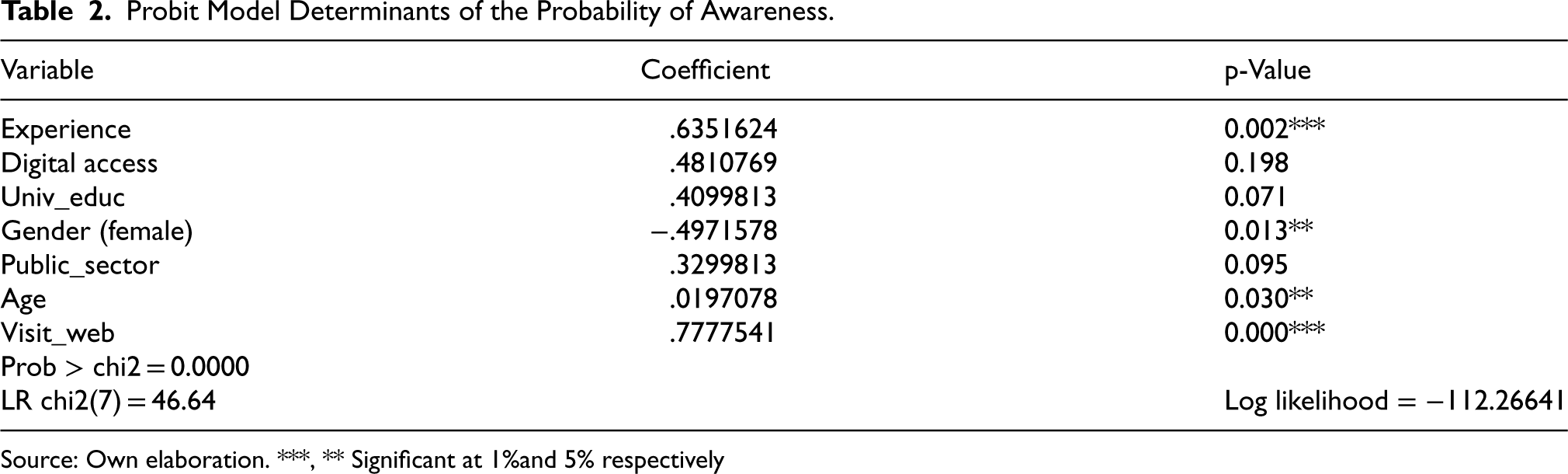
Source: Own elaboration. ***, ** Significant at 1%and 5% respectively
Afterwards, citizens within the common support region were matched by pairing each aware respondent with a non-aware respondent presenting a similar propensity score. It is important to note that the same non-aware individual may be matched with more than one aware respondent 4 .
After matching, all covariates exhibit standardized biases below 10% and no statistically significant differences between matched respondents, indicating satisfactory covariate balance (Table 3). Balance diagnostics indicate that the matching procedure substantially reduces pre-treatment differences between groups.
Covariance Balance.
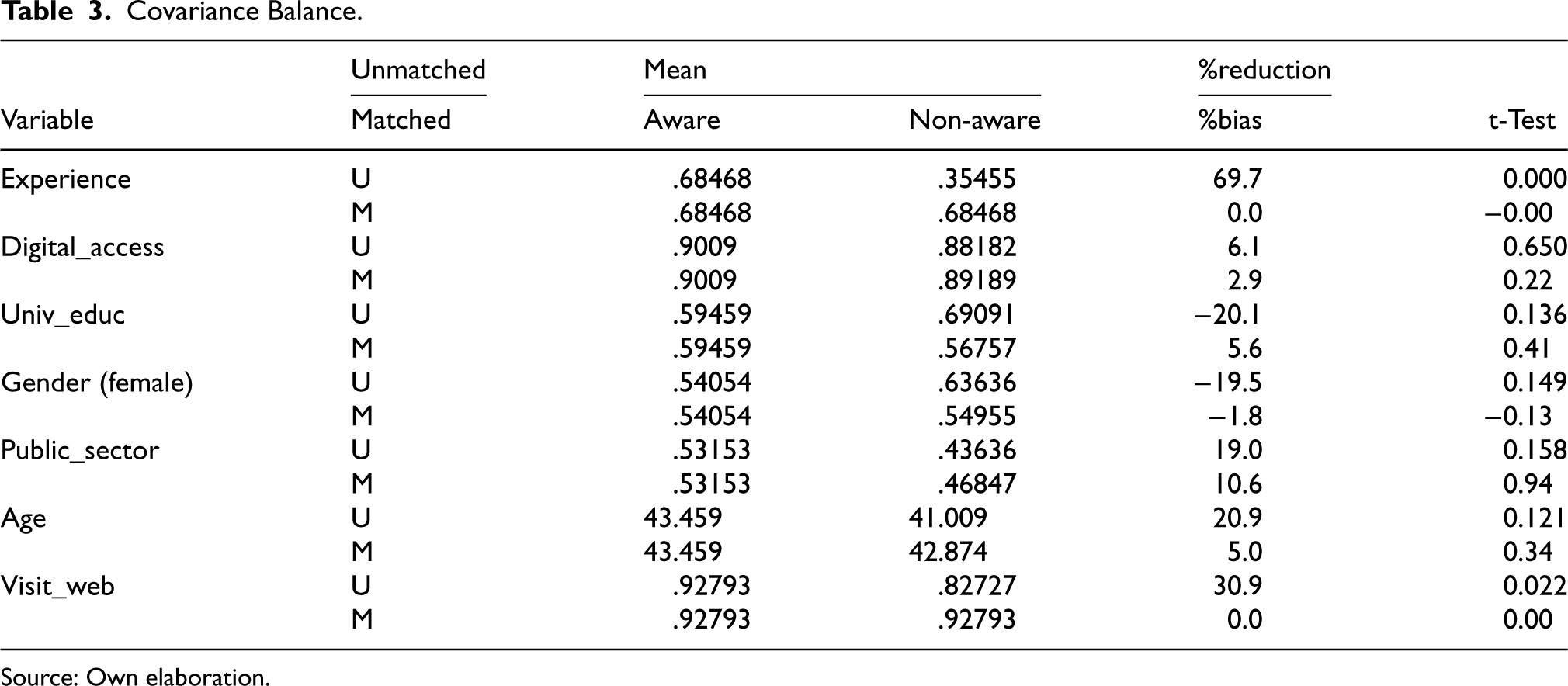
Source: Own elaboration.
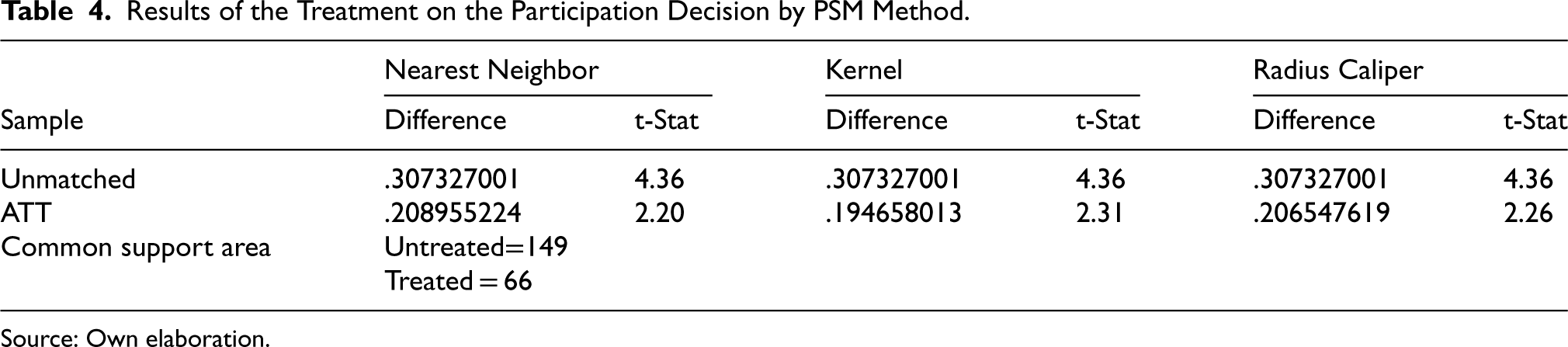
The results obtained using three different matching methods are presented in Table 4 and Table 5.
Results of the Treatment on the Participation Decision by PSM Method.
Source: Own elaboration.
Results of the Treatment on Perception by PSM Method.

Using the different matching methods, Table 4 shows positive and statistically significant average differences in participation outcomes between aware and non-aware citizens with similar observable characteristics. Following the terminology commonly used in the PSM literature, these estimates correspond to the Average Treatment Effect on the Treated (ATT). The estimated differences are statistically significant across the three matching methods: Nearest neighbour (t = 3.17); Kernel (t = 3.36) and Radius Caliper (t = 3.72). These findings suggest that citizens who are aware of municipal participation initiatives tend to report higher levels of participation in local government projects compared with similar individuals without such awareness.
A similar pattern is observed for perceptions of municipal efforts: aware individuals report higher perception scores compared to non-aware respondents with similar observable characteristics. The estimated average differences are positive and statistically significant across the three matching methods (Nearest neighbour (t = 3.17); Kernel (t = 3.36) and Radius Caliper (t = 3.72)).
Previous studies have explored broader determinants of participation (Panopoulou et al., 2014; Simonofski et al., 2021), but few have analysed the specific role of citizens’ awareness as a mechanism that fosters participation and perception of municipal promotion.
Since citizens’ awareness significantly explains participation, our findings confirm the notion of knowledge-based initiatives in urban contexts proposed by García and Martínez (2015). This aligns with Goldberg et al. (2006) and Van Wezemael (2012), who argue that knowledge sharing and learning processes are the cornerstone of knowledge cities. Aware citizens, who understand social, economic, and political systems and are aware of public programs and services, are thus more likely to participate in governance processes (Guo & Neshkova, 2013). Moreover, this supports the idea that participation is not only a democratic right but also a knowledge-driven process that depends on citizens’ informational capacity as emphasized by Hong (2015) and Esposito et al. (2023), who show that municipal digital governance relies on informed collaboration between governments and citizens.
In this sense, awareness can be understood as a precondition for co-creation in urban governance (van der Hoogen et al., 2024), ensuring that technological innovation translates into collective benefits. Besides, the positive association between awareness and perceptions of municipal promotion is consistent with previous research (Bozkuş Kahyaoğlu et al., 2025) showing that the visibility of government communication and participatory initiatives shapes citizens’ perceptions of transparency and responsiveness. Government efforts to promote participatory initiatives can shape how citizens perceive the openness and responsiveness of local authorities (Holum, 2023).
Contrary to previous studies (Bouzguenda et al., 2019; Morato et al., 2020), this research finds that having a computer with Internet access does not significantly explain awareness of participatory initiatives. The result supports the distinction between the digital access gap and the digital usage gap (Maceviciute & Wilson, 2018; Peacock, 2020). In fact, visiting the municipality's website resulted in a positive variable, leading ICT use as more important than ICT access to explain participation. The positive association between visiting the municipality's website and awareness further highlights the growing relevance of digital communication channels in local governance. In Argentina, as in many other countries in the region, municipalities increasingly rely on official websites and online platforms to disseminate information about public initiatives.
While access to technology is necessary, meaningful use and engagement capacities determine effective participation. This distinction echoes the findings of Khatibi et al. (2021), who argue that awareness and engagement, more than mere access to technology, drive effective participation in climate adaptation policies. In this vein, Coelho et al. (2022) show that citizen influence emerges when they mobilize resources, build relationships, and interact with institutional actors. This challenges technological determinism.
On the other side, the positive role of experience further supports the importance of citizen engagement identified by Cortés Cediel and Gil (2018) and Byer (2013): previous engagement builds trust in institutions and strengthens civic commitment. Governments may indirectly shape participation outcomes by mobilizing experienced or aligned citizens, highlighting the importance of balancing inclusiveness with expertise. This is consistent with Kiss et al. (2022) and Chitsa et al. (2022), who stress that sustainable urban governance requires participatory processes that are both socially inclusive and knowledge-enabling.
Furthermore, employment in the public sector appear as non-significant determinant of participation. This finding is contrary to Simonofski et al. (2021), who find that higher educational and employment levels are associated with stronger citizen participation. The lack of a statistically significant effect of public sector employment on awareness and participation outcomes is consistent with prior research on e-participation, which emphasizes that engagement is primarily driven by individual-level factors rather than occupational status (Naranjo-Zolotov et al., 2019).
Interestingly, university-level education is not associated with both awareness and participation, contrasting with previous studies that report a positive relationship between education and citizen engagement (Al-Jamal & Abu-Shanab, 2016; Naranjo-Zolotov et al., 2019; Sharma, 2015). One possible explanation is that highly educated citizens may prefer alternative forms of civic engagement beyond formal municipal participation initiatives. If they perceived that many municipal programs are designed to solve neighbourhood problems or channel local demands of citizens with lower levels of education or greater local needs, they may have less incentive to participate. Given that municipal participatory initiatives often operate at the neighbourhood or community level (Fung, 2006), higher educational attainment does not necessarily translate into greater awareness of locally organized participatory mechanisms. Moreover, gender and age are statistically significant predictors of participation. The negative association between being a woman and participation is consistent with prior studies showing that gender-related barriers and unequal access to civic and political spaces may continue to shape participation patterns (Desposato & Norrander, 2009; Jima-González et al., 2025; Picarella, 2024). This result suggests that citizen engagement is shaped not only by awareness of participatory initiatives but also by individual socio-demographic characteristics. Overall, these findings reinforce that aware and experienced citizens are key drivers of participatory smart cities. As Putra et al. (2025) argue, sustainable and resilient cities depend not only on digital infrastructure but also on the civic capacities of their residents to engage in co-creating policy solutions.
The interpretation of these results also requires considering the broader institutional and social context of citizen participation in Argentina. In many Latin American countries, participatory initiatives promoted by local governments tend to coexist with relatively low levels of institutionalization and uneven dissemination of information about participatory opportunities. As a result, awareness of such initiatives frequently depends on informal networks and previous engagement in civic or community activities rather than on systematic outreach strategies by local governments. This pattern may explain why prior participatory experience—used as a proxy for engagement—emerges as a strong predictor of awareness. Individuals who are already involved in civic activities are more likely to be exposed to information circulating through community organizations, neighborhood networks, or local participatory spaces.
Policy Implications
The findings offer several insights for local governments and policymakers seeking to strengthen participatory governance in smart cities. First, if awareness is a critical factor for participation, local governments should actively promote and disseminate information about participatory initiatives. The findings also suggest that prior experience in participation significantly increases citizens’ awareness of local initiatives. This highlights the importance of designing policies that promote early and accessible participation opportunities. Local governments could implement “small wins” strategies, such as short-term, low-barrier projects or community-based micro-initiatives, that allow citizens to experience tangible outcomes from engagement. These initial experiences can foster trust, reinforce awareness, and create a virtuous cycle of participation, gradually building a stronger culture of civic engagement.
Second, the finding that digital access is not a significant determinant of participation is encouraging for less developed cities, where socioeconomic barriers persist. This implies that fostering participation depends more on communication and awareness strategies than merely on access to technology. Therefore, resources devoted to citizen participation would be more efficiently used if focused on the diffusion of information, successful experiences, and participatory opportunities—especially in smart cities or those with a relatively small digital divide.
Third, public administrations should prioritize informational strategies to ensure that knowledge about participation opportunities is widely disseminated and accessible. Increasing transparency and clarity in communication, for instance, through open government portals and social media, can help reduce informational inequalities that persist even among connected populations. Moreover, given the importance of prior experience, disseminating successful participation stories, through the municipality's website or digital platforms such as YouTube or TEDx-style talks, or through in-person focus groups, may further encourage civic engagement.
Finally, the distinction between digital access and digital usage suggests that smart city policies should move beyond connectivity indicators to include digital literacy and civic awareness dimensions. By integrating these aspects, municipalities can better address the social foundations of participation and ensure that technology serves as a tool for inclusion rather than exclusion.
Conclusion
This paper contributes to the literature on smart cities and participatory governance by providing empirical evidence on the role of citizens’ awareness as a determinant of participation and perceptions of municipal efforts to promote citizen participation. The study first analyses the determinants of citizen participation, with particular attention to awareness and the digital divide, and examines citizens’ engagement to better understand the incentives behind their participation in local government initiatives.
Using a quasi-experimental approach based on Propensity Score Matching (PSM), the study shows awareness of participatory initiatives significantly increases the likelihood of citizen participation and citizens’ perception of municipal efforts to promote participation. The results also indicate that awareness is positively associated with previous experience (engagement), visiting the municipal website (ICT use) and age, and negatively with being a woman. This finding advances previous research that primarily emphasized institutional design or digital infrastructure, by highlighting the informational and experiential dimensions of participation. The use of Propensity Score Matching aims to reduce selection bias by comparing individuals with similar observable characteristics who differ in their awareness of participation policies. As in most observational studies, the method cannot fully eliminate unobserved confounding, and results should therefore be interpreted as conditional associations rather than strict causal effects.
Besides, the analysis offers a nuanced understanding of how citizen participation operates within a mid-sized city context in Latin America, an area still underrepresented in the smart city debate. The case of Bahía Blanca illustrates that digital access alone is insufficient to foster participation; instead, awareness, ICT use, and prior engagement experiences play a more decisive role. Taken together, these findings suggest that awareness of participatory initiatives in Argentine cities is shaped less by structural socio-economic characteristics (education, employment) and more by patterns of civic engagement and interaction with local government communication channels. This highlights the importance for municipalities of developing broader outreach strategies that extend beyond already-engaged citizens and improve the visibility of participatory opportunities across different social groups.
Nevertheless, the study has some further limitations. First, the sample includes only citizens with internet access which may introduce selection bias and restrict generalization to the broader population. Besides, the use of an online sample introduces potential self-selection bias, as individuals with higher levels of digital literacy, civic interest, or prior engagement may have been more likely to respond to the survey. Consequently, the sample may not fully represent the broader population of citizens, particularly less connected or less civically engaged groups. Therefore, findings should be interpreted with caution and understood as exploratory associations within the studied context rather than as fully generalizable population estimates. Second, awareness is measured using a binary variable, which identifies whether respondents are aware of participatory initiatives. This limitation (using a binary not multidimensional construct) does not invalidate the empirical association identified in the analysis, but it suggests caution regarding the interpretation and generalization of the construct. Although this single-item measure allows us to distinguish between aware and non-aware individuals, future research could employ multi-item scales to capture different dimensions of awareness as is done in the measurement of perception of municipal efforts to promote participation. Third, although the Propensity Score Matching improves comparability between aware and non-aware respondents based on observable characteristics, the cross-sectional nature of the data does not allow strong causal claims. In particular, reverse causality between awareness and participation cannot be ruled out. Individuals who are already civically engaged may be more likely to become aware of participatory initiatives. Therefore, the estimated differences identified through the matching procedure should be interpreted as conditional associations rather than causal effects. Awareness may also arise through alternative channels such as media exposure, civic interest, or prior institutional interaction. The cross-sectional nature of the survey prevents drawing strong causal inferences beyond the PSM estimation. Future research using longitudinal data or experimental designs would be necessary to better establish temporal ordering and causal directionality. Future research should also explore the mediating role of trust and institutional responsiveness among the variables. Overall, the results underscore the importance of integrating informational and experiential dimensions into participatory governance strategies. Finally, another limitation of this study is that other theoretical frameworks, such as Actor-Network Theory, were not incorporated, as the analysis focused on the knowledge cities perspective.
Findings support the idea that in the context of smart cities initiatives, citizens’ awareness of policies and mechanisms for participation is an important precondition for fostering meaningful participation and engagement in urban governance processes. Hence, strengthening citizens’ awareness and early engagement opportunities may serve as a foundation for more inclusive, transparent, and responsive smart city governance.
Footnotes
Acknowledgements
The author thanks her CONICET doctoral fellows, Nicolás Alvarez and Lucía Diaz, for their support in the design and dissemination of the survey. This research was funded by CONICET through the PIP project 11220200102872CO, “Participación ciudadana para la construcción de Ciudades Inteligentes en Argentina”.

Funding
The author disclosed receipt of the following financial support for the research, authorship, and/or publication of this article: Universidad Nacional del Sur (PGI 24/E173) and CONICET – (PIP 11220200102872CO).
Declaration of Conflicting Interests
The author declared no potential conflicts of interest with respect to the research, authorship, and/or publication of this article.
Notes
Appendix
Neighborhood councils, neighborhood or community development associations Meetings or consultations with local authorities Public debates organized by the municipality Municipal voting processes (e.g., on bike lanes, vehicle access to Parque de Mayo, naming of a park) Marathons or hackathons Participatory budgeting initiatives Participation in the City Council (“Banca 25”) Other (please specify): ___________
(If yes, please specify which ones: ___________)
1. Strongly disagree 2. Disagree 3. Neither agree nor disagree 4. Agree 5. Strongly agree