






Abstract
Age assessment is crucial in forensic and judicial decision-making, particularly in cases involving undocumented individuals and unaccompanied minors, where legal thresholds determine access to protection, healthcare, and judicial procedures. Dental age assessment is widely recognized as one of the most reliable biological approaches for adolescents and young adults, but current practices are challenged by methodological heterogeneity, fragmented data representation, and limited interoperability between clinical, forensic, and legal information systems. These limitations hinder transparency and reproducibility, amplified by the increasing adoption of AI-based methods. The AIdentifyAGE ontology is domain-specific and provides a standardized, semantically coherent framework, encompassing both manual and AI-assisted forensic dental age assessment workflows, and enabling traceable linkage between observations, methods, reference data, and reported outcomes. It models the complete medico-legal workflow, integrating judicial context, individual-level information, forensic examination data, dental developmental assessment methods, radiographic imaging, statistical reference studies, and AI-based estimation methods. It is being developed together with domain experts, and it builds on upper and established biomedical, dental, and machine learning ontologies, ensuring interoperability, extensibility, and compliance with FAIR principles. The AIdentifyAGE ontology is a fundamental step to enhance consistency, transparency, and explainability, establishing a robust foundation for ontology-driven decision support systems in medico-legal and judicial contexts.
Introduction
In recent years, Europe has experienced significant migratory dynamics, with a marked increase in undocumented migration and asylum seekers, including a substantial number of unaccompanied minors (Pereira, 2025; Pradella et al., 2017). Portugal, as part of this broader European context, has faced growing legal and forensic challenges related to the estimation of age in individuals lacking valid identification documents (Augusto et al., 2021; Pereira et al., 2021). In such cases, age assessment plays an important role, as it directly influences access to legal protection, social services, healthcare, and the applicable judicial framework. Consequently, age estimation must be conducted in a manner that is scientifically robust, ethically sound, transparent, and legally defensible (Pereira et al., 2025; Schmeling et al., 2016).
Age assessment procedures are inherently interdisciplinary, involving medical, dental, radiological, legal, and ethical dimensions. From a forensic perspective, dental age assessment (DAA) is widely recognized as one of the most reliable biological approaches, particularly in adolescents and young adults, due to the well-documented chronology of tooth development (Pereira, 2026; Pereira et al., 2023; Pinchi et al., 2012; Yadava et al., 2011). Tooth development is a biomarker for forensic age estimation, supporting both manual methods based on developmental staging and nowadays approaches relying on artificial intelligence (AI) applied to radiographic dental imaging (Murray et al., 2024; Nushi et al., 2025; Pereira, 2025).
Despite the growing methodological advances in DAA, the practical implementation of these procedures remains challenged by the heterogeneity and lack of harmonization resulting from the coexistence of diverse recommendations, guidelines, and protocols issued by multiple international institutions (Pereira et al., 2024). Clinical data, radiographic findings, methodological parameters, reference studies, statistical outputs, and legal requirements are therefore documented in heterogeneous formats, using inconsistent terminology and variable semantic structures. This lack of standardization limits interoperability, reduces transparency, complicates expert communication, and imposes significant constraints on the development of reliable decision support system (DSS) for forensic and judicial contexts. An example is precisely the lack of common international guidelines, leading to subjective practices on forensic case evaluations. For example, a single panoramic radiograph of the same individual, when evaluated with different DAA methods such as Demirjian et al. (1973), Willems et al. (2001), Moorrees–Fanning–Hunt Moorrees et al. (1963), and Cameriere’s third molar index (I3M) (Galić et al., 2015) can yield estimated ages that differ by more than one year and, critically, can produce discordant classifications across legally relevant thresholds such as 14 or 18 years, as documented in comparative studies on the same population (Pereira et al., 2024; Pinchi et al., 2012). Because each method records developmental stages, scores, and outputs in its own vocabulary and format—point estimates, age intervals, or threshold probabilities—case records produced under different methods cannot be directly aggregated, audited, or reused. This concretely limits expert communication across jurisdictions, obscures the provenance of reported conclusions, and prevents the construction of a unified DSS over heterogeneous case archives.
In parallel, the evolution of judicial and medico-legal DSS has highlighted the critical need for formally defined, semantically coherent, and interoperable representations of knowledge. Ontologies have emerged as a central instrument in medical informatics to address these challenges, enabling structured knowledge representation, standardized terminology, explicit relationships between entities, and integration across heterogeneous data sources. Several ontologies developed in adjacent domains—such as biomedical investigations, medical imaging, anatomical structures, and machine learning workflows—provide relevant conceptual foundations that can be leveraged to support forensic applications. However, these ontologies are not specifically designed to capture the full complexity of forensic DAA, particularly at the intersection of biological markers, methodological diversity, AI outputs, and legal decision-making (Jaulent et al., 2018).
To date, no ontology has been developed with a dedicated focus on forensic DAA that comprehensively integrates judicial context, expert workflows, dental development methods, radiographic data, and AI—based estimation models within a unified semantic framework. This gap limits the reproducibility, comparability, and transparency of age estimation practices and constrains their integration into DSS intended to assist forensic experts and judicial authorities.
The AIdentifyAGE ontology aims to address this unmet need. It provides a standardized, ontology-based modeling framework specifically tailored to forensic DAA, integrating knowledge representation principles with decision support requirements. By formally defining concepts, relationships, and processes related to DAA—using the tooth as a central biological marker—the ontology aims to enhance consistency, interoperability, and transparency, while supporting the development of robust DSS capable of informing forensic and judicial decision-making in complex medico-legal contexts.
Methods
The AIdentifyAGE ontology started in the scope of the national research project AIdentifyAGE—“Artificial Intelligence and its Application by Forensic Science Service Providers: Migrant Unidentified Age Estimation” (2024.07444.IACDC). The project aims to support forensic specialists in performing accurate, transparent, and reproducible DAA in undocumented individuals, migration and asylum seekers, addressing both medico-legal and ethical requirements.
The ontology constitutes a core component of the semantic and knowledge representation framework of the project and provides the formal foundation required for ontology-driven decision-support mechanisms in forensic DAA. Its primary objective is to provide a formally defined, semantically coherent, and interoperable model of the data, processes, and outcomes involved in DAA, enabling consistent interpretation, integration, and reuse across systems.
The ontology integrates heterogeneous and multi-source data domains commonly involved in forensic DAA. These include individual-level information (e.g., reported age, biological sex, and case identifiers), legal and forensic examination data (e.g., requesting authority, examination date), and imaging data, with particular emphasis on orthopantomography (OPG), the most widely used radiographic modality in DAA. All entities, terms and relationships, namely their hierarchy, object properties and data properties, as well as their classification and annotation, were obtained in collaboration with domain experts and from the analysis of 10,000 OPG and related medico-legal DAA exams. By formally representing these domains and their relationships, the ontology supports structured data integration and provides a robust foundation for computational reasoning and decision support.
The AIdentifyAGE ontology is structured into three domains
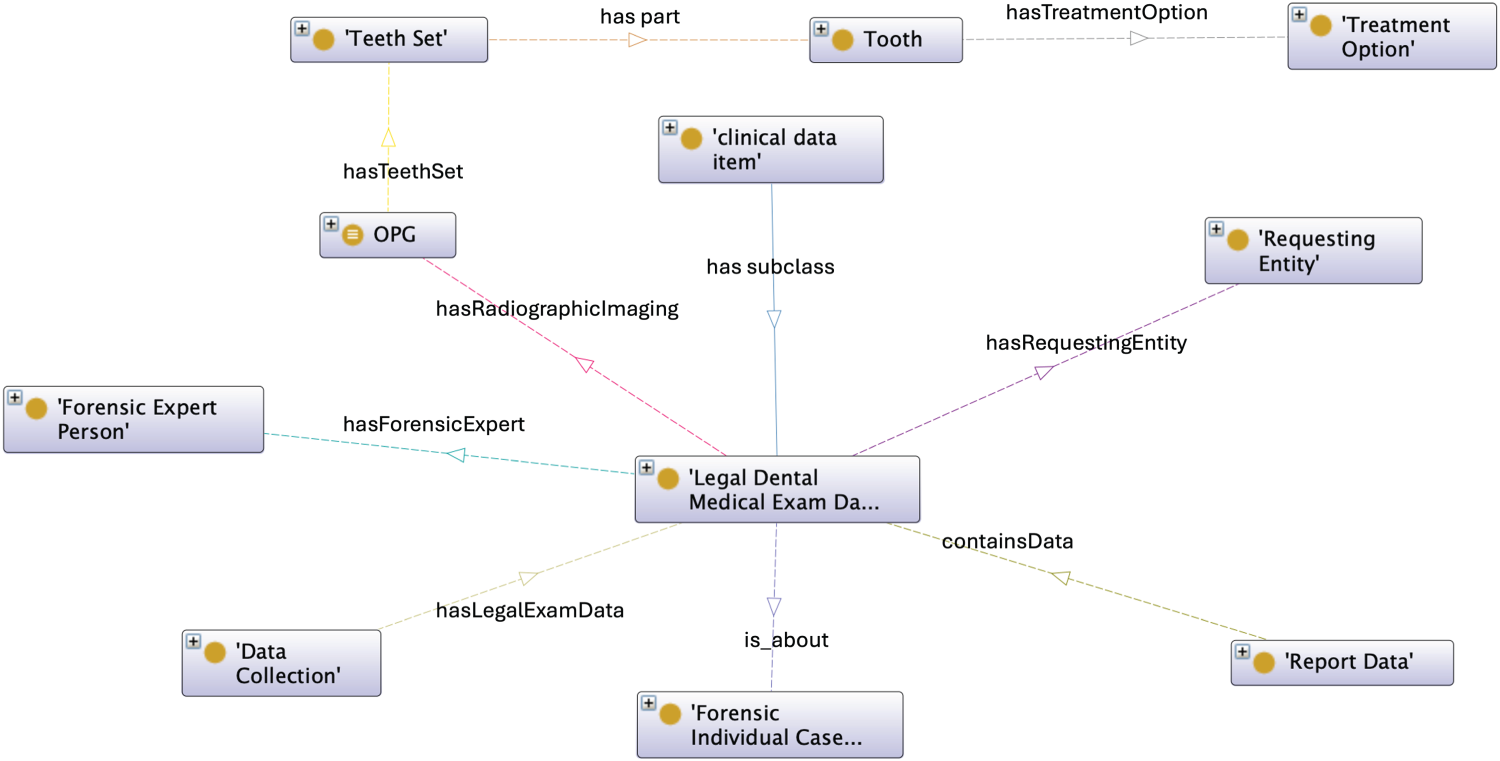
Main entities of AIdentifyAGE judicial/forensic domain. This includes information related to a legal dental medical exam (Legal Dental Medical Exam Data) performed by a forensic expert on an undocumented individual. At the end of all legal procedures, also include information regarding the judicial report (Report Data), containing the age assessment conclusion. The ”has subclass” relations follow the standard convention of pointing from superclass to subclass. The other relations correspond to specific object properties.
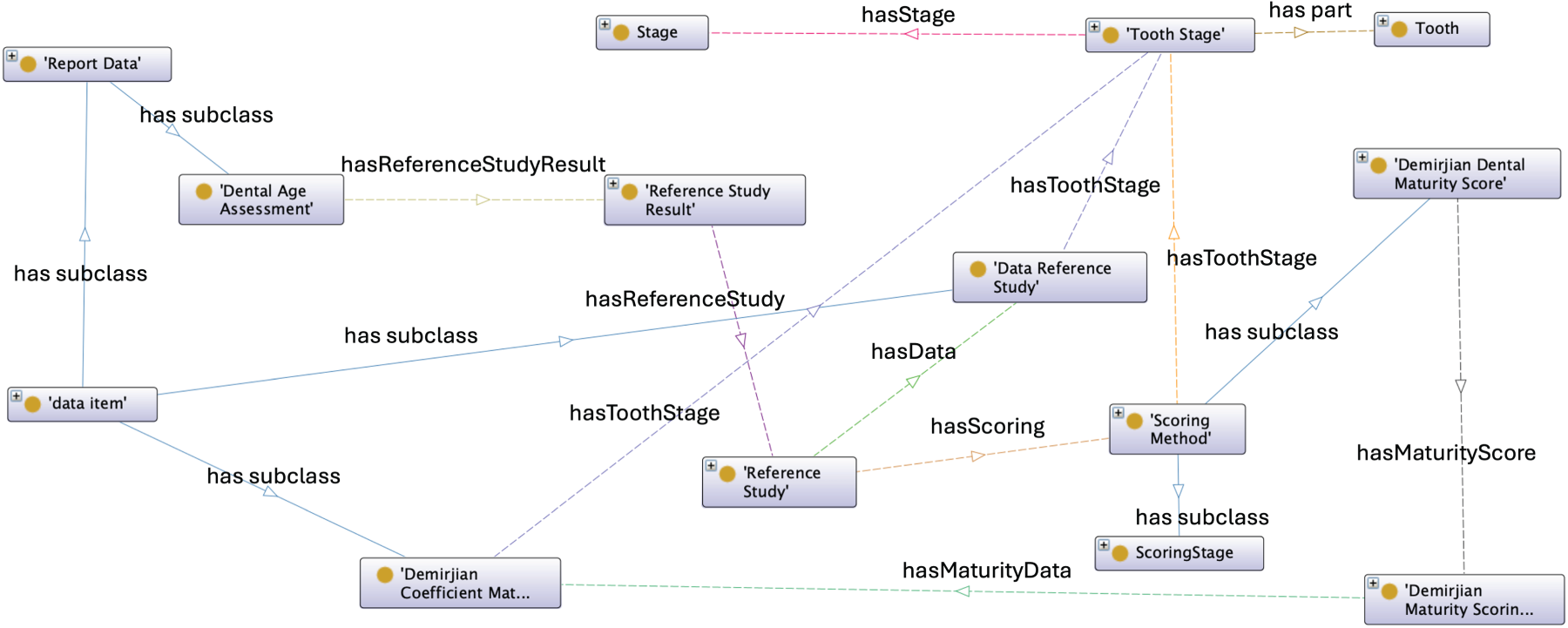
Main entities of AIdentifyAGE manual DAA domain. This includes information regarding Tooth development stage scoring (Tooth Stage). Given that a set of Tooth is scored, a set of Reference Study is applied to calculate statistical measures to produce a Dental Age Assessment conclusion. Data Reference Study and Coefficient Maturity Data contain the statistically significant information that allows the DAA to be performed. The ”has subclass” relations follow the standard convention of pointing from superclass to subclass. The other relations correspond to specific object properties.
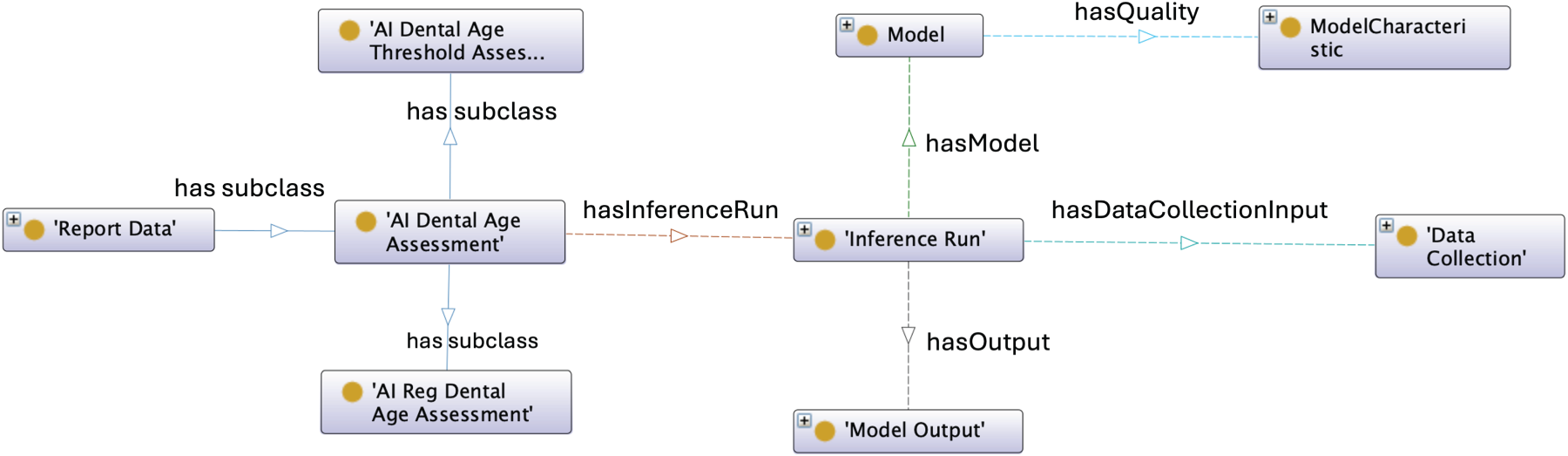
Main entities of AIdentifyAGE AI DAA domain. This includes information regarding the use of machine-learning models (Model) to perform two types of DAA: classification (AI Dental Age Threshold Assessment) and regression (AI Reg Dental Age Assessment). These models were configured using the hyper-parameterizations included in ModelCharacteristic, to perform inference (Inference Run) over a set of images present in Data Collection, producing multiple Model Output. The ”has subclass” relations follow the standard convention of pointing from superclass to subclass. The other ones correspond to specific object properties.
The ontology explicitly models the methodological components of DAA, complementing the case-level and imaging metadata represented in Figure 1. As shown in Figure 2, clinically and judicially accepted DAA methods are captured through a structured representation of tooth developmental stages, following stage-based approaches routinely applied in medico-legal practice. That concept is captured in the Stage class, representing the developmental stage defined by a chosen scoring method (e.g., Demirjian’s stages A–H, Moorrees–Fanning–Hunt’s, Kullmann’s root-development stages). A given Scoring Method specifies its permissible Stage individuals. These methods correspond to internationally recognized reference frameworks used for children, adolescents, and young adults—potentially up to 23 years of age—and support the association of developmental stages with population-specific reference data and statistically derived outputs, including age intervals, mean estimated age, minimum age, and standard deviation, as well as their use in classification tasks based on legally relevant age thresholds (Cfa, 1963; Demirjian et al., 1973; Lee et al., 2009; Liversidge, 2008). At last, Tooth Stage is the per-tooth scoring record produced when a Scoring Method assigns one such Stage to a specific Tooth in the context of a DAA examination.
The ontology also incorporates age estimation approaches based on AI, represented in Figure 3. This integration of manual and AI-assisted age assessment under a single semantic framework is the principal contribution of AIdentifyAGE. It models the key elements of AI-driven workflows, including data collections, model characteristics, inference processes, and model outputs, enabling the representation of both classification-based and regression-based age assessment models applied to dental radiographic images, and ensuring that any AI-based conclusions recorded in a forensic case can be audited end-to-end, reinforcing the traceability and interpretability of results. For a given outcome, the ontology supports retrieving—via SPARQL—the Model used (e.g., a specific CNN), its ModelCharacteristic (hyperparameters and configuration), the Inference Run that produced the result, the Data Collection of OPG images it ran over, and the resulting Model Output, distinguishing classification (AI Dental Age Threshold Assessment) and regression (AI Reg Dental Age Assessment) outputs, beside the manual DAA. Figure 4 illustrates this use: a single SPARQL query that returns both manual DAA statistical outputs and the AI model provenance (model name, task type) for the same forensic case. The inherent terms and relationships were derived from analysis of several AI-based DAA methods (see Karcioglu et al., 2025 for a comprehensive survey), including some developed and tested in the context of the project mentioned above, focusing also on the necessary statistical assessment measures and tests. By integrating the forensic, clinical, methodological, and computational components depicted across Figures 1, 2 and 3, the ontology provides a structured knowledge base that supports decision-making in forensic DAA 1 . This is materialized as (i) each forensic case is represented as an instance graph linking the individual, the OPG, the scored teeth, the scoring method, the reference study, and the resulting statistical outputs. A forensic expert or DSS can therefore query, in a single SPARQL execution, the complete provenance chain underlying a DAA conclusion. The query in Figure 4 illustrates this for the combined retrieval of manual statistical outputs (mean estimated age, standard deviation, age interval) and AI model provenance (model, task type, hyperparameters) for the same case. Its formal representation of data, methods, and outcomes enables consistent interpretation of results and establishes the foundation for an ontology-based DSS capable of assisting forensic experts and judicial authorities in complex medico-legal contexts; (ii) the CQs provided in the Appendix A correspond to recurring information needs of forensic experts and judicial authorities – including method-specific provenance, reference-study identification, age-threshold classification, and AI-model auditability – and each is answerable via a documented SPARQL query over the ontology; (iii) the use of OWL DL together with the HermiT reasoner enables automated checking of class disjointness, cardinality, and range constraints across an integrated case base, flagging contradictory or missing assertions before they propagate into reported conclusions. These three mechanisms are the foundation on which the project’s decision-support system is being developed 2 .
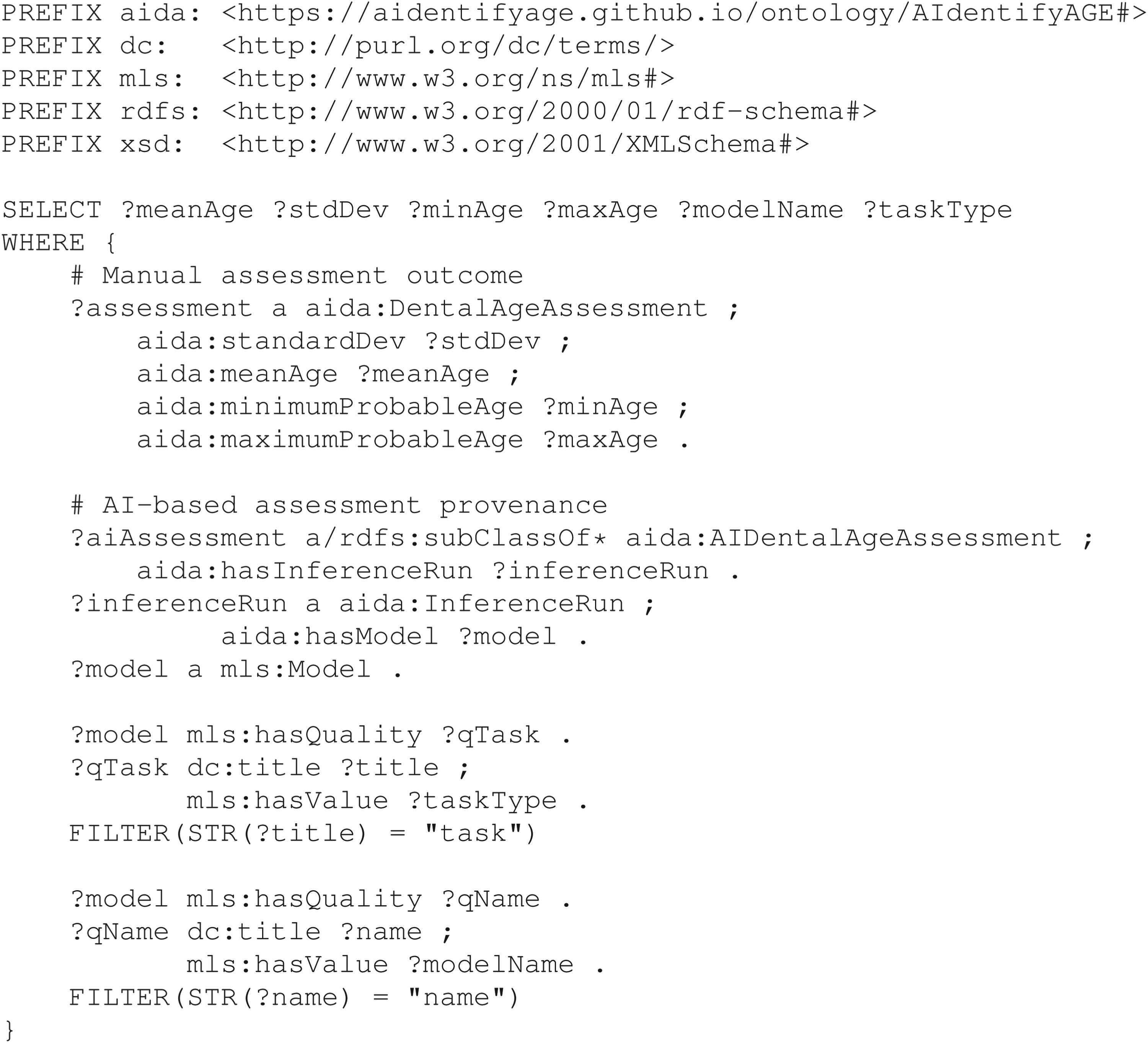
This illustrative SPARQL query demonstrates how the AIdentifyAGE ontology enables simultaneous retrieval of manual DAA results and AI-based assessment provenance within a unified semantic framework. It retrieves statistical outputs from a manual DAA, namely mean estimated age, standard deviation, and age interval, together with information about the AI model task type used in an AI-based assessment (classification or regression).
All terms and consequently the ontology, were defined following the FAIR principles: Findability, Accessibility, Interoperability, and Reusability (Wilkinson et al., 2016). Each identified term was attributed a Internationalized Resource Identifier (IRI), and metadata information was added to describe its significance. This ontology has been also made publicly available using the BioPortal platform, in broadly applicable formats. During its development, the necessity to allow extensions and/or reusability was taken into account.
The AIdentifyAGE ontology is designed to model the complete forensic and legal workflow associated with age assessment in undocumented individuals. Its development proceeded through three structured phases, namely
ontology knowledge-base creation, ontology definition chain, and ontology validation process, as illustrated in Figure 5.

AIdentifyAGE design process. Starting from literature revision, going through the taxonomy creation, annotation, and hierarchical classification following the OBI ontology, ending with the ontology (iterative) validation.
This step established the scope of the ontology and defined the characteristics of the terms to be included. The initial categorization relied on the widely adopted class structure of Ontology for Biomedical Investigations (OBI) (Bandrowski et al., 2016), which served as the upper-level framework. Complementary ontologies were subsequently incorporated to represent domain-specific concepts not covered by OBI, thereby ensuring a coherent and interoperable knowledge base - comprising the agreed terms, definitions, hierarchical structure, object properties, and data properties.
Ontology Definition Chain
The resulting knowledge base is then enriched in the following steps:
insertion of semantic and scientific meaning to the identified terms, identification of similarities between terms, and linking to the appropriate external ontologies.
Insertion of Semantic and Scientific Meaning
This step was carried out by assigning term and property descriptions to each term, including formal definitions, usage notes, and domain-specific descriptions. These annotations were informed by established glossaries in forensic medicine, dentistry, and biomedical informatics (ISO 18374:2025 (International Organization for Standardization, 2025), ISO/IEC 23053 (International Organization for Standardization, 2022), International Organization for Forensic Odonto-Stomatology (IOFOS) recommendations (International Organization for Forensic Odonto-Stomatology, 2018), American Board of Forensic Odontology (ABFO) guidelines (American Board of Forensic Odontology, 2023)), as well as by expert consensus when standardized definitions were unavailable. This ensured that every term in the ontology was associated with a clear and scientifically grounded meaning.
Identification of Similarities Between Terms
In this step, candidate terms of the ontology were extracted, together with the domain experts, based on the analysis of a large set of forensic case reports (medico-legal DAA exams and associated OPG documentation described in the Methods section). Given that these reports are produced by different experts and institutions using heterogeneous and non-standardized terminology, the same underlying concept frequently appeared under different labels. This is precisely the source of semantic overlap and redundancy that this step had to resolve. The comparison itself was a manual, expert-driven process guided by explicit criteria. For each candidate term, the development team and the domain experts compared three aspects against the terms already present in the ontology: (i) the term label and its synonyms; (ii) the formal definition and usage notes; and (iii) the logical constraints – position in the hierarchy, domain and range, and axioms. Based on this comparison, three outcomes were possible: when two terms represented the same concept with identical meaning and constraints, they were merged into a single canonical term. When terms differed in scope or structure but were still conceptually related, equivalence relations were defined to preserve semantic alignment, for example, the AIdentifyAGE OPG class is declared equivalent (owl:equivalentClass) to the corresponding SNOMED-CT radiographic imaging concept, while owl:sameAs relations align each tooth across the UNS, FDI, Palmer, and Haderup numbering systems. When two labels referred to the exact same concept, the most current or domain-appropriate term was selected as the preferred label (e.g., age assessment instead of age estimation), with the alternative kept as a synonym annotation. The same comparison was performed against the reused external ontologies, so that a concept already defined in OBI, IAO, OHD, or another imported ontology was reused rather than redefined. The process was iterative, applied as new terms were added and re-checked during validation with the HermiT reasoner being used to confirm that no unintended equivalences or inconsistencies remained.
External Ontologies Linking
External ontologies were identified through three complementary routes: (i) ontologies formalizing standards and terminologies already familiar to the consortium’s forensic and dental experts (OHD, SNOMED-CT); (ii) the adoption of OBI as the OBO Foundry—aligned upper ontology, together with its companion IAO; and (iii) a requirement-driven literature review covering domains not otherwise addressed—ML-Schema for machine-learning workflows, FOAF for persons, DCMI for metadata, and OHD for tooth anatomy. Candidate ontologies were retained on the basis of public availability, active maintenance, OBO Foundry or W3C alignment, domain coverage, and FAIR compliance.
Ontology Validation Process
Beyond structural and expert validation, by both the development team and domain experts from the Faculty of Dental Medicine of the University of Lisbon (FMDUL), the AIdentifyAGE ontology was evaluated with respect to its suitability for decision-support applications in medico-legal contexts. Two different validation activities were performed: (i) logical consistency was checked using the HermiT reasoner (Glimm et al., 2014), validating all classes and the absence of contradictory axioms across reused ontologies; (ii) OWL 2 DL profile conformance was independently checked using ROBOT tool (Jackson et al., 2019), which reports profile violations directly.
Functional adequacy was assessed through competency questions representing forensic and judicial information needs including method-specific provenance, reference-study identification, age-threshold classification, and AI-model auditability. Each competency question (CQ) was mapped to ontology entities and relations, and verified to be answerable via SPARQL queries over the ontology. A total of 11 CQs, together with their corresponding SPARQL queries, are provided in the Appendix A (also maintained in the GitHub repository 3 ). This ensures that the ontology supports traceable retrieval of examination context, methodological parameters, statistical outputs, and AI model provenance. We provide also in the Supplementary Materials a systematic traceability matrix linking each CQ to the ontology classes and properties that enable its formal representation and querying. This mapping demonstrates that the ontology design is fully requirement-driven and that each CQ is grounded in explicit axiomatic definitions. These competency questions were validated by executing their SPARQL queries over the ontology using the SPARQL engine integrated in Protégé (Musen, 2015). The queries were additionally tested on OpenLink Virtuoso, a triple store on which the project’s decision-support system is being developed.
In addition, interoperability was evaluated by verifying correct semantic alignment with external ontologies, ensuring that reused classes preserve their original semantics and can be queried consistently across integrated knowledge bases. This multi-layer validation confirms the ontology’s readiness to serve as a semantic backbone for forensic DAA decision-support systems. The interoperability of AIdentifyAGE with major biomedical and AI ontologies is demonstrated through an explicit concept-level mapping, provided in Appendix B and also available on the ontology GitHub repository.
Availability
The AIdentifyAGE ontology is published in the BioPortal repository following open-source principles and it can be accessed and downloaded locally from https://bioportal.bioontology.org/ontologies/AIDENTIFYAGE. This corresponds to a merged version of AIdentifyAGE ontology with all external ontologies, all in a single ontology file. Here, the user can find the ontology in the Web Ontology Language (OWL) (Hitzler et al., 2012) standard format, namely in OWL DL. Visiting the ontology GitHub page https://github.com/AIdentifyAGE/ontology, Resource Description Framework (RDF) (Cyganiak et al., 2014) and Terse RDF Triple Language (TTL) (Beckett et al., 2014) additional formats are available to download. These releases (in all formats) correspond to the modular version of the ontology, containing the AIdentifyAGE ontology with resolvable imports for external ontologies, useful for ontology engineers.
Results
As mentioned previously, the AIdentifyAGE taxonomy mainly uses OBI (Bandrowski et al., 2016) as an upper ontology, even though it reuses other ontologies as it is depicted in Table 1. The most relevant entities of OBI that are more relevant to AIdentifyAGE are:
data item, clinical data item, plan specification, data set, material anatomical entity, datum label, and measurement datum.
For example, Legal Dental Medical Exam Data was added as subclass of clinical data item (subclass of data item); the subclasses Data Collection, Demirjian Maturity Scoring, and Reference Study were mapped as subclass to data set (subclass of data item); the Scoring Method, Stage, and Treatment Option classes were mapped as subclass to plan specification class; Teeth Set class was included under the mouth class from material anatomical entity; the Tooth Stage class was included under the categorical measurement datum class, while the Reference Study Result was included in its superclass, measurement datum; classes like Report Data, Demirjian Coefficient Maturity Data, and Data Reference Study, were included under the data item class, as none of its subclasses was adequate.
Ontologies Metadata Information; Each Ontology Information Refers Only to the Determined Classes, Object, and Data Properties (on AIdentifyAGE) and the Relevant Subset (on the Remaining Ontologies).
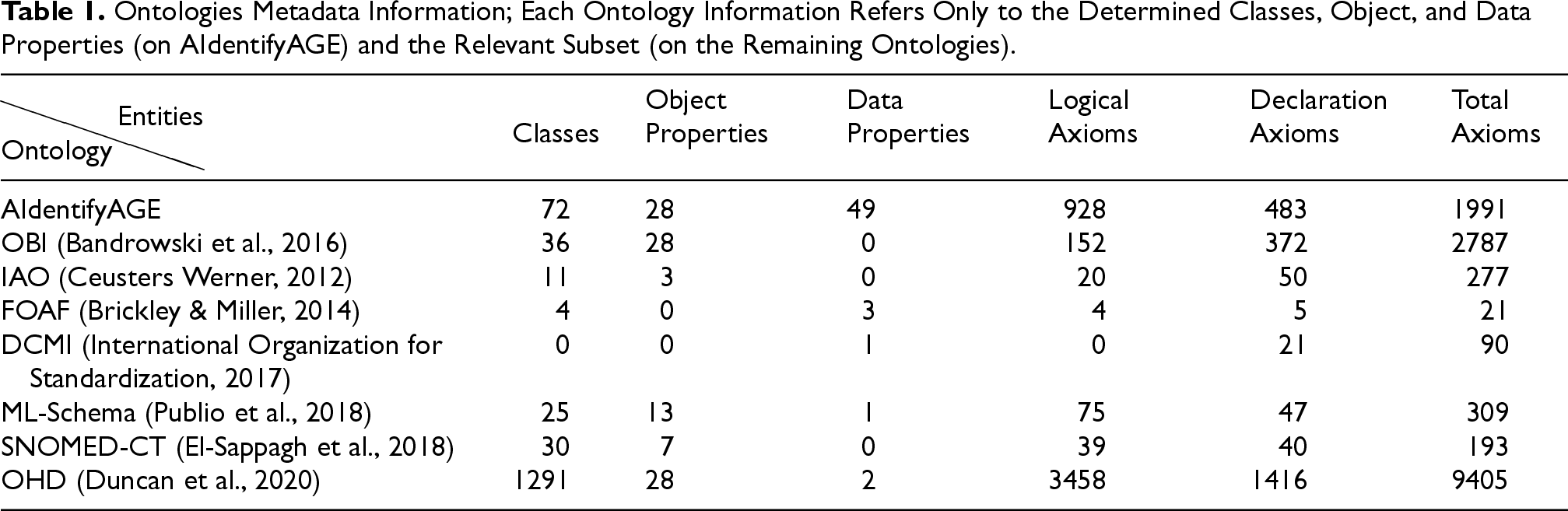
Ontologies Metadata Information; Each Ontology Information Refers Only to the Determined Classes, Object, and Data Properties (on AIdentifyAGE) and the Relevant Subset (on the Remaining Ontologies).
Other AIdentifyAGE classes were classified under other extending ontologies. For example, Forensic Expert Person and Forensic Individual Case Person were classified under FOAF:Person as well as under Homo sapiens (NCBITaxon:9606), the class used by OBI and OHD for human beings. We have deliberately classified them in both ontologies to capture two distinct and complementary aspects of the same entity: its biological identity as an organism and its identity as an information agent. The classification under Homo sapiens is relevant to preserve the alignment with biomedical ontologies and the classification under FOAF:Person is required by the decision-support system relying on FOAF for representation and exchange of person-related information; Model Output and Inference Run were classified following the ML-Schema ontology, under Information Entity and Process class, respectively; OPG was classified following the SNOMED-CT ontology, under the Radiographic imaging procedure (procedure) class. The AIdentifyAGE ontology’s AI DAA domain reuses the ML-Schema ontology (Publio et al., 2018) for the core ML classes (Model, Inference Run, Model Output), keeping the representation aligned with broader ML-ontology efforts and extensible to new architectures, hyperparameter schemes, and evaluation metrics. This auditable representation supports the transparency and explainability that ISO/IEC 23053:2022 and ISO 18374:2025 promote for AI in medico-legal and dental-imaging contexts.
Given the context, Legal Dental Medical Exam Data corresponds to the root class with information related to a given legal medical exam. This includes properties regarding the forensic case identification, requesting entity, relevant radiographic imaging, the forensic expert, and the individual undergoing the legal medical examination. Forensic Expert Person corresponds to the forensic expert performing the legal medical exam, while the Forensic Individual Case Person corresponds to the person undergoing the same exam. From a given orthopantomography (OPG), we can obtain a Teeth Set, aggregating a set of Tooth, that can contain (or not) an associated Treatment Option.
Regarding manual DAA, each Tooth is annotated with a tooth developmental stage according to a selected reference method (e.g., Demirjian et al., 1973, Haavikko, 1970, Kullman et al., 1992, or Moorrees–Fanning–Hunt Moorrees et al., 1963), denoted as ToothStage instances. A Scoring Method is modeled as the method-specific rule set used to assign stages (and, where applicable, alpha-numeric scores) to teeth and to aggregate tooth-level information at the individual level. The ontology supports multiple scoring schemes by representing:
the staging system (set of permissible stages and their definitions), optional stage-to-score mappings when a method uses alpha-numeric values, and the aggregation procedure used to derive method outputs from tooth-level inputs.
The statistical interpretation of the assessed stages/scores is modeled through Reference Study entities that capture population-specific reference data and their associated parameters. Application of a given Reference Study to an assessed case yields a Reference Study Result, which stores the derived outputs required for medico-legal reporting and decision support (e.g., age interval, minimum/maximum, mean estimated age, standard deviation), and, when relevant, supports classification relative to legally defined age thresholds.
Regarding AI-assisted DAA, Inference Run is the root class, corresponding to a run performed by a Model (e.g., CNN model) over one or more OPG, contained in a Data Collection, producing a Model Output. A given Model is also characterized by its configurations, included in the ModelCharacteristic class.
Finally, the Report Data class includes variables regarding the DAA report, such as age range, mean age, and standard deviation. The Dental Age Assessment class, the AI Threshold Dental Age assessment class, and the AI Reg Dental Age Assessment class are used for the manual approach, for the AI-assisted approach, and for regression tasks, respectively.
It is also important to mention that the OHD ontology (Duncan et al., 2020) already implements the Universal Numbering System (UNS) (Harris, 2005) for each tooth. Given that the numbering system is not standard in all countries, other standard naming schemes were added: Fédération Dentaire Internationale (FDI) World Dental Federation notation (for Standardization, 2016), Palmer notation (Palmer, 1891), and Haderup notation (Haderup, 1891).
To give more detail and descriptive knowledge to the AIdentifyAGE ontology and its entities, 312 terms and property descriptions were applied to 70 term classes, 28 object properties, and 49 data properties. Some annotations were added to the ontology to specify information such as versioning and contributors.
These description annotations, as well as ontology development, were done using Protégé software (Musen, 2015). Each entity received mainly two annotations: a label (to specify the name that should be presented for the entity) and a description (clearly describing the significance of that entity). In cases where a formal definition could not be found, a common agreement between the forensic experts allowed them to reach a non-standard definition.
Illustrative Use Case
To demonstrate the practical applicability of AIdentifyAGE in a medico-legal context, we present an illustrative forensic DAA use case. The SPARQL query illustrated in Figure 4 retrieves both manual DAA results and AI model provenance for the illustrative forensic case, including statistical estimates and task type (classification or regression).
This example illustrates how AIdentifyAGE enables transparent retrieval of medico-legal conclusions together with methodological and computational context.
Discussion
AIdentifyAGE addresses a critical gap in forensic medical informatics by providing a formal, interoperable representation of DAA workflows within a legal context. Unlike existing biomedical ontologies that focus on clinical or anatomical aspects in isolation, AIdentifyAGE explicitly models the chain linking observations, methods, reference data, and judicial conclusions. The integration of AI-based age assessment within the same semantic framework as manual methods is particularly relevant given increasing regulatory and ethical scrutiny of algorithmic decision-making. By capturing model characteristics, inference processes, and outputs, the ontology supports transparency and explanation, which are key requirements in medico-legal environments.
Limitations
However, ontology-based approaches also introduce limitations. Knowledge acquisition and maintenance require sustained expert involvement, and no ontology can fully eliminate uncertainty inherent to biological age estimation. Moreover, while AIdentifyAGE supports explainability, it does not itself guarantee correctness of underlying models or reference studies; these remain dependent on empirical validation. Future work should focus on large-scale deployment, integration with institutional information systems, and empirical evaluation of decision-support effectiveness in real forensic workflows.
Contributions
AIdentifyAGE is a reusable, domain-specific ontology model focused on describing the relevant concepts and properties related to forensic and legal procedures supported by DAA, offering a consistent hierarchical concept structure, relevant term and property annotation entities, and accurate relations between terms, serving as the basis for correct data analysis and knowledge handling. It is comprised of 1445 classes, 93 object properties, and 54 data properties, regarding radiographic imaging, odontology, legal and forensic medicine. Its development was closely followed and validated by forensic experts from the Faculty of Dental Medicine - University of Lisbon.
Contributions of this work to medical informatics and forensic decision support:
AIdentifyAGE, the first ontology specifically designed to model the complete medico-legal workflow of forensic DAA, integrating judicial context, clinical observations, statistical reference data, and AI-based inference. A semantically integration of manual and AI-assisted age assessment methods, enabling explainable linkage between tooth-level observations, population-specific reference studies, and legally relevant age conclusions. Demonstration of how reusing existent biomedical and machine learning ontologies, aligned under an upper ontology (OBI), enables interoperability and FAIR-compliant knowledge representation in a legal domain. A reusable semantic foundation for ontology-driven decision-support systems intended to assist forensic experts and judicial authorities in age-related determinations.
Footnotes

Funding
The authors disclosed receipt of the following financial support for the research, authorship, and/or publication of this article: The authors acknowledge the financial support through the AIdentifyAGE project, financed under grant 2024.07444.IACDC, within the scope of the investment “RE-C05-i08 – More Digital Science”, measure “RE-C05-i08.M04 – Support a program of R&D projects for development and implementation of advanced cybersecurity, artificial intelligence and data science systems in public administration, as well as a scientific capacitation program”, within the scope of the agreement between the Recover Portugal Mission Structure and the Fundação para a Ciência e a Tecnologia I.P. (FCT), as an intermediary beneficiary. Renato Marcelo, António Figueiras, Alexandre P Francisco, and Cátia Vaz also acknowledge the financial support by national funds through FCT under grants UID/50021/2025 and UID/PRR/50021/2025 (INESC-ID). Ana Rodrigues, Cristiana Palmela Pereira and Rui Santos acknowledge also the financial support by national funds through FCT under grant UID/PRR/00006/2025 (CEAUL). José Rui Figueira acknowledges also the financial support by national funds through FCT under grant UID/00097/2025 (CEGIST).
Declaration of Conflicting Interests
The authors declared no potential conflicts of interest with respect to the research, authorship, and/or publication of this article.
Notes
Appendix B: Interoperability Mapping With External Ontologies
This appendix presents the explicit mapping between AIdentifyAGE concepts and corresponding entities from established external ontologies and standards, including OBI, IAO, OHD, MLS, FOAF, and SNOMED-CT. The Table 2 is focused on upper-level entities that ensure semantic alignment across the forensic dental age assessment workflow. The mapping demonstrates how AIdentifyAGE ensures semantic consistency, data exchangeability, and interoperability across clinical, forensic, and AI-based decision support systems.