






Abstract
Background
Delivery assist catheters are a new class of devices designed to better navigate tortuous segments and reach the clot interface in mechanical thrombectomy. The RED 72 aspiration catheter with SENDit technology is one such example. SENDit is a novel tapered obturator used instead of a microcatheter to bring up the RED 72. It was designed to speed materials setup and overcome “ledge” effect. This case series aims to assess the safety, efficacy, and associated materials costs of SENDit in a postmarket study.
Methods
This was a single-institution retrospective case series of endovascular thrombectomy for anterior circulation large vessel occlusions affecting the internal carotid artery, M1, or M2 treated with SENDit between August 2023 and May 2024. Demographic, clinical, and cost variables were collected.
Results
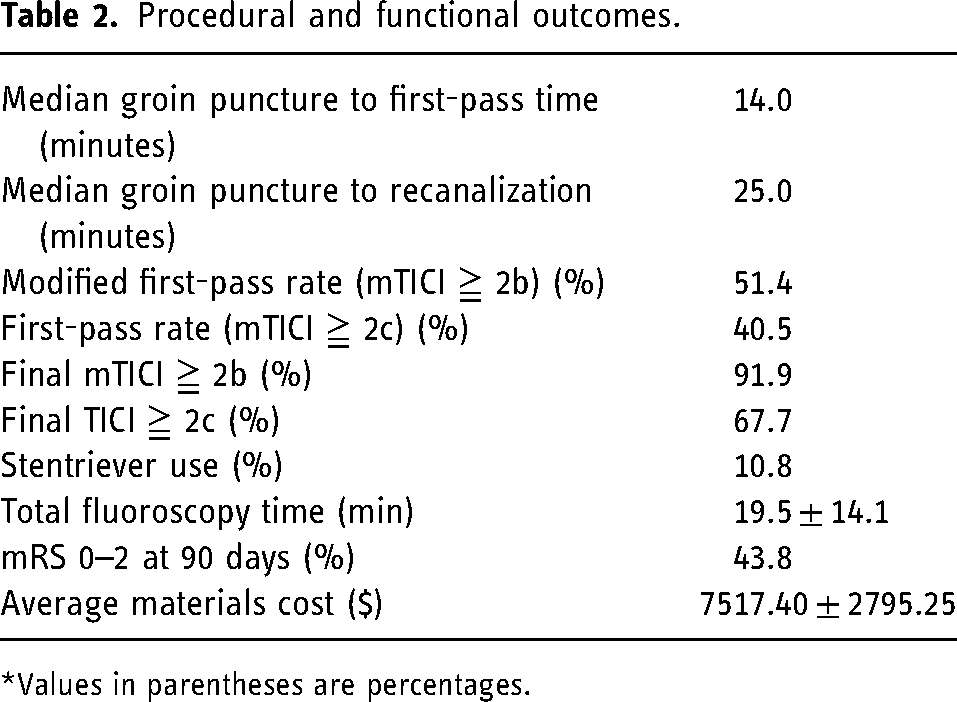
Median time from groin puncture to first pass was 14.0 min, and median time from groin puncture to recanalization was 25.0 min. Modified first-pass effect (mTICI ≥2b) was achieved in 51.4% of cases. The final recanalization mTICI ≥2b rate was 91.9%. A stentriever was required for 10.8% of cases. The rate of functional independence (mRS 0–2) at 3 months follow-up was 43.8%. The average materials cost per case was $7517.40 ± $2795.25; 10.8% of patients experienced access site complications. There was no artery dissection, and the rate of symptomatic intracerebral hemorrhage was 5.4%.
Conclusion
In this case series, SENDit achieved a high rate of first pass effect, rapid recanalization, and low stentriever use and materials cost. It is safe given the low rate of procedural complications and favorable clinical outcomes. Delivery assist catheters are a promising alternative to stentrievers.
Keywords
Introduction
In stroke thrombectomy, there is a direct relationship between the distal inner diameter of an aspiration catheter and efficacy, as measured by first-pass effect (FPE). 1 This insight has motivated the development of longer, larger diameter, and more navigable aspiration catheters designed to further technically optimize the efficacy of mechanical thrombectomy. A variety of strategies have been employed to position these larger catheters closer to the clot interface, including large wires (e.g., Aristotle 2 ) that function as a stiffer rail to facilitate navigation. A stentriever can also be used as an anchor to pull the aspiration catheter to the clot interface. Delivery assist catheters represent a third, newer approach, wherein the standard microcatheter in a triaxial setup is replaced with a larger, tapered obturator that enables navigation of the aspiration catheter through tortuous segments and prominent branch points like the ophthalmic shelf. 3
SENDit (Penumbra Inc, Alameda, CA) is one such delivery assist catheter. It is a novel tapered obturator used instead of a microcatheter to bring up the RED 72 aspiration catheter. SENDit has an internal diameter of 0.018″ and a radiopaque tip that extends 1.5 cm beyond the RED 72. RED 72 is fully PTFE-lined, with 20 transitions and an articulating marker band. It has an internal diameter of 0.072″, outer diameter of 2.16 mm, and length of 132 cm. SENDit is compatible with a 0.014″ wire and was specifically designed to speed materials setup and overcome the “ledge” effect by decreasing the gap between the obturator and aspiration catheter. Accordingly, SENDit occupies 99% of the RED 72 lumen. 4 As a result, SENDit expedites delivery of the aspiration catheter because it is less likely to be impeded by arterial branch points.
The safety, efficacy, and associated procedural costs of RED 72 with SENDit technology have not been assessed in a postmarket study. Here, we report our center's experience with SENDit for the treatment of anterior circulation large vessel occlusions (LVOs). We hypothesized that SENDit would reduce stentriever use without affecting final recanalization or functional outcomes, and that its use might also influence FPE, radiation exposure, and materials cost.
Methods
Patient cohort
This was a case series of patients identified as part of a prospectively maintained database of stroke thrombectomy procedures performed at [our institution]. Included patients were those who underwent endovascular thrombectomy (EVT) for anterior circulation LVOs affecting the internal carotid artery (ICA) or middle cerebral artery (M1 or M2 segments) between August 2023 and May 2024 (Figure 1). A variety of demographic, clinical, radiographic, procedural, and outcome variables were collected. Our institutional review board approved this study. De-identified patient data were used, and we followed CARE guidelines.

Overview of patient selection.
Prior to the introduction of SENDit technology, we often used a triaxial system consisting of a 6F guide catheter, aspiration catheter, and 027 microcatheter brought up over a 0.014″ microwire to treat anterior circulation LVOs. The decision to use SENDit was up to individual surgeon preference. Exclusion criteria included spontaneous recanalization prior to a thrombectomy pass, posterior circulation or anterior cerebral artery distribution occlusions, and distal migration of the clot beyond M2 after CTA and before thrombectomy maneuvers. Statistical analysis was performed using R Statistical Software. 5
Operative technique
Following diagnostic cerebral angiogram, a guide catheter was advanced to the proximal parent artery. SENDit, housed in a RED 72 reperfusion catheter, was then navigated over a microwire to the level of the occlusion. A microwire was used in every case. Once SENDit was confirmed to have reached the face of the clot, the hub of SENDit was disconnected from RED 72. The microwire and obturator were then removed while advancing the RED 72 to engage the thrombus, and continuous suction was applied for 2.5 min, followed by retraction under fluoroscopic guidance. The operative technique used with SENDit differs from a typical triaxial setup in that a microcatheter is not required. However, the system is not compatible with a stentriever.
Results
Baseline patient characteristics
The SENDit group (n = 37) had a mean age of 65.0 ± 15.2 years and 43.2% of participants were men. The average presenting National Institutes of Health Stroke Scale was 15.9 ± 6.9 and 54.1% of strokes were on the right side. The mean time since last known well was 458.1 ± 381.6 min. No patients had an Alberta Stroke Programme Early CT Score of less than 6. Regarding Trial of Org 10172 in Acute Stroke Treatment criteria, the majority of patients’ strokes (51.4%) were cardioembolic in origin. 52.3% of occlusions were located in the M1, 9.1% in the M2, and 38.6% in the ICA. Of the four M2 occlusions, two were proximal dominant frontoparietal branches, one was proximal dominant parietooccipital branch, and one was distal dominant M2 parietal branch. The rate of tandem occlusions was 10.8%. Sixteen patients (43.2%) received IV tPA. The rate of verapamil use was 27.0% (Table 1). A complete list of all guide and intermediate catheters used is in Supplementary Tables 1 and 2. A case illustration is in Figure 2.

Male tricenarian presented with right MCA syndrome and (a) internal carotid artery (ICA) terminus occlusion. (b) RED72 aspiration catheter with SENDit technology brought up over Synchro standard microwire with “J” shape. (c) SENDit crosses clot to bring aspiration catheter to clot interface. (d) SENDit technology unscrewed and removed. RED72 engages clot as Penumbra engine vacuum is connected. (e) TICI3 revascularization after one pass.
Patient characteristics.

*Values in parentheses are percentages.
ASPECTS: Alberta Stroke Programme Early CT Score; ICA: internal carotid artery; NIHSS: National Institutes of Health Stroke Scale; tLKW: time since last known well; TOAST: Trial of Org 10172 in Acute Stroke Treatment.
Technical and clinical outcomes
Median time from groin puncture to first pass was 14.0 min, and median time from groin puncture to recanalization was 25.0 min. Furthermore, modified FPE (mTICI ≧ 2b) was achieved in 51.4% of cases, as compared to first-pass rate (mTICI ≧ 2c) in 40.5% of cases. The rate of successful final recanalization (mTICI ≧ 2b) was 91.9%. Final TICI ≧ 2c occurred in 67.7% of cases. A stentriever was used in 10.8% of cases. Total fluoroscopy time was on average 19.5 min. The rate of functional independence (mRS 0–2) at 90 days was 43.8% (Supplementary Figure 1). The average materials cost per procedure was $7517.40 (Table 2).
Procedural and functional outcomes.
*Values in parentheses are percentages.
Procedural complications
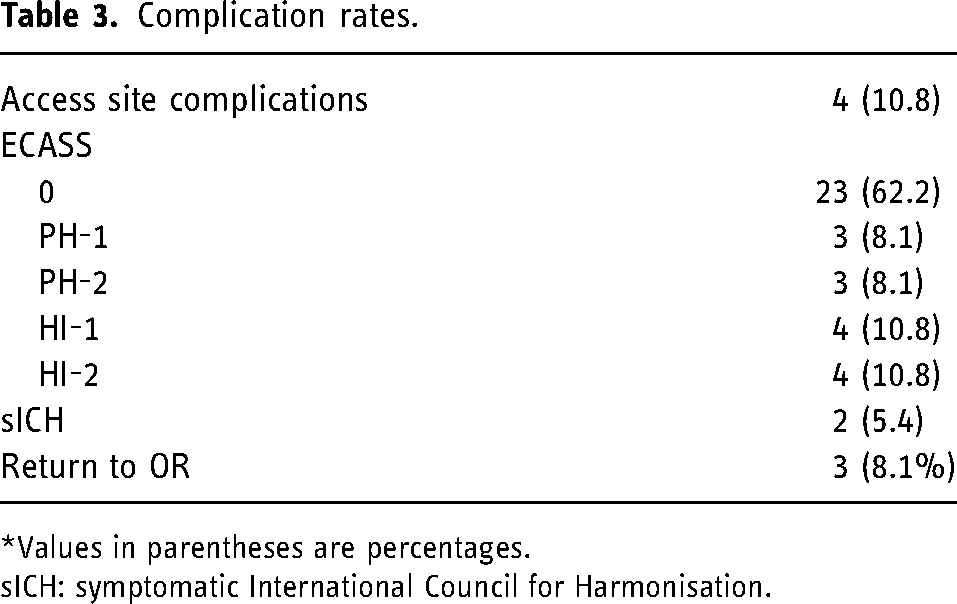
Access site complications occurred in four cases (10.8%). Based on MRI and CT, the frequency of hemorrhagic infarction (European Cooperative Acute Stroke Study HI-1 or HI-2 grade) was 21.6%, and parenchymal hematoma (ECASS PH-1 or PH-2 grade) was 16.2%. Symptomatic HI and PH were collectively observed in 5.4% of patients. There were no artery dissections, hematomas, or pseudoaneurysms. Additional procedures were required for 3 patients (8.1%), which included ICA stenting, EVT for reocclusion, and femoral artery revascularization (Table 3).
Complication rates.
*Values in parentheses are percentages.
sICH: symptomatic International Council for Harmonisation.
Procedural challenges
At times, SENDit required adjunctive devices to achieve a satisfactory angiographic outcome. On one such occasion, SENDit was used on a first pass of a right M1 occlusion, resulting in a TICI 2b. Five additional passes were made for a distal M2 occlusion using a stentriever, but it could not be recanalized. In another case, a tandem occlusion of the ICA and M1 was first treated with angioplasty. SENDit was then used on the first pass, and it pushed the thrombus to the mid-M1 segment. A second pass with a stentriever was required to recanalize (TICI 3). In another patient, recanalization of an M2 occlusion was unsuccessful with SENDit on the first pass. A RED 43 was then used but created an M1 occlusion. A second attempt was made with RED 72 SENDit, which recanalized the M1, resulted in vasospasm, and did not clear the initial M2 occlusion. A stentriever was ultimately required to recanalize the M2 (TICI 3).
Discussion
In this single-institution case series, the use of the RED 72 reperfusion catheter with SENDit technology resulted in high FPE, a low rate of stentriever use, and low procedural costs. SENDit is a safe alternative to stentrievers, with rates of complications, final recanalization, and functional independence at 90 days that are on par with other devices in its class.
SENDit technology is part of a class of products called “delivery assist catheters.” Additional entries in this class include Tenzing 7 (Route 92 Medical Inc, San Mateo CA), Wedge (Terumo Neuro, Aliso Viejo CA), AXS Offset (Stryker, Kalamazoo MI), Carrier (Balt Group, Irvine CA), and Cheetah (Q’Apel, Fremont CA). There are no PubMed-indexed studies reporting on the use of the Balt Carrier or Q’Apel Cheetah products.
Common design elements include a soft tapered distal tip coupled to a proprietary intermediate catheter in a way that creates near-zero offset. Delivery assist catheters are not meant to cross the occlusion but rather stop at the clot interface. Accordingly, SENDit extends just 1.5 cm beyond the tip of RED 72 (as does Wedge, 6 while others, such as Tenzing 7 7 and AXS Offset3,8) have a distal tip of 2 cm. None of the delivery assist catheters are compatible or intended to be used with stent retrievers. Their soft distal tip can be safely navigated without the use of a microwire for safety or support (Table 4).
Comparison of delivery assist catheter specifications.

Limited observational data show a high rate of success with delivery assist catheters in bringing large-bore aspiration catheters to the clot interface without stentriever anchoring. In our series, SENDit successfully delivered the aspiration catheter to the site of occlusion in 37/37 cases. The Tenzing 7, in combination with the FreeClimb 70, reached the target occlusion in 30/30 cases. 11 The Wedge microcatheter brought Sofia Plus to the occlusion in 97.4% of cases. 12 The AXS Offset delivered a 6F aspiration catheter to the clot interface without use of a stentriever in 30/34 cases in one series 3 and 14/15 in another. 13
Stentrievers were rarely used with SENDit technology (11% of cases). This was towards the lower end of the range for other delivery assist catheters: a stentriever was used in 27.0% of Wedge, 12 11.7% of AXS Offset, 3 and 7.0% of Tenzing 7 cases. 11 However, in the Tenzing 7 case series, adjunctive devices (including stentrievers and other aspiration catheters) were required in 33% of cases.
Similar to other delivery assist catheters, SENDit use had low median groin puncture to first pass (14.0 min) and median groin puncture to recanalization (25.0 min) times. Tenzing 7 had a median groin puncture to first-pass time of 12 min; 11 Wedge had a median time of 16 min, 12 and Offset had a mean time of 16 min. 11 For median groin puncture to reperfusion time, it was 16 min for Tenzing 7 11 and 20 min for Wedge. 7 The mean groin puncture to reperfusion time for Offset was 26 min. 13
First pass ≥ mTICI 2b was achieved in 51% of SENDit cases, whereas FPE with contemporary large-bore aspiration catheters typically ranges from 47% to 61.8%.14–16 FPE ranged from 40% to 64% in small series of Wedge, Tenzing 7, and AXS Offset delivery assist catheters paired with aspiration catheters 6F or larger.11–13 The relatively high rate of modified FPE seen with SENDit is likely due to frequent successful delivery to the occlusion.
In our experience, our standard approach of bringing SENDit up over a J-shaped 0.014″ microwire did not result in significant bleeding complications. We recommend using a wire with SENDit upon initial use of the system to gain familiarity with it. As operators gain experience with the technology, they may choose to use it without a wire. Although we always used SENDit with a wire, there are reports of delivery assist catheters such as the Tenzing 7 being used safely without a wire. In one study, the rate of delivery of the aspiration catheter to the occlusion was similar with and without a wire. Final TICI, 90-day mRS, and procedural complications did not vary significantly between the groups. In the no-microwire group, one patient had a vasospasm. 17
In this series, there were four access site complications (10.8%) and 2 patients with symptomatic International Council for Harmonisation (sICH) (5.4%). One study of Tenzing 7 reported one femoral site hematoma (1.4%) without use of a microwire, as well as no dissections. 17 Another study of Tenzing 7 reported 57% of patients having any ICH, with none of them being symptomatic. There were no vessel perforations or dissections. 11 While one study did not report any sICH or dissection with AXS Offset, 13 Pfaff et al. note a rate of any ICH of 38.2%, with 8.8% being symptomatic. They also experienced one vessel perforation, but no dissections or device-related complications. 3 Additionally, the use of Wedge did not result in any device-related complications, although 3.7% of patients had groin hematoma 12 (Table 5).
Comparison of outcomes between delivery assist catheters.

*Mean time reported.
NR: not reported; ICH: International Council for Harmonisation.
We believe that as a consequence of reducing stentriever use, EVT materials cost decreased when using SENDit. There are several reports of procedural cost savings associated with the Zoom suite of catheters, which was also accomplished by enhancing the trackability of aspiration catheters and reducing stentriever use. One such study showed a 57.3% reduction in mean procedural cost, as compared to the Solumbra technique. 18 Materials costs have not been reported in other series of delivery assist catheters.
This study has a few limitations. Firstly, the SENDit delivery assist catheter cannot be used to deploy a stentriever, both because of inadequate length and its inner diameter. The commonality among cases in which RED 72 with SENDit failed and another intermediate catheter was opened was distal emboli. In cases of distal emboli or long thrombi extending into the M2 that require multiple passes, it is necessary to open another microcatheter to introduce a stentriever or a smaller aspiration catheter. This limitation is offset by the aforementioned reduced frequency of needing a stentriever. Further, the rate of verapamil use in the SENDit group (27%) is on par with standard usage reported in a study of commonly used intra-arterial medications in EVT. The radiolucent tip of SENDit can also be difficult to visualize at the clot interface, so we increase magnification to avoid tracking it too far and prevent distal embolization. We acknowledge that the most recent iteration of the device is less radiolucent, but we did not use it in the procedures in this case series. Additionally, this study is limited by its retrospective and observational design. The DSA results in this study were self-adjudicated. This is a single-center study that may not be generalizable to other institutions. Comparisons between different delivery assist catheters may be explored in future studies.
Conclusion
These findings suggest that the RED 72 with SENDit technology can be used safely and effectively in treating anterior circulation LVOs. Specifically, this device yields a high rate of FPE and fast time to recanalization, with low stent retriever use and materials costs and without significant complications. Together, these findings provide additional evidence that delivery assist catheters might further optimize procedural outcomes for mechanical thrombectomy.
Supplemental Material
sj-docx-1-ine-10.1177_15910199251358597 - Supplemental material for A single-center study of the RED 72 reperfusion catheter with SENDit technology in proximal large vessel occlusions
Supplemental material, sj-docx-1-ine-10.1177_15910199251358597 for A single-center study of the RED 72 reperfusion catheter with SENDit technology in proximal large vessel occlusions by Vidhya Dhar, Pablo Valdes Barrera, Sajal Medha K Akkipeddi, Aditya Gunturi, Neil Dogra, Derrek Schartz, Matthew J Cotroneo, Clifton Houk, Lewis Thompson, Nathaniel R Ellens, Charles Matouk, Vincent N Nguyen, Thomas K Mattingly, Tarun Bhalla and Matthew T Bender in Interventional Neuroradiology
Supplemental Material
sj-docx-2-ine-10.1177_15910199251358597 - Supplemental material for A single-center study of the RED 72 reperfusion catheter with SENDit technology in proximal large vessel occlusions
Supplemental material, sj-docx-2-ine-10.1177_15910199251358597 for A single-center study of the RED 72 reperfusion catheter with SENDit technology in proximal large vessel occlusions by Vidhya Dhar, Pablo Valdes Barrera, Sajal Medha K Akkipeddi, Aditya Gunturi, Neil Dogra, Derrek Schartz, Matthew J Cotroneo, Clifton Houk, Lewis Thompson, Nathaniel R Ellens, Charles Matouk, Vincent N Nguyen, Thomas K Mattingly, Tarun Bhalla and Matthew T Bender in Interventional Neuroradiology
Footnotes
Authors’ contribution
The study was designed by Vidhya Dhar, Pablo Valdes Barrera, and Matthew T. Bender. Data were collected by Vidhya Dhar, Pablo Valdes Barrera, Sajal Medha K. Akkipeddi, and Neil Dogra; data interpretation and analysis was done by Vidhya Dhar. The manuscript was written by Vidhya Dhar with input from all authors.
Consent to participate
The requirement for informed consent was waived by our institutional review board.
Data availability statement
Data are available upon request. Please email the corresponding author.
Declaration of conflicting interests
The author(s) declared no potential conflicts of interest with respect to the research, authorship, and/or publication of this article.
Ethical considerations
This study was conducted with the approval of our institutional review board. Documentation is available upon request. We adhered to the standards outlined in the CARE (Case Reports) guidelines.
Funding
The author(s) disclosed receipt of the following financial support for the research, authorship, and/or publication of this article: This study was funded by the University of Rochester Medical Center Department of Neurosurgery, (grant number N/A).
ORCID iDs

Supplemental material
Supplemental material for this article is available online.
References
Supplementary Material
Please find the following supplemental material available below.
For Open Access articles published under a Creative Commons License, all supplemental material carries the same license as the article it is associated with.
For non-Open Access articles published, all supplemental material carries a non-exclusive license, and permission requests for re-use of supplemental material or any part of supplemental material shall be sent directly to the copyright owner as specified in the copyright notice associated with the article.
