







Abstract
Listed alphabetically by title (Author index p. 539)
Contents
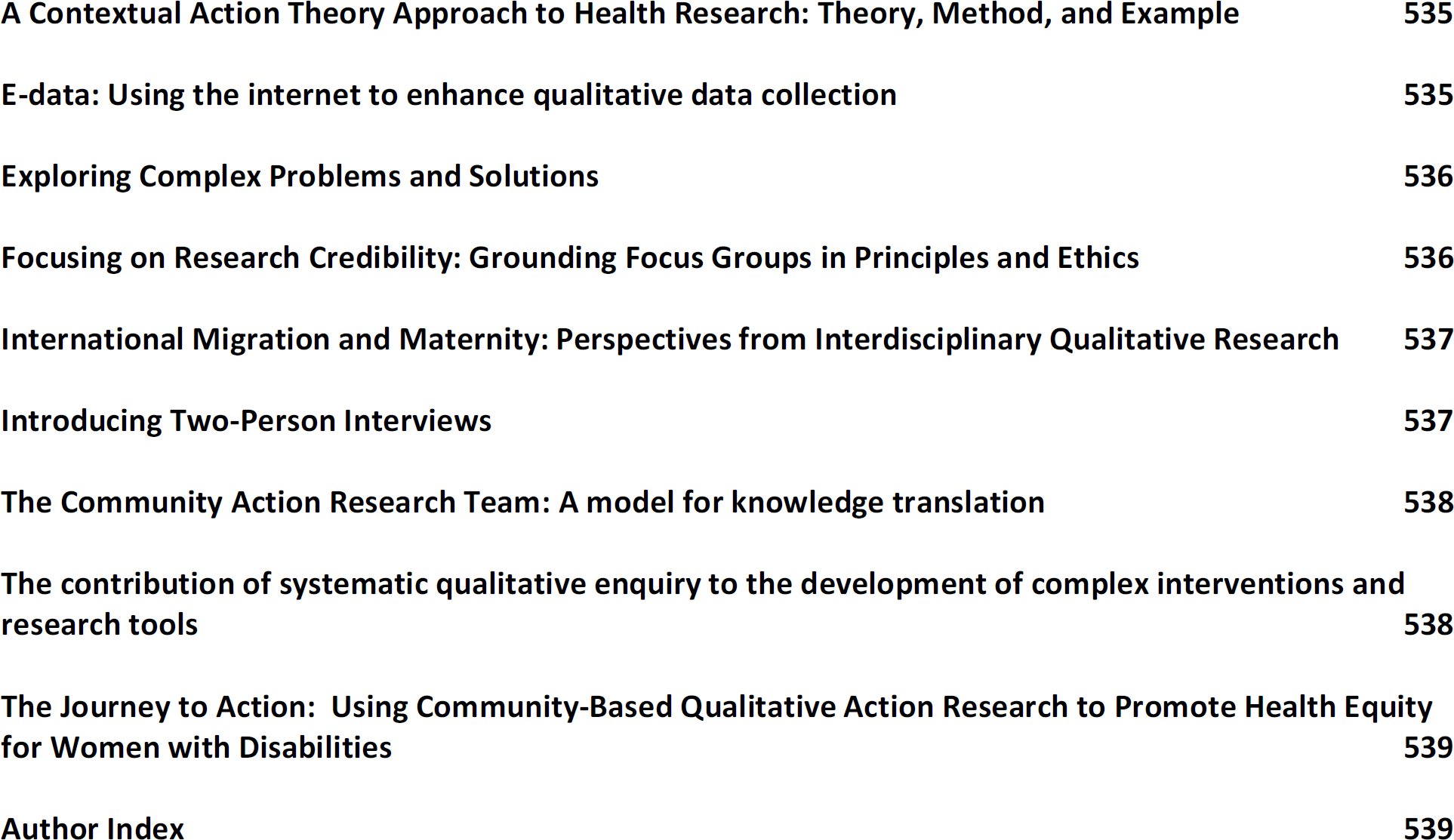
A Contextual Action Theory Approach to Health Research: Theory, Method, and Example
Jose Domene
University of New Brunswick
Andrea Schneider
University of New Brunswick
In this symposium, we describe a novel approach to qualitative research that has many potential health research applications: Contextual action theory and its accompanying action project method. Young and colleagues have developed and refined this approach over the past 20 years. It was originally applied to exploring adolescent career development, but has subsequently been used in a variety of health and human development research contexts. The papers in this symposium provide a comprehensive overview of this systematic approach to social inquiry, and illustrate its potential as a way to engage in qualitative health research. The first paper provides an overview of contextual action theory and argues for the value of this framework in conducting health research. The second paper describes the data collection and analysis procedures associated with this approach. The remaining papers illustrate the use of this theory and method to address specific questions related to health and wellness.
E-data: Using the internet to enhance qualitative data collection
Jennifer Thannhauser
University of Lethbridge
Jose Domene
University of New Brunswick
Tanya Mudry
University of Calgary
Internet access among adolescents and other age brackets has proliferated over the past decade, providing exciting new opportunities for qualitative researchers to access the personal narratives of participants. As a communication tool, the internet provides multiple resources, including blogs, instant messaging (IM), and chat rooms, to allow individuals a new means for co-constructing their experiences. The rise of the internet and social media now provides a new medium for soliciting narratives that may be more consistent with the communication style of young people today. Of note, however, is the limited discussion about the strengths, weaknesses and challenges of using internet resources in qualitative research with young people. This symposium provides opportunity to explore the use of IM, chat rooms, and blogs with adolescents and adults in qualitative research.
Exploring Complex Problems and Solutions
Carrie Matteson
Simon Fraser University
Public health practitioners are increasingly challenged by the task of finding effective ways to address complex problems such as chronic disease and obesity. To better cope with the complexity of these problems, our team has developed frameworks that integrate the components of seemingly intractable challenges to view both problems and solutions with a holistic lens. This process allows for a comprehensive view while using a systematic approach, and generates a canvas for the strategic design of appropriate solutions geared for complexity. While these frameworks are specific to complexity and include a unique set of terminology, they are generalizable across complex problems and transferable to different systems. In our proposed symposia, we review the theory underlying our approach, describe how we generated the frameworks used for our analysis, and review examples of the framework's application to complex problems in an effort to generate novel solutions.
Internet access among adolescents and other age brackets has proliferated over the past decade, providing exciting new opportunities for qualitative researchers to access the personal narratives of participants. As a communication tool, the internet provides multiple resources, including blogs, instant messaging (IM), and chat rooms, to allow individuals a new means for co-constructing their experiences. The rise of the internet and social media now provides a new medium for soliciting narratives that may be more consistent with the communication style of young people today. Of note, however, is the limited discussion about the strengths, weaknesses and challenges of using internet resources in qualitative research with young people. This symposium provides opportunity to explore the use of IM, chat rooms, and blogs with adolescents and adults in qualitative research.
Focusing on Research Credibility: Grounding Focus Groups in Principles and Ethics
Martha Ann Carey
Kells Consulting
To have an impact on social change, study results must be credible. The use of focus groups has suffered from ¡¥method drift¡| in recent published work. Unfortunately, some use has moved from a generally agreed upon definition as a method of data collection, to being used without appropriate epistemological foundations. These presentations will help researchers¡| in planning, conducting, analyzing, and reporting their work to have greater impact. We will present a conceptual foundation and unique elements in working with children, ethnic minorities, elders, gay/lesbian/bisexual/transgendered participants, and the cognitively or emotionally impaired. Because ethical issues are central to qualitative work and especially in group settings, the application of ethical principles will be highlighted. The panelists have extensive experience in research, policy, and ethics in health services, public health, government, and education.
International Migration and Maternity: Perspectives from Interdisciplinary Qualitative Research
Gina Higginbottom
University of Alberta
Beverley O'Brien
University of Alberta
Zubia Mumtaz
University of Alberta
Sophie Yohani
University of Alberta
Yvonne Chiu
Multicultural Health Broker Cooperative
Philomina Okeke-Ihejirika
University of Alberta
Elaheh Ahmadi
Dominion Medical Clinic
Patricia Paton
Alberta Health Services
Rebecca Malhi
University of Alberta
Shireen Bell
University of Alberta
Alberta is a popular Canadian destination for new immigrants, including childbearing families who arrive from all areas of the world. Extant evidence shows that immigrant women have difficulty finding and utilizing existing health services, such as maternity services, which potentially has a negative effect on their health and that of their families. The overarching research question addressed by our multi-year project is how can we reduce or eliminate the disparity experienced by immigrant women in accessing and navigating maternity care services in Alberta? This symposium will present interim findings from the project and highlight the perspectives of the women themselves, health professionals, policy-makers and key stakeholders. The ultimate goal of the project is to impact upon maternity policy and practices, enhancing the provision of maternity health programs and services for this vulnerable group.
Introducing Two-Person Interviews
David Morgan
Portland State University
Two person interviews are a new group interview format with two participants and one interviewer. Because of their emphasis on interaction, they have important similarities to focus groups, but the conversation-like format for two-person interviews also creates a different kind of dynamic. The papers in this symposium examine both substantive and methodological aspects of two-person interviews. From a methodological perspective, they provide insights into both the strengths and limitations of two-person interviews. Among the advantages are ease of recruitment and the possibility of using telephone interviews. In addition, using only two participants provides more in-depth data on each of them then would be the possible in a larger focus group. Among the limitations are potential problems with hierarchy and authority. Overall, two-person interviews show a strong potential for using the interactive dynamics of group interviews as a way to generate useful data from pairs of participants.
The Community Action Research Team: A model for knowledge translation
George Bailey
Tlicho Community Services Agency
Anita Daniels
Tlicho Community Services Agency
Karen Edwards
University of Alberta
Nancy Gibson
Tlicho Community Services Agency
Susan Hopkins
Government of the Northwest Territories
Leona Lafferty
Tlicho Community Services Agency
Mason Mantla
Tlicho Community Services Agency
Patrick Wansbrough
Tlicho Community Services Agency
Cecilia Zoe Martin
Tlicho Community Services Agency
2008 the Tlicho Region of the Northwest Territories had the highest rate of syphilis in Canada. Despite various programs and a region-wide survey conducted by community-based researchers, the evidence-based interventions were hard to implement; those tasked with knowledge translation were already engaged in full-time positions, and thus communication and program development were uneven. In May of 2009, a team of young Tlicho adults was recruited to be trained full-time to work with health professionals and others to develop and conduct interventions, to evaluate them, and to conduct further research to ensure that programming and policies continue to respond to community needs and priorities. The symposium includes CART members, the evaluators and the Public Health Nurse. The integration of the three perspectives, community, public health, and academic provides multidimensional descriptions and understandings of the model with transferable elements.
The contribution of systematic qualitative enquiry to the development of complex interventions and research tools
Kathy Murphy
National University of Ireland, Galway
Cecily Begley
Health Science
Adeline Cooney
Dympna Casey
Lorraine Mee
This symposium will focus on the essential contribution of qualitative research in the design and development of complex interventions for RCTs and other research tools. Three large national Irish research studies, PRINCE, DARES and SCAPE will be described with a focus on how the interventions and research tools for these studies were developed through qualitative enquiry. In each of these studies, qualitative data was gathered from key stakeholders by focus groups or/and one-one interviews. The data was analysed within the stakeholder groups and then cross comparison analysis undertaken to inform the intervention or research instruments. How this was done will be shared and implications for future research discussed and debated. The importance of qualitative work within mixed method and trials will be highlighted.
The Journey to Action: Using Community-Based Qualitative Action Research to Promote Health Equity for Women with Disabilities
M. Bianca Seaton
Mount Sinai Hospital
Linda Muraca
Mount Sinai Hospital
Julie Devaney
Mount Sinai Hospital
Qualitative action research (QAR) is celebrated for its emancipatory potential and practical relevance in addressing pressing concerns of communities. Methodological difficulties of using this strategy in community-based studies are well known, including goal setting for transfomative action, building trust, sharing power, maintaining engagement of team members, and negotiating ethical issues. Less attention has been paid to these challenges as they evolve over time on research teams, and as the setting and focus of QAR changes on the journey to bring about social change.
This symposium discusses the experiences and research journey of our team of community-based workers, university-based health researchers, and healthcare professionals to promote health equity for women with disabilities (WWDs) by creating behaviour change among healthcare providers working in breast cancer screening. We present findings and insights from inter-related projects conducted in Toronto, Ontario, and explore the implications for future work promoting health equity for vulnerable social groups.
Ahmadi, Elaheh, 537
Bailey, George, 538
Begley, Cecily, 538
Bell, Shireen, 537
Carey, Martha Ann, 536
Casey, Dympna, 539
Chiu, Yvonne, 537
Cooney, Adeline, 538
Daniels, Anita, 538
Devaney, Julie, 539
Domene, Jose, 535
Edwards, Karen, 538
Gibson, Nancy, 538
Higginbottom, Gina, 537
Hopkins, Susan, 538
Lafferty, Leona, 538
Malhi, Rebecca, 537
Mantla, Mason, 538
Martin, Cecilia Zoe, 538
Matteson, Carrie, 536
Mee, Lorraine, 539
Morgan, David, 537
Mudry, Tanya, 536
Mumtaz, Zubia, 537
Muraca, Linda, 539
Murphy, Kathy, 538
Paton, Patricia, 537
O'Brien, Beverley, 537
Okeke-Ihejirika, Philomina, 537
Schneider, Andrea, 535
Seaton, M. Bianca, 539
Thannhauser, Jennifer, 535
Wansbrough, Patrick, 538
Yohani, Sophie, 537