






Abstract
Digital traces—such as social media posts and app data—are increasingly used in qualitative research, both as primary data sources and as elicitation tools in interviews. One emerging approach, the scroll-back method, uses participants’ own digital traces from social media as prompts to support memory recall, stimulate reflection, and ground discussion in everyday practices. This article examines the adaptability of scroll-back across varied research contexts and developmental populations. We draw on three case studies involving adolescents, young adults, and older adults to illustrate how scroll-back was tailored to different participant groups, digital platforms, and research aims. These examples highlight how the method can be flexibly implemented, for instance through participant-led vs. researcher-led selection of content, by combining with content analysis, and by drawing on digital traces across platforms. Our reflections show that these adaptations supported rich and sometimes unexpected forms of data generation, while also surfacing important ethical and practical challenges, including issues of privacy, emotional risk, digital inclusion, and researcher–participant power dynamics. We conclude by offering a set of methodological considerations for adapting the scroll-back method in future studies. In doing so, we highlight its value not as a fixed protocol, but as a versatile methodological technique that is suited to adaptation across populations, technologies, and substantive topics.
Introduction
Digital media and technologies are now ubiquitous. Nearly two thirds of the world’s population are online, with daily internet use close to universal in high income countries (OECD, 2025). Young people tend to be more connected than older adults; in the United Kingdom, younger adults (aged 18–24) spend almost twice as much time online as older adults (Ofcom, 2024). These digital interactions create digital traces - records of individuals’ engagement with technology. Digital traces include both active contributions (such as posting or sharing content) and passive data (such as location, step count, or other device information). Collectively, these digital traces form a detailed portrait of individuals and groups, enabling everything from targeted advertising to large-scale research on social behaviour (Lupton, 2016).
Social media, defined as online environments that facilitate user-generated content creation and sharing (Boyd & Ellison, 2007), provide rich source of digital traces. Social media sites store user-generated media content – including text, videos and images – providing a rich archival data source of autobiographical data (Robards & Lincoln, 2017, 2019). Engagement data such as content viewed, time spent on sites and other user reactions to content posted are also stored, albeit passively in ways not obvious to the user (Zhang et al., 2023). Importantly, social media data and other digital traces are not made for researchers; rather they are records of life produced for chosen audiences, usually friends and family, and/or captured passively for self-reflection (Thomas et al., 2018). However, they are of high value to researchers since they constitute rich longitudinal naturally occurring data sources (Robards & Lincoln, 2019; Zhang et al., 2023), are easily accessible and can be used in multiple ways (e.g., as a site of analysis, Talbot et al., 2023).
Of particular relevance here, digital traces have been used as prompts within interviews. The use of digital traces as a prompt to elicit rich data capture draws on the long-standing tradition of photo-elicitation; the practice of using images as a prompt to evoke participants’ image-related recollections (Harper, 2002). Photo-elicitation has been widely used across diverse research contexts since it improves researcher-participant communication while also encouraging deeper reflections on the interview subject matter (Bates et al., 2017; Harper, 2002), often resulting in longer more detailed interviews (Orr et al., 2020).
The Scroll-Back Method
The social media scroll-back extends this tradition. In scroll-back interviews, researchers and participants review participants’ social media content together, co-analysing their social media data to evoke recollections and reflections related to the content, including psychosocial processes, such as self-disclosure and self-presentation (Moran et al., 2024; Robards & Lincoln, 2019). By positioning the participant as a co-analyst, important insights into digital practices are elicited in a way that more researcher-led methods may overlook (Robards & Lincoln, 2017, 2019).
Originally, the scroll-back was developed as a qualitative method for understanding temporality and exploring narratives (Robards & Lincoln, 2017). The first study in which the method was presented focuses on understanding how young adults make sense of their social media use over time and how this changed and why, with regards to their disclosure and presentation strategies. This approach has since been coined the long narrative scroll back (Robards & Lincoln, 2019) and has five stages; [1] pre-interview friending via social media [2] discussion of general social media patterns [3] mapping of personal life events related to the research question [4] scrolling back through social media in reverse chronological order to narrate reflections, and [5] closing questions focused on future usage. Recently, the short snapshot scroll-back method was introduced, wherein the interviewee independently selects fewer specific posts for discussion that directly address questions posed by the researcher (Robards & Lincoln, 2019). The short snapshot scroll-back has three steps: [1] pre-interview preparation, [2] in-interview scroll-back and narration, and [3] optional collection of screenshots to facilitate analysis of interview data.
Both the long-form narrative and short form snapshot scroll-back method are positioned as flexible and adaptable. Thus, a key strength of the scroll-back method lies in its flexibility; not only can it be used in long and short form, but it can also be used to study a wide range of social phenomena in research projects involving diverse populations and diverse social media. Moran et al. (2024) recently reflected on its use in research across diverse topics including national identity, race, sexuality, gender, and media industries, involving diverse groups including migrants, women, queer femmes, and media workers, utilising different social media platforms, including Facebook, Instagram, Snapchat, and WeChat, and employing a variety of modes of engaging with participants (in-person, video conferencing, synchronously, and asynchronously). While particularly suited to non-ephemeral social media content, it can be adapted to include ephemeral posts and other digital traces including those passively collected (e.g., data logs). For example, Bell, Norminton, and Dollimore (2024) encouraged participants’ to draw on digital traces stored across a range of health and fitness technologies (e.g., Strava output, Apple Watch displays, social media posts) to understand how participants made sense of their cumulative uses of digital technologies across the Covid-19 pandemic. There are also differences in the way social media data and digital traces have been selected for inclusion in studies, including through objective (e.g., most recent content) and subjective (e.g., most meaningful content) judgements, and at different timepoints in the research process (in advance or in real time).
The Present Paper
This paper focuses on the scroll-back method as an approach for integrating digital traces into qualitative interviews. Drawing on three case studies, we explore how the scroll-back method can be adapted in innovative ways across different topics and different developmental populations spanning adolescence, young adulthood, and later life. Each case study, involving research led by the authors of this paper, demonstrates a distinct application of scroll-back, utilising different forms of digital traces within variations of interview-based designs to illuminate psychosocial experiences. In our presentation of case studies, a description of the research is provided along with author reflections; to arrive at these, the authors independently revisited original study materials (manuscripts, data, and memos) alongside methodological papers describing scroll-back (Robards & Lincoln, 2017, 2019) to appraise the method through the lens of its application. The paper ends with collective reflections derived through a multistage reflective process, along with a practical guide for future adaptations of the scroll-back method.
In presenting these case studies we extend previous understandings and applications (Moran et al., 2024) by demonstrating [1] the flexibility of the scroll-back method through novel uses including with digital traces beyond social media and in combination with content analysis and, [2] its utility across the life course, showing how people at different life stages engage with their digital histories in distinct ways, and [3] the practical and ethical considerations involved when adapting the method for diverse research context. Crucially, we argue that scroll-back can be understood not only as a way of eliciting reflections on digital practices, but also as a tool for accessing the broader psychosocial processes that underpin them. In this way, scroll-back contributes to methodological debates about how digital traces can be used reflexively and ethically in qualitative research. We conclude with a practical guide for adapting the scroll-back method in future research projects.
Case Study 1: Using Scroll-Back With Adolescent Girls to Understand Appearance-Related Interactions on Social Media and Body Image
Adolescents increasingly communicate through highly visual social media platforms like Instagram (Nesi et al., 2018) and many of these interactions are highly appearance focused, especially among girls (D. L. Paddock & Bell, 2024). Case Study 1 focuses on work by Paddock et al. (2025) that examined adolescent girls’ appearance-related interactions on Instagram within the broader context of their psychosocial development including in relation to body image and social relationships (Choukas-Bradley et al., 2022). Guided by the shorter snapshot scroll-back method (Robards & Lincoln, 2019), Paddock et al. (2025) used a combination of qualitative interviews and content analysis to systematically examine the content of Instagram interactions. There were two key research questions: (1) What is the content of captions, direct comments and participants’ first responses to comments posted on Instagram? and (2) How do adolescents understand and interpret interactions surrounding self-images on Instagram?
Adapted Use of the Scroll-Back Method
Twenty-one adolescent girls (aged 12-18 years) participated in one-to-one semi-structured online interviews. During interviews, participants were asked to scroll through their Instagram profile to identify their ten most recent self-image posts, defined as a post containing an image of the participant, including group images and selfies. Each post (including the image, caption, comments and replies) was discussed individually, with conversations focusing on how they thought and felt (1) at the time of posting the image (2) when receiving comments and likes, and (3) when responding to commenters. Girls were also encouraged to reflect more broadly on how these interactions linked to their social relationships, identity and body image. Participants’ Instagram data was also systematically extracted using screen capture tools; seventeen participants consented to this. For each participant, all posts discussed at interview were extracted (Post M = 5.00, SD = 1.62, Range = 3-8, total extracted across participants = 85) including the images (n = 85), captions (n = 85), direct comments from others (n = 630), and participants’ initial replies to comments (n = 460).
To analyse the data, an inductive-deductive approach was adopted (e.g., Jankowski et al., 2014). First, interview data was analysed using template analysis. This involved coding interview transcripts using a flexible coding framework that centred on the four features of Instagram posts of interest (images, captions, direct comments from others, and participants replies to comments). Then, Instagram data was analysed using inductive-deductive content analysis. This involved developing a codebook based on past research, findings from the template analysis, and researcher’s subjective interpretation of the dataset. The final codebook contained clearly defined categories and illustrative examples. For example, appearance-related comments on posts were coded as Weight, Specific or General. Appearance weight included weight-specific comments (e.g., “you look so skinny in this”), appearance specific included comments that focus on a particular non-weight-related aspect of physical appearance (e.g., “your hair  ”), and appearance general included broader appearance-based praise (e.g., “you look amazing”). These categories were developed in part due to insights from the template analysis of interview data, which indicated that participants considered these three types of appearance comments differently (e.g., one participant stated “you always get general comments that are like ‘you’re gorgeous’ or ‘you’re pretty’ or ‘wow’ and I’m like meh… it’s very generalised and not meaningful”. Thus, interview data informed the development of the coding strategies by clarifying participants’ intentions behind, perceptions of, and emotional responses to interactions. Different codebooks were produced for each of the four features of Instagram posts (i.e., image, caption, comment, and reply). Instagram data was then coded according to the frequency with which content was present or absent within posts. Thus, interview data informed the development of the coding strategies by clarifying participants’ intentions behind, perceptions of, and emotional responses to interactions.
When combined, findings showed how appearance commentary is a normative aspect of girls’ Instagram experience. Most comments were positive and appearance-focused, with general compliments (e.g., “you’re gorgeous”) more common than specific ones (e.g., “your hair is unreal”). Weight-related compliments, which are highly prevalent in offline contexts (Calogero et al., 2009) were notably absent. Girls described strategic self-presentation practices e.g., reciprocating and downplaying compliments to avoid seeming “big-headed”. Overall, the findings suggested that girls carefully manage their digital presence through deliberate posting, captioning, and interaction strategies all shaped by social expectations. They highlight how Instagram is not only a space for sharing images but a platform where appearance is continually evaluated and affirmed.
Reflections
By using the scroll-back method, Paddock et al. (2025) ensured participants reflected on their actual Instagram data and the context in which it was produced; eliciting vivid, authentic and detailed stories of how social media use intersects with broader developmental processes. As reflections happened in real-time, the study was able to capture adolescents’ emotional reactions to their past Instagram content, which may have been lost if different methods were adopted. It also enabled the capture of adolescents’ reflections on how their feelings towards this content had changed over time, including in response to feedback (e.g., comments, likes). Such over-time reflections are particularly important when studying adolescence as a developmental period and are a noted advantage of the scroll-back method.
Appearance-related interactions are intertwined with adolescents’ developing sense of self, body image, and relationships (Choukas-Bradley et al., 2022), and as such can be a sensitive topic. Using the scroll-back method in this context provided a non-threatening and participant-led way to explore social media content and discuss topics that may feel personal and emotionally difficult. Though the researcher stipulated which posts to discuss (ten most recent self-images), participants were empowered to control the interview direction, e.g., drawing attention to which aspects of the post they deemed important and/or felt most comfortable discussing. In this way, the scroll-back method facilitated a youth-centred, enjoyable interview experience for both participant and researcher. This was reflected in anecdotal feedback provided by participants following the interviews who said that their experience had felt less like a formal interview and that having a tangible, visual focus to talk through made the discussion more engaging and comfortable. That said, there were still emotional risks associated with revisiting Instagram posts in interviews, and the research team were mindful of these risks throughout the research process.
By extracting participants' Instagram posts for quantitative content analysis and coupling this data with the qualitative analysis of interview data, Paddock et al. (2025) present a novel and innovative way of integrating adolescent voice into content analytic research methods. Adolescents’ reflections on the meaning associated with Instagram content were used to inform coding frameworks and their subsequent interpretation, helping the research team to avoid making inaccurate assumptions about the data. This is especially important for understanding adolescent interactions, which are bound by complex social rules only adolescents are privy to (Nesi et al., 2018). However, extracting data for content analysis also posed challenges surrounding data security and privacy, since Instagram posts included interactions from other individuals. To ensure data security, Instagram data were only accessed by the researcher from a password-protected computer and were deleted once transcription was complete. Transcribed data were anonymised (e.g., social media usernames removed) and direct quotations were paraphrased in published reports.
Last, attempts to replicate this study with adolescent boys have proved challenging for the research team. First, boys have been difficult to recruit to scroll-back interviews on body image (Paddock, 2023), perhaps reflecting broader societal beliefs that equate talking about appearance with femininity (Strandbu & Kvalem, 2014). In addition, this difficulty may also relate to differences in social media engagement and platform use. Research suggests that adolescent boys may engage less frequently in appearance-focused self-presentation on highly-visual platforms like Instagram (Ohannessian & Vannucci, 2021). Boys may favour platforms oriented towards gaming, humour or ephemeral content (e.g., YouTube, Discord, TikTok or Snapchat) where posts are less permanent and potentially less explicitly tied to self-image (Twenge & Martin, 2020), but research exploring boys’ social media preferences relative to girls is limited. Second, of the boys who participated, the majority were unwilling to have their Instagram posts extracted for content analysis and/or had very few posts in their Instagram profile that could be extracted (Paddock, 2023). Engaging in co-production work with adolescent boys to adapt the method so that it is more acceptable to them may be one way of advancing this strand of research.
Case Study 2: Using Scroll-Back With Young Adults to Understand Digital Fitness Technology Use and Wellbeing During the Global Covid-19 Pandemic
Case Study 2 focuses on research examining how young student women used digital fitness technologies (DFT) to support their health and wellbeing over the course of the global Covid-19 pandemic (Bell et al., 2024). Around the world, individuals increasingly engage with DFT - including social media, diet and exercise apps, exergames and wearables - to support their physical fitness (Kalgotra et al., 2022; Lupton, 2021). Studies show that use of DFT increased during Covid-19 pandemic lockdowns, wherein the UK government mandated the closure of offline fitness spaces (Constandt et al., 2020). DFT users tended to report higher levels of physical activity than non-users during early lockdowns, but usage – along with participation in physical activity – typically declined over the course of the pandemic (Mitchell et al., 2022).
Bell et al. (2024) sought to understand young student women’s retrospective perceptions of their cumulative engagement with DFT from March 2020 to March 2021 through periods of lockdown restrictions and easing. The focus was on understanding participants’ narratives and meaning-making; focusing on how usage changed over time and how this related to their perceptions of their own health and wellbeing. Specifically, Bell et al. (2024) aimed to answer two questions: [1] What are young student women’s perceptions of their engagement with DFT across the Covid-19 pandemic? [2] How did DFT contribute to their health and wellbeing during this time?
Adapted Use of the Scroll-Back Method
Seventeen UK-based women (Age M = 20.29, SD = 1.72, Ethnicity White = 94.12%) participated in an online semi-structured interview. The schedule included questions that explored how the participants had engaged with DFT to support their physical and mental health at several key time points across the Covid-19 pandemic, including before national lockdowns (Jan–Mar 2020), during national lockdowns (Mar–June/July 2020, November 2020, Jan–March 2021) and between lockdowns (July–October 2020, December 2020). To facilitate recall, participants were invited to bring any digital devices that they had used to support their fitness (usually a smartphone, but also wearables and tablets) to the interview and were encouraged to use these devices during the interview to show how they had used different DFT at different times. Thus, scroll-back was not restricted to one specific social media or digital trace, reflecting the overlapping and complementary ways DFT are used in the real world. Participants were not asked to select digital traces in advance and instead encouraged to make decisions in real-time within the interview regarding what to share to help support their narratives.
Data from this study was analysed using narrative-informed reflexive thematic analysis. Three themes were developed to represent how participants’ perceptions of DFT changed over time and how this contributed to their health and wellbeing: [1] My lockdown #fitnesstransformation: DFT as information and inspiration, [2] My unrealistic expectations: DFT as a source of comparison and concern and [3] My new body positive and resilient self: DFT as a catalyst to self-development. DFT were perceived as vital information and support, (theme 1), as sources of unrealistic comparison targets (theme 2) and as contributors to the development of resilience and body positivity (theme 3). These changing perceptions were informed by past and parallel DFT use and experiences, as well as the complex sociocultural context, and had implications for wellbeing. For most young women in the study, DFT engagement across the pandemic “constituted a continuous learning process that contributed to an enhanced understanding of the self, body and health behaviour” (Bell et al., 2024).
Reflections
This case study demonstrates the usefulness of the scroll-back method when used with a variety of different digital traces beyond social media. Participants were encouraged to show diverse content stored within their devices in order to prompt conversation and elicit rich memories within interviews (e.g., ‘It just makes you compare yourself [. . .] I would look at that [shows image of Instagram fitness influencer on phone] and be like, “Oh, well, I should maybe start thinking about losing weight”; Bell et al., 2024). This included Apple Watch displays, specific YouTube workout videos, and screen captures of WhatsApp chats. By not limiting the use of the scroll-back method to one digital trace, participants were able to move between digital traces during the interview, mirroring the messy ways in which technologies are used in overlapping ways with one another in the real world (Lupton, 2021).
One of the key advantages of this approach was that it required participants to reflect on the breadth of their digital traces. This facilitated an in-depth understanding of their cumulative and combined use of DFT; including how using multiple technologies affected them in different ways at different times, and also how past technology use affected subsequent use. Such complex interactions between technologies and users are rarely captured in research and instead the focus has been on snapshot understandings of use at one timepoint and/or use of a specific technology (e.g., fitbits), site (e.g., Instagram) or function (e.g., calorie counting). The scroll-back method played a crucial role in elucidating these more complex interactions between users and technology, showcasing how the impact of cumulative and combined technology use is often greater than the sum of its parts. The ability to access these technologies during the interview helped facilitate accuracy in participants’ description of them (e.g., “I’ll just go on it (fitness app) so I make sure I’m describing it right” Bell et al., 2024), which was important given not all technologies were still being used by participants.
That said, the open nature of the instructions provided space for participants to engage with scroll-back method in varying ways in interviews; meaning some engaged with the method more than others. Some participants came to the interview having thought about which digital traces to show (e.g., having taken screenshots on their phone), whereas others did not. Some participants showed more of their digital traces in interviews than others. Allowing participants to guide the interview in this way likely provided them with a sense of comfort and control (similar to case study 1). However, the inconsistency in method adoption also meant that some stories were more anchored within digital traces than others.
Reflecting on their use of DFT during the pandemic was challenging for participants, as this period was a difficult time for many (e.g., one participant described losing a parent). Nevertheless, participants reported that the interviews helped them to make sense of their experiences, and they generally described the scroll-back process as cathartic. These insights suggest that the scroll-back method holds particular value for researchers examining sensitive topics, while also highlighting the need for robust ethical protocols to safeguard participants. That said, the sample was predominantly comprised of white student women, who represent an economically privileged and educated population who were more likely to engage with DFT during the lockdown (e.g. Parker et al., 2021) and as such they may have been more willing to share their experiences of the pandemic than others, including men, minoritised groups and older populations.
Case Study 3: Using Scroll-Back With People Living With Dementia to Understand Identity
Dementia is a prominent global health issue, currently affecting around 55 million people worldwide and is projected to rise to 139 million by 2050 (Nichols et al., 2022). It is a syndrome characterised by progressive cognitive and functional decline, with symptoms including memory loss, behavioural changes, and difficulties with language, communication, and comprehension (McKeith & Cummings, 2005). Dementia also has a powerful impact upon a person’s identity; while identity persists to some extent (Caddell & Clare, 2010), many people experience changes or losses in work, family, and social roles (e.g., Greenwood & Smith, 2016). Digital technologies have been explored as tools to support identity in adults living with dementia (Goodall et al., 2021; Sweeney et al., 2021). In our final case study, we combine insights from two studies wherein the scroll-back method has been used in research involving older adults living with early-stage dementia (Talbot et al., 2021, 2025). Study 1, grounded in a narrative identity framework, explored motivations and challenges of people with young-onset dementia who use Twitter (now X; Talbot et al., 2021). Study 2 examined how people with dementia engage with a broader range of social media platforms in relation to their identity (Talbot et al., 2025).
Adapted Use of the Scroll-Back Method
Study 1 employed a modified version of the scroll-back method that closely resembled traditional photo-elicitation (Talbot et al., 2021). Eleven people with young-onset dementia (aged 48-66 years) participated in repeat in-person interviews, which were divided into two sections: a conventional semi-structured interview format followed by an adapted scroll-back activity. Participants were shown a printout of their Twitter profile description along with a random sample of 10 tweets they had posted in the previous six months. This random sampling encouraged discussion of a broad range of posts that might not have been mentioned during the semi-structured interview. It yielded examples spanning personal experiences of dementia, non-dementia aspects of life, interactions with others, and advocacy. For each tweet, they were invited to reflect on why they had posted it, what they hoped to achieve, how they felt at the time, and the response to it. Talbot et al. (2021) found that participants used Twitter to re-establish, redefine, communicate, and preserve aspects of identity following diagnosis. These findings also raised questions about what constitutes a narrative, suggesting that it can be constructed over time through a series of short posts (each under 280 characters), that, when combined, formed an illness narrative.
Study 2 examined broader social media use beyond Twitter and was conducted remotely with ten people living with dementia (aged 51-72 years; Talbot et al., 2025). Learning from Study 1, participants were invited to self-select 4-6 posts that were pertinent to them and reflective of their experiences, values, or identity. Content was shared either by emailing screenshots or links to the researcher in advance, or - if this was not possible - by providing their username so the researcher could scroll through their profile during the interview. Interviews were conducted via Zoom or email, depending on participant preference. In both studies, data generated through the scroll-back method were analysed in combination with the traditional interview data using reflexive thematic analysis. Talbot et al. (2025) identified how participants used social media to navigate self-disclosure or concealment, maintain a sense of identity continuity between their pre- and post-diagnosis selves, and experience a holistic identity beyond the confines of diagnosis. The authors also found that different social media platforms offered distinct identity-related affordances for self-expression (i.e., overcoming offline communication challenges with speech and word recall, and enabling multimodal self-expression), visibility (i.e., amplifying experiences of dementia to a wide audience), and association (i.e., facilitating connections with peers and access to social resources).
Reflections
In both studies, the scroll-back method supported memory recall, consistent with research showing that visual materials can prompt memory and reflection among people with dementia and the associated memory difficulties (e.g., Astell et al., 2010). Using participants’ own social media content as prompts provided concrete, personally meaningful material that helped anchor conversations and reduce the cognitive demands of open-ended questioning. In Study 1, one participant was shown a post which prompted detailed reflection on the role of Twitter in reducing the social isolation that often accompanies dementia:
I: How did that tweet make you feel?
P: Loved. My life was very isolated and not many friends. Never went out. I was always in the house and now, it’s opened up this big world to me. It keeps me connected.
It was particularly valuable for participants prone to going off-topic, by providing tangible content that helped sustain focus. That said, some participants still experienced challenges. This was more evident in Study 1 wherein participants sometimes struggled to remember the context of researcher-chosen posts, limiting the depth of reflection (e.g., “I haven’t a clue what that [tweet] was about”). In contrast, the participant-led approach of Study 2 better stimulated memory recall and reflection, likely because the material was personally meaningful and had been reflected on prior to the interview, consistent with research on participant-driven photo-elicitation (Van Auken et al., 2010).
There were broader benefits for participants. In some cases, engaging with social media content during interviews prompted participants to revisit their digital histories independently. Across both studies, participants described how scrolling through their posts rekindled forgotten memories, fostered positive emotions, and reaffirmed valued aspects of the self, demonstrating how digital traces can function as identity anchors for people with dementia. For example, in Study 1, one participant discussed scrolling through their Twitter posts in their own time and remembering awards they had won, which they found affirming: “it’s nice to look back…because obviously the way of dementia, you forget, so when you see these flashbacks, you’re like ‘oh I’d forgotten that’” This unanticipated outcome suggests that the method’s value extends beyond data generation, offering identity-affirming experiences and functioning as a form of digital reminiscence, where technology supports memory retrieval in ways that are personally meaningful (e.g., (Lazar et al., 2014), and in doing highlights the potential for scroll-back to be adapted into support interventions for adults with dementia.
One anticipated concern of the scroll-back method was the potential for emotional distress. Revisiting past social media posts could prompt strong emotional reactions, especially if content touched on themes of health decline, role loss, or shifting abilities. Such reflections may elicit sadness, frustration, or heightened awareness of personal change over time, particularly in populations such as people living with dementia where identity is already in flux (Górska et al., 2018). Although no participants exhibited signs of distress, the possibility remains an important ethical consideration. It is therefore essential that researchers remain attuned to emotional cues when using the scroll-back method and are prepared to pause, skip, or redirect the conversation and signpost support. More broadly, this raises methodological questions about how to ethically engage with digital traces that may simultaneously be both identity-affirming and distressing. These challenges highlight the importance of ethical sensitivity when researchers are facilitating memory work through the scroll-back method, particularly for participants whose memory and sense of identity may be vulnerable.
Finally, the adaptability of the scroll-back method was a key strength. In Study 1, paper-based materials (i.e., printed tweets) were used to improve accessibility, assuming that physical prompts might be easier engage with than digital devices (e.g., for those with visual or motor impairments). In Study 2, participants were empowered to select their own material, rebalanced power dynamics and promoting agency. Flexible options for sharing content (i.e., screenshots, links, or live-scrolling) accommodated varying digital literacy levels, including challenges associated with navigating digital interfaces in real time. For example, one participant was unsure how to send content in advance participated by providing a link to their blog and live scrolling during the interview. These adaptations align with person-centred approaches to research that emphasise responsiveness to individual capabilities, promote inclusion, and amplify a broader range of voices (Conway et al., 2023). It also points to the relational nature of digital identity work in later life, where online engagement is often co-constructed through shared, supportive practices.
Discussion
Collectively, the three case studies presented highlight how the scroll-back method (Robards & Lincoln, 2017) can be used flexibly to integrate digital traces into interview-based research. Across the case studies, scroll-back was utilised in a variety of ways to address different research questions involving different developmental populations. In each case-study, participants scrolled back through different types of digital traces that were selected using different criteria at different stages of the research process. Rich narratives emerged, making participants’ psychosocial processes - identity, body image, wellbeing - visible to the research team and provided space for reflection on how these had evolved over time.
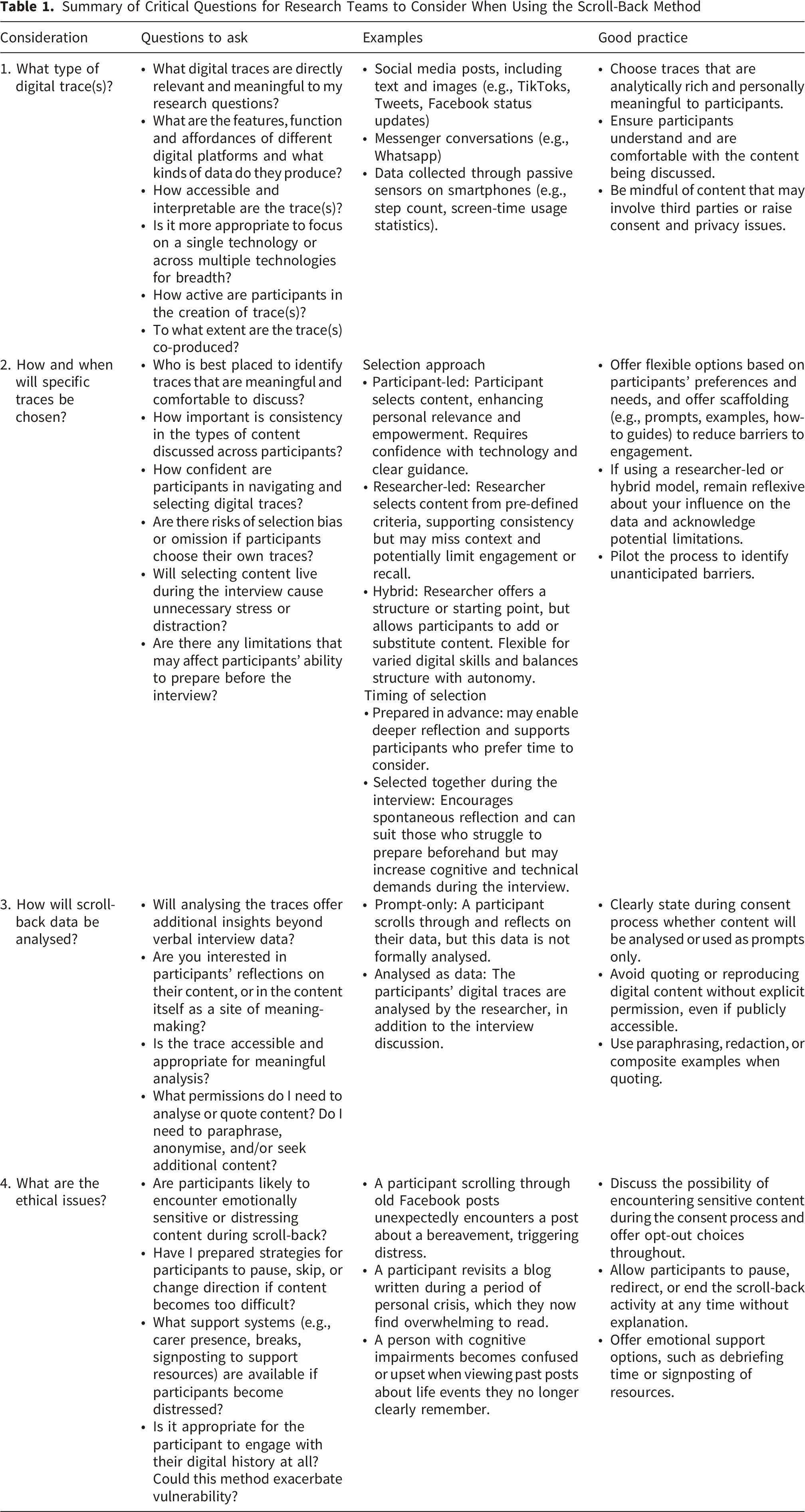
Summary of Critical Questions for Research Teams to Consider When Using the Scroll-Back Method
What Type of Digital Traces?
Each case study focused on different digital traces; Case Study 1 (CS1) used Instagram posts (images, captions, comments and replies), Case Study 2 (CS2) used content from digital fitness technologies, and Case Study 3 (CS3) used Tweets from Twitter/X. Choosing the right digital trace is important; different narratives are evoked by different traces, and ensuring these narratives answer the research question is tantamount to success. Some research questions will dictate digital trace choices (e.g., Instagram data for questions focused on Instagram), other research questions – especially those focused on psychosocial processes– may be answered using a variety of traces. Crucially, digital traces used in scroll-back should not be restricted to social media. This is evidenced in CS2 where digital traces from a range of platforms were effectively used. Considering (i) the unique features and affordances of each site and platform, (ii) the types of digital traces produced, (iii) how active individuals are in the creation of traces and (iv) the extent to which they are coproduced with others, provides a useful starting point for researchers in making these decisions.
How and When Will Specific Traces Be Chosen?
Research teams also need to consider how and when specific digital traces are selected. CS3 highlights the importance of this; in Study 1, digital traces were chosen by the researcher and as such participants struggled with recall, whereas in Study 2, digital traces were chosen by the participant avoiding this issue. Participant-led approaches to selecting digital traces are consistent with the original conceptualisation of scroll-back (Robards & Lincoln, 2017). It is also a key strength of the approach, framing participants as co-analysts of their own digital traces in interviews provides a degree of empowerment, control and comfort. However, this participant-led approach is not without issue. In CS2 where participants were free to choose which digital fitness technology content to show in interviews, they engaged with scroll-back activities to varying degrees. Similarly, determining when specific trace(s) are chosen is also an important consideration. Selection of digital trace(s) in advance may be appropriate for some populations (e.g., in CS3 where participants had memory impairments) but there are also advantages to having participants make decisions about which content to discuss in interviews in real time, as evidenced in CS1. We recommend piloting scroll-back adaptations with the target population to ensure its appropriateness in eliciting data that answers research questions.
How Will Scroll-Back Data Be Analysed?
Traditional scroll-back methods have focused on interview data as the site of analysis (Moran et al., 2024; Robards & Lincoln, 2019). Such research has typically employed qualitative analytic approaches, including reflexive thematic analysis, narrative analysis etc. (Moran et al., 2024). Some of this work has additionally extracted content from the scroll-back and used it to contextualise interview data. Thus, the corpus for analysis has usually been the interview data itself, rather than the digital traces used in the scroll-back. In CS1, the research team adopted a novel approach to analysing data from the scroll-back process; not only do the authors seek to content analyse the digital traces, but interview data (analysed using template analysis) was used to develop the coding framework for this. In the published paper (Paddock et al., 2025), findings from the template analysis and content analysis are presented together and triangulated in the interpretation, providing a holistic understanding of adolescent girls’ appearance interactions that incorporated both quantitative metrics (frequency of certain types of content) and subjective interpretation.
While formally analysing digital traces provides a useful additional layer of information about participants’ technology use and related psychosocial processes, it is resource intensive and opens up a range of issues related to ethics, data security and confidentiality (see next section). It should therefore only be undertaken if it helps research teams meet research aims and questions. It is also not compatible with all variations of the scroll-back method. Extracting the digital traces used in CS2 would have detracted from the informal tone of the interview and interrupted flow. Thus, careful consideration as to the necessity of this is needed.
What are the Ethical Issues?
Sound ethical practice is paramount. Across case studies, the scroll-back method posed myriad ethical issues that were carefully navigated by the research team. First, historic digital traces can provoke emotional reactions in participants; whether that be hurtful comments on Instagram (CS1), revisiting events that unfolded during a global pandemic (CS2) or uncovering aspects of the self that had changed (CS3). Potential negative emotional reactions should be considered when designing scroll-back activities and safety measures embedded into research designs (e.g., allowing participants to choose which content they prioritise in discussions).
There are also issues related to the use of digital traces themselves, since many digital traces are coproduced by multiple users in the real-world (e.g., comments on an Instagram post). Thus, researchers need to consider issues related to data ownership, confidentiality and security. This was an issue in CS1 where Instagram posts containing comments from other users (with usernames visible) were extracted by screen capture for content analysis. As social media usernames are potentially identifiable, care needed to be taken to anonymise these at the point of transcription and delete screen captures when no longer needed.
Limitations
The scroll-back method has limitations. First, it may reproduce digital inequality, since individuals without adequate access to appropriate devices (e.g., those reliant on shared or outdated technology) or without the necessary digital skills may be unable to participate (Lutz, 2022). As a result, older adults, lower-income groups, and those in digitally marginalised communities are systematically excluded. Because digital inequality often overlaps with other forms of marginalisation (Zheng & Walsham, 2021), these intersecting disadvantages may serve to perpetuate existing inequities. Thus, the very richness of data elicited with the scroll-back method comes with a caveat: it may disproportionately capture the experiences of the most connected and digitally confident users, leaving marginalised voices underrepresented. Second, scroll-back method adaptations may not be suitable for all. Most notably, in CS1, difficulties recruiting adolescent boys were reported, highlighting how the scroll-back approach – as operationalised in this study - did not feel relevant, comfortable, or worthwhile to them. We recommend involving target populations in co-production processes to design scroll-back activities. Current discourses around participatory research methods emphasise the importance of participants’ active involvement throughout the entire research process - from shaping research questions and designing methods to interpreting findings and implementing change (Baum et al., 2006; Freire et al., 2022). Engaging with co-production processes in the design of scroll-back tasks will ensure activities are tailored to participants’ needs, foster participant agency and support impactful engagement, ensuring greater inclusivity.
Digital technologies are constantly evolving. Platform features are constantly being refined by technology providers, e.g., introduction of new social media features such as the ephemeral Instagram Stories feature, and the popularity of technology is often in a state of flux, e.g., the migration of MySpace users to Facebook in the late 2000s. This may affect the nature of digital traces that are available to researchers and also how these traces are experienced by participants in interviews. Piloting scroll-back adaptations remains crucial to ensure relevance and usability.
Future Directions
There are multiple ways in which the scroll-back method can be further adapted for research concerned with understanding digital practices and psychosocial processes. First, we propose that the scroll-back can be used with a wider range of autobiographical digital traces than social media data. In CS2, the scroll-back was used with digital traces extracted across a breadth of technology including that which is passively collected (e.g., step counts, exercise logs). It is likely that passively collected data may evoke different types of narratives than more actively created (e.g., may help individuals to understand more unconscious aspects of behaviour, such as app usage stats or location data), but both have uses in studies concerned with autobiographical events, narratives and psychosocial development. Second, we urge researchers to consider using the scroll-back method in research that extends beyond the traditional interview context. For example, CS1 used the scroll-back to integrate participant voice into the analytic part of the content analysis process rather than using the voice data simply as data in its own right. There are likely many applications beyond this.
Last, the scroll-back method may offer therapeutic benefits. In CS3, participants with dementia described how reminiscing through social media offered moments of connection with their personal histories, which improved mood and self-worth. Similarly, participants in CS2 described how scrolling-back provided them with space to reflect on and engage in meaning-making related to the Covid-19 pandemic. Past research has noted similar benefits (e.g., Robards & Lincoln, 2017) and related research has begun to explore how digital traces may be used in therapy (Biddle et al., 2022). Future work should explore how the scroll-back method specifically can be used to support wellbeing and therapy.
Conclusion
Our analysis of scroll-back across three diverse projects demonstrates that its strength lies not in being a uniform technique, but in its adaptability. While originally developed for use with social media data, our work illustrates how scroll-back can be flexibly applied to different platforms, participant groups, and research aims. By examining these adaptations, we identify several methodological considerations that can guide future applications. Above all, we argue that scroll-back is best understood not as a fixed protocol, but as a methodological orientation that invites adaptation. Its flexibility makes it a valuable tool for qualitative researchers seeking to integrate digital traces into interviews across populations, technologies, and substantive domains.
Footnotes

Ethical Considerations
Case Study 1 and 2 received ethical York St. John University Psychology Ethics Committee, reference PY_45679 and 3PY400_189086615_version2 respectively. Case Study 3, Study 1 received approval from the University of Exeter Ethics Committee (Oct17/B/126Δ1) and Study 2 from Bournemouth University (Project 33976).
Consent to Participate
All participants provided written consent to participate.
Consent for Publication
All participants consent to publication of data in anonymous form.
Funding
The authors disclosed receipt of the following financial support for the research, authorship, and/or publication of this article: Case Study 1 was supported by a York St John University PhD studentship; Case Study 2 received no funding; Case Study 3 Study 1 was supported by a University of Exter PhD studentship and Study 2 was supported by the British Academy, grant number (SRG22/220836).
Declaration of Conflicting Interests
The authors received no additional financial support for the research, authorship, and/or publication of this article.